
|
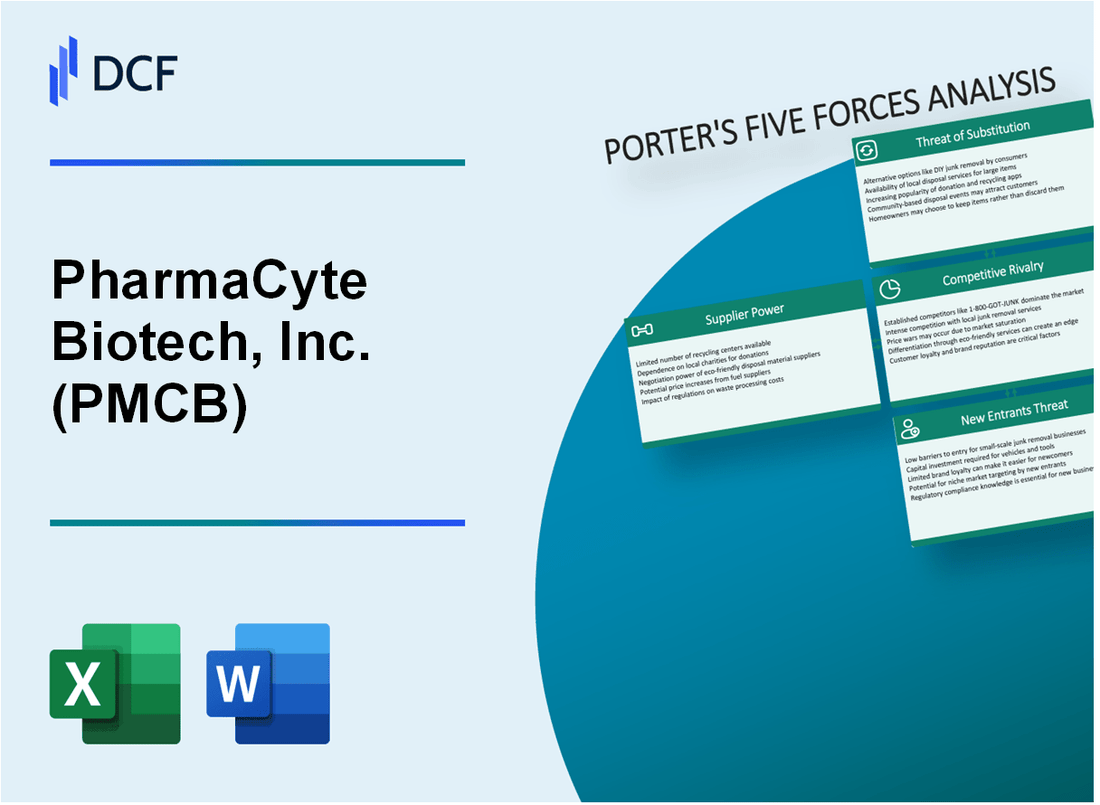
PharmaCyte Biotech, Inc. (PMCB): 5 FORCES Analysis [Nov-2025 Updated] |
Fully Editable: Tailor To Your Needs In Excel Or Sheets
Professional Design: Trusted, Industry-Standard Templates
Investor-Approved Valuation Models
MAC/PC Compatible, Fully Unlocked
No Expertise Is Needed; Easy To Follow
PharmaCyte Biotech, Inc. (PMCB) Bundle
You're looking for a clear-eyed view of PharmaCyte Biotech, Inc.'s competitive position, so here is the breakdown of the five forces that shape their market dynamics.
Honestly, when you map out the competitive landscape for PharmaCyte Biotech, Inc. (PMCB) as of late 2025, you see a classic clinical-stage tightrope walk. While their Cell-in-a-Box platform is unique, which keeps direct competition low, the indirect rivalry against established standard-of-care treatments is intense, and the threat from emerging cell therapies is real. Plus, with the company pre-commercial and holding approximately $45 million in cash, the bargaining power of future payers and the FDA gatekeeper is extremely high due to cost scrutiny and regulatory hurdles, like the ongoing clinical hold. To truly understand the risk profile here, you need to see exactly where the leverage sits-from specialized suppliers demanding premium terms to the high barriers that deter new entrants. Let's map out these five forces so you can see the near-term pressure points.
PharmaCyte Biotech, Inc. (PMCB) - Porter's Five Forces: Bargaining power of suppliers
You're looking at the supplier landscape for PharmaCyte Biotech, Inc. (PMCB), and honestly, the power held by key partners is a major factor you need to watch. Because PharmaCyte Biotech, Inc. is a clinical-stage company, its reliance on specialized, third-party expertise for its core technology means suppliers definitely have leverage.
High power for specialized manufacturing partners like Austrianova.
The relationship with Austrianova, the partner for the core Cell-in-a-Box technology, is central here. This isn't a simple component purchase; it's a deep, technology-specific collaboration. Any disruption or unfavorable change in terms from Austrianova directly impacts PharmaCyte Biotech, Inc.'s ability to advance its product candidates. For instance, the company noted in its filings that delays in the cGMP certification of the Austrianova manufacturing facility in Bangkok, Thailand, could adversely affect supplies for clinical trials. That single point shows you where the control lies.
The structure of the prior agreements, though dated, illustrates the level of commitment and potential ongoing obligation. Here's a quick look at some of the terms that define this relationship:
| Agreement Term Detail | Value/Condition |
| Milestone Payments (Original Obligation) | Eliminated in entirety (per 2017 Term Sheet) |
| Monthly Payment to Austrianova (Per 2017 Term Sheet) | $150,000 per month for 6 months |
| Sublicense Consideration Share to Austrianova | 50% of financial and non-financial consideration |
| Right of First Refusal on Associated Technologies | 5-year period |
| FDA DMF Acceptance Status (as of late 2025 context) | Accepted without questions or suggested changes |
The Cell-in-a-Box technology relies on proprietary, genetically engineered cells.
The very nature of the product candidate-encapsulating genetically engineered human cells-means the supplier isn't just providing a commodity. Austrianova is integral to the manufacturing process that creates the encapsulation for these specialized cells, whether for the pancreatic cancer therapy or the diabetes program involving cells designed to produce insulin. This specialization limits the pool of potential manufacturing providers who can handle this specific, proprietary platform.
Switching costs for the cGMP-compliant manufacturing process are defintely high.
Switching manufacturing partners in the clinical-stage biotech space is never easy, but when it involves a proprietary encapsulation technology that needs to maintain cGMP (current Good Manufacturing Practice) compliance, the costs and delays become substantial. PharmaCyte Biotech, Inc. has already completed stability studies for its pancreatic cancer product candidate over 24 months at the -80C storage point. Replicating this validated process, including the cell line handling and the specific encapsulation method, at a new facility would require significant re-validation, likely pushing back clinical timelines by months, if not years. That risk is a huge cost driver.
Key suppliers of specialized raw materials hold leverage in the clinical-stage biotech space.
Beyond the main manufacturing partner, the specialized raw materials needed for the Cell-in-a-Box-like the special cellulose sulphate mentioned in the agreements-also grant leverage to their respective suppliers. In a clinical-stage environment, where operational expenses for the quarter ended January 31, 2025, totaled $960,252, securing a consistent, high-quality supply chain for unique inputs is critical to avoid costly trial pauses. If only a few vendors can provide materials meeting the strict specifications required for a proprietary, encapsulated cell product, they can command premium pricing or impose strict volume commitments. PharmaCyte Biotech, Inc.'s recent financing of $7.0 million in August 2025 helps shore up the balance sheet, but it doesn't eliminate the fundamental dependency on these niche inputs.
You need to track any public statements about the qualification or auditing of secondary raw material sources.
PharmaCyte Biotech, Inc. (PMCB) - Porter's Five Forces: Bargaining power of customers
When you look at PharmaCyte Biotech, Inc. (PMCB) right now, you are looking at a company that has not yet reached the commercial stage, which fundamentally shifts the balance of power toward the customer base. Honestly, this is the reality for nearly all pre-revenue biotechs.
The current financial standing of PharmaCyte Biotech, Inc. dictates that customers-physicians and, ultimately, the payers-hold significant leverage. As of the quarter ended January 31, 2025, the company reported zero revenue for the three and nine months ended on that date. This pre-commercial status means that, today, patients and providers have zero financial commitment to any product from PharmaCyte Biotech, Inc. The company's current valuation, reflected by a Market Cap of approximately $5.35 million as of September 2, 2025, is based purely on future potential, not realized sales.
Patients and physicians are not entering a vacuum; they have established alternatives for locally advanced, inoperable pancreatic cancer. For context on the severity of the need, pancreatic cancer was the third-leading cause of cancer-related deaths in the U.S. in 2025, with a five-year survival rate of only 13.3%. Existing standards of care already have established efficacy benchmarks. For instance, in a trial for late-stage disease, the combination of Abraxane plus gemcitabine resulted in a median overall survival of 8.5 months, compared to 6.7 months for gemcitabine alone. Any new therapy from PharmaCyte Biotech, Inc. must demonstrate a clear, measurable advantage over these figures to command a premium price.
The power of future payers-insurance companies and government programs like Medicare-is extremely high due to relentless cost scrutiny. This isn't just a US trend; globally, policymakers are pushing for value-based pricing. For example, the EU HTA Regulation introduced the Joint Clinical Assessment (JCA) for new oncology medicines starting in January 2025. Furthermore, in the US, Centers for Medicare & Medicaid Services (CMS) policy shifts that began in January 2023 are reshaping reimbursement for 505(b)(2) drugs, a category that could affect up to 943 drugs approved since 2003. These systemic pressures mean that PharmaCyte Biotech, Inc. will face intense negotiation on price versus demonstrated real-world effectiveness.
The bargaining power of the ultimate gatekeeper, the Food and Drug Administration (FDA), is absolute because market access is impossible without its sign-off. PharmaCyte Biotech, Inc.'s entire commercial viability hinges on successfully navigating the IND process and subsequent trial phases for its CypCaps™ product in locally advanced, inoperable pancreatic cancer (LAPC). The FDA's evolving approach shows its power: In October 2025, the agency launched a pilot program to cut review times for priority drugs from the normal 10 to 12 months down to just one to two months for products addressing major national priorities. This demonstrates the FDA's control over the speed of market entry, which directly impacts PharmaCyte Biotech, Inc.'s ability to generate revenue.
Here is a quick comparison of the current competitive environment PharmaCyte Biotech, Inc. faces from the customer/payer perspective:
| Factor | Data Point/Context | Implication for Customer Power |
|---|---|---|
| Company Revenue Status (as of Jan 31, 2025) | $0 revenue reported | Customers have zero financial commitment today. |
| Market Cap (as of Sep 2, 2025) | $5.35 million | Valuation is speculative; no commercial leverage for pricing. |
| Existing Treatment Efficacy Benchmark (Median OS) | 8.5 months (Abraxane + Gemcitabine) | PharmaCyte Biotech, Inc.'s therapy must significantly exceed this. |
| US Pancreatic Cancer 5-Year Survival Rate (2025) | 13.3% | High unmet need, but also high scrutiny on any new cost. |
| EU HTA Oncology Assessment Start Date | January 2025 | Payers across Europe are using a harmonized, stringent clinical assessment. |
| FDA Priority Review Time Reduction | From 10-12 months down to 1-2 months | FDA controls market access timeline, a key lever for market entry risk. |
The key leverage points for customers and payers can be summarized as follows:
- Pre-commercial status means zero switching costs for patients.
- Existing therapies set a high bar for survival benefit, like 1.8 months median OS gain.
- Payer scrutiny is formalized through new EU HTA Joint Clinical Assessment in 2025.
- CMS policy changes since 2023 impact reimbursement for nearly 1,000 drugs.
- FDA gatekeeping power is absolute, though new vouchers aim to speed review to 1-2 months.
Finance: draft sensitivity analysis on price per quality-adjusted life year (QALY) based on a 1.8 month survival delta by Friday.
PharmaCyte Biotech, Inc. (PMCB) - Porter's Five Forces: Competitive rivalry
You're looking at the competitive landscape for PharmaCyte Biotech, Inc. (PMCB) as of late 2025, and the rivalry is definitely complex. It's not a head-to-head brawl with established players yet; it's more like a skirmish on the periphery of a massive battlefield dominated by Big Pharma giants.
The rivalry is intense, but largely indirect, pitting PharmaCyte Biotech's early-stage platform against the entrenched oncology and diabetes divisions of established pharmaceutical companies. These large entities command massive R&D budgets and market access. For instance, the U.S. pancreatic cancer treatment market, where PharmaCyte Biotech is focused, was projected to reach USD 1.14 billion in 2025, a segment where established chemotherapy regimens hold the lion's share.
Honestly, the financial reality for PharmaCyte Biotech is that of a pre-commercial entity. As of the Fiscal Year 2025 reporting, the company reported $0 in TTM (Trailing Twelve Months) revenue. This contrasts sharply with the net income reported for the full year ended April 30, 2025, which was USD 30.66 million, up significantly from the prior period's USD 0.333763 million. This revenue gap underscores the current competitive dynamic: PharmaCyte Biotech is competing on potential, not current sales volume.
Direct competition is low right now because the core technology, the Cell-in-a-Box platform, is unique. This proprietary cellulose-based live cell encapsulation technology is designed to act as a targeted delivery system, which is a distinct approach compared to traditional drug development. Still, the company is actively working to lift the U.S. Food and Drug Administration's (FDA) clinical hold on its Investigational New Drug Application (IND) to move forward with trials.
The primary competition PharmaCyte Biotech faces is against the current standard-of-care treatments, particularly in pancreatic cancer. These established regimens are what oncologists use today, and they have significant market penetration. For example, the chemotherapy regimens of mFOLFIRINOX or gemcitabine + nab-paclitaxel are the two most common standards of care for pancreatic cancer. Any therapy must demonstrate a clear, measurable advantage over these existing protocols.
Here's a quick look at the market context you're up against:
| Metric | PharmaCyte Biotech (PMCB) Snapshot (Late 2025) | Standard of Care Market Context (Pancreatic Cancer) |
|---|---|---|
| TTM Revenue (FY 2025) | $0 | U.S. Market Size Projected for 2025: USD 1.14 billion |
| Market Capitalization (Sept 2025) | $7M | Global Market Projected to reach $7.5 Billion by 2033 |
| Latest Reported Stock Price (Nov 2025) | $0.84 | Dominant Treatment Share (2024): Chemotherapy segment at 43.25% |
| Net Income (FY Ended Apr 2025) | USD 30.66 million | Historical Objective Response Rate for Standard Regimens: ~25% (for context on improvement needed) |
The success of PharmaCyte Biotech hinges on demonstrating superiority over these entrenched options. The competitive pressure is defined by the hurdles required to displace a proven, albeit imperfect, standard. You need to see clear clinical data that shows a better risk/benefit profile than what's currently being administered.
Key competitive considerations you should track include:
- FDA IND clinical hold status for LAPC.
- Observed efficacy versus mFOLFIRINOX data.
- The ability to secure strategic partnerships.
- Cash position following the $7 million financing in August 2025.
- The platform's potential application in diabetes therapies.
If onboarding takes 14+ days, churn risk rises-though for a clinical-stage biotech, the 'churn' risk is more about investor patience waiting for IND clearance. Finance: draft 13-week cash view by Friday.
PharmaCyte Biotech, Inc. (PMCB) - Porter's Five Forces: Threat of substitutes
You're looking at the competitive landscape for PharmaCyte Biotech, Inc. (PMCB) in late 2025, and the threat of substitutes for their lead pancreatic cancer program is definitely a major factor. When a company is pre-commercial, every existing, approved treatment or emerging alternative is a direct substitute that can capture market share or, more critically for an unmet need like pancreatic cancer, capture patient survival time.
High threat from existing, approved chemotherapy regimens for pancreatic cancer
The established chemotherapy backbones present a significant hurdle. Pancreatic cancer remains one of the most aggressive solid tumors, with a global 5-year survival rate hovering around 5-10%, and for stage four disease, that rate drops to just 1%. The current standard-of-care options, like FOLFIRINOX and gemcitabine/nab-paclitaxel, have been mainstays for years. More recently, combination regimens are pushing the envelope, but only incrementally. For instance, the NALIRIFOX four-drug regimen demonstrated an overall survival (OS) of 11.1 months in a trial for metastatic disease, compared to 9.2 months for the two-drug therapy. Even for resectable or borderline disease, the PAXG regimen showed a median event-free survival (EFS) of 16 months against 10.2 months for mFOLFIRINOX. PharmaCyte Biotech, Inc.'s localized delivery approach must demonstrate a clear, meaningful advantage over these established benchmarks to justify a switch.
Here's a quick look at how established regimens stack up:
| Regimen/Benchmark | Patient Population | Key Survival Metric | Observed Value |
|---|---|---|---|
| Gemcitabine/nab-paclitaxel + TTFields | Locally Advanced PDAC (1st-line) | Overall Survival (OS) Improvement vs. Chemo alone | Two months |
| NALIRIFOX (4-drug) | Advanced/Metastatic | Median Overall Survival (OS) | 11.1 months |
| Gemcitabine/nab-paclitaxel (2-drug) | Advanced/Metastatic | Median Overall Survival (OS) | 9.2 months |
| PAXG | Resectable/Borderline PDAC | Median Event-Free Survival (EFS) | 16 months |
Emerging cell and gene therapies from well-funded rivals are strong substitutes
The pipeline for pancreatic cancer is rapidly evolving with cell and gene therapy, which directly competes with PharmaCyte Biotech, Inc.'s cellular approach. These rivals often boast substantial capital backing. For example, gene-edited TCR-T cell therapies targeting mutant KRAS, such as VIDAR-1, are already in early-stage clinical development. Also, novel targeted agents are gaining traction; an agent approved in December 2024 for NRG1 fusion-positive advanced pancreatic cancer achieved an Objective Response Rate (ORR) of 40% in a trial of 30 patients, with a Duration of Response up to 16.6 months. Furthermore, research is focusing on T-cell therapies targeting cryptic peptides, which are unique to pancreatic tumors, showing promise in slowing tumor growth in preclinical models. These next-generation therapies aim for higher specificity and potentially curative intent, making them very potent substitutes.
New targeted drug delivery systems could offer similar or superior localized effects
It's not just about new drugs; it's about better ways to get them there. While PharmaCyte Biotech, Inc. uses its Cell-in-a-Box® technology for localized delivery of ifosfamide, other non-drug modalities are also achieving localized benefits. Tumour Treating Fields (TTFields), which use electric fields to disrupt cell division, when added to standard chemotherapy (gemcitabine and nab-paclitaxel) for locally advanced pancreatic cancer, showed a statistically significant OS benefit of two months without adding systemic toxicity. This demonstrates that non-cellular, localized physical modalities can also compete by offering targeted efficacy, which is the core value proposition of PharmaCyte Biotech, Inc.'s technology.
The clinical hold on their lead program increases the perceived viability of substitutes
The longevity of the clinical hold on PharmaCyte Biotech, Inc.'s Investigational New Drug (IND) application by the U.S. Food and Drug Administration (FDA) since November 2020 significantly elevates the perceived viability of all substitutes. Every year that passes without an active trial means that competitors' therapies are advancing through the clinic, establishing new efficacy benchmarks. The company's accumulated deficit stands at ($93,329,056) as of July 31, 2025, underscoring the financial pressure to resolve the hold. While PharmaCyte Biotech, Inc. secured a $7 million financing in August 2025, bringing their cash position up from approximately $15.5 million as of April 30, 2025, the delay allows the standard of care to advance and novel therapies to gain ground. If onboarding takes 14+ days, churn risk rises, and for a clinical-stage company, a prolonged regulatory pause definitely increases the market's reliance on alternatives.
- PharmaCyte Biotech, Inc. shares outstanding as of July 31, 2025: 6,795,779.
- Stock price on November 25, 2025: $0.84; Market Cap: $5.71m.
- The FDA clinical hold on the IND has been in place since November 2020.
PharmaCyte Biotech, Inc. (PMCB) - Porter's Five Forces: Threat of new entrants
You're looking at PharmaCyte Biotech, Inc. (PMCB) and wondering how hard it would be for a new player to jump into their niche. Honestly, the barriers to entry here are steep, which is good news for the incumbents, even if the path forward is complex. We see this threat level being kept low by a combination of capital needs, regulatory gauntlets, and proprietary science.
Very High Capital Barrier
Getting a cell therapy platform off the ground requires serious cash, and PharmaCyte Biotech, Inc. has been actively shoring up its balance sheet to meet those demands. As of April 30, 2025, the company reported approximately $15.5 million in cash and over $30 million in securities. Following the closing of a $7 million financing round in August 2025, the total liquid assets and short-term investments would stand around $52.5 million. That's a substantial war chest, but new entrants need to match or exceed that just to start meaningful preclinical work, let alone clinical trials. Here's the quick math on their recent capital position:
| Financial Metric | Amount as of Late 2025 (Post-Financing) | Date of Base Data |
|---|---|---|
| Cash and Cash Equivalents (Pre-Financing) | $15.5 million | April 30, 2025 |
| Securities Held (Pre-Financing) | Over $30 million | April 30, 2025 |
| Recent Financing Proceeds | $7 million | August 2025 |
| Estimated Total Cash/Securities | Approximately $52.5 million | Late 2025 |
A new entrant would need to raise comparable amounts just to reach the same starting line, and that's before accounting for the time value of money lost while they fundraise.
Significant Regulatory Barrier
The regulatory path in biotech is a minefield, and PharmaCyte Biotech, Inc.'s history clearly demonstrates this. The company has faced a clinical hold on its Investigational New Drug (IND) application from the U.S. Food and Drug Administration (FDA) for its pancreatic cancer therapy. While PharmaCyte Biotech, Inc. has been working to address the FDA's requests for additional studies and data, the very existence of this hurdle signals the intense scrutiny and data requirements necessary for approval. Any new entrant must anticipate similar, if not greater, scrutiny for a novel cell-based therapy.
The regulatory challenge involves more than just filing paperwork; it requires successfully navigating the agency's requirements to lift such holds. This process demands deep regulatory expertise, which PharmaCyte Biotech, Inc. has augmented by bringing on firms like Biologics Consulting.
Proprietary Technology as a Hurdle
PharmaCyte Biotech, Inc.'s core asset, the Cell-in-a-Box encapsulation technology, is proprietary and patent-protected. This isn't off-the-shelf stuff; it's a specialized cellulose-based system designed to house genetically engineered cells. The technology acts as a 'bio-artificial liver,' activating chemotherapy prodrugs like ifosfamide directly at the tumor site. Replicating this level of specialized, patented encapsulation and cell engineering is a major technical barrier. Entrants can't just license a known process; they have to invent a comparable one.
The complexity of the technology creates several points of entry difficulty:
- Proprietary cellulose sulphate encapsulation process.
- Genetically engineered cells for prodrug conversion.
- Specific size requirements: capsules are pinhead-sized.
- Need for specialized manufacturing partners like Austrianova.
Long Development Timelines and High R&D Costs
Biotech development is inherently a long game, and PharmaCyte Biotech, Inc.'s journey reflects this. The need to conduct lengthy studies-like the stability studies on CypCaps at various time points-demonstrates the time commitment required just to satisfy regulatory prerequisites. New entrants face years, if not a decade or more, of R&D spending before they see any potential revenue stream. This extended timeline, coupled with the high cost of running clinical trials and satisfying FDA data requests, naturally filters out all but the most well-funded and committed competitors. It's a marathon where the entry fee is measured in tens of millions of dollars and years of effort.
Disclaimer
All information, articles, and product details provided on this website are for general informational and educational purposes only. We do not claim any ownership over, nor do we intend to infringe upon, any trademarks, copyrights, logos, brand names, or other intellectual property mentioned or depicted on this site. Such intellectual property remains the property of its respective owners, and any references here are made solely for identification or informational purposes, without implying any affiliation, endorsement, or partnership.
We make no representations or warranties, express or implied, regarding the accuracy, completeness, or suitability of any content or products presented. Nothing on this website should be construed as legal, tax, investment, financial, medical, or other professional advice. In addition, no part of this site—including articles or product references—constitutes a solicitation, recommendation, endorsement, advertisement, or offer to buy or sell any securities, franchises, or other financial instruments, particularly in jurisdictions where such activity would be unlawful.
All content is of a general nature and may not address the specific circumstances of any individual or entity. It is not a substitute for professional advice or services. Any actions you take based on the information provided here are strictly at your own risk. You accept full responsibility for any decisions or outcomes arising from your use of this website and agree to release us from any liability in connection with your use of, or reliance upon, the content or products found herein.