

|
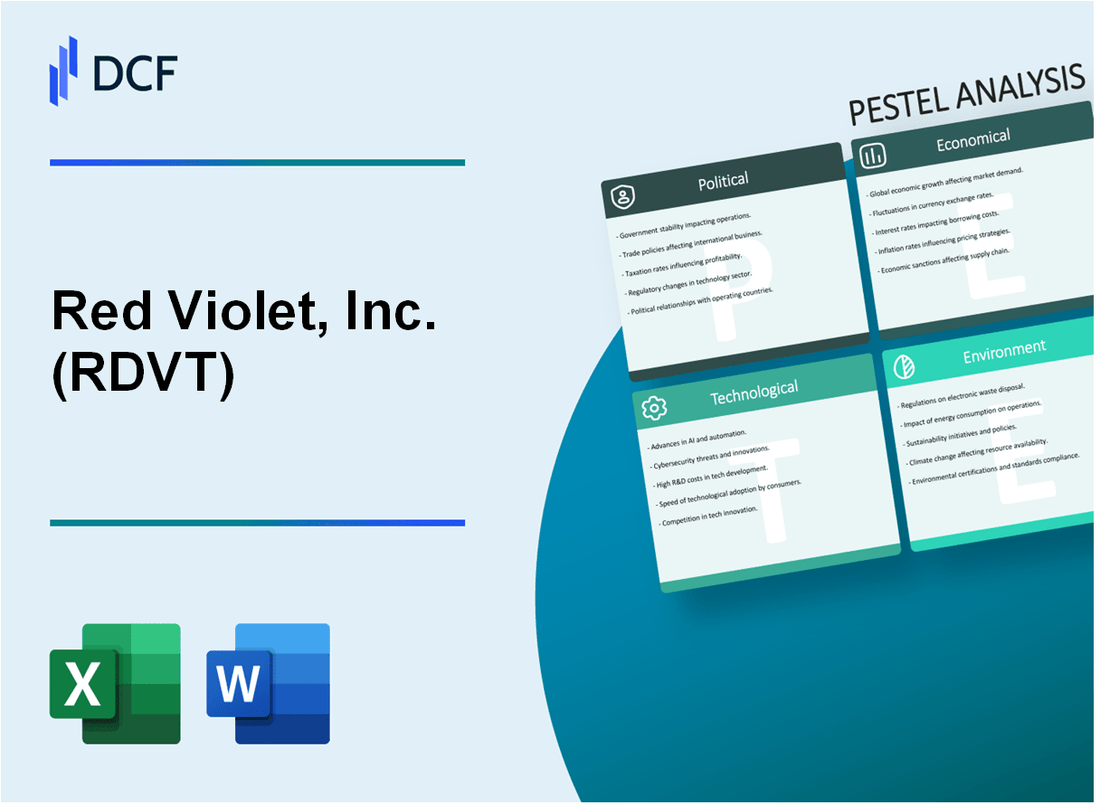
Red Violet, Inc. (RDVT): PESTLE Analysis [Nov-2025 Updated] |
Fully Editable: Tailor To Your Needs In Excel Or Sheets
Professional Design: Trusted, Industry-Standard Templates
Investor-Approved Valuation Models
MAC/PC Compatible, Fully Unlocked
No Expertise Is Needed; Easy To Follow
Red Violet, Inc. (RDVT) Bundle
Red Violet, Inc. (RDVT) is riding a serious wave of financial momentum into late 2025, but the regulatory tide is rising fast, and honestly, that's the core risk you need to track. Their Q3 2025 revenue hit a record $23.1 million, and the full-year consensus estimate is a solid $87.62 million, showing their identity intelligence platform is defintely scaling with a high 73% gross margin. Still, the legal landscape is a minefield; a patchwork of eleven new state comprehensive privacy laws is taking effect in 2025 and 2026, plus active oversight from the FTC and CFPB, which means compliance isn't just a cost-it's the real operational challenge. We need to map these political and legal risks against the economic opportunity to see where RDVT moves next, especially with $45.4 million in cash providing capital flexibility.
Red Violet, Inc. (RDVT) - PESTLE Analysis: Political factors
New US administration's pro-business, deregulation stance creates policy uncertainty.
You're operating in a regulatory environment that's suddenly shifting its foundation. The new US administration, taking office in 2025, has signaled a strong pro-business, deregulation agenda, and we've already seen concrete action that affects data brokers like Red Violet, Inc. (RDVT). For instance, in May 2025, the Consumer Financial Protection Bureau (CFPB) withdrew a proposed rule that would have subjected certain data brokers to the strict accuracy and permissible purpose requirements of the Fair Credit Reporting Act (FCRA).
This move, while seemingly a win for the industry by removing a significant compliance burden, creates profound policy uncertainty. The deregulation push is aimed at sectors like energy and finance, but it has a clear spillover into data privacy. The big question is whether this administration will maintain the Federal Trade Commission's (FTC) aggressive enforcement posture, or if the pendulum will swing back toward a hands-off approach. This uncertainty makes long-term compliance planning defintely tricky.
Geopolitical tensions increase scrutiny on data sharing with foreign actors, per California's SB 361.
The political climate is forcing a hard look at who gets access to US consumer data, especially with rising geopolitical tensions. California's Senate Bill 361 (SB 361), signed into law on October 8, 2025, is a game-changer here, even though it takes effect on January 1, 2026.
This law directly targets the risk of data flowing to foreign adversaries. It now requires data brokers to disclose in their annual registration whether they sold or shared consumer data in the past year with a 'foreign actor.' A foreign actor is defined as a government or entity organized under the laws of a 'foreign adversary country,' which includes nations like China, Russia, Iran, and North Korea. For a company like Red Violet, Inc., which reported a strong Q3 2025 revenue of $23.1 million, any perceived risk in this area could jeopardize lucrative government contracts-a key growth vertical for the company.
- SB 361 requires disclosure of data sharing with foreign actors.
- Penalties for non-compliance start at $200 per day beginning August 1, 2026.
- The law also requires disclosure of sharing data with developers of Generative AI systems.
Federal Trade Commission (FTC) is actively targeting data brokers under its unfair practices authority.
Despite the broader deregulation talk, the FTC remains a formidable and active regulator for data brokers. They are using their Section 5 authority, which prohibits unfair and deceptive acts or practices, to go after companies misusing sensitive data. In late 2024, the FTC took decisive enforcement action against data brokers like Gravy Analytics, Venntel, and Mobilewalla, specifically for collecting and selling sensitive location data that could reveal visits to medical facilities or religious institutions.
The FTC's focus has intensified on national security risks. As of April 2025, the agency is actively investigating potential violations (fewer than five) of the Protecting Americans' Data from Foreign Adversaries Act (PADFA). Violators of PADFA face a civil penalty of just over $50,000 per violation, which can quickly turn into a material financial risk given the volume of data transactions.
Potential for a comprehensive federal privacy law (like APRA) to preempt the confusing state-level patchwork.
The current patchwork of state privacy laws-like California's, Virginia's, and Utah's-is a compliance nightmare, increasing Red Violet, Inc.'s operational costs. The political opportunity for a federal solution is the American Privacy Rights Act (APRA), which was introduced in 2024 and remains a major political factor in 2025.
APRA's core goal is to establish a uniform national data privacy and security standard, which would largely preempt the comprehensive state-level privacy laws. While APRA's passage is not certain due to disagreements on the extent of preemption and the inclusion of a private right of action, its potential impact is massive: a single, clear set of rules would simplify compliance across all 50 states. However, it would also impose a new federal data minimization requirement, forcing companies to only collect, process, or retain data that is 'reasonably necessary and proportionate' to provide a requested product or service.
Here's the quick map of the near-term political factors:
| Political Factor | Near-Term Risk (2025-2026) | Near-Term Opportunity (2025-2026) |
|---|---|---|
| New US Administration Stance | Policy uncertainty; potential for sudden reversal of existing regulations (e.g., the CFPB rule withdrawal in May 2025). | Reduced compliance costs if a pro-business environment leads to less aggressive regulation outside of national security. |
| California SB 361 / Geopolitics | Increased disclosure requirements for data sharing with 'foreign actors' starting January 1, 2026. Risk of fines starting at $200 per day. | Opportunity to solidify position as a 'trusted' provider, especially for government clients, by demonstrating clear compliance and no foreign actor exposure. |
| FTC Enforcement | Active investigations under PADFA with penalties over $50,000 per violation. Continued scrutiny on sensitive location data misuse. | Red Violet, Inc.'s focus on identity intelligence (idiCORE, FOREWARN) for law enforcement and risk mitigation aligns with national security priorities. |
| Federal Privacy Law (APRA) | Uncertainty over its passage and the final scope of its data minimization and private right of action clauses. | If passed, APRA would preempt the confusing state-level patchwork, creating a single, more predictable compliance standard across the US. |
Red Violet, Inc. (RDVT) - PESTLE Analysis: Economic factors
You're looking for a clear map of Red Violet, Inc.'s financial resilience against the current US economic backdrop, and the takeaway is simple: the company's internal performance is strong enough to weather the near-term macro slowdown. Their high-margin, data-as-a-service model acts like a defintely solid buffer against the deceleration in US GDP growth expected for the end of 2025.
Company-Specific Financial Strength (Q3 2025)
Red Violet's third-quarter 2025 results demonstrate exceptional financial health, which is a critical economic defense mechanism. The company delivered record revenue of $23.1 million, marking a robust 21% increase year-over-year. This growth is highly profitable, evidenced by a gross margin of 73%, which is up from 70% in the prior year period, showing a scalable business model where the cost of revenue grows slower than sales.
The full-year 2025 revenue consensus estimate remains solid at $87.62 million. This consistent performance translates directly into cash flow: net cash provided by operating activities hit a record $10.2 million for the quarter, a 40% jump year-over-year. This strong cash generation is what allows the company to self-fund growth and return capital to shareholders, a significant advantage in a higher-interest-rate environment.
Here's the quick math on their liquidity and profitability:
| Financial Metric (Q3 2025) | Value | YoY Change |
|---|---|---|
| Total Revenue | $23.1 million | +21% |
| Gross Margin | 73% | +3 percentage points |
| Adjusted EBITDA | $9.0 million | +35% |
| Net Income | $4.2 million | +145% |
Balance Sheet and Capital Allocation
The balance sheet is robust, giving management significant capital flexibility. As of September 30, 2025, the company held $45.4 million in cash and cash equivalents. Plus, current assets totaled $58 million against low current liabilities of just $6.9 million, indicating a very healthy current ratio and minimal near-term debt risk. In fact, management recently increased the share repurchase authorization by $15.0 million, bringing the total program to $30.0 million, demonstrating confidence in their stock's value and their ongoing cash flow generation. $18.9 million remains available under this program.
Macro-Economic Headwinds and Tailwinds (Late 2025)
While Red Violet's internal metrics are strong, the broader US economy presents mixed signals. The consensus forecast for US real GDP growth in 2025 is around 1.7% to 2.0% annually, but the fourth quarter is expected to decelerate sharply, with some forecasts predicting growth as low as 0.5% to 0.8% (quarter-over-quarter annualized rate).
The Federal Reserve's policy has brought the federal funds target down to the 3.75-4% range following an October cut, but longer-term rates remain elevated, with mortgage rates still above 6%. This high-rate environment makes capital more expensive for competitors and customers alike. Still, Red Violet benefits from a powerful sector tailwind: the massive investment into Artificial Intelligence (AI) infrastructure.
The demand for data and analytics, which Red Violet provides, is non-negotiable for risk management, fraud prevention, and identity verification, especially in a volatile economy. This demand is further amplified by the AI boom, where data center investment is cited as a primary source of positive national economic growth.
- US Core CPI Inflation: 3.0% (through September 2025)
- Federal Funds Target: 3.75-4% (following October 2025 cut)
- 2025 Annual Real GDP Forecast: 1.7% to 2.0%
- Data Center Market CAGR: 15% (projected through 2027)
Red Violet, Inc. (RDVT) - PESTLE Analysis: Social factors
Societal Demand for Identity Intelligence
The core of Red Violet, Inc.'s business model is directly supported by a significant and growing societal demand for security and verification. Honestly, the need to verify who you are dealing with-whether in a business transaction or a face-to-face meeting-has never been more critical. Global losses due to scams are staggering, exceeding $1 trillion annually, which creates an enormous market for the company's identity intelligence solutions.
This high demand is reflected in the adoption of their products. The FOREWARN application, which is designed to provide instant knowledge prior to face-to-face engagements, has seen rapid market acceptance in safety-sensitive industries like real estate. This is a clear indicator that professionals are actively seeking tools to mitigate personal and financial risk.
Here's the quick math on the real-world traction:
- FOREWARN users: Ended Q3 2025 with 372,209 users.
- Association contracts: Over 590 REALTOR Associations across the U.S. are contracted to use FOREWARN.
- Fraud concern: 93% of financial institutions are concerned about the rise of AI-powered fraud attacks in 2025.
Public Concern Over Data Privacy and Security
To be fair, the social factor that creates the biggest near-term risk for any company dealing with massive data sets-a data broker or identity intelligence provider-is the public's rising concern over data privacy. This isn't just a regulatory issue; it's a reputational one. Consumers are demanding more control over their personal information, and this sentiment is driving legislative action at the state level.
The company must navigate this complex landscape carefully. What this estimate hides is the potential for a single high-profile data breach to cause significant reputational damage, even if the company's security is defintely industry-leading. The social contract for data companies is now one of extreme vigilance and transparency.
The regulatory environment, which is a direct response to social concern, is becoming fragmented and onerous:
| Metric (2025 Focus) | Impact on Red Violet | Key Data Point |
|---|---|---|
| State Privacy Laws Enacted | Increased compliance complexity and cost. | At least eight new state privacy laws go into effect in 2025. |
| Consumer Rights Expansion | Higher operational burden for data management. | New laws expand consumer rights to access, delete, and opt out of data collection. |
| Fraud Sophistication | Increased demand for advanced solutions. | AI-driven fraud, including deepfakes and voice cloning, is accelerating in 2025. |
Frictionless Commerce and Efficiency
The positive social impact of Red Violet's solutions is their ability to enable 'frictionless commerce' and increase efficiency. Their identity intelligence platform, CORE, transforms billions of disparate data points into actionable insights for clients. This directly addresses consumer and business needs for swift, safe, and efficient transactions.
For example, in the financial services sector, rapid identity verification is essential for everything from new account openings to loan approvals. The company's technology reduces the time and expense associated with fraud and risk, which is a net benefit to society. They help businesses operate with confidence and reduce the fraud-related expense borne by society.
Finance: Review the Q4 2025 budget for the compliance department to ensure sufficient resources are allocated to meet the requirements of the new state privacy laws going into effect in 2025.
Red Violet, Inc. (RDVT) - PESTLE Analysis: Technological factors
Proprietary, cloud-native CORE™ platform uses AI/ML to transform massive, disparate data sets into actionable identity intelligence
Red Violet's entire business model rests on its proprietary, cloud-native CORE™ platform, which is the engine for its identity intelligence solutions. This isn't just a database; it's a sophisticated data fusion system that uses Artificial Intelligence (AI) and Machine Learning (ML) to process billions of disparate records in real-time.
The core value proposition is translating raw, massive data into actionable insights for risk mitigation, fraud detection, and due diligence. The company is actively integrating AI across its operations, moving beyond simple identity verification toward predictive analytics, which is a critical shift that commands premium pricing in sectors like financial services and healthcare.
Significant investment in infrastructure, with material commitments for data licensing and cloud services
To maintain its competitive edge, Red Violet must continuously invest heavily in its data and cloud infrastructure. For the three months ended September 30, 2025, the company reported a record adjusted gross margin of 84%, which demonstrates the platform's efficiency, but this margin is dependent on securing and maintaining high-quality data feeds and reliable cloud services.
As of March 31, 2025, the company had material commitments under data licensing agreements totaling $11.533 million. Additionally, a new, non-cancellable cloud services agreement was signed in April 2025, which includes a minimum annual purchase commitment of $3.0 million, starting May 1, 2025. This shows a clear, near-term capital outlay to support the platform's scale and performance.
| Contractual Obligation Type | Total Material Commitment (as of 03/31/2025) | Commitment Remaining in 2025 (Estimate) | Nature of Expenditure |
|---|---|---|---|
| Data Licensing Agreements | $11.533 million (Total for all future years) | $6.596 million (Remainder of 2025) | Securing raw data feeds from approximately 30 providers. |
| Cloud Services Agreement | $3.0 million (Minimum Annual Commitment, starting May 2025) | $\approx$ $2.0$ million (May 1 - Dec 31, 2025) | Infrastructure fees and internal-use software development. |
Continuous product innovation and enterprise-wide AI initiatives are key to maintaining market leadership
The company's growth is directly tied to its ability to innovate and expand its product offerings, especially with AI. In the third quarter of 2025, Red Violet generated a record revenue of $23.1 million, a 21% increase year-over-year, which reflects the success of its investment in product advancements.
The subsidiary FOREWARN, for example, added over 25,000 users in Q3 2025, ending the quarter with over 590 realtor associations contracted. This kind of rapid adoption in vertical markets proves the value of their targeted, technology-driven solutions. That's a strong return on investment in product development.
- Q3 2025 Adjusted EBITDA was a record $9.0 million.
- Enterprise-wide AI integration is a defintely stated priority for future investment.
- Gross revenue retention remained strong at 96% in Q3 2025.
High dependence on the CORE™ platform means any interruption poses a major operational risk
The CORE™ platform is the central nervous system for Red Violet, which means any operational failure is an existential threat. The business relies on access to data from approximately 30 external providers, and the loss of even one major provider could have an immediate, material adverse effect on the company's financial position.
Furthermore, because the solutions are accessed via a hosted environment (cloud-native), any interruption in service-whether due to a cyberattack, a catastrophic event, or a failure in the new $3.0 million annual cloud services commitment-would halt revenue generation. The reliance is total.
Red Violet, Inc. (RDVT) - PESTLE Analysis: Legal factors
A patchwork of eleven new state comprehensive privacy laws is taking effect in 2025 and 2026, increasing compliance complexity.
You are operating in a compliance environment that is defintely getting harder, not easier. The biggest near-term risk is the growing fragmentation of US state privacy law, which forces a state-by-state compliance strategy. We saw nine new comprehensive state consumer privacy laws or major amendments take effect throughout 2025, including Delaware, Iowa, Maryland, Minnesota, Nebraska, New Hampshire, New Jersey, and Tennessee, plus amendments to laws in Montana and Oregon.
Plus, three more states-Indiana, Kentucky, and Rhode Island-will join the fray on January 1, 2026. That means you have a dozen new compliance regimes to manage in less than 18 months. This patchwork creates a high-cost environment for data brokers, where the 'high-water mark' approach of complying with the strictest law nationwide is often the only way to scale efficiently.
Here's the quick math: each new state law requires a separate legal review, a privacy notice update, and often a technical change to how data is handled, which can cost a mid-size data firm an estimated $50,000 to $150,000 per state for initial setup alone.
California's SB 361, effective January 1, 2026, mandates new disclosure requirements for data brokers, including data sharing with law enforcement.
California continues to lead the regulatory charge with Senate Bill 361 (SB 361), signed in October 2025 and effective January 1, 2026. This law significantly expands the transparency requirements for data brokers registered with the California Privacy Protection Agency (CPPA). It's a direct response to concerns about government agencies circumventing state protections by purchasing data commercially.
The new law forces Red Violet, Inc. and its peers to disclose much more sensitive information upon annual registration, which is a major compliance lift. Specifically, data brokers must now report if they have sold or shared personal data in the past year with foreign actors, U.S. federal or state governments, law enforcement (outside court orders), or developers of generative AI systems.
The compliance stakes are high. Starting August 1, 2026, brokers must regularly scrub data against the state's Delete Request and Opt-Out Platform (DROP) every 45 days, and non-compliance carries a penalty of $200 per day.
| SB 361 New Disclosure Mandates (Effective Jan 1, 2026) | Key Compliance Action |
|---|---|
| Collection of Biometric Data, Government IDs (SSN, Passport), and Mobile IDs. | Must disclose collection of these sensitive categories to the CPPA. |
| Sharing with Law Enforcement or Government. | Must report if data was sold or shared with these entities in the prior year. |
| Sharing with Foreign Actors or GenAI Developers. | Must report any sale or sharing of data with these groups. |
| Delete Request Compliance. | Must scrub data against the DROP platform every 45 days, starting Aug 1, 2026. |
The Consumer Financial Protection Bureau (CFPB) had a proposed rule in 2025 to increase oversight on data brokers selling sensitive information.
The federal regulatory threat, while real, is currently stalled. The Consumer Financial Protection Bureau (CFPB) proposed a major rule in late 2024, with a comment period ending in March 2025, to classify data brokers selling sensitive financial information as 'consumer reporting agencies' (CRAs) under the Fair Credit Reporting Act (FCRA).
This would have subjected them to tough FCRA requirements like accuracy, consumer access, and explicit consent for selling data like income, credit history, or Social Security Numbers. However, the rule was withdrawn from the Federal Register by the Trump administration in May 2025. This withdrawal temporarily eases the most significant federal compliance risk for data brokers, but the underlying regulatory intent remains a long-term threat.
The core issue hasn't gone away; the CFPB still views the sale of sensitive data as a national security and consumer risk. You must still monitor the possibility of a similar rule being re-proposed or a new federal data privacy law emerging, which would supersede the state patchwork.
Regulatory compliance is a core product feature, offering turnkey solutions to help customers navigate complex rules.
The upside to this regulatory chaos is that it makes Red Violet, Inc.'s core value proposition stronger. The company's entire business model is built around turning complex, disparate data into actionable, compliant intelligence. Their platforms, idiCORE and FOREWARN, are explicitly designed for identity verification, risk mitigation, and regulatory compliance.
Red Violet, Inc. positions its technology as a turnkey solution, providing a 'fortified, fully auditable, layered environment with industry-leading compliance standards.' This is a competitive moat: they sell compliance as a feature, not a cost. This approach is critical for enterprise customers in heavily regulated sectors like financial services and law enforcement.
The growth of the FOREWARN platform shows this value proposition is resonating, particularly in real estate. The platform had 325,336 total users as of Q1 2025, with 21,918 new users added in that quarter alone. This rapid adoption suggests that professionals are willing to pay a premium for a tool that simplifies their due diligence while ensuring they stay on the right side of laws like the FCRA and the growing state privacy acts.
The company's focus on AI-driven predictive analytics also enhances its compliance offering, making it easier for customers to perform required due diligence and risk assessments.
- idiCORE: Aggregates and analyzes data for risk management and identity validation, built for regulatory alignment.
- FOREWARN: Provides real-time safety and identity verification, essential for compliant due diligence in real estate.
- CORE™ Platform: Cloud-native and purpose-built to assimilate and unify billions of records into a compliant, auditable structure.
Red Violet, Inc. (RDVT) - PESTLE Analysis: Environmental factors
Operational Footprint and Inherent Low Direct Impact
As a data analytics and information solutions provider, Red Violet's direct environmental impact from its core operations is inherently low, especially compared to manufacturing or logistics firms. The company's primary environmental footprint stems from its corporate offices and, critically, the energy consumption of its cloud-native CORE™ platform, which relies on data centers.
In the 2025 fiscal year, the real risk isn't the Boca Raton office's electricity bill; it's the indirect, yet massive, energy demand of the digital infrastructure. The U.S. data center sector is projected to account for 6.7% to 12% of total U.S. electricity consumption by 2028, a significant increase driven by the proliferation of artificial intelligence (AI) and massive data repositories like Red Violet's. This dependency means the company's environmental profile is tied to the sustainability of its third-party data center providers.
Physical Climate Risk to Data Center Resilience
The company's 2025 Form 10-K explicitly acknowledges that extreme weather events and natural disasters, exacerbated by climate change, pose a risk of disrupting operations for Red Violet, its customers, and its suppliers. This is not a hypothetical risk; it's a growing financial threat to the digital economy.
For investors, the concern centers on the physical resilience of the data centers housing the CORE™ platform. Currently, approximately 22% of global data centers are already classified as High or Moderate Risk from climate hazards like flooding and extreme heat. This is a defintely material risk. Data center hubs in the US, such as those in New Jersey and Massachusetts, are projected to see a significant increase in physical risk by 2050. If Red Violet uses facilities in these areas, their business continuity plans face escalating costs for insurance and disaster recovery.
| Data Center Environmental Metric | 2025 Industry Benchmark / Trend | Implication for Red Violet, Inc. |
|---|---|---|
| Global Data Center Climate Risk (High/Moderate) | 22% of global data centers currently at risk | Risk of service disruption and rising insurance costs if third-party providers are in high-risk US hubs (e.g., New Jersey, Massachusetts). |
| US Data Center Electricity Consumption | Projected to reach 6.7% to 12% of total U.S. use by 2028 | Indirect exposure to rising energy costs and regulatory pressure on utilities and high-consumption users. |
| Power Usage Effectiveness (PUE) Target | New data centers target PUE of 1.3 or lower | Red Violet's gross profit margin (in the low 80s) is protected by efficient third-party PUEs; any inefficiency could increase operational costs. |
ESG Reporting and Investor Scrutiny
The most immediate environmental factor for Red Violet in 2025 is the rapidly evolving ESG reporting landscape. Investors are no longer satisfied with general statements; they demand structured, financially material disclosures. Over 70% of investors now consider ESG a core part of a company's business strategy.
The anticipated finalization of the SEC's climate disclosure rules means that even smaller public companies will face pressure to quantify and report on climate-related risks and, potentially, greenhouse gas (GHG) emissions. For Red Violet, this means translating its reliance on cloud-based infrastructure into concrete, reportable metrics (Scope 3 emissions), which is a new and complex task for a company of its size.
The current lack of public disclosure on data center PUE (Power Usage Effectiveness) or renewable energy procurement is a clear gap that will attract investor scrutiny in the current environment. Transparency is now a 'right to play' in the capital markets.
- Quantify Scope 3 emissions from cloud computing usage.
- Demand PUE and renewable energy data from all data center vendors.
- Benchmark third-party data center climate risk exposure.
Disclaimer
All information, articles, and product details provided on this website are for general informational and educational purposes only. We do not claim any ownership over, nor do we intend to infringe upon, any trademarks, copyrights, logos, brand names, or other intellectual property mentioned or depicted on this site. Such intellectual property remains the property of its respective owners, and any references here are made solely for identification or informational purposes, without implying any affiliation, endorsement, or partnership.
We make no representations or warranties, express or implied, regarding the accuracy, completeness, or suitability of any content or products presented. Nothing on this website should be construed as legal, tax, investment, financial, medical, or other professional advice. In addition, no part of this site—including articles or product references—constitutes a solicitation, recommendation, endorsement, advertisement, or offer to buy or sell any securities, franchises, or other financial instruments, particularly in jurisdictions where such activity would be unlawful.
All content is of a general nature and may not address the specific circumstances of any individual or entity. It is not a substitute for professional advice or services. Any actions you take based on the information provided here are strictly at your own risk. You accept full responsibility for any decisions or outcomes arising from your use of this website and agree to release us from any liability in connection with your use of, or reliance upon, the content or products found herein.