

|
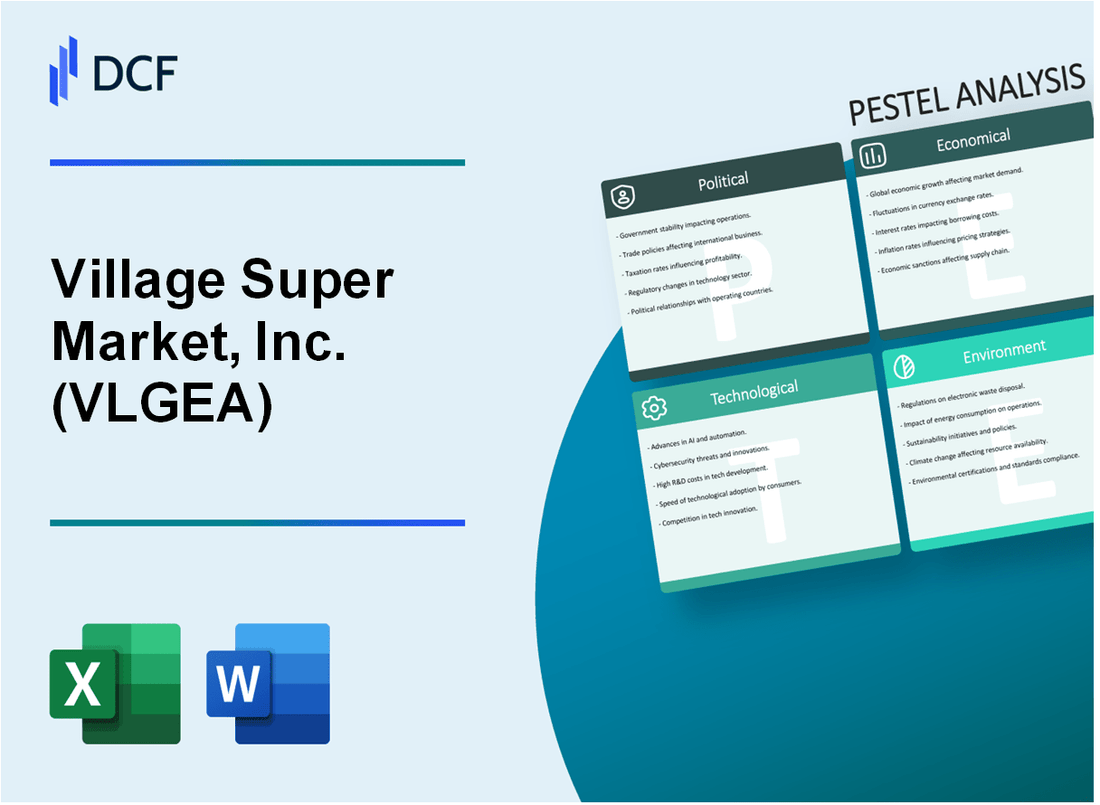
Village Super Market, Inc. (VLGEA): PESTLE Analysis [Nov-2025 Updated] |
Fully Editable: Tailor To Your Needs In Excel Or Sheets
Professional Design: Trusted, Industry-Standard Templates
Investor-Approved Valuation Models
MAC/PC Compatible, Fully Unlocked
No Expertise Is Needed; Easy To Follow
Village Super Market, Inc. (VLGEA) Bundle
If you're tracking Village Super Market, Inc. (VLGEA), you know a regional grocer's biggest challenge isn't just competition-it's the relentless squeeze from macro forces. The reality is, VLGEA's strong Northeast footprint is a huge asset, but it's currently being tested by two major headwinds: persistent food-at-home inflation pushing consumers to private labels, and the high cost of tech upgrades. When the Fed Funds rate is near 5.5% in late 2025, every dollar spent on e-commerce fulfillment is a tough decision, so we need to look past the store aisles and map out the Political, Economic, Sociological, Technological, Legal, and Environmental factors that will defintely shape their next three years.
Village Super Market, Inc. (VLGEA) - PESTLE Analysis: Political factors
Increased state-level minimum wage mandates, impacting labor costs defintely.
The most immediate and quantifiable political factor impacting Village Super Market, Inc. (VLGEA) is the mandated rise in minimum wages across its core operating states, directly increasing labor costs. This is not a federal issue, as the federal minimum wage remains at $7.25/hour, but a state and local one where the company operates 34 supermarkets and three specialty markets across New Jersey, New York, Maryland, and Pennsylvania.
In fiscal year 2025, the labor cost floor rose sharply in three key markets. For a grocery retailer with thin margins, these mandated increases necessitate a strategic response, likely through a combination of price adjustments-which historically can increase grocery prices by 0.36% for every 10% wage hike-and operational efficiencies like increased automation.
Here is the quick math on the 2025 minimum wage impact in the company's core states:
| State | 2025 Minimum Wage Rate (Effective Jan 1, 2025) | Impact on Labor Cost Floor |
|---|---|---|
| New Jersey (26 stores) | $15.49/hour | Significant increase for most employers. |
| New York (6 stores + 3 specialty markets) | $16.50/hour (NYC, Long Island, Westchester) / $15.50/hour (Rest of state) | Highest regional labor costs, especially in New York City's competitive market. |
| Maryland (1 store) | $15.00/hour | Substantial increase to the $15.00 benchmark. |
| Pennsylvania (1 store) | $7.25/hour (Federal minimum) | No mandated state increase, providing a cost advantage in this single location. |
The company must also manage the ripple effect, where employees already making slightly above the minimum wage demand corresponding raises to maintain pay differentials, further inflating the overall payroll budget.
Heightened regulatory scrutiny on food safety and supply chain transparency.
Regulatory pressure from federal agencies is creating a new compliance burden for food retailers, particularly in supply chain transparency. The Food and Drug Administration's (FDA) Food Traceability Final Rule (FSMA 204), while set to take full effect in January 2026, requires significant preparatory investment in 2025.
This rule demands end-to-end tracking for a list of high-risk foods, forcing Village Super Market to upgrade its record-keeping systems to ensure quicker and more effective recalls. On the meat and poultry side, the U.S. Department of Agriculture (USDA) is actively working to crack down on Salmonella, with an updated proposed policy expected in mid-2025 that will set lower thresholds for acceptable Salmonella levels in poultry.
The political climate also signals a focus on nutrition, with the FDA and USDA issuing a joint Request for Information (RFI) in July 2025 to establish a uniform definition for ultra-processed foods. This is a critical first step toward potential future labeling requirements or restrictions that could impact a significant portion of a supermarket's center-store revenue mix.
- FSMA 204: Requires end-to-end tracking for high-risk foods; compliance prep is a major 2025 IT and operational cost.
- USDA Salmonella Rule: New, lower thresholds for poultry are expected mid-2025, demanding tighter supplier controls.
- Ultra-Processed Food RFI: Signals potential future political action on labeling and consumer transparency.
US trade policies affecting import costs for non-domestic produce and goods.
The volatility in US trade policy presents a significant risk to the cost of goods sold (COGS) for Village Super Market, especially for non-domestic produce and specialty items. While the Trump administration rolled back select import tariffs on items like beef, coffee, and cocoa effective November 2025 to ease consumer prices, the broader trade landscape remains unpredictable.
The company's reliance on imported goods, which is typical for a full-service grocer, exposes it to tariffs that were scheduled to increase on non-USMCA-covered food imports to rates as high as 35% for some countries by August 1, 2025.
Even with recent exemptions on key agricultural products, the overall policy direction favors domestic production, meaning procurement teams must constantly monitor tariff schedules for items that cannot be sourced domestically, such as tropical fruits or certain spices.
Local zoning and permitting challenges for new store or fulfillment center development.
The company's planned capital expenditures-including a $75 million budget for fiscal 2026 focused on store expansion and remodels-are directly exposed to the complex and often protracted local political process of zoning and permitting.
In New Jersey, where Village Super Market has 26 of its stores, there is a push by Governor Phil Murphy to reform zoning laws to encourage development, particularly by allowing the conversion of underused retail centers to mixed-use developments. However, this state-level preemption (like bill S-1408) is strongly opposed by the New Jersey League of Municipalities, which views it as undermining local control. This political tension means the approval process for new stores or fulfillment centers remains highly localized, subject to municipal planning boards, public hearings, and potential community opposition over concerns like traffic and noise.
In New York City, where the company operates Fairway and Gourmet Garage markets, the development of new 'last-mile' fulfillment centers-critical for digital sales growth-is facing new regulatory hurdles. The New York City Department of City Planning (DCP) is advancing a special permit process to limit large last-mile facilities near residential areas, requiring a discretionary land-use review (ULURP) for new Parcel Delivery Facilities over 50,000 square feet in certain zones. This adds significant time and uncertainty to any new e-commerce infrastructure development in the New York market.
- New Jersey Zoning: State-level reform efforts (like S-1408) to ease conversion of retail centers are meeting strong local political resistance from the New Jersey League of Municipalities.
- New York City Permits: New Parcel Delivery Facilities over 50,000 square feet now face a discretionary special permit process (ULURP), increasing the political and timeline risk for e-commerce expansion.
- Maryland Development: Montgomery County's updated Public Benefits Point System for development, effective January 1, 2026, incentivizes developers to provide amenities like neighborhood retail, but requires compliance with new criteria for density and affordable housing.
Village Super Market, Inc. (VLGEA) - PESTLE Analysis: Economic factors
The economic landscape in 2025 presents a mixed bag for Village Super Market, Inc. (VLGEA), characterized by persistent consumer price pressure and high borrowing costs, but also a continued shift toward value that directly benefits the grocery sector.
For the fiscal year ending July 26, 2025, Village Super Market reported total sales of $2.321 billion and a net income of $56.4 million, demonstrating resilience despite these macro headwinds. We need to look closely at four key economic variables shaping their operating environment.
Persistent food-at-home inflation, slowing down but still affecting consumer purchasing power.
While the peak inflation rates of the prior years have eased, grocery prices are defintely not retreating. The 'food at home' Consumer Price Index (CPI) rose 2.7% in the 12 months ending September 2025, according to the Bureau of Labor Statistics (BLS). This persistent, albeit slower, increase forces consumers to be highly budget-conscious, which is why Village Super Market saw its same-store sales increase by 2.1% in fiscal 2025, driven partly by inflation in departments like meat and dairy.
Here's the quick math on how inflation impacts the core business:
- Higher revenue: Inflation contributes to a higher nominal sales figure.
- Margin pressure: The company's Gross Profit as a percentage of sales slightly decreased to 28.57% in fiscal 2025 from 28.70% in 2024, due to factors like higher promotional spending and cost inflation that couldn't be fully passed on.
- Consumer stress: Shoppers are trading down, which means the higher sales figures are not necessarily translating to higher-margin product purchases.
High interest rates (e.g., near 5.5% for Fed Funds in late 2025) raise capital expenditure costs.
The Federal Reserve has maintained a restrictive monetary policy to combat inflation, keeping the Federal Funds Rate target range at 3.75%-4.00% as of its October 2025 meeting. This elevated rate environment directly increases the cost of capital for Village Super Market's expansion and modernization plans.
The company has an aggressive capital expenditure (CapEx) strategy, including replacement stores in Watchung and Old Bridge, New Jersey, which opened in fiscal 2025, and a budgeted CapEx of $75,000 thousand for fiscal 2026. Higher interest rates make financing new debt for these projects more expensive, demanding a higher return on investment (ROI) hurdle for each new store or major remodel. This is a real cost-of-doing-business constraint.
Strong consumer focus on value and private-label brands to manage household budgets.
The combination of high prices and debt fatigue has cemented a consumer focus on value. This trend is a clear opportunity for Village Super Market, especially through its affiliation with the Wakefern Food Corporation cooperative, which provides access to strong private-label offerings like ShopRite's own brand products.
Private-label brands are no longer just a cheap alternative; they are a strategic asset. Private-label dollar sales in the U.S. grocery sector grew 4.4% in the first half of 2025, significantly outpacing national brands (1.1% growth). Private-label dollar market share reached a record high of 21.2% in the same period. For Village Super Market, this shift means a higher volume of sales in their own-brand products, which typically carry a higher margin (often 40% or more) than national brands (often 25-35%).
Regional economic disparities impacting store performance across New Jersey, New York, and Pennsylvania.
Village Super Market operates 34 supermarkets across four states, with the majority in New Jersey (26 stores), New York (6 stores), and Pennsylvania (1 store). The uneven economic recovery across these regions creates performance disparities.
For instance, as of August 2025, New Jersey's unemployment rate was 5.0%, notably higher than New York's 4.0% and Pennsylvania's 4.0%. This higher jobless rate in New Jersey, where the company has most of its footprint, suggests a more stressed consumer base and greater pressure on discretionary spending within those stores. Conversely, New York and Pennsylvania saw some of the largest job gains in the country, indicating a stronger labor market that supports consumer spending in those specific areas.
What this estimate hides is the high cost of living in the Northeast, which remains a drag on all consumers, regardless of employment status. The table below illustrates the core state-level economic differences in Village Super Market's primary markets:
| State (VLGEA Stores) | Unemployment Rate (Aug 2025) | Y-o-Y Job Growth (Aug 2024-2025) | Consumer Spending Indicator (May 2025 Retail Sales) |
|---|---|---|---|
| New Jersey (26) | 5.0% | Not listed in top gains | Little change (under 0.3% Y-o-Y) |
| New York (6) | 4.0% | +125,100 jobs (Largest gain) | Year-over-year decrease |
| Pennsylvania (1) | 4.0% | +101,200 jobs (Third largest gain) | Little change (under 0.3% Y-o-Y) |
Next Step: Finance must model the impact of a sustained 4.0% interest rate environment on the ROI for the fiscal 2026 CapEx budget, specifically isolating the New Jersey store performance against the stronger New York/Pennsylvania labor markets.
Village Super Market, Inc. (VLGEA) - PESTLE Analysis: Social factors
Growing consumer demand for online grocery ordering and delivery convenience.
You can't ignore the digital shift; it's now a core part of grocery shopping, not just a pandemic blip. For Village Super Market, this trend is a clear opportunity, and the numbers show they are capturing it. In fiscal 2025, the company's same-store digital sales increased 8% for the year-to-date period, and 9% in the second quarter alone. That growth rate is significantly higher than the overall same-store sales increase of around 2.1% to 2.3% for the same period.
This isn't just about speed; it's about convenience. Across the US, 62.2% of consumers are now buying at least some of their groceries online, a rebound from post-pandemic dips. Honestly, online sales are growing at nearly 5x the rate of in-store sales-a +10% increase online versus +2% in-store. So, the continued investment in omnichannel (online and in-store) capabilities is defintely a must-do action.
| Metric | Fiscal 2025 Value | Significance |
|---|---|---|
| Same-Store Digital Sales Growth (Q2 2025) | 9% | Outpaces overall same-store sales growth (2.3%), showing digital is a key revenue driver. |
| US Consumers Buying Groceries Online | 62.2% | Indicates that a majority of the target market expects an online option. |
| Online Sales Growth Rate vs. In-Store | ~5x faster (+10% vs. +2%) | Highlights the urgency for continued digital investment and optimization. |
Increased preference for locally sourced, organic, and health-focused food options.
The health-and-wellness movement is no longer niche; it's mainstream, especially in Village Super Market's Northeast operating area. This is a critical factor because it directly impacts product mix and gross margin. A massive 72% of US grocery shoppers now identify as health-conscious, with 55% of all consumers actively prioritizing healthier food choices.
The demand for transparency and local sourcing is particularly strong in the Northeast. For instance, 89% of consumers in the region intentionally bought local products in at least one category recently, with 52% believing grocers need to prioritize local produce sourcing. This means your Fairway and Gourmet Garage banners, which cater to premium shoppers, have a clear margin opportunity by emphasizing these attributes. You need to tell the 'farm-to-table' story better.
- 48.4% of Americans are consciously buying in-season goods.
- Younger shoppers (Gen Z and Millennials) prioritize the sustainability of brands.
- Consumer interest in natural and organic foods has grown since 2022.
Labor market tightness, particularly for skilled logistics and in-store personnel.
While the national labor market has shown signs of easing-the ratio of job openings to unemployed persons was just under one open job for every unemployed worker as of August 2025, down significantly from 2022 highs-hiring and retaining specialized staff remains a challenge in the high-cost Northeast. The good news is that Village Super Market appears to be managing this pressure well.
Here's the quick math: the company reported that its operating and administrative expense as a percentage of sales actually decreased to 23.92% in fiscal 2025, down from 24.34% in the prior year. A key driver of this improvement was a 0.16% decrease in employee costs as a percentage of sales, likely due to sales leverage and operational efficiency. Still, unit labor costs nationally climbed by 2.6% in 2024, so wage inflation is a constant pressure you must monitor, especially for the skilled roles needed to support that 9% digital sales growth.
Demographic shifts in the Northeast requiring diverse product assortments and marketing.
The Northeast region, which accounts for about 19% of the U.S. population (around 65 million people), is a patchwork of diverse and shifting populations. Your footprint of 34 supermarkets across New Jersey, New York, Maryland, and Pennsylvania is right in the middle of this dynamic.
The key shift is the move from core cities to suburbs, which is happening in New York and Pennsylvania, benefiting neighboring states like New Jersey and Maryland where you have a strong presence. More importantly, New Jersey and New York have thriving Asian, Black, and Latino populations. Maryland is a majority-minority market where more than one-third of the population identifies as Black. This means a one-size-fits-all product assortment or marketing plan simply won't work.
You must hyper-localize product assortment, stocking culturally relevant items far beyond basic ethnic food aisles. This is where your strong regional ties through the Wakefern Food Corporation cooperative give you a competitive edge over national chains that struggle with this fragmentation. Your marketing needs to speak directly to these diverse communities, not just the general market.
Village Super Market, Inc. (VLGEA) - PESTLE Analysis: Technological factors
Necessity to invest heavily in e-commerce fulfillment infrastructure and micro-fulfillment centers.
You are seeing the same trend I am: digital grocery sales are no longer a side project; they are a core driver of same-store sales growth. For Village Super Market, this means constantly upgrading the infrastructure that supports online orders. The company's same-store digital sales grew a strong 9% in the second quarter of fiscal year 2025, which is a great sign, but it demands serious capital investment to sustain that momentum.
The core challenge for a regional player like Village Super Market is competing with national chains' massive scale. They must invest in e-commerce fulfillment, which includes better in-store picking logic, dedicated staging areas, and potentially micro-fulfillment centers (MFCs)-smaller, automated warehouses closer to the customer. Industry-wide, grocers are prioritizing this, with 72% planning to invest in fulfillment platforms in 2025 to support faster delivery and pickup options. This is a capital-intensive race, and for FY 2025, Village Super Market budgeted a total of $75 million in capital expenditures, a significant portion of which goes toward modernizing stores with enhanced technology and optimized layouts to handle this digital demand.
Here's the quick math: if your online business is growing at 8% to 9% year-to-date, you defintely need to ensure your physical stores can handle the picking volume without disrupting the in-store shopper.
Adoption of AI and machine learning for better inventory forecasting and waste reduction.
The margin pressure in the grocery business is relentless, so using Artificial Intelligence (AI) and machine learning (ML) is a clear path to efficiency. Village Super Market, as a member of the Wakefern cooperative, benefits from shared technology resources, which is a huge advantage for a mid-sized operator. The primary opportunity here is reducing food waste and optimizing inventory, especially in fresh departments like produce and meat.
AI-driven demand forecasting is critical because it tells you exactly how much of a perishable item to order. For the broader industry, the AI market in inventory management is expected to hit $9.6 billion in 2025, up from $7.38 billion in 2024. This is where the real value lies: by 2030, AI is projected to unlock $67.7 billion in value just from supply chain and logistics improvements in the grocery sector. If Village Super Market can cut its spoilage rate by even a small percentage point using predictive analytics, it directly impacts the net income, which stood at $56.38 million in FY 2025.
The AI benefit is clear and immediate.
| AI/ML Application | Strategic Benefit | Industry Value (Projected) |
|---|---|---|
| Demand Forecasting | Reduces perishable food waste; optimizes stock levels. | $67.7 billion in supply chain value unlocked by 2030 |
| Dynamic Pricing | Maximizes revenue on near-expiry items; improves profit margin. | $25.7 billion in merchandising value unlocked by 2030 |
| Inventory Management Market | Streamlines operations and cuts manual labor costs. | Market size of $9.6 billion in 2025 |
Expansion of self-checkout and Scan & Go technologies to manage labor costs.
Labor costs are a constant pressure point, and technology offers a direct way to manage them. The expansion of self-checkout (SCO) and mobile Scan & Go technologies is essential for Village Super Market to improve in-store productivity and customer convenience. When properly implemented, tech-enabled self-checkout can improve in-store productivity by 6% to 12% by reducing the labor hours required for operation.
Customers are already on board; 75% of shoppers who increased their use of self-checkout since the pandemic began intend to continue using it. The global market for self-checkout machines is estimated to be around $5,500 million in 2025, showing the massive industry push. The key is moving to smarter systems, like computer vision AI, which can reduce the need for employee intervention at the self-checkout from the current average of about 25% of transactions to as low as 5%.
This shift frees up employees to focus on higher-value tasks, like stocking shelves or assisting customers, which is crucial for maintaining the superior customer service experience Village Super Market aims to provide.
Cybersecurity risks from managing large volumes of customer and payment data.
As Village Super Market pushes its digital sales-which contributed to its overall sales of $2,320.69 million in FY 2025-it exponentially increases its exposure to cybersecurity threats. For a mid-sized regional grocer, this is a 'highly variable and constant threat' because they often lack the extensive IT capabilities of the largest national chains.
The retail sector is a prime target for cybercriminals, with about a quarter of all cybercrimes aimed at the industry. The risks are severe, ranging from phishing and ransomware to attacks on Point of Sale (POS) systems. The average cost of a data breach in the retail sector is a staggering $4.88 million, plus the immeasurable damage to customer trust. A major supply chain attack, like the one that forced a key distributor to stop deliveries to over 30,000 North American grocery stores in June 2025, shows how vulnerable the entire ecosystem is.
The risk is not just financial; 82% of buyers say they will stop engaging online with a brand following a data breach. This means the company must dedicate a portion of its capital budget to robust, layered defenses, including vendor oversight, to protect the customer and payment data collected through its ShopRite Price Plus and Fairway Insider loyalty programs.
Village Super Market, Inc. (VLGEA) - PESTLE Analysis: Legal factors
The legal landscape for Village Super Market, Inc. (VLGEA) in 2025 is defined by a rapid acceleration of state-level data privacy acts and increasingly complex labor regulations across its core Northeast footprint. You are defintely operating in an environment where compliance is a moving target, especially in New Jersey and New York, the states where the company operates 32 of its 37 stores.
Evolving state and federal data privacy laws requiring compliance
The biggest near-term legal development for Village Super Market is the patchwork of new state data privacy laws. The company's reliance on its ShopRite Price Plus and Fairway Insider loyalty programs means it processes the personal data of over 100,000 consumers, triggering compliance obligations under the new statutes.
Specifically, the New Jersey Data Protection Act (NJDPA) became effective on January 15, 2025, and applies directly to the 26 stores in New Jersey. This law mandates honoring universal opt-out signals (like Global Privacy Control, or GPC) starting July 15, 2025, and requires businesses to process opt-outs for targeted advertising within 15 days. Violations in New Jersey can result in penalties of up to $10,000 per violation.
Also, the Maryland Online Data Privacy Act (MODPA), effective October 1, 2025, sets an even stricter standard, applying to businesses processing data for just 35,000 Maryland residents annually. This law is notable for its data minimization requirements and its prohibition on selling sensitive data, a key issue for the one store Village Super Market operates in Maryland.
Here's the quick math on the shifting privacy compliance landscape:
| State Law | Effective Date (2025) | Applicability Threshold | Max Penalty (per violation) |
|---|---|---|---|
| New Jersey Data Protection Act (NJDPA) | January 15, 2025 | 100,000 NJ consumers (or 25,000 with data sale revenue) | Up to $10,000 |
| Maryland Online Data Privacy Act (MODPA) | October 1, 2025 | 35,000 MD consumers (or 10,000 with >20% revenue from data sale) | Up to $10,000 (initial), $25,000 (repeat) |
| Pennsylvania Consumer Data Privacy Act (HB 78) | Pending Senate Approval (Passed House Oct 1, 2025) | 100,000 PA consumers (or 25,000 with 50% revenue from data sale) | Up to $7,500 |
Strict enforcement of food labeling and allergy disclosure regulations
The regulatory environment for food safety and labeling is tightening, shifting compliance risk from manufacturers to retailers who sell private-label or prepared foods. The U.S. Food and Drug Administration (FDA) released its updated Final Guidance for Industry: Questions and Answers Regarding Food Allergens (Edition 5) in January 2025.
Key changes impact how Village Super Market must handle its in-store bakery, deli, and private-label products, which are often sourced through its cooperative membership with Wakefern Food Corporation.
- Allergen Clarity: The guidance requires expanded definitions for milk and egg sources, demanding specification of the animal source (e.g., 'goat milk') on labels.
- Tree Nut List: The list of major tree nut allergens was refined, notably removing coconut from the list requiring major allergen labeling.
- 'Free-From' Claims: The guidance explicitly clarifies that a product cannot carry a voluntary 'Free-From' claim (like 'milk-free') and also include a precautionary 'May Contain' statement.
Failure to comply can lead to fines and costly product recalls. For instance, in 2025, Wakefern Food Corporation faced a penalty of $12,768 from the Occupational Safety & Health Administration (OSHA) for a safety-related offense in New Jersey, demonstrating the financial risk of non-compliance in the supply chain.
Complex labor laws regarding scheduling and unionization in the Northeast states
Operating in high-cost, highly-regulated states like New York and New Jersey means facing some of the nation's most stringent labor laws. These laws directly increase operating costs and administrative complexity, even as the company's fiscal 2025 adjusted operating and administrative expense as a percentage of sales decreased to 23.95% (down from 24.30% in 2024).
The primary challenge is predictive scheduling and minimum wage hikes:
- Predictive Scheduling: In New York City, where Village Super Market operates six ShopRite and three Gourmet Garage stores, the Fair Workweek Law requires retail employers to provide work schedules at least 72 hours in advance. Violations can result in fines of up to $300 per affected employee.
- Minimum Wage: New York State's minimum wage increased from $16.00 to $16.50 in 2025 for workers in the downstate region, directly impacting labor costs.
- Unionization Risk: The company's 10-K explicitly lists 'the results of union contract negotiations' as a risk factor. The dense concentration of stores in the Northeast, combined with a tight labor market, keeps union activity and negotiation risk high.
Ongoing litigation risk related to premises liability and product recalls
While management states that litigation incidental to the normal course of business 'should not have a material adverse effect,' the financial reports show that legal costs are rising.
The company reported an increase in legal and consulting fees in the fourth quarter of fiscal 2025, contributing to a rise in adjusted operating and administrative expenses. This is a clear, tangible cost of navigating the complex legal environment.
A concrete example of litigation risk in 2025 was the internal dispute with its cooperative, Wakefern Food Corporation. Village Super Market filed a complaint in New Jersey court to try and block Wakefern's acquisition of Morton Williams, arguing the move was anti-competitive. The complaint was ultimately unsuccessful, but it highlights the legal expense of managing the cooperative relationship.
Furthermore, in fiscal 2025, the company recorded $1.5 million in non-cash impairment charges on the long-lived assets of one Gourmet Garage store and assets held for sale, which can be an indirect result of a failed location due to a combination of operational, regulatory, or legal pressures.
Next Step: Finance needs to model the compliance cost of the NJDPA and MODPA, specifically estimating the cost of implementing GPC-honoring technology and a 15-day opt-out processing window by the July 15, 2025 deadline.
Village Super Market, Inc. (VLGEA) - PESTLE Analysis: Environmental factors
State-level bans on single-use plastics and packaging, increasing operational costs.
You are operating in some of the most environmentally regulated states in the country, and that means a direct impact on your cost of goods sold (COGS) and customer experience. New Jersey, where the majority of your 37 stores are located, has the strictest ban, prohibiting both single-use plastic and paper bags for grocery stores larger than 2,500 square feet since 2022. This forces a reliance on thicker, more expensive 'reusable' bags.
Honestly, the law has created an unintended consequence: a November 2025 analysis suggests the total amount of plastic consumed in New Jersey has actually tripled because customers discard the thicker, non-recyclable reusable bags after only a few uses. This is a public relations risk, plus it adds to the consumer's grocery bill when they forget their own bag.
The patchwork of regulations across your operating region forces complex inventory management and different checkout processes for each state. Look at the variable fees you must manage for single-use alternatives:
- New York City: Mandated 5-cent fee on all paper carryout bags.
- Philadelphia, PA: Mandated 10-cent fee on all paper carryout bags, effective in early 2025.
- New Jersey: No paper bag option at all for large grocery stores, forcing the purchase of more costly reusable totes.
This isn't just a compliance issue; it's a customer friction point that competitors are also navigating. You need to defintely factor these non-recoverable compliance costs and the higher unit cost of reusable bags into your Q4 FY 2025 margin forecasts.
Pressure to reduce food waste, potentially through mandated donation or composting programs.
Mandated food waste diversion is moving from a sustainability goal to a hard regulatory requirement, particularly in your core markets. While your existing 'Village Food Rescue Program' is a strong defense-it donated over 1,100,000 pounds of food in 2024-mandates are now forcing capital expenditure on source separation and hauling contracts.
Here's the quick math on the regulatory pressure you are facing in 2025:
| State | Mandate Threshold (Large Generator) | Compliance Requirement (2025) |
|---|---|---|
| New Jersey | Generates 52 tons/year or more of food waste. | Must source-separate and recycle/compost if within 25 road miles of an authorized facility (rules effective September 2025). |
| Maryland | Generates 1 ton/week or more of organic waste. | Must divert food residuals from landfill/incinerator if within 30 miles of an organic recycling facility (effective Jan 2024). |
The New Jersey law offers a waiver if the cost of recycling/composting exceeds the cost of solid waste disposal by 10 percent. This is your near-term financial lever, but relying on waivers is not a long-term strategy. You need to invest in better inventory forecasting and in-store food preparation training now, because the cost of non-compliance-and the methane emissions from landfilling organic waste-will only rise.
Increased scrutiny on supply chain carbon footprint and sustainability reporting.
As a public company with projected FY 2025 revenue of around $2.32 billion, you are now squarely in the crosshairs of state-level climate disclosure rules, even as the federal Securities and Exchange Commission (SEC) ended its defense of its own climate rules in March 2025. The regulatory pressure has shifted to the states.
New York State's reintroduced Senate Bills (SB 3456 and SB 3697) are the most immediate threat to your operational expense. SB 3456 would require companies with over $1 billion in annual revenue doing business in New York to disclose their full carbon footprint, including Scope 3 emissions. Scope 3, which covers your entire value chain (from farm to shelf), is where the risk is highest, as approximately 90% of a supermarket's total emissions are tied to its supply chain.
The key action here is preparing for the disclosure of Scope 3, which is difficult. Your current lack of a formal, public Environmental, Social, and Governance (ESG) report leaves you vulnerable to activist investors and stakeholder scrutiny. Initial compliance costs for large corporations to set up the necessary data collection systems are estimated to be between $2 million and $5 million annually.
Extreme weather events (e.g., severe storms) impacting regional distribution and store operations.
The Northeastern and Mid-Atlantic regions are seeing increasingly severe weather, which translates directly into operational volatility and lost sales. The 2024 hurricane season, including storms like Helene, demonstrated that infrastructure failures-like road collapses and prolonged power outages-are the primary threat to the grocery supply chain.
On average, Atlantic hurricanes cut U.S. local business sales by 12.4 percent, amounting to about $1.38 billion per storm in lost revenue across the affected areas (2017-2024 data).
For your stores, the impact follows a predictable, yet costly, pattern:
- Pre-Storm Surge: Grocery sales spike by an average of +51% in the three days before landfall as customers stockpile essentials.
- Post-Storm Collapse: Daily sales can collapse by nearly 40 percent at landfall, and while activity recovers quickly, the lost revenue is typically not regained.
- Mitigation: Stores with strong online sales show greater resilience, as offline sales losses were more than double those recorded online during a storm event.
Your ongoing store modernization and digital sales growth are critical defenses here. You must continue to prioritize e-commerce infrastructure to offset the inevitable physical disruption from the next major storm.
Disclaimer
All information, articles, and product details provided on this website are for general informational and educational purposes only. We do not claim any ownership over, nor do we intend to infringe upon, any trademarks, copyrights, logos, brand names, or other intellectual property mentioned or depicted on this site. Such intellectual property remains the property of its respective owners, and any references here are made solely for identification or informational purposes, without implying any affiliation, endorsement, or partnership.
We make no representations or warranties, express or implied, regarding the accuracy, completeness, or suitability of any content or products presented. Nothing on this website should be construed as legal, tax, investment, financial, medical, or other professional advice. In addition, no part of this site—including articles or product references—constitutes a solicitation, recommendation, endorsement, advertisement, or offer to buy or sell any securities, franchises, or other financial instruments, particularly in jurisdictions where such activity would be unlawful.
All content is of a general nature and may not address the specific circumstances of any individual or entity. It is not a substitute for professional advice or services. Any actions you take based on the information provided here are strictly at your own risk. You accept full responsibility for any decisions or outcomes arising from your use of this website and agree to release us from any liability in connection with your use of, or reliance upon, the content or products found herein.