

|
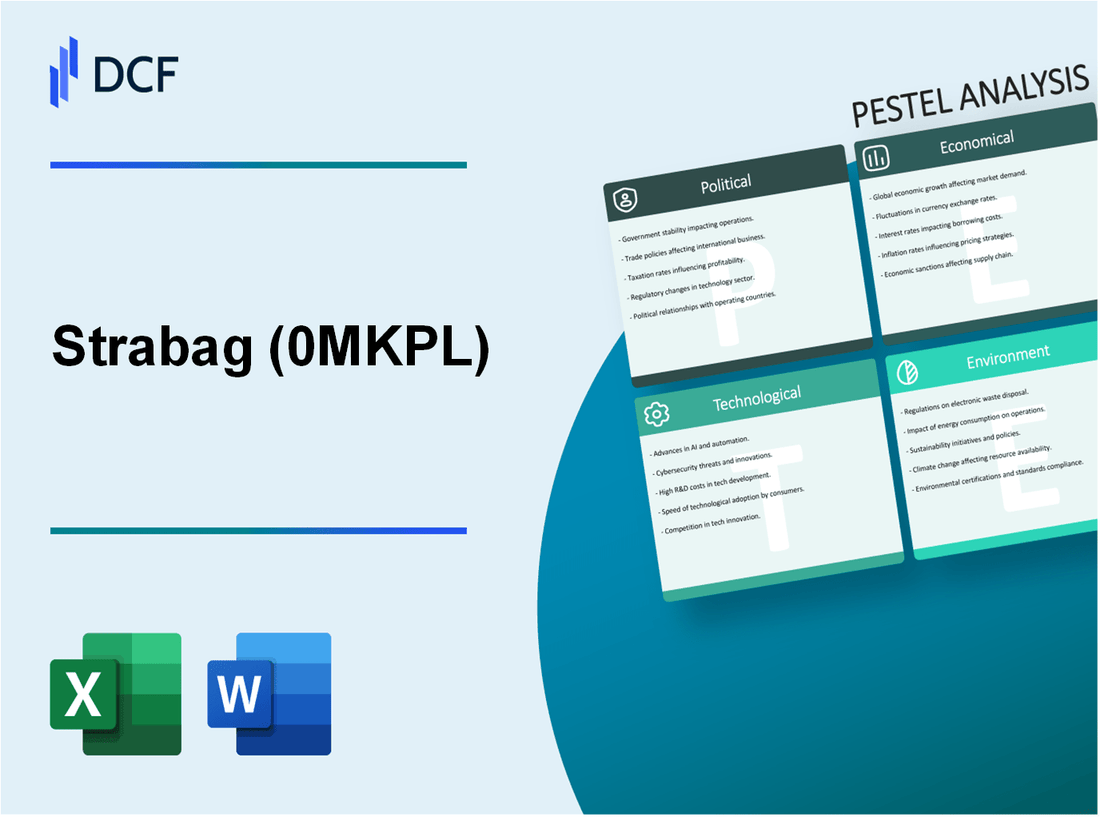
Strabag SE (0MKP.L): PESTLE Analysis [Apr-2026 Updated] |
Totalmente Editável: Adapte-Se Às Suas Necessidades No Excel Ou Planilhas
Design Profissional: Modelos Confiáveis E Padrão Da Indústria
Pré-Construídos Para Uso Rápido E Eficiente
Compatível com MAC/PC, totalmente desbloqueado
Não É Necessária Experiência; Fácil De Seguir
Strabag SE (0MKP.L) Bundle
Strabag stands at a strategic inflection point-backed by strong liquidity, market-leading digital and green construction capabilities (BIM, modular building, low‑carbon materials) and a massive EU and defense-funded pipeline, it is well placed to capture high‑value infrastructure, urban renewal and Ukraine reconstruction work; however, rising labor costs, heavy compliance and reporting burdens, supply‑chain scrutiny and volatile carbon‑linked material prices expose margins and operational complexity, making successful execution on automation, circular resource strategies and regulatory navigation the decisive drivers of future growth or risk.
Strabag SE (0MKP.L) - PESTLE Analysis: Political
EU infrastructure funding prioritized for climate objectives: The European Union has reallocated substantial portions of multiannual budget lines and recovery funds toward climate-resilient and low-carbon infrastructure. The EU's Innovation Fund and the Just Transition Mechanism, together with the 2021-2027 Cohesion Policy and the €723.8 billion NextGenerationEU package, direct an estimated €300-€400 billion toward green infrastructure and decarbonisation-related projects across member states. For Strabag SE, this translates into increased pipeline value for green transport, energy-efficiency retrofits, and renewable integration projects; green tenders now often require lifecycle CO2 reporting and adherence to EU Taxonomy climate mitigation or adaptation criteria.
Eastern European stability boosts cross-border infrastructure investment: Political stabilization and EU accession progress (or candidate status) for countries in the Western Balkans and parts of Eastern Europe have raised cross-border infrastructure spending. EU pre-accession funds, bilateral development loans, and EBRD financing contributed approximately €15-€25 billion annually across the region in recent years. For Strabag, which operates in Austria, Germany, Poland, Czechia, Slovakia, Romania, and the Balkans, this creates stronger regional demand for road, rail, and water projects. Risk premiums have declined in several markets: sovereign bond spreads vs. Germany narrowed by 40-120 basis points in key markets in the last 3-5 years, improving bankability of projects.
Public procurement shifts to social and environmental sustainability: National and municipal procurement policies increasingly incorporate social clauses (local employment quotas, apprenticeship requirements) and environmental performance (GWP limits, circularity targets). EU directives on public procurement require contracting authorities to include environmental and social considerations; many countries set minimum weightings of 20-40% for sustainability criteria in award evaluations. This affects bid strategy and cost structure: sustainable materials and compliance documentation can raise short-term tender costs by 1-4% but improve score and long-term operating resilience.
NATO defense spending fuels military infrastructure growth: Rising NATO defense budgets among member states - NATO defense spending exceeded $1.2 trillion globally in recent reporting years with a 4-6% annual increase in several European members - has driven demand for military-related construction: barracks, logistics hubs, airfield upgrades, and hardened transportation nodes. Contracting channels include direct Ministry of Defence tenders and allied infrastructure programs, where security clearances and compliance add complexity but higher margins. For Strabag, participation can diversify revenue streams, with defense-related contracts potentially representing 3-8% of regional order books where active.
Dual-use and compliant procurement under EU transparency standards: The EU's stricter transparency, sanction compliance, and anti-corruption frameworks (e.g., 2014 and subsequent Public Procurement Directives, AML regulations, and sanctions lists) increase due-diligence responsibilities for contractors. Dual-use projects (civilian infrastructure with potential military application) face additional export-control and procurement scrutiny. Procurement debarment lists and higher reputational risk have prompted leading construction firms to invest in compliance teams; failure to comply can lead to exclusion from EU-funded projects where funding pool sizes range from €10 million to multi-hundred-million-euro programs.
| Political Factor | Estimated Financial Impact | Likelihood (1-5) | Timeframe | Operational Implication for Strabag |
|---|---|---|---|---|
| EU green infrastructure funding | €200M-€1.5B potential project pipeline per country (varies) | 5 | 2023-2030 | Prioritize low-carbon capabilities; invest in green certifications and reporting |
| Eastern European investment growth | €50M-€500M additional contracts annually regionally | 4 | 2024-2028 | Scale regional teams; hedge currency and political risk |
| Sustainability-weighted procurement | Bid cost increase 1%-4%; contract win probability +10% if compliant | 5 | Immediate-ongoing | Embed lifecycle assessment, social clauses in bids |
| Increased NATO/defense projects | Contracts €10M-€200M each; represent 3%-8% of regional revenue | 3 | 2024-2027 | Obtain security clearances; adapt to defence procurement rules |
| EU transparency and sanctions compliance | Compliance costs +0.2%-1% of revenue; litigation/debarment risk high | 5 | Immediate-ongoing | Strengthen legal/compliance functions; supplier due diligence |
- Key political risks: sanctions exposure in cross-border supply chains, procurements blocked by rising protectionism, and sudden regulatory changes (e.g., stricter CO2 limits) that can increase input costs by 2-6%.
- Strategic actions: increase bidding on EU-funded green projects, build partnerships in Eastern Europe to capture €300M+ pipeline opportunities, pursue defense-capable subsidiaries for higher-margin work, and expand compliance staff to cover AML, sanctions, and procurement transparency.
- Quantitative benchmarks to monitor: % revenue from EU-funded projects (target +10 pp), compliance headcount ratio (target 0.5%-1% of workforce), and bid success rate on sustainability-weighted tenders (aim +15% vs. baseline).
Strabag SE (0MKP.L) - PESTLE Analysis: Economic
ECB rate stability supports private mortgage applications: The European Central Bank's current stance of stable policy rates (deposit rate at 4.00% as of Q4 2025) has reduced volatility in mortgage markets across core EU markets where Strabag operates. Mortgage approval rates have improved: EU mortgage origination increased by +6.2% YoY in H1 2025, supporting residential construction demand. Mortgage interest rate spreads narrowed to an average of 1.8 percentage points above ECB rates in Q3 2025, lowering financing costs for private homebuyers and stimulating private developer activity in Germany, Austria and CEE markets-regions accounting for ~62% of Strabag's construction revenue (FY 2024). Lower refinancing stress also reduces counterparty risk on private developer contracts.
Regional growth boosts Strabag's order backlog: GDP growth in Central and Eastern Europe remained robust in 2024-2025, averaging 3.1% YoY versus Eurozone 1.4% YoY. Public infrastructure stimulus and EU Cohesion Fund disbursements increased tender activity. Strabag's reported order backlog reached EUR 20.7bn at FY 2024 (+4.7% YoY), with new awards in transport infrastructure (roads, rail) contributing ~45% of incremental backlog in H1 2025. Increased regional capex plans-national infrastructure budgets up 8-12% in Poland, Czechia and Austria in 2025-translate into multi-year visibility for construction segments.
| Indicator | Value / Trend | Relevance to Strabag (2025) |
|---|---|---|
| ECB Deposit Rate | 4.00% (Q4 2025) | Stable borrowing cost reference for euro-denominated projects and bank funding |
| EU Mortgage Originations | +6.2% YoY (H1 2025) | Supports residential developer activity and private construction contracts |
| Order Backlog | EUR 20.7bn (FY 2024) | Multi-year revenue visibility; basis for resource planning |
| Regional GDP (CEE avg.) | 3.1% YoY (2024-25) | Higher public and private capex supporting bids and awards |
| Transport Infrastructure Budget Growth | +8-12% (2025, selected markets) | Pipeline for large-scale civil engineering projects |
Wage inflation pressures operating costs and automation uptake: Labor markets across Austria, Germany and CEE show tightening-average construction wage inflation ran at +5.5% YoY in 2024 and +4.1% YoY in H1 2025. Skilled labor shortages increase subcontractor rates and overtime costs. Strabag's FY 2024 personnel expenses were EUR 6.8bn (approx. 34% of revenue). To contain margins, the company is accelerating automation and productivity measures: reported capex on digitalization and machinery rose to EUR 210m in 2024 (+18% YoY). Expected unit labor cost impact could compress EBITDA margins by 0.5-1.2 percentage points absent productivity gains.
- 2024 personnel expense: EUR 6.8bn
- Construction wage inflation: +5.5% YoY (2024)
- Digital/automation capex: EUR 210m (2024)
- Estimated margin pressure without automation: -0.5 to -1.2 pp
Material price stabilization lowers bidding risk: After spikes in 2021-2022, major construction material prices (steel rebar, cement, bitumen) have largely stabilized through 2024-2025. Steel billet index for Europe declined -9% YoY in 2024 and remained flat in H1 2025. Cement prices were stable (+1% YoY). Stable input prices reduce the need for aggressive contingency schedules in tenders and lower the risk of contract margin erosion. Strabag's procurement inflation adjustments and hedging practices have reduced raw-material related margin volatility; materials represent ~28% of direct project costs.
| Material | Price Change (2024) | Share of Project Direct Cost |
|---|---|---|
| Steel (rebar) | -9% YoY | 12% |
| Cement | +1% YoY | 7% |
| Bitumen | +2% YoY | 3% |
| Aggregates & concrete | Stable | 6% |
Long-term financing benchmarks provide predictable project economics: Tenor and margin benchmarks in the European project finance and corporate lending markets improved in 2024-2025. Average EUR-denominated corporate loan spreads for investment grade construction firms tightened to ~175 bps over EURIBOR (2025) from ~210 bps in 2023. Availability of EIB/EBRD co-financing and EU recovery fund instruments supports large PPP and infrastructure projects with tenors of 10-20 years at favorable rates. Strabag's net financial debt was EUR 1.1bn at FY 2024, with committed credit facilities covering >12 months of liquidity needs. Predictable long-term rates assist in pricing public-private partnership bids and locked-rate financing of EPC contracts.
- Net financial debt: EUR 1.1bn (FY 2024)
- Average corporate loan spread: ~175 bps over EURIBOR (2025)
- Typical project finance tenor (EIB/EBRD): 10-20 years
- Committed facilities coverage: >12 months liquidity
Strabag SE (0MKP.L) - PESTLE Analysis: Social
Sociological
The aging workforce across Europe and Central/Eastern Europe (CEE) is a material operational driver for Strabag. In the EU the share of workers aged 55+ rose to ~25% of the workforce in 2023 and in Austria/Germany the construction sector median age is ~44-48 years, with an estimated 20-30% of skilled tradespeople reaching retirement eligibility within 5-10 years. This dynamic forces Strabag to expand apprenticeship intake (targets of +10-30% regionally reported by peers) and to invest in productivity-enhancing equipment and training: examples include increased adoption of semi-automated earthmoving equipment, digital site-management tools that can raise per-crew productivity by an estimated 10-20%, and targeted upskilling programs for 2,000+ trainees across markets.
Urbanization trends are increasing demand for high-density residential, transit-oriented development and subsidized housing. United Nations urbanization forecasts show urban population in Europe still growing at ~1% annually with hotspot metro regions growing 2-3% p.a.; housing shortfalls in major German/Austrian cities are estimated at 200,000-500,000 units cumulatively. For Strabag this translates into higher tender volumes for multifamily, mixed-use and social housing projects, often with narrower margins but higher volume and predictable public-sector counterparties.
Hybrid work patterns are redefining commercial real estate needs and creating conversion opportunities. Post-pandemic remote/hybrid adoption stabilized: surveys indicate 25-35% of professional roles continue hybrid work models with office occupancy rates averaging 40-60% of pre-2020 levels in major European cities. Office-to-residential conversion and adaptive reuse projects are a growing revenue stream; conversions can command higher margin per sq. m than speculative office new-builds in markets with office vacancy rates above 12-15% (e.g., Berlin, Warsaw at various times). Strabag faces both risk (reduced new office starts) and opportunity (conversion and retrofit contracts, modular interior fit-outs).
Corporate social responsibility (CSR) and stakeholder transparency have increased societal pressure for gender diversity in leadership. EU and national corporate governance guidelines, plus investor ESG criteria, are pushing for improved female representation: target thresholds commonly cited are 30-40% female representation in senior management within a 3-5 year horizon. Strabag's sector currently averages ~15-20% female leadership at board/executive levels across construction peers. Rising demands from institutional investors and public-sector clients make progress on female leadership and transparent reporting a commercial imperative for access to certain tenders and green/ESG-linked financing.
Workforce expectations around safety, health and digital connectivity are elevated. Construction-industry safety KPIs have become more prominent: lost-time injury frequency rates (LTIFR) targets in leading contractors are below 2.0 per million hours; clients increasingly require real-time safety reporting and safety-technology (wearables, geofencing). Simultaneously, workforce digital connectivity expectations-mobile access to project data, BIM collaboration tools, remote supervision-are high: smartphone/tablet penetration among site workers exceeds 70% in developed markets, and adoption of cloud-based project-management platforms can cut rework-related costs by an estimated 5-10% of project value.
| Social Trend | Quantitative Indicators | Operational Implications for Strabag |
|---|---|---|
| Aging workforce | 25% of EU workforce aged 55+; 20-30% construction skilled staff retire in 5-10 years | Increase apprenticeships, invest in automation, target 2,000+ trainees, succession planning |
| Urbanization & housing shortage | Urban population growth 1-3% p.a.; housing shortfall 200k-500k units in major markets | Focus on multifamily/social housing pipelines, public-private partnership bids |
| Hybrid work / office conversions | Office occupancy 40-60%; vacancy >12-15% in select cities; 25-35% roles hybrid | Develop conversion capabilities, modular retrofit products, repurpose pipeline |
| CSR & female leadership | Sector female execs ~15-20%; stakeholder targets 30-40% | Enhance diversity hiring, transparent ESG reporting, link to tender/financing access |
| Safety & digital connectivity | LTIFR targets <2.0; site-device penetration >70%; rework reduction potential 5-10% | Deploy wearables/BIM/cloud reporting, tighten safety KPIs, implement remote supervision |
Priority actions and internal responses for operational alignment include:
- Scale apprenticeships and vocational partnerships: aim +15-25% intake in high-attrition regions within 24 months.
- Productize housing and conversion offerings: standardized modular systems for faster build and margin control.
- Institutionalize diversity targets: set measurable female leadership goals (e.g., 30% senior roles by 2028) and publish progress.
- Accelerate digital and safety investments: deploy IoT wearables, centralized BIM workflows, and real-time safety dashboards across >50% of major sites.
Strabag SE (0MKP.L) - PESTLE Analysis: Technological
BIM integration becomes mandatory in public projects: Many European markets where Strabag operates are moving from recommended to mandatory BIM for public procurement. Austria, Germany and several Nordic countries require at least Level 2 BIM for projects above specified thresholds. Estimated compliance timelines: Austria/Germany 2023-2025 for major public works; EU-wide standards (EN ISO 19650 adoption) accelerating procurement harmonization. Expected impact on Strabag: ~3-5% increase in pre-construction staffing costs for BIM modelers in first 12-18 months, offset by 6-10% reduction in design rework and clash-detection savings on large projects.
Automation and robotics boost site efficiency and margins: On-site automation (robotic bricklayers, autonomous earthmoving, drone surveys) is increasing productivity and reducing labor risks. Typical productivity gains reported in trials: robotic masonry +300% bricks/hour per operator, autonomous excavation reducing fuel/time by 15-25%. Strabag pilot programs forecast potential gross margin improvement of 1.0-1.8 percentage points on high-repeatability segments (roads, tunnels) over 3-5 years.
| Technology | Typical Productivity Gain | CapEx/Unit (EUR) | Payback Period | Target Application |
|---|---|---|---|---|
| Robotic masonry | +150-300% | 150,000-400,000 | 1-3 years (volume projects) | Residential, structural walls |
| Autonomous excavators | +10-25% efficiency | 300,000-800,000 | 2-4 years | Earthworks, infrastructure |
| Survey drones + photogrammetry | +80-95% speed | 5,000-50,000 | 6-18 months | Topographic surveys, inspections |
| Prefabrication & modular lines | +30-60% schedule reduction | Varies by plant; 1-10m+ | 2-5 years | Buildings, bathroom pods, MEP modules |
AI optimizes supply chains, bidding, and safety monitoring: Machine learning models improve bid-hit rates through probability scoring, optimize procurement by predicting price trends for steel, cement and aggregates, and enable computer-vision-driven safety monitoring. Reported outcomes from industry deployments: bid accuracy improvement 5-12% leading to lower margin erosion; procurement cost savings 2-6% on commodities; safety incident detection reduces lost-time incidents by up to 20% in early adopters. Strabag's scale (annual revenue ~EUR 16-18 billion in recent years) allows centralized data lake investments with potential ROI from reduced claim costs and better margin capture.
- Supply chain AI: predictive ordering reduces downtime; inventory carrying cost decline 7-12%.
- Bid optimization: expected increase in commercial win-rate 3-8% for complex tenders.
- Safety analytics: video analytics reduce H&S costs and insurance premiums over time.
Green construction tech and modularization enhance quality and speed: Low-carbon concrete mixes, recycled aggregates, on-site carbon capture trials, and factory-based modular construction lower embodied carbon and improve delivery predictability. Modular methods cut site labor by 40-60% and schedule durations by 30-50% for building superstructures. Carbon intensity reductions: alternative cements and SCMs can reduce embodied CO2eq by 20-40% per m3 of concrete; combined strategies target net reductions aligned with EU Green Deal and Strabag's internal sustainability targets (e.g., CO2 intensity reduction goals by 2030).
Real-time data and digital twins shorten project delivery: Integration of IoT sensors, BIM, reality capture, and digital twins provides actionable real-time dashboards for progress, quality and asset management. Typical benefits: schedule adherence improvement 10-20%, reduction in commissioning defects 15-30%, and lifecycle OPEX savings for clients (building operation) of 8-15% when digital twin-based FM is implemented. Strabag can leverage digital twins to shift from one-off construction revenue toward services and maintenance contracts, improving long-term revenue visibility.
| Digital Capability | Primary Benefit | Measured Impact | Strategic Opportunity for Strabag |
|---|---|---|---|
| BIM + Digital Twin | Clash detection, lifecycle ops | Design rework ↓ 6-10%; FM OPEX ↓ 8-15% | Recurring service revenue; competitive tender advantage |
| IoT sensors / Site telematics | Progress, equipment utilization | Equipment idle time ↓ 12-25% | Lower fleet costs; higher utilization |
| Computer vision / AI safety | Incident prevention | Lost-time incidents ↓ up to 20% | Lower insurance, improved reputation |
Strabag SE (0MKP.L) - PESTLE Analysis: Legal
100% Tier 1 supplier due diligence mandatory by 2026: The European and national-level regulatory push requires Strabag to implement full due-diligence on all direct suppliers (Tier 1) by 2026, aligned with emerging corporate sustainability due diligence frameworks (effective deadline 2026 for major contractors). Compliance scope includes human rights, modern slavery, conflict minerals, occupational health & safety, and subcontractor auditability. Operationalizing 100% coverage means establishing supplier onboarding checks, continuous monitoring, corrective-action plans, and documented remediation workflows covering an estimated 8,000-12,000 Tier 1 supplier relationships across Central Europe.
Legal enforcement exposure: failure to meet the 2026 deadline creates civil and administrative risk, including suspension of public contracts and increased bid disqualification rates. Conservative internal modelling indicates remediation program costs of €8-€25 million over 2024-2026 to reach full Tier 1 compliance (systems, audits, dedicated staff), plus potential procurement cost inflation of 0.5-1.5% from supplier contract re-negotiations.
| Legal Issue | Effective Date / Timeline | Estimated Financial Impact | Operational Impact | Mitigation Measures |
|---|---|---|---|---|
| 100% Tier 1 supplier due diligence | Mandatory by 2026 | €8-€25m implementation; 0.5-1.5% procurement inflation | Onboarding audits for 8k-12k suppliers; new contract clauses | Supplier screening platform, audit teams, contractual clauses |
| Green revenue reporting & ESG disclosures | Phased 2024-2026; tightening thereafter | Higher capital costs: estimated +10-50 bps on debt for non-compliance | Data collection across projects; external assurance requirements | Green revenue taxonomy mapping; third-party assurance |
| Labor compliance (wage, time-tracking) | Ongoing; heightened enforcement since 2023 | Back-pay, fines, litigation: €1-€30m risk depending on exposures | Payroll system overhaul; local HR training | Automated time-tracking, centralized payroll, compliance audits |
| Biodiversity & environmental permits | Stricter permitting timelines; project-level deadlines 2024-2028 | Delay costs: €0.5-€5m per large civil project for timeline slippage | Longer planning phases; additional baseline studies | Early-stage EIA integration; biodiversity offset planning |
| Timber certification (FSC/PEFC) | Procurement rules tightening 2024-2026 | Material sourcing premium: 2-8% on timber costs | Supply chain validation for wood-based products | Preferred certified suppliers, chain-of-custody tracking |
Green revenue reporting and ESG disclosure requirements tighten capital costs: Credit providers and bond markets increasingly price ESG performance into financing terms. Internal sensitivity analysis indicates that failure to demonstrate verifiable "green" revenue and taxonomy alignment can increase borrowing spreads by 10-50 basis points on new facilities; for Strabag with a net debt profile in the low-single-digit billion euro range, this equates to incremental annual interest expense of approximately €1-€10 million depending on tenor and size.
Wage, time-tracking, and labor compliance heighten legal risk management: Recent enforcement trends in core markets (Austria, Germany, Poland) show intensified audits of construction sector payroll practices. Key exposures include misclassification of workers, unpaid overtime, and non-compliant subcontractor payrolls. Quantitative exposures per major jurisdiction are modelled as: potential aggregate back-pay and penalties of €0.5-€20m per country in worst-case scenarios. Strengthening time-tracking systems, harmonizing contractual standards, and centralizing payroll data are legally prudent and likely mandatory under procurement terms.
- Implemented measures: roll-out of electronic time-tracking to 100% of sites by Q4 2025.
- Required HR actions: harmonize wage rates and documentation across 20+ legal entities.
- Audit cadence: quarterly subcontractor payroll audits in high-risk regions.
Biodiversity and environmental permit timelines tighten project planning: New permitting standards and shorter comment windows for Environmental Impact Assessments increase the risk of project delays. Sample metrics: average permitting lead time for major infrastructure increased from 9 months (2018-2020) to 12-18 months (2021-2024) in several EU states; recent project-level delays attributable to biodiversity considerations have resulted in cost overruns of 3-7% on affected projects. Legal teams must integrate permit milestones into contract risk allocation and contingency budgeting.
Timber certification and FSC/PEFC compliance critical for supply chain: Procurement rules in public and large private projects increasingly mandate FSC or PEFC-certified timber. Market pricing shows certified timber premiums of approximately 2-8% versus uncertified alternatives; non-compliance risks contract rejection, reputational loss, and buyer penalties. For building subcontracts using wood components representing 1-3% of project value, failure to certify can produce bid disqualification or €0.2-€2m contract-level risks depending on project scale.
Recommended legal governance enhancements: expand in-house compliance headcount by 15-30 FTEs across procurement, environmental law, and labor law specialists; deploy enterprise-wide supplier due-diligence software covering 100% of Tier 1 suppliers; secure third-party assurance for green revenue claims starting FY2025; embed permit and biodiversity trigger clauses in bid-stage contracts; and require FSC/PEFC proof-of-origin documentation at purchase order stage with regular chain-of-custody verification.
Strabag SE (0MKP.L) - PESTLE Analysis: Environmental
Strabag has set explicit climate neutrality and decarbonisation ambitions: group-level target to achieve net-zero operational CO2 emissions by 2050, interim target of a 30-40% reduction in Scope 1 and 2 emissions by 2030 versus a 2020 baseline, and a 15-25% reduction in carbon intensity (kg CO2e/€ revenue) by 2027. Capital expenditure guidance allocates approximately €200-300 million through 2030 for energy-efficiency upgrades, electrification of machinery, and onsite renewable generation (solar/wind), aiming to increase onsite renewable share from ~3% in 2023 to >20% by 2030.
Circular economy and material-reuse objectives are embedded into procurement and project delivery. Strabag targets a 50% reuse rate for demolition materials by 2035 and a 30% reduction in virgin aggregate consumption per project by 2030. The company has standardized reuse clauses in major contracts and expanded mobile recycling units - current fleet processes up to 400,000 tonnes/year of reclaimed materials across Europe. These shifts reduce material costs and landfill fees while supporting compliance with EU Waste Framework and Construction Products Regulation expectations.
Zero-Emission Buildings (ZEB) regulations and voluntary standards are changing design and construction workflows. Strabag anticipates >60% of new in-house design contracts to meet ZEB or near-ZEB performance by 2030. This requires integration of high-performance envelopes, heat-pump heating, district heating tie-ins, and onsite PV/battery solutions. Estimated incremental build cost increases vary by project but average +3-7% capex for ZEB compliance; lifecycle operational savings project NPV improvements of 8-15% over 30 years due to energy savings and lower carbon taxes.
Biodiversity restoration and water management criteria now influence site selection and mitigation budgeting. Strabag reports implementation of biodiversity action plans on ~25% of large infrastructure projects (2024), aiming for 100% inclusion on projects >€10m by 2030. Water management metrics tracked include reductions in freshwater consumption (target: -20% per m2 constructed by 2030) and runoff control measures; the company has invested in sediment control, constructed wetlands, and water reuse systems estimated to save ~1.2 million m3/year of freshwater across its operations when fully deployed.
Digital Building Logbooks (DBLs) and material passports are being rolled out to enable material recovery, transparency, and circular procurement. Strabag targets DBL coverage for 50% of delivered buildings by 2030, recording material quantities, composition, and reuse potential. Expected benefits include a 10-25% increase in reclaimed material recovery rates and faster deconstruction planning, with estimated recovery value capture of €5-15/tonne for separated, high-value materials (metals, adhesives-free timber).
| Metric | 2023 Baseline / Current | 2030 Target | 2035/2050 Target |
|---|---|---|---|
| Scope 1 & 2 CO2 reduction vs 2020 | - (baseline) | 30-40% reduction | Net zero operational emissions by 2050 |
| Renewable energy share (onsite + purchased) | ~3% onsite; 15% procured renewables | >20% onsite; 50% procured renewables | 100% procured renewables; neutral carbon balance |
| Material reuse from demolition | ~25% reuse rate | 30-50% reuse rate | 50%+ reuse (circular target) |
| Digital Building Logbook coverage | Pilot projects (2023-24) | 50% of delivered buildings | Standard practice across portfolio |
| Freshwater consumption reduction | Baseline (2023) | -20% per m2 | Continuous improvement |
| Fleet electrification / low-emission machinery | Limited electric heavy machinery pilots | Electrification of small/medium fleet; 15-25% heavy equipment low-emission | Majority low-emission/heavy electrified or hydrogen solutions |
- Operational emissions: rollout of energy management systems across >90% of sites by 2028, ISO 50001 alignment and site-level carbon dashboards.
- Materials strategy: centralized material passports, supplier environmental scoring and increased procurement of secondary aggregates and recycled asphalt (target share 25% by 2030).
- Construction process: modular prefabrication to reduce on-site waste 15-30% and improve circular dismantling.
- Finance and incentives: use of green bonds and sustainability-linked loans (SLLs) to fund transition; SLL pricing linked to CO2 intensity and DBL rollout KPIs.
Regulatory and market pressures driving these actions include EU Fit for 55, the Construction Products Regulation, evolving national ZEB mandates (Netherlands/Austria/Germany ambition timelines to 2030-2035), and insurer/tenant demand for verified low-carbon buildings. Strabag models scenario impacts indicating potential carbon tax exposures of €8-25/tonne CO2 by 2030 could add €5-40 million/year to operating costs without mitigation; planned measures aim to limit net exposure through efficiency and renewables investments.
Disclaimer
All information, articles, and product details provided on this website are for general informational and educational purposes only. We do not claim any ownership over, nor do we intend to infringe upon, any trademarks, copyrights, logos, brand names, or other intellectual property mentioned or depicted on this site. Such intellectual property remains the property of its respective owners, and any references here are made solely for identification or informational purposes, without implying any affiliation, endorsement, or partnership.
We make no representations or warranties, express or implied, regarding the accuracy, completeness, or suitability of any content or products presented. Nothing on this website should be construed as legal, tax, investment, financial, medical, or other professional advice. In addition, no part of this site—including articles or product references—constitutes a solicitation, recommendation, endorsement, advertisement, or offer to buy or sell any securities, franchises, or other financial instruments, particularly in jurisdictions where such activity would be unlawful.
All content is of a general nature and may not address the specific circumstances of any individual or entity. It is not a substitute for professional advice or services. Any actions you take based on the information provided here are strictly at your own risk. You accept full responsibility for any decisions or outcomes arising from your use of this website and agree to release us from any liability in connection with your use of, or reliance upon, the content or products found herein.