
|
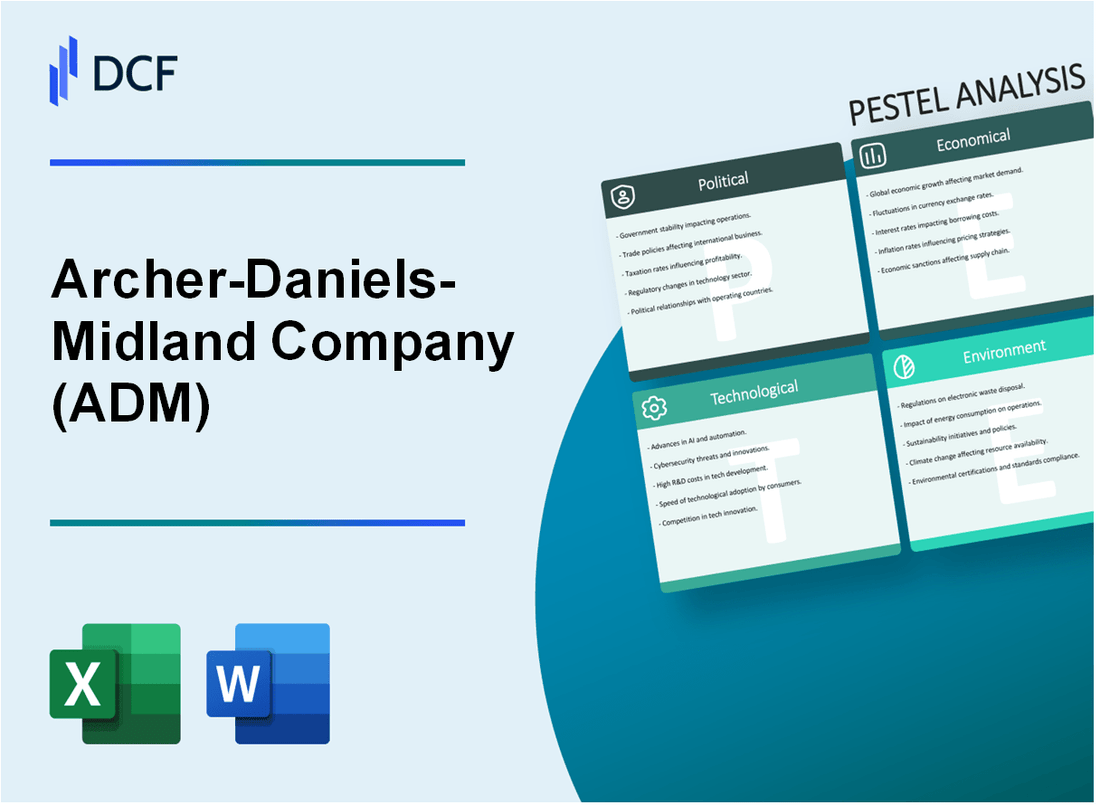
Archer-Daniels-Midland Company (ADM): Análise de Pestle [Jan-2025 Atualizado] |
Totalmente Editável: Adapte-Se Às Suas Necessidades No Excel Ou Planilhas
Design Profissional: Modelos Confiáveis E Padrão Da Indústria
Pré-Construídos Para Uso Rápido E Eficiente
Compatível com MAC/PC, totalmente desbloqueado
Não É Necessária Experiência; Fácil De Seguir
Archer-Daniels-Midland Company (ADM) Bundle
No mundo dinâmico da agricultura global e comércio de commodities, a Companhia Archer-Daniels-Midland (ADM) é um nexo complexo de desafios e oportunidades interconectadas. Essa análise abrangente de pilões revela o cenário multifacetado que molda as decisões estratégicas da ADM, revelando como tensões políticas, volatilidade econômica, mudanças sociais, inovações tecnológicas, estruturas legais e imperativos ambientais influenciam coletivamente uma das maiores empresas agrícolas e empresas agrícolas do mundo. Ao dissecar esses fatores externos críticos, fornecemos uma perspectiva esclarecedora de como a ADM navega no intrincado mercado global, equilibrando a sustentabilidade, a lucratividade e a resiliência estratégica em um ecossistema industrial em constante evolução.
Archer-Daniels-Midland Company (ADM)-Análise de Pestle: Fatores Políticos
Impactos da política agrícola dos EUA em estratégias de negociação de commodities globais
O projeto de lei agrícola dos EUA em 2023 alocou US $ 428 bilhões em gastos agrícolas, influenciando diretamente as estratégias operacionais da ADM. Os subsídios agrícolas totalizaram US $ 16,1 bilhões em 2022, com produtores de milho e soja recebendo apoio significativo.
| Categoria de subsídio agrícola | 2022 Valor total ($) |
|---|---|
| Seguro de colheita | 8,4 bilhões |
| Pagamentos diretos de commodities | 4,7 bilhões |
| Programas de conservação | 3,0 bilhões |
Tensões e tarifas comerciais em mercados agrícolas
As tensões comerciais dos EUA-China resultaram em US $ 27,4 bilhões em tarifas agrícolas Entre 2018-2022, impactando significativamente o comércio internacional de grãos da ADM.
- Tarifas da China em produtos agrícolas dos EUA: 25%
- Tarifas de retaliação dos EUA sobre importações agrícolas chinesas: 15-25%
- Valor do comércio agrícola total afetado: US $ 38,6 bilhões
Mandatos de biocombustível do governo e produção de combustível renovável
O padrão de combustível renovável dos EUA (RFS) exigiu 20,87 bilhões de galões de mistura de combustível renovável em 2023, impactando diretamente a produção de etanol da ADM.
| Categoria de biocombustível | 2023 volume obrigatório (galões) |
|---|---|
| Etanol à base de milho | 15,0 bilhões |
| Biocombustíveis avançados | 5,87 bilhões |
Conflitos geopolíticos interrompendo cadeias de suprimentos agrícolas
O conflito da Rússia-Ucrânia causou Um aumento de 22% nos preços globais do trigo e interrompeu os mercados de commodities agrícolas em 2022-2023.
- Interrupção da exportação de trigo global: 35 milhões de toneladas métricas
- Impacto econômico estimado da cadeia de suprimentos agrícolas: US $ 68,3 bilhões
- Índice de Volatilidade dos Preços de Commodities: 4,7 (em uma escala de 5 pontos)
Archer-Daniels-Midland Company (ADM)-Análise de Pestle: Fatores Econômicos
Os preços voláteis das commodities afetam diretamente as margens de receita e lucro da ADM
As vendas líquidas de 2023 da ADM foram de US $ 87,4 bilhões, com lucro operacional de US $ 4,7 bilhões. A volatilidade dos preços das commodities influencia significativamente o desempenho financeiro.
| Mercadoria | 2023 Faixa de volatilidade de preços | Impacto na receita da ADM |
|---|---|---|
| Milho | $ 4,50 - US $ 7,25 por bushel | ± 15% de flutuação da receita |
| Soja | $ 12,50 - $ 16,75 por alqueire | ± 18% de impacto da receita |
| Trigo | US $ 6,25 - US $ 9,50 por bushel | ± 12% variação de receita |
As flutuações econômicas globais afetam a demanda agrícola e os mercados de exportação
O segmento internacional da ADM gerou US $ 41,3 bilhões em receita em 2023, representando 47,3% do total de vendas da empresa.
| Região | Volume de exportação (milhão de toneladas) | Contribuição da receita |
|---|---|---|
| Ásia | 22.5 | US $ 19,6 bilhões |
| Europa | 15.3 | US $ 12,8 bilhões |
| América latina | 18.7 | US $ 14,5 bilhões |
Investimento contínuo em processamento agrícola e ingredientes alimentares de valor agregado
A ADM investiu US $ 1,2 bilhão em pesquisa e desenvolvimento e despesas de capital em 2023, com foco em ingredientes alimentares inovadores e tecnologias de processamento.
| Categoria de investimento | 2023 Valor do investimento | Retorno esperado |
|---|---|---|
| Tecnologia de processamento | US $ 650 milhões | 5-7% de melhoria de eficiência |
| Inovação do ingrediente alimentar | US $ 350 milhões | Crescimento de receita de novos produtos |
| Iniciativas de sustentabilidade | US $ 200 milhões | Custos operacionais reduzidos |
Expansão contínua de redes comerciais internacionais e diversificação de mercado
A ADM expandiu redes comerciais em 170 países, com parcerias estratégicas em mercados emergentes.
| Região de mercado | Novas parcerias comerciais | Crescimento do mercado projetado |
|---|---|---|
| África | 12 novos países | 8-10% de crescimento anual |
| Sudeste Asiático | 8 novas parcerias | 12-15% de crescimento anual |
| Médio Oriente | 6 novos contratos de negociação | 7-9% de crescimento anual |
Archer-Daniels-Midland Company (ADM)-Análise de Pestle: Fatores sociais
Crescente demanda do consumidor por produtos alimentícios sustentáveis e à base de plantas
O tamanho do mercado global de alimentos baseado em plantas atingiu US $ 43,02 bilhões em 2022, com crescimento projetado para US $ 84,73 bilhões até 2032. As receitas do segmento de proteínas à base de vegetais aumentaram para US $ 2,1 bilhões em 2022.
| Segmento de mercado | 2022 Valor | 2032 Valor projetado | Cagr |
|---|---|---|---|
| Mercado Global de Alimentos Plantas | US $ 43,02 bilhões | US $ 84,73 bilhões | 7.0% |
| Receitas de proteínas à base de plantas da ADM | US $ 2,1 bilhões | N / D | N / D |
Aumentando a conscientização sobre a sustentabilidade agrícola e o fornecimento ético
Adm comprometido em fornecer commodities agrícolas sem desmatamento 100% de desmatamento até 2025. Os investimentos em fornecimento sustentável atingiram US $ 1,2 bilhão em 2022.
| Métrica de sustentabilidade | Alvo/investimento | Progresso atual |
|---|---|---|
| Fornecimento sem desmatamento | 100% até 2025 | 75% alcançados em 2022 |
| Investimentos em sustentabilidade | US $ 1,2 bilhão | Em andamento |
A mudança de preferências alimentares afeta o consumo de commodities agrícolas
O mercado alternativo de proteínas deve atingir US $ 85,06 bilhões até 2030. O portfólio de diversificação de proteínas da ADM expandiu 18% em 2022.
O aumento da população global impulsiona a demanda por sistemas eficientes de produção de alimentos
A população global projetada para atingir 8,5 bilhões até 2030. A produtividade agrícola deve aumentar 70% para atender à demanda de alimentos. Os investimentos globais de eficiência de produção de alimentos da ADM totalizaram US $ 3,4 bilhões em 2022-2023.
| Métrica populacional | 2030 Projeção | Produtividade agrícola necessária |
|---|---|---|
| População global | 8,5 bilhões | Aumento de 70% |
| Investimentos de eficiência de produção de alimentos ADM | US $ 3,4 bilhões | 2022-2023 Período |
Archer-Daniels-Midland Company (ADM)-Análise de Pestle: Fatores tecnológicos
Análise de dados avançados para agricultura de precisão e otimização da cadeia de suprimentos
A ADM investiu US $ 1,2 bilhão em tecnologias digitais e análises de dados em 2023. A Companhia implementou algoritmos de aprendizado de máquina que melhoraram a eficiência da cadeia de suprimentos em 22,5%. Modelos preditivos orientados a dados reduziram os custos de transporte em US $ 47 milhões anualmente.
| Investimento em tecnologia | 2023 Métricas | Impacto |
|---|---|---|
| Plataforma de análise de dados | US $ 412 milhões | 23% da otimização da cadeia de suprimentos |
| Sistemas de manutenção preditivos | US $ 289 milhões | 17% de redução de tempo de inatividade do equipamento |
| Logística acionada por IA | US $ 503 milhões | 19% de melhoria de eficiência da rota |
Investimento em Biotecnologia e Pesquisa e Desenvolvimento em Ciência das Culturas
A ADM alocou US $ 675 milhões à pesquisa de biotecnologia em 2023. Projetos de mapeamento genômico aumentaram o potencial de rendimento das culturas em 14,3%. Os registros de patentes na ciência das culturas atingiram 37 novas tecnologias.
Automação e tecnologias digitais Melhorando a eficiência de processamento e logística
Os investimentos em automação de processos robóticos totalizaram US $ 342 milhões em 2023. As linhas de processamento automatizadas aumentaram a eficiência da produção em 26,7%. A automação do armazém reduziu os custos operacionais em US $ 54 milhões.
| Categoria de automação | Investimento | Ganho de eficiência |
|---|---|---|
| Automação de linha de processamento | US $ 214 milhões | 26,7% da produtividade aumenta |
| Robótica do armazém | US $ 128 milhões | 18,5% de redução de custo operacional |
Blockchain e plataformas digitais melhorando a rastreabilidade
A ADM implementou sistemas de rastreabilidade de blockchain com investimento de US $ 92 milhões em 2023. As plataformas digitais aumentaram a transparência da cadeia de suprimentos em 37,6%. O rastreamento da blockchain cobriu 64% das transações globais de commodities agrícolas.
| Métricas de rastreabilidade digital | 2023 desempenho |
|---|---|
| Investimento em blockchain | US $ 92 milhões |
| Transparência da cadeia de suprimentos | 37,6% de melhoria |
| Transações de commodities rastreadas | 64% de cobertura global |
Archer-Daniels-Midland Company (ADM)-Análise de Pestle: Fatores Legais
Conformidade com os regulamentos internacionais de segurança alimentar e comércio agrícola
A ADM opera sob várias estruturas regulatórias internacionais de segurança alimentar, incluindo:
| Órgão regulatório | Requisitos de conformidade | Custo anual de conformidade |
|---|---|---|
| FDA | Lei de Modernização de Segurança Alimentar | US $ 42,5 milhões |
| USDA | Regulamentos de Serviços de Marketing Agrícola | US $ 18,3 milhões |
| Autoridade Européia de Segurança Alimentar | Certificação HACCP | US $ 35,7 milhões |
Requisitos de relatório ambiental e de sustentabilidade
A conformidade legal ambiental da ADM envolve vários padrões de relatórios:
| Padrão de relatório | Métricas de conformidade | Despesas com relatórios anuais |
|---|---|---|
| Regras de divulgação climática da SEC | Relatórios de emissões de gases de efeito estufa | US $ 7,2 milhões |
| Iniciativa de relatório global | Indicadores de desempenho de sustentabilidade | US $ 5,6 milhões |
Considerações de direito antitruste e concorrência
Acordos legais e custos de conformidade:
- 2023 Despesas legais antitruste: US $ 22,4 milhões
- Orçamento global de conformidade da lei da concorrência: US $ 16,9 milhões
- Reservas de litígio em andamento: US $ 53,6 milhões
Proteção à propriedade intelectual
| Categoria IP | Número de patentes | Despesas anuais de proteção IP |
|---|---|---|
| Tecnologias de processamento agrícola | 87 patentes ativas | US $ 9,3 milhões |
| Inovações de biotecnologia | 42 patentes ativas | US $ 6,7 milhões |
Archer-Daniels-Midland Company (ADM)-Análise de Pestle: Fatores Ambientais
Compromisso em reduzir as emissões de carbono no processamento agrícola
ADM se comprometeu a reduzir as emissões absolutas de gases de efeito estufa por 25% até 2035 de uma linha de base de 2019. Em 2022, as emissões totais de gases de efeito estufa da empresa foram de 20,6 milhões de toneladas de CO2 equivalentes.
| Tipo de emissão | 2022 toneladas métricas | Alvo de redução |
|---|---|---|
| Escopo 1 emissões | 9,2 milhões | Redução de 15% até 2035 |
| Escopo 2 emissões | 5,4 milhões | 100% de eletricidade renovável até 2030 |
| Escopo 3 Emissões | 6,0 milhões | Redução de 10% até 2035 |
Iniciativas sustentáveis de fornecimento e agricultura regenerativa
ADM estabeleceu uma meta de ativar 4 milhões de acres das práticas de agricultura regenerativa até 2025. A partir de 2022, a empresa implementou práticas regenerativas em aproximadamente 1,2 milhão de acres.
| Métrica da Agricultura Regenerativa | 2022 Status | 2025 Target |
|---|---|---|
| Acres sob práticas regenerativas | 1,2 milhão | 4 milhões |
| Programas de treinamento de agricultores | 287 | Expandindo anualmente |
Conservação de água e eficiência de recursos em operações globais
ADM tem como alvo um 15% Redução na intensidade da retirada de água entre operações globais até 2035. Em 2022, a retirada total da água da empresa foi de 1,43 bilhão de metros cúbicos.
| Métrica de gerenciamento de água | 2022 Valor | 2035 Target |
|---|---|---|
| Retirada total de água | 1,43 bilhão de m³ | 15% de redução de intensidade |
| Taxa de reciclagem de água | 22% | Aumentar para 30% |
Estratégias de adaptação para mudanças climáticas para produção agrícola e cadeias de suprimentos
A ADM investiu US $ 50 milhões em tecnologias e práticas de agricultura climática. A empresa desenvolveu parcerias com mais de 500 agricultores para implementar estratégias de resiliência climática.
| Estratégia de adaptação climática | 2022 Investimento | Principais parcerias |
|---|---|---|
| Tecnologias agrícolas inteligentes do clima | US $ 50 milhões | 500 mais de agricultores |
| Pesquisa de culturas resistentes à seca | US $ 15 milhões | 7 instituições de pesquisa agrícola |
Archer-Daniels-Midland Company (ADM) - PESTLE Analysis: Social factors
You're seeing the consumer landscape shift faster than ever, and it's all driven by a focus on self-optimization and mental wellness. This isn't just about diet anymore; it's about a holistic lifestyle where food is medicine, mood booster, and climate action all rolled into one. For Archer-Daniels-Midland Company (ADM), these social forces are directly fueling the high-margin growth in the Nutrition segment, which saw a strong 24% increase in operating profit in the third quarter of 2025. This is where the real value is being unlocked, even as other segments face headwinds.
Consumer demand for 'Lifelong Vitality' is driving growth in functional foods and supplements.
The quest for 'Lifelong Vitality'-staying active and healthy well into old age-is pushing functional foods (nutraceuticals) into the mainstream. It's a massive market, expected to reach between $350 billion and $359.81 billion globally in 2025, with a compound annual growth rate (CAGR) of around 7%. This growth isn't slowing down, so ADM's investments in ingredients like probiotics, prebiotics, and specialty fibers are defintely well-timed. For context, over 65% of US consumers in 2024 were already buying foods or beverages specifically for a functional ingredient, like immune support or gut health. That's a huge, sticky customer base.
Here's the quick math on the opportunity for ADM's ingredient solutions:
- Probiotics and Prebiotics: Top ingredients for gut health, a key consumer focus.
- Plant-Based Proteins: Essential for aging muscles and meeting flexitarian demand.
- Vitamins and Minerals: Core fortification for supplements, a segment valued at $90.4 billion in 2024.
Surge in 'Personalized Optimization' requires tailored nutrition solutions, often using AI-driven insights.
The 'Personalized Optimization' trend is all about moving past one-size-fits-all nutrition. Consumers are using DNA tests, wearable tech, and mobile apps to get tailored dietary plans, and they expect their food and supplement brands to keep up. The global personalized nutrition market is projected to be valued at up to $19.06 billion in 2025, growing at a robust CAGR of up to 14.7%. This is a fast-moving, high-value space. The US market alone is expected to grow at an 11.4% CAGR from 2025 to 2034.
ADM's role here is supplying the highly specialized inputs. Personalized supplements, for instance, are expected to hold a dominant 54.3% market share of the total personalized nutrition product segment in 2025. This requires precision blending and high-purity ingredients that ADM's Human Nutrition subsegment is uniquely positioned to provide. It's a clear path to higher margins, but it demands more complex supply chain and formulation support for their B2B customers.
Shifting lifestyles prioritize health, climate support, and time management, favoring sustainable products.
People are linking their health to the planet's health, and this is fundamentally changing what they buy. The demand for products with clear environmental benefits-like those sourced from regenerative agriculture or with a low carbon footprint-is now a major purchasing driver. 92% of consumers now say sustainability is important when choosing a brand. This demand is especially strong in the plant-based category, where the global market will hit $77.9 billion in 2025. To be fair, while many consumers choose plant-based for sustainability, 48% primarily choose it because they perceive it as healthier. ADM must manage this dual motivation.
The pressure is on ADM to demonstrate transparency in its agricultural sourcing and processing. Consumers, especially younger generations, are willing to pay more for sustainable products, but they need the proof. This is a risk for ADM's massive commodity business, but a huge opportunity for its specialty ingredients.
| 2025 Consumer Trend | Market Size / Growth Rate (Global) | ADM's Opportunity/Risk |
| Functional Food/Lifelong Vitality | Up to $359.81 billion in 2025, ~7% CAGR. | High-volume sales of probiotics, prebiotics, and specialty proteins. |
| Personalized Nutrition/Optimization | Up to $19.06 billion in 2025, ~14.7% CAGR. | High-margin, tailored ingredient solutions; requires advanced R&D. |
| Sustainable/Plant-Based Foods | Plant-based market at $77.9 billion in 2025. | Leverage sustainable sourcing claims; mitigate risk from slower plant-based meat growth. |
The 'Mood Quest' trend is boosting demand for products offering feel-good experiences or dopamine boosts.
Against a backdrop of heightened anxiety, consumers are actively seeking food and beverages that support their mental and emotional wellbeing-the 'Mood Quest.' A significant 36% of consumers globally now identify emotional wellbeing as their primary health goal. This is driving demand for ingredients that offer relaxation, focus, or a genuine mood lift. The opportunity is massive because, despite the high consumer interest, the market for mood-boosting functional food is still underdeveloped.
Younger demographics are leading this charge: 82% of Gen Z and 84% of Millennials consider ingredients that help relaxation or boost mood to be essential or nice to have in their food and drink. ADM's Flavors and Health & Wellness subsegments are essential here, incorporating adaptogens, nootropics, and specific vitamins (like B6, B9, B12, C, D, E, and magnesium) into finished products. The company needs to move quickly to fill this gap with innovative, scientifically-backed ingredient systems that deliver a clear emotional benefit.
Finance: draft 13-week cash view by Friday.
Archer-Daniels-Midland Company (ADM) - PESTLE Analysis: Technological factors
ADM is enhancing digital capabilities to optimize its extensive global supply chain and asset network.
You know that in a low-margin business like commodity processing, efficiency is the only game. ADM is defintely leaning into digitalization to wring out cost and complexity from its massive global network. The company is targeting $500 million in cost savings over two years, a plan that heavily relies on optimizing operations and the supply chain.
This optimization isn't just about cutting headcount; it's a strategic shift toward a data-driven, algorithmic trading and comprehensive risk management approach that will help them exploit arbitrage opportunities and optimize global supply chains more effectively. For example, in the Nutrition business, they are streamlining their product portfolio, cutting 17% of Stock Keeping Units (SKUs) to ease pressure on the supply chain and improve demand fulfillment performance. This focus on digitalization and differentiation in the Ag Services & Oilseeds segment is a core part of their strategy to reach the higher end of their $6.00 to $7.00 adjusted Earnings Per Share (EPS) target for 2025.
- Cut 17% of SKUs in Nutrition to simplify operations.
- Targeting $500 million in cost savings through optimization.
- Prioritizing capital for plant modernization and digital partnerships.
Use of AI and data analytics is increasing to provide highly-tailored, personalized nutrition solutions.
The convergence of Artificial Intelligence (AI) and personalized nutrition is a huge growth area, and ADM is positioning its Nutrition segment right in the middle of it. The global AI in personalized nutrition market is projected to grow from $3.66 billion in 2024 to $4.5 billion in 2025, a compound annual growth rate (CAGR) of 23.1%. ADM is leveraging its deep ingredient pantry and research to provide tailored solutions for its customers to tap into this.
A concrete example is ADM's new supportive solutions platform for users of Anti-Obesity Medications (AOMs) like GLP-1s. Their proprietary research shows that 83% of US consumers taking these medications find food products specifically marketed as supportive appealing. ADM has responded by developing over 25 GLP-1 complementary food and supplement concepts using ingredients like plant-based proteins, prebiotics, and postbiotics to address common side effects like muscle loss and gastrointestinal issues.
Plus, their Animal Nutrition business uses data-driven services called SINCRO, a compilation of smart solutions that continuously synchronize data for nutritional analysis, formulation optimization, and real-time adjustments for livestock and poultry performance. That's precision nutrition, but for farm animals.
Technical innovation, like providing expertise and incentives to farmers, is core to the regenerative agriculture program.
Technology is the backbone of ADM's sustainability commitments, particularly in regenerative agriculture, which they call the re:generations™ program. They actually hit their 2025 goal of enrolling 5 million acres a year ahead of schedule in 2024. This massive scale-up is driven by a technical model that provides farmers with both financial incentives and technical expertise.
The program offers financial incentives for adopting specific conservation practices like cover crops, nutrient management, and reduced tillage. The technical innovation comes from connecting farmers with expert partners like Farmers Business Network and Bayer, and using digital technology for simple enrollment and smooth data collection. The environmental results are measurable: the regenerative agriculture acres reduced ADM's Scope 3 greenhouse gas (GHG) emissions by more than 1 million metric tons in 2024, which is triple the reduction achieved in 2023.
| Regenerative Agriculture 2025 Metrics | Value/Target | Impact |
|---|---|---|
| Acres Enrolled (2025 Goal) | 5 million acres (Achieved in 2024) | Secures lower-carbon feedstocks for customers. |
| GHG Emissions Reduced (2024) | >1 million metric tons | Triple the reduction from the previous year. |
| Key Technical Support | Digital tools for data collection, expert partners (e.g., Farmers Business Network) | Enables outcome-based incentives and practice adoption. |
Rapid technological acceleration is a macro force that is reshaping consumer decision-making.
Technological acceleration is a macro force that ADM itself identifies as fundamentally changing the consumer landscape in its 2025 Global Trend Report. Consumers now expect radical transparency and full traceability, demanding to know exactly where their food comes from and how it was produced.
This shift is why nearly half of food industry companies, 50%, are prioritizing investment in AI in 2025, and 48% are focusing on supply chain tracking systems. For ADM, this means the demand for their ingredients is increasingly tied to the data they can provide. Consumers are also driven by 'Digital Fusions,' where social media and AI-supported experiences influence their choices, like the 51% of European consumers who prioritize healthy and sustainable choices. This forces ADM to not only innovate ingredients but also to provide the data layer-the transparency-that modern brands need to satisfy the digitally-informed consumer.
Archer-Daniels-Midland Company (ADM) - PESTLE Analysis: Legal factors
Enforcement of Supply Chain Due Diligence Laws
The legal landscape for global sourcing is getting much tougher, and for a company the size of Archer-Daniels-Midland Company (ADM), this means a massive compliance lift. The enforcement of human rights and supply chain due diligence laws is not slowing down; it's accelerating. The most prominent example is the Uyghur Forced Labor Prevention Act (UFLPA) in the U.S. This law creates a rebuttable presumption that all goods made, wholly or in part, in China's Xinjiang Uyghur Autonomous Region (XUAR) are produced with forced labor and are banned from import.
The U.S. Customs and Border Protection (CBP) is defintely stepping up its game. In fiscal year 2023, CBP detained $1.42 billion worth of shipments for UFLPA compliance review, and they reached that same figure in just the first seven months of fiscal year 2024. This shows the velocity of enforcement is increasing. ADM, as a major player in agricultural commodities, must navigate this risk, especially since the Forced Labor Enforcement Task Force (FLETF) significantly expanded its Entity List in August 2025 to 144 entities, up from 66 in 2024. This scrutiny directly impacts the agricultural goods sector.
Increased Regulatory Scrutiny on ESG Claims to Combat Greenwashing
You can't just talk the talk on Environmental, Social, and Governance (ESG) anymore; you have to prove it, and the legal system is the new proving ground. Regulators worldwide are intensely focused on combating greenwashing-making misleading or unsubstantiated environmental claims. The food and beverage sector, which is central to ADM's operations, has been particularly exposed, with over 2,000 companies globally involved in greenwashing incidents over the past four years.
ADM has set ambitious public targets, which now fall under this intense legal spotlight. For example, ADM's 2024 Corporate Sustainability Report noted that they achieved their 2025 regenerative agriculture goal a year early, expanding the program to 5 million acres globally. They also reported a 14.5% reduction in Scope 1 + 2 Greenhouse Gas (GHG) emissions over their 2019 baseline. These are excellent numbers, but they are exactly the kind of public claims that must be backed by transparent, audit-ready data to avoid regulatory action, such as those prioritized by the Australian Securities and Investments Commission (ASIC) in their 2024-2025 corporate plan.
Deferral of U.S. Biofuel Policy Decisions Creates Regulatory Risk
The lack of clear, long-term policy on U.S. biofuels, particularly around the Renewable Fuel Standard (RFS), has created a volatile and risky environment for ADM's Carbohydrate Solutions and Ag Services segments. This regulatory uncertainty was a direct factor when ADM cut its 2025 profit outlook, as it pressured oilseed crush margins. It's hard to plan capital expenditures when the rules of the game keep shifting.
The core of the risk lies in the unresolved Small Refinery Exemptions (SREs), which allow certain refineries to bypass biofuel blending obligations. The Environmental Protection Agency (EPA) has been slow to resolve these.
- For compliance years 2021-2024, the EPA's November 2025 update showed 33 full and 65 partial (50%) SRE petitions were granted.
- For the current compliance year, 12 petitions for 2025 are still under review.
This lack of clarity directly affects the demand for feedstocks like soybean oil. While the EPA has proposed huge biomass-based diesel mandates for 2026 and 2027-5.25 billion gallons and 5.75 billion gallons, respectively-which is a 57% increase from 2025's 3.35 billion gallons, the SRE backlog creates a major headwind. This volatility is also reflected in the price of Renewable Identification Numbers (RINs), the compliance credits, which swung between $0.90 and $1.02 in 2025.
Legal Investigations and Trade Disputes Impede Operational Flexibility
For a company with global sales of approximately $80 billion, legal investigations and trade disputes are a constant, material risk. Two major legal fronts have been active for ADM in 2025, consuming management time and creating reputational risk.
First, the company faced a significant antitrust lawsuit alleging manipulation of U.S. ethanol prices. In July 2025, the Seventh Circuit U.S. Court of Appeals affirmed the dismissal of the case, which is a key legal victory for ADM, but the litigation itself was a major distraction. Second, ADM is dealing with ongoing shareholder investigations and a class-action lawsuit related to its Nutrition segment's accounting practices.
The class-action complaint alleges false or misleading statements about the segment's performance. The court denied the defendants' motion to dismiss the lawsuit around March 2025, meaning the case will proceed and continue to pose a risk to the company's reputation and financial health.
Here's the quick math on the legal risks: The cost of defense and management distraction from these complex cases, plus the financial hit from trade and regulatory uncertainty, directly impacts the bottom line.
| Legal/Regulatory Risk Area | 2025 Specific Data/Status | Impact on ADM Operations |
|---|---|---|
| UFLPA/Supply Chain Due Diligence | CBP detained $1.42 billion in shipments (FY2023 figure reached in 7 months of FY2024). FLETF Entity List expanded to 144 entities (Aug 2025). | Increases compliance costs, necessitates deep supply chain mapping, and creates import/export disruption risk. |
| ESG/Greenwashing Scrutiny | ADM achieved 5 million acres in regenerative agriculture (2025 goal met in 2024); 14.5% GHG reduction (Scope 1+2). | Requires rigorous verification of public sustainability claims to avoid litigation and regulatory fines from bodies like ASIC. |
| U.S. Biofuel Policy (RFS) | ADM cut 2025 profit forecast due to uncertainty. 12 SRE petitions for 2025 are under review. RIN prices volatile ($0.90 to $1.02 in 2025). | Creates volatility in feedstock demand and crush margins, complicating investment in renewable diesel and ethanol capacity. |
| Legal Investigations/Disputes | Antitrust lawsuit dismissal affirmed (Jul 2025). Shareholder class-action on Nutrition segment accounting is proceeding (motion to dismiss denied Mar 2025). | Consumes significant executive and legal resources; poses a material risk to corporate reputation and potential financial settlements. |
The immediate action for you is to task your legal and compliance teams to draft a 13-week risk mitigation plan for the UFLPA's expanded Entity List by Friday.
Archer-Daniels-Midland Company (ADM) - PESTLE Analysis: Environmental factors
The environmental landscape for Archer-Daniels-Midland Company (ADM) is defined by aggressive, near-term sustainability targets, particularly in regenerative agriculture and deforestation, which are now core to managing supply chain risk and meeting customer demand for low-carbon ingredients. The company has moved from setting goals to demonstrating concrete, measurable outcomes, but still faces scrutiny on its carbon capture technology.
ADM Surpasses 2025 Regenerative Agriculture Goal
You need to know that ADM is a clear leader in scaling regenerative agriculture, having achieved its 2025 goal a full year ahead of schedule. By the end of 2024, the company's global program had engaged more than 5 million acres of farmland, well surpassing the initial 2024 target of 3.5 million acres. This expansion, which spans six continents, is a critical component of their Scope 3 emissions strategy and involves working directly with over 28,000 growers globally. It's a huge operational win that translates directly into a stronger ESG profile.
Here's the quick math on the impact from their 2024 efforts:
- Scope 3 Greenhouse Gas Emissions Reduction: Over 1 million metric tons
- CO2 Sequestered in Soil: Over 363,000 metric tons of CO2 equivalent
- Reduction Rate: The Scope 3 reduction was more than triple the amount achieved in 2023
The focus now shifts from meeting the 2025 acreage goal to retaining those farmers and deepening the adoption of practices like no-till farming and cover crops. That's the defintely harder part.
Commitment to Deforestation-Free Supply Chains
ADM's commitment to achieving a 100% deforestation-free supply chain by the end of December 31, 2025, for all commodities is a non-negotiable factor for European and US customers. This commitment applies to both direct and indirect sourcing, which is a significant undertaking for a company of ADM's scale. To be fair, they are making tangible progress in high-risk areas.
For example, in Brazil, a major sourcing region, ADM has already achieved 100% traceability and a 99% deforestation and conversion-free status in its soy supply chains, including the Cerrado biome. They are also committed to eliminating the conversion of primary native vegetation in all direct supply chains by the same 2025 deadline. This proactive stance helps ADM stay ahead of new regulations, such as the European Union's Deforestation Regulation, which will soon require proof of deforestation-free sourcing for imports.
Emissions Reduction and Carbon Capture Risks
Beyond the agricultural supply chain, ADM is aggressively working to decarbonize its own operations (Scope 1 and 2 emissions). Their long-term goal is a 25% reduction in Scope 1 and 2 GHG emissions by 2035 (from a 2019 baseline), and they have already delivered a 14.7% reduction. A key part of this strategy is shifting energy sources and pioneering Carbon Capture and Storage (CCS) technology.
At their Decatur, Illinois, facility, ADM has safely sequestered approximately 4.5 million metric tons of CO2 over the past decade, making them a world leader in commercial CCS. Still, this technology carries near-term risk. In late 2024, the Decatur site faced federal scrutiny and a temporary pause in CO2 injections following reports of a leak and an 'anomaly' in a well, which raised concerns among local officials about potential impacts to drinking water sources. This is a real-world example of how even cutting-edge environmental solutions can introduce new, localized operational and reputational risks.
| Environmental Metric (2025 Fiscal Year Data) | Target / Baseline | 2024 Achievement / Status | Significance |
|---|---|---|---|
| Regenerative Agriculture Enrollment | 5 Million Acres (2025 Goal) | Over 5 million acres engaged | Goal achieved one year early; provides a competitive edge in sustainable sourcing. |
| Scope 3 GHG Emissions Reduction | 25% by 2035 (2021 Baseline) | Over 1 million metric tons reduced | Represents more than triple the reduction from 2023, accelerating climate progress. |
| CO2 Sequestered in Soil (Regenerative) | N/A (Outcome Metric) | Over 363,000 metric tons of CO2e | Demonstrates tangible carbon capture benefit from farming practices. |
| Deforestation-Free Supply Chain | 100% by December 31, 2025 | On track; 99% DCF in Brazil Soy supply chain | Crucial for market access and compliance with evolving global regulations (e.g., EUDR). |
| Scope 1 & 2 GHG Emissions Reduction | 25% by 2035 (2019 Baseline) | 14.7% reduction delivered | Solid progress in direct operational decarbonization. |
| Low-Carbon Energy Use | 25% of Total Energy Use (New Goal) | Initiatives underway (e.g., coal-to-gas conversion) | Maps a clear path to reducing reliance on high-carbon energy sources. |
Actionable Insight:
Finance: Model the cost of the CCS operational pause against the value of the 45Q tax credit, plus draft a communication plan to address supply chain customers concerned about the deforestation-free commitment's final mile compliance by year-end.
Disclaimer
All information, articles, and product details provided on this website are for general informational and educational purposes only. We do not claim any ownership over, nor do we intend to infringe upon, any trademarks, copyrights, logos, brand names, or other intellectual property mentioned or depicted on this site. Such intellectual property remains the property of its respective owners, and any references here are made solely for identification or informational purposes, without implying any affiliation, endorsement, or partnership.
We make no representations or warranties, express or implied, regarding the accuracy, completeness, or suitability of any content or products presented. Nothing on this website should be construed as legal, tax, investment, financial, medical, or other professional advice. In addition, no part of this site—including articles or product references—constitutes a solicitation, recommendation, endorsement, advertisement, or offer to buy or sell any securities, franchises, or other financial instruments, particularly in jurisdictions where such activity would be unlawful.
All content is of a general nature and may not address the specific circumstances of any individual or entity. It is not a substitute for professional advice or services. Any actions you take based on the information provided here are strictly at your own risk. You accept full responsibility for any decisions or outcomes arising from your use of this website and agree to release us from any liability in connection with your use of, or reliance upon, the content or products found herein.