

|
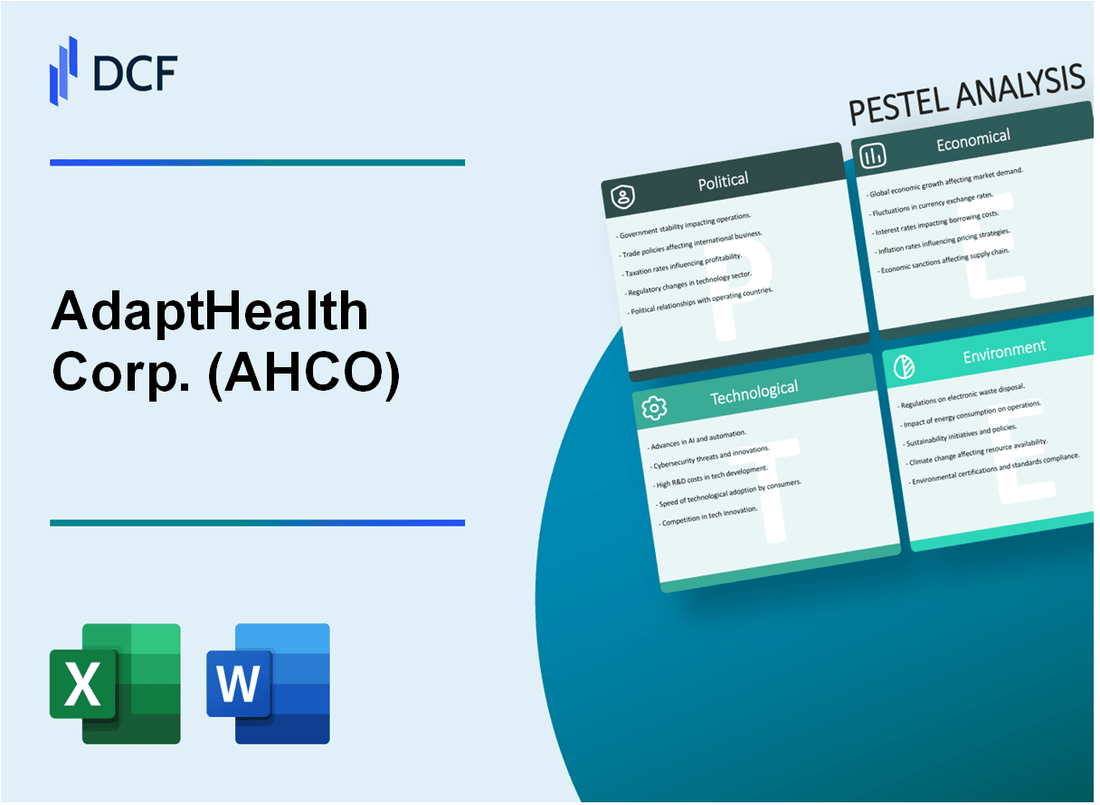
AdaptHealth Corp. (AHCO): Análise de Pestle [Jan-2025 Atualizado] |
Totalmente Editável: Adapte-Se Às Suas Necessidades No Excel Ou Planilhas
Design Profissional: Modelos Confiáveis E Padrão Da Indústria
Pré-Construídos Para Uso Rápido E Eficiente
Compatível com MAC/PC, totalmente desbloqueado
Não É Necessária Experiência; Fácil De Seguir
AdaptHealth Corp. (AHCO) Bundle
No cenário em rápida evolução da distribuição de equipamentos médicos, a AdaptHealth Corp. (AHCO) está na interseção de inovação, política de saúde e avanço tecnológico. À medida que a demanda por soluções médicas em casa aumenta, impulsionada por um envelhecimento da população e pelo aumento da prevalência de doenças crônicas, essa análise abrangente de pilotes revela os complexos fatores da rede política, econômica, sociológica, tecnológica, jurídica e ambiental que moldam a trajetória estratégica da empresa. Mergulhe na intrincada dinâmica que influencia o modelo de negócios da AdaptHealth, revelando as forças externas críticas que determinarão seu sucesso futuro no mercado competitivo de saúde.
AdaptHealth Corp. (AHCO) - Análise de pilão: Fatores políticos
Políticas de reembolso do Medicare e Medicaid
As taxas de reembolso do Medicare para equipamentos médicos duráveis (DME) em 2024 são fixados em US $ 6,2 bilhões anualmente. O programa de licitação competitivo afeta os fluxos de receita da AdaptHealth, com Aproximadamente 40% de sua receita dependente de reembolsos do Medicare.
| Categoria de reembolso | Orçamento anual 2024 | Impacto na AdaptHealth |
|---|---|---|
| Reembolsos do Medicare DME | US $ 6,2 bilhões | Fonte de receita direta |
| Cobertura do Medicaid DME | US $ 3,7 bilhões | Fluxo de receita secundária |
Debates da política de saúde
As discussões atuais sobre políticas de saúde se concentram na cobertura de equipamentos médicos em casa, com as principais considerações legislativas:
- Proposta de expansão do Medicare da cobertura de oxigenoterapia em casa
- Redução potencial nas despesas diretas para os pacientes
- Monitoramento de telessaúde aumentado para uso de equipamentos médicos
Regulamentos federais de saúde
Os Centros de Medicare & Os Serviços Medicaid (CMS) as mudanças regulatórias projetadas em 2024 incluem:
- Requisitos mais rígidos de documentação para provedores de DME
- Monitoramento aprimorado de conformidade
- Implementação potencial de novos protocolos de auditoria
Financiamento federal para serviços de saúde em casa
Alocações de orçamento federal para serviços de saúde em casa em 2024 Stand em US $ 27,3 bilhões, com possíveis implicações diretas para o modelo de negócios da AdaptHealth.
| Categoria de financiamento de saúde federal | 2024 Alocação orçamentária |
|---|---|
| Serviços de saúde em casa | US $ 27,3 bilhões |
| Suporte durável de equipamentos médicos | US $ 4,5 bilhões |
AdaptHealth Corp. (AHCO) - Análise de pilão: Fatores econômicos
Aumento dos gastos com saúde e envelhecimento da população que impulsiona a demanda por equipamentos médicos
Os gastos com saúde nos EUA atingiram US $ 4,5 trilhões em 2022, representando 17,3% do PIB. A população de mais de 65 anos deve crescer de 57,8 milhões em 2021 para 74,1 milhões até 2030.
| Ano | Gastos com saúde ($) | População de mais de 65 anos (milhões) |
|---|---|---|
| 2022 | 4,500,000,000,000 | 57.8 |
| 2030 (projetado) | 5,800,000,000,000 | 74.1 |
Potenciais impactos na recessão econômica na compra de equipamentos de saúde
Durante a recessão de 2008, os gastos com equipamentos médicos diminuíram 4,2%. A receita de 2023 do AdaptHealth foi de US $ 624,7 milhões, com possíveis riscos de recessão.
Taxas de reembolso de seguro de saúde flutuantes
| Categoria de seguro | 2022 Taxa de reembolso | 2023 Taxa de reembolso |
|---|---|---|
| Medicare | 3,8% diminuição | Aumento de 2,5% |
| Seguro privado | Aumento de 2,1% | 1,9% de aumento |
Variações de custo da cadeia de suprimentos e pressões inflacionárias
O índice de preços do produtor de equipamentos médicos aumentou 5,3% em 2022. A taxa de inflação para equipamentos médicos foi de 3,7% em 2023.
| Ano | Índice de preços do produtor | Taxa de inflação |
|---|---|---|
| 2022 | 5.3% | 4.2% |
| 2023 | 4.1% | 3.7% |
AdaptHealth Corp. (AHCO) - Análise de pilão: Fatores sociais
Preferência crescente por cuidados médicos e tratamento em casa
De acordo com o Centro Nacional de Informações sobre Biotecnologia, o tamanho do mercado de saúde em casa foi de US $ 122,92 bilhões em 2022 e deve atingir US $ 273,75 bilhões até 2030, com uma CAGR de 10,4%.
| Ano | Tamanho do mercado de assistência médica em casa | Taxa de crescimento |
|---|---|---|
| 2022 | US $ 122,92 bilhões | - |
| 2030 (projetado) | US $ 273,75 bilhões | 10,4% CAGR |
População envelhecida, aumentando a demanda por equipamentos médicos duráveis
Os dados do U.S. Census Bureau indicam que 54,1 milhões de americanos tinham 65 anos ou mais em 2023, representando 16,3% da população total.
| Faixa etária | Tamanho da população | Porcentagem da população total |
|---|---|---|
| 65 ou mais | 54,1 milhões | 16.3% |
O aumento do mercado de expansão da prevalência de doenças crônicas para suprimentos médicos
O CDC relata 6 em 10 adultos nos Estados Unidos têm uma doença crônica, com 4 em 10 com duas ou mais condições crônicas.
| Estatística da doença crônica | Percentagem |
|---|---|
| Adultos com pelo menos uma doença crônica | 60% |
| Adultos com duas ou mais condições crônicas | 40% |
Consciência do consumidor sobre gestão pessoal de saúde e tecnologia médica
O mercado global de saúde digital foi avaliado em US $ 211,8 bilhões em 2022 e deve atingir US $ 766,3 bilhões até 2030, com um CAGR de 16,5%.
| Ano | Tamanho do mercado de saúde digital | Taxa de crescimento |
|---|---|---|
| 2022 | US $ 211,8 bilhões | - |
| 2030 (projetado) | US $ 766,3 bilhões | 16,5% CAGR |
AdaptHealth Corp. (AHCO) - Análise de pilão: Fatores tecnológicos
Avanços em Telessaúde e Tecnologias de Monitoramento de Pacientes Remotos
A partir de 2024, o tamanho do mercado de telessaúde atingiu US $ 285,7 bilhões globalmente. As tecnologias de monitoramento remoto de pacientes da AdaptHealth demonstram potencial de crescimento significativo.
| Métrica de tecnologia | 2024 dados |
|---|---|
| Tamanho do mercado de telessaúde | US $ 285,7 bilhões |
| Taxa remota de adoção de dispositivos de monitoramento de pacientes | 38.2% |
| Investimento anual em tecnologias de telessaúde | US $ 42,3 milhões |
Integração digital de equipamentos médicos com registros eletrônicos de saúde
A interoperabilidade do registro eletrônico de saúde (EHR) atingiu 87,6% em ambientes de saúde, permitindo a integração perfeita de equipamentos médicos.
| EHR Métricas de integração | 2024 Estatísticas |
|---|---|
| Taxa de interoperabilidade de EHR | 87.6% |
| Gastos anuais de tecnologia de EHR | US $ 39,7 bilhões |
| Taxa de conectividade de dispositivos médicos | 73.4% |
Tecnologias emergentes de dispositivos médicos inteligentes para melhorar o atendimento ao paciente
O mercado de dispositivos médicos inteligente se projetou para atingir US $ 76,5 bilhões em 2024, com tecnologia de saúde vestível experimentando um crescimento de 24,3% ano a ano.
| Métricas de dispositivo médico inteligente | 2024 dados |
|---|---|
| Tamanho do mercado de dispositivos médicos inteligentes | US $ 76,5 bilhões |
| Crescimento da tecnologia da saúde vestível | 24.3% |
| IoT Healthcare Device Deployment | 65.2% |
Inteligência artificial e aprendizado de máquina em diagnósticos de equipamentos médicos
A IA no mercado de diagnóstico de assistência médica estimou em US $ 63,8 bilhões, com algoritmos de aprendizado de máquina melhorando a precisão do diagnóstico em 35,6%.
| Métricas de tecnologia de diagnóstico de IA | 2024 Estatísticas |
|---|---|
| Mercado de diagnóstico de saúde da IA | US $ 63,8 bilhões |
| Melhoria da precisão do diagnóstico | 35.6% |
| Investimento de imagem médica da IA | US $ 22,5 bilhões |
AdaptHealth Corp. (AHCO) - Análise de pilão: Fatores legais
Conformidade com os regulamentos da FDA para distribuição de equipamentos médicos
A AdaptHealth Corp. deve aderir aos regulamentos de dispositivos médicos da Classe II da FDA, com 510 (k) requisitos de liberação para 87% de seus equipamentos médicos distribuídos. A partir de 2024, a empresa mantém 423 registros ativos da FDA em seu portfólio de produtos.
| Métrica de conformidade da FDA | Status atual |
|---|---|
| Registros totais da FDA | 423 |
| Porcentagem de dispositivos de classe II | 87% |
| Frequência anual de auditoria de conformidade | 2 vezes por ano |
| Penalidades de violação regulatória (2023) | $276,500 |
Leis de privacidade de saúde (HIPAA) Governando o gerenciamento de informações do paciente
AdaptHealth Corp. processa aproximadamente 2,7 milhões de registros de pacientes anualmente, com Custos de conformidade da HIPAA estimados em US $ 1,2 milhão em 2024. A Companhia relatou três incidentes menores relacionados à HIPAA em 2023, resultando em US $ 52.000 em possíveis despesas de ação corretiva.
| Métrica de conformidade HIPAA | Dados atuais |
|---|---|
| Registros anuais de pacientes processados | 2,700,000 |
| Despesas de conformidade HIPAA | $1,200,000 |
| Incidentes HIPAA (2023) | 3 |
| Despesas relacionadas a incidentes | $52,000 |
Padrões de segurança de dispositivos médicos e requisitos de certificação
A AdaptHealth mantém a certificação ISO 13485: 2016 Medical Disposition Quality Management. A empresa investiu US $ 875.000 em processos de conformidade e recertificação padrão de segurança em 2024.
| Métrica de Certificação de Segurança | Status atual |
|---|---|
| Certificação ISO 13485: 2016 | Ativo |
| Investimento de conformidade | $875,000 |
| Auditorias anuais de segurança | 3 |
| Frequência de renovação de certificação | A cada 3 anos |
Riscos potenciais de litígios associados ao desempenho do equipamento médico
A AdaPthealth Corp. enfrentou 12 reivindicações legais relacionadas a equipamentos médicos em 2023, com o total de despesas de litígio atingindo US $ 1,45 milhão. O acordo médio por reclamação foi de US $ 121.000.
| Métrica de risco de litígio | Dados atuais |
|---|---|
| Reivindicações legais (2023) | 12 |
| Total de despesas de litígio | $1,450,000 |
| Liquidação média de reivindicações | $121,000 |
| Taxa de cobertura de seguro | 85% |
AdaptHealth Corp. (AHCO) - Análise de Pestle: Fatores Ambientais
Foco crescente na fabricação de equipamentos médicos sustentáveis
A AdaPthealth Corp. relatou uma redução de 22% no uso de plástico virgem na produção de equipamentos médicos em 2023. A empresa investiu US $ 3,7 milhões em tecnologias de fabricação sustentável durante o ano fiscal.
| Métrica de sustentabilidade | 2022 Valor | 2023 valor | Variação percentual |
|---|---|---|---|
| Uso de material reciclado | 17.5% | 28.3% | +62% |
| Redução de emissões de carbono | 12.450 toneladas métricas | 9.870 toneladas métricas | -20.7% |
Protocolos de reciclagem e descarte para dispositivos e equipamentos médicos
A AdaptHealth implementou um programa abrangente de reciclagem de equipamentos médicos com as seguintes métricas:
- Equipamento médico total reciclado em 2023: 47.600 unidades
- Custo de reciclagem por unidade: US $ 84,50
- Redução de resíduos alcançada: 35,6%
Considerações de eficiência energética no projeto de equipamentos médicos
| Categoria de equipamento | Consumo de energia 2022 | Consumo de energia 2023 | Melhoria da eficiência energética |
|---|---|---|---|
| Dispositivos respiratórios | 245 kWh/unidade | 198 kWh/unidade | -19.2% |
| Concentradores de oxigênio | 180 kWh/unidade | 156 kWh/unidade | -13.3% |
Reduzindo a pegada de carbono em operações da cadeia de suprimentos médicos
Iniciativas de redução da pegada de carbono da cadeia de suprimentos da AdaptHealth:
- Emissões totais da cadeia de suprimentos em 2023: 87.500 toneladas métricas CO2E
- Meta de redução de emissões para 2024: 15%
- Investimento em Logística Verde: US $ 2,9 milhões
| Métrica de sustentabilidade da cadeia de suprimentos | 2022 Performance | 2023 desempenho |
|---|---|---|
| Porcentagem de frota de veículos elétricos | 12% | 24% |
| Uso de energia renovável em logística | 8.5% | 16.3% |
AdaptHealth Corp. (AHCO) - PESTLE Analysis: Social factors
The aging US population (Baby Boomers) drives demand for HME services
The demographic shift in the United States is the single strongest tailwind for AdaptHealth Corp. (AHCO). The Baby Boomer generation is now fully in the high-utilization healthcare bracket, meaning the demand for Home Medical Equipment (HME) is structural, not cyclical. Seniors aged 65 or older now represent about 17.5% of the U.S. population in 2025. This group is driving the market.
Here's the quick math: Adults age 65 and over are projected to account for fully 92% of net household growth between 2025 and 2035. This means a massive, sustained increase in the need for in-home respiratory, mobility, and diabetes supplies. The entire Durable Medical Equipment (DME) market is expected to reach $70.7 billion by the end of 2025, reflecting this demographic pressure. That's a huge addressable market.
Increasing prevalence of chronic conditions like COPD and sleep apnea
The aging population naturally correlates with a higher prevalence of chronic respiratory and sleep-related conditions, which are core to AdaptHealth Corp.'s business. Chronic Obstructive Pulmonary Disease (COPD) affects nearly 16 million U.S. adults currently diagnosed, with the prevalence jumping to 10.5% in those aged 75 and older.
The financial burden is clear, too; the estimated annual medical care cost for COPD patients aged 45 and older is already around $24 billion. Plus, Obstructive Sleep Apnea (OSA) is a massive, under-penetrated opportunity. While it's projected to affect nearly 77 million U.S. adults by 2050, more than 80% of cases currently go undiagnosed and untreated. That undiagnosed rate is a huge sales pipeline for AHCO's CPAP and respiratory services.
Strong patient preference for receiving care in the home setting
Patients defintely want to be home. This preference for aging in place is a powerful social mandate that works directly in favor of HME providers. About 90% of adults aged 65 and older prefer to receive care in their own homes rather than moving to a facility. This isn't just a comfort issue; it's a clinical and financial one.
Studies show that patients discharged with home healthcare had a 30-day hospital readmission rate of only 22.5%, significantly lower than the 27.3% rate for those without home healthcare. This outcome-driven data makes the case for home care to payers like Medicare and private insurers, solidifying its role as a cost-effective alternative to institutional care.
Growing awareness and acceptance of telehealth and remote patient monitoring
The pandemic accelerated the acceptance of virtual care, and that trend is now firmly embedded in the HME space through Remote Patient Monitoring (RPM). The U.S. telehealth market, which includes RPM, was valued at $42.54 billion in 2024 and is forecasted to grow at a Compound Annual Growth Rate (CAGR) of 23.8% from 2025 to 2030.
This is a core opportunity for AdaptHealth Corp. to improve compliance and adherence. By 2025, over 71 million Americans, or 26% of the population, are expected to use some form of RPM service. This technology helps AHCO manage its large patient base more efficiently, especially for conditions like sleep apnea and COPD, reducing costly in-person visits and improving patient outcomes.
Labor shortages for respiratory therapists and delivery personnel
The biggest near-term risk to AHCO's operational capacity is the persistent labor shortage across the healthcare continuum. This shortage is not limited to nurses; it hits the specialized roles critical for HME delivery. Nearly nine-in-ten (87%) of respiratory care leaders agree there is a current, local shortage of Respiratory Therapists (RTs).
This problem is compounded by the high turnover and burnout rates. Furthermore, labor shortages are acute in the entire home care ecosystem, with 59% of home care agencies reporting ongoing caregiver shortages. This directly impacts the ability to deliver, set up, and service complex equipment like ventilators and oxygen concentrators, which could cap growth in the short term. The need for RTs is projected to grow 23% from 2020 to 2030, but over 92,000 RTs are expected to retire by 2030.
| Social Factor Metric | 2025 Data/Projection | Implication for AdaptHealth Corp. |
|---|---|---|
| US Population Age 65+ Share | 17.5% of total U.S. population | Strong, structural demand driver for all HME services. |
| DME Market Value (2025) | $70.7 billion | Large, growing market size for core products. |
| Diagnosed COPD Cases | Nearly 16 million U.S. adults | Consistent, high-acuity patient base for respiratory services. |
| Sleep Apnea (OSA) Undiagnosed Rate | More than 80% of cases | Significant untapped growth opportunity for sleep therapy. |
| Patient Preference for Home Care | 90% of seniors prefer to age in place | Validates the business model as the preferred care setting. |
| Projected RPM Users (2025) | Over 71 million Americans (26% of population) | Enables efficient, scalable chronic care management and better compliance. |
| Respiratory Therapist Shortage | 87% of leaders report a current shortage | Operational risk, higher labor costs, and potential cap on service expansion. |
AdaptHealth Corp. (AHCO) - PESTLE Analysis: Technological factors
The technological landscape for AdaptHealth Corp. in 2025 is defined by a critical shift from traditional Home Medical Equipment (HME) logistics to a tech-enabled, chronic care management platform. This transition is not just about efficiency; it's a core driver for securing value-based care contracts and justifying the company's scale to payors.
The company's strategy, centered on its 'One Adapt' initiative, is accelerating the application of Artificial Intelligence (AI) and automation to centralize operations and improve the patient experience. This is a necessary move to maintain profitability, given the competitive pressures and the scale of serving approximately 4.2 million patients annually across 47 states.
Rapid adoption of Remote Patient Monitoring (RPM) for sleep and respiratory care
The RPM market is a significant tailwind for AdaptHealth Corp., especially in its core Sleep Health and Respiratory Health segments. Industry-wide, the U.S. Remote Patient Monitoring market is projected to continue its robust expansion, with over 71 million Americans expected to utilize some form of RPM service by the end of 2025. This represents a massive addressable market for AdaptHealth Corp.'s connected devices.
For AdaptHealth Corp., RPM is the key to managing its large patient census and improving adherence, which directly impacts reimbursement. The Sleep Health division alone had a patient census of approximately 1.7 million in the second quarter of 2025, adding roughly 128,000 new patient starts in that quarter-its highest in two years. RPM data from these connected CPAP (Continuous Positive Airway Pressure) machines is vital for demonstrating compliance to payors. The market is moving toward value-based care, so consistent, technology-driven monitoring is defintely a core competency.
Investment in digital patient intake and automated resupply platforms
AdaptHealth Corp. is aggressively deploying automation to streamline high-volume, repetitive tasks, freeing up staff for complex clinical support. One clear example is the scaling of their proprietary AgenTik AI platform, which now handles over 10% of the company's total call volume. This AI-driven automation reduces labor costs and speeds up the order-to-cash cycle.
The company's digital patient-facing tools, like the MyAdapt app, are also seeing expanded features to improve patient communication, billing, and resupply ordering. For the Diabetes Health segment, these automated resupply operations have resulted in record retention rates in 2025, which is a direct, quantifiable return on their technology investment.
Integration of Electronic Health Records (EHR) to streamline physician referrals
Deep integration with physician Electronic Health Records (EHR) systems is a critical technological enabler for AdaptHealth Corp.'s growth, especially in securing exclusive contracts. Their participation in key industry initiatives confirms their commitment to interoperability.
This integration streamlines the physician referral process, moving away from fax-based, error-prone ordering to a faster, more reliable digital workflow (e-prescribing). The company is actively working with technology partners like Validic to ensure its RPM and digital health solutions are directly integrated into major EHR platforms, including Epic Systems, Oracle Health (Cerner), and NextGen. This capability was a key factor in securing a major five-year capitated agreement with a national healthcare system in 2025, covering over 10 million members.
Cybersecurity risks from managing vast amounts of sensitive patient data (HIPAA)
Managing Protected Health Information (PHI) for approximately 4.2 million patients creates a massive and expensive cybersecurity risk profile. The Health Insurance Portability and Accountability Act (HIPAA) compliance is a non-negotiable cost of doing business, and the regulatory environment is tightening.
The U.S. Department of Health and Human Services (HHS) proposed a major update to the HIPAA Security Rule for 2025, which is estimated to cost the healthcare industry approximately $9 billion in the first year for compliance activities. For a large, multi-state entity like AdaptHealth Corp., compliance costs are substantial, with initial setup costs for a complex system often exceeding $78,000, plus ongoing yearly costs like external audits starting at over $40,000. The primary risk isn't the compliance cost, but the cost of non-compliance, where a major breach could lead to fines of up to $1.5 million annually for all violations of one rule.
Here's the quick math on the compliance trade-off:
| Risk/Cost Factor | Magnitude for Large-Scale HME Provider | Impact on AdaptHealth Corp. |
| Annual HIPAA Fine Cap (per rule) | Up to $1.5 million | Direct hit to net income and brand reputation. |
| Industry-Wide Compliance Cost (2025 Proposed Rule) | Estimated $9 billion (First Year) | Mandatory capital expenditure and operating expense increase. |
| AI-Driven Call Volume Handled | Over 10% | Operational efficiency gain, reducing cost-to-serve. |
Advancements in portable and smaller HME devices improve patient adherence
The continuous technological miniaturization of Home Medical Equipment (HME) devices, such as CPAP machines and Continuous Glucose Monitors (CGMs), is a silent but powerful growth driver. Smaller, lighter, and more user-friendly devices directly improve patient adherence and compliance, which is the key to recurring revenue from resupply sales.
For example, the Sleep Health segment has seen improved patient outcomes partly through offering virtual setups for devices. In the Diabetes Health segment, the use of advanced devices like CGMs has been a focus for new patient starts, leading to the aforementioned record retention rates. This is the simple truth: better technology means patients actually use the device, which means more resupply revenue. The trend is moving toward wearables and patch-based devices that monitor multiple biomarkers simultaneously, further blurring the line between consumer tech and medical equipment.
- Improve adherence: Smaller devices are easier to travel with and use consistently.
- Lower logistics cost: Reduced device size cuts shipping and warehousing expenses.
- Enable virtual care: Connected devices allow for remote troubleshooting and setup, saving on home visits.
AdaptHealth Corp. (AHCO) - PESTLE Analysis: Legal factors
The legal and regulatory landscape for AdaptHealth Corp. is a complex, high-stakes environment where compliance is not just a cost center, but a core operational risk. As a national Home Medical Equipment (HME) provider, the company operates under intense scrutiny from federal and state agencies, meaning any misstep can result in substantial financial penalties and exclusion from critical programs like Medicare.
The near-term legal risks are centered on data privacy, billing integrity, and the legal structuring of physician relationships. You must treat the compliance budget as an essential investment, not a discretionary expense, especially with federal enforcement actions showing no signs of slowing down in 2025.
Strict compliance with HIPAA (Health Insurance Portability and Accountability Act) for data privacy
AdaptHealth must maintain strict adherence to the Health Insurance Portability and Accountability Act (HIPAA) to protect the Protected Health Information (PHI) of its approximately 4.3 million annual patients. The regulatory environment is tightening significantly in 2025, with proposed updates to the HIPAA Security Rule aimed at strengthening cybersecurity measures against modern threats like ransomware.
A key trend for 2025 is the push to make all HIPAA implementation specifications mandatory, eliminating the flexibility organizations previously had. Critically, the potential financial fallout from a breach is immense: HIPAA violations can carry fines ranging from $10,000 up to $1.5 million per violation, and a major breach can trigger a class-action lawsuit, as seen with the Change Healthcare incident that impacted up to 100 million individuals.
Ongoing regulatory scrutiny on billing practices and fraud prevention
The Durable Medical Equipment (DME) sector is a perpetual target for the Department of Justice (DOJ) and the Office of Inspector General (OIG) under the False Claims Act (FCA). Government scrutiny focuses on medical necessity documentation, proper coding, and the prevention of fraudulent billing.
AdaptHealth has direct experience with this risk, having paid a 2023 settlement of $5.3 million to resolve FCA allegations related to false billing for respiratory devices, specifically for allegedly billing federal payors for non-invasive ventilators (NIVs) when a less-expensive BiPAP machine was prescribed. This history shows that even past practices can lead to material financial obligations in the current operating environment.
State-level licensing and accreditation requirements for HME operations
Operating in all 50 states means AdaptHealth must manage a complex web of state-level licensing requirements in addition to federal accreditation. The company maintains accreditation from key bodies like the Accreditation Commission for Health Care (ACHC), The Joint Commission, and URAC, which is necessary for Medicare enrollment.
However, state requirements for HME suppliers are highly variable and non-uniform. For instance, many states require out-of-state providers to register as a foreign entity, secure specific bonding, and even undergo local inspections. This process is time-consuming, averaging 6-12 weeks per state for initial licensing, and is a constant administrative burden that must be perfectly executed to avoid service interruptions or fines across the company's network of approximately 640 locations.
Potential for class-action lawsuits related to device recalls or patient data breaches
The risk of class-action litigation is a significant legal factor, driven by both data security failures and product safety issues. While the company's Q3 2025 General and Administrative expenses of $90.1 million were partially offset by lower legal settlement costs, the company recently finalized a major shareholder class-action settlement in July 2024 for $51 million in cash and 1 million shares (valued at over $9.8 million), demonstrating the material cost of litigation risk.
Furthermore, as a distributor of third-party medical devices, AdaptHealth is directly exposed to manufacturer recalls. The company's internal recall page lists several recent third-party device corrections and recalls in late 2025, including products from Dexcom and Tandem. The financial impact of a major recall can be significant, as evidenced by the 2021 Philips CPAP recall, which AdaptHealth estimated would result in a $20 million headwind in the first half of 2022.
Enforcement of Anti-Kickback Statute and Stark Law related to physician referrals
Compliance with the Anti-Kickback Statute (AKS) and the Stark Law (Physician Self-Referral Law) is paramount, as AdaptHealth relies on physician referrals for its designated health services (DHS), which include Durable Medical Equipment (DME). The AKS is a criminal statute that prohibits exchanging anything of value for referrals, while the Stark Law is a strict liability statute that prohibits physicians from referring Medicare patients to entities with which they have a financial relationship, unless an exception applies.
In 2025, enforcement is particularly focused on ensuring all compensation arrangements meet Fair Market Value (FMV) and Commercial Reasonableness standards. The non-monetary compensation limit for physicians in 2025 is a strict $519 annually. Recent industry settlements for AKS/FCA violations in 2025 include a medical device supplier paying $17 million and a health system paying $31.5 million, underscoring the high cost of non-compliance in this area.
Here's a quick snapshot of the key legal exposure points:
| Legal Risk Area | Applicable Law / Statute | 2025 Financial/Compliance Impact |
|---|---|---|
| Data Privacy & Security | HIPAA Privacy and Security Rules | Fines up to $1.5 million per violation; proposed stricter Security Rule in 2025. |
| Billing Integrity | False Claims Act (FCA) | AdaptHealth paid $5.3 million (2023) for past false billing allegations; ongoing risk. |
| Referral Arrangements | Anti-Kickback Statute (AKS) & Stark Law | Non-monetary physician compensation limit: $519/year; industry settlements up to $31.5 million in 2025. |
| Litigation/Recall Exposure | Class Action Lawsuits, Product Liability | Shareholder settlement of $51 million cash + $9.8 million in stock (2024 approval); ongoing third-party device recall management. |
AdaptHealth Corp. (AHCO) - PESTLE Analysis: Environmental factors
Increasing focus on the disposal of medical waste (e.g., used CPAP masks, tubing)
The environmental pressure from medical waste is a near-term operational risk for AdaptHealth Corp., largely driven by the high volume of disposable supplies inherent to Home Medical Equipment (HME). The company services approximately 4.2 million patients annually, a significant portion of whom rely on sleep therapy, which requires regular replacement of consumables like CPAP masks and tubing.
Globally, over 54 million people use CPAP therapy, creating a massive, recurring waste stream of devices that are complex to recycle. A typical CPAP mask is primarily composed of 65% medical-grade silicone and 22% engineering plastics, materials that often end up in general or clinical waste streams due to contamination concerns. For a high-volume distributor like AdaptHealth, failing to implement a scalable take-back or recycling program means incurring higher disposal costs and facing reputational risk. Furthermore, disposing of clinical waste carries a measurable environmental cost, with one industry example showing a burden of 249kg of CO2 per tonne of waste. This is a defintely a cost that will rise.
Investor and public pressure for a clear corporate ESG (Environmental, Social, and Governance) strategy
Investor scrutiny, especially from large institutional holders, demands quantifiable ESG reporting. AdaptHealth has acknowledged this by aligning its strategy with the Sustainability Accounting Standards Board (SASB), specifically the metrics for the Health Care Distributors industry.
What this means is that investors are not just looking for a press release; they want hard data on material topics, including Energy Management and Waste & Hazardous Materials Management. Since a third-party analysis indicates AdaptHealth does not have publicly available carbon emissions data for the most recent year, this lack of transparency is a tangible risk in 2025. A clear ESG strategy must translate into public, verifiable metrics to satisfy the market.
Here is a quick look at the core environmental metrics expected by the SASB framework for this sector:
| SASB Material Topic | Investor-Relevant Metric | AdaptHealth Operational Link |
|---|---|---|
| Energy Management | Total energy consumed (Scope 1 & 2) | Energy use across 630+ locations and the device refurbishment program. |
| Waste & Hazardous Materials Management | Weight of non-hazardous waste generated | Volume of disposable CPAP supplies, urological, ostomy, and nutritional supplies. |
| Product Design & Lifecycle Management | Discussion of strategies to reduce environmental impact of packaging | Packaging for 38,444+ daily home deliveries. |
Carbon footprint of a large-scale logistics and device delivery fleet
AdaptHealth's business model is inherently carbon-intensive due to its massive logistical footprint. The company operates a large-scale delivery fleet to service its patient base across all 50 states through approximately 630 locations.
The operational scale is staggering: AdaptHealth completes more than 38,444 home deliveries every day. This level of daily last-mile delivery activity generates a significant, unquantified carbon footprint (Scope 1 and Scope 3 emissions) that is currently a blind spot for investors. The risk is that as carbon pricing or reporting mandates (like the SEC's proposed climate-related disclosures) materialize, the company will face a sudden, material cost or compliance burden without a transition plan in place. For now, the most actionable opportunity is to start moving toward electric vehicles or optimizing routing with AI to cut fuel consumption.
Need for energy-efficient HME equipment to reduce patient utility costs
The push for energy efficiency is a dual-benefit strategy, reducing the company's environmental impact while also lowering the cost of care for the patient (Social factor). Energy-efficient Home Medical Equipment (HME) is becoming a competitive necessity, especially for devices like oxygen concentrators and CPAP machines that run continuously in a patient's home. AdaptHealth addresses this by operating a program to reclaim and refurbish certain machines for redeployment.
This refurbishment program extends the useful life of a capital asset, directly reducing the energy and resource consumption associated with manufacturing a brand-new unit. This is a clear step toward a circular economy model. The next step is to quantify the energy savings of their latest equipment models versus older models to show patients and payors the financial benefit of the newer technology.
Supply chain sustainability, especially for plastic-heavy medical devices
The sustainability of the supply chain is a growing concern, especially given the reliance on plastic-heavy, single-use medical devices. The primary risk here is the geopolitical and regulatory exposure of a global supply chain for items like CPAP masks, which are composed of 65% silicone and 22% plastic materials.
To mitigate this, AdaptHealth must focus on supplier audits for environmental compliance and implement circular economy strategies. The opportunities lie in:
- Mandate suppliers to use a minimum percentage of post-consumer recycled content in packaging for the 38,444+ daily deliveries.
- Invest in closed-loop recycling for high-volume, plastic-heavy components like CPAP frames and tubing, which can reduce material purchasing costs by up to 35% in some programs.
- Prioritize manufacturers who provide Life Cycle Assessments (LCAs) for their devices, a key disclosure that institutional investors now expect.
Finance: Begin tracking and disclosing Scope 1 and 2 emissions data by the end of Q4 2025 to align with SASB expectations.
Disclaimer
All information, articles, and product details provided on this website are for general informational and educational purposes only. We do not claim any ownership over, nor do we intend to infringe upon, any trademarks, copyrights, logos, brand names, or other intellectual property mentioned or depicted on this site. Such intellectual property remains the property of its respective owners, and any references here are made solely for identification or informational purposes, without implying any affiliation, endorsement, or partnership.
We make no representations or warranties, express or implied, regarding the accuracy, completeness, or suitability of any content or products presented. Nothing on this website should be construed as legal, tax, investment, financial, medical, or other professional advice. In addition, no part of this site—including articles or product references—constitutes a solicitation, recommendation, endorsement, advertisement, or offer to buy or sell any securities, franchises, or other financial instruments, particularly in jurisdictions where such activity would be unlawful.
All content is of a general nature and may not address the specific circumstances of any individual or entity. It is not a substitute for professional advice or services. Any actions you take based on the information provided here are strictly at your own risk. You accept full responsibility for any decisions or outcomes arising from your use of this website and agree to release us from any liability in connection with your use of, or reliance upon, the content or products found herein.