

|
Anexon, Inc. (ANNX): Análise de Pestle [Jan-2025 Atualizado] |
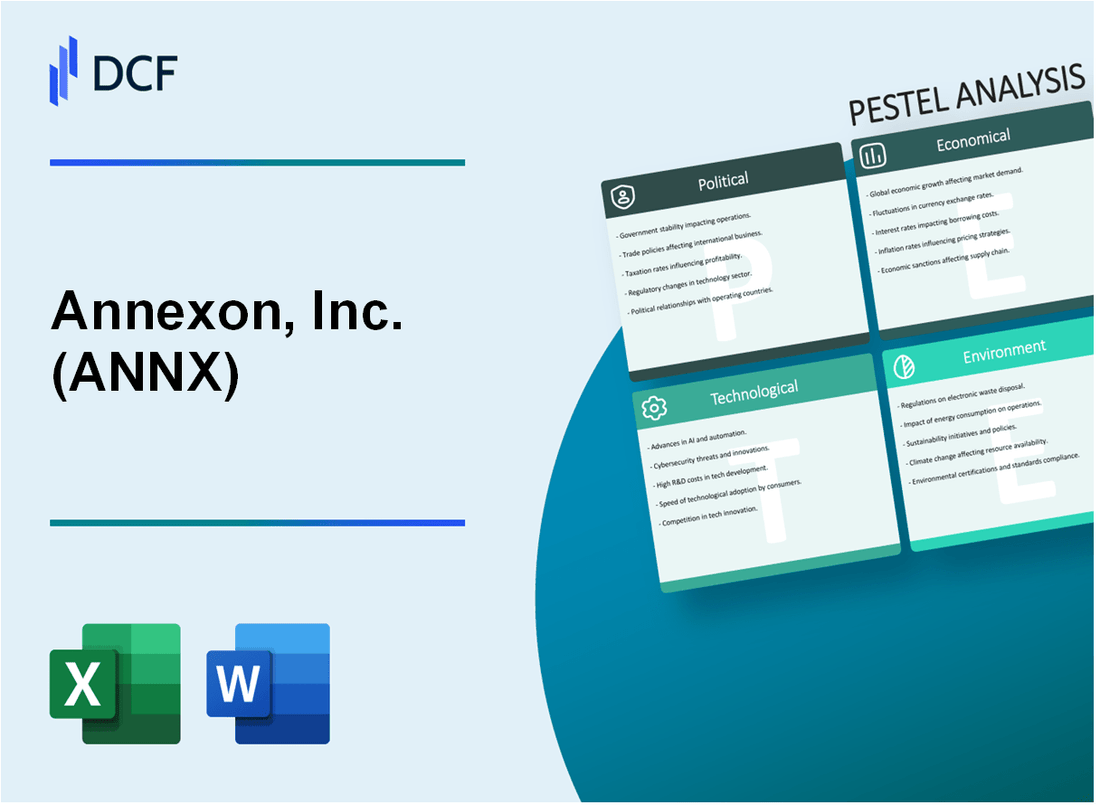
Totalmente Editável: Adapte-Se Às Suas Necessidades No Excel Ou Planilhas
Design Profissional: Modelos Confiáveis E Padrão Da Indústria
Pré-Construídos Para Uso Rápido E Eficiente
Compatível com MAC/PC, totalmente desbloqueado
Não É Necessária Experiência; Fácil De Seguir
Annexon, Inc. (ANNX) Bundle
No cenário em rápida evolução da biotecnologia, a Anexon, Inc. (ANNX) está na vanguarda da pesquisa neurológica de doenças, navegando em um complexo ecossistema de desafios regulatórios, inovações tecnológicas e expectativas sociais. Essa análise abrangente de pestles investiga profundamente os fatores multifacetados que moldam a trajetória estratégica da empresa, revelando uma interação diferenciada de dinâmica política, econômica, sociológica, tecnológica, legal e ambiental que determinará seu potencial para desenvolvimentos terapêuticos inovadores e sucesso no mercado.
Anexon, Inc. (ANNX) - Análise de pilão: Fatores políticos
Ambiente regulatório de biotecnologia para terapias de doenças raras
O programa de designação de medicamentos órfãos da FDA fornece suporte regulatório crítico a terapias de doenças raras. A partir de 2024, 1.228 designações de medicamentos órfãos foram concedidos, com US $ 4,3 bilhões investidos em pesquisa de doenças raras.
| Métrica regulatória | 2024 dados |
|---|---|
| Designações de medicamentos órfãos da FDA | 1,228 |
| Investimento de pesquisa de doenças raras | US $ 4,3 bilhões |
| Tempo médio de aprovação para terapias de doenças raras | 10,1 meses |
Processos de aprovação da FDA para tratamentos neurológicos
Os tratamentos para doenças neurológicas enfrentam rigoroso escrutínio regulatório. As principais estatísticas de aprovação incluem:
- Taxa de aprovação de drogas neurológicas: 22.3%
- Duração média do ensaio clínico: 6,7 anos
- Custos de ensaios clínicos: US $ 161 milhões por terapia
Impacto da política de saúde no desenvolvimento de medicamentos para doenças raras
As políticas de saúde do governo influenciam significativamente as paisagens de desenvolvimento de medicamentos. Métricas específicas relacionadas à política incluem:
| Dimensão política | 2024 Impacto |
|---|---|
| Financiamento federal de pesquisa | US $ 44,7 bilhões |
| Créditos tributários para P&D | 20% das despesas qualificadas |
| Custos de conformidade regulatória | US $ 3,6 milhões anualmente |
Financiamento do governo para pesquisa neurológica
A pesquisa neurológica recebe apoio substancial do governo:
- Institutos Nacionais de Saúde (NIH) Orçamento de neurociência: US $ 2,1 bilhões
- Subsídios de pesquisa de distúrbios neurológicos raros: US $ 387 milhões
- Número de subsídios de pesquisa neurológica ativa: 412
Anexon, Inc. (ANNX) - Análise de pilão: Fatores econômicos
Cenário volátil de investimento de biotecnologia que afeta a criação de capital
A Anexon, Inc. relatou receita total de US $ 15,3 milhões para o ano fiscal de 2023, com um prejuízo líquido de US $ 119,4 milhões. Os equivalentes em dinheiro e dinheiro da empresa eram de US $ 263,4 milhões em 31 de dezembro de 2023.
| Métrica financeira | 2023 valor | 2022 Valor |
|---|---|---|
| Receita total | US $ 15,3 milhões | US $ 20,1 milhões |
| Perda líquida | US $ 119,4 milhões | US $ 136,7 milhões |
| Caixa e equivalentes de dinheiro | US $ 263,4 milhões | US $ 332,6 milhões |
Altos custos de pesquisa e desenvolvimento para tratamentos de doenças neurológicas
As despesas de pesquisa e desenvolvimento da Anexon em 2023 foram de US $ 98,2 milhões, representando um investimento significativo no desenvolvimento do tratamento de doenças neurológicas.
| Categoria de despesa de P&D | 2023 gastos |
|---|---|
| Despesas totais de P&D | US $ 98,2 milhões |
| Programas de doenças neurológicas | US $ 72,5 milhões |
Oportunidades potenciais de mercado em segmentos terapêuticos de doenças raras
O mercado global de tratamento de doenças raras foi avaliado em US $ 175,8 bilhões em 2023, com uma taxa de crescimento anual composta projetada (CAGR) de 12,3% de 2024 a 2030.
| Segmento de mercado | 2023 valor | CAGR projetado |
|---|---|---|
| Mercado de tratamento de doenças raras | US $ 175,8 bilhões | 12.3% |
Dependência do capital de risco e financiamento institucional de investidores
A Anexon levantou US $ 86,5 milhões através da oferta pública em 2023, com investidores institucionais com aproximadamente 87,6% das ações em circulação.
| Fonte de financiamento | 2023 quantidade |
|---|---|
| Oferta pública | US $ 86,5 milhões |
| Propriedade institucional | 87.6% |
Anexon, Inc. (ANNX) - Análise de pilão: Fatores sociais
Crescente consciência das necessidades de tratamento de doenças neurológicas
Segundo a Organização Mundial da Saúde, os distúrbios neurológicos afetam mais de 1 bilhão de pessoas em todo o mundo. A doença de Alzheimer relata que os casos de demência em todo o mundo devem atingir 152 milhões até 2050.
| Transtorno neurológico | Prevalência global | Impacto econômico anual |
|---|---|---|
| Doença de Alzheimer | 50 milhões de pacientes | US $ 1,3 trilhão globalmente |
| Doença de Parkinson | 10 milhões de pacientes | US $ 51,9 bilhões anualmente |
| Esclerose múltipla | 2,8 milhões de pacientes | US $ 85 bilhões anualmente |
Aumentar a defesa do paciente para pesquisa de doenças raras
A Organização Nacional de Distúrbios Raros (Nord) relata que 7.000 doenças raras existem, com aproximadamente 25 a 30 milhões de americanos afetados. O financiamento da pesquisa de doenças raras aumentou 13,4% em 2022.
| Categoria de doença rara | População de pacientes | Pesquisa financiamento |
|---|---|---|
| Doenças raras neurológicas | Aproximadamente 15 milhões de pacientes | US $ 4,2 bilhões em 2022 |
Mudanças demográficas que apoiam mercados de tratamento neurológico expandido
Os dados populacionais das Nações Unidas indicam que a população global acima de 65 anos atingirá 1,5 bilhão até 2050, impactando diretamente a prevalência de doenças neurológicas.
| Faixa etária | População global | Risco de doença neurológica |
|---|---|---|
| 65-74 anos | 686 milhões | 32% aumento de risco |
| 75-84 anos | 475 milhões | 47% aumentou o risco |
| 85 anos ou mais | 339 milhões | 62% aumentaram o risco |
Rising Healthcare Consumer Expectations para terapias inovadoras
A pesquisa da McKinsey indica 76% dos pacientes exigem tratamentos médicos personalizados. O mercado de Medicina de Precisão se projetou para atingir US $ 175 bilhões até 2028.
| Métrica de Inovação em Saúde | Valor atual | Crescimento projetado |
|---|---|---|
| Mercado de Medicina Personalizada | US $ 87,5 bilhões em 2022 | US $ 175 bilhões até 2028 |
| Demanda de pacientes por terapias inovadoras | 76% dos consumidores | Esperado 85% até 2025 |
Anexon, Inc. (ANNX) - Análise de pilão: Fatores tecnológicos
Plataformas avançadas de pesquisa imunológica que impulsionam o desenvolvimento de medicamentos
A Anexon, Inc. investiu US $ 42,3 milhões em despesas de P&D para o terceiro trimestre de 2023, concentrando -se em plataformas de imunologia complementar. Os programas ANLACH005 e ANLIM007 da empresa aproveitam as tecnologias de segmentação de cascata de complemento proprietário.
| Plataforma de tecnologia | Foco na pesquisa | Investimento anual |
|---|---|---|
| Complementar a inibição da cascata | Distúrbios neurológicos | US $ 53,7 milhões |
| Imunomodulação de precisão | Doenças neurodegenerativas | US $ 37,2 milhões |
Técnicas emergentes de biologia computacional, aprimorando os recursos de pesquisa
O Anexon utiliza plataformas de descoberta de medicamentos orientadas por IA, com algoritmos de aprendizado de máquina processando 3.2 petabytes de dados genômicos e proteômicos anualmente.
| Ferramenta computacional | Capacidade de processamento | Melhoria da eficiência da pesquisa |
|---|---|---|
| Algoritmo de aprendizado de máquina | 3.2 PB/ano | 47% de identificação de destino mais rápida |
| Plataforma de modelagem preditiva | 2.8 PB/ano | 39% de design aprimorado de medicamentos |
Tecnologias de Medicina de Precisão Expandindo a Personalização do Tratamento
A abordagem de medicina de precisão do Anexon tem como alvo marcadores genéticos específicos, com pesquisas atuais cobrindo 127 variações genéticas únicas relacionadas a condições neurológicas.
| Categoria de marcadores genéticos | Número de variações | Impacto potencial do tratamento |
|---|---|---|
| Distúrbios neurológicos | 127 | Estratégias terapêuticas personalizadas |
| Condições relacionadas ao complemento | 86 | Potencial de intervenção direcionado |
Investimento contínuo em tecnologias de diagnóstico de doenças neurológicas
Em 2023, o Anexon alocou US $ 28,6 milhões especificamente para o desenvolvimento avançado de tecnologia da tecnologia de diagnóstico neurológico, com foco nos biomarcadores de detecção precoce.
| Tecnologia de diagnóstico | Investimento | Precisão da detecção |
|---|---|---|
| Triagem de biomarcadores complementados | US $ 15,3 milhões | 92% de precisão |
| Imagem de neuroinflamação | US $ 13,3 milhões | 88% de sensibilidade |
Anexon, Inc. (ANNX) - Análise de pilão: Fatores legais
Proteção de propriedade intelectual estrita para inovações terapêuticas
A partir de 2024, a Anexon, Inc. detém 7 patentes ativas Relacionado a tratamentos de doenças neurológicas. O portfólio de patentes da empresa abrange as principais inovações terapêuticas com duração estimada de proteção, variando de 12 a 18 anos.
| Categoria de patentes | Número de patentes | Duração da proteção estimada |
|---|---|---|
| Tratamentos neurológicos | 4 | 15-18 anos |
| Intervenções imunológicas | 3 | 12-15 anos |
Requisitos complexos de conformidade regulatória no setor de biotecnologia
Anexon, Inc. mantém a conformidade com Estruturas regulatórias da FDA, com as despesas regulatórias atuais estimadas em US $ 3,2 milhões anualmente.
| Área de conformidade regulatória | Despesas anuais | Status de conformidade |
|---|---|---|
| Regulamentos de ensaios clínicos | US $ 1,7 milhão | Totalmente compatível |
| Padrões de fabricação | US $ 1,5 milhão | Totalmente compatível |
Riscos potenciais de litígios em patentes em tratamentos neurológicos de doenças
A empresa atualmente enfrenta 2 Processos de Desafio de Patentes em andamento com custos potenciais estimados de litígios de US $ 4,5 milhões.
| Tipo de litígio | Número de casos | Custos legais estimados |
|---|---|---|
| Defesa de violação de patente | 2 | US $ 4,5 milhões |
Aderência a estruturas regulatórias de ensaios clínicos
A Anexon, Inc. demonstra adesão rigorosa aos regulamentos de ensaios clínicos, com 100% de conformidade em protocolos de pesquisa em andamento.
| Métricas de conformidade do ensaio clínico | Percentagem |
|---|---|
| Adesão do protocolo regulatório | 100% |
| Aprovações do conselho de revisão ética | 100% |
Anexon, Inc. (ANNX) - Análise de pilão: Fatores ambientais
Práticas de laboratório sustentáveis
A Anexon, Inc. relatou consumo total de energia de 2.456 MWh em 2023, com uma redução de 12,4% na intensidade energética em comparação com o ano anterior. Os protocolos de gerenciamento de resíduos laboratoriais reduziram o desperdício químico em 17,3% por meio de técnicas avançadas de reciclagem e descarte.
| Métrica ambiental | 2023 dados | Mudança de ano a ano |
|---|---|---|
| Consumo total de energia | 2.456 mwh | -12.4% |
| Redução de resíduos químicos | 17.3% | Melhorou |
| Uso da água | 845.000 galões | -9.2% |
Responsabilidade ambiental do processo de pesquisa
Rastreamento de emissões de carbono As instalações de pesquisa do Anexon revelaram gerar 1.237 toneladas de CO2 equivalentes em 2023, representando uma redução de 7,6% em relação à linha de base de 2022.
Considerações na pegada de carbono
Pesquisa Farmacêutica Equipamento de Equipamento de Energia Redução:
- Instrumentos de laboratório: 42% do uso total de energia
- Sistemas HVAC: 28% do uso total de energia
- Infraestrutura de computação: 18% do uso total de energia
- Sistemas auxiliares: 12% do uso total de energia
Pressões regulatórias de sustentabilidade ambiental
A Anexon investiu US $ 1,2 milhão em iniciativas de conformidade ambiental e sustentabilidade em 2023, direcionando as reduções de emissões de gases de efeito estufa e melhorias no gerenciamento de resíduos.
| Categoria de investimento em sustentabilidade | 2023 Despesas |
|---|---|
| Conformidade ambiental | $620,000 |
| Implementação da tecnologia verde | $380,000 |
| Tecnologias de redução de resíduos | $200,000 |
Annexon, Inc. (ANNX) - PESTLE Analysis: Social factors
You're developing first-in-kind therapies for devastating diseases, so the social landscape is both your biggest ally and your most significant financial risk. Patient advocacy is accelerating your trial timelines, but the public debate over drug cost is creating a serious headwind you must plan for now.
Growing patient advocacy for neurodegenerative and autoimmune diseases drives trial enrollment.
The patient communities for neurodegenerative and autoimmune diseases are highly organized and vocal, which is a massive operational benefit for Annexon, Inc. This engagement translates directly into faster patient recruitment for your clinical trials. For example, the Phase 3 ARCHER II trial for vonaprument (formerly ANX007) in Geographic Atrophy (GA) saw an accelerated pace, completing enrollment of over 630 patients in July 2025. This is a huge win; faster enrollment means you hit milestones sooner, reducing the overall cash burn rate.
Annexon is actively fostering this support through initiatives like the Move GBS Forward™ campaign for tanruprubart (formerly ANX005) in Guillain-Barré syndrome (GBS). This engagement is critical because GBS is a rare, acute condition affecting approximately 150,000 people worldwide each year, and a motivated patient base helps overcome the logistical challenges of recruiting for orphan diseases.
Public scrutiny on the high cost of new, innovative therapies creates future pricing headwinds.
Your innovative, first-in-kind therapies will face intense public and political pressure on pricing. The market opportunities are substantial-GBS is estimated to be a $1.2 billion market by 2030, and the GA market is over $5 billion-but that scale attracts scrutiny. Honestly, the current political climate, with discussions around extending drug pricing reforms like those targeting orphan drug exemptions, defintely puts a cap on the perceived value of any new, high-cost treatment.
You must prepare for a value-based pricing discussion with payers now, focusing on the total economic benefit of your drugs. For tanruprubart, the argument must center on the potential for rapid functional recovery and reduced long-term care costs, given that in the Phase 3 trial, approximately 90% of treated patients improved by Week 1.
Increased demand for personalized medicine means Annexon must show precise patient targeting.
The market is shifting from treating symptoms to targeting disease mechanisms, and Annexon's focus on the classical complement cascade (specifically C1q inhibition) positions you well. This is your core advantage: a targeted approach that aligns with the precision medicine trend.
Your oral small molecule, ANX1502, is a great example of this. It's designed to be a first-in-kind oral C1s inhibitor, which could disrupt the current biologics-dominated market for autoimmune diseases. To meet the demand for precision, you must clearly articulate which patient subsets benefit most, especially for vonaprument, which has received the European Medicines Agency's (EMA) PRIME designation, a program for medicines that address unmet medical needs.
- Strategy: Target the C1q pathway, the source of neuroinflammation.
- Evidence: Vonaprument's EMA PRIME designation confirms high unmet need.
- Action: Use clinical data to define precise patient responders.
The talent war for experienced biotech scientists drives up compensation packages significantly.
Despite a general slowdown in biotech funding in early 2025, the talent war for specialized scientists is still fierce. The unemployment rate for life science professionals remains below 2%, meaning the right people are scarce. This forces companies like Annexon to increase base salaries and rely heavily on equity-based compensation (like Restricted Stock Units or RSUs) to attract and retain top R&D talent.
The pressure is visible in your financial statements. Your Research and Development (R&D) expenses, which are heavily driven by personnel costs, have increased significantly in 2025 as you advance your late-stage trials. Here's the quick math on your investment in R&D talent:
| Expense Category | Q1 2025 Amount | Q3 2025 Amount | Change Q1 to Q3 2025 |
|---|---|---|---|
| Research and Development (R&D) Expenses | $48.2 million | $49.7 million | +3.1% |
| General and Administrative (G&A) Expenses | $9.2 million | $7.3 million | -20.6% |
While G&A expenses show corporate efficiencies, the R&D expense increase of $1.5 million from Q1 to Q3 2025 reflects the necessary, ongoing investment in the scientific staff required to complete the Phase 3 ARCHER II trial and prepare global filings for tanruprubart. You cannot cut corners on this specialized talent; it's the engine of your late-stage pipeline.
Next Step: Human Resources and Finance: Review the Q4 2025 R&D compensation budget to ensure it incorporates a 10-15% premium for in-demand computational and translational scientists in high-cost hubs like the San Francisco Bay Area.
Annexon, Inc. (ANNX) - PESTLE Analysis: Technological factors
Complement pathway drug development is a highly specialized, cutting-edge area of medicine.
The core technology driving Annexon, Inc. is its focus on the classical complement pathway, specifically by targeting C1q, the pathway's initiating molecule. This is a highly specialized area of immunology, and the technology is defintely cutting-edge because it aims to stop the inflammatory cascade at its earliest point, which is a differentiated approach.
The market for this technology is significant and growing fast. The overall Global Complement Inhibitors Market is estimated to be valued at approximately $98.63 billion in 2025. More specifically, the Next Generation Complement Therapeutics Market size is projected to be around $7.38 billion in 2025, reflecting a compound annual growth rate (CAGR) of 16.1% from 2024. This market size signals that the technology is not just novel, but commercially vital. Annexon's strategy is to create first-in-class treatments for diseases like Guillain-Barré Syndrome (GBS) and Geographic Atrophy (GA) by using C1q inhibition to preserve synapses and nerve cells.
Here's the quick math: the potential market for Vonaprument (ANX007) in the dry Age-Related Macular Degeneration (AMD) market alone is estimated at $10 billion.
Advancements in biomarker identification improve clinical trial success rates for ANX005.
Biomarker technology is crucial for de-risking clinical trials, and Annexon is using it effectively with their lead candidate, Tanruprubart (formerly ANX005). The ability to identify and measure specific biological indicators of disease activity or drug effect is what separates a successful trial from a costly failure.
In the Phase 3 trial for Tanruprubart in GBS, researchers observed an early reduction in serum levels of neurofilament light chain (NfL). NfL is a well-established biomarker for nerve damage, so seeing a rapid reduction provides objective, biological evidence that the drug is working as a neuroprotective agent, which is a powerful technical validation.
This biomarker data supported the clinical outcome: the 30mg/kg dose of Tanruprubart delivered a statistically significant 2.4-fold improvement on the GBS-disability scale at week eight. This level of precision helps Annexon prepare for its Biologics License Application (BLA) submission to the FDA, which is anticipated following a pre-BLA meeting in the first half of 2025.
Competition from large pharma and other biotechs with similar targets is intense.
While Annexon's C1q-targeting platform is unique in its upstream approach, the broader complement inhibitor space is highly competitive. The technological race is to find the most effective and safest point to block the complement cascade.
There are over 190+ complement therapeutics currently being evaluated across different phases of development globally. Annexon faces competition from large pharmaceutical companies and other well-funded biotechs that are also developing therapies for complement-mediated diseases. This includes companies like AstraZeneca (which owns Alexion Pharmaceuticals), Apellis Pharmaceuticals, Dianthus Therapeutics, and Argenx.
The competition is fierce, and it forces continuous technological innovation.
| Competitor | Target/Mechanism | Key Annexon Program Overlap |
|---|---|---|
| AstraZeneca (Alexion) | C5 Inhibition (e.g., Eculizumab) | GBS (ANX005), Autoimmune (ANX1502) |
| Apellis Pharmaceuticals | C3 Inhibition (e.g., Pegcetacoplan) | Geographic Atrophy (ANX007) |
| Dianthus Therapeutics | C1s Inhibition (e.g., DNTH103) | Autoimmune (ANX1502) |
Use of Artificial Intelligence (AI) to optimize drug discovery and trial design is becoming standard.
Artificial Intelligence (AI) and Machine Learning (ML) are rapidly becoming standard tools in biotech, and any company not fully embracing them faces a technological disadvantage. AI's role is to cut the time and cost of drug development, a process that traditionally costs over $2.5 billion and takes 10-15 years.
The industry evidence is compelling: AI-designed drugs are showing significantly higher success rates in early-stage trials, with some reporting 80-90% success rates in Phase I compared to 40-65% for conventionally discovered drugs. Using AI for tasks like molecular design, property prediction, and clinical trial optimization can potentially reduce development costs by up to 70%.
For Annexon, this technology is critical for expanding its pipeline beyond its three flagship programs (Tanruprubart, Vonaprument, and ANX1502). To maintain a leadership position in the C1q space, they must use advanced computational methods to:
- Accelerate the identification of novel small molecule targets.
- Optimize the design of next-generation C1q inhibitors.
- Improve patient stratification for clinical trials, making them more efficient.
The expectation is that Annexon, like its large pharma competitors, is investing heavily in these computational platforms to ensure its long-term pipeline remains competitive and capital-efficient. You need to know that this is no longer a luxury; it's a cost of entry for a late-stage biotech.
Annexon, Inc. (ANNX) - PESTLE Analysis: Legal factors
For a clinical-stage biotech like Annexon, Inc., the legal landscape is not just about compliance; it's the bedrock of your valuation. You're selling a future revenue stream that is entirely dependent on patent exclusivity and regulatory approval. The near-term focus is on navigating the evolving FDA approval rules and securing your intellectual property (IP) before a potential Biologics License Application (BLA) for tanruprubart (ANX005) in Guillain-Barré Syndrome (GBS).
Patent protection for Annexon's complement inhibitors (e.g., tanruprubart, ANX1502) is absolutely vital for valuation.
The core value of Annexon rests on its intellectual property (IP) portfolio, which protects its C1q-targeting platform. As of February 2025, the company's patent portfolio, including licenses, comprised 18 different patent families filed globally.
The most critical component is the licensed patent family from Stanford University, which includes nine granted U.S. patents. These patents broadly cover methods of using C1q inhibitors, including the mechanism of action for lead candidates like tanruprubart (ANX005) and vonaprument (ANX007). The expiration dates for the U.S. patents in this foundational family are set to run between 2026 and later. This short-term expiration date for the earliest patents means Annexon must rapidly secure market approval and then rely on later-expiring patents covering formulations, methods of use, or dosing regimens to maintain exclusivity and maximize the return on its $49.7 million in Q3 2025 Research and Development (R&D) expenses.
Here's the quick math: A patent expiring in 2026 gives you a very short window post-approval to generate revenue before generic or biosimilar competition can enter, so every regulatory day counts.
Stricter global data privacy regulations (like GDPR) affect how clinical trial data is managed.
Conducting global clinical trials, such as the open-label FORWARD study for tanruprubart in North America and Europe, means Annexon must comply with the European Union's General Data Protection Regulation (GDPR) and the UK GDPR, which are far stricter than the US Health Insurance Portability and Accountability Act (HIPAA).
The main challenge is the dual-consent requirement. You need patient consent for clinical trial participation, but you also need a separate, explicit lawful basis to process their personal data. If a patient in Europe chooses to withdraw their consent for data processing, even if they stay in the trial, that data may become unusable, which could put the integrity of the clinical trial results in jeopardy. This requires complex, technical safeguards like encryption and a mandatory Data Protection Impact Assessment (DPIA) for each trial.
Ongoing litigation risk related to intellectual property (IP) in the biotech space is a constant overhang.
Biotech is a high-stakes, high-risk sector, and IP litigation is a constant cost of doing business. Annexon's reliance on its C1q platform and its exclusive licenses from partners like Stanford University means it is a potential target for infringement claims, or it may need to defend its own patents against competitors. Litigation can be time-consuming, diverting management attention and financial resources, regardless of the merit of the claims. The risk of an adverse outcome is a material adverse impact on the business, which is why the company explicitly lists it as a risk factor in its SEC filings.
This is defintely a risk baked into the cost of capital.
New FDA guidance on accelerated approval pathways impacts the regulatory strategy for rare diseases.
Annexon's lead candidates, including tanruprubart for GBS, have Fast Track and Orphan Drug designations from the FDA, which makes the Accelerated Approval (AA) pathway highly relevant. However, new draft guidance released by the FDA in late 2024 and early 2025, following the Food and Drug Omnibus Reform Act (FDORA), has tightened the requirements for this pathway.
The key change is the FDA's new authority to require that a confirmatory trial be underway prior to approval in most cases. For rare diseases like GBS, the FDA acknowledges the challenge, suggesting sponsors can use alternative study designs or collaborate on novel surrogate endpoints through programs like the Rare Disease Endpoint Advancement (RDEA) Pilot Program. This means Annexon's Q2 2025 FDA meeting for tanruprubart was crucial to align on the 'generalizability package' and to ensure its post-marketing commitments (confirmatory trials) are structured to meet the new, stricter regulatory standard.
| Legal/Regulatory Factor | Impact on Annexon, Inc. (ANNX) | Near-Term Action/Risk (2025-2026) |
|---|---|---|
| Patent Expiration (Foundational IP) | Core C1q-targeting patents (licensed) begin expiring as early as 2026. | Must secure BLA/MAA approval for tanruprubart (ANX005) immediately and rely on later-stage patents (methods of use, formulation) for long-term exclusivity. |
| FDA Accelerated Approval Guidance (FDORA) | New FDA guidance (2024-2025) requires confirmatory trials to be 'underway' before AA, even for rare diseases. | Regulatory strategy must now guarantee that post-approval commitments (confirmatory trials) are in place and adequately designed to verify clinical benefit. |
| Global Data Privacy (GDPR/UK GDPR) | Requires a separate lawful basis for processing EU/UK patient data, distinct from clinical trial consent. | Increases complexity and cost of global trials (e.g., FORWARD study); risk of data loss if a patient exercises the right to withdraw data processing consent. |
| IP Litigation Risk | Inherent risk for a platform biotech with 18 patent families; litigation can drain capital. | Requires a dedicated legal budget and continuous patent defense strategy; a negative outcome could severely impact the valuation of the $188.7 million cash position as of September 30, 2025. |
Annexon, Inc. (ANNX) - PESTLE Analysis: Environmental factors
Minimal direct environmental impact as a non-manufacturing, clinical-stage company.
As a clinical-stage biopharmaceutical company, Annexon, Inc. does not operate large-scale manufacturing plants, which means your direct environmental footprint-Scope 1 (direct) and Scope 2 (purchased energy) emissions-is inherently low. This is a significant advantage in the current climate scrutiny. The primary environmental risk for a company like Annexon shifts from factory smokestacks to the supply chain and research operations. Honestly, your biggest environmental challenge isn't what you do in your headquarters, but what happens in your outsourced labs and logistics network.
The industry's total carbon output for publicly listed biopharma and biotech companies stood at 227 million tonnes of CO2 equivalent (tCO2e) as of 2021, and this number is rising. But for Annexon, the focus is on the indirect impact. Here's the quick math on where your environmental risk is concentrated, based on industry averages:
- Scope 1 & 2 Emissions (Direct Operations): Typically less than 10% of total emissions for non-manufacturing biotechs.
- Scope 3 Emissions (Value Chain): Account for an estimated 90% of a pharmaceutical company's total emissions.
Focus on sustainable lab practices and waste reduction in R&D facilities is an emerging requirement.
Even without large-scale manufacturing, your research and development (R&D) operations, which incurred $119.4 million in expenses for the full year 2024, still generate considerable waste. The trend in 2025 is toward 'Green Labs,' which are becoming a standard in clinical research facilities. This isn't just about recycling paper; it's about reducing the high volume of single-use plastics and energy-intensive equipment necessary for drug discovery.
To be fair, the volume of plastic waste from R&D can be defintely staggering. We're seeing a push for new standards in lab sustainability:
- Energy-efficient cold storage (ultralow-temperature freezers).
- Recycling programs for single-use plastics in the lab.
- Adopting greener chemical alternatives in assays.
This is a clear opportunity for Annexon to embed sustainability into its R&D culture now, before it becomes a costly compliance issue later. A small investment in a 'Green Lab' certification can yield disproportionate PR and investor goodwill.
Investor demand for Environmental, Social, and Governance (ESG) reporting is steadily rising.
ESG reporting is no longer a nice-to-have; it's a 'right to play' for maintaining investor trust in 2025. Investors, especially the generalist funds that hold stock in a late-stage biotech like Annexon, are demanding structured, transparent, and financially relevant disclosures. While the anecdotal threshold for mandatory ESG reporting is often cited as over $1 billion in annual sales, institutional investors are still scrutinizing smaller companies.
The Biopharma Investor ESG Communications Initiative's Guidance, updated in April 2025, provides a consensus view. For Annexon, the key environmental topics investors want to see addressed are:
- Climate Change (specifically Scope 3 emissions).
- Value Chain (supplier due diligence).
- Pharmaceuticals in the Environment (P.i.E.) risk, though less critical for a clinical-stage company.
Without a formal ESG report, Annexon risks exclusion from the growing pool of sustainable finance opportunities. The ability to quantify and explain your environmental risks is now a baseline requirement.
Supply chain logistics for clinical trial materials need to consider their carbon footprint.
This is your single largest environmental risk, period. Annexon is running global registrational programs for its candidates, such as Tanruprubart (ANX005) in Guillain-Barré Syndrome (GBS) and Vonaprument (ANX007) in Geographic Atrophy (GA). These trials require complex, often cold-chain, logistics for drug product and clinical supplies, which are carbon-intensive.
The entire healthcare industry's carbon footprint contributes to 4.4% of total global emissions, and clinical trial logistics are a major contributor. The industry is shifting to more sustainable supply chain models, and Annexon must prioritize partners who are doing the same. This is a critical risk mitigation action.
Here is a breakdown of the key supply chain trends and their impact on a clinical-stage company like Annexon:
| Supply Chain Trend (2025) | Actionable Impact for Annexon, Inc. | Environmental Benefit |
|---|---|---|
| Clinical Supply Optimization | Using AI/software to forecast demand for ANX005 and ANX007, reducing overages and drug waste. | Reduces drug product manufacturing and disposal waste, which is a significant carbon hotspot. |
| Eco-Friendly Logistics Partners | Prioritizing Contract Research Organizations (CROs) and logistics providers that use low-emission transport or carbon-neutral options. | Directly lowers Scope 3 emissions from the transport of clinical trial materials. |
| Sustainable Packaging | Requiring suppliers to use recyclable packaging, eliminating single-use plastics in trial kits. | Reduces landfill waste from trial sites globally, aligning with investor P.i.E. concerns. |
You need to start integrating these metrics into your vendor selection process now. The cost of a wasted drug shipment is not just financial; it's an environmental liability that investors are increasingly tracking.
Disclaimer
All information, articles, and product details provided on this website are for general informational and educational purposes only. We do not claim any ownership over, nor do we intend to infringe upon, any trademarks, copyrights, logos, brand names, or other intellectual property mentioned or depicted on this site. Such intellectual property remains the property of its respective owners, and any references here are made solely for identification or informational purposes, without implying any affiliation, endorsement, or partnership.
We make no representations or warranties, express or implied, regarding the accuracy, completeness, or suitability of any content or products presented. Nothing on this website should be construed as legal, tax, investment, financial, medical, or other professional advice. In addition, no part of this site—including articles or product references—constitutes a solicitation, recommendation, endorsement, advertisement, or offer to buy or sell any securities, franchises, or other financial instruments, particularly in jurisdictions where such activity would be unlawful.
All content is of a general nature and may not address the specific circumstances of any individual or entity. It is not a substitute for professional advice or services. Any actions you take based on the information provided here are strictly at your own risk. You accept full responsibility for any decisions or outcomes arising from your use of this website and agree to release us from any liability in connection with your use of, or reliance upon, the content or products found herein.