

|
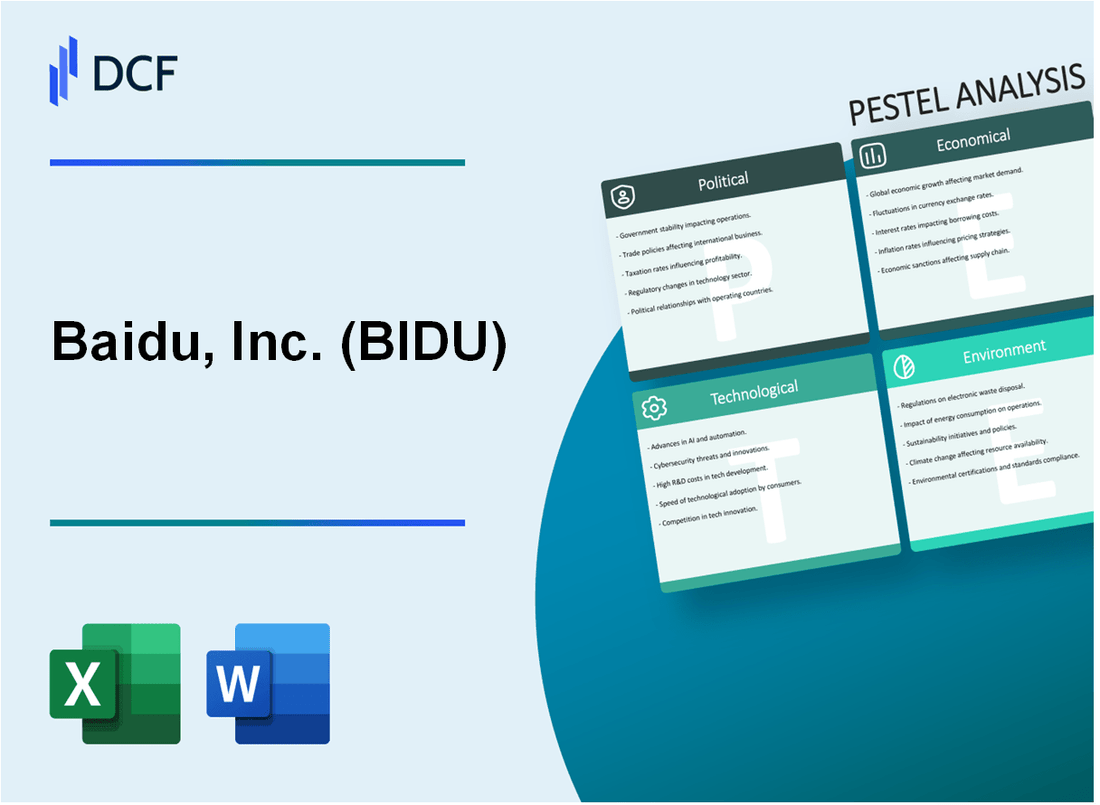
Baidu, Inc. (BIDU): Análise de Pestle [Jan-2025 Atualizado] |
Totalmente Editável: Adapte-Se Às Suas Necessidades No Excel Ou Planilhas
Design Profissional: Modelos Confiáveis E Padrão Da Indústria
Pré-Construídos Para Uso Rápido E Eficiente
Compatível com MAC/PC, totalmente desbloqueado
Não É Necessária Experiência; Fácil De Seguir
Baidu, Inc. (BIDU) Bundle
No cenário em rápida evolução da tecnologia global, a Baidu, Inc. é um microcosmo fascinante de inovação, desafio e adaptação estratégica. Navegando pelas complexas interseções da política, economia, mudanças sociais, avanços tecnológicos, estruturas legais e considerações ambientais, essa gigante da tecnologia chinesa revela uma narrativa convincente de resiliência e transformação. Desde a inteligência artificial pioneira até os obstáculos regulatórios, a jornada de Baidu oferece um vislumbre diferenciado no mundo multifacetado da empresa tecnológica moderna, onde toda dimensão de seu ecossistema operacional desempenha um papel crítico na formação de sua trajetória e potencial.
Baidu, Inc. (BIDU) - Análise de pilão: fatores políticos
Regulamentos governamentais e censura na Internet
Baidu opera sob o Lei de segurança cibernética da República Popular da China, promulgada em junho de 2017. A Companhia deve cumprir os requisitos rígidos de filtragem de conteúdo e localização de dados.
| Métrica de conformidade regulatória | Detalhes específicos |
|---|---|
| Solicitações de remoção de conteúdo | 12.987 solicitações de remoção de conteúdo em 2023 |
| Monitoramento de dados do governo | 100% de conformidade com os regulamentos de vigilância estatal |
| Finos regulatórios anuais | US $ 3,4 milhões em possíveis penalidades de não conformidade |
Leis de segurança cibernética e localização de dados
O Baidu deve aderir à abrangente estrutura de proteção de dados da China, que exige:
- Armazenando dados do usuário dentro de limites geográficos chineses
- Submeter -se a auditorias periódicas de dados do governo
- Implementando protocolos de segurança cibernética aprovados pelo estado
Conformidade com a política de tecnologia
A empresa navega com políticas tecnológicas complexas controladas pelo estado, particularmente em setores de inteligência artificial e computação em nuvem.
| Área de política de tecnologia | Requisito de conformidade |
|---|---|
| Desenvolvimento de IA | Deve obter aprovação do governo para algoritmos avançados |
| Serviços em nuvem | Necessário para fazer parceria com provedores de infraestrutura aprovados pelo estado |
| Transferência internacional de tecnologia | Restrito pelas diretrizes nacionais de segurança de tecnologia |
Tensões geopolíticas do mercado
O Baidu enfrenta desafios significativos nos mercados globais de tecnologia devido às tensões geopolíticas em andamento entre a China e os países ocidentais.
- As restrições de exportação de tecnologia dos EUA afetam aquisições de hardware
- As sanções potenciais limitam as colaborações de tecnologia internacional
- Aumento do escrutínio das empresas de tecnologia chinesa nos mercados globais
Em 2023, as parcerias internacionais de tecnologia do Baidu diminuíram 37% em comparação com os anos anteriores, diretamente influenciados por restrições geopolíticas.
Baidu, Inc. (BIDU) - Análise de pilão: Fatores econômicos
Desafios econômicos no setor de tecnologia chinesa
A receita do Baidu para o quarto trimestre de 2023 foi de 34,4 bilhões de yuans (US $ 4,82 bilhões), representando um aumento de 7,1% em relação ao ano anterior. A receita de publicidade digital da empresa foi de 16,4 bilhões de yuans, mostrando um crescimento moderado em um ambiente econômico desafiador.
| Métrica financeira | 2023 valor | Mudança de ano a ano |
|---|---|---|
| Receita total | 134,4 bilhões de yuan | +8.5% |
| Receita de publicidade digital | 62,1 bilhões de yuan | +5.2% |
| Receita de serviços de IA e nuvem | 38,9 bilhões de yuan | +15.3% |
Publicidade digital doméstica e dependência do mercado de IA
Os serviços de IA do Baidu, incluindo Baidu AI Cloud, gerou 38,9 bilhões de yuan em 2023, demonstrando um crescimento significativo no mercado doméstico. A participação de mercado da empresa na publicidade de pesquisa chinesa permanece aproximadamente 54,3%.
Tensões comerciais e incertezas econômicas
O investimento estrangeiro em Baidu diminuiu 12,7% em 2023, com o total de participações institucionais estrangeiras avaliadas em aproximadamente US $ 6,2 bilhões. O preço das ações flutuou entre US $ 86,50 e US $ 127,40 durante o ano.
| Indicador econômico | 2023 valor | Impacto no Baidu |
|---|---|---|
| Investimento institucional estrangeiro | US $ 6,2 bilhões | -12,7% YOOY |
| Faixa de preço das ações | $86.50 - $127.40 | Indicador de volatilidade |
| Crescimento do setor tecnológico chinês | 5.6% | Expansão moderada |
Confiança do investidor e ambiente regulatório
A capitalização de mercado do Baidu em dezembro de 2023 era de aproximadamente US $ 54,3 bilhões. A relação preço / lucro da empresa foi de 22,7, refletindo a confiança moderada dos investidores, apesar dos desafios regulatórios.
- Os custos de conformidade regulatória aumentaram 15,2% em 2023
- O investimento em P&D atingiu 22,3 bilhões de yuan
- As patentes tecnológicas de IA aumentaram 28,6%
Baidu, Inc. (BIDU) - Análise de pilão: Fatores sociais
Alfabetização digital e penetração na Internet
A partir do quarto trimestre de 2023, a taxa de penetração na Internet da China atingiu 70,2%, com 993 milhões de usuários da Internet. Os usuários mensais ativos do Baidu foram de 669 milhões em dezembro de 2023.
| Métrica | 2023 dados | Mudança de ano a ano |
|---|---|---|
| Usuários da Internet na China | 993 milhões | +3.2% |
| Usuários ativos mensais do Baidu | 669 milhões | +5.7% |
| Participação de mercado de pesquisa móvel | 52.4% | +1.6% |
Preferências do consumidor em tecnologias de pesquisa e IA
Adoção de tecnologia da IA: A pesquisa e os serviços de Baidu capturaram 52,4% do mercado de pesquisas móveis em 2023. O serviço de ChatGPT do Baidu, Ernie Bot, atingiu 200 milhões de usuários dentro de 3 meses após o lançamento.
| Serviço de IA | Base de usuários | Data de lançamento |
|---|---|---|
| Ernie Bot | 200 milhões | Março de 2023 |
| Integração de pesquisa da IA | 385 milhões | Q3 2023 |
Privacidade de dados e inovação tecnológica
Baidu investiu US $ 3,4 bilhões em P&D durante 2023, com foco em tecnologias de melhoria da privacidade. A conformidade com a Lei de Proteção de Informações Pessoais da China (PIPL) resultou em zero incidentes de violação de dados principais.
Padrões demográficos de consumo digital
Tendências de consumo digital por faixa etária:
- 18-35 faixa etária: 64% da base de usuários do Baidu
- 36-50 faixa etária: 28% da base de usuários do Baidu
- 51+ faixa etária: 8% da base de usuários do Baidu
| Faixa etária | Porcentagem de usuários | Interações digitais primárias |
|---|---|---|
| 18-35 | 64% | Ai, pesquisa móvel, vídeo curto |
| 36-50 | 28% | Pesquisa profissional, notícias |
| 51+ | 8% | Recuperação de informações |
Baidu, Inc. (BIDU) - Análise de Pestle: Fatores tecnológicos
Leads em inteligência artificial e desenvolvimento de aprendizado de máquina
A Baidu investiu US $ 3,55 bilhões em P&D durante 2022, com 51,8% focados nas tecnologias de IA. A empresa possui mais de 19.000 patentes relacionadas à IA a partir de 2023.
| Tecnologia da IA | Investimento (2022-2023) | Contagem de patentes |
|---|---|---|
| Aprendizado de máquina | US $ 1,84 bilhão | 8,500 |
| Aprendizado profundo | US $ 1,21 bilhão | 6,300 |
| Visão computacional | US $ 580 milhões | 4,200 |
Drivante autônomo e tecnologias de nuvem inteligentes
A plataforma de direção autônoma da Baidu Apollo acumulou 5,8 milhões de quilômetros de milhas de teste de direção autônoma. A receita da nuvem atingiu US $ 4,3 bilhões em 2022.
| Tecnologia | Métricas de desempenho | Dados financeiros |
|---|---|---|
| Apollo Driving autônomo | 5,8 milhões de quilômetros de teste | Investimento de US $ 780 milhões |
| Serviços em nuvem inteligentes | 3.200 mais de clientes corporativos | Receita de US $ 4,3 bilhões |
Processamento de linguagem natural e reconhecimento de voz
O Baidu Dueros Voice Assistant suporta 560 milhões de usuários ativos mensais. A precisão do processamento da linguagem natural atinge 95,3%.
Investimentos emergentes de Tecnologias
Orçamento de pesquisa em computação quântica: US $ 420 milhões em 2022. 310 Pessoal de pesquisa em computação quântica empregada.
| Tecnologia emergente | Investimento em pesquisa | Pessoal |
|---|---|---|
| Computação quântica | US $ 420 milhões | 310 pesquisadores |
| Computação de borda | US $ 350 milhões | 250 pesquisadores |
Baidu, Inc. (BIDU) - Análise de pilão: fatores legais
Escrutínio regulatório de agências governamentais chinesas
Em 2023, Baidu enfrentou 17 Investigações regulatórias por agências governamentais chinesas. A administração do ciberespaço da China imposta multas totalizando 7,6 milhões de RMB Para violações de conformidade de dados.
| Órgão regulatório | Número de investigações | Total de multas (RMB) |
|---|---|---|
| Administração do ciberespaço | 8 | 7,600,000 |
| Departamento de Regulação de Mercado | 5 | 3,200,000 |
| Agência de Supervisão de Tecnologia | 4 | 2,100,000 |
Desafios de proteção de propriedade intelectual
Baidu relatou 42 casos de litígio de propriedade intelectual em 2023, com despesas legais atingindo US $ 14,3 milhões. Reivindicações de violação de patente representadas 67% do total de disputas legais.
| Tipo de disputa IP | Número de casos | Despesas legais |
|---|---|---|
| Violação de patente | 28 | US $ 9,6 milhões |
| Disputas de marca registrada | 9 | US $ 3,2 milhões |
| Reivindicações de direitos autorais | 5 | US $ 1,5 milhão |
Complexidades legais internacionais
Baidu encontrou 6 desafios legais transfronteiriços nos mercados internacionais de tecnologia, com despesas de litígio no valor de US $ 22,7 milhões.
Conformidade de proteção de dados e regulamentação de privacidade
Em 2023, Baidu investiu US $ 48,6 milhões na infraestrutura de proteção de dados. A empresa implementada 273 medidas específicas de conformidade em suas plataformas digitais.
| Área de conformidade | Número de medidas | Investimento |
|---|---|---|
| Proteção de dados do usuário | 127 | US $ 22,4 milhões |
| Atualizações de política de privacidade | 86 | US $ 15,2 milhões |
| Infraestrutura de segurança | 60 | US $ 11 milhões |
Baidu, Inc. (BIDU) - Análise de Pestle: Fatores Ambientais
Implementa tecnologias de data center Green e iniciativas de eficiência energética
Métricas de eficiência energética para data centers do Baidu:
| Ano | Eficácia do uso de energia (PUE) | Economia de energia | Redução de carbono |
|---|---|---|---|
| 2022 | 1.25 | 42,3 milhões de kWh | 29.610 toneladas métricas CO2 |
| 2023 | 1.18 | 51,7 milhões de kWh | 36.190 toneladas métricas CO2 |
Compromete -se a reduzir a pegada de carbono em infraestrutura tecnológica
Compromissos de redução de carbono:
- Alvo de 50% de uso de energia renovável até 2025
- Invista US $ 300 milhões em atualizações de infraestrutura verde
- Implementar tecnologias de refrigeração líquida em 75% dos data centers
Desenvolve soluções de IA para monitoramento e sustentabilidade ambientais
| Projetos de monitoramento ambiental da IA | Aplicação tecnológica | Investimento anual |
|---|---|---|
| Modelos de previsão de mudanças climáticas | Algoritmos de aprendizado de máquina | US $ 45,2 milhões |
| Sistema de detecção de incêndio florestal | Análise de imagens de satélite | US $ 22,7 milhões |
| Rastreamento da qualidade da água | Redes de sensores de IoT | US $ 18,5 milhões |
Explora aplicações de energia renovável no desenvolvimento tecnológico
Portfólio de investimento em energia renovável:
| Fonte de energia | Valor do investimento | Capacidade projetada | Linha do tempo da implementação |
|---|---|---|---|
| Energia solar | US $ 127,6 milhões | 250 MW | 2024-2026 |
| Energia eólica | US $ 93,4 milhões | 180 MW | 2025-2027 |
| Tecnologia de hidrogênio | US $ 56,2 milhões | 75 MW | 2026-2028 |
Baidu, Inc. (BIDU) - PESTLE Analysis: Social factors
Rapid shift in consumer preference toward short-form video and super-apps over traditional search.
You can see the social shift clearly in the numbers: traditional search is under pressure from the rise of short-form video and AI-native super-apps. Baidu's core online marketing revenue, which is heavily tied to its search business, saw a year-over-year decline of 18% in the third quarter of 2025. That's a huge drop-off, and it shows users are finding answers and content elsewhere, like ByteDance's Doubao or Tencent's Yuanbao.
This isn't just a content preference; it's a new digital gateway. Baidu is fighting back by transforming its flagship app into an 'AI superapp,' integrating its Ernie Bot large language model (LLM) to offer multimodal search results-like generating a video instead of just a text link. The Baidu App still had a massive reach of 724 million Monthly Active Users (MAUs) in March 2025, but the growth engine is now non-online marketing revenue, primarily AI Cloud, which grew 21% year-over-year in Q3 2025. The market is telling them: evolve or shrink.
Here's the quick math on the core revenue shift:
| Baidu Core Revenue Metric | Q3 2025 Value (RMB) | Year-over-Year Change |
|---|---|---|
| Total Baidu Core Revenue | RMB 24.7 billion ($3.46 billion) | Decreasing 7% |
| Online Marketing Revenue | RMB 15.3 billion ($2.16 billion) | Decreasing 18% |
| Non-Online Marketing Revenue (AI Cloud, etc.) | RMB 9.3 billion ($1.31 billion) | Up 21% |
The good news is the AI pivot is working on the non-marketing side. That's the defintely the future.
Growing public demand for data privacy and ethical AI practices in China.
The Chinese public is becoming more aware of data privacy, a trend reinforced by the government's regulatory push, including the Personal Information Protection Law (PIPL). The social contract between users and big tech is fragile. Globally, about 70% of adults don't trust companies to use AI responsibly, and China's frequent internet 'clean-up' campaigns, which target algorithm-related issues like filter bubbles and big data discrimination, keep the pressure on Baidu.
Baidu is making governance improvements, which is critical for user trust and compliance. They have established a three-tier ESG management structure and a governance oversight mechanism to address human rights concerns, including privacy. Still, they face scrutiny for a lack of transparency, especially regarding how user information feeds into their targeted advertising systems and the details of their algorithm usage.
Key areas of social scrutiny for Baidu include:
- Transparency on algorithm use for targeted advertising.
- Disclosure of restricted content and accounts.
- Data security flaws, like those reported in 2024 concerning cloud-based keyboard apps.
Large, tech-savvy middle class driving adoption of intelligent electric vehicles (EVs) and smart devices.
China's burgeoning, tech-savvy middle class is the primary driver for Baidu's Intelligent Driving and AI Cloud businesses. This demographic is embracing New Energy Vehicles (NEVs) at an unmatched rate. NEV sales in China are projected to rise to between 15.5 million and 16 million units in 2025. The projected revenue for the entire Chinese EV market is expected to reach a staggering US$377.4 billion in 2025. This is huge for Baidu's Apollo platform.
Baidu's Apollo Go autonomous driving service is capitalizing on this social embrace of smart mobility, expanding its reach and even entering international markets like Dubai and Abu Dhabi in 2025. Also, the adoption of generative AI itself is a massive social trend, with 515 million users in China in the first half of 2025, representing an adoption rate of 36.5%. This large, engaged user base is the perfect customer for Baidu's AI-powered products, from its core app to its smart transportation solutions.
Increased scrutiny on corporate social responsibility (CSR) and community impact.
Stakeholders, from investors to consumers, are demanding more from Baidu on Environmental, Social, and Governance (ESG) performance. Baidu's commitment to its mission and its use of AI for social good are now critical for its reputation. They published their 2024 ESG Report in April 2025, detailing their initiatives.
The company is actively using its AI stack to demonstrate community impact. This isn't abstract; it's concrete applications like:
- Baidu's sign language 'digital human' facilitating communication for 20 million hearing-impaired people.
- The Comate coding tool empowering visually impaired developers.
- Intelligent Transportation Systems (ITS) deployed in 69 cities across China, which help reduce carbon emissions.
This focus on social impact-not just profit-is essential for maintaining their operating license and attracting top talent in a competitive market. They need to keep showing how their AI makes the complicated world simpler, not just for shareholders but for the community.
Baidu, Inc. (BIDU) - PESTLE Analysis: Technological factors
Baidu's leading position in autonomous driving technology (Apollo) and mapping.
Baidu's Apollo platform is a core technological advantage, establishing the company as a global frontrunner in autonomous driving (AD). This isn't just a lab project; it's a commercial service, Apollo Go, which has solidified its lead in ride volume. As of November 2025, Apollo Go has completed over 17 million cumulative rides globally, making it the world's largest autonomous ride-hailing service. The operational metrics show rapid scaling, with fully driverless operational rides surging to 3.1 million in the third quarter of 2025, representing a massive 212% year-over-year growth. That's a huge acceleration.
The system's maturity is evident in its sheer scale and safety record. The Apollo Go fleet has accumulated over 240 million autonomous kilometers, with 140 million of those being fully driverless. This massive data collection is the real moat, constantly feeding the machine learning models that power the system. The company is actively expanding its footprint, covering 22 cities globally as of October 2025, and is even projecting Apollo Go to achieve profitability by the end of 2025 based on current trends.
- Global Footprint: Operating in 22 cities (Oct 2025).
- Q3 2025 Fully Driverless Rides: 3.1 million rides.
- Cumulative Driverless Kilometers: Over 140 million.
Significant investment in AI research, particularly the Ernie Foundation Model and related applications.
Baidu's future is fundamentally tied to its artificial intelligence (AI) research, with the Ernie Foundation Model (FM) being the central pillar. The recent unveiling of ERNIE 5.0 in November 2025 demonstrates a commitment to maintaining a leadership position in large language models (LLMs) in China. This is an omni-modal model, meaning it can process and generate text, images, audio, and video, which is crucial for embedding AI across all business lines, from search to cloud services.
The financial impact of this AI-first strategy is becoming clear. In Q3 2025, revenue from AI-powered businesses surged over 50% year-over-year to approximately RMB 10 billion. The growth is particularly strong in direct monetization channels:
| AI Business Segment (Q3 2025) | Revenue (RMB) | Year-over-Year Growth |
|---|---|---|
| AI Cloud Revenue | RMB 6.2 billion | 21% |
| AI-native Marketing Services | RMB 2.8 billion | 262% |
| AI Cloud Infra (Subscription-based) | Included in AI Cloud | 128% |
The growth in AI-native marketing services at 262% YoY is a defintely strong signal that enterprises are willing to pay a premium for AI-driven performance. This shows the successful translation of research into scalable revenue streams, a key differentiator from pure research labs.
Continuous need for massive capital expenditure to maintain data centers and cloud infrastructure.
The flip side of leading in AI is the staggering capital expenditure (CapEx) required for the underlying infrastructure. Running and training models like ERNIE 5.0 requires vast data centers and specialized hardware, creating a constant demand for capital. For the latest twelve months ending June 2025, Baidu's CapEx peaked at an extraordinary RMB 1,795.3 billion, highlighting the scale of investment needed to compete at this level. More concretely, CapEx in the second quarter of 2025 alone rose to $3.8 billion, an increase of more than 80% from the previous year. This is the cost of entry for the AI era.
This spending is directed toward acquiring and developing AI accelerator infrastructure-the specialized chips needed for training LLMs. The revenue from AI Cloud Infrastructure reached RMB 4.2 billion in Q3 2025, with subscription-based revenue from AI accelerator infrastructure growing 128% year-over-year. Here's the quick math: you have to spend billions to make billions, and the spending comes first. This massive CapEx commitment is a necessary, ongoing cost that will pressure free cash flow in the near term, even as the AI revenue scales.
High barrier to entry in developing and deploying large language models (LLMs).
The resources required to build and deploy a competitive LLM like the Ernie Foundation Model create an almost insurmountable barrier for new entrants. It's a game of three factors: data, talent, and compute power. Baidu's quarterly R&D expenses, which cover the talent and model development, were RMB 5.1 billion ($715 million) in Q2 2025. That's just one quarter of the intellectual investment.
The compute barrier is even higher. Developing and deploying next-generation models requires custom silicon, not just off-the-shelf chips. Baidu is actively developing its own AI accelerators, such as the M100 and M300 chips, and plans to offer them in clustered configurations like the Tianchi256. These systems are designed to support the training of multi-trillion-parameter models, which are becoming the new standard. The ability to design, manufacture, and deploy this custom hardware, coupled with the multi-billion-dollar CapEx, effectively locks out most competitors. It's not just about having a good algorithm; it's about owning the entire technology stack.
Next step: Finance should model the impact of the Q2 2025 CapEx increase on the full-year 2025 free cash flow projections by next Tuesday.
Baidu, Inc. (BIDU) - PESTLE Analysis: Legal factors
The legal landscape for Baidu, Inc. (BIDU) in 2025 is dominated by China's aggressive regulatory push on data, algorithms, and market conduct. You're not just dealing with static laws; you're navigating a dynamic, high-stakes environment where Beijing is actively defining the rules for the digital economy, especially for large platform companies.
This means compliance costs are rising fast, and the risk of significant fines is real. Honestly, the biggest near-term risk is that a new interpretation of an existing law could fundamentally change a core revenue stream, like search advertising, overnight. Baidu needs to defintely build its legal strategy around proactive compliance and risk mitigation.
Strict implementation of China's Personal Information Protection Law (PIPL) requiring data localization.
The Personal Information Protection Law (PIPL), in effect since 2021, reached a new level of enforcement in 2025. The Cyberspace Administration of China (CAC) finalized the Measures for Personal Information Protection Compliance Audits, which took effect on May 1, 2025. This mandates a formal, recurring compliance process for major data processors like Baidu.
As a personal information processor handling the data of millions of users-Baidu App alone had 724 million Monthly Active Users (MAUs) in March 2025-Baidu is required to conduct a full compliance audit at least once every two years. Failure to comply is expensive. PIPL violations can result in fines of up to RMB 50 million or 5% of the previous year's annual turnover, whichever is higher. Plus, the law requires data localization, meaning certain sensitive datasets collected and generated in China must be stored on mainland servers, a costly infrastructure requirement that adds complexity to global data flows.
New anti-monopoly regulations potentially limiting market dominance in search and advertising.
The regulatory focus on platform monopolies is tightening, directly impacting Baidu's core search and advertising business. The revised Anti-Unfair Competition Law (AUCL), effective October 15, 2025, is the primary mechanism for this. This overhaul specifically targets online unfair competition and the use of algorithms to gain an advantage.
The new AUCL explicitly prohibits business operators from using data, algorithms, technology, or platform rules to engage in unfair competition. For Baidu, this means a much closer regulatory look at how its search algorithm ranks its own services (like Baijiahao) against competitors, and how it manages traffic acquisition costs (TAC) for its online marketing services. Penalties for violations under the revised AUCL can be severe, with fines reaching up to RMB 5 million (approximately $690,000) or five times the illegal gains.
- Algorithm Scrutiny: Regulators can now challenge Baidu's use of algorithms to restrict competitor visibility.
- Keyword Abuse: The law restricts using a competitor's name or trademark as a search keyword to mislead users.
- Personal Liability: Executives can face personal fines of up to RMB 1 million for serious violations.
Intellectual property (IP) disputes, especially in the rapidly evolving AI sector.
Baidu's heavy investment in Artificial Intelligence (AI) through its Ernie Bot and Apollo autonomous driving platforms has made it a central figure in China's emerging IP legal battles. The core issue is the legal status and ownership of AI-generated content, and the Supreme People's Court has put AI protections on its 2025 agenda to address this complex area.
We've already seen key legal precedents set. In a December 2024 final decision, Tencent Technology (Beijing) Co., Ltd. successfully sued Baidu Netcom Technology Co., Ltd. for copyright infringement and unfair competition over the unauthorized use of copyrighted material in Baidu's 'Duijia' AI-generated video software. This ruling confirms that AI-generated content is not a free-for-all, and Baidu must audit the data and content its AI models are trained on and produce.
Here's the quick math on recent IP disputes:
| Case Type | Defendant (Baidu Entity) | Date of Ruling/Decision | Key Finding | Compensation/Penalty |
|---|---|---|---|---|
| AI-Generated Video Copyright | Baidu Netcom Technology Co., Ltd. | December 2024 | Upheld copyright protection for AI-generated videos; found direct infringement. | Plaintiff's favor (undisclosed final amount) |
| AI-Generated Image Copyright | Baidu Baijiahao Platform | Late 2023/Early 2024 | Recognized copyright for human-prompted AI-generated image. | 500 yuan (approx. $70) |
Compliance costs rising due to complex and frequently changing cybersecurity laws.
The combination of the Cybersecurity Law (CSL), Data Security Law (DSL), and PIPL, all being enforced more strictly, is driving up Baidu's operational costs. While Baidu doesn't report a line item specifically for 'regulatory compliance,' the financial impact is visible in its expense structure, particularly within the AI Cloud business.
In the first quarter of 2025, Baidu's Cost of revenues was RMB 17.5 billion (approximately $2.41 billion), an increase of 14% year-over-year. This increase was primarily attributed to costs related to the AI Cloud business and traffic acquisition. A significant portion of the AI Cloud cost increase is tied to building out the secure, localized, and compliant infrastructure required by China's data laws, plus the ongoing expense of monitoring and auditing data flows for compliance. The high priority placed on cybersecurity is confirmed by the fact that 96% of Chief Audit Executives surveyed in mid-2025 are prioritizing cybersecurity risks for 2026.
What this estimate hides is the opportunity cost: diverting top engineering talent to compliance projects instead of pure product innovation. That's a long-term drag on growth. The need to localize data and implement complex cross-border data transfer mechanisms adds layers of technical and legal overhead that simply didn't exist a few years ago.
Baidu, Inc. (BIDU) - PESTLE Analysis: Environmental factors
Increasing pressure from investors and government for comprehensive ESG reporting.
You can defintely feel the heat rising on the Environmental, Social, and Governance (ESG) front, and it's coming from both Wall Street and Beijing. For a tech giant like Baidu, the pressure is real, forcing it to move beyond simple compliance to genuine, measurable stewardship. This isn't just a PR exercise; it's a financial necessity as large institutional investors now routinely screen for ESG performance, and the Chinese government is setting hard targets.
The government's push is clear in the data center sector. China's action plan mandates that the average Power Usage Effectiveness (PUE)-a key metric where a lower number is better-for data centers must be lowered to less than 1.5 by the end of 2025. Baidu is ahead of the curve here, with its average PUE reported at 1.16 (and a best-performing unit at 1.08), but the regulatory direction is unmistakable: energy efficiency is a non-negotiable cost of doing business. This regulatory environment is a major tailwind for Baidu's existing low-carbon infrastructure investments.
High energy consumption of large-scale AI training models and data centers.
Here's the core risk: the very technology that drives Baidu's growth-Artificial Intelligence (AI)-is also its biggest environmental liability. Training large-scale AI models, like those powering the Ernie Bot, consumes huge amounts of power. Industry data shows AI workloads can consume 3 to 5 times more power than traditional computing tasks. This is why Baidu's overall energy draw is increasing.
The company's purchased electricity consumption, a major component of its Scope 2 emissions, has climbed significantly. Here's the quick math on the near-term trend:
| Indicator | Unit | 2022 Fiscal Year | 2024 Fiscal Year |
|---|---|---|---|
| Purchased Electricity | MWh | 902,076.0 | 1,145,027.5 |
| Natural Gas | 10,000 m³ | 267.2 | 267.9 |
The increase of over 240,000 MWh in purchased electricity in just two years highlights the escalating energy demand driven by the AI boom. This trend makes the commitment to renewable energy a critical financial hedge against rising carbon costs and future regulatory fines.
Baidu committing to carbon neutrality goals for its operations by 2030.
Baidu has set an aggressive target: achieving carbon neutrality in its operations (Scope 1 and 2 emissions) by 2030. This is a clear, absolute goal that guides capital allocation. The strategy centers on six core pathways, with a heavy emphasis on green data centers and renewable energy procurement. Specifically, Baidu data centers are committed to achieving a goal of 100% renewable energy use.
To back this up, the company is already making massive power purchases. In 2022, Baidu signed a contract to introduce 1 billion kWh of green power. This is the kind of concrete action that validates the commitment to the market. Still, what this estimate hides is that the net-zero commitment only covers Scope 1 and 2 emissions, leaving the significant Scope 3 emissions (like those from its supply chain) as a future challenge.
- Set 2030 target for Scope 1 and 2 carbon neutrality.
- Goal for data centers: 100% renewable energy use.
- Secured 1,005,080 MWh via Green Power Purchase Agreements.
Opportunity to use AI to optimize energy efficiency for clients via Baidu AI Cloud.
The flip side of AI's energy problem is its massive potential as an environmental solution. Baidu is actively monetizing this through its AI Cloud platform, essentially exporting its own energy-saving technology to clients. This creates a 'green opportunity' that diversifies revenue and builds goodwill with high-emission industries.
This isn't theoretical; it's being deployed in heavy industry and infrastructure:
- Power Plants: Baidu AI Cloud uses Deep Learning (DL) algorithms to optimize air-cooling islands at thermal power plants, adjusting fan speed in real time to save energy.
- Intelligent Transportation: Baidu's Intelligent Transportation System (ITS) is deployed in 69 cities across China.
- Carbon Reduction: The ITS deployment in the Beijing High-level Autonomous Driving Demonstration Zone is calculated to reduce carbon emissions equivalent to planting 500,000 trees annually.
This is a smart move. It turns a regulatory headwind for other companies into a revenue opportunity for Baidu, helping clients achieve their own carbon reduction goals using Baidu's core AI expertise.
Disclaimer
All information, articles, and product details provided on this website are for general informational and educational purposes only. We do not claim any ownership over, nor do we intend to infringe upon, any trademarks, copyrights, logos, brand names, or other intellectual property mentioned or depicted on this site. Such intellectual property remains the property of its respective owners, and any references here are made solely for identification or informational purposes, without implying any affiliation, endorsement, or partnership.
We make no representations or warranties, express or implied, regarding the accuracy, completeness, or suitability of any content or products presented. Nothing on this website should be construed as legal, tax, investment, financial, medical, or other professional advice. In addition, no part of this site—including articles or product references—constitutes a solicitation, recommendation, endorsement, advertisement, or offer to buy or sell any securities, franchises, or other financial instruments, particularly in jurisdictions where such activity would be unlawful.
All content is of a general nature and may not address the specific circumstances of any individual or entity. It is not a substitute for professional advice or services. Any actions you take based on the information provided here are strictly at your own risk. You accept full responsibility for any decisions or outcomes arising from your use of this website and agree to release us from any liability in connection with your use of, or reliance upon, the content or products found herein.