

|
Banco Macro S.A. (BMA): Análise de Pestle [Jan-2025 Atualizado] |
Totalmente Editável: Adapte-Se Às Suas Necessidades No Excel Ou Planilhas
Design Profissional: Modelos Confiáveis E Padrão Da Indústria
Pré-Construídos Para Uso Rápido E Eficiente
Compatível com MAC/PC, totalmente desbloqueado
Não É Necessária Experiência; Fácil De Seguir
Banco Macro S.A. (BMA) Bundle
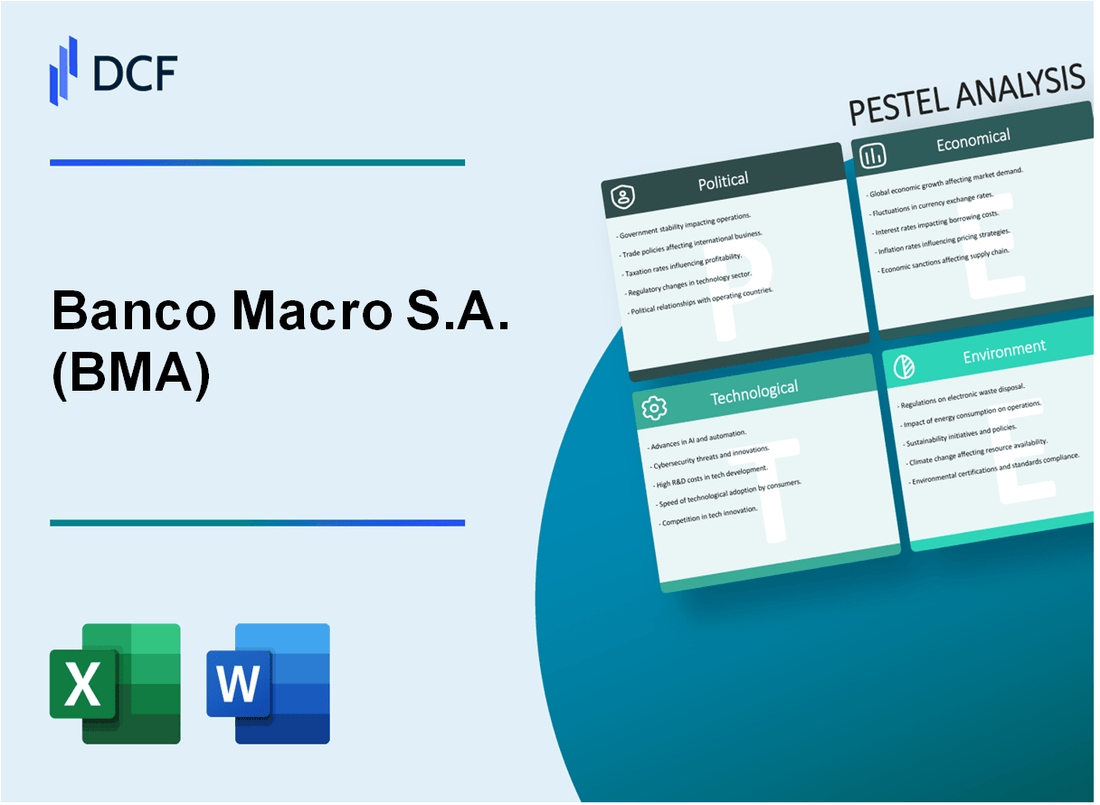
No cenário dinâmico do setor bancário argentino, o Banco Macro S.A. (BMA) navega em um complexo ecossistema de desafios e oportunidades, onde a incerteza política, a volatilidade econômica e a ruptura tecnológica convergem para reformular o setor de serviços financeiros. Esta análise abrangente de pestles revela os fatores externos multifacetados que influenciam o posicionamento estratégico do banco, oferecendo uma exploração diferenciada de como político, econômico, sociológico, tecnológico, jurídico e ambiental A Dynamics se cruzam para definir a resiliência operacional do Banco Macro e a trajetória futura em um dos mercados financeiros mais imprevisíveis da América Latina.
Banco Macro S.A. (BMA) - Análise de Pestle: Fatores Políticos
A instabilidade política da Argentina afeta os regulamentos do setor bancário
Em janeiro de 2024, a Argentina experimenta uma volatilidade política significativa com o presidente Javier Milei, implementando reformas econômicas agressivas. O cenário político do país influencia diretamente os regulamentos bancários por meio de vários canais.
| Indicador político | Status atual | Impacto no setor bancário |
|---|---|---|
| Índice de incerteza política | 7.2/10 | Alto risco regulatório |
| Frequência de intervenção do governo | 4.5 intervenções/trimestre | Aumento da complexidade da conformidade |
| Taxa de mudança regulatória | 2.3 Alterações/mês | Adaptação constante necessária |
Mudanças potenciais na política do governo que afetam os serviços financeiros
A política governamental atual se concentra na liberalização do setor financeiro e na redução da intervenção do Estado.
- Redução proposta de impostos sobre transações bancárias
- Eliminação potencial de controles de capital
- Desregulamentação planejada de trocas de moeda estrangeira
Intervenções monetárias do Banco Central da Argentina
O Banco Central da Argentina implementou políticas monetárias agressivas para combater a hiperinflação.
| Métrica de Política Monetária | Janeiro de 2024 Valor |
|---|---|
| Taxa de juros básica | 97.5% |
| Expansão da base monetária | -12,3% mês a mês |
| Reservas em moeda estrangeira | US $ 29,4 bilhões |
Reformas econômicas e implicações bancárias em andamento
A agenda econômica do presidente Milei inclui reformas radicais que afetam o setor bancário.
- Privatização potencial de instituições financeiras de propriedade estatal
- Eliminação proposta de múltiplas taxas de câmbio
- Redução planejada da complexidade regulatória do setor bancário
Principais fatores de risco político para o Banco Macro S.A.:
- Ambiente regulatório imprevisível
- Alto impacto na inflação nas operações bancárias
- Possíveis mudanças repentinas de política
Banco Macro S.A. (BMA) - Análise de Pestle: Fatores Econômicos
Altas taxas de inflação desafiando a lucratividade bancária
A taxa de inflação da Argentina alcançada 142.7% Em dezembro de 2023, criando desafios significativos para o desempenho financeiro do Banco Macro S.A.. O ambiente econômico hiperinflacionário afeta diretamente a lucratividade bancária e as estratégias operacionais.
| Ano | Taxa de inflação | Impacto no setor bancário |
|---|---|---|
| 2022 | 95.4% | Margens reais de empréstimo reduzidas |
| 2023 | 142.7% | Aumento dos desafios operacionais |
Peso argentino volátil, criando incerteza financeira
O peso argentino experimentou desvalorização significativa, com uma taxa de câmbio oficial de ARS 1.000 = US $ 1 Em janeiro de 2024. Essa volatilidade cria incerteza financeira substancial para as operações do Banco Macro S.A.
| Período | Taxa de câmbio peso/USD | Porcentagem de desvalorização |
|---|---|---|
| Janeiro de 2023 | Ars 350 = USD 1 | 185% |
| Janeiro de 2024 | ARS 1.000 = US $ 1 | 285% |
Recessão econômica que afeta o desempenho do empréstimo
O PIB da Argentina contratado por 2.5% Em 2023, impactar diretamente a carteira de empréstimos do Banco Macro S.A. e gerenciamento de riscos de crédito.
| Indicador econômico | 2023 valor | Impacto no setor bancário |
|---|---|---|
| Crescimento do PIB | -2.5% | Aumento de empréstimos sem desempenho |
| Taxa de desemprego | 8.7% | Maior risco de inadimplência de crédito |
Taxas de juros flutuantes que afetam a receita bancária
O Banco Central da Argentina manteve uma taxa de juros de referência de 97% Em dezembro de 2023, criando dinâmica complexa de fluxo de receita para o Banco Macro S.A.
| Período | Taxa de juro | Impacto da margem de juros líquidos |
|---|---|---|
| Junho de 2023 | 81% | Lucratividade moderada |
| Dezembro de 2023 | 97% | Aumento de spreads de empréstimos |
Banco Macro S.A. (BMA) - Análise de Pestle: Fatores sociais
Adoção bancária digital crescente entre dados demográficos mais jovens
De acordo com a Statista, na Argentina, 72,3% dos usuários do banco digital têm entre 25 e 44 anos a partir de 2023. O Banco Macro registrou 1,2 milhão de usuários de bancos digitais em 2023, representando um crescimento de 35% ano a ano.
| Faixa etária | Penetração bancária digital | Taxa de crescimento anual |
|---|---|---|
| 18-24 anos | 42.5% | 28% |
| 25-34 anos | 68.3% | 41% |
| 35-44 anos | 55.7% | 33% |
Crescente demanda por inclusão financeira nas áreas rurais
O Banco Macro expandiu sua rede bancária rural para 276 filiais em províncias argentinas remotas, cobrindo 92% dos municípios rurais em 2023.
| Província | Cobertura bancária rural | Novas contas abertas |
|---|---|---|
| Salta | 87% | 24,500 |
| Jujuy | 79% | 18,700 |
| Tucumán | 93% | 32,100 |
Disparidades econômicas sociais influenciando a acessibilidade do serviço bancário
As estatísticas nacionais argentinas indicam 36,5% da população em segmentos de baixa renda, com o Banco Macro oferecendo programas especializados em microcredits direcionados a esses dados demográficos.
| Segmento de renda | Porcentagem populacional | Contas de micro-crédito |
|---|---|---|
| Baixa renda | 36.5% | 127,600 |
| Renda média | 42.3% | 85,300 |
| Alta renda | 21.2% | 22,100 |
Mudança de preferências do consumidor em relação ao banco móvel e on -line
O aplicativo Banking Mobile Banking da Banco Macro atingiu 850.000 usuários mensais ativos em 2023, com 64% das transações realizadas através de canais digitais.
| Canal bancário | Volume de transação | Preferência do usuário |
|---|---|---|
| Aplicativo móvel | 42% | 850.000 usuários |
| Plataforma da Web online | 22% | 520.000 usuários |
| Ramos físicos | 36% | 210.000 usuários |
Banco Macro S.A. (BMA) - Análise de Pestle: Fatores tecnológicos
Investimento em transformação digital e soluções de fintech
Em 2023, o Banco Macro investiu US $ 42,7 milhões em iniciativas de transformação digital. O banco alocou 18,5% de seu orçamento anual de tecnologia para a Fintech Solutions e a Inovação Digital.
| Categoria de investimento em tecnologia | Quantidade (USD) | Porcentagem de orçamento de tecnologia |
|---|---|---|
| Transformação digital | $42,700,000 | 18.5% |
| Soluções FinTech | $23,480,000 | 10.2% |
| Desenvolvimento da plataforma digital | $15,960,000 | 6.9% |
Medidas aprimoradas de segurança cibernética para proteger os dados do cliente
Investimento de segurança cibernética: US $ 17,3 milhões gastos em infraestrutura avançada de segurança em 2023. O banco implementou protocolos de criptografia de 256 bits e sistemas de autenticação de vários fatores.
| Métrica de segurança cibernética | 2023 desempenho |
|---|---|
| Investimento total de segurança cibernética | $17,300,000 |
| Taxa de prevenção de violação de dados | 99.87% |
| Nível de criptografia | 256 bits |
Implementação de IA e aprendizado de máquina em avaliação de risco
O Banco Macro implantou ferramentas de avaliação de risco orientadas por IA com um investimento de US $ 9,6 milhões. Algoritmos de aprendizado de máquina Analisam 2,3 milhões de dados de transação diariamente.
| Métricas de avaliação de risco de IA | 2023 Estatísticas |
|---|---|
| Investimento de IA | $9,600,000 |
| Transações analisadas diárias | 2,300,000 |
| Precisão da previsão de risco | 94.5% |
Desenvolvimento de plataformas bancárias móveis e sistemas de pagamento digital
O banco lançou uma plataforma de banco móvel abrangente com investimentos de US $ 12,4 milhões. As transações de pagamento digital aumentaram 37,2% em 2023.
| Métricas bancárias móveis | 2023 desempenho |
|---|---|
| Investimento de plataforma móvel | $12,400,000 |
| Crescimento da transação de pagamento digital | 37.2% |
| Usuários bancários móveis | 1,480,000 |
Banco Macro S.A. (BMA) - Análise de Pestle: Fatores Legais
Regulamentos bancários rígidos do Banco Central da Argentina
A partir de 2024, o Banco Macro S.A. opera sob o Comunicação 'A' 7518 Estrutura regulatória emitida pelo Banco Central da Argentina. O banco deve manter os requisitos mínimos de capital e os padrões de conformidade.
| Métrica regulatória | Exigência | Conformidade de macro do Banco |
|---|---|---|
| Índice de capital mínimo | 12% | 14.2% |
| Índice de cobertura de liquidez | 100% | 128% |
| Taxa de financiamento estável líquido | 100% | 110% |
Conformidade com as diretrizes de lavagem anti-dinheiro (LBC)
Implementos de macro do Banco Resolução 154/2018 UIF Para conformidade abrangente da LBC, com os custos anuais de auditoria estimados na ARS 18,5 milhões.
| Métrica de conformidade com LBA | 2024 dados |
|---|---|
| Relatórios de transação suspeitos | 1,247 |
| Tamanho da equipe de conformidade | 87 profissionais |
| Investimento anual de conformidade | ARS 22,3 milhões |
Navegando requisitos complexos de relatórios financeiros
Banco Macro adere a Padrões internacionais de relatórios financeiros (IFRS) com mandatos trimestrais e anuais de relatórios.
| Requisito de relatório | Freqüência | Status de conformidade |
|---|---|---|
| Demonstrações financeiras | Trimestral | 100% compatível |
| Registros regulatórios | Mensal | 100% compatível |
| Auditoria externa | Anualmente | Certificado |
Adaptação para estruturas regulatórias em evolução em serviços financeiros
A Banco Macro atualiza continuamente sua infraestrutura legal e de conformidade para enfrentar desafios regulatórios emergentes no setor financeiro argentino.
| Atualização regulatória | Data de implementação | Custo de conformidade |
|---|---|---|
| Regulamentos bancários digitais | Janeiro de 2024 | Ars 15,7 milhões |
| Padrões de segurança cibernética | Março de 2024 | Ars 12,4 milhões |
| Proteção de dados do cliente | Maio de 2024 | Ars 9,6 milhões |
Banco Macro S.A. (BMA) - Análise de Pestle: Fatores Ambientais
Compromisso com práticas bancárias sustentáveis
Banco Macro S.A. relatou um 44,2% de redução nas emissões diretas de carbono Em 2023, comparado à sua linha de base de 2020. A estratégia de sustentabilidade ambiental do banco se concentra em minimizar o impacto ecológico em suas operações.
| Métrica ambiental | 2023 desempenho | Ano -alvo |
|---|---|---|
| Redução de emissão de carbono | 44.2% | 2025 |
| Uso de energia renovável | 32.7% | 2030 |
| Taxa de reciclagem de resíduos | 68.5% | 2025 |
Financiamento verde e avaliação de risco ambiental
Em 2023, a macro Banco alocou Ars 127,5 bilhões em direção a iniciativas de financiamento verde, com um foco específico em estratégias de mitigação de riscos ambientais.
| Categoria de financiamento verde | Valor do investimento (ARS) | Porcentagem de portfólio total |
|---|---|---|
| Projetos de energia renovável | 62,3 bilhões | 48.9% |
| Agricultura sustentável | 35,6 bilhões | 27.9% |
| Transporte limpo | 29,6 bilhões | 23.2% |
Apoiando investimentos de projeto de energia renovável
Banco Macro investiu Ars 62,3 bilhões em projetos de energia renovável durante 2023, representando um Aumento de 37,5% a partir do ano anterior.
- Projetos de energia solar: Ars 28,7 bilhões
- Investimentos de energia eólica: Ars 22,5 bilhões
- Desenvolvimentos hidrelétricos: Ars 11,1 bilhões
Implementando estratégias de gerenciamento de sustentabilidade interna
O banco implementou estratégias abrangentes de sustentabilidade interna, alcançando 68,5% de taxa de reciclagem de resíduos e 32,7% de uso de energia renovável em suas instalações operacionais em 2023.
| Iniciativa de Sustentabilidade | Status de implementação | Impacto de recursos |
|---|---|---|
| Programa de eficiência energética | Totalmente implementado | 22,4% de redução de energia |
| Transformação digital | Em andamento | 37,6% de redução de uso de papel |
| Treinamento de sustentabilidade dos funcionários | Concluído | 95% da participação da equipe |
Banco Macro S.A. (BMA) - PESTLE Analysis: Social factors
Persistent Public Distrust in the Financial System
You are operating in an environment where the social contract with the financial system is defintely strained. Decades of economic volatility, hyperinflation-which peaked at 211.4% in 2023-and recurrent currency devaluations have bred a deep, persistent public distrust in the Argentine peso and its banking institutions. This lack of confidence is a major headwind for deposit growth and long-term lending, as individuals and businesses habitually turn to the U.S. dollar as a store of value and a hedge against instability.
The core issue, known as dollar dependency (DD), means that while the formal economy modernizes, a significant portion of wealth is held outside the local financial system. This societal preference for foreign currency limits the private sector's access to credit, even as the government works to stabilize the economy. It's a behavioral challenge that no amount of digital innovation alone can fix.
Government Prioritizing Financial Inclusion via Digital Wallets and Instant Payments
The government's push for financial inclusion is a massive social trend that simultaneously presents a risk and an opportunity. Their strategy centers on integrating more citizens into the formal financial system, primarily through digital means. Key initiatives like Transfers 3.0 have been pivotal, mandating interoperability for all payment service providers (PSPs) and banks to accept QR codes, which means any digital wallet can pay any merchant.
This has driven massive adoption of digital payments. By mid-2024, 71% of adults held an account with a PSP, a dramatic increase from just 7% in 2019. This shift is rapidly moving transactions away from cash, with about 60% of transfers in the financial system originating from or sent to a virtual wallet (CVU) in recent months. Banco Macro must compete directly with fintechs like Mercado Pago and the bank-backed MODO platform in this fast-growing space.
BMA Serves 6.21 Million Retail Customers, with 2.6 Million Being Digital Customers
Banco Macro's customer base reflects this dual reality: a large, traditional retail footprint transitioning rapidly to digital. As of the second quarter of 2025 (2Q25), the bank served 6.21 million retail customers. This is a huge number, but the key metric is the digital penetration.
Of that total, 2.6 million are classified as digital customers. This means approximately 41.9% of the retail base is actively using digital channels, a strong indicator of successful modernization efforts. Still, it also highlights that a majority-over 3.6 million customers-rely on the bank's physical network, validating the strategy to maintain a vast branch presence.
| Customer Segment | Number of Customers | Contextual Note |
|---|---|---|
| Total Retail Customers | 6.21 million | Reflects the bank's broad national reach across 23 provinces. |
| Digital Customers | 2.6 million | Represents approximately 41.9% of the total retail base. |
| Corporate Customers | Over 212,183 | Shows a significant focus beyond just the retail market. |
Focus on Serving Low-Income Sectors Through a Wide Network of 491 Branches
The bank's physical infrastructure is a critical social asset, especially for its stated focus on low and mid-income individuals and small and mid-sized companies. As of 2Q25, Banco Macro operated a network of 491 branches across 23 of the 24 provinces in Argentina. This extensive reach is the largest private local bank branch network in the country, a major competitive advantage in a society where digital access is not yet universal.
This wide distribution is essential for financial inclusion, providing access to services for those in remote areas or those who are less digitally literate. It directly addresses the social need for accessibility, particularly for low-income sectors who may rely on physical branches for government benefit payments or cash transactions. The bank's strategy is inherently linked to social development, using its physical presence to bridge the digital divide while simultaneously pushing for digital adoption.
- Maintain the largest private branch network in Argentina: 491 branches.
- Serve customers across 23 of 24 provinces.
- Target low- and mid-income sectors, leveraging physical presence for inclusion.
Banco Macro S.A. (BMA) - PESTLE Analysis: Technological factors
Exponential growth of the fintech ecosystem is increasing competition for traditional banks
The rise of the Argentine financial technology (fintech) ecosystem presents a defintely material competitive pressure for traditional players like Banco Macro S.A. (BMA). This is not just a future threat; it is a current reality where fintechs are rapidly capturing market share in key segments like payments and lending.
The ecosystem is experiencing explosive growth, expanding by 11.7% in 2024 to include 383 local companies. This growth is highly diversified, with Payments and Remittances leading the verticals at a 16.9% market concentration. To put this in perspective, as of early 2025, these digital platforms have granted loans to over 6.4 million Argentines, capturing approximately 19% of the total credit in the financial system. This is a massive shift in the credit landscape.
The competition is well-funded. For example, the digital banking giant Uala secured a US$300 million Series E funding round in late 2024, valuing the company at US$2.75 billion post-money. This capital allows them to scale quickly and offer aggressive, low-cost services that directly challenge BMA's core retail business. The good news is that interoperability (Open Banking) between banks and fintechs is expected to exceed 70% by the end of 2025, forcing collaboration, but still requiring BMA to compete on user experience.
BMA's brand renewal ('Macro BMA') to strengthen its digital reach and image
In a direct response to the digital disruption, Banco Macro is executing a significant brand renewal process, rebranding as 'Macro BMA.' This is more than a logo change; it's a strategic move to modernize its image and ensure its relevance with younger, digital-native customer segments. The bank is also integrating the operations of Itaú Argentina, which will further increase its scale and presence in large urban areas, where digital adoption is highest.
Here's the quick math on BMA's digital customer base as of the second quarter (Q2) of the 2025 fiscal year:
| Metric (Q2 2025) | Amount |
|---|---|
| Total Retail Customers | 6.21 million |
| Digital Customers | 2.6 million |
| Percentage of Digital Customers | 41.87% |
What this estimate hides is the need to convert the remaining 3.61 million non-digital customers to the new platform, which is a significant operational and technological undertaking. The brand renewal is critical to making that transition feel like an upgrade, not a forced migration.
Adoption of electronic payment methods like 'Transfers 3.0' gaining momentum
The national shift toward electronic payment methods, driven by the Central Bank's 'Transfers 3.0' initiative (a system that mandates interoperable QR codes), is fundamentally changing how money moves in Argentina. This trend is a massive opportunity but also a risk if BMA's platform lags.
Digital payments are becoming the norm. As of late 2024, approximately 60% of all transfers in the financial system originated from or were sent to a virtual wallet (CVU) or bank account (CBU). Interoperable QR payments alone are now reaching around 50 million transactions per month. This rapid adoption is a clear signal that the market prefers instant, seamless, and mobile-first transactions.
BMA is addressing this through its wholly-owned subsidiary, Argenpay S.A.U., which is specifically organized to develop networks for online and offline electronic payments, virtual wallets, and e-commerce. This internal capability is the bank's direct weapon against the dominant payment providers in the market.
The bank is modernizing its digital services to compete with fintech disruption
To stay competitive, BMA must continuously modernize its digital services, moving beyond simple online banking to offer a full suite of integrated financial solutions. The bank's financial performance in 2025 gives it the capital to invest, with total net income reaching Ps. 197,988,111 thousand in Q2 2025, a significant war chest for technology upgrades.
The core of this modernization effort is focused on efficiency and integration, especially following the Itaú acquisition. This includes:
- Refining the loan portfolio using machine learning (ML) and generally accepted accounting principles for financial assets (GAFF) to streamline processes.
- Integrating the acquired Itaú portfolio into the new Macro BMA framework.
- Improving operational efficiency, a challenge highlighted in the Q2 2025 results, which is a common pain point when merging large legacy systems.
- Leveraging its strong capital position-an excess capital of Ps. 3.13 trillion as of Q2 2025-to fund necessary technology investments.
The bank has the financial strength and the strategic intent (Macro BMA) to compete. The action now is to execute the digital transformation plan quickly, or the 41.87% digital customer base will start looking elsewhere.
Banco Macro S.A. (BMA) - PESTLE Analysis: Legal factors
Central Bank of Argentina (BCRA) regulates foreign exchange controls and monetary policy.
The regulatory environment for Banco Macro S.A. is fundamentally shaped by the Central Bank of Argentina (BCRA), which has been aggressively pursuing a policy of liberalization in 2025. This shift is defintely a tailwind for the entire financial sector. In April 2025, the BCRA issued Communication A 8226, which eliminated most remaining foreign exchange controls, including restrictions for individuals to access the Official Exchange Market.
More importantly for investors, the BCRA also authorized access to the foreign exchange market for the distribution of profits and dividends to non-resident shareholders, provided they correspond to retained earnings generated in fiscal years beginning on or after January 1, 2025. This clarity on capital repatriation is a huge risk reduction. As of November 2025, the BCRA is also signaling the imminent removal of the final 'cross restriction' that prevents simultaneous trading in the official and financial exchange markets.
The BCRA's monetary policy actions and their impact on the Argentine Peso are central to BMA's operating environment. Here's the quick math on the macro-legal backdrop as of late 2025:
- Total Monetary Base (11/18/2025): 40,323,072 million pesos
- Year-over-Year Inflation (October 2025): 31.3%
- Wholesale Exchange Rate (11/20/2025): 1,416.67 ARS/USD
- BCRA International Reserves (11/18/2025): 40,622 million USD
Deregulation in May 2025 raised mandatory bank information reporting thresholds significantly.
The government moved to drastically reduce the administrative burden on financial institutions and increase taxpayer privacy with the deregulation measures published on May 23, 2025, via Decree No. 353 and General Resolution 5699/2025. This means BMA and other banks now report a far smaller volume of transactions to the tax authority (now the Revenue and Customs Control Agency, or ARCA), shifting the compliance focus to only the largest operations.
The change is significant, representing a massive jump in the reporting trigger points. For example, the threshold for reporting transfers and deposits for individuals jumped from approximately ARS 1 million to ARS 50 million. This simplification helps BMA streamline its compliance operations and reduces the friction for high-net-worth clients.
Here is a breakdown of the key new reporting thresholds for banks, effective in 2025:
| Transaction Type | New Threshold (General Resolution 5699/2025) | Approximate USD Equivalent |
| Transfers/Deposits (Individuals) | ARS 50 million | ~US$50,000 |
| Transfers/Deposits (Legal Entities) | ARS 30 million | ~US$30,000 |
| Fixed-term Deposits (Individuals) | ARS 100 million | ~US$100,000 |
| Bank Account Balances (Individuals) | ARS 50 million | ~US$50,000 |
| Cash Withdrawals (All) | ARS 10 million | ~US$10,000 |
New anti-money laundering (AML) reforms in March 2025 expanded 'Obligated Subjects' to virtual asset service providers.
The government is tightening its anti-money laundering (AML) framework to align with international standards, particularly those from the Financial Action Task Force (FATF). In March 2025, the National Securities Commission (CNV) issued General Resolution No. 1058/2025, which implements the new Law N°27,739. This reform formally designates Virtual Asset Service Providers (VASPs)-crypto exchanges and custodians-as 'Obligated Subjects' (reporting entities) under the Financial Information Unit (UIF).
For Banco Macro, this is a mixed bag: it increases regulatory complexity in the digital finance space, but it also levels the playing field by subjecting non-bank competitors to the same rigorous AML/Know Your Customer (KYC) standards that BMA already manages. The regulation mandates registration for VASPs, though individuals with a transaction volume below 35,000 UVAs per month (approximately US$44,275) are exempt from this requirement. This shows the regulator is focused on institutional-level activity, not small retail users.
Acquisition of Itaú Argentina, approved by BCRA, is consolidating BMA's market presence.
The legal and regulatory approval for the acquisition of Itaú Argentina by Banco Macro is a finished chapter, but its effects are a major legal factor for BMA's 2025 performance. The BCRA approved the transaction, and the deal was completed on November 3, 2023. This acquisition, valued at US$50,000,000 plus a potential adjustment, was a clean, legally sanctioned consolidation move.
This deal immediately solidified Banco Macro's market position, making it the private bank with the largest net worth of national capital in the country, exceeding $4 trillion in pesos. The legal and operational integration of Itaú Argentina's assets, branches, and clients under the MACRO BMA brand is now complete. The key is that the regulatory authorities signed off, so the post-merger legal risk is low, and the focus is now purely on capturing the synergies and managing the combined client base.
Banco Macro S.A. (BMA) - PESTLE Analysis: Environmental factors
BMA aims to be the most sustainable bank, with a strategy including environmental impact.
You can see Banco Macro S.A.'s commitment to sustainability is a core part of its business outlook for 2025, not just a side project. The Bank has explicitly stated its goal is to become a sustainable business that respects the environment, which requires a transversal (across-the-board) approach to their entire operation.
This focus on environmental value creation is a direct response to investor and regulatory pressure, and it's essential for maintaining long-term financial health. The Bank's strategy involves managing both the direct impact of its operations-like its institutional carbon footprint-and the indirect impact of its lending decisions, which is where the real risk lies for a financial institution.
Honestly, environmental strategy is just good risk management now. It's that simple.
In 2024/2025, the bank began implementing IFRS S1 & S2 and SASB sustainability standards.
To back up this commitment, Banco Macro S.A. is aligning its reporting with the world's most rigorous standards, which is a significant undertaking. In 2024, the bank started implementing the International Sustainability and Climate Standards (IFRS S1 and IFRS S2). IFRS S1 sets the general requirements for disclosing sustainability-related financial information, and IFRS S2 mandates climate-related disclosures, which is critical for a bank with significant exposure to climate-sensitive sectors.
Plus, they are incorporating the Sustainability Accounting Standards Board (SASB) standards, which provide industry-specific metrics for material (financially relevant) sustainability topics. This move anticipates future regulatory requirements and gives investors the precise, comparable data they are increasingly demanding.
| Standard | Focus | Implementation Status (2024/2025) |
|---|---|---|
| IFRS S1 | General Sustainability-related Financial Disclosure | Began implementation in 2024, aligning with future requirements. |
| IFRS S2 | Climate-related Disclosures | Began implementation in 2024, based on the TCFD framework. |
| SASB Standards | Industry-specific Material Sustainability Topics | Began incorporating in 2024 for better communication with investors. |
The banking sector is subject to the Argentine Sustainable Finance Protocol.
The Argentine banking sector is not just making voluntary moves; it's operating within a clear, self-imposed framework. Banco Macro S.A. is a founding signatory of the Argentine Sustainable Finance Protocol, an agreement signed by 18 banks whose combined market share represents over 75% of the country's bank loans. This protocol formalizes the commitment to integrate environmental, social, and economic factors into the financial industry.
The protocol requires signatories to focus on four strategic axes, with a direct impact on environmental risk management:
- Develop internal policies for sustainable strategies.
- Create financial products for projects with positive environmental and social impact.
- Optimize risk analysis systems with an environmental and social focus.
- Promote a culture of sustainability across the organization.
This collective action means that the entire financial system is moving toward climate-risk assessment, which defintely raises the bar for all players, including Banco Macro S.A.
Exposure to the agricultural sector via its Macro Agro SAU subsidiary creates environmental risk linkage.
The Bank's deep connection to Argentina's agricultural sector is a clear environmental risk factor. The 100%-owned subsidiary, Macro Agro SAU, is a key player in cereals brokerage, directly linking the bank to the production and trading of grain and oilseeds.
For a bank, this exposure isn't just about the brokerage business; it's about the credit risk tied to climate-sensitive activities. As of 2Q25, Banco Macro S.A.'s total financing (loan book) reached Ps. 9.24 trillion, and a significant portion of its corporate lending (which accounts for 24% of private sector loans) is dedicated to the agri-business segment.
The environmental risk is amplified by the financing terms offered in 2025, which include long-term loans for agricultural machinery with terms up to 48 months in dollars and 60 months in pesos. These long-term commitments lock the bank into risk exposure for a sector highly vulnerable to climate change-related events like droughts or floods, which can severely impact crop yields and, consequently, borrower repayment capacity. The risk is real: poor harvests directly increase the potential for loan defaults in the corporate segment.
Disclaimer
All information, articles, and product details provided on this website are for general informational and educational purposes only. We do not claim any ownership over, nor do we intend to infringe upon, any trademarks, copyrights, logos, brand names, or other intellectual property mentioned or depicted on this site. Such intellectual property remains the property of its respective owners, and any references here are made solely for identification or informational purposes, without implying any affiliation, endorsement, or partnership.
We make no representations or warranties, express or implied, regarding the accuracy, completeness, or suitability of any content or products presented. Nothing on this website should be construed as legal, tax, investment, financial, medical, or other professional advice. In addition, no part of this site—including articles or product references—constitutes a solicitation, recommendation, endorsement, advertisement, or offer to buy or sell any securities, franchises, or other financial instruments, particularly in jurisdictions where such activity would be unlawful.
All content is of a general nature and may not address the specific circumstances of any individual or entity. It is not a substitute for professional advice or services. Any actions you take based on the information provided here are strictly at your own risk. You accept full responsibility for any decisions or outcomes arising from your use of this website and agree to release us from any liability in connection with your use of, or reliance upon, the content or products found herein.