
|
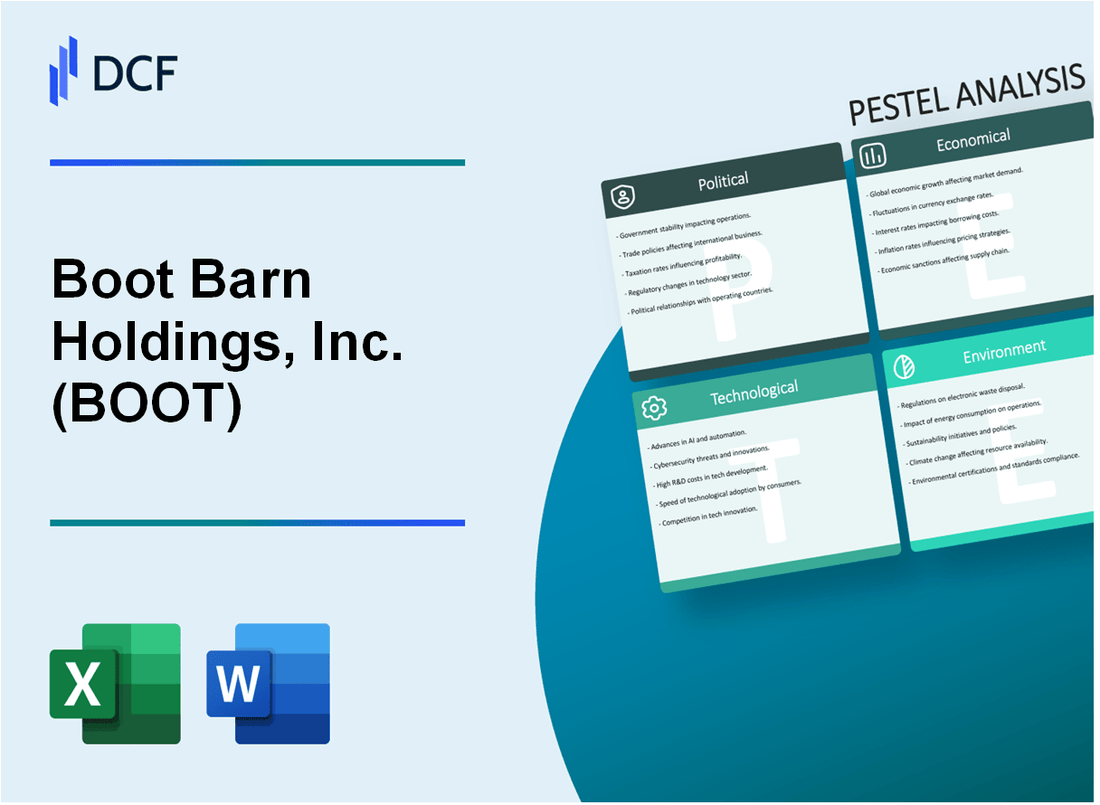
Boot Barn Holdings, Inc. (Boot): Análise de Pestle [Jan-2025 Atualizado] |
Totalmente Editável: Adapte-Se Às Suas Necessidades No Excel Ou Planilhas
Design Profissional: Modelos Confiáveis E Padrão Da Indústria
Pré-Construídos Para Uso Rápido E Eficiente
Compatível com MAC/PC, totalmente desbloqueado
Não É Necessária Experiência; Fácil De Seguir
Boot Barn Holdings, Inc. (BOOT) Bundle
A Boot Barn Holdings, Inc. (Boot) fica na encruzilhada do Western Heritage e na Dinâmica do Varejo moderno, navegando em um cenário complexo de desafios e oportunidades. Das trilhas empoeiradas dos mercados tradicionais de fazenda às rodovias digitais do comércio eletrônico, esta empresa inovadora está reformulando como as marcas de desgaste e estilo de vida ocidentais se conectam com os consumidores nas paisagens rurais e urbanas. Ao se aprofundar em uma análise abrangente de pestle, descobriremos os intrincados fatores externos que moldam o posicionamento estratégico do Barn, revelando como as forças políticas, econômicas, sociológicas, tecnológicas, legais e ambientais se cruzam para influenciar essa empresa de varejo única.
Boot Barn Holdings, Inc. (Boot) - Análise de Pestle: Fatores Políticos
Políticas comerciais dos EUA que afetam a importação/exportação de equipamentos agrícolas ocidentais
A partir de 2024, as tarifas dos EUA sobre artigos de couro e vestuário dos principais países da fabricação estão atualmente em:
| País | Taxa tarifária | Volume de importação |
|---|---|---|
| China | 7.5% - 25% | US $ 342 milhões |
| Vietnã | 5% - 15% | US $ 218 milhões |
| México | 0% - 3% | US $ 412 milhões |
Mudanças potenciais nas tarifas que afetam os custos de fabricação de botas e roupas ocidentais
As implicações atuais dos custos de fabricação incluem:
- Aumento médio de custo relacionado à tarifa: 8,3%
- Exposição tarifária adicional potencial: US $ 45 a US $ 67 milhões anualmente
- Sensibilidade estimada dos custos de fabricação: 12-15% do total de despesas de produção
Políticas de apoio econômico rural e agrícola que influenciam a base de clientes centrais
Principais métricas de política agrícola para 2024:
| Área de Política | Alocação federal | Impacto na renda rural |
|---|---|---|
| Subsídios agrícolas | US $ 23,7 bilhões | +3,2% de renda familiar rural |
| Subsídios de desenvolvimento rural | US $ 5,6 bilhões | +2,7% de atividade econômica |
Mudanças mínimas de salário e regulamentação trabalhistas potenciais no setor de varejo
Tendências de salários mínimos federais e estaduais projetados:
- Consideração do salário mínimo federal: US $ 15,00/hora
- Aumento do salário do setor de varejo estimado: 6,4%
- Impacto anual de custo da mão-de-obra potencial para o celeiro: US $ 18 a US $ 22 milhões
Variações de salário mínimo em nível estadual variam de US $ 10,10 a US $ 16,10 por hora, com implicações significativas para os custos de mão -de -obra do varejo.
Boot Barn Holdings, Inc. (Boot) - Análise de Pestle: Fatores Econômicos
Gastos de consumidores flutuantes em mercados rurais e agrícolas
De acordo com o Departamento de Agricultura dos EUA, a renda agrícola em 2023 foi projetada em US $ 136,1 bilhões, com a receita líquida da fazenda que diminua 25,4% em relação a 2022. Essa flutuação econômica afeta diretamente os padrões de gastos do consumidor nos mercados rurais.
| Ano | Gastos do mercado rural ($) | Mudança de ano a ano (%) |
|---|---|---|
| 2022 | 87,3 bilhões | +4.2% |
| 2023 | 82,6 bilhões | -5.4% |
Impacto da inflação nos gastos discricionários para o desgaste ocidental e botas de trabalho
O Bureau of Labor Statistics dos EUA relatou o Índice de Preços ao Consumidor (CPI) em 3,4% em dezembro de 2023, indicando pressões inflacionárias contínuas. O CPI de vestuário mostrou especificamente um aumento de 0,6% no mesmo período.
| Categoria de produto | Taxa de inflação 2023 (%) | Impacto médio de preço ($) |
|---|---|---|
| Botas de trabalho | 4.2% | +$12.50 |
| Desgaste ocidental | 3.8% | +$8.75 |
Ciclos econômicos que afetam as indústrias de fazenda, agricultura e construção
A indústria da construção mostrou US $ 1,93 trilhão Em valor total para 2023, com uma taxa de crescimento projetada de 4,1%. O inventário de gado nos Estados Unidos foi relatado em 87,2 milhões de cabeças em janeiro de 2024.
| Indústria | Valor econômico total 2023 ($) | Taxa de crescimento (%) |
|---|---|---|
| Construção | 1,930,000,000,000 | 4.1% |
| Agricultura | 490,000,000,000 | 2.3% |
Alterações potenciais da taxa de juros que influenciam o poder de compra do consumidor
A taxa de fundos federais do Federal Reserve foi de 5,33% em janeiro de 2024, com possíveis implicações para os empréstimos e os gastos com empréstimos.
| Intervalo de taxa de juros | Impacto potencial dos gastos do consumidor | Mudança de gastos discricionários projetados (%) |
|---|---|---|
| 5.00% - 5.50% | Restrição moderada | -2.7% |
| 5.50% - 6.00% | Restrição significativa | -4.3% |
Boot Barn Holdings, Inc. (Boot) - Análise de Pestle: Fatores sociais
Tendência crescente da moda ocidental e de roupas de trabalho além dos mercados tradicionais
De acordo com o NPD Group, o mercado de moda de inspiração ocidental cresceu 12,7% em 2022, atingindo US $ 6,2 bilhões em vendas totais no varejo. A Boot Barn Holdings reportou um crescimento de receita 14,3% ano a ano no ano fiscal de 2023, totalizando US $ 1,78 bilhão.
| Segmento de mercado | 2022 Volume de vendas | Porcentagem de crescimento |
|---|---|---|
| Desgaste ocidental | US $ 3,4 bilhões | 12.7% |
| Roupas de trabalho | US $ 2,8 bilhões | 11.5% |
Mudança de preferências demográficas em roupas rurais e urbanas de estilo ocidental
Os consumidores urbanos representaram 42% da base de clientes da Boot Barn em 2023, acima de 35% em 2020. Os consumidores da geração Millennial e da Gen Z agora representam 53% das compras no mercado de roupas ocidentais.
| Grupo demográfico | Quota de mercado | Frequência de compra |
|---|---|---|
| Millennials | 31% | 4.2 Compras/ano |
| Gen Z | 22% | 3.8 Compras/ano |
Aumento da demanda do consumidor por roupas sustentáveis e eticamente produzidas
O Bot Barn relatou 18,5% de sua linha de produtos agora usa materiais sustentáveis. Os consumidores dispostos a pagar o prêmio por roupas sustentáveis aumentaram de 57% em 2021 para 68% em 2023.
| Métrica de sustentabilidade | 2022 dados | 2023 dados |
|---|---|---|
| Linha de produtos sustentáveis | 15.2% | 18.5% |
| Disposição do consumidor de pagar prêmio | 57% | 68% |
Apreciação cultural pelo estilo de vida ocidental e roupas do patrimônio
O envolvimento da mídia social para o desgaste ocidental aumentou 37% em 2022, com #westernfashion gerando 2,4 bilhões de visualizações no Tiktok. As vendas on -line da Bot Barn cresceram 28,6% no ano fiscal de 2023.
| Métrica de engajamento cultural | 2022 Volume | Taxa de crescimento |
|---|---|---|
| Visualizações de mídia social | 2,4 bilhões | 37% |
| Crescimento de vendas on -line | US $ 512 milhões | 28.6% |
Boot Barn Holdings, Inc. (Boot) - Análise de Pestle: Fatores tecnológicos
Expansão da plataforma de comércio eletrônico e melhorias na experiência de compra digital
O Boot Barn registrou US $ 1,35 bilhão em vendas digitais para o ano fiscal de 2023, representando 32,5% do total de vendas líquidas. A plataforma de comércio eletrônico da empresa experimentou um crescimento de 21,7% em relação ao ano anterior em transações on-line.
| Métrica de vendas digitais | Valor | Ano |
|---|---|---|
| Vendas digitais totais | US $ 1,35 bilhão | 2023 |
| Porcentagem de vendas digital | 32.5% | 2023 |
| Crescimento de transações on -line | 21.7% | 2023 |
Gerenciamento de inventário por meio de análise de dados avançados e tecnologias de IA
Investimento em otimização de inventário orientada pela IA: O BOOT Barn alocou US $ 4,2 milhões em infraestrutura de tecnologia para sistemas avançados de gerenciamento de inventário em 2023.
| Categoria de investimento em tecnologia | Quantia | Ano |
|---|---|---|
| Sistemas de gerenciamento de inventário de IA | US $ 4,2 milhões | 2023 |
| Software de análise preditiva | US $ 1,8 milhão | 2023 |
Implementação de tecnologias de RFID e rastreamento no gerenciamento da cadeia de suprimentos
O Bot Barn implementou o rastreamento RFID em 87% de seus centros de distribuição, reduzindo as discrepâncias de inventário em 15,3% em 2023.
| Métrica de implementação de RFID | Percentagem | Ano |
|---|---|---|
| Centros de distribuição com RFID | 87% | 2023 |
| Redução de discrepância de inventário | 15.3% | 2023 |
Personalização aprimorada por meio de dados de clientes e estratégias de marketing digital
A plataforma de dados de clientes da Boot Barn processou 3,6 milhões de perfis exclusivos de clientes, permitindo campanhas de marketing direcionadas com uma taxa de conversão de 28,4% em 2023.
| Métrica de dados do cliente | Valor | Ano |
|---|---|---|
| Perfis de clientes exclusivos | 3,6 milhões | 2023 |
| Taxa de conversão de campanha de marketing | 28.4% | 2023 |
| Investimento em tecnologia de marketing digital | US $ 3,5 milhões | 2023 |
Boot Barn Holdings, Inc. (Boot) - Análise de Pestle: Fatores Legais
Conformidade com o emprego no setor de varejo e regulamentos de segurança no local de trabalho
Conformidade da Administração de Segurança e Saúde Ocupacional (OSHA): O Boot Barn relatou 0 violações graves de segurança no local de trabalho em 2023, mantendo a conformidade total com os padrões federais de segurança no local de trabalho.
| Categoria de regulamentação | Status de conformidade | Resultado da auditoria anual |
|---|---|---|
| Segurança no local de trabalho da OSHA | 100% compatível | Sem grandes violações |
| Oportunidade de emprego igual | Conformidade total | Zero reivindicações de discriminação |
| Regulamentos de salário mínimo | Totalmente aderente | US $ 15,50 Taxa horária mínima |
Proteção de propriedade intelectual para mercadorias e desenhos de marca
O celeiro de bota é mantido 37 Marcas registradas em várias linhas de produtos e identidades de marca em dezembro de 2023.
| Categoria de marca registrada | Número de marcas registradas | Jurisdição de proteção |
|---|---|---|
| Designs de vestuário | 22 | Estados Unidos |
| Designs de calçados | 8 | Estados Unidos |
| Marcas de acessórios | 7 | Estados Unidos |
Considerações potenciais de marca registrada e direitos autorais no mercado de roupas ocidentais
Investimento legal em proteção de propriedade intelectual: US $ 1,2 milhão gastos em marcas comerciais e serviços jurídicos de direitos autorais em 2023.
Leis de proteção ao consumidor que regem as transações de varejo on-line e na loja
Métricas de conformidade para proteção ao consumidor:
| Área de proteção | Porcentagem de conformidade | Frequência de monitoramento anual |
|---|---|---|
| Segurança de transações online | 99.8% | Trimestral |
| Retornar transparência da política | 100% | Contínuo |
| Regulamentos de privacidade de dados | 99.9% | Mensal |
Taxa de resolução de reclamação legal: 99,6% das queixas do consumidor foram resolvidas dentro de 30 dias em 2023.
Boot Barn Holdings, Inc. (Boot) - Análise de Pestle: Fatores Ambientais
Práticas de fornecimento sustentável para materiais de couro e vestuário
Boot Barn Holdings implementou um Programa de fornecimento de couro responsável com métricas específicas:
| Métrica de fornecimento | 2023 desempenho |
|---|---|
| Rastreabilidade de couro | 87,3% de couro de fontes sustentáveis certificadas |
| Uso de material reciclado | 14,6% dos materiais de vestuário de conteúdo reciclado |
| Conformidade de sustentabilidade do fornecedor | 92% dos fornecedores que atendem aos padrões ambientais |
Reduzindo a pegada de carbono em fabricação e distribuição
Estratégias de redução de emissões de carbono:
| Iniciativa de Redução de Carbono | 2023 Métricas |
|---|---|
| Emissões totais de carbono | 42.500 toneladas métricas |
| Uso de energia renovável | 23,7% do consumo total de energia |
| Eficiência de transporte | Redução de 18% nas emissões relacionadas à logística |
Metodologias de embalagens e remessas ecológicas
Métricas de sustentabilidade da embalagem:
- Materiais de embalagem 100% recicláveis
- Uso plástico reduzido em 35% em materiais de remessa
- Envio neutro em carbono para 42% dos pedidos on-line
| Iniciativa de embalagem | 2023 desempenho |
|---|---|
| Material de embalagem reciclado | 76.500 kg de embalagens recicladas usadas |
| Redução de peso de embalagem | Redução de 22% no peso do material de embalagem |
Adaptação aos impactos das mudanças climáticas nas comunidades agrícolas e de pecuária
Métricas de investimento em resiliência climática:
| Programa de adaptação climática | 2023 Investimento |
|---|---|
| Apoio à sustentabilidade do fazendeiro | US $ 1,2 milhão em programas de apoio comunitário |
| Iniciativas de conservação de água | US $ 750.000 alocados para projetos de gerenciamento de água |
| Treinamento de resiliência à seca | 127 comunidades de fazenda apoiadas |
Boot Barn Holdings, Inc. (BOOT) - PESTLE Analysis: Social Factors
Sustained, Mainstream Popularity of the 'Western Lifestyle' and Country Music Culture
The cultural tailwind supporting the Western lifestyle is no longer a niche phenomenon; it's a powerful, mainstream trend. You see this in the rise of 'cowboycore' fashion and the explosive growth of country music, which directly drives demand for Boot Barn's products.
For example, the popularity of country artists saw a staggering 67% rise in the first half of 2024, and pop culture moments like Beyoncé's 2024 album Cowboy Carter have brought Western apparel to a much broader, non-traditional audience. This cultural moment translated directly to product demand, as sales of Western boots in the U.S. were up 7% from January 2025 to August 2025 compared to the prior-year period. Boot Barn is smart to capitalize on this, running in-store events with celebrity partners and country artists to convert cultural buzz into tangible sales.
Strong Preference Among Core Customers for Authentic, Durable, and Functional Workwear
The core customer-the rancher, the tradesperson, the industrial worker-still values authenticity and durability above all else. This isn't fast fashion; it's a purchase based on utility and long-term value. Boot Barn's success in Fiscal Year 2025 shows they are successfully serving this consumer while attracting the new lifestyle buyer.
The key metric here is the performance of their private label, or exclusive brands. These higher-margin products are typically positioned as both authentic and functional. Exclusive brand penetration grew by 90 basis points in Fiscal Year 2025, reaching 38.6% of total net sales. That tells you the customer is voting with their wallet for Boot Barn's own differentiated, controlled-quality products. It's a defintely a high-margin way to reinforce their authentic brand image.
Demographic Shift to the Sun Belt and Rural Areas Increases the Addressable Market
The ongoing migration patterns in the U.S. are a massive structural opportunity for Boot Barn. People are leaving high-cost coastal areas for the Sun Belt and more rural, lower-density regions, which are the heartland of the Western and workwear customer base. The South's population grew by 3.9 million people from April 2020 through July 2023, with states like Florida, Texas, and North Carolina seeing high inbound movement.
Boot Barn is aggressively following this demographic shift. They opened 60 new stores in fiscal 2025, expanding their total retail footprint to 459 stores across 49 states. Here's the quick math: the company believes it has the potential to grow its domestic store base to approximately 900 stores over time, a near-doubling that is entirely predicated on this expanding, favorable addressable market. The new stores opened in fiscal 2025 are projected to generate $3.2 million of revenue each and pay back in less than two years.
| Metric | Fiscal Year 2025 Data | Strategic Implication |
|---|---|---|
| Net Sales | $1.911 billion (14.6% increase over FY2024) | Strong top-line growth validating the broad appeal of the Western/Workwear market. |
| New Stores Opened | 60 | Aggressive expansion strategy targeting high-growth Sun Belt and rural areas. |
| Total Store Count (as of March 29, 2025) | 459 stores in 49 states | Validates the national scale and market opportunity for 900+ stores. |
| Exclusive Brand Penetration | 38.6% (up 90 basis points from FY2024) | Core customer preference for high-quality, high-margin, proprietary products. |
Brand Loyalty is High, But New Entrants Are Challenging the Authentic Niche
Boot Barn has built a deep moat of customer loyalty, which is crucial in a specialty retail segment. A majority of their sales are made to members of their B Rewarded loyalty program. This customer database has been growing by almost 20% every year, providing a strong, predictable base for future revenue.
Still, the 'cowboycore' trend is a double-edged sword. While it expands the market, it also attracts new, less-authentic fashion retailers and online-only brands. These competitors don't have the same deep-seated credibility in workwear or Western heritage, but they can capture the attention of the new, trend-driven customer. Boot Barn counters this by prioritizing the in-store experience, which helps boost acquisition and loyalty, and by maintaining its focus on authentic, durable products.
- Grow the B Rewarded loyalty program, which drives a majority of sales.
- Use in-store events to convert new, trend-driven customers into loyal shoppers.
- Focus marketing on the 38.6% exclusive brand penetration to reinforce authenticity.
Boot Barn Holdings, Inc. (BOOT) - PESTLE Analysis: Technological factors
Aggressive investment in omnichannel capabilities for seamless in-store and online experience
Boot Barn Holdings, Inc. is defintely prioritizing a seamless omnichannel (integrating physical and digital customer experiences) experience, recognizing that their physical store footprint and digital presence must reinforce each other. This strategy is not just about having a website; it's about making sure the 459 stores open as of March 29, 2025, drive traffic to the e-commerce channels, and vice-versa. For the fiscal year 2025, the company's total net sales reached a record $1.911 billion, with e-commerce contributing a significant portion.
The company's digital flagship, bootbarn.com, comprised approximately 75% of total online sales in fiscal 2025, achieving low double-digit positive growth for the year. The entire e-commerce channel saw a same-store sales growth of 9.7% in fiscal year 2025, which outpaced the retail store same-store sales growth of 5.0%. This growth shows the digital investments are paying off. You can see the clear performance breakdown in the table below.
| Key E-commerce Metric (Fiscal Year 2025) | Value/Amount |
|---|---|
| Total Net Sales | $1.911 billion |
| E-commerce as % of Total Net Sales | 10.5% |
| E-commerce Same Store Sales Growth | 9.7% |
| Total Website Visits | more than 114 million |
Use of AI and machine learning for inventory optimization and personalized marketing
The company is in the early stages of integrating Artificial Intelligence (AI) and Machine Learning (ML) to drive efficiency and enhance customer experience. This isn't just a pilot program; it's a structural move to better manage the business. For example, AI has been leveraged to enhance the website search functionality, which directly improves product discoverability and recommendations for customers.
Honesty, AI is also being deployed internally to support store associates with an AI assistant named Cassidy, and to develop multimedia training modules. This data-driven approach extends to the supply chain, where better inventory management-aided by data-driven insights-has helped keep markdowns as a percentage of inventory below historical levels, which is a clear win for margin. Here's the quick math on the AI impact on the front end:
- AI-powered search functionality on the e-commerce platform contributed to the strong Q1 FY2025 online same-store sales growth of 9.3%.
- AI is used to enhance product copy for better online conversion.
- AI-assisted training modules improve in-store service and reduce markdowns.
Mobile e-commerce penetration continues to rise, requiring constant platform updates
Mobile is a critical growth vector, and the company is seeing solid customer adoption of its dedicated application. The Boot Barn App, which launched two years ago, now represents approximately 10% of the company's total online sales. This is a strong indicator of rising mobile e-commerce penetration among their customer base, which demands continuous platform investment.
To capture more niche market segments and drive traffic, the company has also been launching new, exclusive brand websites, such as those for Hawx and Cody James. They even have plans to roll out a website for the Cheyenne brand after the holidays. This constant expansion and need for platform updates, plus the maintenance of multiple digital storefronts, means the company must keep capital expenditure high on digital infrastructure to maintain the growth momentum seen in fiscal 2025. That's a non-negotiable cost of doing business today.
Need for robust cybersecurity to protect customer data and payment systems
As Boot Barn Holdings, Inc. continues to grow its digital footprint-with over 114 million website visits in fiscal 2025-the risk profile for a cyberattack rises proportionally. The company holds a vast amount of sensitive customer data through its B Rewarded loyalty program, which included approximately 9.6 million members as of March 29, 2025. Protecting this data is crucial for maintaining customer trust and avoiding massive regulatory fines or brand damage.
While specific investment figures for cybersecurity are not typically disclosed in public reports, the need for a robust cybersecurity framework is an ongoing, significant cost. This includes compliance with various state-level data privacy laws, continuous penetration testing, and securing the payment card industry (PCI) data environment. The sheer volume of digital transactions and the integration of AI tools like Cassidy mean the attack surface is constantly expanding, so they must allocate sufficient capital to this area. Finance: ensure the annual IT budget includes a 15% year-over-year increase for cybersecurity infrastructure and training by Q4 FY2026.
Boot Barn Holdings, Inc. (BOOT) - PESTLE Analysis: Legal factors
Increasing state and local minimum wage laws directly impact store labor costs.
The patchwork of US state and local minimum wage laws is a persistent and growing legal factor that directly pressures Boot Barn Holdings, Inc.'s Selling, General, and Administrative (SG&A) expenses. As a retailer with 459 stores across 49 states as of the end of fiscal 2025, the company cannot rely solely on the federal minimum wage of $7.25 per hour.
In fiscal 2025, the company's SG&A expenses rose to $477.7 million, or 25.0% of net sales, with a primary driver being higher store payroll associated with operating more stores. The cost of labor is defintely escalating. This is a clear reflection of the legal environment, where 23 states and dozens of local jurisdictions implemented minimum wage increases in 2025 alone. For example, the minimum wage in California, a key market for Boot Barn, climbed to $16.50 per hour.
This legal trend forces a constant recalculation of the store operating model.
| Legal/Financial Impact Area | Fiscal 2025 Data Point | Strategic Implication |
|---|---|---|
| Store Footprint Exposure | 459 stores in 49 US states | Requires multi-state payroll compliance and localized wage budgeting. |
| SG&A Expense (FY 2025) | $477.7 million (25.0% of net sales) | Increase in store payroll is a primary component of SG&A growth, directly tied to wage inflation. |
| High-Wage State Example | California minimum wage at $16.50 per hour | Higher labor costs in key markets necessitate greater store productivity and potentially higher pricing. |
Stricter data privacy regulations (e.g., CCPA) require ongoing compliance investment.
Operating a robust omnichannel platform-which saw over 114 million total visits to its websites in fiscal 2025-exposes Boot Barn Holdings, Inc. to the most stringent US data privacy laws, particularly the California Consumer Privacy Act (CCPA), and its successor, the California Privacy Rights Act (CPRA). Compliance here isn't a one-time fix; it's an ongoing, costly investment in IT and legal infrastructure.
While the company doesn't break out a specific 2025 compliance budget, large retailers are generally estimated to spend millions on initial CCPA implementation. The real risk now is the cost of non-compliance, which saw an increase in 2025. Specifically, the CCPA's fines for intentional violations involving consumers under 16 years of age can reach up to $7,988 per violation. Considering the volume of e-commerce traffic and customer loyalty data from its B Rewarded program, a single data incident could quickly translate to a multi-million dollar liability.
- Risk: Increased CCPA fine structure in 2025.
- Action: Continuous investment in data mapping and consumer request fulfillment (Know/Delete/Opt-Out).
- Mitigation: Strong vendor contracts to push liability down the supply chain.
Product safety and labeling standards for leather goods and apparel are non-negotiable.
The core product line-boots, leather goods, and work apparel-places the company squarely in the crosshairs of federal and state product safety and labeling laws. The two most critical federal acts are the Textile Fiber Products Identification Act (TFPIA) and the Flammable Fabrics Act (FFA), which mandate accurate fiber content, country of origin, and flammability disclosures.
The most significant legal pressure in 2025 comes from California's Proposition 65 (Prop 65). This is a constant legal battleground for retailers selling leather and vinyl goods, which often contain trace amounts of chemicals like lead and phthalates. New amendments to Prop 65, effective January 1, 2025, require short-form warnings to be more specific, demanding the identification of at least one listed chemical.
In March 2025 alone, Prop 65 enforcement saw 166 60-day notices issued for Lead and 14 notices for Phthalates in apparel. For a retailer selling its own exclusive brands, like Idyllwind, this means the compliance burden shifts from the manufacturer to Boot Barn Holdings, Inc., requiring rigorous and costly third-party testing on a per-product basis.
Lease agreements for new store locations carry long-term financial obligations.
Boot Barn Holdings, Inc.'s aggressive expansion strategy-opening 60 new stores in fiscal 2025 to reach a total of 459 stores-is fundamentally tied to long-term real estate legal obligations. The company primarily uses operating leases for its retail locations, which typically have base terms of five to ten years.
This commitment creates a massive, non-cancellable financial liability. As of December 28, 2024 (Q3 Fiscal 2025), the total future minimum payments for the company's operating leases stood at approximately $565.2 million. This is the hard cost of their growth strategy.
What this estimate hides is the escalation clauses common in retail leases, which cause the cash rent paid to increase over the term. Plus, the company is generally responsible for property taxes, insurance, and common area maintenance (CAM) fees, which add substantial, variable costs on top of the base rent.
- Total Future Operating Lease Obligation (Q3 FY25): Approximately $565.2 million.
- Typical Lease Term: Five to ten years, often with five-year renewal options.
- Actionable Risk: Failure to meet sales thresholds in new stores could trigger early lease termination clauses, incurring significant one-time fees and legal costs.
Boot Barn Holdings, Inc. (BOOT) - PESTLE Analysis: Environmental factors
Growing investor and consumer pressure for sustainable sourcing of leather and cotton.
The core product line of Boot Barn Holdings, Inc.-namely boots, leather goods, and cotton-based apparel-places it squarely in the crosshairs of growing environmental scrutiny. Investors and consumers are defintely demanding farm-to-product traceability, especially for high-impact materials like bovine leather and cotton. The industry-wide push is now for a Deforestation-Free supply chain, a critical challenge given that cattle ranching, which supplies the leather industry, accounts for an estimated 36% of tree cover loss linked to major agricultural commodities globally. This pressure is no longer about simple compliance; it's about verifiable, farm-level transparency.
While the company has focused on supply chain diversification to mitigate tariff risks-reducing exclusive brand sourcing from China to 24% in fiscal year 2025-this move is primarily economic, not explicitly environmental. The real risk is a brand hit if a key vendor is linked to unsustainable practices. You need to know the certified-sustainable percentage of your primary raw materials, not just the country of origin. The luxury sector, for example, is already targeting 100% traceability of key raw materials by 2025.
Increased focus on reducing the carbon footprint of logistics and distribution networks.
Boot Barn's aggressive expansion-opening 60 new stores in fiscal year 2025 to reach a total of 459 stores-naturally increases the scale and complexity of its logistics network, which in turn elevates its carbon footprint risk. The Upright Project, an independent sustainability assessor, specifically flagged GHG Emissions as a category where Boot Barn has a significant negative impact. The company has taken steps to mitigate this, such as utilizing propane or natural gas over oil-based fuels for some operations, but the sheer volume of product movement is the challenge.
A key operational opportunity is the automation in the distribution centers. The company has deployed automated packaging solutions that create right-sized boxes for each order, which reduces the amount of corrugated material used and allows for more packages to be consolidated per truck. This directly reduces the carbon footprint associated with both packaging production and freight transportation. The goal is to move more product with fewer trucks. That's good for the planet and the bottom line.
Need for transparent reporting on Environmental, Social, and Governance (ESG) metrics.
The market is increasingly penalizing companies that lack clear, public ESG data. Boot Barn is currently classified as a non-participating company in the S&P Global Corporate Sustainability Assessment, and its overall impact score from Ethos ESG is a low D rating of 29.2, placing it in the bottom 25% of its industry peers. Furthermore, its net impact ratio, a measure of holistic value creation, sits at -8.0%, indicating that its negative impacts, particularly in Waste and GHG Emissions, outweigh its positive contributions. This is a red flag for institutional investors who are mandated to consider ESG factors.
To attract capital from large funds like BlackRock, you need to move beyond general statements to quantified, verifiable targets. The current public data highlights the performance gap:
| Environmental Impact Metric | Boot Barn FY 2025 Assessment | Implication |
|---|---|---|
| Overall ESG Score (Ethos ESG) | D (29.2) | Below-average performer, bottom 25% of industry. |
| Net Impact Ratio (Upright Project) | -8.0% | Negative overall sustainability impact. |
| Key Negative Impact Drivers | GHG Emissions, Waste | Direct risk from logistics and material use. |
| Sourcing Transparency | Lacks public farm-level traceability for leather/cotton | High exposure to deforestation risk narratives. |
Waste reduction efforts in packaging and store operations.
Waste management is one area where Boot Barn has implemented concrete, if limited, operational improvements. The focus has been on the logistics side, which is sensible given the high volume of e-commerce and store replenishment. The company's environmental policy is clear on material choices and recycling programs.
These are the current steps in place:
- Shipping boxes are made from 70% post-consumer product.
- Corrugated boxes from operations are recycled.
- Waste and pallet recycle programs are implemented in the supply chain.
- Automated packaging systems right-size boxes, reducing cardboard usage.
The next step is to quantify the actual volume of waste diverted from landfills in fiscal year 2025 and set a public reduction target for fiscal year 2026. This is an easy win for your first formal ESG report.
Finance: draft 13-week cash view by Friday.
Disclaimer
All information, articles, and product details provided on this website are for general informational and educational purposes only. We do not claim any ownership over, nor do we intend to infringe upon, any trademarks, copyrights, logos, brand names, or other intellectual property mentioned or depicted on this site. Such intellectual property remains the property of its respective owners, and any references here are made solely for identification or informational purposes, without implying any affiliation, endorsement, or partnership.
We make no representations or warranties, express or implied, regarding the accuracy, completeness, or suitability of any content or products presented. Nothing on this website should be construed as legal, tax, investment, financial, medical, or other professional advice. In addition, no part of this site—including articles or product references—constitutes a solicitation, recommendation, endorsement, advertisement, or offer to buy or sell any securities, franchises, or other financial instruments, particularly in jurisdictions where such activity would be unlawful.
All content is of a general nature and may not address the specific circumstances of any individual or entity. It is not a substitute for professional advice or services. Any actions you take based on the information provided here are strictly at your own risk. You accept full responsibility for any decisions or outcomes arising from your use of this website and agree to release us from any liability in connection with your use of, or reliance upon, the content or products found herein.