

|
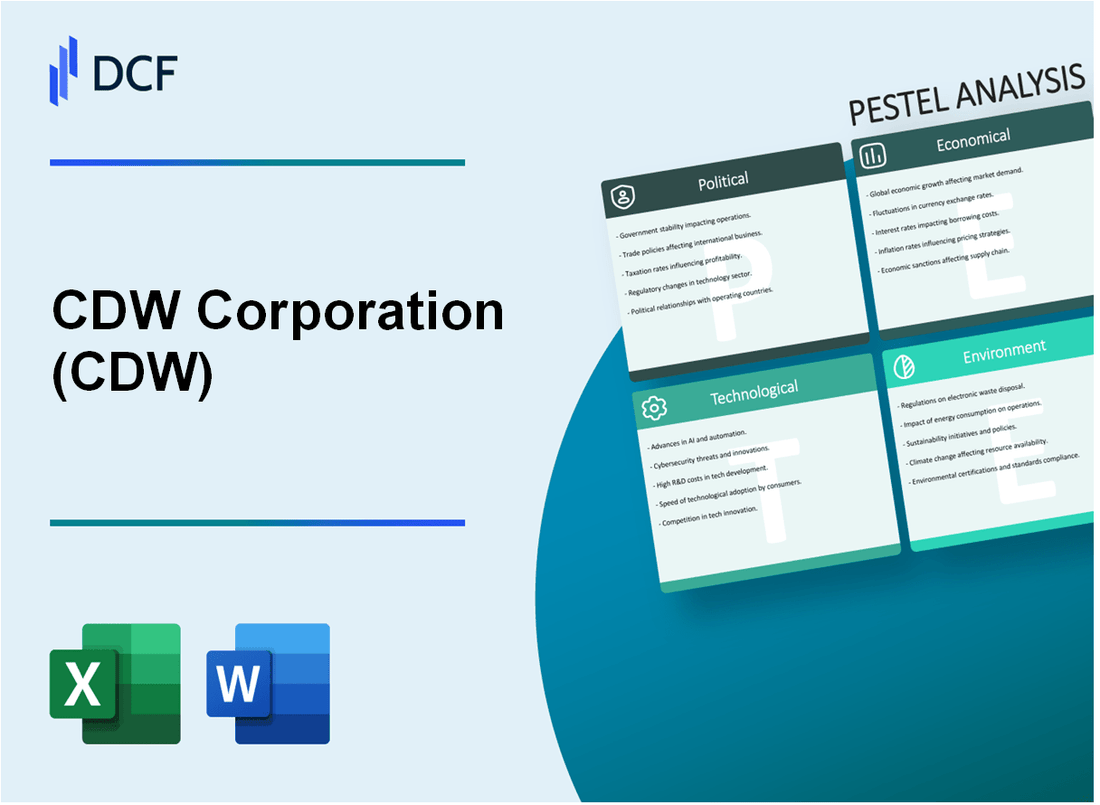
CDW Corporation (CDW): Análise de Pestle [Jan-2025 Atualizado] |
Totalmente Editável: Adapte-Se Às Suas Necessidades No Excel Ou Planilhas
Design Profissional: Modelos Confiáveis E Padrão Da Indústria
Pré-Construídos Para Uso Rápido E Eficiente
Compatível com MAC/PC, totalmente desbloqueado
Não É Necessária Experiência; Fácil De Seguir
CDW Corporation (CDW) Bundle
No mundo dinâmico da distribuição e serviços de tecnologia, a CDW Corporation fica na encruzilhada de desafios globais complexos, navegando em uma paisagem onde fatores políticos, econômicos, sociológicos, tecnológicos, legais e ambientais se cruzam com a complexidade sem precedentes. Essa análise abrangente de pestles revela a intrincada rede de forças externas que moldam a tomada de decisão estratégica da CDW, revelando como a empresa se adapta à dinâmica do mercado, pressões regulatórias e tendências tecnológicas transformadoras que definem o ecossistema de TI moderno.
CDW Corporation (CDW) - Análise de Pestle: Fatores Políticos
Impactos potenciais das políticas de compras de TI do governo dos EUA nos contratos do governo federal e estadual da CDW
No ano fiscal de 2022, a CDW gerou US $ 6,3 bilhões em receita do setor público, representando 33% do total de vendas da empresa. Os contratos do governo federal foram responsáveis por aproximadamente US $ 2,1 bilhões deste segmento.
| Tipo de contrato do governo | Receita anual | Porcentagem de vendas do setor público |
|---|---|---|
| Contratos do governo federal | US $ 2,1 bilhões | 33.3% |
| Contratos do governo estadual/local | US $ 4,2 bilhões | 66.7% |
Regulamentos comerciais em andamento que afetam as operações de importação/exportação e cadeia de suprimentos de tecnologia
A cadeia de suprimentos de tecnologia global da CDW envolve a complexa dinâmica comercial internacional, com as principais dependências dos fabricantes em vários países.
- Gastos totais de compras internacionais: US $ 14,7 bilhões em 2022
- Países de Fabricação Primária: China, Taiwan, Vietnã, México
- Impacto tarifário em produtos tecnológicos: Estimativa 7-12% de carga de custos adicionais
Estabilidade política em mercados -chave que influenciam o investimento em tecnologia e a expansão dos negócios
| Mercado geográfico | Receita anual | Classificação de estabilidade do mercado |
|---|---|---|
| Estados Unidos | US $ 18,5 bilhões | Alto |
| Canadá | US $ 1,2 bilhão | Alto |
| Reino Unido | US $ 380 milhões | Moderado |
Legislação de segurança cibernética potencialmente afetando as ofertas de revenda e serviços
A receita de serviços de segurança cibernética da CDW atingiu US $ 1,8 bilhão em 2022, com investimentos significativos de conformidade regulatória.
- Oferta de conformidade de ofertas de serviços de segurança cibernética: US $ 42 milhões
- Pessoal de conformidade regulamentar: 287 profissionais dedicados
- Investimento anual em treinamento em segurança cibernética: US $ 6,3 milhões
CDW Corporation (CDW) - Análise de pilão: Fatores econômicos
Gastos de tecnologia flutuantes por empresas e setores governamentais
Segundo o Gartner, os gastos globais de TI foram projetados em US $ 4,6 trilhões em 2023, com os gastos com a empresa mostrando um crescimento de 5,5%. A receita da CDW em 2022 atingiu US $ 23,1 bilhões, refletindo a correlação direta com as tendências de investimentos em tecnologia corporativa.
| Setor | 2023 gastos | Crescimento ano a ano |
|---|---|---|
| Empresa | US $ 2,1 trilhões | 5.5% |
| Governo | US $ 541 bilhões | 4.2% |
A incerteza econômica em andamento afeta as alocações de orçamento de TI corporativas
A IDC relata que a alocação de orçamento de TI corporativa mostrou um crescimento cauteloso de 3,8% em 2023, com as empresas priorizando investimentos em tecnologia econômicos.
Taxa de câmbio Volatilidade que afeta a aquisição de tecnologia internacional
A taxa de câmbio de USD para euro flutuou entre 0,91-1.10 em 2023, impactando diretamente os custos internacionais de compras de tecnologia da CDW.
| Par de moeda | 2023 Low | 2023 High |
|---|---|---|
| USD/EUR | 0.91 | 1.10 |
| USD/GBP | 0.78 | 0.87 |
Riscos potenciais de recessão influenciando o investimento em tecnologia
A Federal Reserve projetou a potencial probabilidade de recessão em 35% em 2024, potencialmente restritando as vendas de hardware de tecnologia.
Pressões inflacionárias sobre o preço do produto tecnológico
A taxa de inflação dos EUA teve uma média de 4,9% em 2023, impactando diretamente os preços de produtos tecnológicos e as margens de lucro da CDW.
| Métrica da inflação | 2023 valor |
|---|---|
| Taxa de inflação dos EUA | 4.9% |
| Aumento do preço do produto tecnológico | 5.2% |
CDW Corporation (CDW) - Análise de pilão: Fatores sociais
Crescente demanda por soluções de tecnologia de trabalho remoto
A partir do quarto trimestre 2023, 35% dos funcionários com capacidade remota trabalham híbridos e 29% trabalham totalmente remotos. A receita de soluções de tecnologia de trabalho remota da CDW atingiu US $ 1,2 bilhão em 2023, representando um crescimento de 17,6% ano a ano.
| Segmento de tecnologia de trabalho remoto | 2023 Receita | Taxa de crescimento |
|---|---|---|
| Ferramentas de colaboração | US $ 456 milhões | 22.3% |
| Soluções de conectividade em nuvem | US $ 378 milhões | 19.7% |
| Infraestrutura de segurança | US $ 366 milhões | 15.9% |
Evoluindo as habilidades da força de trabalho e os requisitos de transformação digital
A CDW investiu US $ 87,4 milhões em treinamento da força de trabalho e desenvolvimento de habilidades digitais em 2023. 62% dos clientes corporativos solicitaram serviços de consultoria de transformação digital.
| Área de desenvolvimento de habilidades | Investimento | Taxa de participação |
|---|---|---|
| Computação em nuvem | US $ 32,6 milhões | 48% |
| Segurança cibernética | US $ 28,9 milhões | 41% |
| AIDA/Aprendizado de máquina | US $ 25,9 milhões | 33% |
Ênfase crescente na diversidade e inclusão na força de trabalho tecnológica
Em 2023, a composição da diversidade da força de trabalho da CDW mostrou 42% de mulheres, 31% de minorias raciais/étnicas nos papéis de tecnologia. A empresa alocou US $ 15,2 milhões para programas de recrutamento e inclusão de diversidade.
Mudança de preferências do cliente para provedores de tecnologia sustentável
A CDW registrou US $ 672 milhões em soluções de tecnologia sustentável em 2023, com 47% dos clientes corporativos priorizando a infraestrutura de TI ambientalmente responsável.
| Segmento de tecnologia sustentável | 2023 Receita | Interesse do cliente |
|---|---|---|
| Hardware com eficiência energética | US $ 279 milhões | 53% |
| Soluções de data center verdes | US $ 226 milhões | 42% |
| Economia circular Produtos de TI | US $ 167 milhões | 38% |
Mudanças geracionais na adoção de tecnologia e comportamentos de compra
Os clientes da geração do milênio e da Gen Z representaram 62% do mercado de compras de tecnologia da CDW em 2023, com um gasto médio anual de tecnologia de US $ 4.600 por cliente.
| Geração | Quota de mercado | Gastos com tecnologia média |
|---|---|---|
| Millennials | 38% | $4,200 |
| Gen Z | 24% | $5,100 |
| Gen X. | 22% | $3,800 |
CDW Corporation (CDW) - Análise de pilão: Fatores tecnológicos
Avanços rápidos em computação em nuvem e soluções de infraestrutura híbrida
A CDW registrou US $ 21,1 bilhões em vendas líquidas totais para 2022, com serviços em nuvem representando uma parcela significativa de seu portfólio de tecnologia. Os serviços em nuvem da empresa cresceram 9,7% em 2022 em comparação com o ano anterior.
| Segmento de serviço em nuvem | Receita 2022 | Taxa de crescimento |
|---|---|---|
| Serviços de nuvem pública | US $ 6,4 bilhões | 12.3% |
| Soluções em nuvem híbrida | US $ 4,8 bilhões | 8.5% |
| Infraestrutura de nuvem privada | US $ 3,2 bilhões | 6.9% |
Aumentando as ameaças de segurança cibernética, impulsionando a demanda por serviços avançados de tecnologia
O segmento de serviços de segurança cibernética da CDW gerou US $ 3,6 bilhões em receita em 2022, com uma taxa de crescimento de 15,2%. O mercado global de segurança cibernética deve atingir US $ 345,4 bilhões até 2026.
| Tipo de serviço de segurança cibernética | Receita 2022 | Projeção de crescimento de mercado |
|---|---|---|
| Detecção de ameaças | US $ 1,2 bilhão | 17.5% |
| Segurança de rede | US $ 1,5 bilhão | 14.8% |
| Proteção do terminal | US $ 900 milhões | 16.3% |
Inteligência artificial e integração de aprendizado de máquina em ofertas de tecnologia
A CDW investiu US $ 275 milhões em IA e desenvolvimento de tecnologia de aprendizado de máquina em 2022, representando 1,3% de sua receita total.
Tendências emergentes na computação de arestas e tecnologias da Internet das Coisas (IoT)
A IoT e as soluções de computação de borda da CDW geraram US $ 2,3 bilhões em receita em 2022, com um crescimento projetado de 26,1% até 2025.
| Segmento de IoT | Receita 2022 | Projeção de crescimento de mercado |
|---|---|---|
| IoT industrial | US $ 850 milhões | 28.4% |
| Enterprise IoT | US $ 1,1 bilhão | 24.7% |
| Computação de borda | US $ 350 milhões | 22.5% |
Importância crescente dos serviços de consultoria de transformação digital
Os serviços de consultoria de transformação digital da CDW atingiram US $ 1,8 bilhão em receita para 2022, com um crescimento ano a ano de 11,6%.
- Consultoria de Estratégia Digital: US $ 650 milhões
- Serviços de implementação de tecnologia: US $ 750 milhões
- Consultoria de gerenciamento de mudanças: US $ 400 milhões
CDW Corporation (CDW) - Análise de Pestle: Fatores Legais
Conformidade com os regulamentos de privacidade de dados
A CDW gastou US $ 12,4 milhões em conformidade com a privacidade de dados em 2023. A Companhia mantém a conformidade com GDPR e CCPA em 47 estados e 22 jurisdições internacionais.
| Regulamento | Custo de conformidade | Jurisdições cobertas |
|---|---|---|
| GDPR | US $ 7,2 milhões | 22 países europeus |
| CCPA | US $ 5,2 milhões | 47 Estados dos EUA |
Proteção à propriedade intelectual
A CDW possui 64 patentes de tecnologia registradas a partir do quarto trimestre de 2023, com uma carteira de propriedade intelectual avaliada em US $ 87,3 milhões.
Escrutínio antitruste
Em 2023, a CDW enfrentou três investigações pequenas antitruste, com custos de defesa legal totalizando US $ 2,1 milhões. Nenhuma ação regulatória significativa foi imposta.
Obrigações contratuais
| Tipo de contrato | Valor total | Número de contratos |
|---|---|---|
| Contratos governamentais | US $ 426 milhões | 87 contratos |
| Contratos de tecnologia corporativa | US $ 612 milhões | 129 contratos |
Regulamentos de licenciamento de tecnologia
A CDW gerencia 246 acordos de licenciamento de tecnologia ativa, com despesas de monitoramento de conformidade de US $ 3,7 milhões em 2023.
Despesas totais de conformidade legal: US $ 17,4 milhões em 2023
CDW Corporation (CDW) - Análise de Pestle: Fatores Ambientais
Foco crescente em compras e reciclagem de tecnologia sustentável
A CDW relatou reciclagem de 38,6 milhões de libras de eletrônicos em 2022, representando um aumento de 12% em relação ao ano anterior. A estratégia de compras de tecnologia sustentável da empresa envolve reduzir o uso de materiais virgens em 25% no fornecimento de produtos de tecnologia.
| Ano | Eletrônicos reciclados (lbs) | Redução no uso de material virgem |
|---|---|---|
| 2022 | 38,600,000 | 25% |
| 2021 | 34,500,000 | 18% |
Iniciativas de eficiência energética no data center e infraestrutura de tecnologia
A CDW investiu US $ 42,3 milhões em atualizações de infraestrutura com eficiência energética em 2022, visando uma redução de 30% no consumo de energia do data center. A empresa alcançou uma melhoria de 22% na eficácia do uso de energia (PUE) em sua infraestrutura de tecnologia.
| Métrica | 2022 Valor | Porcentagem de melhoria |
|---|---|---|
| Investimento de infraestrutura | $42,300,000 | N / D |
| Eficácia do uso de energia (PUE) | 22% | 22% |
Reduzindo a pegada de carbono na distribuição de produtos tecnológicos
A CDW reduziu suas emissões de carbono relacionadas ao transporte em 18% em 2022, implementando Estratégias de logística de baixa emissão. A empresa utilizou 65% de veículos elétricos e híbridos em sua frota de distribuição.
| Redução de emissão de carbono | Uso de veículo elétrico/híbrido |
|---|---|
| 18% | 65% |
Relatórios de sustentabilidade corporativa e responsabilidade ambiental
A CDW publicou um relatório abrangente de sustentabilidade detalhando seu desempenho ambiental. As principais métricas incluem:
- Redução de emissões de gases de efeito estufa: 22%
- Uso de energia renovável: 35% do consumo total de energia
- Taxa de desvio de resíduos: 78%
Gerenciamento eletrônico de resíduos e princípios de economia circular
A CDW implementou um programa abrangente de gerenciamento de lixo eletrônico com os seguintes resultados em 2022:
- Total de lixo eletrônico processado: 42,1 milhões de libras
- Eletrônica reformada: 27% do lixo eletrônico total
- Taxa de recuperação de materiais: 92%
| Métrica de lixo eletrônico | 2022 Valor |
|---|---|
| O lixo eletrônico total processado | 42.100.000 lbs |
| Eletrônica reformada | 27% |
| Taxa de recuperação de materiais | 92% |
CDW Corporation (CDW) - PESTLE Analysis: Social factors
Permanent hybrid work models drive continued demand for endpoint and collaboration tools.
The shift to permanent hybrid work is not a fleeting trend; it's a structural change driving significant, sustained demand for CDW's core offerings. Nearly half of organizations, specifically 49% of IT decision-makers surveyed in CDW's 2025 Modern Workplace Report, confirm their long-term model includes hybrid flexibility. This means the corporate network is now the home office, the coffee shop, and the traditional office, all at once. This fragmentation is a major tailwind for CDW's Digital Experience and Security segments.
In Q2 2025, CDW's Corporate net sales were up a robust 18%, partially fueled by customers leveraging the comprehensive suite of client solutions and services to meet priorities for enhancing workplace experience and productivity. This growth isn't just in laptops; it's in the entire collaboration stack-high-definition webcams, noise-canceling headsets, and secure endpoint management software. Still, the transition isn't seamless: 60% of organizations report communication gaps across locations, and 52% cite challenges with equal visibility in hybrid meetings, which points to a clear, near-term sales opportunity for advanced collaboration technology like Microsoft Teams Rooms and Cisco Webex devices.
Talent war for specialized cloud and security engineers keeps labor costs high.
The 'war for talent' in specialized IT roles, particularly in cloud and cybersecurity, is less a war and more a persistent, high-stakes bidding frenzy, which directly impacts CDW's own services margin and the IT budgets of its clients. The global cybersecurity workforce gap is a staggering 4.8 million professionals, a structural imbalance that forces companies to pay a premium.
For CDW, this translates into higher labor costs for its own 1,200+ engineers in the Digital Velocity team, who are critical for delivering high-margin services. The average salary for a senior Cloud Security Engineer, a role central to CDW's value proposition, is commanding between $165,000 and $210,000 annually in 2025. This is a defintely a high barrier to entry for smaller competitors. Moreover, the cost of an unfilled role is brutal, estimated at a loss of $216,000 over a five-month hiring cycle, pushing clients to outsource more complex security and cloud migration projects to trusted partners like CDW.
Here's the quick math on the talent premium for critical roles in 2025:
| Specialized IT Role (2025) | Typical U.S. Salary Range | Market Driver |
|---|---|---|
| Cloud Security Engineer (Senior) | $165,000 - $210,000 | Cloud-first strategy, rising 20-30% YoY in some cases. |
| Security Architect | $130,000 - $190,000 | Exploding attack surface, regulatory compliance (e.g., SEC rules). |
| DevSecOps Engineer (Senior) | $155,000 - $200,000 | Need to embed security into agile development cycles. |
Rising focus on digital inclusion and accessibility in IT deployment.
Societal pressure and new regulations are making digital inclusion (DEI&B) a non-negotiable factor in IT procurement, moving it from a 'nice-to-have' to a core business requirement. This is a significant factor for CDW, especially in its Public sector segment, which serves education and government. The European Accessibility Act (EAA), with a compliance deadline of June 28, 2025, mandates that products and services sold in the EU must be accessible, impacting CDW's global vendor partners and its own solutions.
CDW is proactively addressing this, with a Social Impact strategy focused on digital equity. They cite data showing that over 30% of economically disadvantaged families lack home computer access, illustrating the massive market gap they aim to bridge with partners. This focus helps CDW position itself as a strategic partner, not just a reseller, for clients who must comply with accessibility standards for the over 61 million people with disabilities in the U.S. alone. What this estimate hides is the massive, secondary population-anyone who benefits from better design, like an employee with a temporary injury or an older worker.
Increased corporate focus on employee well-being and tech-driven productivity.
Employee well-being is now viewed as a critical business continuity and productivity factor, creating a clear market for CDW's digital workplace solutions. Companies are realizing that a burnt-out workforce is an unproductive one; ADP research shows 43% of employees feel burned out, impacting their ability to work effectively. This has driven a greater investment in technology that supports mental health, resilience, and better work-life balance.
CDW's opportunity here is to sell the tools that enable 'tech-driven productivity' without sacrificing well-being. This includes collaboration platforms that reduce email volume, AI-powered tools that automate routine tasks, and robust network infrastructure that eliminates frustrating lag and downtime. Cisco's 2025 study highlights the payoff: 73% of respondents reported higher productivity under new work arrangements, translating to an average self-reported gain of 19%, or about 7.6 hours per week. That's a powerful ROI story for CDW's sales teams.
Key areas for CDW's tech-driven well-being solutions include:
- Deploying AI-assisted management tools to optimize workload distribution.
- Implementing digital wellness initiatives and mental health support systems.
- Securing distributed systems to reduce employee frustration from security friction.
Finance: Draft a competitive analysis comparing the total cost of ownership (TCO) for a fully managed CDW security service versus the fully loaded cost of hiring two senior Cloud Security Engineers by the end of the quarter.
CDW Corporation (CDW) - PESTLE Analysis: Technological factors
Generative AI adoption is fueling a major refresh cycle for compute power and cloud services.
The explosive adoption of Generative AI (GenAI) is creating a significant demand shock for high-performance compute infrastructure, which is a massive opportunity for CDW Corporation. Global GenAI spending is forecast to total $644 billion in 2025, according to one major forecast, representing a 76.4% increase from the prior year. This isn't just software; it drives a hardware refresh cycle for servers, networking, and high-end client devices capable of running AI models at the edge (on-device).
CDW is actively positioning itself to capture this spend, focusing on providing the enterprise-grade AI solutions that customers need to move from pilot programs to full deployment. Our own 2025 research shows that while 98% of organizations have initiated at least one AI project, only 34% have achieved full deployment on their highest-priority projects, illustrating the clear need for CDW's integration and services expertise. To be fair, GenAI market size estimates vary widely-from a projected $51.8 billion to $62.72 billion in 2025-but the growth rate is defintely high, showing a Compound Annual Growth Rate (CAGR) of over 36.6%. That's where the next wave of IT investment is going.
Cybersecurity spending is surging, a definitely high-margin opportunity.
The escalating sophistication of cyberattacks, often powered by AI itself, makes cybersecurity a non-negotiable, high-margin revenue stream. The global cybersecurity market size is estimated to be around $301.91 billion in 2025, with a projected CAGR of about 12.60% to 2034. This is a defensive spend that holds up even when other IT budgets tighten.
For CDW, this translates into robust growth in its services and software segments. In the third quarter of 2025, the company reported a Gross Profit of $1,256 million, with the increase in gross profit margin to 21.9% attributed, in part, to a higher contribution from services. Cybersecurity services-like implementing zero-trust architectures and managing extended detection and response (XDR) platforms-are inherently higher-margin than reselling hardware. Plus, 85% of IT decision-makers believe AI can help them improve their security posture, creating a direct cross-sell opportunity for AI-powered security solutions.
Continued, aggressive migration to multi-cloud environments requires complex integration services.
The days of a single, monolithic cloud strategy are over; most enterprises are now multi-cloud (using services from Amazon Web Services, Microsoft Azure, Google Cloud, etc.) or hybrid cloud (a mix of public cloud and on-premise data centers). This complexity is a huge tailwind for CDW's services business. You can't just buy the pieces; you need someone to make them talk to each other securely.
The company's strategic focus on 'robust services and cloud offerings' is what drove margin performance in Q3 2025. Our Services revenue growth was up 9% year-over-year in Q3 2025, a clear indicator that customers are paying for the complex integration and managed services required to operate in this environment. The acquisition of Mission Cloud Services, which strengthens CDW's capabilities, particularly around AWS, further cements our position as a high-value cloud solutions integrator.
Edge computing adoption expands the addressable market beyond core data centers.
Edge computing-processing data closer to the source, like on a factory floor or in a retail store-is rapidly expanding the total addressable market for IT infrastructure outside of the traditional data center. The global edge computing market size is estimated to be between $33.44 billion and $564.56 billion in 2025, growing at a CAGR as high as 33.0% through 2033.
This trend is a boon for CDW because it requires a combination of hardware, software, and services for deployment and management. It's a full-stack opportunity: selling the edge-ready hardware, integrating the software for local data processing, and providing the managed services to remotely monitor the distributed infrastructure. This is critical for real-time applications like AI-enabled quality control on a manufacturing line or instant diagnostics in healthcare. The hardware segment of the edge computing market accounted for over 42.0% of the market share in 2024, providing a solid base for CDW's core product sales, while the services component grows fastest.
| Technological Trend (2025) | Market Size Estimate (2025) | CDW Q3 2025 Performance Link | CDW Actionable Opportunity |
|---|---|---|---|
| Generative AI (GenAI) | Spending up to $644 billion globally | Strategic focus on AI integration; Acquisition of Mission Cloud Services | Major refresh cycle for high-end compute, storage, and networking hardware. |
| Cybersecurity | Market size ~$301.91 billion | Gross Profit Margin at 21.9% (up from 21.8% YoY) due to higher services contribution | High-margin security software and services (XDR, Zero Trust, AI-powered security). |
| Multi-Cloud/Hybrid Cloud | Implied by Services growth | Services revenue up 9% year-over-year | Complex integration, orchestration, and managed cloud services (Cloud Lifecycle Services). |
| Edge Computing | Market size up to $564.56 billion, CAGR up to 33.0% | Promoting 'Edge-ready hardware procurement and deployment' | Selling specialized hardware and services for distributed, low-latency infrastructure. |
CDW Corporation (CDW) - PESTLE Analysis: Legal factors
EU's AI Act and US state-level data privacy laws increase compliance costs significantly.
You are operating in a world where data and artificial intelligence (AI) are now regulated at a granular level, and this patchwork of laws is a major operational cost. The lack of a unified US federal privacy law means you must comply with a growing list of state-level statutes, which is a compliance nightmare. In 2025, eight new state privacy laws, including the Delaware Personal Data Privacy Act (DPDPA) and the Iowa Consumer Data Protection Act (ICDPA), took effect, adding to the complexity. The average cost of a US data breach reached $9.48 million in 2024, showing the real financial risk of non-compliance.
The European Union's AI Act is also a factor, especially since CDW Corporation has international operations. The second implementation phase began on August 2, 2025, imposing specific rules on providers of General Purpose AI (GPAI) models, which are often the core of the cloud solutions you resell. Non-compliance with the AI Act carries severe penalties, with fines reaching up to €35 million or 7% of global annual turnover for the most serious violations. That is a serious number that forces immediate action.
Here is a snapshot of the key regulatory deadlines and financial risks you must manage:
| Regulation | Key 2025 Milestone | Maximum Penalty for Violation |
|---|---|---|
| EU AI Act | August 2, 2025: Obligations for General Purpose AI (GPAI) providers commence. | Up to €35 million or 7% of global annual turnover. |
| US State Privacy Laws (e.g., DPDPA, ICDPA) | January 1, 2025: Multiple new state laws take effect, expanding consumer rights. | Varies by state, but the average US data breach cost was $9.48 million in 2024. |
| EU Corporate Sustainability Due Diligence Directive (CS3D) | Enacted July 2025: Requires due diligence across the value chain. | Up to 5% of annual revenue for companies over €400 million turnover. |
Stricter software licensing and intellectual property enforcement by vendors.
The days of lax software license management are over. Major vendors like Microsoft and Cisco are using advanced, automated tools to monitor license usage, especially in hybrid and cloud environments like Microsoft 365 and Azure. This isn't always a formal audit; often, the review happens during a renewal conversation, but the financial outcome is the same.
The data shows the trend is accelerating: 62% of organizations reported being audited by a major software vendor in 2025, a sharp increase from 40% the year before. The average financial impact of a software audit has climbed to $3.4 million in 2025, up from $2.6 million in 2022. Your customers, and by extension, your advisory services, must reflect this new reality.
Plus, Microsoft's shift away from traditional Enterprise Agreement (EA) incentives for Licensing Solution Providers (LSPs) like CDW Corporation, which began on January 1, 2025, is changing the revenue model. LSPs previously earned commissions, typically around 1-1.5% of the EA value. This shift forces a pivot to value-added managed services to replace that potential loss of recurring licensing revenue. One scenario showed a potential loss of $1.2 million in annual licensing revenue for a provider managing just 20 enterprise customers.
You need to focus on:
- Reducing customer exposure to audit penalties, which can exceed $10 million for large enterprises.
- Pivoting from simple license reselling to high-margin Software Asset Management (SAM) services.
- Managing the complexity of Cisco Smart Licensing and new cloud subscription models.
Increased regulatory pressure on supply chain due diligence, especially for components.
The scrutiny on the IT supply chain has intensified beyond just security and tariffs; it's now about human rights and environmental impact. The EU Corporate Sustainability Due Diligence Directive (CS3D), enacted in July 2025, mandates that large companies identify, prevent, and mitigate adverse human rights and environmental impacts throughout their entire value chain. This applies to your entire chain of activities, including the sourcing of components from global manufacturers.
While the final compliance thresholds are still being debated-with a push to apply it to companies with over 5,000 employees and €1.5 billion in annual turnover-the legal framework is set. For a company of CDW Corporation's size, the risk is clear: non-compliance can lead to fines of up to 5% of annual revenue for companies with over €400 million in net annual turnover. This is a direct threat to your bottom line if a supplier in your chain is found to be non-compliant.
This due diligence is not free. Critics point to high administrative expenses and increased personnel costs, with nearly 50% of large companies in one survey having to create one to two additional full-time compliance positions. You must invest in new supply chain traceability tools to manage this risk and ensure your procurement process is defensible.
New SEC rules on climate-related disclosures (if finalized) will impact reporting.
The regulatory environment for climate-related disclosures in the US is currently in flux, but the underlying pressure remains high. The SEC's climate-related disclosure rules, finalized in March 2024, were intended to mandate reporting on climate-related governance, strategy, risk management, and Scope 1 and 2 greenhouse gas emissions for large public companies like CDW Corporation, with phased implementation starting in the 2025 fiscal year.
However, the SEC voted to end its defense of the rules in court in March 2025, and the rules remain stayed. This means the immediate federal mandate is unlikely to take effect. Still, you can't ignore it. State laws, particularly California's climate disclosure laws (SB 253 and SB 261), and the EU's Corporate Sustainability Reporting Directive (CSRD) are already in force and apply to large companies operating in those jurisdictions. The market expects this data anyway.
What this means for CDW Corporation is a dual compliance path:
- You must continue to prepare for state and international disclosure requirements, particularly for your UK and Canadian operations.
- You need to maintain the ability to report on Scope 1 and 2 emissions, as well as climate-related risks, to meet investor and stakeholder expectations.
The cost of compliance is an ongoing operational expense, regardless of the SEC's final ruling. You need to budget for the IT systems and personnel required to track and report this data accurately. Finance: draft a clear, multi-jurisdictional ESG reporting plan by the end of Q4 2025.
CDW Corporation (CDW) - PESTLE Analysis: Environmental factors
You need to see the environmental factors not just as a cost center, but as a major competitive filter in 2025. The shift is already here: your largest customers-government, education, and big business-are now demanding auditable environmental compliance and certified products, making this a strategic necessity, not a voluntary add-on. Honestly, if you aren't leading on e-waste and supply chain emissions, you're losing bids.
Customer demand for sustainable IT and e-waste reduction is now a competitive factor.
The market has clearly spoken. Consumer and corporate purchasing decisions are heavily influenced by environmental concerns, and that pressure flows right to CDW Corporation. Recent research shows that 74% of consumers say their environmental concerns influence their purchasing decisions, and 72% are actively buying more environmentally friendly products than they did five years ago. This isn't just about retail; it means your corporate clients' employees and stakeholders expect the same from their IT providers.
Your IT Asset Disposition (ITAD) service is a critical defense against this pressure and a clear revenue opportunity. Since 2022, CDW's ITAD services have processed over 144,000 devices from customers. This effort has successfully diverted more than 1 million pounds of e-waste from landfills and illegal export, which is a powerful, concrete number to use in sales conversations. That's a huge value proposition right there.
Pressure to meet Scope 3 emissions targets, focusing on supply chain logistics.
For a non-manufacturing company like CDW, your own operations (Scope 1 and 2) are small; the real elephant in the room is Scope 3, or your value chain emissions. These represent the vast majority of your total Greenhouse Gas (GHG) emissions. So, your climate strategy must be a supply chain strategy.
CDW has set a clear, science-based target (SBTi-approved) to reduce absolute Scope 3 GHG emissions from remaining categories by 25% by 2030 from a 2022 base year. This means you must lean hard on your partners-Original Equipment Manufacturers (OEMs) and distributors-to decarbonize. Your goal is that 80% of your suppliers by emissions covering purchased goods and services will have their own science-based targets by 2028. That's a defintely aggressive timeline.
To manage this risk, you use the EcoVadis sustainability intelligence platform to rate your supply chain, and you were awarded its gold medal, placing CDW in the top 5% of companies that use the product. This is a strong signal of supply chain due diligence.
Increased investor scrutiny on CDW's own operational energy consumption.
While Scope 3 is the largest chunk, investors still scrutinize your operational footprint. CDW is committed to reducing absolute Scope 1 and Scope 2 (operational) GHG emissions by 42% by 2030 from a 2022 base year. This reduction is driven by efficiency and consolidation.
The biggest near-term risk here is the explosive growth of Artificial Intelligence (AI) workloads. Data center energy use is expected to quintuple by 2040, becoming 5% of all global electricity. As a solutions provider, you must help customers manage this energy spike, plus you need to ensure your own facilities are optimized. Here's the quick math on your internal targets:
| Emission Scope | Target | Base Year | Target Year |
|---|---|---|---|
| Scope 1 & 2 (Operational) | Reduce by 42% | 2022 | 2030 |
| Scope 3 (Value Chain) | Reduce by 25% | 2022 | 2030 |
Green IT certifications becoming a requirement for large corporate bids.
Certifications are the new table stakes, especially for high-margin government and enterprise contracts. Your attainment of the International Organization for Standardization's 14001 certification for Environmental Management Systems across all your distribution centers is crucial. This is what gets you past the first gate on many Request for Proposals (RFPs).
The regulatory environment is tightening, making compliant, certified products non-negotiable. For example, California's climate disclosure laws will require organizations doing business in the state to meet new emissions requirements in 2026 and 2027. Similarly, the European Union's Corporate Sustainability Reporting Directive (CSRD) extends scrutiny to global companies with EU operations. This forces customers to demand certified, energy-efficient products and services like those in your expanded portfolio of environmentally certified products.
Key certifications and ratings that underpin your competitive edge include:
- ISO 14001 Certification: Achieved for all distribution centers and two UK offices.
- LEED Gold Certification: Secured for new, energy-efficient office consolidations, like the facility in Tempe, Arizona.
- EcoVadis Gold Medal: Places CDW in the top 5% of rated companies for supply chain sustainability.
Your next step is to have the Strategy team map these six external factors against CDW's current strategic initiatives by next Wednesday. Owner: Strategy Lead.
Disclaimer
All information, articles, and product details provided on this website are for general informational and educational purposes only. We do not claim any ownership over, nor do we intend to infringe upon, any trademarks, copyrights, logos, brand names, or other intellectual property mentioned or depicted on this site. Such intellectual property remains the property of its respective owners, and any references here are made solely for identification or informational purposes, without implying any affiliation, endorsement, or partnership.
We make no representations or warranties, express or implied, regarding the accuracy, completeness, or suitability of any content or products presented. Nothing on this website should be construed as legal, tax, investment, financial, medical, or other professional advice. In addition, no part of this site—including articles or product references—constitutes a solicitation, recommendation, endorsement, advertisement, or offer to buy or sell any securities, franchises, or other financial instruments, particularly in jurisdictions where such activity would be unlawful.
All content is of a general nature and may not address the specific circumstances of any individual or entity. It is not a substitute for professional advice or services. Any actions you take based on the information provided here are strictly at your own risk. You accept full responsibility for any decisions or outcomes arising from your use of this website and agree to release us from any liability in connection with your use of, or reliance upon, the content or products found herein.