
|
Cleveland-Cliffs Inc. (CLF): Análise de Pestle [Jan-2025 Atualizada] |
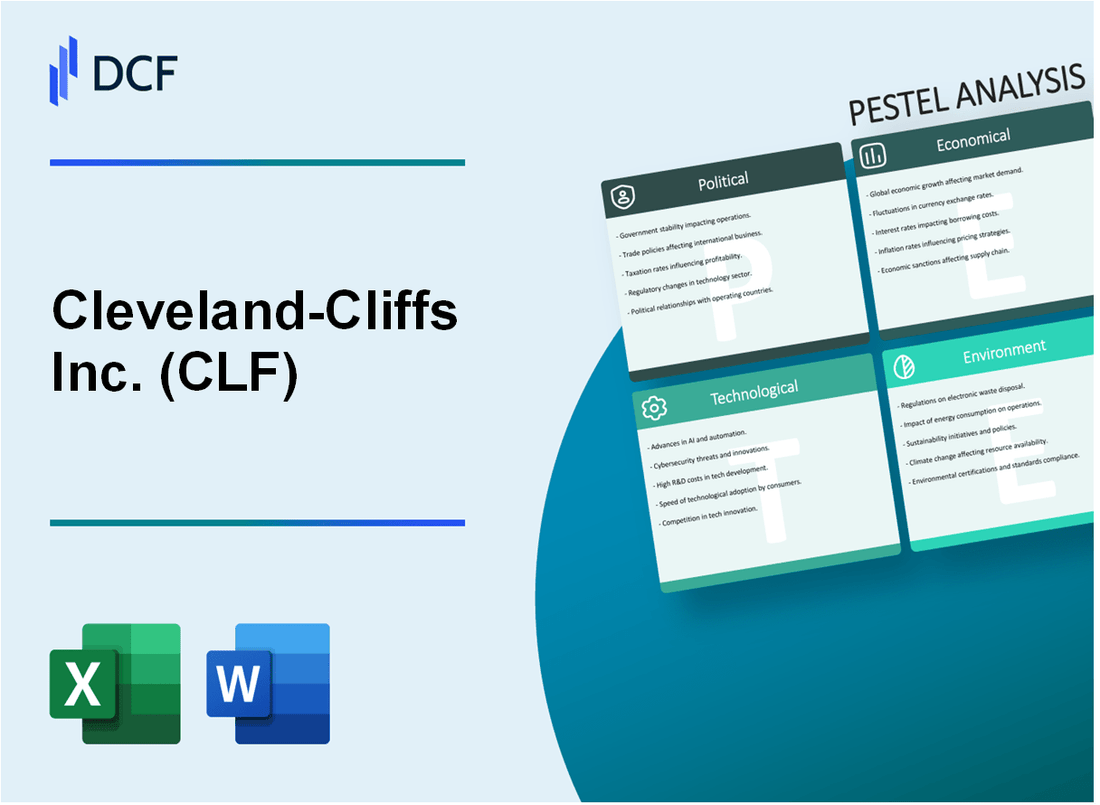
Totalmente Editável: Adapte-Se Às Suas Necessidades No Excel Ou Planilhas
Design Profissional: Modelos Confiáveis E Padrão Da Indústria
Pré-Construídos Para Uso Rápido E Eficiente
Compatível com MAC/PC, totalmente desbloqueado
Não É Necessária Experiência; Fácil De Seguir
Cleveland-Cliffs Inc. (CLF) Bundle
No mundo dinâmico da fabricação de aço, a Cleveland-Cliffs Inc. (CLF) fica na encruzilhada de desafios globais complexos e oportunidades transformadoras. Essa análise abrangente de pestles revela a intrincada rede de fatores políticos, econômicos, sociológicos, tecnológicos, legais e ambientais que moldam o cenário estratégico da empresa, oferecendo uma exploração diferenciada de como as forças externas estão redefinindo o futuro da produção de aço em uma cada vez mais interconectada e rapidamente Evoluving Marketplace Global.
Cleveland -Cliffs Inc. (CLF) - Análise de Pestle: Fatores Políticos
Políticas e tarifas comerciais dos EUA
A partir de 2024, a seção 232 tarifas de aço permanecem em 25% para a maioria dos produtos de aço importados. O Cleveland-Cliffs se beneficiou diretamente dessas tarifas, com a produção de aço doméstico protegido contra a competição internacional.
| Impacto da política comercial | Percentagem |
|---|---|
| Proteção do mercado de aço doméstico | 25% |
| Taxa tarifária de importação | 25% |
Investimentos de infraestrutura do governo
A Lei de Investimentos e Empregos de Infraestrutura de 2021 US $ 1,2 trilhão para o desenvolvimento de infraestrutura, apoiando diretamente a demanda de aço doméstico.
- Investimentos relacionados a aço de infraestrutura: US $ 110 bilhões
- Requisitos de aço da infraestrutura de transporte: estimado US $ 48,5 bilhões
- Reparo de ponte e demanda de aço de reposição: aproximadamente US $ 40 bilhões
Tensões geopolíticas
As tensões comerciais dos EUA-China continuam afetando a dinâmica do mercado global de aço, com restrições e tarifas comerciais em andamento.
| Métrica de comércio geopolítico | Valor |
|---|---|
| Importações de aço dos EUA da China (2023) | 2,1 milhões de toneladas métricas |
| Taxa tarifária em aço chinês | Até 266% |
Regulamentos ambientais
Os regulamentos propostos de emissões de gases de efeito estufa da Agência de Proteção Ambiental para setores industriais potencialmente exigem adaptações significativas do processo de fabricação.
- Alvo de redução de emissões de carbono proposto: 52-55% até 2030
- Investimento estimado de conformidade: US $ 250 a US $ 500 milhões para Cleveland Cliffs
- Redução de emissões anuais potenciais: 30-40%
Cleveland -Cliffs Inc. (CLF) - Análise de Pestle: Fatores econômicos
Natureza cíclica da indústria siderúrgica
A produção da indústria siderúrgica dos EUA em 2023 atingiu 87,9 milhões de toneladas, com o PIB do setor manufatureiro em US $ 2,48 trilhões. A contribuição do setor de construção para o PIB foi de US $ 1,35 trilhão no mesmo ano.
| Indicador econômico | 2023 valor | Mudança de ano a ano |
|---|---|---|
| Produção de aço | 87,9 milhões de toneladas métricas | -3.2% |
| PIB de fabricação | US $ 2,48 trilhões | +1.7% |
| PIB de construção | US $ 1,35 trilhão | +2.1% |
Volatilidade do preço de commodities
Os preços à vista de minério de ferro flutuaram entre US $ 75 e US $ 130 por tonelada métrica em 2023. Os preços do aço variaram de US $ 600 a US $ 900 por tonelada métrica durante o mesmo período.
| Mercadoria | Preço mínimo | Preço máximo | Preço médio |
|---|---|---|---|
| Minério de ferro | US $ 75/ton métrica | US $ 130/ton métrica | US $ 98/ton métrica |
| Aço | $ 600/ton métrica | US $ 900/tonelada métrica | US $ 735/ton métrica |
Recuperação econômica e gastos com infraestrutura
Os gastos com infraestrutura dos EUA em 2023 totalizaram US $ 443 bilhões, com crescimento projetado de 4,5% em 2024. Investimento federal de infraestrutura da Lei de Investimento e Empregos de Infraestrutura atingiu US $ 110 bilhões em 2023.
Impacto potencial da recessão econômica
A utilização da capacidade de fabricação em 2023 foi de 76,8%. A recessão potencial pode reduzir isso para aproximadamente 70-72%, de acordo com as projeções econômicas. O Cleveland-Cliffs registrou receita anual de US $ 22,4 bilhões em 2023, com potencial risco de redução de 8 a 12% durante a crise econômica.
| Métrica econômica | 2023 real | Projeção de recessão potencial |
|---|---|---|
| Utilização da capacidade de fabricação | 76.8% | 70-72% |
| Receita anual de Cleveland-Cliffs | US $ 22,4 bilhões | US $ 19,7 a US $ 20,8 bilhões |
Cleveland -Cliffs Inc. (CLF) - Análise de Pestle: Fatores sociais
Foco crescente na fabricação sustentável e diversidade da força de trabalho
Cleveland-Cliffs registrou 35,7% de mulheres e minorias em posições de liderança a partir de 2023. A Companhia investiu US $ 12,4 milhões em programas de treinamento e diversidade de sustentabilidade em 2022.
| Métrica de diversidade | Percentagem | 2023 Investimento |
|---|---|---|
| Mulheres em liderança | 20.3% | US $ 6,2 milhões |
| Representação de liderança minoritária | 15.4% | US $ 6,2 milhões |
Mudança de dinâmica do mercado de trabalho em regiões de fabricação tradicionais
A Cleveland-Cliffs empregou 25.600 trabalhadores em 2023, com um salário médio de US $ 82.340 por ano em regiões de fabricação. A redução da força de trabalho de 3,2% ocorreu entre 2022-2023.
| Região | Total de funcionários | Salário médio |
|---|---|---|
| Centro -Oeste | 16,450 | $85,620 |
| Nordeste | 9,150 | $76,540 |
Crescente preferência do consumidor por produtos de aço produzidos no mercado interno
A produção de aço doméstico por Cleveland-Cliffs atingiu 16,3 milhões de toneladas em 2023, representando 42,6% do total de participação no mercado de aço dos EUA.
| Categoria de produto | Produção doméstica (toneladas) | Quota de mercado |
|---|---|---|
| Aço automotivo | 5,6 milhões | 52.3% |
| Aço de Construção | 4,7 milhões | 38.9% |
Adaptação de habilidades da força de trabalho aos avanços tecnológicos na produção de aço
O Cleveland-Cliffs alocou US $ 24,6 milhões em treinamento tecnológico em 2023, com 78,5% dos funcionários participando de programas de desenvolvimento de habilidades digitais.
| Categoria de treinamento | Investimento | Participação dos funcionários |
|---|---|---|
| Habilidades digitais | US $ 14,2 milhões | 65.3% |
| Fabricação avançada | US $ 10,4 milhões | 13.2% |
Cleveland -Cliffs Inc. (CLF) - Análise de Pestle: Fatores tecnológicos
Automação e digitalização transformando processos de fabricação de aço
A Cleveland-Cliffs investiu US $ 120 milhões em tecnologias de transformação digital em 2023. A Companhia implementou 37 sistemas robóticos em suas instalações de fabricação, aumentando a eficiência da produção em 22%. Os sistemas automatizados agora controlam 64% das primeiras linhas de produção de aço da empresa.
| Categoria de investimento em tecnologia | 2023 investimento ($) | Ganho de eficiência (%) |
|---|---|---|
| Sistemas de fabricação robótica | 52,000,000 | 18.5% |
| Controle de processo digital | 35,000,000 | 15.7% |
| Integração da IoT | 33,000,000 | 12.3% |
Investimentos em tecnologias metalúrgicas avançadas para melhorias de eficiência
O Cleveland-Cliffs alocou US $ 85 milhões para pesquisa e desenvolvimento metalúrgicos avançados em 2023. A empresa alcançou uma redução de 17% nos custos de produção por meio de técnicas metalúrgicas inovadoras, com foco em ligas de aço de alta resistência.
| Tecnologia metalúrgica | Investimento em P&D ($) | Melhoria de desempenho |
|---|---|---|
| Desenvolvimento avançado de liga de aço | 42,000,000 | 15% de força de força do material |
| Técnicas de metalurgia de precisão | 25,000,000 | 12% de consistência da produção |
| Análise de microestrutura | 18,000,000 | 8% de aprimoramento da qualidade do material |
Implementação de IA e aprendizado de máquina na otimização da produção
O Cleveland-Cliffs implantou 12 algoritmos de aprendizado de máquina em 2023, resultando em uma melhoria de 19% na manutenção preditiva e em uma redução de 16% no tempo de inatividade do equipamento não planejado. A empresa investiu US $ 45 milhões em tecnologias de otimização de produção orientadas pela IA.
| Aplicação da IA | Investimento ($) | Impacto no desempenho |
|---|---|---|
| Manutenção preditiva AI | 22,000,000 | 19% de redução de tempo de inatividade |
| Algoritmos de otimização de produção | 15,000,000 | 16% de eficiência aumentam |
| Aprendizado de máquina de controle de qualidade | 8,000,000 | 12% de melhoria de detecção de defeitos |
Tecnologias emergentes para reduzir as emissões de carbono na produção de aço
Cleveland-Cliffs comprometeu US $ 210 milhões às tecnologias de redução de carbono em 2023. A Companhia reduziu as emissões de carbono em 27% por meio de processos inovadores de redução direta baseados em hidrogênio e tecnologias de forno de arco elétrico.
| Tecnologia de redução de carbono | Investimento ($) | Redução de emissão (%) |
|---|---|---|
| Redução direta de hidrogênio | 95,000,000 | 15% de redução de CO2 |
| Atualização do forno de arco elétrico | 65,000,000 | Diminuição de 12% de emissão |
| Integração de energia renovável | 50,000,000 | 8% de redução da pegada de carbono |
Cleveland -Cliffs Inc. (CLF) - Análise de Pestle: Fatores Legais
Conformidade com a proteção ambiental e os regulamentos de segurança no local de trabalho
A Cleveland-Cliffs Inc. relatou despesas totais de conformidade ambiental de US $ 76,3 milhões em 2022. A taxa de lesão registrada da OSHA foi de 1,02 por 100 trabalhadores em 2022, em comparação com a média da indústria de 2,7.
| Categoria regulatória | Despesas de conformidade ($ M) | Penalidades pagas ($) |
|---|---|---|
| Regulamentos ambientais | 76.3 | 412,000 |
| Segurança no local de trabalho | 24.7 | 98,500 |
Potenciais considerações antitruste na consolidação da indústria siderúrgica
O Cleveland-Cliffs adquiriu a ArcelorMittal USA em 2020 por US $ 1,4 bilhão, aprovando com sucesso o Departamento de Justiça Antitrust Review. O valor total da transação da fusão da indústria siderúrgica em 2022 foi de US $ 3,2 bilhões.
| Detalhes da fusão | Valor ($ b) | Status de aprovação regulatória |
|---|---|---|
| Aquisição da ArcelorMittal EUA | 1.4 | Aprovado |
Proteção de propriedade intelectual para inovações de fabricação
O Cleveland-Cliffs detinha 37 patentes ativas no processamento metalúrgico a partir de 2022. As despesas legais relacionadas a patentes foram de US $ 2,1 milhões no mesmo ano.
| Categoria IP | Número de patentes | Despesas legais ($ m) |
|---|---|---|
| Inovações de fabricação | 37 | 2.1 |
Navegando com estruturas legais de comércio internacional complexo
O Cleveland-Cliffs pagou US $ 48,3 milhões na seção 232 tarifas de aço em 2022. Os custos internacionais de conformidade jurídica do comércio foram de US $ 3,6 milhões.
| Regulamentação comercial | Tarifas pagos ($ m) | Custos de conformidade ($ m) |
|---|---|---|
| Seção 232 Tarifas de aço | 48.3 | 3.6 |
Cleveland -Cliffs Inc. (CLF) - Análise de Pestle: Fatores Ambientais
Compromisso em reduzir a pegada de carbono na produção de aço
O Cleveland-Cliffs relatou uma meta de redução de emissões de CO2 de 35% até 2030 em relação aos níveis de linha de base de 2017. As emissões totais de gases de efeito estufa da empresa em 2022 foram 22,1 milhões de toneladas métricas de CO2 equivalente.
| Ano | Emissões de CO2 (milhão de toneladas) | Progresso de redução |
|---|---|---|
| 2017 (linha de base) | 34.0 | 0% |
| 2022 | 22.1 | 35% |
Aumento de investimentos em tecnologias de fabricação sustentável
A Cleveland-Cliffs investiu US $ 156 milhões em tecnologias de sustentabilidade e descarbonização ambiental em 2022. A empresa comprometeu US $ 250 milhões para iniciativas de aço verde até 2025.
| Categoria de investimento | Valor investido (USD) | Linha do tempo |
|---|---|---|
| Sustentabilidade Ambiental | US $ 156 milhões | 2022 |
| Iniciativas de aço verde | US $ 250 milhões | 2023-2025 |
Gerenciando o impacto ambiental das operações de fabricação de mineração e aço
O Cleveland-Cliffs opera 9 locais de mineração de minério de ferro e 5 instalações de fabricação de aço. O consumo de água em 2022 foi de 38,2 bilhões de galões, com uma taxa de reciclagem de 82%.
| Métrica operacional | Valor total | Taxa de reciclagem/eficiência |
|---|---|---|
| Locais de mineração | 9 | N / D |
| Instalações de fabricação de aço | 5 | N / D |
| Consumo de água | 38,2 bilhões de galões | 82% |
Adaptação a regulamentos ambientais mais rígidos e padrões de emissão de carbono
O Cleveland-Cliffs alocou US $ 475 milhões para conformidade com os regulamentos da EPA Clean Air Act e melhorias no desempenho ambiental entre 2023-2026.
| Categoria de conformidade regulatória | Valor do investimento | Período de implementação |
|---|---|---|
| Conformidade da Lei do Ar Limpo da EPA | US $ 475 milhões | 2023-2026 |
Cleveland-Cliffs Inc. (CLF) - PESTLE Analysis: Social factors
Labor relations are critical following the 2023 United Auto Workers (UAW) contract.
Labor relations represent a significant social and operational risk factor for Cleveland-Cliffs Inc., particularly given its deep union ties and the recent history of high-stakes negotiations. The company operates under major collective bargaining agreements with both the United Steelworkers (USW) and the United Auto Workers (UAW).
The USW contract, ratified in October 2022 and covering approximately 12,000 members across 13 facilities, set a high bar by including historic wage improvements of more than 20 percent over its term. This agreement also included a commitment from Cleveland-Cliffs to invest $4 billion in USW-represented facilities, establishing a clear link between labor stability and capital expenditure.
However, labor tensions resurfaced in 2025. In August 2025, the UAW staged a protest after Cleveland-Cliffs idled operations and laid off over 500 workers at its Dearborn Works. The union accused the company of not honoring a 2024 pledge to invest $300 million in the facility. Management countered that $125 million had already been spent, with the remaining $175 million scheduled for investment over the next three years, citing a weak auto market and tariffs as the reason for the delay in reinstating idled furnace operations. This ongoing dispute highlights the volatile nature of union-management relationships, even with long-term contracts in place.
Workforce demographics require significant investment in skilled trade retention.
The steel industry faces a persistent demographic challenge: an aging workforce and a shortage of skilled tradespeople. Cleveland-Cliffs must invest heavily to mitigate the risk of labor shortages caused by experienced employee attrition, which is explicitly noted as a risk factor in 2025 corporate filings. You can't run a complex, integrated steel mill without highly trained talent.
To retain key personnel, the company uses a multi-faceted approach. This includes competitive salaries, incentive-based bonus programs, and development programs for continuous learning. Crucially, targeted, equity-based grants with vesting conditions are used to lock in critical talent. The economic landscape of union contracts also drives up retention costs; for example, the UAW's general wage increase (GWI) trend includes a projected 3% GWI for skilled trades in September 2025, pushing up the total compensation base.
Here's the quick math on the skilled labor market pressure:
| Metric | Value (2025 Fiscal Year Data/Trend) | Strategic Impact |
|---|---|---|
| USW Contract Wage Increase (2022-2026) | >20% | Sets a high cost-of-labor benchmark for the entire company. |
| UAW Skilled Trades GWI (Sept 2025) | 3% | Represents the minimum annual increase in fixed labor costs. |
| Employee Headcount (Approx.) | 30,000 (US & Canada) | Scale of the retention and training challenge. |
| Investment in USW Facilities (Contractual) | $4 billion (Over contract term) | Directly links capital expenditure to labor stability. |
Growing public demand for domestically sourced, 'Made in USA' steel products.
The social factor of consumer and political preference for domestically sourced goods is a major tailwind for Cleveland-Cliffs Inc. This preference is amplified by government policies aimed at strengthening domestic supply chains and infrastructure.
The company is uniquely positioned as the largest flat-rolled steel producer in North America and a primary supplier to the automotive industry. In the third quarter of 2025, CEO Lourenco Goncalves noted a 'clear sign of demand recovery for automotive-grade steel made in the USA,' directly attributing this to the new trade environment. The automotive sector alone accounts for approximately 20-25% of total domestic steel demand, and with US domestic auto production projected to rise by 1.16% to 10.45 million vehicles in 2025, Cliffs is set to benefit directly.
Also, the massive government spending on infrastructure and manufacturing, backed by legislation like the Infrastructure Investment and Jobs Act, ensures a robust, long-term demand floor for domestic steel. This public demand for American-made steel is a significant competitive advantage over foreign competitors.
Safety culture and incident rates impact insurance and community trust.
A strong safety culture is not just a moral imperative; it's a hard financial and social asset that impacts insurance premiums, regulatory compliance, and community goodwill. Cleveland-Cliffs Inc. has made measurable progress in this area, which is crucial for a heavy industrial operator.
The company achieved its lowest-ever Total Recordable Incident Rate (TRIR) of 0.9 in 2024, a metric it proudly touts as the 'new benchmark in the steel industry.' This low TRIR, which measures the number of injuries per 200,000 hours worked, is a tangible result of its reinforced 'zero injury culture' and strong union partnerships. A lower TRIR defintely reduces workers' compensation and liability insurance costs, plus it strengthens the company's 'safety track record,' a key risk factor cited in its financial reports.
The continuous focus on proactive sustainable safety initiatives and sharing incident learnings across its facilities, which employ approximately 30,000 people, helps maintain community trust and a positive social license to operate.
- Achieve lowest TRIR of 0.9 in 2024.
- Reduce insurance costs via improved safety record.
- Maintain community trust through safe operations.
Cleveland-Cliffs Inc. (CLF) - PESTLE Analysis: Technological factors
Expansion of Hot-Briquetted Iron (HBI) Capacity
You're seeing Cleveland-Cliffs make a clear, strategic move to future-proof its iron supply, and it centers on Hot-Briquetted Iron (HBI) and Direct Reduced Iron (DRI). The company's Toledo, Ohio, plant currently provides a clean iron unit source with an annual HBI capacity of 1.9 million metric tons. This HBI is a premium feedstock, crucial for making advanced steel grades in Electric Arc Furnaces (EAFs), and it significantly lowers the carbon footprint compared to traditional methods.
The real technological leap, however, is the planned facility at Middletown Works. This project, which is a major capital investment starting in 2025, involves replacing the existing blast furnace with a new, hydrogen-ready Direct Reduced Iron (DRI) Plant and two 120 MW Electric Melting Furnaces (EMF). This new DRI plant is expected to have a capacity of 2.5 million metric tons per annum (mtpa) and will dramatically reduce carbon emissions intensity at the facility by over 50% when fueled by natural gas, with the option to use hydrogen for even greater reductions.
Increased Adoption of Electric Arc Furnace (EAF) Technology by Customers
The steel industry is shifting, and EAFs-which use high-quality scrap and iron substitutes like HBI-are the future for lower-carbon steel production. Cleveland-Cliffs is positioning itself as the key domestic raw material supplier for this shift. Their HBI is specifically designed to feed these EAFs, enabling them to produce the high-margin, sophisticated steel required for automotive and other demanding end markets.
This focus is backed by significant capital allocation. The company is investing approximately $1.3 billion (net of a potential $575 million Department of Energy grant) over a five-year period, primarily starting in 2025, to fund these decarbonization projects, including the EAF-style melting furnaces at Middletown. This isn't just about selling a product; it's about aligning their entire supply chain with their customers' decarbonization goals, which is a massive competitive advantage right now.
Here's the quick math on the EAF-enabling technology:
- Total decarbonization investment (net of grant): Approximately $1.3 billion (2025-2029).
- Middletown DRI/EMF capacity: 2.5 million metric tons per annum.
- Target carbon reduction at Middletown: Over 50% (using natural gas).
Digital Transformation in Mining Operations to Cut Costs and Improve Yield
While the term 'digital transformation' might sound like corporate filler, what it really translates to here is aggressive, data-driven operational efficiency. Cleveland-Cliffs is executing a major footprint optimization initiative that is expected to generate over $300 million annually in savings. This is a direct result of using data to identify and idle high-cost, underperforming assets, such as the Minorca mine and the Dearborn blast furnace, and focusing on their most efficient, vertically integrated assets.
The tangible result of this technological and operational focus is a projected reduction in steel unit costs of approximately $50 per net ton in 2025 compared to 2024. That's a huge number in a commodity business. This kind of cost discipline, which includes better asset management and process automation, is what separates the winners. The company also reduced its full-year 2025 capital expenditures guidance to approximately $525 million, down from an earlier expectation of $600 million, showing a defintely tighter focus on capital efficiency.
| Metric | 2025 Target/Expectation | Source of Improvement |
|---|---|---|
| Steel Unit Cost Reduction (Y/Y) | Approximately $50 per net ton | Footprint optimization and asset idling |
| Annual Cost Savings from Idled Facilities | Over $300 million | Streamlining operations (e.g., Minorca mine, Dearborn BF) |
| Full-Year Capital Expenditures | Approximately $525 million | Increased capital efficiency and project prioritization |
High-Strength, Lightweight Steel Development for Electric Vehicles (EVs)
Cleveland-Cliffs is the largest flat-rolled steel producer in North America, and their technology is deeply embedded in the automotive sector, which accounts for about 36% of their revenue. The shift to Electric Vehicles (EVs) is a massive technological opportunity, and the company is capitalizing on it with advanced steel grades.
They developed the C-STAR advanced high-strength steel (AHSS) system, which is a lightweight, durable material essential for EV battery enclosures and car frames. They are also a key supplier of third-generation (Gen 3) steel grades, which allow automakers to create thinner, lighter parts, reducing vehicle weight and improving efficiency while maintaining superior safety performance.
Plus, they are the sole domestic producer of Grain-Oriented Electrical Steel (GOES), a critical, high-grade component for the electric motors and generators in both hybrid and battery-electric vehicles. This is a specialized, high-margin product that directly benefits from the Inflation Reduction Act (IRA) and the build-out of a domestic EV supply chain. Their new transformer plant in Weirton, West Virginia, is on schedule to be operational by the fourth quarter of 2025, further boosting demand for their GOES.
Cleveland-Cliffs Inc. (CLF) - PESTLE Analysis: Legal factors
You are navigating a complex legal landscape right now, where environmental compliance and shareholder litigation are creating real financial friction. The legal factor isn't just about avoiding fines; it's about managing massive capital expenditure and the fallout from major corporate actions. For Cleveland-Cliffs Inc., this means dealing with both old-school regulatory burdens and new-era securities scrutiny, all while fighting a global trade war.
Strict enforcement of EPA air and water quality standards at legacy plants.
The core challenge for a legacy steelmaker like Cleveland-Cliffs Inc. is the cost of modernizing older facilities to meet increasingly strict U.S. Environmental Protection Agency (EPA) standards. For the 2025 fiscal year, the company has estimated its capital expenditures for environmental control facilities at approximately $100 million. This money is earmarked for critical projects like water treatment, air quality improvements, and dust control across its integrated steel mills.
To be fair, the regulatory environment is not a straight line. In July 2025, an executive order provided a temporary two-year exemption for several Cleveland-Cliffs and U.S. Steel facilities from certain EPA emissions requirements, citing national security and economic resilience concerns. Still, this temporary relief doesn't erase the underlying compliance risk. For instance, in June 2025, environmental groups petitioned the EPA to object to an air permit renewal for the Indiana Harbor East and West facilities, arguing the permit fails to ensure continuous compliance with the Clean Air Act. This kind of back-and-forth legal pressure is a constant operational headwind.
Ongoing legal scrutiny of mergers and acquisitions in the consolidated steel sector.
The aggressive consolidation strategy of Cleveland-Cliffs Inc. has brought significant legal scrutiny, particularly in the securities arena. Following the disappointing Q1 2025 earnings report, which revealed a GAAP net loss of $483 million, multiple law firms launched investigations into potential securities fraud.
This scrutiny centers on whether the company misled investors by allegedly downplaying risks related to underperforming non-core assets. Also, the November 2024 acquisition of Stelco Holdings Inc. triggered a separate securities investigation in February 2025 concerning the issuance of unregistered shares to former Stelco stockholders. While the high-profile litigation with Nippon Steel and U.S. Steel over the attempted U.S. Steel acquisition was dropped in September 2025, the legal risk from shareholders remains high.
- Manage litigation costs: Diverts resources from core business.
- Address investor confidence: Stock price dropped 15.8% after Q1 2025 results.
- Ensure disclosure accuracy: Avoids future securities class actions.
Compliance costs related to new federal reporting on carbon emissions.
While Cleveland-Cliffs Inc. has been proactive, achieving its initial 2030 Scope 1 (direct) and Scope 2 (indirect) greenhouse gas (GHG) emissions intensity reduction goal ahead of schedule, new federal and international reporting mandates are creating a new layer of compliance complexity. The company is now working toward a new goal of a 30% reduction in Scope 1 and 2 GHG emissions intensity per metric ton of crude steel by 2035, relative to 2023 levels. Here's the quick math: achieving this requires massive investment in new technology.
The true cost is hard to nail down exactly because of the dynamic nature of regulation. The company's 2025 outlook notes that the inability to quantify the long-term net impacts of potential carbon compliance costs is a real issue. This includes federal reporting obligations, as well as the indirect impact of international mechanisms like the European Union's Carbon Border Adjustment Mechanism (CBAM), which affects the competitiveness of steel exports.
Trade dispute litigation over imported steel dumping practices.
Cleveland-Cliffs Inc. is a leading force in trade dispute litigation, working closely with the United Steelworkers (USW) to combat the dumping (selling below fair market value) of imported steel products. The company has seen success, with the Department of Commerce making a final determination in January 2024 that four key countries were guilty of dumping tin mill products in the U.S. market. This litigation is defintely a core part of their strategy to level the playing field for domestic steel.
The alleged dumping margins illustrate the scale of the threat. For instance, the original petitions cited a dumping margin for China at 122.52% and Canada at 79.59% for tin mill products. The International Trade Commission (ITC) has been inconsistent, rejecting some tariffs while upholding others, like the tariffs on tin mill products from Japan in May 2024. The ongoing nature of these trade cases means Cleveland-Cliffs Inc. must maintain a significant legal and lobbying presence to protect its market share.
| Legal/Regulatory Area | 2025 Action/Status | Financial/Numerical Impact |
|---|---|---|
| Environmental Compliance (EPA) | Ongoing compliance with air/water standards; temporary EPA compliance deadline extension until April 2027. | Estimated 2025 Environmental Capital Expenditures: $100 million. |
| Merger/Acquisition Scrutiny | Multiple securities fraud investigations launched following Q1 2025 results and Stelco acquisition. | Q1 2025 GAAP Net Loss: $483 million. |
| Carbon Emissions Reporting | Working toward new 2035 GHG reduction goals; navigating new federal and international reporting rules. | Target: 30% reduction in Scope 1 & 2 GHG intensity by 2035 (vs. 2023). |
| Trade Dispute Litigation | Successful antidumping determinations against China, Canada, Germany, and Korea for tin mill products. | Alleged Dumping Margin (China): 122.52%. |
Cleveland-Cliffs Inc. (CLF) - PESTLE Analysis: Environmental factors
Aggressive carbon reduction targets drive investment in Direct Reduced Iron (DRI) production.
Cleveland-Cliffs has set ambitious new greenhouse gas (GHG) reduction targets, which are now the main driver for significant capital expenditure starting in the 2025 fiscal year. The company's new goal is a 30% reduction in Scope 1 and Scope 2 emissions per ton of steel produced, plus a 20% reduction in Scope 3 emissions by 2035, with a long-term goal of near-zero emissions by 2050. That's a serious commitment, especially for a heavy industry player.
The core of this strategy was the planned replacement of the blast furnace at Middletown Works with a 2.5 million tons per annum (MMtpa) Direct Reduced Iron (DRI) plant. The initial decarbonization plan involved a net capital outlay of approximately $1.3 billion over a five-year period, primarily beginning in 2025. This investment was expected to yield substantial operational benefits, including an estimated $150 per net ton reduction in production costs, translating to roughly $450 million in annual savings.
However, a major near-term risk materialized in May 2025: the project scope is being 'substantially altered' due to shifting political priorities. The original hydrogen-heavy plan, which qualified for up to $500 million in Department of Energy (DOE) funding, is pivoting toward more readily available fossil fuels, which will result in a defintely lower-cost project but also a less aggressive carbon reduction pathway in the short term [cite: 12 in previous step]. This shift creates a strategic tension between immediate cost savings and long-term decarbonization leadership.
Water usage restrictions in the Great Lakes region affect iron ore processing.
Water stewardship is a critical operational risk for Cleveland-Cliffs, given its extensive iron ore mining and processing operations across the Great Lakes region. The Great Lakes Compact prohibits water diversions outside the basin, but growing internal demand from sectors like critical minerals mining and data centers is increasing regulatory pressure on existing large-scale users [cite: 24 in previous step, 27 in previous step].
A concrete example of this regulatory friction occurred in June 2025 when the company's Tilden Mine in Michigan received a permit approval to permanently fill 32.5 acres of regulated wetland and 272 linear feet of regulated stream to expand its rock stockpile capacity [cite: 20 in previous step]. The approval was contingent on significant mitigation efforts, showcasing the cost of maintaining a 'social license to operate' (SLO) in a water-sensitive area.
The mitigation requirements illustrate the high cost of environmental compliance in this area. Here's the quick math on the trade-off:
| Project Impact | Mitigation Requirement | Ratio (Mitigation:Impact) |
|---|---|---|
| Fill 32.5 acres of regulated wetland | Preserve 114.9 acres of wetland | 3.54:1 |
| Fill 272 linear feet of regulated stream | Protect streams and wetlands within the Goose Lake Inlet Conservation Area | Qualitative, but substantial |
The cost of this required land preservation and conservation easement is an unavoidable operational expense that directly impacts the iron ore pelletizing segment's profitability.
Increased operational costs due to carbon capture and storage (CCS) pilot programs.
While the focus is on DRI, Cleveland-Cliffs is also investing in Carbon Capture and Storage (CCS) technology, which represents a separate, near-term R&D cost. The company is finalizing the initial phase of research for the Front-End Engineering Design (FEED) study for large-scale carbon capture at its Burns Harbor integrated steel facility in Indiana.
This pilot program aims to capture up to 2.8 million tons of CO2 per year from blast furnace gas, achieving a net capture efficiency of at least 95%. The financial commitment for this 24-month study is a direct cost to the company, even with government help.
- Total FEED Study Duration: 24 months.
- Cleveland-Cliffs Funding Share: 50%.
- Technology Focus: ION Energy's solvent-based, post-combustion capture [cite: 3 in previous step].
What this estimate hides is the massive capital expenditure that will follow if the FEED study proves commercially viable; the current cost is just the price of admission to the next generation of carbon technology.
Pressure from institutional investors on Environmental, Social, and Governance (ESG) metrics.
The pressure on Cleveland-Cliffs to perform on ESG metrics is immense because institutional investors hold a controlling stake in the company. As of November 2025, institutional investors own approximately 67.7% of the company's shares [cite: 2 in previous step]. This level of ownership means that ESG performance, particularly on the 'E' for environmental and climate risk, directly impacts the company's valuation and access to capital.
The board is clearly responding to this stakeholder pressure. The company's Strategy and Sustainability Committee is explicitly chartered to oversee Cliffs' sustainability strategies, its commitment to environmental stewardship, and to monitor ESG-related risks and decarbonization opportunities [cite: 11 in previous step]. In late 2024 and early 2025, management proactively engaged with its top 25 shareholders, representing over 45% of outstanding shares, to discuss sustainability and governance topics [cite: 7 in previous step]. You can't ignore a shareholder base that large.
The key takeaway is that ESG is not just a public relations exercise; it is a core governance function tied to capital allocation and risk management, which is why the board is now directly involved in monitoring climate strategy.
Disclaimer
All information, articles, and product details provided on this website are for general informational and educational purposes only. We do not claim any ownership over, nor do we intend to infringe upon, any trademarks, copyrights, logos, brand names, or other intellectual property mentioned or depicted on this site. Such intellectual property remains the property of its respective owners, and any references here are made solely for identification or informational purposes, without implying any affiliation, endorsement, or partnership.
We make no representations or warranties, express or implied, regarding the accuracy, completeness, or suitability of any content or products presented. Nothing on this website should be construed as legal, tax, investment, financial, medical, or other professional advice. In addition, no part of this site—including articles or product references—constitutes a solicitation, recommendation, endorsement, advertisement, or offer to buy or sell any securities, franchises, or other financial instruments, particularly in jurisdictions where such activity would be unlawful.
All content is of a general nature and may not address the specific circumstances of any individual or entity. It is not a substitute for professional advice or services. Any actions you take based on the information provided here are strictly at your own risk. You accept full responsibility for any decisions or outcomes arising from your use of this website and agree to release us from any liability in connection with your use of, or reliance upon, the content or products found herein.