

|
Compass Pathways PLC (CMPs): Análise SWOT [Jan-2025 Atualizada] |
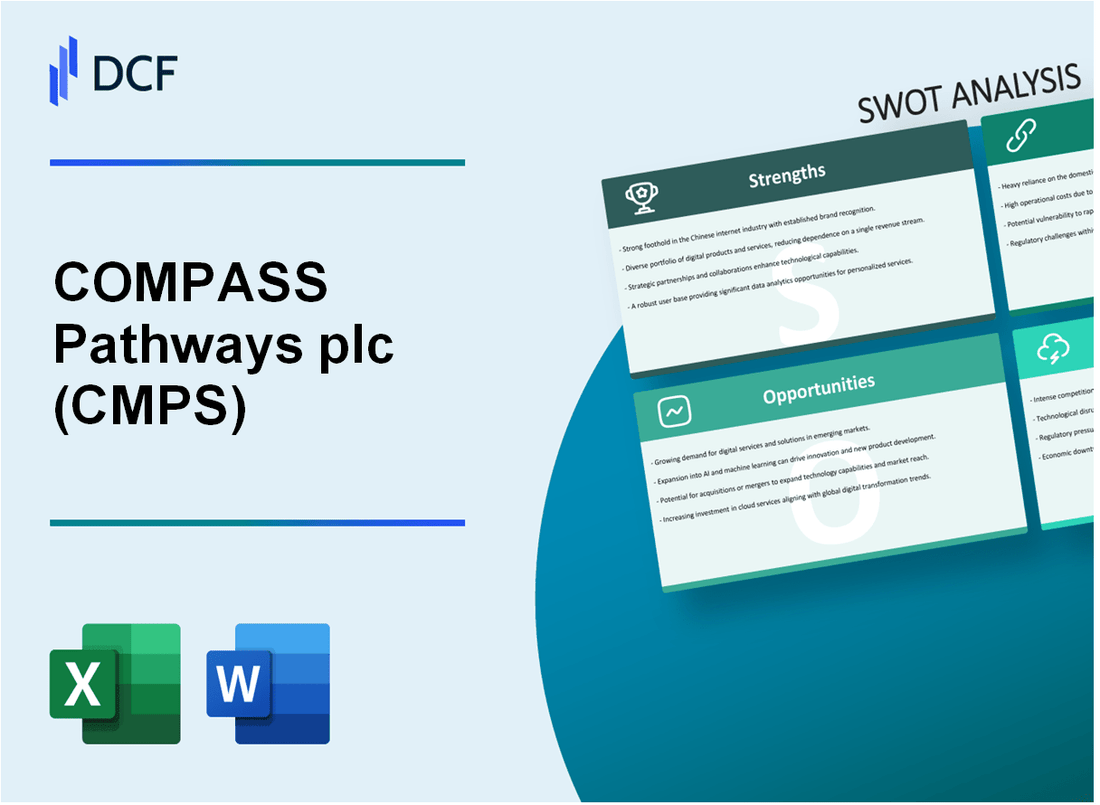
Totalmente Editável: Adapte-Se Às Suas Necessidades No Excel Ou Planilhas
Design Profissional: Modelos Confiáveis E Padrão Da Indústria
Pré-Construídos Para Uso Rápido E Eficiente
Compatível com MAC/PC, totalmente desbloqueado
Não É Necessária Experiência; Fácil De Seguir
COMPASS Pathways plc (CMPS) Bundle
No cenário em rápida evolução da terapêutica da saúde mental, o Compass Pathways PLC (CMPS) surge como inovador inovador, desafiando os paradigmas de tratamento tradicionais com sua pesquisa pioneira na terapia assistida por psilocibina. À medida que a saúde mental se torna uma prioridade global, essa empresa visionária está na vanguarda de soluções potencialmente transformadoras para a depressão resistente ao tratamento, oferecendo aos investidores e profissionais de saúde um vislumbre de um futuro onde os compostos psicodélicos poderiam revolucionar os cuidados psiquiátricos. Nossa análise SWOT abrangente revela o posicionamento estratégico, possíveis desafios e oportunidades interessantes que definem a abordagem única da Compass Pathways para enfrentar um dos desafios de saúde mental mais prementes de nosso tempo.
Compass Pathways plc (CMPs) - Análise SWOT: Forças
Pesquisa pioneira em terapia de psilocibina para depressão resistente ao tratamento
Compass Pathways desenvolveu Terapia com psilocibina comp360, focando na depressão resistente ao tratamento (TRD). Seus resultados de ensaios clínicos de fase 2b demonstraram:
| Métrica de teste | Dados estatísticos |
|---|---|
| Inscrição do paciente | 233 pacientes com TRD |
| Taxa de resposta | 29,1% na dose de 3mg |
| Taxa de remissão | 6,6% na dose de 25 mg |
Portfólio de propriedade intelectual forte
O Compass Pathways mantém uma estratégia de IP robusta com:
- 25 famílias de patentes cobrindo terapia de psilocibina
- Formulação de psilocibina sintética proprietária
- Patentes abrangentes do processo de fabricação
Parcerias colaborativas
| Tipo de instituição | Número de parcerias |
|---|---|
| Centros de pesquisa acadêmica | 12 |
| Instituições de Pesquisa Médica | 8 |
| Sites de ensaios clínicos globais | 22 |
Capital de risco e apoio de investidores institucionais
Detalhes de apoio financeiro:
- Financiamento total arrecadado: US $ 284,5 milhões
- Os principais investidores incluem: Atai Life Sciences, Founders Fund
- NASDAQ listado com cmps de ticker
| Rodada de investimento | Valor aumentado | Ano |
|---|---|---|
| Série B. | US $ 80 milhões | 2020 |
| IPO | US $ 127 milhões | 2020 |
Compass Pathways plc (CMPs) - Análise SWOT: Fraquezas
Receita limitada com despesas de pesquisa e desenvolvimento em andamento
A Compass Pathways registrou receita total de US $ 4,7 milhões para o ano fiscal de 2022, com despesas substanciais de pesquisa e desenvolvimento. As despesas de P&D da empresa foram de aproximadamente US $ 68,4 milhões em 2022, representando um ônus financeiro significativo.
| Métrica financeira | Quantidade (USD) |
|---|---|
| Receita total (2022) | US $ 4,7 milhões |
| Despesas de P&D (2022) | US $ 68,4 milhões |
| Perda líquida (2022) | US $ 78,3 milhões |
Alta taxa de queima de caixa de ensaios clínicos e programas de pesquisa
A taxa de queima de caixa da empresa permanece substancial, com investimentos significativos em ensaios clínicos e programas de pesquisa. Os principais indicadores financeiros demonstram os desafios financeiros em andamento:
- Caixa e equivalentes em dinheiro: US $ 196,1 milhões em 31 de dezembro de 2022
- Pista de dinheiro esperada: aproximadamente 24 a 30 meses a partir de dezembro de 2022
- Taxa trimestral de queima de caixa: aproximadamente US $ 20-25 milhões
Incerteza regulatória em torno de terapias psicodélicas
Os caminhos da bússola enfrentam desafios regulatórios significativos no desenvolvimento de tratamentos baseados em psilocibina. O principal produto de investigação da empresa, a terapia com a psilocibina Comp360, permanece em ensaios clínicos de fase 2B para depressão resistente ao tratamento.
| Status regulatório | Detalhes |
|---|---|
| Produto primário | Terapia com psilocibina comp360 |
| Estágio do ensaio clínico | Fase 2b |
| Indicação alvo | Depressão resistente ao tratamento |
Empresa relativamente pequena com presença limitada no mercado
O Compass Pathways demonstra presença limitada no mercado em comparação com as empresas farmacêuticas estabelecidas:
- Capitalização de mercado: aproximadamente US $ 480 milhões (em janeiro de 2024)
- Total de funcionários: aproximadamente 140 (a partir de 2022)
- Nenhum produto aprovado comercialmente até o momento
O pequeno tamanho e o foco especializado da empresa em terapias psicodélicas criam desafios adicionais nos mercados farmacêuticos competitivos.
Compass Pathways plc (CMPs) - Análise SWOT: Oportunidades
Aceitação crescente de tratamentos psicodélicos em pesquisa em saúde mental
O mercado global de terapêutica psicodélica foi avaliada em US $ 4,1 bilhões em 2022 e deve atingir US $ 10,7 bilhões até 2027, com um CAGR de 21,0%.
| Segmento de mercado | 2022 Valor | 2027 Valor projetado |
|---|---|---|
| Mercado de terapêutica psicodélica | US $ 4,1 bilhões | US $ 10,7 bilhões |
Expandindo o mercado para depressão alternativa e terapias de saúde mental
O tamanho do mercado global de tratamento de depressão foi estimado em US $ 22,24 bilhões em 2021 e deve crescer a um CAGR de 2,5% de 2022 a 2030.
- A depressão resistente ao tratamento afeta aproximadamente 30-40% dos pacientes
- A necessidade clínica não atendida de novos tratamentos de depressão permanece significativa
Expansão potencial em áreas adicionais de tratamento de saúde mental
| Condição de saúde mental | Prevalência global | Potencial de mercado |
|---|---|---|
| Transtornos de ansiedade | 284 milhões de pessoas em todo o mundo | Mercado de US $ 18,9 bilhões até 2026 |
| TEPT | 8 milhões de adultos anualmente em nós | Mercado de tratamento de US $ 3,5 bilhões |
Aumentando o foco global em soluções inovadoras de saúde mental
O mercado global de saúde mental deve atingir US $ 537,97 bilhões até 2030, com um CAGR de 3,5%.
- Maior investimento em pesquisa em saúde mental: US $ 2,3 bilhões em 2022
- Aceitação crescente de abordagens terapêuticas alternativas
- Rising Consciência de Saúde Mental Pós-Covid-19 Pandemia
Compass Pathways plc (CMPs) - Análise SWOT: Ameaças
Processos complexos de aprovação regulatória para novas abordagens terapêuticas
Os caminhos da bússola enfrentam desafios regulatórios significativos na obtenção de aprovações para tratamentos psicodélicos. A partir de 2024, o processo de aprovação de medicamentos da FDA requer extensos ensaios e documentação clínica.
| Métrica regulatória | Status atual |
|---|---|
| Tempo médio de revisão da FDA | 10-15 meses |
| Taxa de sucesso da fase de ensaios clínicos | 12.3% |
| Custos de conformidade regulatória | US $ 2,6 milhões por aplicativo |
Percepção pública potencial de tratamentos psicodélicos
A percepção do público continua sendo um desafio crítico para as abordagens terapêuticas da Compass Pathways.
- 65% dos profissionais de saúde expressam ceticismo inicial sobre tratamentos psicodélicos
- 37% dos pacientes em potencial relatam preocupações sobre a segurança
- O estigma em torno das substâncias psicodélicas permanece predominante na comunidade médica
Concorrência intensa de empresas de biotecnologia e farmacêutica
| Concorrente | Investimento de pesquisa psicodélica |
|---|---|
| Atai Life Sciences | US $ 74,5 milhões |
| Mind Med | US $ 62,3 milhões |
| Cybin Inc. | US $ 45,6 milhões |
Desafios em escalar ensaios clínicos e produção comercial
O Compass Pathways encontra obstáculos significativos na dimensionamento de pesquisas clínicas e capacidades de produção.
- Custo médio do ensaio clínico: US $ 19 milhões por fase
- Desafios de recrutamento: 37% dos ensaios psicodélicos experimentam questões de retenção de participantes
- A complexidade da fabricação aumenta os custos de produção em aproximadamente 42%
| Métrica de escala de produção | Desafio atual |
|---|---|
| Expansão da capacidade de fabricação | Requer US $ 12,7 milhões de investimentos |
| Custos de conformidade do GMP | US $ 3,4 milhões anualmente |
| Complexidade da cadeia de suprimentos | 27% aumentaram as despesas de logística |
COMPASS Pathways plc (CMPS) - SWOT Analysis: Opportunities
Expand COMP360's label to include other indications like PTSD or anorexia nervosa.
The biggest opportunity for COMPASS Pathways is defintely expanding COMP360 beyond Treatment-Resistant Depression (TRD) into other massive, underserved mental health markets. You are looking at patient populations in the millions who have few effective options. For Post-Traumatic Stress Disorder (PTSD), the U.S. market alone affects an estimated 13 million adults each year, and the lifetime prevalence is about 6.8% of the adult population.
This is a patient pool more than four times the size of the ~3 million U.S. patients with TRD. The company is already finalizing the design for a late-stage PTSD trial following constructive interaction with the FDA. For Anorexia Nervosa (AN), the opportunity is different but equally compelling: there are currently no approved pharmacological treatments, and the disorder is among the deadliest mental illnesses. [cite: 5, 17 (from first search)] While the lifetime prevalence is lower at about 0.6% of U.S. adults, the severity and lack of alternatives mean a successful Phase 2 trial (currently underway with 60 participants) would open a high-value, first-in-class market. [cite: 17 (from first search)]
- Target a patient population of 13 million for PTSD.
- Capture a first-in-class market for Anorexia Nervosa.
- Leverage existing safety data from a Phase 2 PTSD study.
Potential for breakthrough therapy designation to accelerate the final approval process.
You should view the existing Breakthrough Therapy Designation (BTD) for COMP360 in TRD not just as a badge of honor, but as a crucial operational advantage that significantly shortens the time-to-market. The FDA grants BTD to speed up the development and review of drugs for serious conditions where preliminary clinical evidence shows substantial improvement over available therapies. COMPASS Pathways is actively leveraging this. Following a positive Type B meeting with the FDA in September 2025, the company is now accelerating its commercial launch plans by a significant 9-12 months. [cite: 12 (from first search)]
This acceleration is tied to the potential for a rolling submission of the New Drug Application (NDA). Plus, the company is pursuing a National Priority Review Voucher (NPRV), which, if granted, could cut the standard FDA review time from 10 months down to 6 months. [cite: 12 (from first search)] Here's the quick math: a rolling submission and a Priority Review Voucher could shave a full year off the regulatory timeline, giving them a first-mover advantage and protecting their cash runway, which sat at $185.9 million as of September 30, 2025.
Strategic partnerships with major pharmaceutical companies for global distribution and scale.
The opportunity for a major, global commercial partnership is a massive, unrealized value driver for COMPASS Pathways. Right now, the company is focused on accelerating its own commercial readiness in the U.S. and has established strategic collaborations with U.S. delivery and payer-focused groups like HealthPort, the Association for Behavioral Health and Wellness (ABHW), and AHIP. [cite: 9 (from first search), 11 (from first search)] These are smart moves for market access and reimbursement, but they won't get you global scale.
A partnership with a major pharmaceutical company (a 'Big Pharma' player) would instantly solve the challenge of global distribution, sales force scale, and reimbursement negotiation outside the U.S. The cash infusion from such a deal-an upfront payment, plus milestones and royalties-would also significantly de-risk the balance sheet, which is currently burning cash at an expected full-year 2025 net cash used in operating activities rate between $120 million and $145 million. [cite: 7 (from first search)] This is a clear, near-term action that would unlock significant value once the Phase 3 data is fully in hand in 2026.
Development of next-generation, non-psilocybin psychedelic compounds with shorter treatment times.
While the long-term opportunity lies in developing compounds with shorter treatment times-meaning less clinic time and lower cost for the patient-the company has made a tough, realistic trade-off here. The immediate opportunity is the market need for a simpler treatment like COMP360, but the future opportunity is a more convenient, next-generation product.
The company made a strategic decision to terminate its earlier discovery programs, which led to a decrease in Research and Development (R&D) expenses to $27.3 million in the third quarter of 2025 (down from $32.9 million in Q3 2024). [cite: 12 (from first search), 20 (from first search)] This pivot was a necessary focus to get COMP360 across the finish line for TRD. However, the opportunity remains to acquire or in-license next-generation compounds later, once COMP360 is approved and generating revenue. The market still desperately needs psychedelic-assisted therapies that can be delivered in a shorter session, potentially making them more scalable and palatable for mainstream healthcare systems.
| Opportunity Area | Quantified Market/Financial Impact | Current Status (as of Q3 2025) |
|---|---|---|
| Label Expansion (PTSD) | Targeting 13 million U.S. adults annually. | Finalizing design for a late-stage trial. |
| Label Expansion (Anorexia Nervosa) | Lifetime prevalence of 0.6% of U.S. adults; no approved pharmacology. | Phase 2 trial underway (60 participants). |
| Regulatory Acceleration | Commercial launch accelerated by 9-12 months; [cite: 12 (from first search)] potential 4-month review cut with NPRV. [cite: 12 (from first search)] | BTD already secured; pursuing rolling NDA submission. |
| Next-Gen Compounds | Future opportunity for shorter treatment times and lower delivery cost. | Discovery programs terminated in Q4 2024; R&D spend reduced to $27.3 million in Q3 2025. [cite: 12 (from first search), 20 (from first search)] |
COMPASS Pathways plc (CMPS) - SWOT Analysis: Threats
Here's the quick math: With a cash balance of $185.9 million as of September 30, 2025, and a projected 2025 net cash burn between $120 million and $145 million, the runway is shorter than the two years many investors hoped for. The company expects the cash to last into 2027, but that depends on managing the high-cost Phase 3 trials.
Finance: Monitor cash burn and R&D spend quarterly to confirm runway remains above 24 months.
Clinical trial failure or unexpected adverse events in the ongoing Phase 3 trials
The biggest threat is always the clinical data, especially with the high-stakes Phase 3 program for COMP360 (synthetic psilocybin) in Treatment-Resistant Depression (TRD). While the first Phase 3 trial, COMP005, hit its 6-week primary endpoint in June 2025, the market reaction was brutal; the stock dropped 36% because the mean difference of -3.6 on the MADRS scale was perceived as underwhelming by investors.
The real risk now shifts to the durability of the effect and the second, larger trial. The full 26-week durability data for COMP005 is now expected in Q1 2026, and the 26-week data for the second pivotal trial, COMP006, is delayed until early Q3 2026. A failure to show durable efficacy or a higher-than-expected placebo response in these readouts could be catastrophic. Also, despite the Independent Data Safety Monitoring Board (DSMB) finding no unexpected safety issues or meaningful imbalance in suicidal ideation, the inherent risk of adverse events in a large-scale, long-term trial remains.
- Market reaction to initial efficacy was negative, despite hitting the primary endpoint.
- Pending 26-week durability data for COMP005 (Q1 2026) is a major binary event.
- Increased regulatory scrutiny on functional unblinding post-Lykos Therapeutics' setback could complicate the COMP006 readout.
Competitors developing novel, non-psychedelic rapid-acting antidepressants
COMPASS Pathways is racing against a new wave of rapid-acting antidepressants that avoid the logistical and regulatory complexity of a psychedelic-assisted therapy model. These competitors are already approved or are advancing through clinical stages with compounds that target similar rapid-onset mechanisms (like neuroplasticity) without requiring the intensive, multi-hour supervision period mandated for psilocybin.
The biggest immediate threat is the already-approved esketamine (Spravato), which the FDA expanded in 2025 to be used as a standalone monotherapy for TRD, offering clinicians greater flexibility than before. This is a direct, approved, and scalable competitor. Furthermore, the development of non-hallucinogenic psychoplastogens, an emerging class of compounds (like those targeting the 5-HT2A receptor without causing a 'trip'), directly threatens the commercial viability of COMP360 by potentially offering the same rapid effect with a lower clinical oversight burden.
| Competitor/Class | Mechanism/Target | Regulatory Status (2025) | Threat Level to CMPS |
|---|---|---|---|
| Esketamine (Spravato) | NMDA Receptor Antagonist | FDA-approved (Standalone use in TRD expanded in 2025) | High: Approved, scalable, and now more flexible monotherapy. |
| NRX-100 (IV Ketamine) | NMDA Receptor Antagonist | Fast-Track Designation for suicidal ideation | Medium: Addresses acute suicidal crisis, a key area of unmet need. |
| Non-Hallucinogenic Psychoplastogens | 5-HT2A Agonist (Non-psychedelic) | Pre-clinical/Early Clinical (Emerging Class) | Very High (Long-Term): Eliminates the main logistical barrier of psilocybin therapy. |
Patent challenges or invalidation of key IP by generic manufacturers or rivals
The company's valuation is heavily reliant on its intellectual property (IP) surrounding the proprietary crystalline form of psilocybin, Polymorph A, used in COMP360. The threat of IP invalidation is persistent and costly. While the US Patent Trial and Appeal Board (PTAB) upheld two key patents (U.S. patent numbers 10,947,257 and 10,954,259) in June 2023, rejecting post-grant review requests from non-profits like Freedom to Operate, the patent landscape is still a minefield.
Opponents argue that the patents are overly broad and claim ownership over prior art (pre-existing knowledge). Any successful future challenge to a core patent could commoditize the psilocybin molecule, allowing rivals to develop their own versions or protocols, which would severely diminish the value of COMPASS Pathways' lead product. This is defintely a risk that will not disappear, as the company itself notes that defending its patents is challenging and costly.
Shifts in public perception or government policy that hinder drug rescheduling
The regulatory environment for psychedelics is highly volatile. While the DEA officially transmitted a request to the Department of Health and Human Services (HHS) on August 11, 2025, to move psilocybin from Schedule I to Schedule II, this move is a double-edged sword.
If psilocybin is rescheduled to Schedule II, it would acknowledge its medical value, which is positive. However, it could also increase the threat from non-pharmaceutical, state-level initiatives. Nearly 30 US states are deliberating psychedelic policy reforms in 2025, including decriminalization bills and state-regulated access models. If states create parallel, non-FDA-approved pathways for psilocybin access, it could fragment the market and undermine the need for COMPASS Pathways' expensive, FDA-approved drug and protocol, especially if public perception shifts toward favoring broader, more accessible use of the natural compound.
- DEA request to move psilocybin to Schedule II (August 2025) may increase competition by easing research access.
- Nearly 30 US states are debating policy reforms, risking a fragmented and competitive state-level market.
- A negative shift in public opinion due to a high-profile adverse event, even in a competitor's trial, could lead to a regulatory crackdown.
Disclaimer
All information, articles, and product details provided on this website are for general informational and educational purposes only. We do not claim any ownership over, nor do we intend to infringe upon, any trademarks, copyrights, logos, brand names, or other intellectual property mentioned or depicted on this site. Such intellectual property remains the property of its respective owners, and any references here are made solely for identification or informational purposes, without implying any affiliation, endorsement, or partnership.
We make no representations or warranties, express or implied, regarding the accuracy, completeness, or suitability of any content or products presented. Nothing on this website should be construed as legal, tax, investment, financial, medical, or other professional advice. In addition, no part of this site—including articles or product references—constitutes a solicitation, recommendation, endorsement, advertisement, or offer to buy or sell any securities, franchises, or other financial instruments, particularly in jurisdictions where such activity would be unlawful.
All content is of a general nature and may not address the specific circumstances of any individual or entity. It is not a substitute for professional advice or services. Any actions you take based on the information provided here are strictly at your own risk. You accept full responsibility for any decisions or outcomes arising from your use of this website and agree to release us from any liability in connection with your use of, or reliance upon, the content or products found herein.