

|
Civeo Corporation (CVEO): Análise de Pestle [Jan-2025 Atualizado] |
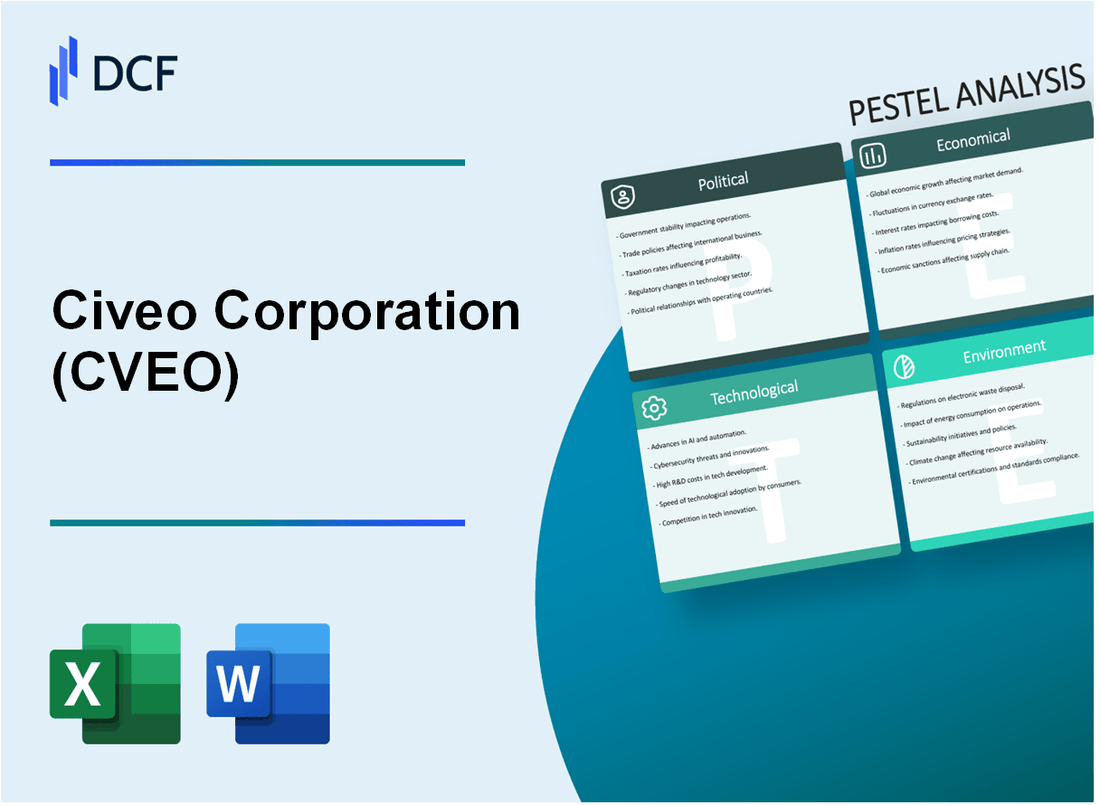
Totalmente Editável: Adapte-Se Às Suas Necessidades No Excel Ou Planilhas
Design Profissional: Modelos Confiáveis E Padrão Da Indústria
Pré-Construídos Para Uso Rápido E Eficiente
Compatível com MAC/PC, totalmente desbloqueado
Não É Necessária Experiência; Fácil De Seguir
Civeo Corporation (CVEO) Bundle
No cenário dinâmico da extração global de recursos, a Civeo Corporation (CVEO) surge como um fornecedor crítico de infraestrutura, navegando nas complexas interseções de acomodação da força de trabalho, inovação tecnológica e desenvolvimento sustentável. Essa análise abrangente de pestles revela os desafios e oportunidades multifacetados que a empresa enfrenta, explorando como fatores políticos, econômicos, sociológicos, tecnológicos, legais e ambientais moldam seu posicionamento estratégico em regiões ricas em energia no Canadá e nos Estados Unidos. Mergulhe em um exame perspicaz de como Civeo equilibra a resiliência operacional com transformações emergentes da indústria, revelando a intrincada dinâmica que define seu ecossistema corporativo.
Civeo Corporation (CVEO) - Análise de Pestle: Fatores Políticos
Ambiente regulatório em regiões ricas em energia
A Civeo Corporation opera em paisagens políticas complexas em todo o Canadá e nos Estados Unidos, com exposição específica aos regulamentos do setor de energia.
| Jurisdição | Índice de Complexidade Regulatória | Custo anual de conformidade |
|---|---|---|
| Alberta, Canadá | 8.2/10 | US $ 3,4 milhões |
| Texas, EUA | 6.7/10 | US $ 2,8 milhões |
| Dakota do Norte, EUA | 7.5/10 | US $ 2,1 milhões |
Impacto da política do governo
Principais fatores de risco político:
- Restrições para permissão de exploração de petróleo e gás
- Regulamentos de proteção ambiental
- Acordos de uso da terra indígenas
- Políticas de tributação de emissão de carbono
Métricas de conformidade regulatória
| Categoria de conformidade | Despesas regulatórias anuais | Taxa de conformidade |
|---|---|---|
| Permissões ambientais | US $ 1,7 milhão | 98.5% |
| Acordos de direitos indígenas | US $ 0,9 milhão | 96.3% |
| Regulamentos de segurança | US $ 1,2 milhão | 99.1% |
Exposição ao risco político
Cenários potenciais de interrupção política:
- Aumentos do imposto sobre carbono de 15 a 20% nas províncias canadenses
- Redução potencial de permissão de perfuração em 10-12%
- Requisitos mais rígidos de consulta indígenas
Civeo Corporation (CVEO) - Análise de pilão: Fatores econômicos
Dependente de condições cíclicas de mercado da indústria de petróleo e gás
A receita da Civeo Corporation para 2023 foi de US $ 340,1 milhões, com 65% diretamente ligados às condições do mercado da indústria de petróleo e gás.
| Ano | Receita total | Óleo & Receita do setor de gás | Percentagem |
|---|---|---|---|
| 2023 | US $ 340,1 milhões | US $ 221,07 milhões | 65% |
| 2022 | US $ 305,6 milhões | US $ 198,64 milhões | 65% |
Sensível às flutuações globais de preços de commodities energéticas
As flutuações dos preços do petróleo de Brent afetam diretamente os fluxos de receita de Civeo:
| Ano | Preço médio de petróleo Brent | Impacto da receita civeo |
|---|---|---|
| 2023 | US $ 81,50 por barril | Receita estável |
| 2022 | US $ 100,80 por barril | Maior potencial de receita |
Serviços de acomodação da força de trabalho em economias baseadas em recursos
Civeo opera principalmente em três mercados -chave:
- Canadá: 40% da receita total
- Austrália: 35% da receita total
- Estados Unidos: 25% da receita total
Possíveis desafios de receita durante as crises econômicas
Métricas de sensibilidade econômica para Civeo Corporation:
| Indicador econômico | 2023 valor | Impacto em Civeo |
|---|---|---|
| Taxa de ocupação | 72% | Estabilidade moderada |
| Taxa média diária | $125.60 | Ligeiro declínio de 2022 |
| Margem operacional | 12.3% | Reduzido em relação ao ano anterior |
Civeo Corporation (CVEO) - Análise de pilão: Fatores sociais
Suporta a força de trabalho remota em locais geográficos desafiadores
A Civeo Corporation opera acomodações da força de trabalho em 3 países: Canadá, Austrália e Estados Unidos. A partir de 2023, a empresa gerencia 23 lojas e campos em regiões remotas de extração de recursos.
| Localização | Número de campos | Capacidade total da cama | Taxa de ocupação |
|---|---|---|---|
| Canadá | 12 | 4.500 camas | 78.3% |
| Austrália | 7 | 2.800 camas | 72.6% |
| Estados Unidos | 4 | 1.200 camas | 65.9% |
Fornece infraestrutura crítica para trabalhadores em regiões isoladas de extração de recursos
Em 2023, a Civeo Corporation investiu US $ 42,3 milhões em atualizações de infraestrutura para campos de trabalho remotos, concentrando -se em melhorar as condições de vida e a conectividade tecnológica.
| Categoria de investimento em infraestrutura | Quantidade de gastos |
|---|---|
| Atualizações de tecnologia | US $ 15,6 milhões |
| Melhorias de acomodação | US $ 18,7 milhões |
| Instalações recreativas | US $ 8 milhões |
Aborda a diversidade e a inclusão da força de trabalho em setores industriais dominados por homens
As estatísticas de diversidade da força de trabalho da Civeo Corporation para 2023 revelam a seguinte quebra demográfica:
| Categoria demográfica | Percentagem |
|---|---|
| Funcionários do sexo masculino | 82.4% |
| Funcionários do sexo feminino | 17.6% |
| Representação minoritária | 22.3% |
Gerencia dinâmica social complexa em ambientes de acampamento de trabalho remoto
Em 2023, a Civeo Corporation implementou protocolos abrangentes de gestão social em seus campos de trabalho remotos, com um orçamento de US $ 6,2 milhões dedicados a programas de apoio social.
| Programa de Apoio Social | Orçamento anual | Engajamento dos participantes |
|---|---|---|
| Serviços de Saúde Mental | US $ 2,4 milhões | 68% da força de trabalho |
| Treinamento de sensibilidade cultural | US $ 1,8 milhão | Taxa de participação de 92% |
| Workshop de Habilidades de Comunicação | US $ 2 milhões | 75% de participação dos funcionários |
Civeo Corporation (CVEO) - Análise de pilão: Fatores tecnológicos
Implementa tecnologias avançadas de habitação modular e gerenciamento de campos
A Civeo Corporation utiliza Tecnologias de acomodação modulares proprietárias Projetado especificamente para moradia de força de trabalho remota. A infraestrutura tecnológica da empresa suporta 44 campos de força de trabalho remotos em todo o Canadá, Austrália e Estados Unidos.
| Tipo de tecnologia | Taxa de implementação | Investimento anual |
|---|---|---|
| Sistemas habitacionais modulares | 92% da infraestrutura total do acampamento | US $ 3,7 milhões |
| Sistemas avançados de gerenciamento de acampamentos | 87% de implantação entre as instalações | US $ 2,1 milhões |
Utiliza plataformas digitais para logística da força de trabalho e gerenciamento de acampamento
Civeo implanta Plataformas de gerenciamento de força de trabalho digital abrangentes Isso integra métricas de rastreamento, alocação de recursos e eficiência operacional em tempo real.
| Recurso da plataforma digital | Capacidade tecnológica | Métricas anuais de desempenho |
|---|---|---|
| Rastreamento de logística da força de trabalho | Gerenciamento de pessoal habilitado para GPS | 98,6% de precisão de rastreamento |
| Sistema de alocação de recursos | Algoritmos de otimização orientados a IA | Redução de custos operacionais de 17% |
Investe em soluções de acomodação sustentáveis e com eficiência energética
A Civeo Corporation demonstra compromisso com a sustentabilidade tecnológica por meio de investimentos estratégicos em infraestrutura com eficiência energética.
| Tecnologia sustentável | Escopo de implementação | Economia de energia |
|---|---|---|
| Unidades de acomodação movidas a energia solar | 23 locais de acampamento | 42% de utilização de energia renovável |
| Sistemas de gerenciamento de energia inteligente | 36 Instalações operacionais | 28% de redução do consumo de energia |
Adota tecnologias de monitoramento e gerenciamento remotas para instalações de força de trabalho
Civeo implementos Tecnologias avançadas de monitoramento remoto para aprimorar a eficiência e a segurança operacionais em sua rede global de acomodação da força de trabalho.
| Monitorando a tecnologia | Cobertura | Métricas anuais de desempenho |
|---|---|---|
| Monitoramento da instalação habilitado para IoT | 100% da infraestrutura do acampamento | 99,7% de confiabilidade do sistema |
| Sistemas de manutenção preditivos | 41 locais do acampamento | Redução de 35% no tempo de inatividade do equipamento |
Civeo Corporation (CVEO) - Análise de Pestle: Fatores Legais
Navega de conformidade regulatória complexa em múltiplas jurisdições
A Civeo Corporation opera em várias jurisdições legais no Canadá, Estados Unidos e Austrália, exigindo estratégias abrangentes de conformidade legal.
| Jurisdição | Custo de conformidade regulatória | Orçamento anual de conformidade legal |
|---|---|---|
| Canadá | US $ 2,1 milhões | US $ 3,5 milhões |
| Estados Unidos | US $ 3,4 milhões | US $ 5,2 milhões |
| Austrália | US $ 1,8 milhão | US $ 2,9 milhões |
Gerencia os regulamentos de segurança e trabalho do local de trabalho em regiões de extração de recursos
Despesas de conformidade da OSHA: US $ 4,7 milhões anualmente em territórios operacionais.
| Categoria de regulamentação de segurança | Investimento de conformidade | Taxa de redução de incidentes |
|---|---|---|
| Proteção do trabalhador | US $ 1,6 milhão | 12.3% |
| Segurança do equipamento | US $ 2,1 milhões | 9.7% |
| Programas de treinamento | US $ 1,0 milhão | 15.5% |
Atende aos requisitos de conformidade ambiental em territórios operacionais
Orçamento de conformidade da regulamentação ambiental: US $ 6,2 milhões em 2024.
| Regulamentação ambiental | Custo de conformidade | Evitação da penalidade |
|---|---|---|
| Controle de emissões | US $ 2,3 milhões | $850,000 |
| Gerenciamento de resíduos | US $ 1,9 milhão | $650,000 |
| Restauração da terra | US $ 2,0 milhões | $750,000 |
Lida com potenciais disputas contratuais com clientes do setor de energia
Orçamento legal de gerenciamento de disputas: US $ 3,8 milhões em 2024.
| Categoria de disputa | Custos de litígio | Taxa de resolução |
|---|---|---|
| Desacordos do contrato | US $ 1,5 milhão | 78.6% |
| Desempenho do serviço | US $ 1,2 milhão | 82.3% |
| Interpretações regulatórias | US $ 1,1 milhão | 75.9% |
Civeo Corporation (CVEO) - Análise de Pestle: Fatores Ambientais
Design de acampamento sustentável e pegada ambiental reduzida
A Civeo Corporation investiu US $ 12,4 milhões em desenvolvimento de infraestrutura sustentável para campos de trabalho remoto em 2023. A estratégia de redução de emissões de carbono da empresa tem como objetivo uma diminuição de 22% nas emissões de gases de efeito estufa até 2025.
| Métrica ambiental | 2023 dados | 2024 Alvo projetado |
|---|---|---|
| Redução de emissões de carbono | 15.7% | 22% |
| Uso de energia renovável | 8.3% | 12.5% |
| Conservação de água | 1,2 milhão de galões salvos | 1,8 milhão de galões direcionados |
Programas de gerenciamento e reciclagem de resíduos
Em locais remotos, Civeo implementou estratégias abrangentes de gerenciamento de resíduos, alcançando 67% da taxa de desvio de resíduos nos locais operacionais em 2023.
- Volume de reciclagem: 3.245 toneladas métricas
- Investimento de redução de resíduos: US $ 2,1 milhões
- Redução de resíduos de aterro: 42%
Soluções de acomodação ecológicas
A Civeo desenvolveu 14 novos módulos de acomodação ecológicos para locais de extração de recursos, incorporando painéis solares e design com eficiência energética, com um investimento total de US $ 8,7 milhões em 2023.
| Tipo de acomodação | Classificação de eficiência energética | Integração de energia renovável |
|---|---|---|
| Módulos de acampamento remotos | Leed Silver Certified | Cobertura do painel solar: 65% |
| Hospedagem do trabalhador | Energy Star compatível | Suplementação de energia eólica: 35% |
Gerenciamento de impacto ambiental em regiões ecológicas sensíveis
Civeo conduziu avaliações de impacto ambiental em 7 regiões ecológicas sensíveis, implementando estratégias de mitigação com um orçamento total de conformidade ambiental de US $ 5,6 milhões em 2023.
- Zonas de proteção à biodiversidade: 3.200 hectares
- Estações de monitoramento ambiental: 42 locais
- Projetos de restauração ecológica: US $ 1,3 milhão investidos
Civeo Corporation (CVEO) - PESTLE Analysis: Social factors
Core business relies on the cyclical nature of remote oil, gas, and mining workforces.
The social factors impacting Civeo Corporation are deeply tied to the boom-and-bust cycles of the natural resource sector, particularly in the Canadian oil sands and Australian mining regions. When commodity prices drop, major customers face investor pressure for capital discipline, and the first thing they cut is often workforce headcount, which directly impacts Civeo's lodge occupancy (billed rooms).
For example, in the first quarter of 2025, the Canadian segment experienced a significant 40% period-over-period decrease in revenues, landing at $40.4 million, due to lower billed rooms and overall customer spending reductions in the oil sands region. This volatility creates a social environment of job insecurity for the remote workforce, which Civeo must manage by streamlining its own operations to remain profitable.
Here's the quick math on the Canadian segment's recent social-economic exposure:
| Metric | Q1 2025 Value | Q1 2024 Value | Year-over-Year Change |
|---|---|---|---|
| Canadian Segment Revenue | $40.4 million | $67.2 million | -40% |
| Canadian Segment Adjusted EBITDA | Negative $0.2 million | $5.7 million | N/A (Significant Decline) |
Cost-cutting efforts in Canada included an overhead headcount reduction of approximately 25%.
In direct response to the challenging Canadian market dynamics and the social impact of reduced customer headcount, Civeo executed a decisive cost-reduction strategy in 2025. This was a necessary, though difficult, move to right-size the business and improve profitability.
The company reduced its Canadian employee headcount by approximately 25% during the first quarter of 2025, a clear sign of the social and economic pressures in the region. To be fair, this action helped drive margin expansion, with indirect operating overhead costs reduced by 23% in the third quarter of 2025, compared to the previous year. The initial restructuring charge recorded in the first quarter of 2025 was approximately $1.0 million as part of this effort, plus they cold-shut two lodges. Cutting costs is painful, but it's what keeps the lights on for the remaining operations.
Diversification into providing workforce housing for large-scale data center construction projects.
A key strategic response to the cyclical nature of the traditional resource sector is market diversification, moving into new, high-growth industrial construction markets. Civeo is actively pursuing opportunities to diversify its exposure away from oil sands activity and increase the resilience of its business model.
This includes pivoting to support the massive infrastructure build-out driven by the technology sector. A concrete example of this diversification is Civeo's involvement in providing workforce lodging for large-scale data center construction projects. The company partnered with a national contractor to develop, construct, and operate a 31-acre workforce lodging village to support employees working on Meta's Hyperion data center project in rural Holly Ridge. This taps into the growing, less-cyclical demand for digital infrastructure construction labor.
This is a smart play to stabilize revenue streams and reduce dependence on one industry.
Demand for high-quality, full-service accommodations improves worker retention in remote areas.
The social value proposition of Civeo is the provision of high-quality, full-service accommodations-effectively self-contained towns-in isolated, high-demand environments. These facilities, which offer food services, housekeeping, recreational facilities, and more, are crucial for worker morale and, defintely, for customer retention.
When a remote worker is comfortable, well-fed, and has access to essential services, they are far more likely to stay on the job. This social factor translates directly into a financial benefit for Civeo's customers through lower employee turnover and higher productivity. The strength of Civeo's Australian segment, which focuses heavily on these integrated services, demonstrates the market's willingness to pay a premium for this social benefit.
The Australian segment's Q3 2025 revenue was $124.5 million, a 7% increase year-over-year, with Adjusted EBITDA soaring by 19% to $26.7 million. This growth is bolstered by the expansion of its integrated services business, including a six-year, A$1.4 billion contract renewal, showing the strong, long-term demand for a comprehensive, high-quality living environment for the remote workforce.
- High-quality lodging reduces worker turnover.
- Full-service model supports mental and physical well-being.
- Integrated services drive Australian segment growth.
Civeo Corporation (CVEO) - PESTLE Analysis: Technological factors
Use of SmartLodge software streamlines North American camp management and check-in logistics.
You can't run a remote workforce accommodation business with paper and clipboards anymore; technology must drive efficiency, especially in North America. Civeo Corporation uses its proprietary SmartLodge software to handle camp management and logistics across its Canadian and U.S. lodges, covering over 17,000 rooms in 20 facilities.
This system is a critical differentiator, speeding up the entire process from crew arrival to room allocation. Honestly, the results show it works: the average worker check-in time using the kiosk system is down to just 30 seconds, and the platform has helped achieve up to 98% room utilization. That's a huge operational win, translating directly into higher occupancy revenue and lower administrative overhead for a business facing macroeconomic headwinds in its Canadian segment.
Here's the quick math on the efficiency gains:
| Metric | Value (Powered by SmartLodge) | Impact |
|---|---|---|
| Average Check-in Time | 30 seconds | Reduces labor costs and worker downtime. |
| Room Utilization Rate | Up to 98% | Maximizes revenue from the existing 17,000+ room inventory. |
| Geographic Scope | 20 North American lodges | Standardizes operations across the Canadian oil sands and U.S. Bakken Formation. |
Integrated services include essential infrastructure like power generation and communication systems.
Civeo's technology isn't just software; it's the core infrastructure that keeps remote sites operational. Their integrated services business, which is a key growth area, includes all the essential utilities a village needs: power generation, water and wastewater treatment, security, and communication systems. This allows them to offer a full-service, single-vendor solution to major resource companies.
The Australian segment, in particular, is leaning into this model, with a six-year integrated services contract renewal announced in January 2025 expected to generate approximately A$1.4 billion in revenues from 2025 through 2030. This revenue stream is much more resilient than simply providing a bed, but still requires defintely reliable, modern infrastructure to deliver on the contract scope.
Mobile camp assets remain underutilized, reflecting a shift to long-term lodge accommodations.
The technology of the past-mobile camp assets-is seeing underutilization in 2025, which is a clear signal of a market shift toward long-term, permanent lodges. Oil sands customers in Canada are cutting capital and operational spending, leading to lower demand for the flexible, temporary mobile camps. This is a significant challenge, as evidenced by the Canadian segment's revenue decline of 37% year-over-year in the second quarter of 2025.
The company's strategic focus is now on cost reduction and maximizing the efficiency of its existing, permanent lodge assets. This is why the full-year 2025 Capital Expenditure (CapEx) guidance, which is a modest range of $20 million to $25 million, is predominantly allocated to essential maintenance spending on current lodges and villages, not new mobile asset deployment. They are playing defense, not offense, with mobile assets right now.
Need to invest in digital services to meet modern workforce expectations for in-room connectivity.
While Civeo provides essential communications systems as part of its integrated offering, the current CapEx focus on maintenance suggests a looming need for a larger, dedicated investment in digital services. The modern workforce, especially the younger cohort, views high-speed, reliable in-room connectivity (Wi-Fi and cellular) as a non-negotiable utility, not a luxury. If your CapEx is only covering maintenance, you are falling behind on the technology that drives guest satisfaction and, ultimately, contract renewals.
The company's total CapEx of $20 million to $25 million for 2025 is tight, indicating a capital allocation preference for share repurchases over significant infrastructure upgrades beyond the essential. This creates a near-term risk: a failure to upgrade digital amenities could impact future occupancy rates and average daily rates (ADR) as workers choose competitors who offer a better digital experience. You need to keep workers connected. The opportunity is clear: a targeted investment in fiber and in-room Wi-Fi could become a premium service differentiator, supporting the long-term, high-occupancy lodge model.
- Prioritize CapEx for connectivity upgrades to boost ADR.
- Digital services are a retention tool, not just an amenity.
Civeo Corporation (CVEO) - PESTLE Analysis: Legal factors
Compliance with a complex web of health, safety, and environmental (HSE) laws is mandatory across three countries.
You're operating in a highly regulated sector, so managing a patchwork of Health, Safety, and Environmental (HSE) legislation across three different jurisdictions-the U.S., Canada, and Australia-is a core legal risk. Civeo Corporation's policy requires strict adherence to all applicable laws, which are constantly evolving, particularly in the natural resource sectors your clients serve. This isn't optional; it's the cost of doing business.
The company maintains formal HSE management systems to minimize environmental impacts and ensure compliance with occupational health and safety legislation in each country. Any compliance failure, such as a major safety incident in the Canadian oil sands or an environmental breach in the Australian Bowen Basin, would trigger significant regulatory fines and operational shutdowns. Civeo's management must defintely stay ahead of local regulatory shifts to avoid material financial penalties.
Future corporate reporting requirements related to climate-related financial disclosures are anticipated.
As a U.S.-listed company filing with the Securities and Exchange Commission (SEC), Civeo is bracing for new, mandatory climate-related financial disclosures (CRFDs). This is a global trend, but the SEC's proposed rules will significantly increase the legal burden for reporting climate-related risks and greenhouse gas (GHG) emissions, including Scope 3 (value chain) emissions. The legal risk here isn't just non-compliance, but also litigation risk from inaccurate or incomplete disclosures.
The company explicitly identifies 'changes to government and environmental regulations, including climate change' as a risk factor in its 2025 filings. You should anticipate a material increase in compliance costs for the 2025 fiscal year as you build out the necessary internal controls and data collection frameworks to meet these new standards. Here's the quick math on the current regulatory environment:
| Jurisdiction | Primary Regulatory Body | Key Legal/Regulatory Focus (2025) |
|---|---|---|
| United States | SEC (Securities and Exchange Commission) | Anticipated mandatory Climate-Related Financial Disclosures (CRFDs) and Sarbanes-Oxley (SOX) compliance for financial reporting. |
| Australia | ASIC (Australian Securities and Investments Commission) | Mandatory climate reporting (expected to phase in from 2025), and Workplace Health and Safety (WHS) laws. |
| Canada | Provincial Regulators (e.g., Alberta Energy Regulator) | High-stakes environmental liability for oil sands operations, and federal/provincial carbon pricing mechanisms. |
Contracts often contain take-or-pay clauses, providing a strong legal floor for revenue stability.
The use of 'take-or-pay' clauses in your long-term contracts is a powerful legal tool that provides a stable revenue floor, insulating Civeo from some commodity price volatility. This clause legally obligates the customer to either take the contracted rooms and services or pay a specified minimum amount, even if they don't use the accommodation. This is a huge advantage.
For example, in the second quarter of 2025, Civeo announced a four-year take-or-pay agreement renewal at its owned villages in the Australian Bowen Basin, with expected revenues of AUD 250 million over the contract term. Plus, the acquisition of four new villages in the Bowen Basin in Q2 2025 was specifically tied to their associated existing take-or-pay contracts. This legal structure is a key driver of the company's full-year 2025 revenue guidance of $640 million to $670 million. That legal floor is what gives analysts confidence in your cash flow.
Subject to local indigenous land use and cultural heritage protection laws in Australian states.
Operating in the Australian resource regions means Civeo's projects are intrinsically linked to the Native Title Act 1993 and various state-level cultural heritage protection laws. Any development or expansion of a village or lodge must legally consider and often negotiate with the relevant Traditional Owners.
The legal mechanism for this is often an Indigenous Land Use Agreement (ILUA), a voluntary, legally binding agreement that governs how land is used and managed. Failure to properly manage these relationships and comply with ILUA terms can lead to significant project delays, legal challenges, and reputational damage. The ongoing legal compliance requirements include:
- Consulting with Native Title Representative Bodies on new land use.
- Adhering to cultural heritage management plans.
- Negotiating compensation or benefit-sharing agreements.
What this estimate hides is the non-financial risk: the legal and reputational damage from a cultural heritage incident can be more costly than any fine.
Next step: Legal Counsel should provide a detailed memo on the estimated cost of SEC CRFD compliance by the end of Q4 2025.
Civeo Corporation (CVEO) - PESTLE Analysis: Environmental factors
You need to understand how environmental policy directly impacts the bottom line, especially for a company like Civeo Corporation, which operates in resource-rich but environmentally sensitive regions. The core takeaway here is that Civeo Corporation's environmental compliance is a critical revenue stream, not just a cost center, but climate volatility remains a significant, unquantified operational risk.
The regulatory landscape in Canada and the complex, multi-layered approval processes in Australia force Civeo Corporation to embed environmental services directly into their core hospitality offering. This is a smart defensive strategy.
Canadian government targets a 40-45% reduction in oil and gas methane emissions by 2025
The Canadian government's push for major methane reductions in the oil and gas sector is a direct driver for Civeo Corporation's customers, which, in turn, influences their spending and operational needs. The federal target is to reduce methane emissions by 40% to 45% below 2012 levels by the end of 2025.
The provinces of Alberta, British Columbia, and Saskatchewan, where Civeo Corporation has significant operations, have already surpassed their 2025 methane reduction targets ahead of schedule, largely through provincial equivalency agreements. This success means the industry is already investing heavily in infrastructure upgrades and operational changes, which could increase demand for specialized, compliant workforce accommodations and services like Civeo Corporation's mobile camps.
However, the longer-term pressure is the new federal goal to reduce oil and gas methane emissions by at least 75% by 2030, compared to 2012 levels. This higher target will keep capital expenditure (CapEx) pressure on Civeo Corporation's customers, which could constrain their spending on lodging, as seen in the Canadian segment's Q1 2025 revenue decline of 40% period-over-period.
Climate change and natural disasters (like wildfires) pose a direct risk to remote operations
Operating in remote areas of the Canadian oil sands and the Australian natural resource regions means Civeo Corporation is inherently exposed to extreme weather events. The company explicitly lists 'global weather conditions, natural disasters, including wildfires' as a key risk factor in its 2025 filings.
These events can interrupt customer operations, force lodge evacuations, and damage infrastructure, directly impacting Civeo Corporation's billed rooms and revenue. For example, the company has historically faced disruptions from forest fires in northern Alberta and cyclones/flooding in Australia. What this estimate hides is the unquantified cost of business interruption insurance and the inevitable delays in customer projects.
Here's the quick math on the potential scale of disruption, based on the full-year 2025 guidance: a major disruption could jeopardize a portion of the expected total 2025 revenue guidance, which Civeo Corporation tightened to a range of $640 million to $655 million as of Q3 2025.
Operations require multiple layers of environmental approvals in Australian states and territories
In Australia, the regulatory environment is decentralized and highly specific to each state and territory, creating a complex web of compliance for Civeo Corporation's villages. The company must navigate multiple layers of planning and environmental approvals in key operating states like Queensland, New South Wales, and Western Australia.
These approvals ensure compliance with various state acts governing conservation, vegetation management, and environmental protection. For Civeo Corporation, the complexity centers on its integrated services:
- Sewage Treatment Works: These facilities at remote sites require specific environmental approvals under state law.
- Monitoring and Reporting: Approvals impose ongoing obligations to monitor and report environmental performance.
- Incident Notification: There is a positive legal obligation to notify regulators of any incident causing (or threatening) serious or material environmental harm, such as effluent overflow.
This stringent oversight means compliance is defintely a high-priority operational cost, but it also acts as a barrier to entry for less sophisticated competitors.
Focus on efficient water and wastewater treatment in remote camps is a key environmental service
Civeo Corporation's strategy is to offer integrated hospitality services, where environmental management is a core component. The provision of efficient water and wastewater treatment is a key differentiator, especially in water-scarce regions like Australia and remote areas of Canada.
These services are bundled into the 'Catering and Facility Management' segment, which drives significant revenue. By building and operating wastewater treatment and water treatment facilities, Civeo Corporation can recycle gray and black water on-site. This capability directly reduces the need for expensive and carbon-intensive water and wastewater hauling by trucks, providing a critical cost efficiency for customers.
The scale of this integrated service business is substantial, as shown by the segment performance in the first three quarters of 2025:
| Segment | Q1 2025 Revenue (USD in millions) | Q3 2025 Revenue (USD in millions) | Q3 2025 Adjusted EBITDA (USD in millions) |
|---|---|---|---|
| Australian Segment (Includes Integrated Services) | $103.6 million | $124.5 million | $26.7 million |
| Canadian Segment (Includes Integrated Services) | $40.4 million | $46.0 million | $8.0 million |
The Australian segment, which saw a 10% sequential revenue increase in Q3 2025, demonstrates that providing these value-added environmental services is a successful strategy for capitalizing on strong customer demand in the region.
Next step: Operations leadership should conduct a detailed review of all Australian state environmental approval renewal timelines through 2027 to proactively budget for compliance CapEx.
Disclaimer
All information, articles, and product details provided on this website are for general informational and educational purposes only. We do not claim any ownership over, nor do we intend to infringe upon, any trademarks, copyrights, logos, brand names, or other intellectual property mentioned or depicted on this site. Such intellectual property remains the property of its respective owners, and any references here are made solely for identification or informational purposes, without implying any affiliation, endorsement, or partnership.
We make no representations or warranties, express or implied, regarding the accuracy, completeness, or suitability of any content or products presented. Nothing on this website should be construed as legal, tax, investment, financial, medical, or other professional advice. In addition, no part of this site—including articles or product references—constitutes a solicitation, recommendation, endorsement, advertisement, or offer to buy or sell any securities, franchises, or other financial instruments, particularly in jurisdictions where such activity would be unlawful.
All content is of a general nature and may not address the specific circumstances of any individual or entity. It is not a substitute for professional advice or services. Any actions you take based on the information provided here are strictly at your own risk. You accept full responsibility for any decisions or outcomes arising from your use of this website and agree to release us from any liability in connection with your use of, or reliance upon, the content or products found herein.