

|
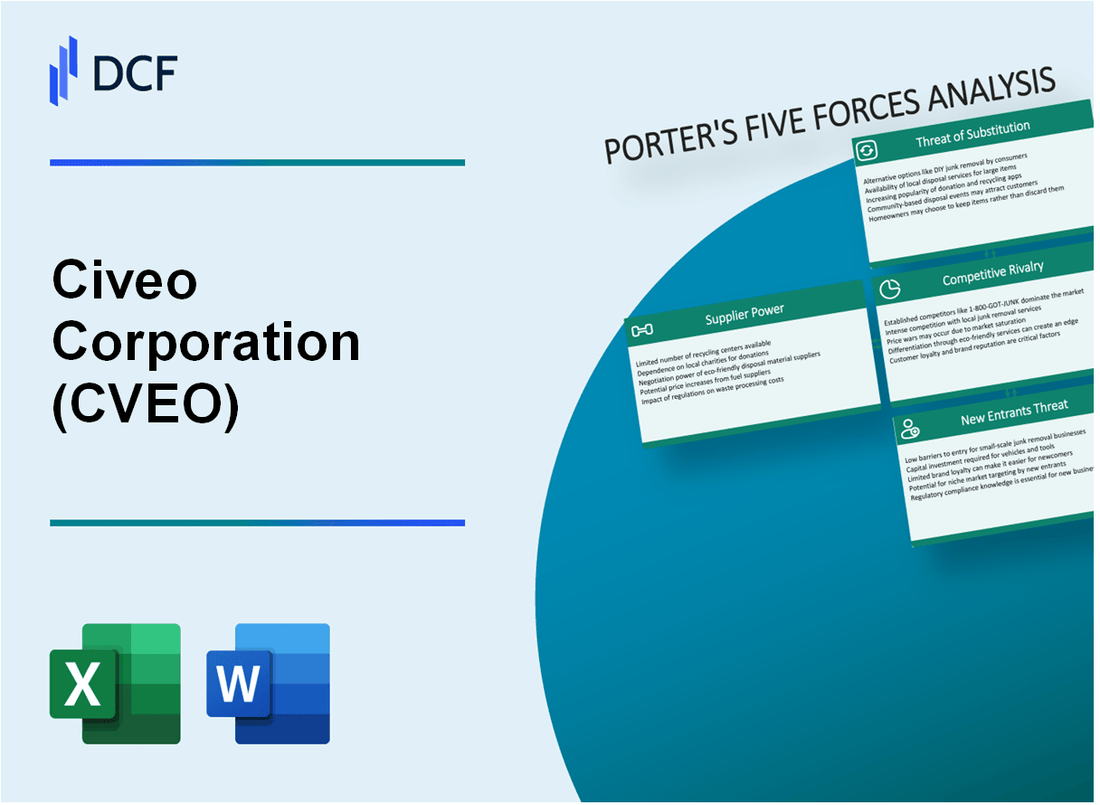
Civeo Corporation (CVEO): 5 forças Análise [Jan-2025 Atualizada] |
Totalmente Editável: Adapte-Se Às Suas Necessidades No Excel Ou Planilhas
Design Profissional: Modelos Confiáveis E Padrão Da Indústria
Pré-Construídos Para Uso Rápido E Eficiente
Compatível com MAC/PC, totalmente desbloqueado
Não É Necessária Experiência; Fácil De Seguir
Civeo Corporation (CVEO) Bundle
No mundo do alto risco de acomodação remota da força de trabalho, a Civeo Corporation navega em uma paisagem complexa, onde a sobrevivência depende da compreensão da dinâmica estratégica do mercado. Ao dissecar a estrutura das cinco forças de Michael Porter, revelamos os intrincados desafios e pressões competitivas que enfrentam esse provedor de serviços especializado nas indústrias de petróleo, gás e mineração. Desde as restrições de combate ao fornecedor até o gerenciamento de expectativas dos clientes e a guarda dos possíveis disruptores do mercado, o posicionamento estratégico de Civeo revela um conto diferenciado de resiliência, inovação e adaptação estratégica em um setor volátil de recursos globais.
Civeo Corporation (CVEO) - As cinco forças de Porter: poder de barganha dos fornecedores
Fornecedores de equipamentos e serviços especializados
Nas indústrias de petróleo, gás e mineração, a Civeo Corporation opera com um número limitado de fornecedores especializados. A partir de 2024, a empresa identifica aproximadamente 7-9 provedores críticos de equipamentos e serviços para acomodações remotas da força de trabalho.
| Categoria de fornecedores | Número de provedores | Concentração de mercado |
|---|---|---|
| Fabricantes de moradias modulares | 4-5 | 82.3% |
| Especialistas em infraestrutura remota | 3-4 | 76.5% |
Trocar custos e requisitos técnicos
A troca de custos para fornecedores permanece alta devido a especificações técnicas complexas em acomodações remotas da força de trabalho.
- Custos de certificação técnica: US $ 1,2-1,5 milhão
- Despesas de verificação de conformidade: US $ 750.000 a US $ 900.000
- Custos de adaptação para infraestrutura: US $ 2,3-2,7 milhões
Experiência especializada
Fornecedores com experiência em força de trabalho remota especializada comandam o posicionamento significativo do mercado.
| Área de especialização | Fornecedores especializados | Quota de mercado |
|---|---|---|
| Soluções climáticas do Ártico/Extremo | 2-3 provedores | 67.4% |
| Infraestrutura do acampamento de mineração | 3-4 provedores | 73.6% |
Requisitos de investimento de capital
Investimentos significativos de capital são necessários para a infraestrutura e o desenvolvimento habitacional modular.
- Investimento de infraestrutura habitacional modular: US $ 45-55 milhões
- Custos de desenvolvimento do local remoto: US $ 30-40 milhões
- Aquisição de equipamentos especializados: US $ 15-22 milhões
Civeo Corporation (CVEO) - As cinco forças de Porter: poder de barganha dos clientes
Análise de base de clientes concentrada
Em 2024, a base de clientes da Civeo Corporation está concentrada principalmente em setores de energia e mineração, com a seguinte composição do cliente:
| Setor | Porcentagem de base de clientes |
|---|---|
| Óleo & Gás | 62% |
| Mineração | 38% |
Grande alavancagem do cliente
Os principais clientes incluem:
- Energia Suncor
- Recursos naturais canadenses
- Grupo BHP
- Rio Tinto
Dinâmica do contrato
Características do contrato a partir de 2024:
| Métrica do contrato | Valor |
|---|---|
| Duração média do contrato | 3,2 anos |
| Taxa de renovação | 78% |
| Valor médio anual do contrato | US $ 14,3 milhões |
Volatilidade da demanda
Impacto de preço de commodities na demanda:
| Faixa de preço de commodities | Flutuação da demanda |
|---|---|
| $ 50- $ 70 por barril (óleo) | -12% Redução da demanda |
| US $ 70 a US $ 90 por barril (óleo) | Demanda estável |
| Acima de US $ 90 por barril (óleo) | +8% da demanda aumenta |
Métricas de dependência do cliente
- Contratos baseados em projetos: 67% da receita total
- Acordos de serviço de longo prazo: 33% da receita total
- Risco de concentração do cliente: os 5 principais clientes representam 52% da receita anual
Civeo Corporation (CVEO) - As cinco forças de Porter: rivalidade competitiva
Cenário de mercado e análise de concorrentes
A partir de 2024, a Civeo Corporation opera em um mercado especializado de acomodação da força de trabalho com concorrentes limitados. Os principais mercados geográficos incluem as regiões ricas em recursos do Canadá e da Austrália.
| Concorrente | Presença de mercado | Regiões -chave | Receita anual |
|---|---|---|---|
| Civeo Corporation | Provedor principal | Canadá, Austrália, EUA | US $ 468,3 milhões (2023) |
| Alvo de hospitalidade | Concorrente secundário | América do Norte | US $ 392,1 milhões (2023) |
| Black Diamond Group | Concorrente regional | Canadá | US $ 345,6 milhões (2023) |
Fatores de intensidade competitivos
O mercado de acomodações da força de trabalho demonstra alta intensidade competitiva com características específicas:
- 3-4 grandes fornecedores especializados no mercado
- Concorrência geográfica concentrada
- Barreiras significativas à entrada
- Requisitos de investimento de capital alto
Dinâmica da concorrência de preços
A concorrência de preços é fortemente influenciada pelos ciclos econômicos da indústria, particularmente nos setores de extração de recursos.
| Indicador econômico | Impacto nos preços | 2023-2024 Tendência |
|---|---|---|
| Volatilidade do preço do petróleo | Pressão de preços diretos | ± 12,5% de flutuação |
| Índice de Atividade de Mineração | Demanda de acomodação | 7,3% de crescimento |
Estratégias de diferenciação de serviço
A Civeo Corporation diferencia -se:
- Gerenciamento abrangente de instalações
- Infraestrutura tecnológica avançada
- Soluções de acomodação personalizadas
- Serviços focados na sustentabilidade
Civeo Corporation (CVEO) - As cinco forças de Porter: ameaça de substitutos
Opções de acomodação alternativas
No quarto trimestre 2023, o mercado global de acomodações modulares foi avaliado em US $ 57,3 bilhões. Campos temporários e alternativas de habitação local apresentam riscos significativos de substituição para o modelo de negócios principal de Civeo.
| Tipo de acomodação | Custo médio por noite | Penetração de mercado |
|---|---|---|
| Campos de trabalhadores tradicionais | $125 | 42% |
| Hotel/motel local | $95 | 28% |
| Soluções habitacionais remotas | $110 | 18% |
Impacto remoto do trabalho
As tendências de trabalho remotas indicam potencial redução da força de trabalho:
- 63% das empresas agora suportam modelos de trabalho híbridos
- Trabalho remoto em setores industriais aumentou 27% desde 2020
- Força de trabalho remota projetada em extração de recursos: 18,5% até 2025
Inovações tecnológicas
As tecnologias de colaboração digital estão transformando o gerenciamento da força de trabalho:
- Mercado global de tecnologia de trabalho remoto: US $ 22,5 bilhões em 2023
- Taxa de adoção da ferramenta de colaboração virtual: 46% nos setores industriais
- Investimento anual em tecnologias de trabalho remoto: US $ 3,7 bilhões
Análise de custo-efetividade
| Tipo de acomodação | Custo anual por trabalhador | Eficiência de custos |
|---|---|---|
| Soluções modulares civeo | $45,600 | Médio |
| Campos tradicionais | $41,200 | Alto |
| Solução de trabalho remoto | $36,800 | Muito alto |
Acordos de vida sustentáveis
Tendências emergentes de acomodação sustentável:
- Crescimento do mercado de acomodações verdes: 15,3% anualmente
- Investimentos de Habitação da Força de Trabalho Sustentável: US $ 2,9 bilhões em 2023
- Soluções de acomodação neutra em carbono: 22% participação de mercado
Civeo Corporation (CVEO) - As cinco forças de Porter: ameaça de novos participantes
Altos requisitos de capital para desenvolvimento de infraestrutura
O desenvolvimento de infraestrutura da Civeo Corporation requer investimento substancial de capital:
| Categoria de infraestrutura | Faixa de investimento estimado |
|---|---|
| Unidades habitacionais modulares | US $ 75 milhões - US $ 125 milhões |
| Instalações remotas do site | US $ 50 milhões - US $ 90 milhões |
| Infraestrutura de logística | US $ 40 milhões - US $ 70 milhões |
Ambiente regulatório complexo
A conformidade regulatória envolve desafios significativos:
- Custos de licença ambiental: US $ 500.000 - US $ 2,5 milhões
- Despesas de documentação de conformidade: US $ 250.000 anualmente
- Investimentos de certificação de segurança: US $ 350.000 - US $ 750.000
Requisitos de especialização especializados
As barreiras de especialização incluem:
| Domínio da experiência | Investimento de treinamento |
|---|---|
| Gerenciamento remoto do site | US $ 1,2 milhão - US $ 3,5 milhões |
| Treinamento especializado em logística | $ 800.000 - US $ 2,1 milhões |
Relacionamentos estabelecidos da indústria
Barreiras de relacionamento existentes:
- Valores de contrato de longo prazo: US $ 250 milhões - US $ 500 milhões
- Acordos de parceria exclusivos: mandatos de 7 a 10 anos
Investimento inicial em infraestrutura
Requisitos totais de investimento inicial:
| Categoria de investimento | Custo estimado |
|---|---|
| Desenvolvimento total da infraestrutura | US $ 165 milhões - US $ 285 milhões |
| Despesas operacionais do primeiro ano | US $ 75 milhões - US $ 125 milhões |
Civeo Corporation (CVEO) - Porter's Five Forces: Competitive rivalry
Rivalry within the sectors Civeo Corporation serves is best characterized as moderate, with key competitors like Dexterra and ATCO operating in the segmented market. You see this dynamic playing out quite differently across Civeo Corporation's two primary geographic areas of operation.
In the Canadian segment, the pressure is definitely felt on pricing. This intensity stems from lower lodge occupancy and, frankly, customers in the oil sands continuing to cut costs related to lodging for base operations and turnaround activity. The numbers from the third quarter of 2025 clearly show this strain: Canadian segment revenues were $46.0 million, a noticeable drop from $57.7 million in the third quarter of 2024. Despite this revenue pressure, Civeo Corporation's cost-cutting measures implemented since late 2024 helped drive gross margin expansion in the region. Specifically, the company achieved a year-over-year gross profit increase of 35% in Canada, driven by a 29% reduction in direct field-level costs and a 23% reduction in indirect operating overhead costs during the third quarter. Still, the segment posted an operating loss of $2.4 million and an Adjusted EBITDA of $8.0 million in Q3 2025.
The Australian segment presents a different competitive picture, largely due to Civeo Corporation's integrated services model and its recent strategic move to acquire four villages. This acquisition, completed on May 7, 2025, for a total cash consideration of A$105 million (approximately US$67 million), included 1,340 rooms and associated customer contracts. This move differentiates Civeo Corporation by expanding its owned-village portfolio in the Bowen Basin and establishing a presence in the Blackwater region. The contracts secured are under take-or-pay terms, which means Civeo Corporation gets paid whether the capacity is fully utilized or not, providing a competitive buffer.
The success of the Australian strategy is visible in the financials. For the third quarter of 2025, the Australian segment delivered revenues of $124.5 million, marking a 7% year-over-year increase. The Adjusted EBITDA for this segment grew even more strongly, up 19% year-over-year to $26.7 million. This growth reflects the full-quarter contribution from the four acquired villages, which were expected to add annualized revenue of approximately A$50 million (or US$32 million).
Civeo Corporation's overall market positioning and the impact of these segment performances are summarized in the latest full-year projections. You need to keep these figures in mind when assessing the competitive environment:
| Metric | Value / Range (Full Year 2025) | Source Segment |
|---|---|---|
| Projected Revenue | $640 million to $655 million | Consolidated |
| Projected Adjusted EBITDA | $86 million to $91 million | Consolidated |
| Capital Expenditure Guidance | $20 million to $25 million | Consolidated |
The company's focus on capital allocation also signals confidence in its competitive standing and future cash flow generation. As of the third quarter of 2025, Civeo Corporation had returned approximately $52 million to shareholders year-to-date via share repurchases, completing 69% of its authorization to buy back 20% of its common shares outstanding. This aggressive buyback strategy, using no less than 100% of annual free cash flow for the program, suggests management views the stock as undervalued relative to its operational improvements and contracted assets.
The competitive dynamics are further illustrated by the following operational data points from the third quarter of 2025:
- Australian Segment Revenue Growth (YoY): 7%
- Canadian Segment Revenue Decline (YoY): From $57.7 million to $46.0 million
- Australian Segment Adjusted EBITDA Growth (YoY): 19%
- Canadian Direct Field-Level Cost Reduction: 29%
- Acquisition Cost for Four Australian Villages: A$105 million (approx. US$67 million)
- Total Liquidity (as of September 30, 2025): Approximately $70.2 million
The integrated services model in Australia, bolstered by the recent acquisition, provides Civeo Corporation with a stronger, more contractually secure footing against rivals there. In contrast, the Canadian market forces Civeo Corporation to compete intensely on cost structure to maintain viability against customers actively reducing their own spending.
Civeo Corporation (CVEO) - Porter's Five Forces: Threat of substitutes
You're assessing Civeo Corporation's competitive moat, and the threat of substitutes is definitely a key area to watch. This force looks at what customers might use instead of Civeo's core offering: remote site accommodation and integrated services for resource projects.
The largest substitute you need to consider is customer self-supply through owned and operated accommodations. This means a major client decides to build, own, and manage their own camp facilities rather than contracting Civeo. While we don't have a direct percentage for self-supply substitution, looking at Civeo's segment performance gives you a sense of the operating environment. For the third quarter of 2025, Civeo's total revenue was $170.5 million, with the Australian segment generating $124.5 million of that. Conversely, the Canadian segment saw revenues drop to $46.0 million in Q3 2025 from $57.7 million in the prior year's third quarter. This Canadian market softness suggests that customer spending reductions, which can include opting for leaner, self-managed solutions, remain a real headwind.
Next up are modular and mobile camp providers. These firms offer a lower-capital, shorter-term substitute compared to Civeo's strategy of owning and operating permanent lodges. To be fair, Civeo counters this by securing long-duration contracts. For example, Civeo announced a six-year integrated services contract renewal in Western Australia, effective January 1, 2025, anticipated to generate approximately A$1.4B in revenues through 2030. Another recent award was a four-year contract in the Bowen Basin. This commitment to multi-year service agreements is Civeo's defense against more transient, mobile solutions.
Here's a quick look at how Civeo's contract tenure stacks up against the broader modular construction industry, which is the source of many mobile/shorter-term substitutes. The global modular construction market size was estimated at USD 103.55 billion in 2024 and is projected to reach USD 162.42 billion by 2030.
| Metric | Value/Period | Source Year/Period |
|---|---|---|
| Civeo Long-Term Contract Example | 6 Years (Western Australia Renewal) | 2025-2030 |
| Civeo Contract Example Revenue | A$1.4 Billion | 2025-2030 |
| Global Modular Construction Market Size | USD 103.55 Billion | 2024 |
| Projected Global Modular Market Size | USD 162.42 Billion | 2030 |
| Permanent Modular Construction Revenue Share (Global) | 64.45% | 2024 |
Also, you can't ignore the impact of remote work technology and automation. While Civeo's clients are in heavy industry-mining and oil sands-where full remote operations aren't feasible, technology can still reduce the overall need for on-site personnel and, consequently, accommodation demand. Civeo's CEO noted in Q3 2025 that staffing in Australia 'continues to be a challenge,' particularly for chefs and general labor, though it is not necessarily getting worse. This points to an operational reality where labor efficiency, whether through tech or process improvement, is a constant factor affecting occupancy needs.
Still, the high quality of Civeo's integrated hospitality services acts as a significant barrier against simple, low-cost substitutes, especially for long-term projects. Civeo is actively pushing this value proposition. They are targeting AUD 500 million in Australian integrated services revenue by 2027. This integrated offering goes beyond just beds; it includes:
- Catering and retail services
- Village, mine, and port site cleaning services
- Facilities maintenance
- Provision of health and wellbeing solutions
When a client commits to a six-year contract for this level of service, the perceived risk of switching to a cheaper, less comprehensive provider for a major, multi-year operation definitely rises. Finance: draft 13-week cash view by Friday.
Civeo Corporation (CVEO) - Porter's Five Forces: Threat of new entrants
You're assessing the barriers to entry in Civeo Corporation's specialized accommodation sector, and honestly, the picture suggests a very high wall for any newcomer. The threat of new entrants is decidedly low because the upfront and ongoing investment required to compete at scale is immense.
The capital intensity alone acts as a significant deterrent. Building and maintaining remote lodges and villages-which provide everything from rooms to catering and utilities-requires massive, lumpy capital deployment. While Civeo Corporation's full-year 2025 capital expenditure guidance is set between $20 million to $25 million, this is largely for maintenance of its existing fleet. The true barrier is the initial build cost, which we can infer from recent activity. For instance, Civeo Corporation executed a strategic acquisition of four villages in the Bowen Basin for approximately ~$67M. That's a benchmark for acquiring established capacity, not building from scratch, which would likely carry a higher initial outlay plus development time.
New entrants also run headfirst into significant logistical hurdles across Civeo Corporation's core markets in remote Canadian and Australian resource regions. These locations are defined by their inaccessibility, which translates directly into operational complexity and cost for anyone trying to establish a footprint.
- Transport and installation involve long lead times and expensive logistics.
- Harsh climates in regions like the Canadian Northwest Territories or Western Australia rapidly wear down infrastructure.
- Getting spare parts or specialized technicians to remote sites is slow and costly, increasing maintenance risk.
- Infrastructure is often scarce, meaning a new entrant must build power, water, and communications systems themselves.
Furthermore, Civeo Corporation's deep entrenchment via established, long-term contracts locks up significant future revenue streams, making it difficult for a new player to secure the anchor business needed to justify their own initial capital outlay. You see this clearly in the sheer size of their recent wins.
| Contract Detail | Value/Period | Region |
|---|---|---|
| Major Integrated Services Renewal | Anticipated A$1.4B over 2025-2030 (6 years) | Australia (11 Villages) |
| Bowen Basin Contract Renewal | Approximately A$250 million over 2025-2029 (4 years) | Australia |
| Queensland Integrated Services Contract | Approximately A$64 million over 2025-2028 (3 years) | Australia |
These multi-year agreements, like the A$1.4B deal running through 2030, provide Civeo Corporation with revenue surety that a startup simply cannot match. It's a classic case of incumbency advantage built on performance and relationship trust.
Finally, the regulatory environment in natural resource areas adds another layer of substantial friction. Operating remote villages requires navigating complex permitting for land use, environmental compliance, and worker safety standards specific to mining and energy projects in both Canada and Australia. A new entrant must secure these specialized permits, which is a time-consuming and capital-intensive process that Civeo Corporation has already navigated across its portfolio of 28 owned and operated lodges and villages as of mid-2025. The need for specialized permits in these sensitive and heavily regulated operational zones creates a high administrative and compliance barrier to entry.
Disclaimer
All information, articles, and product details provided on this website are for general informational and educational purposes only. We do not claim any ownership over, nor do we intend to infringe upon, any trademarks, copyrights, logos, brand names, or other intellectual property mentioned or depicted on this site. Such intellectual property remains the property of its respective owners, and any references here are made solely for identification or informational purposes, without implying any affiliation, endorsement, or partnership.
We make no representations or warranties, express or implied, regarding the accuracy, completeness, or suitability of any content or products presented. Nothing on this website should be construed as legal, tax, investment, financial, medical, or other professional advice. In addition, no part of this site—including articles or product references—constitutes a solicitation, recommendation, endorsement, advertisement, or offer to buy or sell any securities, franchises, or other financial instruments, particularly in jurisdictions where such activity would be unlawful.
All content is of a general nature and may not address the specific circumstances of any individual or entity. It is not a substitute for professional advice or services. Any actions you take based on the information provided here are strictly at your own risk. You accept full responsibility for any decisions or outcomes arising from your use of this website and agree to release us from any liability in connection with your use of, or reliance upon, the content or products found herein.