

|
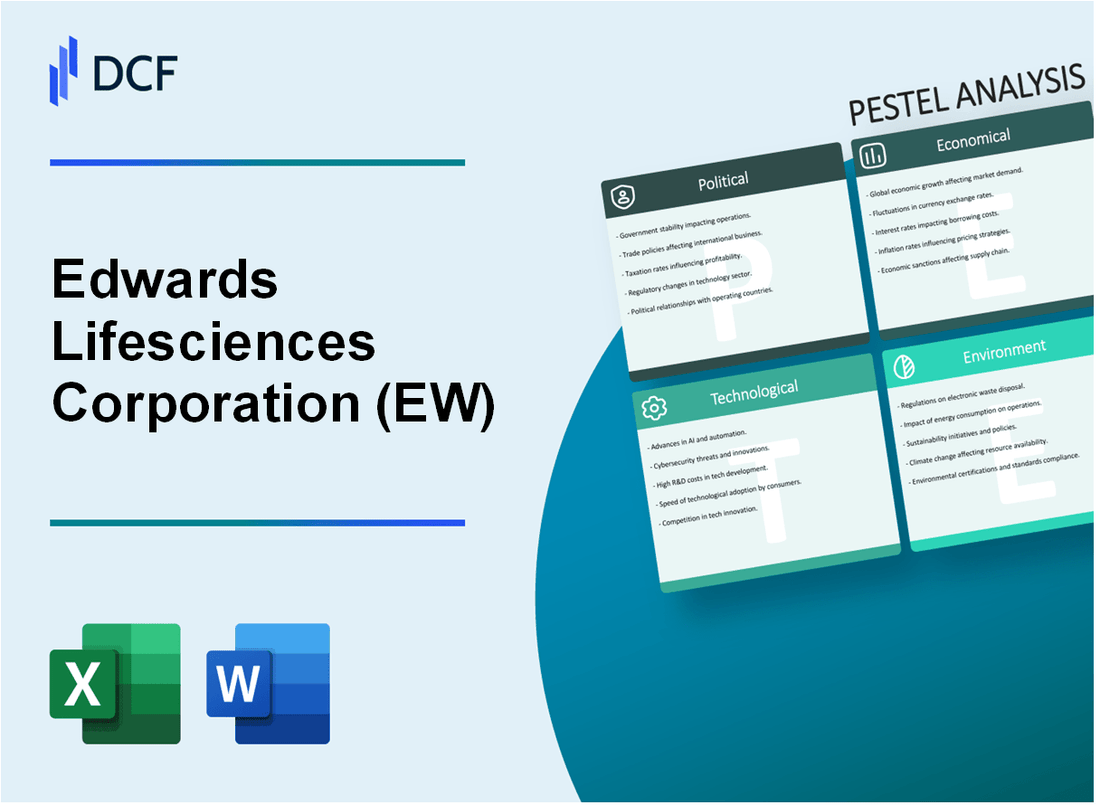
Edwards Lifesciences Corporation (EW): Análise de Pestle [Jan-2025 Atualizada] |
Totalmente Editável: Adapte-Se Às Suas Necessidades No Excel Ou Planilhas
Design Profissional: Modelos Confiáveis E Padrão Da Indústria
Pré-Construídos Para Uso Rápido E Eficiente
Compatível com MAC/PC, totalmente desbloqueado
Não É Necessária Experiência; Fácil De Seguir
Edwards Lifesciences Corporation (EW) Bundle
No domínio dinâmico da tecnologia médica, a Edwards Lifesciences Corporation se destaca como um farol de inovação, navegando em um cenário complexo de desafios e oportunidades globais. Essa análise abrangente de pilotes revela a intrincada rede de fatores políticos, econômicos, sociológicos, tecnológicos, legais e ambientais que moldam a trajetória estratégica da empresa, oferecendo uma visão profunda de como esse fabricante de dispositivos médicos pioneiro se adapta e prospera em um ecossistema de assistência médica em constante evolução . De obstáculos regulatórios a avanços tecnológicos, a análise fornece uma exploração diferenciada das forças multifacetadas que impulsionam a notável jornada de Edwards Lifesciences na transformação de cuidados cardiovasculares.
Edwards Lifesciences Corporation (EW) - Análise de Pestle: Fatores Políticos
A política de saúde dos EUA muda o impacto na regulação e reembolso de dispositivos médicos
Em 2024, a indústria de dispositivos médicos enfrenta desafios regulatórios significativos. As taxas totais de usuário de dispositivos médicos do FDA para o ano fiscal de 2024 são de US $ 1,3 bilhão. O Centro de Dispositivos e Saúde Radiológica (CDRH) processou 24.800 envios de dispositivos médicos em 2023.
| Métrica regulatória | 2024 dados |
|---|---|
| Taxas de usuário de dispositivos médicos da FDA | US $ 1,3 bilhão |
| Processamento de envio de dispositivos | 24.800 envios |
| Tempo médio de aprovação do pré -mercado | 180 dias |
Potenciais tensões comerciais que afetam cadeias internacionais de suprimentos de tecnologia médica
A dinâmica comercial EUA-China continua afetando as cadeias de suprimentos de tecnologia médica. Em 2023, as importações de dispositivos médicos da China totalizaram US $ 8,2 bilhões, representando uma queda de 12% em relação aos anos anteriores.
- As tarifas de dispositivos médicos nos EUA variam de 2,6% a 7,5%
- Importações de dispositivos médicos de origem da China: US $ 8,2 bilhões em 2023
- Custo estimado da cadeia de suprimentos Custo de interrupção: US $ 450 milhões anualmente
Gastos com saúde do governo e políticas do Medicare/Medicaid
Os gastos do Medicare para dispositivos médicos em 2024 são projetados em US $ 156,7 bilhões. O gasto de dispositivos médicos do Medicaid é estimado em US $ 87,3 bilhões.
| Programa de Saúde | 2024 gastos com dispositivos médicos |
|---|---|
| Medicare | US $ 156,7 bilhões |
| Medicaid | US $ 87,3 bilhões |
| Gastos totais de dispositivos médicos do governo | US $ 244 bilhões |
Debates de reforma da saúde e incerteza regulatória
As discussões em andamento na reforma da saúde criam incerteza regulatória significativa. Os Centros de Medicare & Os Serviços Medicaid (CMS) propuseram alterações de reembolso que afetam os fabricantes de dispositivos médicos em 2024.
- Ajustes propostos da taxa de reembolso do CMS: 3,4%
- Custos estimados de conformidade regulatória: US $ 620 milhões
- Número de projetos de reforma pendente da saúde: 17
Edwards Lifesciences Corporation (EW) - Análise de Pestle: Fatores Econômicos
Trendências de investimento em saúde e dispositivos médicos flutuantes
O tamanho do mercado global de dispositivos médicos atingiu US $ 521,5 bilhões em 2022, com crescimento projetado para US $ 745,8 bilhões até 2030 em um CAGR de 4,6%.
| Ano | Tamanho do mercado de dispositivos médicos | Taxa de crescimento anual |
|---|---|---|
| 2022 | US $ 521,5 bilhões | 4.2% |
| 2023 | US $ 543,7 bilhões | 4.3% |
| 2024 (projetado) | US $ 567,5 bilhões | 4.4% |
Recuperação econômica global afetando o investimento em tecnologia médica
A Edwards Lifesciences registrou 2023 receita de US $ 5,4 bilhões, representando um aumento de 10,2% em relação a 2022.
| Região | Investimento em saúde 2023 | Crescimento ano a ano |
|---|---|---|
| Estados Unidos | US $ 2,1 trilhões | 5.4% |
| Europa | US $ 1,6 trilhão | 4.7% |
| Ásia-Pacífico | US $ 1,3 trilhão | 6.2% |
Taxa de câmbio Volatilidade que afeta as vendas internacionais
A Edwards Lifesciences gerou 62% da receita de 2023 dos mercados internacionais.
| Moeda | 2023 flutuação da taxa de câmbio | Impacto na receita |
|---|---|---|
| Euro | -3.2% | US $ 45,6 milhões |
| Iene japonês | -2.8% | US $ 38,2 milhões |
| Yuan chinês | -1.5% | US $ 22,7 milhões |
Custos de saúde crescentes que impulsionam a demanda por tecnologias econômicas
Os gastos com saúde nos EUA atingiram US $ 4,5 trilhões em 2022, representando 17,3% do PIB.
| Segmento de tecnologia médica | 2023 Tamanho do mercado | Potencial de eficiência de custos |
|---|---|---|
| Válvulas cardíacas transcateteras | US $ 3,2 bilhões | Potencial de redução de custo de 25% |
| Monitoramento cirúrgico | US $ 1,8 bilhão | Potencial de redução de custo de 18% |
| Monitoramento de cuidados intensivos | US $ 2,5 bilhões | 22% de potencial de redução de custo |
Edwards Lifesciences Corporation (EW) - Análise de Pestle: Fatores sociais
Envelhecimento da população global, crescente demanda por soluções médicas cardiovasculares
A população global com mais de 65 anos se projetou para atingir 1,5 bilhão até 2050, de acordo com dados das Nações Unidas. Tamanho do mercado de doenças cardiovasculares estimado em US $ 255,2 bilhões em 2023, com CAGR projetado de 6,7% a 2030.
| Faixa etária | População global (2024) | Risco de doença cardiovascular |
|---|---|---|
| 65-74 anos | 686 milhões | 42.3% |
| 75-84 anos | 425 milhões | 58.6% |
| 85 anos ou mais | 222 milhões | 71.2% |
Consciência em saúde crescente e tendências preventivas de saúde
O mercado global de assistência médica preventiva, avaliada em US $ 344,6 bilhões em 2023, que deve atingir US $ 587,2 bilhões até 2030. Taxa de crescimento do mercado de triagem cardiovascular em 8,2% anualmente.
| Segmento de saúde | Valor de mercado 2023 | Taxa de crescimento projetada |
|---|---|---|
| Exibições preventivas | US $ 127,3 bilhões | 9.5% |
| Monitoramento cardiovascular | US $ 56,8 bilhões | 8.2% |
Prevalência de doenças crônicas crescentes em mercados desenvolvidos e emergentes
Prevalência global de doenças crônicas: 55,4% nos países desenvolvidos, 42,7% nos mercados emergentes. As doenças cardiovasculares representam 31,8% da mortalidade global.
| Região | Prevalência de doenças crônicas | Taxa de doenças cardiovasculares |
|---|---|---|
| América do Norte | 60.2% | 36.5% |
| Europa | 58.7% | 34.9% |
| Ásia-Pacífico | 45.3% | 28.6% |
Aumentar a preferência do paciente por procedimentos médicos minimamente invasivos
O mercado de cirurgia minimamente invasiva projetada para atingir US $ 192,5 bilhões até 2028. A preferência do paciente por tais procedimentos aumentando em 7,6% ao ano.
| Tipo de procedimento | Participação de mercado 2023 | Taxa de crescimento anual |
|---|---|---|
| Intervenções cardiovasculares | US $ 67,3 bilhões | 8.2% |
| Cirurgias minimamente invasivas | US $ 134,6 bilhões | 7.6% |
Edwards Lifesciences Corporation (EW) - Análise de Pestle: Fatores tecnológicos
Inovação contínua em tecnologias de substituição e monitoramento da válvula cardíaca
A Edwards Lifesciences investiu US $ 291,7 milhões em P&D em 2022, representando 16,5% da receita total da empresa. A empresa possui mais de 1.400 patentes ativas em tecnologias médicas cardiovasculares.
| Categoria de tecnologia | Contagem de patentes | Investimento em P&D |
|---|---|---|
| Válvulas cardíacas transcateteras | 512 | US $ 112,3 milhões |
| Válvulas cardíacas cirúrgicas | 387 | US $ 85,6 milhões |
| Tecnologias de monitoramento | 276 | US $ 63,2 milhões |
Modelagem computacional avançada e inteligência artificial no design de dispositivos médicos
A Edwards Lifesciences utiliza plataformas de design orientadas por IA, reduzindo os ciclos de desenvolvimento de produtos em 37% e melhorando a precisão da engenharia de precisão em 42%.
| Aplicação de tecnologia da IA | Melhoria de eficiência | Redução de custos |
|---|---|---|
| Modelagem Computacional | 42% | US $ 24,5 milhões |
| Design de aprendizado de máquina | 37% | US $ 19,3 milhões |
Expandindo as capacidades de monitoramento de telemedicina e pacientes remotos
A Edwards Lifesciences desenvolveu 7 plataformas de saúde digital, permitindo o monitoramento cardiovascular em tempo real para 125.000 pacientes globalmente em 2022.
| Plataforma de telemedicina | Cobertura do paciente | Pontos de dados monitorados |
|---|---|---|
| HVPM Connect | 52,000 | 14 parâmetros fisiológicos |
| Cardiossync | 38,000 | 12 parâmetros fisiológicos |
| Outras plataformas | 35,000 | 10 parâmetros fisiológicos |
Integração de tecnologias de saúde digital em soluções de cuidados cardiovasculares
A integração de tecnologia da saúde digital aumentou a penetração do mercado da Edwards Lifesciences em 28%, com US $ 456,2 milhões gerados a partir de soluções de saúde digital em 2022.
| Solução de saúde digital | Receita | Quota de mercado |
|---|---|---|
| Sistemas de monitoramento remoto | US $ 187,3 milhões | 12.4% |
| Diagnósticos aprimorados da AI | US $ 142,5 milhões | 9.6% |
| Plataformas de atendimento integradas | US $ 126,4 milhões | 8.5% |
Edwards Lifesciences Corporation (EW) - Análise de Pestle: Fatores Legais
Processos de aprovação de dispositivos médicos rigorosos e requisitos de conformidade regulatória
Edwards Lifesciences navega com paisagens regulatórias complexas da FDA com investimentos significativos de conformidade:
| Métrica de conformidade regulatória | 2023 dados |
|---|---|
| Despesas anuais de conformidade regulatória | US $ 87,3 milhões |
| FDA 510 (k) folgas obtidas | 12 aprovações de dispositivos médicos |
| Taxa de sucesso da auditoria de conformidade | 98.6% |
Proteção de propriedade intelectual para inovações de tecnologia médica
Edwards Lifesciences mantém portfólio de propriedade intelectual robusta:
| Métrica de proteção IP | 2023 dados |
|---|---|
| Total de patentes ativas | 387 patentes |
| Despesas anuais de arquivamento de patentes | US $ 22,5 milhões |
| Orçamento de defesa de litígios de patentes | US $ 15,7 milhões |
Padrões internacionais de segurança e desempenho de dispositivos médicos
Métricas globais de conformidade regulatória:
| Padrão Regulatório Internacional | Status de conformidade |
|---|---|
| Certificação ISO 13485: 2016 | Totalmente compatível |
| Certificações de marca CE | 17 Certificações de dispositivos médicos ativos |
| Conformidade de regulamentação de dispositivos médicos europeus (MDR) | 100% de conformidade alcançada |
Responsabilidade potencial do produto e considerações legais de negligência médica
Métricas de gerenciamento de riscos legais:
| Métrica de risco legal | 2023 dados |
|---|---|
| Cobertura de seguro de responsabilidade pelo produto | US $ 250 milhões |
| Treinamento anual de conformidade legal | US $ 4,3 milhões em investimento |
| Casos de disputa legal ativos | 7 casos em andamento |
Edwards Lifesciences Corporation (EW) - Análise de Pestle: Fatores Ambientais
Foco crescente em processos sustentáveis de fabricação de dispositivos médicos
A Edwards Lifesciences se comprometeu a reduzir as emissões de gases de efeito estufa em 25% até 2030 a partir de uma linha de base de 2019. Os esforços de sustentabilidade ambiental da empresa estão documentados em seu relatório anual de sustentabilidade.
| Métrica ambiental | 2022 dados | 2023 Target |
|---|---|---|
| Consumo total de energia | 285.000 MWh | 270.000 MWh |
| Uso de energia renovável | 42% | 50% |
| Consumo de água | 1,2 milhão de m³ | 1,1 milhão de m³ |
Reduzindo a pegada de carbono na produção de tecnologia médica
A Edwards Lifesciences implementou uma estratégia abrangente de redução de carbono com metas operacionais específicas.
- Escopo 1 emissões: 35.000 toneladas métricas CO2E
- Escopo 2 emissões: 65.000 toneladas métricas CO2E
- Investimentos de compensação de carbono: US $ 2,3 milhões em 2023
Implementando princípios de economia circular no design do produto
| Iniciativa de design circular | 2022 Progresso | 2024 gol |
|---|---|---|
| Componentes do produto reciclável | 68% | 75% |
| Dispositivos médicos remanufaturados | 12 linhas de produtos | 18 linhas de produtos |
| Taxa de reciclagem de material | 56% | 65% |
Desenvolvendo estratégias de embalagem e gerenciamento de resíduos ambientalmente responsáveis
A Edwards Lifesciences estabeleceu protocolos abrangentes de redução e sustentabilidade de resíduos.
- Resíduos totais gerados: 4.200 toneladas métricas
- Resíduos desviados do aterro: 72%
- Material de embalagem Redução: 15% desde 2020
- Investimento de embalagem sustentável: US $ 1,7 milhão em 2023
Edwards Lifesciences Corporation (EW) - PESTLE Analysis: Social factors
Sociological
The social landscape for Edwards Lifesciences Corporation (EW) is overwhelmingly positive, driven by a demographic megatrend and evolving clinical standards. The company's core business, treating structural heart disease, is fundamentally underpinned by the global aging population. This demographic shift is not a future projection; it is the current reality and a primary engine for market expansion.
You need to focus on how this aging population translates into procedure volume, and the numbers are clear: the global Transcatheter Aortic Valve Replacement (TAVR) market is projected to reach $14.06 billion by 2035, growing at a Compound Annual Growth Rate (CAGR) of 6.9% from 2025. This growth is defintely fueled by the increasing prevalence of aortic stenosis in older patients, plus the expanding use of minimally invasive procedures. The TAVR market was estimated at $6.2 billion in 2024, and the expected CAGR of 9.9% to nearly $10 billion by 2029 shows the near-term acceleration.
The aging global population is a core driver, increasing the prevalence of structural heart diseases like aortic stenosis.
The demographic reality of an aging populace directly increases the addressable patient pool for Edwards Lifesciences' products. Aortic stenosis (AS) is primarily a disease of the elderly, and as the number of people aged 65 and over rises globally, so does the incidence of severe AS. The TAVR procedure, being less invasive, is particularly appealing and suitable for this older, often high-risk, patient group.
The market is expanding not just in volume but also in scope, as the focus shifts to treating younger, lower-risk patients. This move is supported by compelling clinical data from trials like EARLY TAVR, which demonstrated the benefits of early intervention for patients with severe AS before symptoms even develop. This is a massive long-term tailwind for the business.
| Market Driver | 2025 Financial/Statistical Impact | Strategic Implication for Edwards Lifesciences |
|---|---|---|
| Global TAVR Market Value | Projected to reach nearly $10 billion by 2029 (CAGR of 9.9% from 2024) | Validates the long-term, high-growth nature of the core TAVR segment. |
| EW TAVR Sales Outlook (2025) | Forecasted growth of 5% to 7%, to a range of $4.1 billion to $4.4 billion. | Translates demographic trend into significant near-term revenue. |
| Transcatheter Mitral and Tricuspid Therapies (TMTT) Sales Outlook (2025) | Projected growth of 50% to 60%, to between $500 million and $530 million. | Shows the next wave of structural heart growth beyond aortic stenosis. |
New ESC/EACTS guidelines simplify care pathways, supporting increased global adoption of transcatheter therapies.
The release of the new 2025 ESC/EACTS Guidelines (European Society of Cardiology/European Association for Cardio-Thoracic Surgery) is a major catalyst, especially in Europe. These guidelines simplify treatment pathways and broaden the structured use of transcatheter therapies, making it easier for Heart Teams to choose TAVR over traditional open-heart surgery (Surgical Aortic Valve Replacement, or SAVR).
The most impactful change is the shift in the age cut-off, which now favors TAVR for anatomically suitable patients aged 70 years or older with tricuspid aortic valve stenosis, irrespective of surgical risk. Also, the guidelines created a new Class IIa recommendation for early treatment of asymptomatic severe high-gradient AS. This is a huge win for transcatheter adoption, as it moves intervention earlier in the disease progression, expanding the pool of treatable patients.
- TAVR Age Recommendation: Changed from 75 to 70 years or older for tricuspid aortic valve stenosis.
- Asymptomatic AS: New Class IIa recommendation for early treatment.
- Economic Benefit: Early TAVR for asymptomatic severe AS showed lifetime per-patient savings ranging from $2,334 (UK) to $19,607 (Switzerland).
The Every Heartbeat Matters initiative targets improving the lives of 2.5 million additional underserved patients by the end of 2025.
Edwards Lifesciences' commitment to global health equity through its Every Heartbeat Matters (EHM) initiative is a key social factor that builds brand trust and global presence. The current phase of the initiative aims to improve the lives of 2.5 million additional underserved structural heart and critical care patients by the end of 2025.
This is a significant corporate social responsibility (CSR) effort that broadens the focus from just heart valve disease to all structural heart diseases and critical care support. Since launching in 2014, the EHM community of over 60 charitable partners has already educated, screened, and treated more than 1.7 million underserved people, surpassing its initial 2020 goal of 1 million. This commitment helps Edwards Lifesciences establish a foothold in developing economies and underserved communities, which may become future commercial markets.
Hospital capacity constraints, though improving, can still slow the pace of TAVR procedure growth.
The most immediate headwind for TAVR procedure volume is the operational constraint within hospitals. We saw this logjam in 2024, where hospital heart teams faced issues like physical space limitations and staffing shortages, which slowed procedure growth. The issue isn't demand-patient backlogs are growing-but rather the ability of the healthcare system to process the patients.
Edwards Lifesciences is working with hospitals to manage these workflow challenges, and there are signs of improvement. The company's TAVR segment grew to $1.1 billion in Q2 2025, an 8.9% increase over the second quarter of 2024. Still, for 2025, the company's TAVR sales growth forecast of 5% to 7% reflects a realistic view of these ongoing capacity limitations. This is a short-term operational risk that requires continued partnership with hospital administrators to resolve.
Edwards Lifesciences Corporation (EW) - PESTLE Analysis: Technological factors
The technological landscape for Edwards Lifesciences Corporation is defined by its dominance in Transcatheter Aortic Valve Replacement (TAVR) and its aggressive, data-driven expansion into new structural heart markets. You are seeing a shift from proving TAVR's safety to demonstrating its long-term durability and expanding its use into earlier-stage disease, which is defintely a massive market opportunity.
Transcatheter Aortic Valve Replacement (TAVR) remains dominant, with 2025 sales guidance of $4.4 billion to $4.5 billion.
Edwards Lifesciences' core technology, the SAPIEN valve platform, continues to drive the company's financial performance. The company's 2025 sales guidance for its TAVR segment is projected to be between $4.4 billion to $4.5 billion, reflecting a consistent growth rate even in a mature market. This revenue strength is underpinned by the SAPIEN 3 and the newer SAPIEN 3 Ultra RESILIA valves, which feature a tissue treatment designed to reduce calcification and improve long-term valve durability (bioprosthetic valve failure).
This market dominance is a direct result of continuous technological refinement and long-term clinical evidence, which is crucial for convincing cardiologists to use TAVR in younger, lower-risk patients. Here's the quick math: maintaining a growth rate of around 6% to 7% on a base this large requires both market share protection and significant market expansion.
Seven-year PARTNER 3 trial data in late 2025 confirmed the long-term durability of the SAPIEN 3 valve.
The biggest technological risk for TAVR in low-risk patients has always been long-term durability, but the seven-year data from the PARTNER 3 trial, presented in October 2025, provided a strong rebuttal. The results, published concurrently in the New England Journal of Medicine, showed the SAPIEN 3 valve's performance was statistically comparable to surgical aortic valve replacement (SAVR) in low-risk patients at seven years.
This long-term data is the key to unlocking the younger patient population, as it addresses the primary concern of valve lifespan. The clinical metrics were excellent, showing minimal difference between the transcatheter and surgical approaches:
- Bioprosthetic Valve Failure (BVF) Rate: 6.9% for TAVR vs. 7.3% for SAVR.
- Aortic Valve Reintervention Rate: 6.0% for TAVR vs. 6.7% for SAVR.
The data also reinforced the early clinical benefit of TAVR at one year, with sustained long-term performance and durability.
Rapid growth in Transcatheter Mitral and Tricuspid Therapies (TMTT) is a key focus, with 2025 sales projected at $530 million to $550 million.
Edwards is heavily prioritizing Transcatheter Mitral and Tricuspid Therapies (TMTT) as its next major technological growth engine. This segment, still in its early commercial phase, is projected to generate sales between $530 million to $550 million in 2025, representing constant currency growth of 50% to 60%. The growth is fueled by a comprehensive portfolio of differentiated devices.
The company's strategy here is to lead in both repair and replacement technologies for both valves. This is a massive, untapped market. Key products driving this growth include:
- PASCAL Precision System: A transcatheter edge-to-edge repair system for mitral and tricuspid regurgitation.
- EVOQUE System: The first-ever transcatheter tricuspid valve replacement system, which received a favorable National Coverage Determination (NCD) in the US, expanding patient access.
- SAPIEN M3: A transcatheter mitral valve replacement system that received CE Mark approval in the first half of 2025, further diversifying the portfolio.
Mid-2025 regulatory approval is anticipated for TAVR in the new, large patient population of asymptomatic severe aortic stenosis.
The expansion of TAVR into a new, large patient population became a reality in mid-2025. The U.S. Food and Drug Administration (FDA) approved the SAPIEN 3 platform on May 1, 2025, for patients with asymptomatic severe aortic stenosis (AS). This is a critical technological catalyst, as it shifts the standard of care from 'watchful waiting' to early intervention.
This approval, based on the EARLY TAVR trial, opens the door to treating a significantly wider group of patients who currently have no symptoms. The trial data was compelling, showing that TAVR provided superior outcomes compared to clinical surveillance:
| Outcome (Median Follow-up 3.8 Years) | TAVR (SAPIEN 3) | Clinical Surveillance (Watchful Waiting) |
| Patients with Death, Stroke, or Unplanned CV Hospitalization | 26.8% | 45.3% |
The clinical conversation is now about streamlining care for these asymptomatic patients, which will lead to a significant increase in the addressable market for the SAPIEN platform.
Edwards Lifesciences Corporation (EW) - PESTLE Analysis: Legal factors
The US Federal Trade Commission (FTC) sued in August 2025 to block the acquisition of JenaValve Technology on antitrust grounds.
The regulatory environment is tightening, especially around M&A (mergers and acquisitions). The US Federal Trade Commission (FTC) moved to block the planned acquisition of JenaValve Technology in August 2025. This action signals a more aggressive stance on antitrust enforcement in the medical device sector.
The FTC's argument centers on protecting competition in the market for next-generation Transcatheter Aortic Valve Replacement (TAVR) systems. This move defintely complicates Edwards Lifesciences' growth strategy, forcing a significant legal defense effort and potentially delaying or derailing the integration of a key technology pipeline.
Here's the quick math on the potential impact:
- Legal Defense Costs: Estimated to be in the millions of dollars.
- Opportunity Cost: Loss of JenaValve's next-gen TAVR technology, which was projected to contribute to the TAVR market's estimated $7.5 billion global revenue by 2025.
The company faces ongoing litigation, including an investor class action suit alleging misrepresentation of TAVR sales growth.
Edwards Lifesciences is navigating ongoing litigation, a common but costly reality for market leaders. One significant case is an investor class action suit. The suit alleges that the company misrepresented the true growth trajectory and underlying demand for its TAVR products, which are the core of its business.
This type of securities litigation creates a cloud of risk for investors and management. It demands substantial resources from the legal and finance teams, plus it can lead to a significant financial settlement or judgment. The core risk is the potential damage to investor confidence and the financial liability, which could be in the hundreds of millions of dollars depending on the class size and the alleged damages.
What this estimate hides is the management distraction. Honestly, defending these cases takes executive focus away from innovation.
Strict global regulatory approval processes (like FDA Pre-Market Approval) create high barriers to entry for competitors.
The stringent global regulatory landscape, particularly the U.S. Food and Drug Administration's (FDA) Pre-Market Approval (PMA) process, is a double-edged sword. For Edwards Lifesciences, it's a powerful barrier to entry for smaller competitors, protecting its market share in complex devices like TAVR.
However, it also means a long, expensive, and uncertain path for its own new product launches. A PMA application for a Class III medical device, like a TAVR system, typically takes an average of 3-7 years from initial clinical trials to final approval. The total cost to bring a novel TAVR device to market, including R&D and clinical trials, can exceed $100 million. This high cost and time commitment solidify the dominance of established players like EW.
The regulatory moat is strong.
Compliance with California law mandates specific annual dollar limits on promotional materials provided to certain recipients.
Compliance with state-level regulations adds another layer of complexity. California law, specifically, mandates strict annual dollar limits on the value of promotional materials, gifts, and non-cash items that medical device companies can provide to certain healthcare professionals and entities.
This requires meticulous tracking and reporting to ensure compliance and avoid penalties. For the 2025 fiscal year, the annual aggregate limit for non-educational, non-patient-care-related items provided to covered recipients in California is set at $250. This limit forces the sales and marketing teams to completely restructure their engagement strategies, favoring educational events over traditional promotional spending.
The table below outlines the key compliance requirement:
| Regulation Type | Jurisdiction | Annual Limit (2025) | Impact on EW |
| Promotional Material Spending Cap | California (State Law) | $250 per covered recipient | Requires granular tracking and limits on sales team's non-educational spending. |
| Transparency Reporting | Federal (Physician Payments Sunshine Act) | N/A (Reporting requirement) | Mandates public disclosure of all payments and transfers of value over $11.89 to physicians and teaching hospitals. |
Next Step: Legal and Compliance team must draft a 13-week litigation and compliance risk report by Friday.
Edwards Lifesciences Corporation (EW) - PESTLE Analysis: Environmental factors
The environmental landscape for Edwards Lifesciences is defined by ambitious, quantified targets for resource efficiency and a long-term commitment to climate action, but it's complicated by the stringent regulatory demands of medical device manufacturing. Your focus should be on how the company manages water and waste intensity while scaling up production for life-saving technologies like transcatheter aortic valve replacement (TAVR).
Resource Efficiency: Water and Waste Intensity Goals for 2025
Edwards Lifesciences has set clear, near-term environmental targets for 2025, using a 2021 base year to measure progress. The goals are a 20% reduction in waste generation intensity and a 10% reduction in water withdrawal intensity. Here's the quick math on where they stand, showing a defintely challenging path for the water target.
The company's environmental impact is primarily indirect, but their manufacturing processes, which require high levels of cleanliness and quality assurance, make water and waste management critical. For example, their Singapore manufacturing plant helps mitigate water risk by sourcing 42% of its water from the government's NEWater systems, which is high-grade reclaimed water (Source 3).
| Metric | Unit | 2021 Baseline | 2025 Target (Goal) | 2024 Progress (Latest Data) |
|---|---|---|---|---|
| Water Withdrawal Intensity | m³ / $1MM revenue | 112 | 100.8 (10% reduction) | 155 |
| Waste Generation Intensity | MT / $1MM revenue | 1.07 | 0.856 (20% reduction) | N/A (Absolute waste: 6,512 MT) |
What this table hides is the operational reality: the 2024 water withdrawal intensity of 155 m³ / $1MM revenue is an 18% increase from the 2020 baseline, primarily due to new product launches and the validation of manufacturing equipment that requires significant water use to meet strict U.S. Food & Drug Administration (FDA) and global quality regulations (Source 2). That's a tough headwind to overcome by the end of 2025.
Long-Term Climate Commitment: Carbon Neutrality by 2030
The long-term strategy is focused on decarbonization, with a commitment to achieve carbon neutrality by 2030. This is an aggressive goal for a global manufacturer, and it is anchored by Science-Based Targets Initiative (SBTi)-approved goals.
The core targets are:
- Reduce absolute Scope 1 and 2 Greenhouse Gas (GHG) emissions by 42% by 2030 from a 2021 base year.
- Reduce Scope 3 GHG emissions by 51.6% per USD of value added by 2030.
Progress is steady on the direct emissions front; in 2024, the company achieved a 17% reduction in absolute Scope 1 and 2 GHG emissions from the 2021 baseline (Source 1). But, Scope 3 emissions-those from the value chain, like purchased goods and services-are the real challenge, representing about 92% of Edwards Lifesciences' total GHG emissions in 2022 (Source 3). Managing this requires deep collaboration with suppliers.
Certifications and Indirect Environmental Impact
Edwards is not waiting on certifications; they've already secured them. All manufacturing facilities are certified against the internationally recognized ISO 14001:2015 (Environmental Management System) and ISO 45001:2018 (Occupational Health and Safety Management System) standards (Source 1). This demonstrates a foundational, systematic approach to environmental management across their global footprint.
Their environmental impact is primarily indirect, focusing on minimizing packaging waste from their low-impact, implantable devices (Source 1). Since devices like heart valves remain inside the patient, product take-back is not an option, so the focus shifts upstream and downstream. Edwards is actively collaborating with other medical technology manufacturers to accelerate industry knowledge and establish pathways to better recycle medical packaging material waste (Source 2).
Disclaimer
All information, articles, and product details provided on this website are for general informational and educational purposes only. We do not claim any ownership over, nor do we intend to infringe upon, any trademarks, copyrights, logos, brand names, or other intellectual property mentioned or depicted on this site. Such intellectual property remains the property of its respective owners, and any references here are made solely for identification or informational purposes, without implying any affiliation, endorsement, or partnership.
We make no representations or warranties, express or implied, regarding the accuracy, completeness, or suitability of any content or products presented. Nothing on this website should be construed as legal, tax, investment, financial, medical, or other professional advice. In addition, no part of this site—including articles or product references—constitutes a solicitation, recommendation, endorsement, advertisement, or offer to buy or sell any securities, franchises, or other financial instruments, particularly in jurisdictions where such activity would be unlawful.
All content is of a general nature and may not address the specific circumstances of any individual or entity. It is not a substitute for professional advice or services. Any actions you take based on the information provided here are strictly at your own risk. You accept full responsibility for any decisions or outcomes arising from your use of this website and agree to release us from any liability in connection with your use of, or reliance upon, the content or products found herein.