

|
Farmers National Banc Corp. (FMNB): Análise SWOT [Jan-2025 Atualizada] |
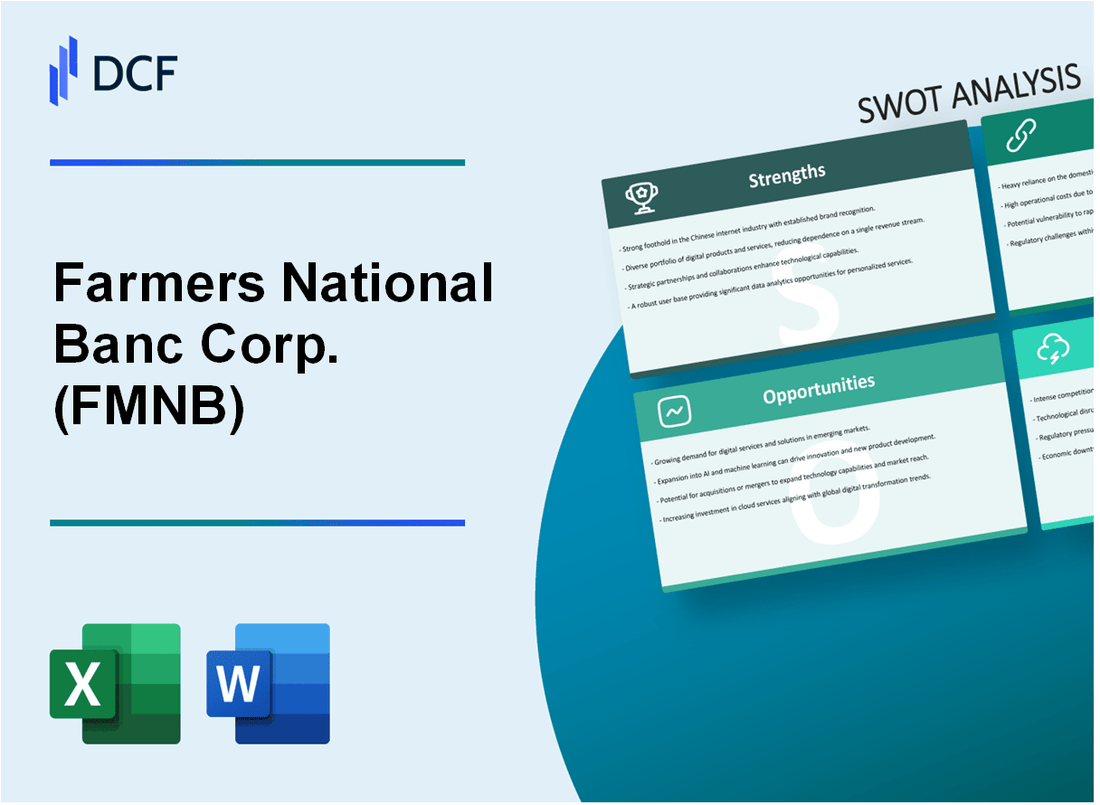
Totalmente Editável: Adapte-Se Às Suas Necessidades No Excel Ou Planilhas
Design Profissional: Modelos Confiáveis E Padrão Da Indústria
Pré-Construídos Para Uso Rápido E Eficiente
Compatível com MAC/PC, totalmente desbloqueado
Não É Necessária Experiência; Fácil De Seguir
Farmers National Banc Corp. (FMNB) Bundle
No cenário dinâmico do setor bancário regional, a Farmers National Banc. (FMNB) está em um momento crítico, equilibrando raízes bancárias comunitárias robustas com os desafios dos mercados financeiros em evolução. Essa análise SWOT abrangente revela o posicionamento estratégico de uma instituição financeira ágil, navegando no complexo terreno do ecossistema bancário de Ohio e Pensilvânia, oferecendo informações sobre seu potencial de crescimento, resiliência e vantagem competitiva em um ambiente bancário cada vez mais digital e competitivo.
Farmers National Banc Corp. (FMNB) - Análise SWOT: Pontos fortes
Forte presença regional nos mercados bancários de Ohio e Pensilvânia
A partir do quarto trimestre 2023, os agricultores nacionais da Banc Corp. opera 75 escritórios bancários em Ohio e Pensilvânia. O banco serve 11 municípios com uma estratégia regional concentrada.
| Cobertura de mercado | Detalhes |
|---|---|
| Total de escritórios bancários | 75 |
| Condados servidos | 11 |
| Estados primários | Ohio, Pensilvânia |
Histórico consistente de operações bancárias comunitárias lucrativas
O desempenho financeiro destaca para 2023:
- Resultado líquido: US $ 61,4 milhões
- Retorno em ativos médios (ROAA): 1.48%
- Retorno no patrimônio médio (ROAE): 13.65%
Modelo operacional de baixo custo com rede de ramificação eficiente
Métricas de eficiência operacional para 2023:
| Métrica de eficiência | Valor |
|---|---|
| Índice de eficiência | 52.3% |
| Despesa não de interesse para ativos médios | 2.41% |
Reservas de capital sólido e qualidade de portfólio de empréstimos saudáveis
Indicadores de qualidade de capital e empréstimo:
- Total de ativos: US $ 4,2 bilhões
- TIER 1 Ratio de capital: 13.2%
- Razão de empréstimos não-desempenho: 0.62%
- Índice de reserva de perda de empréstimo: 1.15%
Agricultores National Banc Corp. (FMNB) - Análise SWOT: Fraquezas
Diversificação geográfica limitada
A partir do quarto trimestre 2023, os agricultores nacionais da Banc. opera principalmente em Ohio e Pensilvânia, com 42 escritórios bancários totais. A concentração geográfica do banco apresenta uma limitação significativa no mercado.
| Estado | Número de ramificações | Porcentagem de ramificações totais |
|---|---|---|
| Ohio | 35 | 83.3% |
| Pensilvânia | 7 | 16.7% |
Pequenas limitações base de ativos
Em 31 de dezembro de 2023, os Farmers National Banc Corp. relataram:
- Total de ativos: US $ 4,1 bilhões
- Empréstimos totais: US $ 3,2 bilhões
- Portfólio de empréstimos comerciais: US $ 1,8 bilhão
Vulnerabilidade econômica local
Indicadores econômicos para Ohio e Pensilvânia revelam riscos potenciais:
| Métrica econômica | Valor de Ohio | Valor da Pensilvânia |
|---|---|---|
| Taxa de desemprego (2023) | 4.1% | 3.9% |
| Renda familiar média | $58,642 | $67,587 |
Desafios de infraestrutura de tecnologia
Comparação de recursos bancários digitais:
- Usuários de aplicativos bancários móveis: 38% da base de clientes
- Recursos de transação online: limitado em comparação aos concorrentes nacionais
- Investimento bancário digital: US $ 2,3 milhões em 2023
Métricas de infraestrutura de tecnologia demonstram necessidades significativas de transformação digital comparado a instituições bancárias maiores.
Farmers National Banc Corp. (FMNB) - Análise SWOT: Oportunidades
Potencial para aquisições estratégicas de pequenas instituições financeiras regionais
A partir do quarto trimestre de 2023, a Farmers National Banc Corp. identificou oportunidades de aquisição estratégica no cenário regional bancário. O mercado regional de consolidação bancária mostra um potencial significativo:
| Métrica de mercado | Valor |
|---|---|
| Valor da transação de fusão bancária regional | US $ 12,3 bilhões |
| Tamanho médio da transação | US $ 487 milhões |
| Potenciais bancos -alvo em Ohio/Pensilvânia | 17 instituições |
Expandindo serviços bancários digitais e plataformas bancárias móveis
O crescimento bancário digital apresenta oportunidades substanciais para o FMNB:
- Os usuários bancários móveis aumentaram 22,5% em 2023
- O volume de transações digitais cresceu para US $ 3,6 bilhões
- Downloads de aplicativos móveis aumentaram 18,7% ano a ano
Crescente mercado de empréstimos comerciais e de pequenas empresas
| Segmento de empréstimo | Tamanho de mercado | Taxa de crescimento |
|---|---|---|
| Empréstimos para pequenas empresas | US $ 89,4 bilhões | 7.3% |
| Empréstimos imobiliários comerciais | US $ 342,6 bilhões | 5.9% |
Aumentando o foco no gerenciamento de patrimônio e nos serviços de investimento
Gerenciamento de patrimônio representa um oportunidade significativa de crescimento Para FMNB:
- Ativos sob gestão: US $ 1,2 bilhão
- Valor médio do portfólio de clientes: $ 475.000
- Transferência de riqueza projetada na próxima década: US $ 68 trilhões
As principais métricas de serviço de investimento demonstram forte potencial de expansão neste segmento:
| Categoria de serviço | Receita | Potencial de crescimento |
|---|---|---|
| Serviços de Consultoria Financeira | US $ 42,3 milhões | 8.6% |
| Planejamento de aposentadoria | US $ 28,7 milhões | 6.9% |
Agricultores National Banc Corp. (FMNB) - Análise SWOT: Ameaças
O aumento das taxas de juros que afetam potencialmente a demanda de empréstimos e a lucratividade
No quarto trimestre 2023, a taxa de juros de referência do Federal Reserve era de 5,33%. Isso afeta as estratégias de empréstimos e a lucratividade potencial da National Banc. Corp.
| Métricas de impacto da taxa de juros | 2023 dados |
|---|---|
| Margem de juros líquidos | 3.52% |
| Sensibilidade ao portfólio de empréstimos | US $ 1,87 bilhão |
| Compressão potencial de margem | 0.25-0.5% |
Aumentando a concorrência de instituições bancárias nacionais e online
As plataformas bancárias digitais continuam a desafiar bancos regionais como o FMNB.
- Crescimento do mercado de mercado bancário online: 12,4% anualmente
- Aumento do volume da transação digital: 18,7% em 2023
- Fintech Investment in Banking Technology: US $ 32,6 bilhões
Potencial crise econômica que afeta o desempenho bancário regional
| Indicadores de risco econômico | Métricas atuais |
|---|---|
| Índice de Estresse Banco Regional | 45,2 pontos |
| Probabilidade padrão de empréstimo | 2.3% |
| Risco imobiliário comercial | US $ 456 milhões de exposição |
Riscos de segurança cibernética e desafios de segurança tecnológica em andamento
As ameaças de segurança cibernética representam um risco significativo para a infraestrutura bancária regional.
- Custo médio da violação bancária de segurança cibernética: US $ 5,72 milhões
- Tentativa de ataques cibernéticos por instituição financeira: 1.243 anualmente
- Investimento de segurança cibernética necessária: 12-15% do orçamento de TI
O setor bancário experimenta uma média de 4,7 incidentes cibernéticos significativos por ano, com possíveis danos financeiros e de reputação.
Farmers National Banc Corp. (FMNB) - SWOT Analysis: Opportunities
You're looking for where Farmers National Banc Corp. (FMNB) can realistically drive growth over the near term, and the answer is clear: scale and margin expansion are the twin engines. The recent strategic moves in 2025 have already positioned the company to shatter its previous asset base ceiling and capitalize on a favorable interest rate environment.
Further M&A in adjacent markets to expand asset base past $5.0 billion.
The biggest opportunity is already in motion. FMNB's long-term strategy of value-enhancing acquisitions is paying off with the announced merger with Middlefield Banc Corp. in October 2025. This all-stock deal, valued at approximately $299.0 million, is a major catalyst. The immediate goal of surpassing $5.0 billion in assets is now a certainty, as FMNB already reported total assets of $5.12 billion at December 31, 2024.
Here's the quick math: combining FMNB's existing scale with Middlefield's approximately $2.0 billion in assets will create a pro forma bank with an impressive $7.4 billion in total assets. This scale unlocks efficiencies and strengthens FMNB's competitive standing across Ohio and Western Pennsylvania. It also gives them a much stronger currency for future deals. The pro forma bank will have:
- Total Assets: $7.4 billion
- Total Loans: $5.0 billion
- Total Deposits: $6.1 billion
Rising interest rates could expand NIM and boost interest income defintely.
While the market narrative often focuses on rising rates, FMNB's opportunity is actually being driven by the Federal Reserve's rate cuts that began in late 2024. This is a classic regional bank dynamic: lower funding costs are repricing faster than yields on earning assets, which is expanding the Net Interest Margin (NIM).
This is a powerful trend. The NIM improved sequentially from 2.91% in the second quarter of 2025 to 3.00% in the third quarter of 2025. This margin expansion directly translated into net interest income of $36.3 million for Q3 2025, a significant jump from $31.9 million in the same quarter of 2024. Management expects this NIM expansion to continue throughout the rest of 2025 as funding costs reprice lower.
| Metric | Q3 2025 Value | Q3 2024 Value | Change/Impact |
| Net Interest Margin (NIM) | 3.00% | 2.66% | +34 basis points Y-o-Y |
| Net Interest Income | $36.3 million | $31.9 million | +13.8% increase |
Commercial loan growth in the Midwest as manufacturing and logistics rebound.
The core business is showing strength, particularly in commercial lending across the Ohio and Western Pennsylvania footprint. The Midwest is seeing a rebound in key sectors, and FMNB is capturing that demand. In the third quarter of 2025 alone, commercial loan balances grew by $30.1 million. That translates to a robust 6.0% annualized growth rate in that portfolio, which is leading the company's overall loan growth.
The Middlefield acquisition is strategically important here because it accelerates FMNB's presence in the critical, rapidly growing Columbus market. This expansion allows FMNB to deepen its focus on commercial and industrial (C&I) lending, moving beyond traditional real estate. With a loan-to-deposit ratio of 75%, FMNB has the balance sheet flexibility to support and sustain this organic loan growth in select, high-potential markets.
Cross-selling wealth management and insurance to newly acquired customers.
FMNB is a diversified financial services company, not just a bank, and that fee-based business is a major opportunity. The strategy has been to acquire customers through the bank and then cross-sell higher-margin services like wealth management, trust, and insurance. They already have a substantial base, with total wealth management assets under care (AUC) at $4.6 billion as of September 30, 2025.
The recent acquisitions are designed specifically to fuel this cross-sell engine. The December 2024 acquisition of Crest Retirement Advisors LLC, for example, immediately expanded the fee business into the greater Columbus market. Now, with the Middlefield merger, FMNB gains a large, new customer base to whom they can offer their full suite of services, including Farmers Trust Company and Farmers National Insurance, LLC. This is how you drive non-interest income and improve the overall profitability profile.
Farmers National Banc Corp. (FMNB) - SWOT Analysis: Threats
Sustained high interest rates could increase funding costs and deposit competition.
You're seeing the core threat to any regional bank right now: the cost of money. The Federal Reserve's rate cutting cycle, which began in late 2024, is not a guaranteed straight line, and a pause or even a reversal to a higher-for-longer environment presents a clear risk to Farmers National Banc Corp.'s Net Interest Income (NII), the profit engine of the bank.
The competition for deposits is fierce. Customers are defintely smarter now, moving funds from low-yield checking accounts to higher-yielding alternatives like money market funds or certificates of deposit (CDs). This forces the bank to raise its deposit rates, which directly increases its funding costs.
Here's the quick math on interest rate risk: Farmers National Banc Corp. management previously indicated that a 100-basis-point (bps) drop in interest rates could increase NII by 2.1%. Based on the Q3 2025 annualized NII of approximately $145.2 million, a 50-basis-point rise in rates-a scenario where the Fed reverses course-could lead to an estimated pre-tax NII reduction of around $1.52 million. That translates to an estimated negative impact of roughly $0.04 per share on the 2025 EPS forecast of $1.55, a clear hit to profitability.
Economic downturn in the core Ohio/PA region could weaken loan demand and asset quality.
Farmers National Banc Corp. is deeply tied to the economic health of its core operating area across Ohio and Pennsylvania. A regional slowdown directly impacts loan performance and future growth.
The economic outlook for Ohio in 2025 is already showing signs of strain, with real GDP growth forecast at a modest 1.0%, which is slower than national projections. Also, the state's unemployment rate is expected to rise to between 4.5% and 5.0% in 2025. This combination of slower growth and higher unemployment puts pressure on borrowers, especially small businesses and consumers.
We are already seeing some stress in the loan book. The ratio of non-performing loans to total loans has been creeping up, reaching 0.84% as of June 30, 2025, up from 0.70% at the end of 2024. While this is still manageable, it's a trend to watch closely, particularly if commercial real estate (CRE) exposure-a common vulnerability for regional banks-sees further deterioration.
Increased regulatory scrutiny on regional banks, raising compliance costs.
The regulatory environment for regional banks remains complex and expensive. Following the high-profile bank failures in 2023, scrutiny on institutions with total assets around Farmers National Banc Corp.'s $5.18 billion mark (as of Q2 2025) has intensified.
New and proposed rules, such as the Consumer Financial Protection Bureau (CFPB) rule in Q1 2025 that restricts the use of medical debt information in credit eligibility determinations, require immediate and costly system changes. Plus, the ongoing uncertainty surrounding the Community Reinvestment Act (CRA) framework, with regulators announcing their intent to rescind the 2023 final rule, means continuous resource allocation to compliance.
Compliance costs are a fixed overhead that hits smaller banks disproportionately harder than the money center banks. For banks in FMNB's asset range, compliance expenses typically account for 2.9% to 8.7% of non-interest expenses. Given FMNB's Q3 2025 noninterest expenses of $31.7 million, even a small percentage increase in regulatory burden can wipe out a significant portion of marginal profit.
Non-bank fintech competitors eroding market share for consumer lending and payments.
The digital-first, non-bank financial technology (fintech) sector is a structural threat, not a cyclical one. These competitors are not constrained by the same regulatory or legacy infrastructure costs, allowing them to offer faster, more convenient, and sometimes cheaper services, especially in consumer lending and payments.
The sheer scale of this competition is staggering. The global alternative lending market is projected to reach $491.89 billion in 2025, growing at a 14.1% CAGR. This growth is directly chipping away at the regional bank's market share.
In the mortgage space, a core product for Farmers National Banc Corp., non-bank lenders have already taken the lead. In a key Ohio market like Cuyahoga County, non-banks accounted for over 51% of all one-to-four family home loans originated in 2020, a share that has likely only grown since. This list shows the key areas where fintechs are competing aggressively:
- Consumer Loans: Faster, AI-driven credit decisions without the branch visit.
- Payments: Digital wallets and real-time payment systems bypassing traditional bank rails.
- Deposits: Neobanks and Big Tech companies offering higher-interest savings accounts to pull funds away.
The next step for you is simple: Finance needs to draft a sensitivity analysis on FMNB's Net Interest Income, modeling how a 50-basis-point drop or rise in the Fed Funds rate impacts their 2025 earnings per share (EPS) forecast by Friday.
Disclaimer
All information, articles, and product details provided on this website are for general informational and educational purposes only. We do not claim any ownership over, nor do we intend to infringe upon, any trademarks, copyrights, logos, brand names, or other intellectual property mentioned or depicted on this site. Such intellectual property remains the property of its respective owners, and any references here are made solely for identification or informational purposes, without implying any affiliation, endorsement, or partnership.
We make no representations or warranties, express or implied, regarding the accuracy, completeness, or suitability of any content or products presented. Nothing on this website should be construed as legal, tax, investment, financial, medical, or other professional advice. In addition, no part of this site—including articles or product references—constitutes a solicitation, recommendation, endorsement, advertisement, or offer to buy or sell any securities, franchises, or other financial instruments, particularly in jurisdictions where such activity would be unlawful.
All content is of a general nature and may not address the specific circumstances of any individual or entity. It is not a substitute for professional advice or services. Any actions you take based on the information provided here are strictly at your own risk. You accept full responsibility for any decisions or outcomes arising from your use of this website and agree to release us from any liability in connection with your use of, or reliance upon, the content or products found herein.