

|
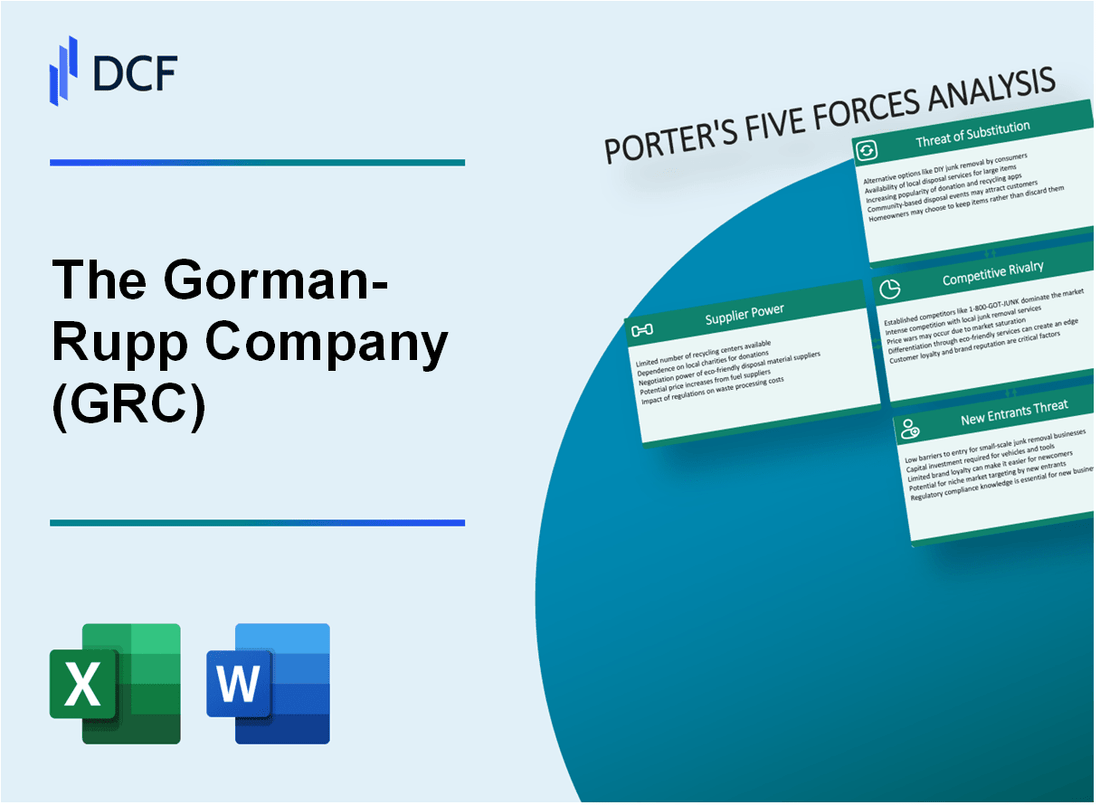
A Companhia Gorman-Rupp (GRC): 5 forças de análise [Jan-2025 Atualizada] |
Totalmente Editável: Adapte-Se Às Suas Necessidades No Excel Ou Planilhas
Design Profissional: Modelos Confiáveis E Padrão Da Indústria
Pré-Construídos Para Uso Rápido E Eficiente
Compatível com MAC/PC, totalmente desbloqueado
Não É Necessária Experiência; Fácil De Seguir
The Gorman-Rupp Company (GRC) Bundle
Na intrincada cenário da fabricação de bombas industriais, a Companhia Gorman-Rupp (GRC) navega em um terreno estratégico complexo moldado pelas cinco forças competitivas de Michael Porter. Desde o gerenciamento de relações especializadas de fornecedores até os desafios tecnológicos emergentes, o GRC demonstra uma resiliência notável em um mercado definido pela inovação tecnológica, personalização do cliente e dinâmica competitiva cada vez mais sofisticada. Essa análise de mergulho profundo revela como a empresa se posiciona estrategicamente nas dimensões críticas do mercado, equilibrando a experiência tradicional de engenharia com a adaptabilidade prospectiva em um ecossistema industrial em evolução.
A Companhia Gorman -Rupp (GRC) - Cinco Forças de Porter: Poder de barganha dos fornecedores
Fabricantes de componentes de bomba e motor especializados
Em 2024, o Gorman-Rupp identifica aproximadamente 7 a 10 fornecedores especializados críticos no setor de fabricação de componentes da bomba e do motor. Esses fornecedores representam um mercado concentrado com alternativas limitadas.
| Categoria de fornecedores | Número de fornecedores -chave | Concentração de mercado |
|---|---|---|
| Componentes da bomba | 4-5 Fabricantes | Alta concentração |
| Componentes do motor | 3-5 fabricantes | Concentração moderada |
Dinâmica de custo de matéria -prima
Os custos da matéria -prima para 2024 demonstram volatilidade significativa:
- Os preços do aço flutuam entre US $ 800 e US $ 1.200 por tonelada
- Os custos de alumínio variam de US $ 2.200 a US $ 2.600 por tonelada métrica
- Os preços do cobre oscilam entre US $ 8.500 e US $ 9.500 por tonelada
Gerenciamento de relacionamento com fornecedores
Gorman-Rupp mantém Parcerias estratégicas de longo prazo Com os principais fornecedores, com uma duração média de relacionamento de 12 a 15 anos no setor de equipamentos de bombeamento.
| Métrica de relacionamento com fornecedores | Valor |
|---|---|
| Duração média da parceria | 14 anos |
| Contratos anuais de fornecedores | 6-8 acordos estratégicos |
Análise de concentração de mercado
A concentração de fornecedores nos mercados industrial e municipal mostra as seguintes características:
- Concentração do fornecedor do mercado industrial: 65-70%
- Concentração do fornecedor do mercado municipal: 55-60%
- Fornecedores de componentes únicos: 3-4 por categoria de componente crítico
A Companhia Gorman -Rupp (GRC) - As cinco forças de Porter: Power de clientes de clientes
Base de clientes diversificados em mercados
Em 2023, Gorman-Rupp relatou atender clientes em três segmentos de mercado primários:
| Segmento de mercado | Porcentagem de receita |
|---|---|
| Municipal | 42% |
| Industrial | 33% |
| Proteção contra incêndio | 25% |
Demanda do cliente por soluções personalizadas
As métricas de personalização de produtos 2023 da Gorman-Rupp:
- 93% dos clientes industriais solicitaram configurações de bomba personalizadas
- 87% dos clientes municipais precisavam de soluções de bombeamento especializadas
- Praxo médio de entrega para o design personalizado da bomba: 6-8 semanas
Sensibilidade ao preço na compra
Dados de sensibilidade ao preço do governo e de compras de compras do governo e de infraestrutura:
| Categoria de compras | Intervalo de negociação de preços médios |
|---|---|
| Projetos de água municipal | 5-12% Redução de preço |
| Contratos federais de infraestrutura | 8-15% de negociação de preços |
Contratos de serviço e confiabilidade de longo prazo
Métricas de desempenho do contrato em 2023:
- Duração média do contrato: 5,3 anos
- Taxa de renovação do contrato de serviço: 78%
- Garantia de confiabilidade: 99,7% de tempo de atividade
A Companhia Gorman -Rupp (GRC) - Cinco Forças de Porter: Rivalidade Competitiva
Cenário competitivo de mercado
A partir de 2024, o Gorman-Rupp enfrenta a rivalidade competitiva no segmento de fabricação de bombas especializado com os seguintes concorrentes-chave:
| Concorrente | Quota de mercado | Receita anual |
|---|---|---|
| Pentair | 8.2% | US $ 3,1 bilhões |
| Xylem Inc. | 7.5% | US $ 5,2 bilhões |
| Gorman-Rupp | 5.6% | US $ 491,2 milhões |
Fatores de diferenciação competitivos
Gorman-Rupp mantém vantagem competitiva por meio de:
- Experiência em engenharia em tecnologia de bomba
- Taxa de inovação de produtos de 12,3% anualmente
- Diversificação geográfica em 47 países
Métricas de concentração de mercado
| Métrica | Valor |
|---|---|
| Índice Herfindahl-Hirschman (HHI) | 1.425 pontos |
| Número de concorrentes significativos | 6-8 empresas |
A Companhia Gorman -Rupp (GRC) - Cinco Forças de Porter: ameaça de substitutos
Tecnologias alternativas de bombeamento emergindo no gerenciamento de água
Em 2023, o mercado global de tecnologias de bombeamento alternativo atingiu US $ 12,4 bilhões, com um CAGR projetado de 6,7% a 2028. Tecnologias específicas que desafiam os designs tradicionais de bombas do Gorman-Rupp incluem:
| Tipo de tecnologia | Quota de mercado | Taxa de crescimento |
|---|---|---|
| Bombas de acionamento magnético | 22.3% | 7.2% |
| Bombas de motor enlatadas | 18.6% | 6.9% |
| Bombas submersíveis | 27.5% | 8.1% |
Sistemas avançados de monitoramento digital
As tecnologias de monitoramento de bombas digitais demonstram penetração significativa no mercado:
- Mercado de sistemas de bomba habilitado para IoT: US $ 4,2 bilhões em 2023
- Taxa de adoção de bombas inteligentes: 34,5% em setores industriais
- Tecnologias de manutenção preditiva, reduzindo os custos operacionais em 25-40%
Soluções de bombeamento de energia renovável
Estatísticas do mercado de bombas movidas a energia solar para 2023:
| Região | Valor de mercado | Instalação anual |
|---|---|---|
| América do Norte | US $ 687 milhões | 3.200 unidades |
| Ásia -Pacífico | US $ 1,9 bilhão | 12.500 unidades |
| Europa | US $ 542 milhões | 2.800 unidades |
Alternativas de bombeamento com eficiência energética
Métricas de eficiência energética para tecnologias alternativas de bombeamento:
- Crescimento do mercado de bombas de alta eficiência: 9,3% anualmente
- Potencial de economia de energia: 20-40% em comparação com os sistemas tradicionais
- Mercado endereçável total para bombas com eficiência energética: US $ 8,6 bilhões em 2023
A Companhia Gorman -Rupp (GRC) - Cinco Forças de Porter: Ameaça de novos participantes
Altos requisitos de capital para infraestrutura de fabricação de bombas
A infraestrutura de fabricação de bombas da Gorman-Rupp requer investimento substancial de capital. A partir de 2023, a propriedade, a planta e o equipamento da empresa (PP&E) foi avaliada em US $ 97,4 milhões.
| Categoria de investimento de capital | Valor do investimento |
|---|---|
| Equipamento de fabricação | US $ 42,6 milhões |
| Instalações de pesquisa e desenvolvimento | US $ 22,8 milhões |
| Infraestrutura de teste | US $ 15,2 milhões |
| Custos iniciais de configuração | US $ 16,8 milhões |
Requisitos significativos de conhecimento técnico
As barreiras técnicas à entrada incluem conhecimento especializado em engenharia e recursos complexos de design.
- Entendimento avançado de dinâmica de fluidos
- Técnicas de fabricação de precisão
- Engenharia de materiais complexos
- Especialização em design de sistemas hidráulicos
Reputação de marca estabelecida
A posição de mercado da Gorman-Rupp é reforçada pela presença de longa data da indústria. A empresa está operacional desde 1933 e mantém uma forte reputação do mercado.
| Métrica da marca | Indicador de desempenho |
|---|---|
| Participação de mercado em bombas municipais | 18.7% |
| Taxa de retenção de clientes | 92.3% |
| Anos de negócios | 90 |
Desafios de conformidade regulatória
A entrada nos mercados de bombas municipais e industriais requer conformidade regulatória extensa.
- Requisitos de certificação ISO 9001: 2015
- Padrões do sistema de água da EPA
- Especificações de desempenho da bomba ANSI/AWWA
- Regulamentos internacionais de segurança e qualidade
| Custo de conformidade regulatória | Despesa anual |
|---|---|
| Processos de certificação | US $ 1,2 milhão |
| Teste e documentação | $750,000 |
| Gerenciamento de conformidade | $500,000 |
The Gorman-Rupp Company (GRC) - Porter's Five Forces: Competitive rivalry
You're looking at a sector that's definitely mature, which means growth isn't coming easy. The global pumps market size is valued at about USD 62.33 billion in 2025, and while it's expected to grow to around USD 89.1753 billion by 2033, that growth is spread thin across many players. The Gorman-Rupp Company (GRC) operates in this space, which is known to be moderately fragmented globally.
Rivalry here isn't a race to the bottom on price; it's a fight over technical merit. Competition hinges on a few key areas where The Gorman-Rupp Company must constantly prove its worth. You see this reflected in the company's own performance metrics, which are closely watched against the broader industrial landscape. For instance, The Gorman-Rupp Company's trailing Price-to-Earnings (P/E) ratio of 23.5x as of late 2025 is sitting right next to the US machinery industry average P/E of 23.9x. This tells you the market views The Gorman-Rupp Company's earnings power as essentially on par with the general machinery sector right now, suggesting neither a massive premium nor a deep discount based on valuation alone. Still, the company posted Q3 2025 net sales of $172.8 million, showing it's actively participating in the market, even as Q3 net income dipped to $11.3 million year-over-year.
To maintain that valuation parity, The Gorman-Rupp Company must continuously invest in innovation. This isn't optional; it's table stakes for staying relevant against competitors who are also pushing technology. The company's commitment to capital spending, with full-year CapEx planned at approximately $20.0 million, supports this need for technological advancement. The focus areas-self-priming technology and digital monitoring capabilities-are direct responses to industry trends favoring efficiency and data integration.
Here's a quick look at how The Gorman-Rupp Company's recent operational scale compares to the competitive environment:
| Metric | The Gorman-Rupp Company (GRC) Data (2025) | Context/Benchmark |
|---|---|---|
| Q3 2025 Net Sales | $172.8 million | Reflects ongoing revenue generation in a competitive market. |
| Q3 2025 Adjusted EPS | $0.52 per share | The market's view of per-share profitability against peers. |
| Order Backlog (Sept 30, 2025) | $234.2 million | Indicates near-term revenue visibility against competitors. |
| Planned Full-Year CapEx | Approx. $20.0 million | Investment level supporting product quality and engineering. |
The basis of competition means that if you fall behind on engineering or service, you lose share quickly. Key competitive battlegrounds include:
- Product quality validation and reliability.
- Specialized engineering for complex fluid handling needs.
- Aftermarket service response times and parts availability.
- Adoption of smart pump features like remote diagnostics.
For example, the industry is seeing a push toward AI-powered pump systems and smart pumps with remote monitoring, which means The Gorman-Rupp Company's investment in digital monitoring isn't just an upgrade; it's a necessary defense against rivals who are integrating these capabilities to reduce customer downtime. The company's strong order intake, with incoming orders for the first nine months of 2025 up 10.9% year-over-year, suggests its current product mix is still resonating, but sustained R&D spend is defintely required to keep that momentum.
The Gorman-Rupp Company (GRC) - Porter's Five Forces: Threat of substitutes
When you look at the threat of substitutes for The Gorman-Rupp Company (GRC), you have to segment the market, because the risk changes dramatically depending on what the pump is actually doing. For you, the analyst, this means that a single substitute threat rating for the entire business just won't cut it.
Low Threat in Critical, Specialized Applications
For highly specialized uses, like municipal wastewater handling or fire suppression systems, the threat of substitution is definitely low. These applications demand absolute reliability, and switching costs-both in terms of capital outlay and operational risk-are significant. We see this reflected in the sales mix. For the nine months ended September 30, 2025, The Gorman-Rupp Company (GRC) posted total sales of $515.82 million. Looking just at the third quarter of 2025, the municipal market showed growth, adding $2.1 million to sales, and the fire suppression market added $0.4 million. These are areas where performance history trumps a lower initial price from a new entrant.
Cost of Failure Drives Reliability Preference
In critical infrastructure, like flood control or major municipal water systems, the cost of a pump failure is measured in millions of dollars, public safety risks, and regulatory fines, not just replacement cost. This high cost of failure strongly favors established, proven pump systems from The Gorman-Rupp Company (GRC). The CEO noted strong demand in the municipal and fire markets during the Q3 2025 commentary, which supports the idea that customers are prioritizing proven performance over unproven alternatives.
Repair and Parts Revenue as a Barrier
The revenue stream from servicing existing, durable assets acts as a powerful moat against substitution. Customers who invest in a long-lasting The Gorman-Rupp Company (GRC) pump are locked into a service ecosystem. While Q3 2025 saw a small dip, with the repair market sales decreasing by $0.4 million compared to the prior year's quarter, this should be viewed against the backdrop of Q1 2025, where the repair sector experienced growth driven by infrastructure investment. The very existence of this revenue stream, which contributes to the trailing twelve months revenue of $678.52 million as of November 2025, shows customers prefer maintaining their robust The Gorman-Rupp Company (GRC) assets.
Moderate Threat in General Industrial Markets
In less-specialized industrial fluid transfer applications, the threat from substitutes becomes more moderate. Here, the switching costs are lower, and competition from lower-cost providers is more frequent. To give you a sense of the industrial segment's activity, it was actually the strongest growth driver in Q3 2025, increasing sales by $5.3 million. This growth suggests The Gorman-Rupp Company (GRC) is successfully competing, but the market segment itself is more susceptible to substitutes than the municipal or fire segments.
Here's a quick look at how the key segments performed in Q3 2025 sales compared to the prior year's quarter, which helps frame the competitive environment:
| Market Segment | Q3 2025 Sales Change (vs. Q3 2024) | Implied Substitute Threat Level |
|---|---|---|
| Industrial | +$5.3 million increase | Moderate |
| Municipal | +$2.1 million increase | Low |
| Fire Suppression | +$0.4 million increase | Low |
| Repair | -$0.4 million decrease | Low (due to high maintenance preference) |
| Construction | -$4.6 million decrease | N/A (Market-specific slowdown) |
The company's overall order backlog stood at $234.2 million at the end of Q3 2025, which suggests that, despite the threat landscape, current demand for The Gorman-Rupp Company (GRC)'s offerings remains strong across the board.
- Municipal and fire systems face the lowest substitution risk.
- High failure cost protects critical infrastructure sales.
- Industrial segment shows the highest sales growth in Q3 2025.
- Repair revenue indicates customer commitment to durable assets.
- Total Q3 2025 net sales were $172.83 million.
The Gorman-Rupp Company (GRC) - Porter's Five Forces: Threat of new entrants
The threat of new entrants for The Gorman-Rupp Company remains relatively low, primarily due to substantial upfront investment requirements and significant regulatory barriers in key end-markets. A new competitor can't just start making pumps; they need to build a foundation that matches the scale and compliance history of The Gorman-Rupp Company.
High capital investment required for specialized manufacturing and extensive testing facilities.
Building out the necessary physical infrastructure represents a massive initial hurdle. The Gorman-Rupp Company itself has planned capital expenditures for the full-year 2025 to be approximately $20.0 million. For context, capital expenditures for the first nine months of 2025 totaled $12.5 million, mostly for machinery and equipment. This level of ongoing investment in manufacturing and equipment suggests the scale of fixed assets required to compete effectively, especially when considering that The Gorman-Rupp Company manufactures over 5,000 models of pumps across its various entities.
The required investment isn't just in production capacity; it's also in inventory to support crisis demand. The Gorman-Rupp Company has historically maintained significant reserves, recognizing that a portion of its business is 'crisis business' where customers need immediate delivery. A new entrant would need capital not only for facilities but also for the working capital to stock the necessary breadth of products.
Significant regulatory hurdles and certifications for municipal and fire suppression markets.
Entering the fire suppression and municipal markets demands rigorous, time-consuming, and expensive third-party validation. For fire pumps, compliance is non-negotiable. All US fire pumps must be NRTL-listed, such as by Underwriters Laboratories (UL) or Factory Mutual (FM) Approvals, which verifies testing to NFPA 20 standards. These certifications are globally recognized, but achieving them requires adherence to stringent performance, electrical, and design requirements. For municipal water and wastewater projects, which contributed to a $7.5 million sales increase for The Gorman-Rupp Company in the first nine months of 2025, meeting specific local and federal engineering specifications is another layer of entry cost.
The barrier is not just the initial certification cost, but the ongoing expense of maintaining compliance and passing regular inspections.
GRC's global distribution network and long-standing brand reputation act as a strong barrier.
The Gorman-Rupp Company has cultivated a vast, established route-to-market that is difficult and slow to replicate. The company markets its products through wholly owned subsidiaries and a broad network of distributors, with exports reaching over 100 countries. The structure includes entities like Gorman-Rupp of Europe B.V. and Gorman-Rupp Africa Pty Ltd, demonstrating deep international infrastructure. Furthermore, The Gorman-Rupp Company family comprises 11 companies, each serving specific niches. This established network provides immediate access to end-users, which is critical for the 'crisis business' mentioned earlier. A new entrant faces the challenge of building trust and securing distribution agreements against a company with a philosophy rooted in providing a 'superior product with better performance' for over 90 years.
The scale of The Gorman-Rupp Company's established footprint can be seen in its market penetration:
| Metric | Value/Context |
|---|---|
| Total Companies in Family | 11 |
| International Export Reach | Over 100 countries |
| Planned 2025 Capital Expenditure | Approximately $20.0 million |
| Q1-Q3 2025 Sales Increase (Municipal Market) | $7.5 million |
Risk of intellectual property (IP) infringement from foreign competitors, especially in Asia, is a constant concern.
While the threat of new entrants is low, the risk of IP challenges from established or emerging foreign players is a persistent operational concern. The legal landscape in key manufacturing regions, particularly concerning Original Equipment Manufacturer (OEM) practices, is evolving. For instance, in 2024 IP cases in China, courts ordered joint compensation payments reaching RMB 5 million for trademark infringement and unfair competition. The shift signaled by initiatives like 'Made in China 2025' suggests that the legal environment for protecting foreign IP is becoming more complex, requiring new entrants and established players alike to dedicate resources to legal defense and proactive IP management.
The Gorman-Rupp Company's existing IP portfolio, built over decades, acts as a deterrent, but any new entrant must be prepared to defend its own innovations from the outset.
- Fire pump certification requires adherence to NFPA 20 standards.
- The Gorman-Rupp Company has subsidiaries in Europe and Africa, indicating established global compliance infrastructure.
- Planned 2025 CapEx is $20.0 million, setting a high bar for new physical plant investment.
- IP disputes can involve significant financial penalties, such as RMB 5 million in one 2024 case.
Finance: review the CapEx allocation for Q4 2025 against the planned $20.0 million by next Tuesday.
Disclaimer
All information, articles, and product details provided on this website are for general informational and educational purposes only. We do not claim any ownership over, nor do we intend to infringe upon, any trademarks, copyrights, logos, brand names, or other intellectual property mentioned or depicted on this site. Such intellectual property remains the property of its respective owners, and any references here are made solely for identification or informational purposes, without implying any affiliation, endorsement, or partnership.
We make no representations or warranties, express or implied, regarding the accuracy, completeness, or suitability of any content or products presented. Nothing on this website should be construed as legal, tax, investment, financial, medical, or other professional advice. In addition, no part of this site—including articles or product references—constitutes a solicitation, recommendation, endorsement, advertisement, or offer to buy or sell any securities, franchises, or other financial instruments, particularly in jurisdictions where such activity would be unlawful.
All content is of a general nature and may not address the specific circumstances of any individual or entity. It is not a substitute for professional advice or services. Any actions you take based on the information provided here are strictly at your own risk. You accept full responsibility for any decisions or outcomes arising from your use of this website and agree to release us from any liability in connection with your use of, or reliance upon, the content or products found herein.