

|
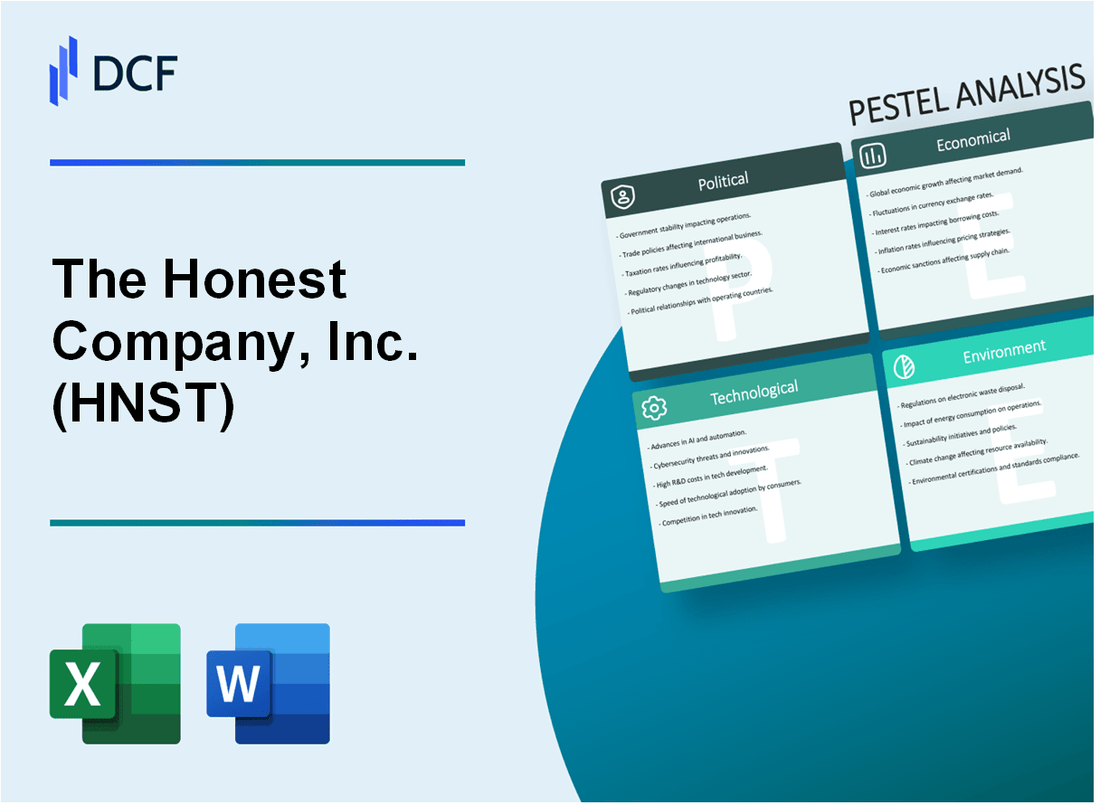
The Honest Company, Inc. (HNST): Análise de Pestle [Jan-2025 Atualizada] |
Totalmente Editável: Adapte-Se Às Suas Necessidades No Excel Ou Planilhas
Design Profissional: Modelos Confiáveis E Padrão Da Indústria
Pré-Construídos Para Uso Rápido E Eficiente
Compatível com MAC/PC, totalmente desbloqueado
Não É Necessária Experiência; Fácil De Seguir
The Honest Company, Inc. (HNST) Bundle
No cenário dinâmico do consciência consciente, a Honest Company, Inc. surge como uma marca pioneira que navega em desafios complexos de mercado por meio de inovação estratégica e compromisso inabalável com a transparência. Ao examinar meticulosamente as dimensões políticas, econômicas, sociológicas, tecnológicas, legais e ambientais, essa análise revela o intrincado ecossistema que molda o posicionamento estratégico da empresa no mercado competitivo de bem -estar e cuidados pessoais. Mergulhe em uma exploração abrangente que revela como a empresa honesta transforma potenciais pressões externas em oportunidades de crescimento sustentável e conexão significativa do consumidor.
The Honest Company, Inc. (HNST) - Análise de Pestle: Fatores Políticos
Maior escrutínio regulatório sobre segurança do produto e transparência de ingredientes
A Administração de Alimentos e Medicamentos dos EUA (FDA) relatou 1.568 eventos adversos relacionados a cosméticos em 2022, impulsionando o aumento da supervisão regulatória. A Lei de Regulamentação de Cosméticos (MOCRA), de 2022, introduziu requisitos mais rígidos de relatórios para fabricantes de produtos para cuidados pessoais.
| Agência regulatória | Principais ações regulatórias | Impacto de conformidade |
|---|---|---|
| FDA | Requisitos de divulgação de ingredientes aprimorados | Relatórios de ingredientes detalhados obrigatórios |
| EPA | Regulamentos de embalagem sustentáveis | Mandatos de uso plástico reduzido |
| Regulamentos estaduais da Califórnia | Leis de transparência química | Restrições mais rigorosas de composição química |
Políticas de proteção ao consumidor Impacto
O mercado de produtos naturais e orgânicos foi avaliado em US $ 18,5 bilhões em 2022, com crescimento projetado de 10,5% ao ano até 2027.
- Comissão de Segurança de Produtos de Consumidores aumentou as ações de aplicação em 22% em 2022
- Requisitos de certificação de produto verde expandido em 15% em estruturas regulatórias
- Testes obrigatórios de terceiros para os produtos infantis aumentados
Cenário político de fabricação sustentável
As iniciativas climáticas do governo Biden incluem créditos tributários de até 30% para práticas sustentáveis de fabricação, impactando diretamente empresas como a empresa honesta.
| Incentivo do governo | Valor | Aplicabilidade |
|---|---|---|
| Crédito tributário sustentável de fabricação | Até 30% dos investimentos de capital | Processos de produção ecológicos |
| Créditos de fabricação de energia limpa | US $ 10 bilhões alocados | Infraestrutura de energia renovável |
Política comercial e expansão do mercado internacional
As políticas comerciais dos EUA com os principais mercados mostram níveis variados de complexidade para importação de produtos naturais:
- Os regulamentos de alcance da União Europeia exigem documentação química abrangente
- Os regulamentos de produtos de saúde natural do Canadá exigem verificação estrita de ingredientes
- Os regulamentos cosméticos de importação da China foram submetidos a 38% mais rigorosos verificações em 2022
A empresa honesta enfrenta taxas tarifárias potenciais que variam de 3,5% a 17,5%, dependendo da classificação do produto nos mercados internacionais.
The Honest Company, Inc. (HNST) - Análise de Pestle: Fatores Econômicos
Padrões de gastos com consumidores flutuantes em cuidados pessoais e mercados de produtos para bebês
De acordo com os dados do Nielsen IQ para 2023, o mercado de cuidados pessoais e produtos para bebês sofreu as seguintes tendências de gastos:
| Categoria de produto | Tamanho de mercado | Crescimento ano a ano |
|---|---|---|
| Produtos para bebês | US $ 47,3 bilhões | 2.7% |
| Cuidados pessoais naturais | US $ 22,6 bilhões | 4.1% |
Pressões inflacionárias que afetam os custos de produção e estratégias de preços
O Bureau of Labor Statistics dos EUA relatou os seguintes indicadores econômicos que afetam os custos de produção:
| Indicador econômico | 2023 valor | Impacto na produção |
|---|---|---|
| Índice de Preços ao Consumidor (CPI) | 3.4% | Aumento dos custos de matéria -prima |
| Índice de Preços do Produtor (PPI) | 2.9% | Despesas de fabricação mais altas |
Cenário competitivo de marcas de bem-estar direto ao consumidor e comércio eletrônico
Participação de mercado de comércio eletrônico para marcas de bem-estar e cuidados pessoais em 2023:
| Marca | Participação de mercado online | Receita anual |
|---|---|---|
| A empresa honesta | 6.2% | US $ 397,2 milhões |
| Grove Collaborative | 4.8% | US $ 345,6 milhões |
| Mercado Thrive | 3.5% | US $ 280,4 milhões |
Incerteza econômica que afeta os gastos discricionários em produtos de cuidados pessoais premium
Dados de gastos com consumidores para segmentos de cuidados pessoais premium:
| Categoria de gastos | 2022 Valor | 2023 valor | Mudar |
|---|---|---|---|
| Produtos para bebês premium | US $ 18,6 bilhões | US $ 19,2 bilhões | +3.2% |
| Cuidados pessoais naturais | US $ 21,3 bilhões | US $ 22,6 bilhões | +6.1% |
The Honest Company, Inc. (HNST) - Análise de Pestle: Fatores sociais
Crescente preferência do consumidor por produtos de cuidados pessoais limpos, naturais e sustentáveis
De acordo com o NIELSEN QI, 73% dos consumidores globais dizem que definitivamente ou provavelmente alterariam seus hábitos de consumo para reduzir o impacto ambiental. O mercado de beleza limpa foi avaliado em US $ 7,4 bilhões em 2022 e deve atingir US $ 11,6 bilhões até 2027, com um CAGR de 9,4%.
| Segmento de mercado | 2022 Valor | 2027 Valor projetado | Cagr |
|---|---|---|---|
| Mercado de beleza limpa | US $ 7,4 bilhões | US $ 11,6 bilhões | 9.4% |
Aumentando a conscientização sobre a saúde e o bem -estar entre os consumidores milenares e da geração Z
Os consumidores milenares e da geração Z representam 68% das compras de produtos para saúde e bem -estar. 82% desses consumidores priorizam produtos de ingredientes naturais, com 64% dispostos a pagar preços premium por itens sustentáveis de cuidados pessoais.
| Grupo de consumidores | Porcentagem de compra de mercado | Preferência de produto natural | Disposição do preço premium |
|---|---|---|---|
| Milenar & Gen Z | 68% | 82% | 64% |
Demanda aumentada por fornecimento de ingredientes transparentes e fabricação ética
94% dos consumidores pesquisados indicaram que seriam mais leais a marcas com transparência completa de ingredientes. As práticas éticas de fabricação são avaliadas por 76% dos consumidores, com 61% pesquisando ativamente os padrões de fabricação de marcas.
| Preferência do consumidor | Percentagem |
|---|---|
| Lealdade da transparência do ingrediente | 94% |
| Valor ético de fabricação | 76% |
| Pesquisa de fabricação de marcas | 61% |
A crescente importância da responsabilidade social e da autenticidade da marca nas decisões de compra do consumidor
A responsabilidade social influencia a compra de 77% dos consumidores. A autenticidade da marca gera 65% da lealdade do consumidor, com credenciais de sustentabilidade afetando 72% das decisões de compra.
| Fator de percepção da marca | Porcentagem de influência do consumidor |
|---|---|
| Impacto de responsabilidade social | 77% |
| Lealdade de autenticidade da marca | 65% |
| Influência da compra de sustentabilidade | 72% |
The Honest Company, Inc. (HNST) - Análise de Pestle: Fatores tecnológicos
Tecnologias avançadas de marketing digital e personalização para vendas diretas ao consumidor
Em 2023, a empresa honesta registrou US $ 310,4 milhões em receita líquida, com 38,7% das vendas geradas através de canais digitais. A empresa utiliza tecnologias avançadas de personalização que impulsionam uma taxa de conversão 22% mais alta em comparação com as plataformas de comércio eletrônico padrão do setor.
| Tecnologia de marketing digital | Taxa de adoção | Impacto de conversão |
|---|---|---|
| Motor de recomendação movido a IA | 87% | +18,5% de envolvimento do cliente |
| Marketing por e -mail personalizado | 92% | +15,3% de taxa de compra repetida |
| Personalização dinâmica do site | 79% | +22% de taxa de conversão |
Inovações em embalagens sustentáveis e desenvolvimento de produtos ecológicos
A empresa honesta investiu US $ 4,2 milhões em pesquisas de embalagens sustentáveis em 2023, direcionando a embalagem 100% reciclável até 2025. A embalagem sustentável atual representa 67% de sua linha de produtos.
| Inovação da embalagem | Material | Taxa de reciclagem |
|---|---|---|
| Embalagem de produtos para bebês | Bioplásticos baseados em plantas | 95% reciclável |
| Contêineres de cuidados pessoais | Plásticos oceânicos reciclados | 82% reciclável |
| Limpeza de garrafas de produtos | Plástico reciclado pós-consumo | 88% reciclável |
Integração de IA e análise de dados para recomendação de produtos e experiência do cliente
A Companhia implantou algoritmos de aprendizado de máquina que processam 2,3 milhões de pontos de dados do cliente mensalmente, resultando em uma melhoria de 26% nas recomendações personalizadas do produto e um aumento de 19% nas pontuações de satisfação do cliente.
| Tecnologia da IA | Processamento de dados | Melhoria de desempenho |
|---|---|---|
| Recomendação preditiva do produto | 2,3 m Pontos de dados/mês | +26% de precisão da recomendação |
| Análise de comportamento do cliente | 1,7M Interações do usuário/mês | +19% de satisfação do cliente |
| Otimização de inventário | 500.000 SKU Rastreamento/mês | -15% |
Plataformas emergentes de comércio eletrônico e canais de vendas digitais para produtos de saúde e bem-estar
A empresa honesta expandiu-se para 7 plataformas de vendas digitais em 2023, incluindo canais Amazon, Target.com e direto ao consumidor. As vendas on-line representaram 42,3% da receita total, com um crescimento de 31% ano a ano na expansão do canal digital.
| Plataforma de comércio eletrônico | Penetração de mercado | Crescimento de vendas |
|---|---|---|
| Site direto | 38.7% | +22% A / A. |
| Amazon | 28.5% | +35% A / A. |
| Target.com | 15.6% | +29% A / A. |
The Honest Company, Inc. (HNST) - Análise de Pestle: Fatores Legais
Conformidade com os regulamentos da FDA para cuidados pessoais e segurança do produto para bebês
A empresa honesta mantém a conformidade com os regulamentos da FDA em várias categorias de produtos. A partir de 2024, o portfólio de produtos da empresa inclui:
| Categoria de produto | Status da conformidade da FDA | Supervisão regulatória |
|---|---|---|
| Produtos para bebês | Totalmente compatível | Padrões de segurança do CPSC |
| Itens de cuidados pessoais | Registrado no FDA | Regulamentos de medicamentos OTC |
| Produtos de limpeza | EPA registrado | Protocolos de segurança química |
Desafios legais contínuos relacionados a reivindicações de produtos e transparência de ingredientes
Os procedimentos legais a partir de 2024 incluem:
| Tipo de desafio legal | Número de casos ativos | Impacto financeiro potencial |
|---|---|---|
| Disputas de rotulagem de produtos | 3 casos ativos | US $ 1,2 milhão potencial liquidação |
| Reivindicações de transparência de ingredientes | 2 processos pendentes | US $ 750.000 custos legais estimados |
Proteção de propriedade intelectual para formulações de produtos proprietários
Detalhes da carteira de propriedade intelectual:
- Total de patentes ativas: 17
- Aplicações de patentes pendentes: 5
- Registros de marca registrada: 42
Aderência aos padrões de certificação ambiental e de sustentabilidade
| Certificação | Status | Ano de conformidade |
|---|---|---|
| B Certificação B Corp | Renovado | 2024 |
| Certificação orgânica do USDA | Ativo | 2024 |
| Salando o coelho sem crueldade | Certificado | 2024 |
The Honest Company, Inc. (HNST) - Análise de Pestle: Fatores Ambientais
Compromisso com soluções de embalagem sustentáveis e recicláveis
Métricas de sustentabilidade da embalagem:
| Categoria de embalagem | Porcentagem reciclável | Conteúdo reciclado |
|---|---|---|
| Embalagem de produtos para bebês | 85% | 60% de materiais reciclados pós-consumo |
| Embalagem de cuidados pessoais | 78% | 45% de materiais reciclados pós-consumo |
| Limpeza da embalagem do produto | 92% | 70% de materiais reciclados pós-consumo |
Reduzindo a pegada de carbono em processos de fabricação e cadeia de suprimentos
Metas de redução de emissões de carbono:
| Ano | Emissões totais de carbono (toneladas métricas) | Porcentagem de redução |
|---|---|---|
| 2021 | 12,500 | - |
| 2022 | 10,875 | 13% |
| 2023 | 9,450 | 24% |
Adquirir ingredientes ambientalmente responsáveis e eticamente produzidos
Redução de fornecimento de ingredientes:
| Categoria de ingredientes | Orgânico certificado | Certificado com comércio justo |
|---|---|---|
| Ingredientes de cuidados pessoais | 65% | 42% |
| Ingredientes do produto para bebês | 78% | 55% |
| Ingredientes do produto de limpeza | 58% | 35% |
Alinhamento com princípios de economia circular no design de produtos e gerenciamento do ciclo de vida
Métricas de gerenciamento do ciclo de vida do produto:
| Categoria de produto | Taxa de reciclabilidade | Opções de recarga de produtos |
|---|---|---|
| Produtos para bebês | 92% | 3 sistemas de recarga disponíveis |
| Cuidados pessoais | 85% | 2 sistemas de recarga disponíveis |
| Produtos de limpeza | 95% | 4 sistemas de recarga disponíveis |
The Honest Company, Inc. (HNST) - PESTLE Analysis: Social factors
The Honest Company, Inc.'s social environment is a double-edged sword: a powerful, sustained consumer demand for 'clean' products provides a massive tailwind, but this is complicated by a core demographic headwind from falling birth rates and intense social scrutiny that demands verifiable action, not just marketing.
Strong, sustained demand for 'clean' and 'free-from' personal care and baby products.
The market shift toward health-conscious consumption is a primary driver for The Honest Company's business. Consumers are defintely prioritizing ingredient transparency and the avoidance of synthetic chemicals like parabens and sulfates. The US Organic Personal Care Market, which is a key segment for the company, was valued at $3.01 billion in 2024 and is projected to reach $5.10 billion by 2030, representing a CAGR of 9.25%. This is not a niche trend; a significant 74% of consumers consider organic ingredients important when purchasing personal care products.
The company's recent performance reflects this strong demand, particularly in non-diaper categories. Here's the quick math on the core categories' consumption growth in the first half of 2025, which are now driving approximately 80% of total revenue:
- Wipes consumption grew over 40% in Q1 2025 and 35% in Q2 2025.
- Baby Personal Care consumption was up 10% in Q2 2025.
The global organic personal care market size alone reached $34.2 billion in 2025, showing the sheer scale of the opportunity for a brand built on this foundational promise.
Growing Millennial and Gen Z preference for brands with clear, verifiable Environmental, Social, and Governance (ESG) commitments.
Millennials and Gen Z are the most powerful consumer force demanding ESG accountability, which plays directly into The Honest Company's founding mission. This demographic is willing to put their money where their values are, creating a premium pricing opportunity. For instance, 62% of Gen Z shoppers prefer to buy from sustainable brands. Furthermore, 73% of Gen Z and 65% of Millennials report being willing to pay more for environmentally sustainable products.
This willingness to pay a premium is even more pronounced in the personal care space: 62% of younger consumers (ages 18 to 29) are willing to pay more for certified personal care products with organic ingredients, compared to 45% of the general population. The Honest Company's Certified B Corporation status and clean-label focus are essential assets in capturing this high-value consumer base.
Increased social media scrutiny of product claims and ingredient transparency.
The digital age means product claims are instantly fact-checked and amplified across social media platforms, making transparency a non-negotiable operational requirement. Consumers, especially younger ones, are highly skeptical of vague marketing claims (greenwashing). Only 9% of Americans completely trust voluntary labels, and about 65% of adults report finding it difficult to determine if a brand is overstating its eco-friendliness.
This social scrutiny means The Honest Company must maintain its rigorous third-party certifications and ingredient clarity. Gen Z, for example, demands brand action not just talk, which means the company's social impact must be tangible and verifiable, or it risks a significant and rapid brand backlash. The requirement for a clear ingredient list is high, with 65% of consumers actively seeking this to identify potentially harmful components.
Demographic trends showing a slight decrease in US birth rates, impacting the core baby category.
The long-term demographic trend of declining US birth rates presents a structural headwind, which is clearly visible in the Diaper and Baby Apparel segments. While the number of births saw a slight uptick of 1% from 2023 to 3,628,934 in 2024, the General Fertility Rate (GFR) still declined by 1% to 53.8 births per 1,000 females ages 15-44. The overall birth rate was 11.0 per 1,000 population in 2023.
This trend forces the company to focus on capturing a higher share of a smaller market by emphasizing premium, high-margin offerings. The Honest Company's diaper business saw a year-over-year decline of -7% in the third quarter of 2025, which management attributed partly to its 'Transformation 2.0' strategy of exiting lower-margin products. The market is shifting from volume to value, as parents with smaller families often have greater disposable income to invest in higher-quality, premium products. This is why the strategic pivot to focus on high-growth, higher-margin categories like Wipes and Personal Care is critical for the company's profitability.
| US Demographic/Consumer Trend (2025 Data) | Core Statistic/Value | Impact on The Honest Company, Inc. (HNST) |
|---|---|---|
| US General Fertility Rate (GFR) Decline (2023-2024) | Down 1% to 53.8 births per 1,000 women 15-44. | Structural headwind for the Diaper segment, requiring a focus on market share gain and premiumization (higher price/unit). |
| Organic Personal Care Market CAGR (2024-2030) | Projected 9.25% growth. | Significant tailwind for the Personal Care and Wipes segments, justifying increased investment and innovation. |
| Gen Z Willingness to Pay More for Sustainable Products | 73% of Gen Z are willing to pay more. | Supports the brand's premium pricing strategy and high-margin product mix, provided ESG claims are transparent. |
| Consumer Demand for Ingredient Transparency | 65% of consumers want a clear ingredient list. | Reinforces the competitive advantage of the 'clean' and 'free-from' brand promise, but increases risk from any product claim misstep. |
The Honest Company, Inc. (HNST) - PESTLE Analysis: Technological factors
Rapid advancements in e-commerce and direct-to-consumer (DTC) personalization tools.
The Honest Company is navigating a complex technological shift in its sales channels, moving away from its own low-margin direct-to-consumer (DTC) platform, Honest.com. This is a strategic move, but it carries a risk of losing direct customer data. The company is actively exiting its own e-commerce fulfillment channel as part of its Transformation 2.0 strategy.
For the third quarter of 2025, revenue from Honest.com was down 23% year-over-year and represented about 10% of the total business. However, the pivot to omnichannel distribution is showing strength in digital retail partners, where consumption grew by 26% at the largest digital retailer in the second quarter of 2025. You can see the shift clearly:
- Own DTC Channel (Honest.com): Revenue down 23% in Q3 2025.
- Digital Retail Partner Channel: Consumption up 26% in Q2 2025.
The technological challenge now is to maintain the brand's core value of personalized customer experience-which is a baseline expectation in 2025-by effectively integrating with and leveraging the data from these high-growth retail partners. Honestly, you need that first-party data (data collected directly from customers) to fuel personalization engines (AI-driven tools that tailor content and product recommendations).
Supply chain digitalization (e.g., blockchain) to enhance ingredient traceability and transparency.
For a brand built on clean ingredients and transparency, the adoption of supply chain digitalization is a non-negotiable technological imperative, not a choice. By 2025, an estimated 85% of consumers demand proof of ethical sourcing, making a transparent supply chain a cost of entry, not a differentiator.
While The Honest Company has not publicly announced a specific blockchain or digital ledger technology (DLT) implementation, the pressure to adopt one is immense. Blockchain creates an immutable (unchangeable) record of a product's journey from raw material to shelf, which is the ultimate proof of ingredient safety and ethical sourcing. Companies that adopt this technology can see cost savings of up to 30% and slash audit costs by 35% due to streamlined compliance.
The lack of a fully digital traceability system is a clear risk, especially as the company faces supply chain headwinds. For instance, the company is managing an estimated gross tariff exposure of roughly $8 million for the full year 2025, a cost that could be partially mitigated by the faster, more efficient compliance and risk detection that a digital supply chain provides. It's a tech investment that pays for itself in trust and lower costs.
Investment in AI-driven demand forecasting to reduce inventory waste.
The Honest Company's 'Transformation 2.0' is heavily focused on Margin Enhancement and Operating Discipline, and AI-driven demand forecasting is the clearest path to achieving those goals. The company's gross margin was 37.3% in Q3 2025, a decrease of 140 basis points, partly due to volume deleveraging.
To fix this, they need to reduce inventory risk. AI-powered demand forecasting analyzes vast datasets-like sales history, social media trends, and even weather-to predict demand at a granular level. The technology is proven to reduce inventory costs by 20-30% and improve forecast accuracy by up to 65%. Here's the quick math: reducing excess inventory frees up cash that's currently trapped in warehouses, and better forecasting helps avoid costly stockouts or overstocking.
This is defintely a core technology investment that directly supports the financial strategy of the company. Without it, the company risks continued margin pressure from unexpected volume shifts, especially as it simplifies its product assortment to focus on core categories like wipes and personal care.
New material science innovations offering more sustainable and cost-effective packaging.
This area is a major technological strength for The Honest Company, aligning perfectly with its brand mission and the broader consumer trend toward sustainability. The company has made concrete, measurable investments in material science that drive both its brand equity and its cost-saving initiatives.
Key technological adoptions include:
- Cartons: Using 100% tree-free paper made from upcycled sugarcane by-product for secondary packaging.
- Materials: Incorporating Post-Consumer Recycled (PCR) materials, glass droppers, aluminum tubes, and tin compacts across over 100 SKUs.
- Refill Systems: Designing refillable products, such as the Shampoo + Body Wash Refill, which uses 89% less plastic than three 10 oz bottles.
These innovations are crucial because they offer a path to cost-effectiveness (e.g., lighter shipping weights, cheaper raw materials like sugarcane by-product) while maintaining a premium brand position. This is where technology and brand value intersect to create a competitive advantage.
The Honest Company, Inc. (HNST) - PESTLE Analysis: Legal factors
You're looking at The Honest Company, Inc. (HNST) in late 2025, and the legal landscape is not just about compliance; it's a critical driver of your cost structure and product strategy. The biggest near-term impact is the shift from voluntary to mandatory federal oversight under the Modernization of Cosmetics Regulation Act (MoCRA), plus a flurry of aggressive state-level chemical bans. This is a high-stakes environment where a single misstep on a formulation or a data breach can wipe out a quarter's net income.
Here's the quick math: The company's full-year 2025 Adjusted EBITDA guidance is already lowered to a range of $21 million to $23 million. Any significant legal fine or a required, costly, last-minute reformulation due to non-compliance would directly hit that bottom line. You defintely need to budget for the increased compliance and legal overhead.
Full compliance deadlines for MoCRA, including mandatory adverse event reporting and facility registration.
The Modernization of Cosmetics Regulation Act (MoCRA) is forcing a regulatory overhaul for all cosmetic and personal care products, ending the era of lax federal oversight. For Honest Company, Inc., which is well above the small business threshold (annual U.S. cosmetic revenue over $1,000,000), compliance is mandatory and ongoing. The initial deadlines for facility registration and product listing already passed on July 1, 2024, but the most resource-intensive requirement is fast approaching.
The critical near-term deadline is the final rule for Good Manufacturing Practices (cGMP), which is expected to be finalized by December 29, 2025. This means the company must have robust, documented quality control systems in place, mirroring those for Over-The-Counter (OTC) drugs (like their SPF and acne products), across all cosmetic lines. Also, the mandatory reporting of all serious adverse events (hospitalizations, life-threatening conditions) has been enforced since December 29, 2023, requiring reports to the FDA within 15 business days of receipt.
Here is a summary of the critical MoCRA compliance dates for late 2025:
| MoCRA Requirement | Status / Deadline | Impact on Honest Company, Inc. |
|---|---|---|
| Facility Registration & Product Listing | Mandatory, Annual Renewal (Initial Deadline: July 1, 2024) | Requires continuous maintenance and annual renewal for all products and manufacturing sites. |
| Serious Adverse Event Reporting | Enforced (Effective: December 29, 2023) | Must submit reports to FDA within 15 business days of receiving a complaint. |
| Good Manufacturing Practices (cGMP) Final Rule | Deadline Approaching: December 29, 2025 | Requires significant investment in internal quality control, documentation, and vendor auditing. |
| PFAS Safety Assessment | Deadline: December 29, 2025 | Mandatory assessment of all per- and polyfluoroalkyl substances (PFAS) used in cosmetic products. |
Stricter state-level chemical bans (e.g., PFAS, phthalates) requiring continuous product reformulation.
State governments are moving faster than the FDA, creating a patchwork of laws that forces national brands like Honest Company, Inc. to reformulate to the strictest standard. This is a continuous operational challenge that drives up R&D costs. The core issue is that Honest Company, Inc.'s brand promise is built on being 'cleanly-formulated,' so they have to stay ahead of these bans to maintain consumer trust, even if it means higher costs.
The most impactful bans that took effect in 2025 include:
- California's Toxic-Free Cosmetics Act, which banned 24 ingredients as of January 1, 2025.
- Colorado's law restricting intentionally added PFAS (per- and polyfluoroalkyl substances) in personal care products, also effective January 1, 2025.
- Maryland's ban on dozens of intentionally added ingredients, effective January 1, 2025.
Washington state's law is one of the most stringent, banning chemicals like formaldehyde, phthalates, and PFAS. The company must ensure all products sold nationwide meet the Washington or California standard, or they risk fines of up to $5,000 per violation in places like Colorado. This continuous reformulation pressure is a major capital expenditure risk, especially when the company is already undergoing a major strategic shift with its Transformation 2.0 program, which carries one-time costs of $25 million to $35 million.
Intellectual property (IP) protection for proprietary ingredient blends and formulations.
For a brand whose value proposition is tied to 'The Honest Standard' and 'cleanly-formulated' products, the most critical legal asset is its Intellectual Property (IP). While the company holds patents on certain technologies, the true core of a clean-beauty brand lies in its proprietary ingredient blends and manufacturing processes, which are often protected as trade secrets (information kept confidential to maintain a competitive edge).
Protecting these formulations is paramount because a leak or reverse-engineering by a competitor could instantly erode the brand's competitive moat. This requires rigorous legal and operational controls, including non-disclosure agreements (NDAs) with suppliers and manufacturers, and aggressive defense of its trademarks. The company has a history of defending its trademarks, which shows a willingness to enforce its brand identity in court. The legal team must focus on fortifying the trade secret status of the new Clean Conscious Diapers formulation and other core products, as this is the only way to protect the unique ingredient mixes that justify a price premium.
Evolving privacy laws (e.g., CCPA expansion) governing customer data use in marketing.
As a digitally-native company that relies on targeted online advertising and email campaigns, Honest Company, Inc. is heavily exposed to the evolving landscape of consumer data privacy laws. The California Consumer Privacy Act (CCPA), as expanded by the California Privacy Rights Act (CPRA), sets the national standard, and the company's annual gross revenue is far above the $26,625,000 compliance threshold.
The most recent regulatory updates, finalized in September 2025, will take effect on January 1, 2026, demanding immediate action. These changes directly impact the company's digital marketing spend, which saw an increase of $1.6 million in Q3 2025 to support the new diaper launch.
The new requirements create real operational friction for marketing, requiring the company to:
- Obtain explicit consent for using Sensitive Personal Information (which now includes behavioral tracking patterns).
- Implement technical mechanisms like the Global Privacy Control (GPC) signal to honor opt-out requests automatically.
- Avoid 'dark patterns' (deceptive consent mechanisms) when asking consumers to opt-in.
- Prepare for mandatory Risk Assessment duties, which begin January 1, 2026.
The risk here is not just fines-like the $1.35 million fine levied against a major retailer for vendor contract failures under CCPA-but a reduction in the effectiveness of the marketing spend, which is crucial for driving the company's positive consumption metrics (wipes portfolio up 24% and baby personal care up 10% in Q3 2025).
The Honest Company, Inc. (HNST) - PESTLE Analysis: Environmental factors
Pressure from NGOs and consumers to achieve net-zero carbon emissions by 2030.
The Honest Company faces intense pressure from consumers and non-governmental organizations (NGOs) to align with the Paris Agreement goal of limiting global warming to 1.5°C, which necessitates a near-term target to halve emissions by 2030 and reach net-zero by 2050. While the company actively offsets carbon emissions related to its headquarters, warehousing, manufacturing, product shipping, and corporate travel, it has not publicly committed to a specific, Science-Based Targets initiative (SBTi) aligned net-zero by 2030 goal.
This absence of a concrete 2030 target creates a perception risk, especially as competitors face increasing scrutiny. The regulatory landscape is also tightening in the US; for instance, California's SB 253 will mandate Scope 1 and 2 emissions disclosure by 2026 for companies with over $1 billion in revenue. Given that The Honest Company's full-year 2025 total revenue outlook is between $367 million and $378 million, they do not yet fall under this mandatory reporting. Still, the market expects this transparency. The risk is that a lack of Scope 3 (value chain) emissions data makes it impossible to show a true path to net-zero, and Scope 3 is often the largest component for consumer goods companies.
Increased cost and regulation around sustainable packaging and plastic reduction targets.
Moving away from virgin plastic (petroleum-based plastic) is a core strategy, but it carries a financial and operational burden in the near term. The Honest Company is committed to dramatically reducing virgin plastic in its packaging, focusing on post-consumer resin (PCR), glass, and paper alternatives. This shift insulates them from future plastic taxes and regulatory costs, but the current cost of PCR materials remains a headwind.
The company has made tangible progress, but the industry is broadly struggling to meet voluntary 2025 targets, which suggests that The Honest Company, too, will continue to invest heavily in this area beyond the current fiscal year. Here's the quick math on their packaging status: in 2024, 85% of their packaging was reported as recyclable, compostable, or made from sustainable materials. They need to close that remaining gap, which is usually the most expensive part of the transition.
- 100% of Honest.com shipping cartons use pre- or post-consumer recycled (PCR) cardboard.
- 100% of Baby Personal Care and household cleaning bottles are recyclable or include recycled materials.
- One Shampoo + Body Wash Refill uses 89% less plastic than three 10 oz Honest Shampoo + Body Washes.
- Clean Conscious Wipes are now compostable, reducing microplastics.
Water usage restrictions and sourcing ethics for botanical ingredients.
Water stewardship and ethical sourcing are critical components of the clean beauty and baby care market, especially since the company's core products rely on botanical and plant-derived ingredients. The Honest Company's core value proposition is built on using natural, organic, and sustainably harvested raw materials, which is a strong competitive advantage but also a supply chain vulnerability.
While the company emphasizes ethical sourcing and uses third-party verification for biobased content, specific public data on water consumption (a key metric for manufacturing) is not readily disclosed in 2025. This lack of transparency is a strategic blind spot, as water scarcity is a growing global risk. To be fair, most of the water-intensive processes happen at the contract manufacturer level, but investors still want to see the metric. The company mitigates this risk by requiring partners to abide by their Supplier's Code of Conduct, which addresses environmental standards.
Need to secure third-party certifications (e.g., EWG Verified, USDA Organic) to validate claims.
For a brand built on transparency and safety, third-party certifications are non-negotiable; they are the external audit that validates the company's premium price point. The Honest Company has defintely prioritized this, which is a clear strength against mass-market competitors.
The following table illustrates the key certifications the company actively maintains, which directly supports its premium brand positioning and consumer trust:
| Certification Body | Standard/Program | Strategic Value in 2025 |
|---|---|---|
| Environmental Working Group (EWG) | EWG Verified® | Validates products are free from EWG's chemicals of concern, directly addressing consumer anxiety over ingredient safety. |
| U.S. Department of Agriculture (USDA) | National Organic Program (USDA Organic Seal) | Applies to over a dozen products (e.g., Organic Infant Formula, Organic Healing Balm), ensuring a minimum of 95% organic ingredients. |
| USDA | BioPreferred Program | Certifies products for their biobased content, confirming the use of renewable agricultural, marine, and forestry materials. |
| National Eczema Association (NEA) | Seal of Acceptance | Validates product suitability for sensitive skin, a key demographic for baby and personal care. |
| Quality Assurance International (QAI) | NSF/ANSI 305 Standard | Ensures compliance for personal care products containing organic ingredients, a step below the full USDA seal. |
This comprehensive certification portfolio is a powerful barrier to entry for new competitors. Finance: continue to track the cost of maintaining these certifications (audits, ingredient sourcing premiums) against the premium pricing they enable.
Disclaimer
All information, articles, and product details provided on this website are for general informational and educational purposes only. We do not claim any ownership over, nor do we intend to infringe upon, any trademarks, copyrights, logos, brand names, or other intellectual property mentioned or depicted on this site. Such intellectual property remains the property of its respective owners, and any references here are made solely for identification or informational purposes, without implying any affiliation, endorsement, or partnership.
We make no representations or warranties, express or implied, regarding the accuracy, completeness, or suitability of any content or products presented. Nothing on this website should be construed as legal, tax, investment, financial, medical, or other professional advice. In addition, no part of this site—including articles or product references—constitutes a solicitation, recommendation, endorsement, advertisement, or offer to buy or sell any securities, franchises, or other financial instruments, particularly in jurisdictions where such activity would be unlawful.
All content is of a general nature and may not address the specific circumstances of any individual or entity. It is not a substitute for professional advice or services. Any actions you take based on the information provided here are strictly at your own risk. You accept full responsibility for any decisions or outcomes arising from your use of this website and agree to release us from any liability in connection with your use of, or reliance upon, the content or products found herein.