

|
Coffee Holding Co., Inc. (JVA): 5 forças Análise [Jan-2025 Atualizada] |
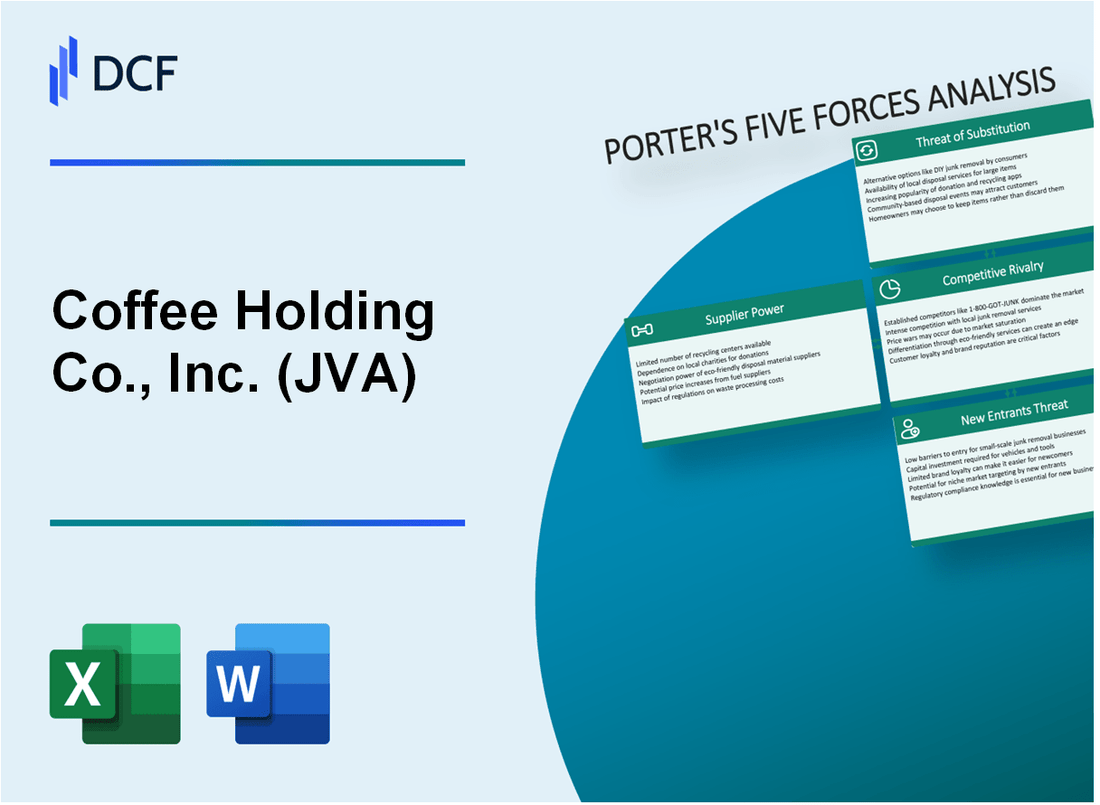
Totalmente Editável: Adapte-Se Às Suas Necessidades No Excel Ou Planilhas
Design Profissional: Modelos Confiáveis E Padrão Da Indústria
Pré-Construídos Para Uso Rápido E Eficiente
Compatível com MAC/PC, totalmente desbloqueado
Não É Necessária Experiência; Fácil De Seguir
Coffee Holding Co., Inc. (JVA) Bundle
No mundo dinâmico do comércio de café, a Coffee Holding Co., Inc. (JVA) navega em um cenário complexo de forças de mercado que moldam suas decisões estratégicas. Desde a intrincada dança do fornecimento de feijão até os desafios da rivalidade competitiva, essa análise investiga profundamente os fatores críticos que influenciam a posição de mercado da empresa. Ao examinar a estrutura das cinco forças de Michael Porter, descobrimos a dinâmica diferenciada que impulsiona o sucesso no setor de comércio de café especializado, revelando o delicado equilíbrio entre fornecedores, clientes, concorrentes e tendências emergentes do mercado.
Coffee Holding Co., Inc. (JVA) - As cinco forças de Porter: poder de barganha dos fornecedores
Número limitado de fornecedores de feijão de café globalmente
A partir de 2024, a produção global de feijão de café está concentrada em 10 países primários:
| País | Produção anual (milhões de sacos de 60 kg) |
|---|---|
| Brasil | 66.3 |
| Vietnã | 27.5 |
| Colômbia | 11.5 |
| Indonésia | 10.6 |
| Etiópia | 8.4 |
Volatilidade potencial de preço nos mercados de commodities de café cruas
Flutuações de preços de commodities de café em 2024:
- Faixa de preço do Futuros do Café Arábica: US $ 1,60 - US $ 2,30 por libra
- Robusta Coffee Futures Preço Faixa de preço: US $ 1,10 - US $ 1,80 por libra
- Volatilidade média anual de preço: 22,7%
Dependência da qualidade e consistência do fornecimento de feijão de café
| Métrica de qualidade | 2024 padrão |
|---|---|
| Porcentagem de café especial de grau especializado | 18.5% |
| Feijão certificado pelo comércio justo | 12.3% |
| Feijão certificado orgânico | 9.7% |
Concentração geográfica de regiões de feijão de café premium
Distribuição regional de feijão de café premium:
- América Latina: 65,4% da produção de feijão premium
- África: 22,1% da produção de feijão premium
- Ásia-Pacífico: 12,5% da produção de feijão premium
Coffee Holding Co., Inc. (JVA) - As cinco forças de Porter: poder de barganha dos clientes
Diversificadas Base de Clientes
Coffee Holding Co., Inc. serve vários segmentos de clientes com a seguinte quebra:
| Segmento de clientes | Porcentagem de vendas totais |
|---|---|
| Atacadistas | 42% |
| Varejistas | 33% |
| Cafeterias especiais | 15% |
| Distribuidores online | 10% |
Análise de sensibilidade ao preço
Indicadores de sensibilidade ao preço de mercado para negociação de café:
- Elasticidade média de preços: 0,7
- Variação do preço do atacado: ± 8,3% anualmente
- Faixa de desconto de compra em massa: 5-12%
Demanda de mercado de café especializado
Tendências especializadas do mercado de café:
| Ano | Taxa de crescimento do mercado | Demanda de café sustentável |
|---|---|---|
| 2022 | 7.5% | 18% |
| 2023 | 9.2% | 24% |
Grande dinâmica de negociação do cliente
Grande alavancagem de preços de clientes:
- Volume mínimo de ordem em massa: 50.000 lbs
- Faixa potencial de negociação de preços: 3-15%
- Limite anual de valor do contrato: US $ 500.000
Coffee Holding Co., Inc. (JVA) - As cinco forças de Porter: rivalidade competitiva
Concorrência de mercado Overview
A Coffee Holding Co., Inc. opera em um setor de comércio de café especializado competitivo, com US $ 22,4 milhões em vendas líquidas para o ano fiscal de 2023. A empresa enfrenta a concorrência de aproximadamente 15 a 20 empresas de comércio de café especiais nos Estados Unidos.
| Categoria de concorrentes | Número de concorrentes | Faixa de participação de mercado |
|---|---|---|
| Pequenos comerciantes regionais | 12-15 | 5-10% |
| Grandes comerciantes nacionais | 3-5 | 25-40% |
Características da paisagem competitiva
Os principais fatores competitivos incluem:
- Diferenciação da qualidade do produto
- Força de relacionamento de fornecimento
- Estratégias de preços
- Eficiência da cadeia de suprimentos
Dinâmica de pressão de preços
A margem bruta média para comerciantes de café especial varia entre 18-22%. A Coffee Holding Co., Inc. manteve uma margem bruta de 19,7% em 2023, indicando pressões significativas de preços competitivos.
| Fator de precificação | Nível de impacto | Porcentagem estimada |
|---|---|---|
| Intensidade da concorrência de preços | Alto | 65-70% |
| Potencial de redução de custos | Moderado | 15-20% |
Concentração de mercado
Os 5 principais comerciantes de café especiais controlam aproximadamente 55-60% do mercado total, com a Coffee Holding Co., Inc. representando aproximadamente 7-9% desse segmento.
Coffee Holding Co., Inc. (JVA) - As cinco forças de Porter: ameaça de substitutos
Crescente popularidade de opções alternativas de bebidas
O mercado global de bebidas não alcoólicas foi avaliado em US $ 1.924,61 bilhões em 2022. Taxa alternativa de crescimento de participação de mercado de bebidas projetada em 5,6% de CAGR de 2023-2030.
| Categoria de bebida | Tamanho do mercado 2022 ($ b) | Taxa de crescimento |
|---|---|---|
| Chá | 55.3 | 6,2% CAGR |
| Bebidas energéticas | 86.4 | 7,5% CAGR |
| Bebidas à base de plantas | 37.7 | 9,8% CAGR |
Aumento do interesse do consumidor em bebidas alternativas
As preferências do consumidor mudam para alternativas mais saudáveis:
- O consumo de chá aumentou 23,1% entre 2018-2022
- O mercado de bebidas energéticas espera atingir US $ 110,6 bilhões até 2025
- O mercado de bebidas baseado em vegetais se projetou para atingir US $ 52,7 bilhões até 2024
Surgimento de alternativas prontas para bebidas e bebidas frias
Estatísticas do mercado de bebidas prontas para beber (RTD):
| Categoria RTD | Valor de mercado 2022 ($ B) | Crescimento projetado |
|---|---|---|
| Café frio | 4.3 | 22,4% CAGR |
| Rtd Tea | 12.7 | 8,3% CAGR |
| RTD Bebidas energéticas | 57.5 | 9,1% CAGR |
Tendências do consumidor consciente da saúde
Preferências de saúde do consumidor que impulsionam a substituição de bebidas:
- 62% dos consumidores priorizam bebidas com baixo teor de açúcar
- 47% buscam alternativas de ingrediente natural
- 35% preferem bebidas funcionais com benefícios de saúde adicionais
Coffee Holding Co., Inc. (JVA) - As cinco forças de Porter: ameaça de novos participantes
Requisitos de capital inicial no comércio de café
A Coffee Holding Co., Inc. requer investimento inicial de capital inicial substancial. Em 2024, o total de ativos da empresa é de US $ 41,24 milhões, com capital de giro de US $ 12,7 milhões. A entrada no comércio de café requer aproximadamente US $ 5-7 milhões em capital inicial para infraestrutura, estoque e despesas operacionais.
| Categoria de requisito de capital | Faixa de custo estimada |
|---|---|
| Investimento inicial de inventário | US $ 2,5 - US $ 3,5 milhões |
| Infraestrutura de armazenamento | $ 1,2 - $ 1,8 milhão |
| Sistemas de Tecnologia de Negociação | $500,000 - $750,000 |
Complexidade da cadeia de suprimentos
A Coffee Holding Co., Inc. opera dentro de uma complexa cadeia de suprimentos global envolvendo vários mercados internacionais.
- As redes de fornecimento abrangem 12 países diferentes de produção de café
- Requer mínimo de 5 a 7 anos de experiência no setor para navegar efetivamente
- Conhecimento de compras crítico para negociações de qualidade e preços
Relacionamentos estabelecidos do produtor
A empresa mantém relacionamentos de longo prazo com os produtores de café, criando barreiras significativas de entrada no mercado. Os contratos atuais dos produtores têm em média de 3 a 5 anos de duração, com aproximadamente 85% de renovação.
Requisitos de conformidade regulatória
Os padrões regulatórios rigorosos exigem investimentos significativos em conformidade. As certificações necessárias incluem:
- Certificação de comércio justo custos: US $ 15.000 - US $ 25.000 anualmente
- Certificação orgânica do USDA: US $ 10.000 - US $ 20.000 por ano
- Conformidade de importação da FDA: US $ 50.000 - US $ 75.000 Configuração inicial
| Tipo de certificação | Custo anual de conformidade |
|---|---|
| Feira comercial | $20,000 |
| USDA Organic | $17,500 |
| FDA Importar conformidade | $62,500 |
Coffee Holding Co., Inc. (JVA) - Porter's Five Forces: Competitive rivalry
The market for Coffee Holding Co., Inc. (JVA) remains mature and highly fragmented. You see competitors like Farmer Bros. Co. and Laird Superfood, Inc. operating across the same space. To illustrate the scale difference, Farmer Bros. Co. reported fiscal 2025 net sales of $342.3 million and a fiscal 2025 gross margin of 43.5%.
Despite this environment, Coffee Holding Co., Inc. (JVA) showed operational strength in the third quarter of 2025. Net sales for the quarter ending July 31, 2025, hit $23.9 million, marking a 27% increase over the $18.8 million recorded in Q3 2024. This growth suggests Coffee Holding Co., Inc. (JVA) is successfully taking share, even as the overall market remains competitive.
Rivalry intensity is clearly visible in the cost structure. Competitors are definitely feeling the squeeze from high raw material costs. For Coffee Holding Co., Inc. (JVA), the cost of sales in Q3 2025 reached $20,997,777, which was 87.8% of net sales. This compares to a cost of sales that accounted for 79.1% of net sales in the same quarter last year.
This cost pressure directly impacts profitability metrics. While the company maintained a 19% gross margin in Q2 2025, the Q3 2025 gross profit fell to $2,912,737, representing only 12.2% of net sales, down from 20.9% in Q3 2024.
Coffee Holding Co., Inc. (JVA) competes by focusing on price and supply chain efficiency, leveraging its integrated model to manage these commodity swings. Here's a quick look at the margin pressure across recent quarters:
| Metric | Q2 2025 Value | Q3 2025 Value | Q3 2024 Value |
| Gross Margin Percentage | 19% | 12.2% | 20.9% |
| Net Sales (Millions USD) | Not specified | $23.9 | $18.8 |
| Net Income (Millions USD) | Not specified | Net Loss of $1.19 | Profit of $1.12 |
The competitive dynamics force specific actions from Coffee Holding Co., Inc. (JVA) management to maintain its footing:
- Securing inventory at advantageous rates following price dips.
- Maintaining pricing strategy despite market challenges in Q3 2025.
- Achieving 27% net sales growth in Q3 2025.
- Seeing its recent acquisition, Second Empire, achieve profitability in July 2025.
- Navigating a $2.2 million negative impact from derivative positions in Q3 2025.
The pressure is real; if onboarding takes 14+ days, churn risk rises, and in this market, margin erosion is the equivalent risk. Finance: draft 13-week cash view by Friday.
Coffee Holding Co., Inc. (JVA) - Porter's Five Forces: Threat of substitutes
You're analyzing the competitive landscape for Coffee Holding Co., Inc. (JVA) as of late 2025, and the threat from substitutes is a major factor you need to quantify. The core business, while strong with Q3 2025 net sales reaching $23.9M, faces constant pressure from alternatives that offer similar functional benefits-namely, caffeine and ritual-but through different product forms.
The company faces strong substitution from tea, energy drinks, and other caffeinated beverages. While Coffee Holding Co., Inc. is a leading wholesale coffee roaster, the broader beverage market is fragmented. For instance, in a recent national survey, coffee accounted for 69% of caffeine intake from beverages, but tea and energy drinks still command significant shares of the functional beverage space, representing 8.8% and 6.3% of caffeine intake, respectively. Furthermore, the energy drinks market in the U.S. is projected to grow at a Compound Annual Growth Rate (CAGR) of 7.2% from 2025 to 2030. This shows that while coffee leads, the substitutes are actively growing their presence.
JVA partially addresses this by offering bulk tea selections in its product portfolio. This is a smart move to capture some of the demand that might otherwise go entirely to competitors. Coffee Holding Co., Inc.'s product offering spans whole-bean and ground coffees, single-serve pods, cold brew formats, and bulk tea selections, utilizing both branded and private-label solutions. This diversification helps insulate the company somewhat, especially as the combined Ready-to-Drink (RTD) tea and coffee market was valued at $119.84 billion globally in 2024.
Consumer switching costs are defintely low, making the threat persistent and high. For a wholesale customer buying green coffee or a retailer stocking packaged goods, switching from a coffee supplier to a tea or energy drink supplier is logistically simple, requiring minimal capital investment or retraining. The cost to switch is primarily the lost relationship, which is often outweighed by better pricing or product availability from a substitute supplier. This low friction means that any perceived value gap in Coffee Holding Co., Inc.'s offerings can quickly translate into lost volume.
The rise of specialty and instant coffee alternatives provides diverse substitute options. This isn't just about other beverage categories; it's about format innovation within the broader caffeine space. Coffee Holding Co., Inc. itself sells instant coffees and provides single-cup coffee pods. The market is seeing rapid innovation in convenience, which directly challenges traditional wholesale roasting models. Consider the scale of these alternatives:
| Beverage Category | Metric | Value (Latest Available) |
|---|---|---|
| Coffee (Caffeine Intake Contributor) | Percentage Share | 69% |
| Tea (Caffeine Intake Contributor) | Percentage Share | 8.8% |
| Energy Drinks (Caffeine Intake Contributor) | Percentage Share | 6.3% |
| U.S. RTD Tea Market | Estimated Value (2025) | $15.1 Billion |
| Global Energy Drinks Market | Projected Value (2025) | $85.25 Billion |
Coffee Holding Co., Inc.'s ability to maintain a 19% gross margin in Q2 2025 while navigating these substitution pressures shows operational resilience, but the threat remains structural. The company's product breadth is key to mitigating this:
- Offers bulk tea selections alongside coffee.
- Markets instant coffees and single-serve pods.
- Sells products under eight proprietary brands.
- Serves diverse channels including coffeehouses, hotels, and retail chains.
The overall revenue for Coffee Holding Co., Inc. over the last twelve months ending July 31, 2025, was $89.75M, which puts the company's scale into perspective against the multi-billion dollar substitute markets. Finance: draft 13-week cash view by Friday.
Coffee Holding Co., Inc. (JVA) - Porter's Five Forces: Threat of new entrants
You're assessing the competitive landscape for Coffee Holding Co., Inc. (JVA), and the threat from brand-new players trying to set up shop is definitely moderate. It isn't a zero-risk situation, but the initial financial hurdle is substantial enough to keep most small-time dreamers out.
The capital investment needed just to get the physical plant running-roasting, packaging, and setting up distribution-is high. A lean, direct-to-consumer micro-roasting model might squeak by with an initial outlay between $15,000 and $30,000, but that's for the bare minimum. If a new entrant wants a mid-to-large scale wholesale operation, say with a 12-15kg roaster, they should plan for costs well over $120,000, with total startup costs for wholesale operations often ranging from $75,000 to over $300,000.
This high barrier is clearer when you look at the equipment alone. Commercial roasting equipment can cost anywhere from $5,000 up to $150,000. Plus, you have to factor in facility build-out, which can run from $25,000 to $80,000 just for ventilation and plumbing in a dedicated space.
Here's a quick look at how Coffee Holding Co., Inc.'s current size stacks up against those entry costs. It helps put the barrier into perspective:
| Metric | Coffee Holding Co., Inc. (JVA) Value (Late 2025) | New Entrant Cost Benchmark |
|---|---|---|
| Market Capitalization (Nov 25, 2025) | $20.78 million | N/A (Represents established scale) |
| Q3 2025 Net Sales | $23.9 million (for the quarter ended July 31, 2025) | N/A (Represents established revenue base) |
| Minimal Roastery Startup Cost | N/A | Approx. $15,000 to $30,000 |
| Mid-to-Large Wholesale Startup Cost | N/A | Often exceeds $120,000 |
| Employees (as of Nov 22, 2025) | 92 | Initial staffing cost is an immediate OpEx |
Also, a new entrant would struggle mightily to immediately match Coffee Holding Co., Inc.'s established supplier relationships and any long-term contracts they have locked in. Securing reliable, quality green coffee at favorable terms is a major operational advantage that takes years to build.
Then there's the complexity of managing commodity price swings. Coffee Holding Co., Inc. uses derivative strategies to hedge, but even that is tricky; for instance, in the quarter ending July 31, 2025, derivative positions caused a $2.2 million negative impact on profitability, leading to a net loss of $1.19 million despite a 27% sales increase. A new, smaller player attempting to replicate this sophisticated financial management without the scale or experience would likely face severe, immediate financial penalties.
To be fair, Coffee Holding Co., Inc.'s own small size-with a market capitalization around $20.78 million as of November 25, 2025-means it's a less intimidating target than, say, a Nestlé or Starbucks. Still, the regulatory environment adds another layer of defense. New entrants must navigate significant hurdles, including securing necessary business licensing, permits, and, critically, food safety certifications, which adds time and expense before a single bag of beans can be sold legally.
- Regulatory compliance requires adherence to food safety standards.
- Securing necessary permits adds to initial time-to-market.
- Established supplier contracts act as a de facto barrier.
- Derivative management complexity deters less sophisticated entrants.
Disclaimer
All information, articles, and product details provided on this website are for general informational and educational purposes only. We do not claim any ownership over, nor do we intend to infringe upon, any trademarks, copyrights, logos, brand names, or other intellectual property mentioned or depicted on this site. Such intellectual property remains the property of its respective owners, and any references here are made solely for identification or informational purposes, without implying any affiliation, endorsement, or partnership.
We make no representations or warranties, express or implied, regarding the accuracy, completeness, or suitability of any content or products presented. Nothing on this website should be construed as legal, tax, investment, financial, medical, or other professional advice. In addition, no part of this site—including articles or product references—constitutes a solicitation, recommendation, endorsement, advertisement, or offer to buy or sell any securities, franchises, or other financial instruments, particularly in jurisdictions where such activity would be unlawful.
All content is of a general nature and may not address the specific circumstances of any individual or entity. It is not a substitute for professional advice or services. Any actions you take based on the information provided here are strictly at your own risk. You accept full responsibility for any decisions or outcomes arising from your use of this website and agree to release us from any liability in connection with your use of, or reliance upon, the content or products found herein.