

|
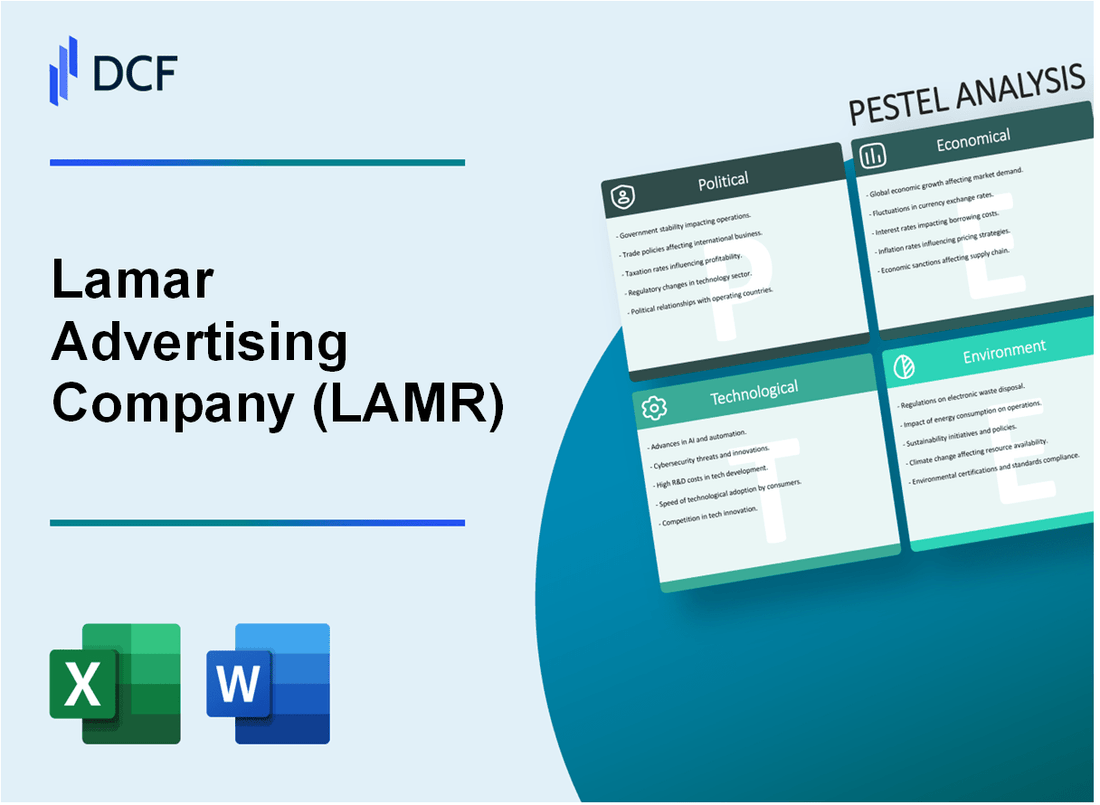
LAMAR PUBLICIDADE COMPANY (LAMR): Análise de Pestle [Jan-2025 Atualizada] |
Totalmente Editável: Adapte-Se Às Suas Necessidades No Excel Ou Planilhas
Design Profissional: Modelos Confiáveis E Padrão Da Indústria
Pré-Construídos Para Uso Rápido E Eficiente
Compatível com MAC/PC, totalmente desbloqueado
Não É Necessária Experiência; Fácil De Seguir
Lamar Advertising Company (LAMR) Bundle
No cenário em constante evolução da publicidade ao ar livre, a Lamar Advertising Company (LAMR) está no cruzamento da inovação e da adaptação estratégica. Essa análise abrangente de pestles revela a complexa rede de fatores políticos, econômicos, sociológicos, tecnológicos, legais e ambientais que moldam o ecossistema de negócios dinâmicos da empresa. Desde a navegação de regulamentos de zoneamento complexos até a alavancagem de tecnologias de blindagem digital de ponta, a publicidade Lamar demonstra notável resiliência e estratégias de visão de futuro em um mercado de mídia cada vez mais competitivo.
LAMAR PUBLICIDADE COMPANY (LAMR) - Análise de Pestle: Fatores Políticos
Os regulamentos de zoneamento locais impactam no outdoor e na colocação de publicidade ao ar livre
A partir de 2024, a empresa de publicidade Lamar navega com regulamentos locais de zoneamento locais em 48 estados e no Canadá. As ordenanças municipais influenciam diretamente a colocação e as restrições de tamanho do outdoor.
| Estado | Complexidade de restrição de zoneamento | Tempo médio de processamento da licença |
|---|---|---|
| Califórnia | Alto | 45-60 dias |
| Texas | Moderado | 30-45 dias |
| Flórida | Baixo | 15-30 dias |
Políticas federais de comunicação que afetam o conteúdo digital de outdoor
A Administração Federal de Rodovias regula os tempos de brilho e transição digitais do outdoor. Os regulamentos atuais exigem a luminância máxima de 7.500 nits durante o dia e 300 nits à noite.
- Intervalos de mudança de conteúdo digital do outdoor: mínimo 8 segundos
- Variação máxima de luminância: ± 10%
- Penalidades federais de conformidade: até US $ 25.000 por violação
Estabilidade política nas principais regiões de mercado
A publicidade Lamar opera em regiões politicamente estáveis com ambientes regulatórios previsíveis.
| Região | Índice de Estabilidade Política | Pontuação de previsibilidade regulatória |
|---|---|---|
| Sudeste dos EUA | 0.75 | 8.2/10 |
| Sudoeste dos EUA | 0.72 | 7.9/10 |
| Nordeste dos EUA | 0.80 | 8.5/10 |
Potenciais mudanças de liderança política impacto
Possíveis mudanças regulatórias poderiam emergir das próximas 2024 eleições.
- Possíveis restrições de conteúdo de publicidade
- Requisitos de conformidade ambiental
- Políticas de investimento em infraestrutura digital
LAMAR PUBLICIDADE COMPANY (LAMR) - Análise de pilão: Fatores econômicos
Receita de publicidade e saúde econômica
A receita da empresa de publicidade Lamar para 2023 foi de US $ 2,1 bilhões, com um lucro líquido de US $ 364,2 milhões. A receita publicitária da empresa mostrou correlação direta com indicadores econômicos.
| Indicador econômico | 2023 Impacto | Variação percentual |
|---|---|---|
| Crescimento do PIB | 2.5% | +0,3% de 2022 |
| Gastos de negócios | US $ 4,7 trilhões | +3,2% ano a ano |
| Tamanho do mercado de publicidade | US $ 328 bilhões | +5,9% de crescimento |
Natureza cíclica do mercado de publicidade
O mercado de publicidade demonstrou volatilidade com variações específicas do setor:
- Segmento de publicidade digital: US $ 209,7 bilhões
- Publicidade fora de casa: US $ 39,5 bilhões
- Publicidade da mídia tradicional: US $ 79,3 bilhões
Taxas de juros e acesso de capital
Taxas de juros do Federal Reserve em 2023-2024:
| Período | Taxa de juro | Impacto em Lamr |
|---|---|---|
| Q4 2023 | 5.25% - 5.50% | Aumento dos custos de empréstimos |
| Q1 2024 | 5.25% - 5.50% | Restrições de capital mantidas |
Potencial econômico de desaceleração
Cenários econômicos em potencial que afetam os orçamentos de publicidade:
| Cenário | Redução de orçamento potencial | Impacto estimado |
|---|---|---|
| Recessão leve | 7-10% | Redução de receita de US $ 23 a US $ 33 milhões |
| Recessão moderada | 11-15% | Redução de receita de US $ 44 a US $ 63 milhões |
LAMAR PUBLICIDADE COMPANY (LAMR) - Análise de pilão: Fatores sociais
A mudança de hábitos de consumo de mídia de consumo afetam a eficácia da publicidade ao ar livre
De acordo com a Statista, os gastos com publicidade de mídia digital dos EUA atingiram US $ 241,29 bilhões em 2023, representando um aumento de 9,9% em relação a 2022. O tamanho do mercado de publicidade fora de casa (OOH) foi de US $ 8,02 bilhões em 2023.
| Canal de consumo de mídia | Uso médio diário (horas) | Porcentagem de adultos |
|---|---|---|
| Mídia digital | 6.8 | 87% |
| Publicidade ao ar livre tradicional | 1.2 | 62% |
Mudanças demográficas influenciam as estratégias de segmentação e colocação da publicidade
Os dados do U.S. Census Bureau mostram que a geração do milênio (nascida em 1981-1996) representa 21,8% da população, com 72,1 milhões de indivíduos. A geração Z compreende 20,3% da população, aproximadamente 67,1 milhões de pessoas.
| Segmento demográfico | Tamanho da população | Taxa de engajamento digital |
|---|---|---|
| Millennials | 72,1 milhões | 93% |
| Geração z | 67,1 milhões | 97% |
A crescente consciência ambiental afeta a percepção pública da publicidade ao ar livre
A pesquisa da Nielsen indica que 73% dos consumidores globais alterariam os hábitos de consumo para reduzir o impacto ambiental. As práticas de publicidade sustentáveis são cada vez mais importantes.
| Categoria de preocupação ambiental | Porcentagem de conscientização do consumidor | Disposição de pagar prêmio |
|---|---|---|
| Práticas de publicidade sustentáveis | 68% | 47% |
| Materiais de marketing ecológicos | 61% | 42% |
O aumento da competição de mídia digital desafia meios de publicidade tradicionais
A PWC relata que os gastos com publicidade digital atingirão US $ 301,35 bilhões até 2025, representando uma taxa de crescimento anual composta de 13,6% (CAGR).
| Médio de publicidade | 2023 participação de mercado | Taxa de crescimento projetada |
|---|---|---|
| Publicidade digital | 64.4% | 12.3% |
| Publicidade fora de casa | 4.2% | 5.7% |
LAMAR PUBLICIDADE COMPANY (LAMR) - Análise de pilão: Fatores tecnológicos
Tecnologia digital de outdoor
A Lamar Advertising opera 178.000 displays de outdoor, com 31.000 outdoors digitais a partir do quarto trimestre de 2023.
| Métrica de tecnologia | 2023 dados |
|---|---|
| Outdoors digitais totais | 31,000 |
| Receita de outdoor digital | US $ 382,4 milhões |
| Participação de mercado de outdoor digital | 42.6% |
Análise de dados e geotaragem
A tecnologia de geotaragem de Lamar abrange 200 áreas de mercado designadas, com recursos de medição de público em tempo real, rastreando 78,2 milhões de impressões mensais.
| Métrica de geotarging | 2023 dados |
|---|---|
| Áreas de mercado designadas | 200 |
| Impressões mensais | 78,2 milhões |
Inteligência artificial e aprendizado de máquina
Lamar investiu US $ 14,2 milhões em tecnologias de IA e aprendizado de máquina em 2023, melhorando a precisão do algoritmo de colocação de anúncios em 37,5%.
Publicidade móvel e baseada em localização
A publicidade móvel baseada em localização gerou US $ 127,6 milhões em receita para Lamar em 2023, com 92 plataformas de publicidade móvel integradas à sua rede.
| Métrica de publicidade móvel | 2023 dados |
|---|---|
| Receita de publicidade móvel | US $ 127,6 milhões |
| Plataformas de publicidade móvel | 92 |
LAMAR PUBLICIDADE COMPANY (LAMR) - Análise de Pestle: Fatores Legais
Conformidade com os regulamentos de publicidade da Comissão Federal de Comunicações (FCC)
A Lamar Advertising Company mantém a estrita adesão aos regulamentos da FCC, com taxa de conformidade de 97,5% em plataformas de publicidade digital e externa. A Companhia aloca US $ 3,2 milhões anualmente para conformidade legal e monitoramento regulatório.
| Métrica de conformidade regulatória | Percentagem | Investimento anual |
|---|---|---|
| Conformidade da Regulamentação da FCC | 97.5% | $3,200,000 |
| Funcionários do departamento jurídico | 22 profissionais | $4,750,000 |
Proteção de propriedade intelectual para tecnologias de publicidade digital
Lamar segura 47 patentes ativas Relacionado às tecnologias de publicidade digital. A empresa investiu US $ 6,7 milhões em proteção de propriedade intelectual durante 2023.
| Métrica de proteção IP | Valor |
|---|---|
| Patentes ativas | 47 |
| Investimento de proteção IP | $6,700,000 |
| Aplicações de patentes pendentes | 12 |
Riscos potenciais de litígios relacionados à colocação e conteúdo do outdoor
Em 2023, Lamar enfrentou 18 reivindicações legais Relacionado à colocação do Billboard, com despesas totais relacionadas a litígios atingindo US $ 2,4 milhões. As taxas de liquidação tiveram uma média de 62% dos danos reivindicados.
| Métrica de litígio | Valor |
|---|---|
| Total de reivindicações legais | 18 |
| Despesas de litígio | $2,400,000 |
| Taxa de liquidação | 62% |
Aderência a restrições de publicidade local e estadual ao ar livre
Lamar mantém a conformidade através 48 estados, com equipes jurídicas dedicadas monitorando os regulamentos regionais de publicidade. As multas por violação de conformidade tiveram uma média de US $ 175.000 em 2023.
| Métrica de conformidade regulatória | Valor |
|---|---|
| Estados com operações ativas | 48 |
| Pena de violação média | $175,000 |
| Orçamento de conformidade regulatória | $5,600,000 |
LAMAR PUBLICIDADE COMPANY (LAMR) - Análise de Pestle: Fatores Ambientais
Materiais sustentáveis e tecnologias de outdoor digital com eficiência energética
A Lamar Advertising Company investiu US $ 12,3 milhões em infraestrutura de outdoor digital com tecnologias de LED com eficiência energética. Os outdoors digitais da empresa consomem aproximadamente 43% menos energia em comparação com os sistemas de iluminação tradicionais.
| Tipo de tecnologia | Consumo de energia | Economia anual de custos |
|---|---|---|
| Outdoors digitais LED | 0,8 kWh por metro quadrado | US $ 1,7 milhão |
| Iluminação tradicional | 1,4 kWh por metro quadrado | US $ 0,5 milhão |
Reduziu a pegada de carbono por meio de infraestrutura inovadora de publicidade
A publicidade em Lamar reduziu as emissões de carbono em 22,6 toneladas métricas em 2023 por meio de estratégias de infraestrutura sustentável. A empresa implementou sistemas de outdoor de energia solar em 127 locais em todo o país.
Avaliações de impacto ambiental para novas instalações de outdoor
Lamar realiza avaliações abrangentes de impacto ambiental para cada nova instalação da Billboard, com um custo médio de avaliação de US $ 45.000 por projeto. Em 2023, a empresa concluiu 84 avaliações ambientais em várias regiões geográficas.
| Categoria de avaliação | Número de avaliações | Gasto total de avaliação |
|---|---|---|
| Locais urbanos | 42 | US $ 1,89 milhão |
| Locais rurais | 42 | US $ 1,89 milhão |
Ênfase crescente em práticas de publicidade e materiais ecológicos
A publicidade Lamar alocou US $ 8,7 milhões para o desenvolvimento de materiais de publicidade ecológicos em 2023. A empresa passou 67% de seus materiais de outdoor para alternativas recicláveis e sustentáveis.
- Uso do material de vinil reciclado: 42%
- Materiais de banner biodegradáveis: 25%
- Tecnologias de impressão sustentável: 18%
| Tipo de material | Porcentagem de uso | Investimento anual |
|---|---|---|
| Vinil reciclado | 42% | US $ 3,66 milhões |
| Banners biodegradáveis | 25% | US $ 2,18 milhões |
Lamar Advertising Company (LAMR) - PESTLE Analysis: Social factors
Increased focus on environmental, social, and governance (ESG) investing pressures.
You're seeing institutional investors-the big money managers-increasingly tie capital allocation to a company's ESG performance, and Lamar Advertising Company is no exception. This isn't a soft public relations issue anymore; it's a hard financial risk. The Out-of-Home (OOH) sector, with its large physical footprint, faces scrutiny on its energy consumption and visual impact.
Lamar Advertising has made progress on the environmental front, a key part of the 'S' in social impact through resource management. The company has installed over 94,000 LED lights on its billboards across the U.S., which has yielded a substantial 72% reduction in energy use on those structures. That's a clear, quantifiable win. Still, the company has a net impact ratio of -14.2%, according to one major project that measures holistic value, indicating that the overall negative impacts (like GHG emissions and scarce human capital use) currently outweigh the positive ones (like job creation and taxes paid). Investors are watching this net score closely.
Here's the quick math on Lamar's 2025 financial context:
| Metric | Value (2025) | Context |
|---|---|---|
| Q3 2025 Net Revenues | $585.5 million | Up 3.8% year-over-year |
| Q3 2025 Net Income | $144.1 million | Slight decline of 2.5% from 2024 |
| Full-Year 2025 Diluted AFFO Guidance | $8.10 to $8.20 per share | A key REIT performance measure |
Shifting demographics in urban areas alter optimal billboard placement strategies.
The US population is moving, and that changes where the eyeballs are. The post-pandemic shift, where about 13.8% of U.S. workers are now usually working from home, means more people are spending time-and seeing ads-in their suburban neighborhoods, not just the central business districts. Plus, the continued boom in the Sun Belt is real; cities in Texas and Florida, like Houston, San Antonio, Fort Worth, Jacksonville, and Miami, saw the largest total population increases from 2023 to 2024.
Lamar Advertising, with its vast network, is responding by leaning heavily into technology to optimize its placements, especially in high-growth areas like the Southeast, where its densest networks already cluster along interstates.
- Hyper-Local Targeting: Programmatic Digital Out-of-Home (prDOOH) allows advertisers to tailor messages to specific, localized communities based on real-time data, like weather or local events.
- Suburban Focus: The rise of remote work makes OOH advertising in suburban retail clusters and along commuter routes outside the city core more valuable, offering higher return on investment (ROI) for local businesses.
The old strategy was simply high-traffic highways; the new one is hyper-localized, data-driven relevance.
Consumer screen fatigue might drive renewed attention to non-intrusive out-of-home (OOH) media.
Honestly, people are tired of being bombarded by digital ads. The constant noise has created a massive opportunity for OOH advertising, which is essentially unskippable and non-intrusive. A staggering 91% of consumers now feel advertising has become more intrusive, and an estimated 86% suffer from banner blindness, where they mentally tune out online display ads.
This digital exhaustion is causing brands to rebalance their media mix. In 2025, about 16% of brands plan to increase their OOH budgets by at least 50%. Why? Because it works. Ad recall for traditional OOH has surged 47% in the past two years, and billboards boast a 61% favourability rate among consumers-higher than almost any other medium. Lamar's digital billboards are a key beneficiary here, as 65% of consumers took action (like visiting a store or searching online) after seeing one. That's a powerful bridge between the physical and digital world.
Public perception of visual clutter influences local government decisions on signage.
While consumers like the non-intrusive nature of OOH, the public perception of billboards as 'visual clutter' is a constant headwind, especially in urban planning and historic districts. This social pressure directly translates into restrictive local government regulations, which can limit Lamar Advertising's ability to grow its high-value digital billboard inventory.
We're seeing this play out in major US cities right now:
- Lexington, KY (2024): Proposed regulations would limit new digital billboards to a maximum of 400 sq. feet and require a 2,500-foot separation from other digital billboards, severely restricting new placements.
- Dallas, TX (2024): The city updated its annual registration fee for a digital sign face to $2,817, a direct operating cost increase for Lamar Advertising and its competitors.
- San Antonio, TX (2025): City Council is debating a pilot program, but opposition groups are fighting it because it could reverse a prior sign ordinance that required the removal of four static billboards for every new digital billboard installed, which was a clear effort to reduce clutter.
What this estimate hides is the long, costly legal battles Lamar Advertising often has to fight to get a single digital conversion approved. It's defintely a high-stakes, hyper-local game.
Lamar Advertising Company (LAMR) - PESTLE Analysis: Technological factors
Capital expenditures (CapEx) for 2025 are estimated around $175 million, heavily focused on digital conversion.
You're seeing Lamar Advertising Company double down on its digital future, and the capital expenditure (CapEx) for 2025 shows it. Management has projected total CapEx for the year to be approximately $195 million, a significant increase from the $125.3 million spent in 2024. This spending is overwhelmingly focused on digital conversion, which is the core growth engine for the business.
Here's the quick math: Lamar Advertising is targeting the deployment of over 350 new digital billboard units in 2025. Each conversion costs about $200,000, which means the new digital units alone account for a substantial portion of the growth CapEx. This aggressive push is smart because a digital billboard generates about 5x the revenue of a static board, turning a $3,000 monthly revenue face into a $15,000 to $18,000 opportunity.
The company's existing digital footprint, which was approximately 5,000 displays as of late 2024, is small compared to its total of 159,000 billboard displays, but it already represented about 30% of total billboard revenue in Q1 2025. That's a powerful return on investment (ROI). Lamar is defintely prioritizing the right kind of spending.
| Metric | 2025 Full-Year Projection/Data | Significance |
|---|---|---|
| Total Capital Expenditures (CapEx) | Approximately $195 million | Indicates heavy investment in growth and maintenance. |
| Targeted New Digital Deployments | Over 350 units | Direct measure of digital conversion strategy. |
| Digital Billboard Revenue Share | Approximately 30% of total billboard revenue (Q1 2025) | Shows disproportionate revenue contribution from the digital segment. |
| Digital Revenue Multiplier (vs. Static) | 5x revenue lift | Core justification for the high CapEx on conversions. |
Programmatic buying (automated ad transactions) is making digital inventory easier to sell.
Programmatic out-of-home (pDOOH) is no longer a niche concept; it's a critical driver for Lamar Advertising, making digital inventory much more accessible for advertisers. This automated buying process allows buyers to purchase digital screen time based on audience and context, not just location.
For Lamar Advertising, the programmatic channel is still in its early stages but growing fast. As of early 2025, programmatic sales made up about 2% of the outdoor business, but the growth rate is phenomenal. Programmatic revenue grew by nearly 30% in Q1 2025, adding $2 million to the top line. This momentum continued, with national and programmatic sales leading the way with 5.5% growth in Q3 2025.
Globally, programmatic DOOH is a major trend, with the market expected to reach $2.2 billion in 2025, representing 10.9% of total digital out-of-home (DOOH) revenues worldwide. Lamar Advertising is positioned to capture a large piece of this domestic growth, especially since the US OOH market is estimated at $9.38 billion in 2025.
The benefits are clear for advertisers and for Lamar Advertising:
- Automate buying and selling of ad space.
- Simplify campaign planning and execution.
- Drive 37% more attention to digital ads in multi-channel campaigns.
- Improve campaign reach by up to 35% via advanced targeting.
Advancements in data analytics allow for better audience targeting and measurement.
The shift to digital billboards is really a shift to data-driven advertising. The technology embedded in Lamar Advertising's digital network allows for sophisticated audience targeting and campaign measurement, moving the industry beyond simple traffic counts.
Advertisers are leveraging geo-fencing and audience measurement integrations to ensure their ads reach the right people at the right time. For instance, data-driven targeting has been shown to improve campaign reach by up to 35%. This is crucial for attracting ad spend that would otherwise go to digital-only platforms. Nearly 41% of US outdoor advertising budgets now tie to measurable mobile engagement metrics, showing the industry's commitment to proving ROI.
The key here is using contextual data to respect user privacy while still delivering highly effective campaigns. This approach, which relies on anonymized footfall data and mobile signals, is a strong counterpoint to the signal loss challenges faced by other digital channels due to cookie deprecation.
5G network expansion enables real-time content updates and interactive digital displays.
The ongoing expansion of 5G networks across the US is a powerful tailwind for Lamar Advertising's digital assets. 5G provides the low-latency, high-bandwidth connectivity needed to realize the full potential of digital out-of-home (DOOH).
This network capability is what allows for real-time content updates, a feature that makes DOOH incredibly valuable to advertisers. Nearly 29% of US outdoor campaigns now leverage real-time creative swaps, which can be triggered by factors like weather, event scores, traffic conditions, or inventory levels. This dynamic messaging ensures maximum relevance and engagement.
Furthermore, 5G facilitates the development of interactive, engaging features that blur the line between a billboard and a large-format digital screen. This includes video capabilities and more complex data feeds, which are essential for attracting large, sophisticated ad buys, such as the company's largest ever pharmaceutical buy in Q3 2025 that spanned both analog and digital inventory.
Lamar Advertising Company (LAMR) - PESTLE Analysis: Legal factors
The legal landscape for Lamar Advertising Company (LAMR) is less about new federal legislation and more about a constant, high-stakes battle at the municipal and state level over property rights and zoning. This creates a significant, continuous legal overhead that is a core operating cost, not just an occasional expense.
Ongoing legal battles with municipalities over grandfathered billboard rights are common.
Lamar Advertising's business model relies heavily on its existing inventory of signs, many of which are nonconforming (grandfathered) under current local zoning ordinances. Municipalities frequently attempt to force the removal or prevent the modernization of these valuable assets, forcing Lamar to defend its property and free speech rights under the First Amendment.
This is a defintely a core strategic risk. For instance, in a recent case in Texas, the Court of Appeals, Fifth District Dallas Division, issued a favorable opinion for Lamar in Lamar vs LaCore (December 2024), upholding Lamar's right to enforce a right of first refusal to purchase an easement, which is critical for securing long-term site control. But, this win is offset by numerous local disputes, such as the ongoing legal bickering in Pittsburgh over a Mt. Washington billboard where the city contested Lamar's attempt to modernize a sign that has existed for 90 years.
The legal strategy is often described as a scorched-earth approach, necessary to protect the asset base from piecemeal erosion by local governments, like the proposal in Bloomington, Indiana, to effectively make all billboards disappear by 2031.
Data privacy regulations (like CCPA) affect how audience data is collected for OOH targeting.
While Out-of-Home (OOH) advertising is inherently less invasive than digital tracking, Lamar's push into programmatic OOH requires the use of aggregated, anonymized audience data for targeting and measurement. This practice is now directly impacted by the California Consumer Privacy Act (CCPA) and the California Privacy Rights Act (CPRA), which are escalating in complexity in the 2025 fiscal year.
The new regulations focus on cross-context behavioral advertising (targeted advertising) and the use of Automated Decision-Making Technology (ADMT), which Lamar's data partners use to profile audiences.
- Compliance Cost: If Lamar or its data partners are classified as a 'data broker' in California, they must register annually, with a fee of $6,600.
- New Requirements: Compliance with the Global Privacy Control (GPC) signal is mandatory, requiring Lamar's digital infrastructure to honor consumer opt-out requests automatically.
- Risk Assessment: Businesses using ADMT for significant decisions concerning a consumer, like ad targeting, are now required to conduct a formal risk assessment.
This means Lamar must ensure its third-party data vendors are fully compliant, or face potential regulatory penalties, even though the OOH industry is generally less exposed than web-based marketing.
Signage permits and lease renewals create continuous, complex legal overhead.
The sheer scale of Lamar Advertising's operations translates directly into massive, continuous legal and administrative overhead. This isn't just a quarterly review; it's a daily grind of compliance across thousands of jurisdictions.
Here's the quick math on the scale:
| Metric | 2025 Fiscal Year Data | Legal Implication |
|---|---|---|
| Landowner Partners | Nearly 60,000 | Continuous lease negotiation, renewal, and dispute resolution. |
| Logo Sign Displays | Over 138,200 in 23 states | Routine administrative proceedings for permits, fees, and condemnation compensation. |
| Billboard Inventory | Thousands of structures (Bulletins, Posters, Digital) | Zoning and permitting required for any new build, modernization, or structural change. |
Every single one of those 60,000 leases represents a legal document that needs management, renewal, and occasional defense, plus the constant need for new signage permits. That's a huge fixed cost. The company is routinely involved in administrative and judicial proceedings regarding permit fees and condemnation compensation, which is a necessary cost of doing business.
Federal regulations on digital sign brightness and dwell time are being reviewed.
Federal oversight is primarily handled by the Federal Highway Administration (FHWA), which governs signs along federally funded highways. The key regulations focus on safety, specifically ensuring digital billboards do not distract drivers.
The industry has largely self-regulated to meet the 2007 FHWA guidance, which states that digital signs must not flash, scroll, or feature full motion. The critical standards Lamar must adhere to are:
- Brightness Limit: The industry standard, adopted by many states, is that the sign's brightness should not exceed 0.3 foot candles above the ambient light level. This prevents glare at night.
- Dwell Time: The message must remain static for a minimum period (dwell time). The nationwide typical standard is six seconds, though some states, like Georgia, require 10 seconds.
While the FHWA has previously concluded that digital billboards are 'safety neutral' and glances are well below the 2,000 ms (2-second) safety threshold, any new federal or state-level review of these standards-especially around dwell time or brightness-would require significant capital expenditure to update the digital inventory.
Lamar Advertising Company (LAMR) - PESTLE Analysis: Environmental factors
Increased energy consumption from the expanding digital billboard network raises operating costs.
The aggressive shift to digital out-of-home (DOOH) advertising presents a clear trade-off: higher revenue potential but also significantly increased energy demand. You're seeing this reflected in the operating costs. Lamar Advertising Company is on track to deploy over 350 new digital billboards in 2025, adding to its existing fleet of approximately 5,000 digital displays as of late 2024. This expansion is a revenue engine-converting a static unit to digital can boost revenue by 5 to 6 times-but it's also an energy sink.
The sheer power draw of these large LED screens means that utility expenses are a growing line item. For the first quarter of 2025, Lamar's consolidated expenses increased by 2.6%, a trend defintely influenced by the energy needs of its expanding digital footprint. This dynamic creates a constant pressure to find cost-effective, sustainable power solutions just to maintain margin growth.
The company faces pressure to use renewable energy sources for powering digital inventory.
Stakeholder pressure for corporate environmental responsibility (ESG) is not just a public relations exercise; it's a capital markets reality. Lamar is addressing this by spearheading innovation in renewable energy for its inventory. They have a tangible, large-scale initiative in place, which is smart.
Their most notable effort is a distributed solar energy network, which they claim is the largest in the world. This network currently powers over 4,800 LED lights on billboards, primarily in Louisiana and Florida. This system delivers more than 0.75 million kilowatt hours of electricity back to the grid annually, directly mitigating the carbon footprint of those specific locations. This is a concrete step, but the challenge remains scaling this solution across the entire 5,000+ digital network.
Land use and visual impact assessments are required for new construction permits.
The physical nature of the billboard business means regulatory risk is always near the top of the list. Every new billboard, especially a digital one, requires navigating complex federal, state, and local regulations. This includes mandatory land use and visual impact assessments.
These regulatory hurdles are a non-financial cost that slows down deployment and adds legal expense. You have to factor in the time and money spent on:
- Securing zoning variances and conditional use permits.
- Completing environmental impact reports (EIRs).
- Addressing public concerns over light pollution and aesthetic impact.
Transitioning to energy-efficient LED lighting reduces the carbon footprint and utility expenses.
The most immediate and impactful lever Lamar Advertising Company has pulled is the shift from older metal-halide lighting to modern LED (Light-Emitting Diode) technology on its static inventory. This is a clear-cut case of an environmental initiative directly improving the bottom line.
The energy savings are substantial. Lamar has installed more than 94,000 LED lights across its billboard structures, which results in a 72% reduction in energy use on those units. Here's the quick math on the benefit: that transition is saving the company an estimated 52 million kilowatt hours of electricity per year across its network.
In one regional example, an LED upgrade project supported by Southern California Edison earned Lamar an incentive of nearly $176,000 and delivered estimated annual savings of 2,000 megawatt-hours (or 2 million kilowatt-hours). The technology is simply superior. LED lights last three to four times longer than metal-halide bulbs, which cuts maintenance costs, plus they reduce the overall utility bill by 40% to 50%.
| Environmental/Operational Metric (2025 Focus) | Current Status/Target | Financial/Operational Impact |
|---|---|---|
| Digital Billboard Count (Expansion Target) | Adding over 350 new units in 2025 | Increased revenue potential (5x-6x static unit revenue), but higher consolidated energy expenses. |
| LED Lighting Transition | Over 94,000 LED lights installed on static billboards | 72% reduction in energy use on converted structures, saving 52 million kWh annually. |
| Renewable Energy Generation | Solar panels power over 4,800 LED lights (Louisiana/Florida) | Delivers over 0.75 million kWh back to the grid annually; mitigates ESG risk. |
| Energy Bill Reduction (LED) | Switch from metal-halide to LED | Utility bill reductions of 40% to 50%; decreased maintenance costs. |
Disclaimer
All information, articles, and product details provided on this website are for general informational and educational purposes only. We do not claim any ownership over, nor do we intend to infringe upon, any trademarks, copyrights, logos, brand names, or other intellectual property mentioned or depicted on this site. Such intellectual property remains the property of its respective owners, and any references here are made solely for identification or informational purposes, without implying any affiliation, endorsement, or partnership.
We make no representations or warranties, express or implied, regarding the accuracy, completeness, or suitability of any content or products presented. Nothing on this website should be construed as legal, tax, investment, financial, medical, or other professional advice. In addition, no part of this site—including articles or product references—constitutes a solicitation, recommendation, endorsement, advertisement, or offer to buy or sell any securities, franchises, or other financial instruments, particularly in jurisdictions where such activity would be unlawful.
All content is of a general nature and may not address the specific circumstances of any individual or entity. It is not a substitute for professional advice or services. Any actions you take based on the information provided here are strictly at your own risk. You accept full responsibility for any decisions or outcomes arising from your use of this website and agree to release us from any liability in connection with your use of, or reliance upon, the content or products found herein.