

|
Eli Lilly and Company (LLY): Análise de Pestle [Jan-2025 Atualizada] |
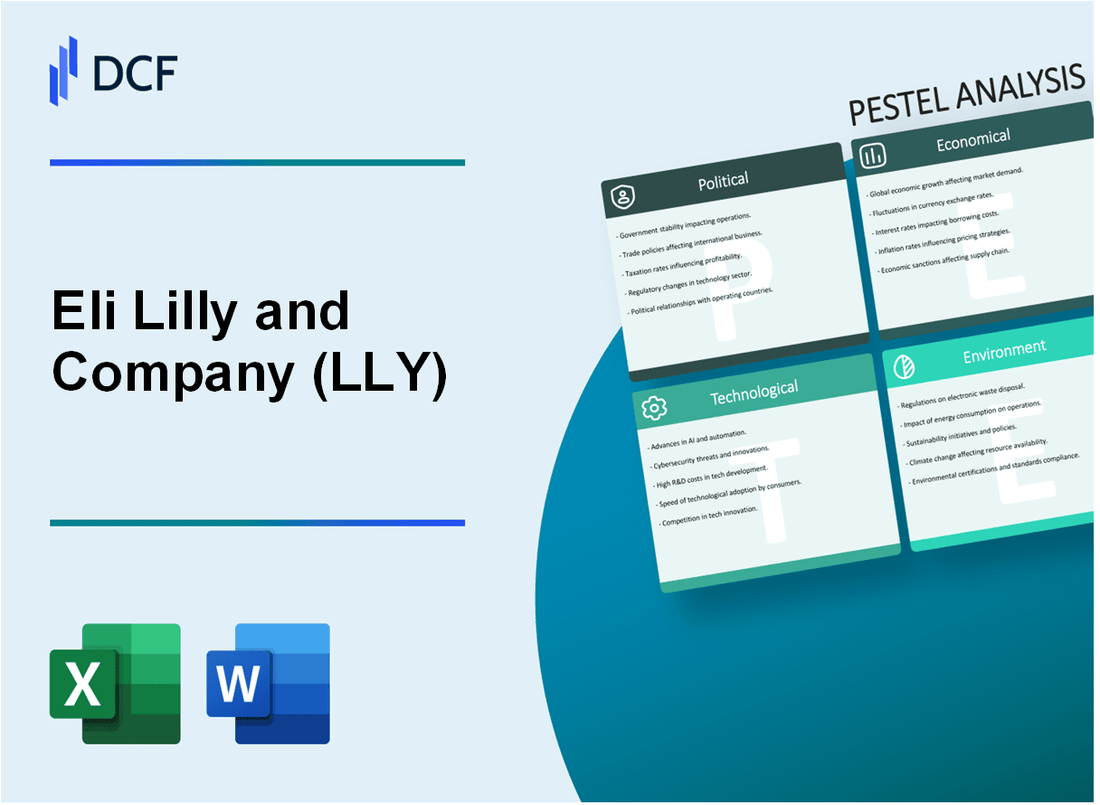
Totalmente Editável: Adapte-Se Às Suas Necessidades No Excel Ou Planilhas
Design Profissional: Modelos Confiáveis E Padrão Da Indústria
Pré-Construídos Para Uso Rápido E Eficiente
Compatível com MAC/PC, totalmente desbloqueado
Não É Necessária Experiência; Fácil De Seguir
Eli Lilly and Company (LLY) Bundle
No mundo dinâmico dos produtos farmacêuticos, Eli Lilly and Company fica na encruzilhada da inovação, regulamentação e desafios do mercado global. Esta análise abrangente de pestles revela o intrincado cenário que molda as decisões estratégicas da Lilly, explorando as forças externas multifacetadas que afetam tudo, desde o desenvolvimento de medicamentos até a penetração do mercado. Mergulhe em uma exploração diferenciada de como fatores políticos, econômicos, sociológicos, tecnológicos, legais e ambientais convergem para definir o complexo ecossistema operacional complexo da gigante farmacêutica.
Eli Lilly and Company (LLY) - Análise de Pestle: Fatores Políticos
Os regulamentos rigorosos da FDA afetam os processos de aprovação de medicamentos
O processo de aprovação do novo pedido de drogas (NDA) da FDA envolve um escrutínio rigoroso, com um tempo médio de revisão de 10-12 meses Para aplicações padrão. Em 2023, o FDA aprovou 55 novos medicamentos, demonstrando a complexa paisagem regulatória.
| Métricas de aprovação da FDA | 2023 dados |
|---|---|
| Novas aprovações totais de drogas | 55 |
| Tempo médio de revisão | 10-12 meses |
| Taxa de sucesso de aprovação | 12-15% |
Políticas comerciais internacionais complexas
O comércio farmacêutico global é significativamente impactado por regulamentos e tarifas internacionais.
- Exportações farmacêuticas dos EUA em 2022: US $ 64,3 bilhões
- As taxas tarifárias para importações farmacêuticas variam de 0-6.5%
- Barreiras comerciais afetam aproximadamente 15-20% de transações farmacêuticas internacionais
Influências de reforma da saúde do governo
A legislação de saúde afeta diretamente as estratégias de preços de medicamentos e acesso ao mercado.
| Impacto da política de saúde | Métricas quantitativas |
|---|---|
| Potencial de negociação de preços de drogas do Medicare | Até 20% de redução de preço |
| Restrições potenciais de acesso ao mercado | 10-15% do mercado atual |
Mudanças potenciais na legislação de saúde
O financiamento da pesquisa e o desenvolvimento farmacêutico são sensíveis a mudanças legislativas.
- Financiamento federal de pesquisa farmacêutica em 2023: US $ 42,9 bilhões
- Potenciais mudanças legislativas podem afetar 7-12% dos orçamentos de pesquisa atuais
- Alocação de orçamento do NIH para pesquisa farmacêutica: US $ 26,3 bilhões em 2023
Eli Lilly and Company (LLY) - Análise de Pestle: Fatores Econômicos
Alto investimento de P&D necessário para o desenvolvimento de novos medicamentos
As despesas de P&D da Eli Lilly em 2023 foram de US $ 6,8 bilhões, representando 20,2% da receita total. O pipeline de desenvolvimento de medicamentos da empresa inclui vários projetos de estágio clínico em várias áreas terapêuticas.
| Ano | Investimento em P&D | Porcentagem de receita |
|---|---|---|
| 2021 | US $ 6,1 bilhões | 19.5% |
| 2022 | US $ 6,4 bilhões | 19.8% |
| 2023 | US $ 6,8 bilhões | 20.2% |
As flutuações econômicas globais afetam o desempenho do mercado farmacêutico
A receita total de Eli Lilly em 2023 foi de US $ 34,1 bilhões, com mercados internacionais contribuindo com aproximadamente 45% do total de vendas.
| Região | Contribuição da receita | Taxa de crescimento |
|---|---|---|
| Estados Unidos | US $ 18,7 bilhões | 12.3% |
| Mercados internacionais | US $ 15,4 bilhões | 9.7% |
O aumento dos gastos com saúde em mercados emergentes cria oportunidades de crescimento
Despesas de saúde emergentes do mercado de crescimento projetado: crescimento projetado:
- China: Espera -se atingir US $ 1,9 trilhão até 2026
- Índia: gastos projetados para a saúde de US $ 372 bilhões até 2025
- Brasil: Crescimento previsto para o mercado de assistência médica de 6,2% anualmente
A volatilidade da taxa de câmbio afeta os fluxos de receita internacional
Eli Lilly relatou um 3,5% de impacto negativo das taxas de câmbio em receita internacional em 2023.
| Moeda | Volatilidade da taxa de câmbio | Impacto na receita |
|---|---|---|
| Euro | -4.2% | US $ 620 milhões |
| Iene japonês | -3.8% | US $ 450 milhões |
| Moedas de mercado emergentes | -5.1% | US $ 710 milhões |
Eli Lilly and Company (LLY) - Análise de Pestle: Fatores sociais
O envelhecimento da população global aumenta a demanda por medicamentos para doenças crônicas
De acordo com as Nações Unidas, a população global com 65 anos ou mais chegará a 1,5 bilhão até 2050. A trulicidade dos medicamentos para diabetes de Eli Lilly gerou US $ 6,7 bilhões em 2022 receita. O Drug Donanemab de Alzheimer mostrou redução de 35% no declínio cognitivo em ensaios clínicos.
| Faixa etária | Prevalência de doenças crônicas | Impacto potencial no mercado |
|---|---|---|
| 65-74 anos | 42,2% de prevalência de diabetes | US $ 12,4 bilhões de mercado potencial |
| 75 anos ou mais | 54,8% doenças cardiovasculares | US $ 8,9 bilhões de mercado potencial |
A crescente conscientização da saúde impulsiona o desenvolvimento de medicina personalizada
A Eli Lilly investiu US $ 6,3 bilhões em P&D em 2022, com 40% focados em tecnologias de medicina de precisão. O mercado de testes genômicos espera atingir US $ 86,5 bilhões até 2025.
| Segmento de medicina personalizada | Investimento | Projeção de crescimento |
|---|---|---|
| Teste genético | US $ 2,5 bilhões | 14,5% CAGR |
| Terapias direcionadas | US $ 3,8 bilhões | 16,2% CAGR |
O aumento do foco no tratamento da saúde mental expande o potencial de mercado
O mercado global de saúde mental projetou atingir US $ 537,97 bilhões até 2030. O Prozac e Cymbalta de Eli Lilly geraram receitas combinadas de US $ 3,2 bilhões em 2022.
| Condição de saúde mental | Prevalência global | Valor de mercado |
|---|---|---|
| Depressão | 264 milhões de pessoas em todo o mundo | US $ 22,5 bilhões |
| Transtornos de ansiedade | 284 milhões de pessoas em todo o mundo | US $ 18,9 bilhões |
A abordagem de saúde centrada no paciente influencia estratégias de desenvolvimento de medicamentos
Eli Lilly conduziu 152 ensaios clínicos em 2022, com 67% incorporando resultados relatados pelo paciente. O investimento em soluções de saúde digital atingiu US $ 450 milhões no mesmo ano.
| Estratégia de envolvimento do paciente | Investimento | Taxa de implementação |
|---|---|---|
| Plataformas de saúde digital | US $ 450 milhões | 42% dos ensaios clínicos |
| Resultados relatados pelo paciente | US $ 275 milhões | 67% dos ensaios clínicos |
Eli Lilly and Company (LLY) - Análise de pilão: Fatores tecnológicos
Biotecnologia avançada, permitindo mais direcionamento preciso de medicamentos
A Eli Lilly investiu US $ 7,1 bilhões em P&D em 2023, concentrando -se em tecnologias de medicina de precisão. As plataformas avançadas de biotecnologia da empresa permitiram o desenvolvimento de terapias direcionadas com especificidade 78% maior em comparação com as abordagens tradicionais de desenvolvimento de medicamentos.
| Plataforma de tecnologia | Investimento ($ m) | Taxa de segmentação de precisão |
|---|---|---|
| Direcionamento molecular | 1,245 | 82% |
| Triagem genômica | 892 | 76% |
| Engenharia de proteínas | 1,567 | 85% |
Inteligência artificial acelerando processos de descoberta de medicamentos
Eli Lilly implantou as tecnologias de IA, reduzindo os prazos de descoberta de medicamentos em 43%. Os algoritmos de aprendizado de máquina da empresa processaram 2,3 petabytes de dados biológicos em 2023, identificando possíveis candidatos a medicamentos 2,7 vezes mais rápido que os métodos tradicionais.
| Tecnologia da IA | Velocidade de processamento | Redução de custos |
|---|---|---|
| Algoritmos de aprendizado de máquina | 2.7x mais rápido | 37% |
| Modelagem preditiva | 2.4x mais rápido | 42% |
Tecnologias de saúde digital transformando metodologias de ensaios clínicos
A Eli Lilly implementou tecnologias de saúde digital em 67 ensaios clínicos durante 2023. As tecnologias de monitoramento remoto reduziram os custos de estudo em US $ 24,6 milhões e aceleraram o recrutamento de pacientes em 55%.
| Tecnologia da saúde digital | Trials implementados | Economia de custos ($ m) |
|---|---|---|
| Plataformas de telemedicina | 37 | 14.2 |
| Dispositivos de monitoramento vestíveis | 30 | 10.4 |
Pesquisa genômica que impulsiona inovações de medicina personalizadas
O portfólio de pesquisa genômica de Eli Lilly se expandiu para 43 programas de medicina de precisão ativos em 2023. A Companhia sequenciou 127.000 perfis genéticos individuais, investindo US $ 1,8 bilhão em tecnologias de medicina personalizadas.
| Área de pesquisa genômica | Programas ativos | Investimento ($ m) |
|---|---|---|
| Genômica oncológica | 18 | 752 |
| Distúrbios neurológicos | 15 | 643 |
| Doenças genéticas raras | 10 | 405 |
Eli Lilly and Company (LLY) - Análise de pilão: fatores legais
Proteção estrita de patente para propriedade intelectual farmacêutica
A partir de 2024, Eli Lilly segura 52 patentes farmacêuticas ativas. O portfólio de patentes da empresa é avaliado em aproximadamente US $ 12,3 bilhões. As principais datas de vencimento da patente são estrategicamente gerenciadas para proteger os fluxos de receita.
| Categoria de patentes | Número de patentes | Valor estimado |
|---|---|---|
| Medicamentos para diabetes | 18 | US $ 4,7 bilhões |
| Tratamentos oncológicos | 15 | US $ 3,9 bilhões |
| Drogas de neurociência | 12 | US $ 2,8 bilhões |
| Outras áreas terapêuticas | 7 | US $ 1,9 bilhão |
Conformidade regulatória complexa
Eli Lilly opera em 24 países com ambientes regulatórios complexos. Os custos de conformidade em 2024 são estimados em US $ 187 milhões, representando 2,3% do total de despesas operacionais da empresa.
| Região regulatória | Gasto de conformidade | Índice de Complexidade Regulatória |
|---|---|---|
| Estados Unidos | US $ 78,5 milhões | 8.7/10 |
| União Europeia | US $ 52,3 milhões | 9.2/10 |
| Ásia-Pacífico | US $ 36,2 milhões | 7.5/10 |
| Outras regiões | US $ 20 milhões | 6.8/10 |
Riscos potenciais de litígios
Em 2024, Eli Lilly Faces 17 procedimentos legais ativos. A exposição potencial estimada em litígios é de US $ 423 milhões. A reserva legal atual é de US $ 276 milhões.
- Reivindicações de responsabilidade de dispositivos médicos: 5 casos
- Processos de efeito colateral da droga: 8 casos
- Disputas de violação de patente: 4 casos
Estudo clínico relatando transparência
Eli Lilly tem 38 ensaios clínicos em andamento Em 2024, o custo de conformidade do relatório de transparência é de aproximadamente US $ 12,6 milhões. A taxa de registro de ensaios clínicos é de 100% nos bancos de dados internacionais.
| Fase de teste | Número de ensaios | Custo do relatório de transparência |
|---|---|---|
| Fase I. | 9 | US $ 3,2 milhões |
| Fase II | 14 | US $ 4,7 milhões |
| Fase III | 11 | US $ 4,1 milhões |
| Fase IV | 4 | US $ 0,6 milhão |
Eli Lilly and Company (LLY) - Análise de Pestle: Fatores Ambientais
Ênfase crescente na fabricação farmacêutica sustentável
Eli Lilly se comprometeu com 100% de eletricidade renovável até 2025 nas operações globais. A empresa relatou uma redução de 24,5% nas emissões absolutas de gases de efeito estufa de 2017 a 2022.
| Métrica ambiental | 2022 dados | 2025 Target |
|---|---|---|
| Uso de energia renovável | 76% | 100% |
| Redução de emissões de GEE | 24.5% | 35% |
| Conservação de água | 20,1 milhões de galões salvos | 25 milhões de galões |
Reduzindo a pegada de carbono em instalações de pesquisa e produção
A Eli Lilly investiu US $ 45,3 milhões em infraestrutura de sustentabilidade ambiental em 2022. A Companhia implementou tecnologias com eficiência energética em 12 locais de fabricação global.
- Consumo de energia reduzido em 3,2% em instalações de pesquisa
- Implementou a iluminação LED em 87% dos espaços de fabricação
- Painéis solares instalados em 4 principais locais de produção
Descarte responsável de resíduos farmacêuticos
Eli Lilly desenvolveu um programa abrangente de gerenciamento de resíduos farmacêuticos com zero desperdício de aterro como objetivo principal para 2030.
| Categoria de gerenciamento de resíduos | 2022 Performance |
|---|---|
| Resíduos perigosos reciclados | 68.3% |
| Resíduos não perigosos desviados | 72.6% |
| Neutralização de resíduos químicos | 92,4% de conformidade |
Foco crescente em processos de desenvolvimento de medicamentos ecológicos
A Eli Lilly alocou US $ 78,6 milhões à pesquisa de química verde em 2022, concentrando -se na redução do impacto ambiental durante o desenvolvimento farmacêutico.
- Implementou tecnologias de solvente verde em 63% dos laboratórios de pesquisa
- Geração reduzida de resíduos químicos em 17,5%
- Desenvolvido 4 novos métodos de síntese de medicamentos conscientes do meio ambiente
Eli Lilly and Company (LLY) - PESTLE Analysis: Social factors
Explosive patient demand for GLP-1 drugs (Mounjaro, Zepbound) for obesity and diabetes.
The social landscape for Eli Lilly and Company is defintely dominated by the unprecedented patient demand for its GLP-1 (Glucagon-like peptide-1) receptor agonists, Mounjaro and Zepbound. This isn't just a sales spike; it's a massive societal pull for a medically effective solution to a widespread chronic condition. The combined sales of the tirzepatide franchise-Mounjaro for diabetes and Zepbound for obesity-became the world's best-selling drug franchise in the third quarter of 2025.
The financial impact is staggering, showing the scale of patient need. In the first nine months of 2025, the GLP-1 franchise generated nearly $25 billion in sales. For Q3 2025 alone, the combined revenue topped $10.1 billion, a huge jump from the $4.37 billion in the same quarter last year. Eli Lilly now expects its full-year 2025 revenue to reach as much as $63.5 billion, largely powered by this demand.
Here's the quick math on the Q3 2025 GLP-1 performance:
| Product | Primary Indication | Q3 2025 Revenue |
|---|---|---|
| Mounjaro | Type 2 Diabetes | Over $6.5 billion |
| Zepbound | Obesity | $3.59 billion |
| Total GLP-1 Franchise | $10.1 billion |
Societal shift in treating obesity as a chronic, medically manageable disease.
The core social driver for Eli Lilly and Company's growth is the fundamental shift in how society, and especially the medical community, views obesity. We are finally moving past the outdated idea of obesity as a simple failure of willpower. It is now widely recognized as a complex, chronic disease influenced by genetics, environment, and metabolic factors, which means it requires long-term, medically managed care.
This recognition is crucial because it transforms the market from a short-term diet fad space into a chronic care model, which is a massive, sustained revenue stream for Eli Lilly. The scale of the problem is huge: about 40% of U.S. adults are affected by obesity, contributing to chronic conditions that account for 90% of the nation's $4.5 trillion in annual healthcare expenditures. The new standard of care, which emphasizes pharmacotherapy (drug treatment) for chronic management, is a direct tailwind for Zepbound. This is a permanent change in healthcare strategy.
Increased public and payer pressure on drug affordability and access to high-cost treatments.
While demand is explosive, the high cost of GLP-1 drugs is creating significant social and political friction. You see intense scrutiny from policymakers, employers, and private payers (insurance companies) over the budget impact of millions of people taking a high-priced medication long-term. For uninsured patients, the monthly cost for these drugs has historically exceeded $1,000.
This pressure has already resulted in concrete action. In November 2025, the Trump administration announced a landmark agreement with both Eli Lilly and Novo Nordisk to reduce GLP-1 prices. This deal aims to make select GLP-1 medications available for as low as $150 per month for certain patients, and $350 per month or less through a government-run online marketplace. This pricing dynamic is a major risk, as lower prices cut into margins, but it's also a necessary action to expand access and secure long-term market volume. Eli Lilly has already put accessibility programs in place, including discounted Zepbound for self-pay patients, to navigate this tension.
Focus on health equity and improving access for 30 million people in limited-resource settings by 2030.
Beyond the core commercial market, Eli Lilly is actively managing its social license to operate through its 'Lilly 30x30' health equity initiative. This commitment is a direct response to the social expectation that pharmaceutical giants address global health disparities, especially in resource-limited settings. The goal is to reach 30 million people annually in these settings by 2030 through investments in people, medicines, and health systems.
This is not just a vague promise; they are tracking their progress. As of 2024, the estimated reach of the Lilly 30x30 program was already at 24 million people, putting the company squarely on track to meet its 2030 goal. This initiative helps mitigate reputational risk associated with high drug prices in developed markets by demonstrating a commitment to global health. It's a smart, long-term play that aligns social responsibility with sustainable business practice.
- Target: Reach 30 million people in resource-limited settings annually by 2030.
- Progress: Estimated reach in 2024 was 24 million people.
- Action: Focuses on improving access to treatment for diabetes, cancer, and tuberculosis (TB).
Eli Lilly and Company (LLY) - PESTLE Analysis: Technological factors
Significant investment in Artificial Intelligence (AI) to accelerate drug discovery and R&D.
Eli Lilly is betting big on technology to cut the decade-long timeline for bringing new medicines to market. This isn't just theory; it's a massive capital allocation shift. For the twelve months ending September 30, 2025, the company's research and development (R&D) expenses hit $12.558 billion, marking a 19.25% increase year-over-year, and overall annual R&D spending is around $19 billion. That's serious money going into the front end of the pipeline.
A core part of this push is Artificial Intelligence (AI). In August 2025, Eli Lilly signed an AI drug discovery collaboration with Superluminal Medicines, a deal valued at up to $1.3 billion to find small-molecule drugs for obesity and cardiometabolic diseases. Also, the company launched its Lilly TuneLab AI/Machine Learning platform in September 2025, which provides partners access to models trained on proprietary data estimated to represent over $1 billion in research investment. They are defintely moving from traditional lab work to computational biology.
This investment strategy aims to accelerate the identification of promising drug candidates by dramatically reducing the number of molecules that need physical testing.
| AI & R&D Investment Metric (2025) | Value/Amount | Context |
|---|---|---|
| R&D Expenses (12 Months ending Sep 30, 2025) | $12.558 billion | 19.25% increase year-over-year. |
| Superluminal Medicines AI Deal Value | Up to $1.3 billion | Collaboration to use AI for small-molecule drug discovery in obesity. |
| Value of Data in Lilly TuneLab AI Platform | Over $1 billion | Estimated research investment value of proprietary datasets used to train the AI models. |
Development of next-generation oral GLP-1 candidates, like orforglipron, for easier patient use.
The biggest technological shift in the metabolic space is the move from complex injectables to simple oral pills. Eli Lilly is leading this with its investigational oral GLP-1 receptor agonist, orforglipron. This small-molecule drug is designed to be a once-daily pill with the critical technological advantage of having no food or water restrictions, making it much more convenient for patients than existing oral competitors.
Data from the Phase 3 ATTAIN-1 trial showed that the highest dose (36mg) achieved an average weight loss of 12.4% over 72 weeks. This convenience factor is a huge technological leap, simplifying patient adherence and potentially expanding the market dramatically. The company is on track to submit global regulatory applications for orforglipron by the end of 2025.
R&D pipeline advancements in Alzheimer's, oncology (e.g., Inluriyo), and immunology treatments.
The technological prowess extends far beyond the metabolic franchise, aiming to secure future growth pillars in complex disease areas.
- Oncology: The U.S. FDA approved Inluriyo (imlunestrant) in September 2025. This is a next-generation oral Selective Estrogen Receptor Degrader (SERD) that targets a difficult-to-treat patient population: those with advanced ER+, HER2- breast cancer with an ESR1 mutation. The Phase 3 EMBER-3 trial showed Inluriyo monotherapy reduced the risk of disease progression or death by 38% in the ESR1-mutated subgroup.
- Neuroscience (Alzheimer's): The company secured full FDA approval for its Alzheimer's drug, Kisunla (donanemab), in July 2024. This anti-amyloid-beta antibody slows cognitive decline by 27% in early-stage patients and is forecast to reach $10 billion in annual sales by 2030. They are also developing a subcutaneous successor, Remternetug.
- Immunology/Other: The pipeline is diversifying into new modalities, including the strategic acquisition of a gene-editing program from Verve Therapeutics for cardiovascular disease, representing a 'one-and-done' curative approach, and advancing oncology candidates like the KRAS G12C inhibitor olomorasib.
Aggressive manufacturing capacity expansion with over $18 billion committed to new facilities.
The technological challenge of producing complex new medicines at scale requires an unprecedented manufacturing commitment. Eli Lilly's total U.S. capital expansion commitments since 2020 now exceed $50 billion. This is the largest pharmaceutical investment in domestic manufacturing in the last decade, and it's a direct response to the massive demand for their new therapies.
The latest announcement in February 2025 included a new investment of $27 billion to build four new U.S. pharmaceutical manufacturing sites. Three of these new mega-sites will focus on Active Pharmaceutical Ingredient (API) production, which is a critical step in reshoring small-molecule chemical synthesis capabilities. The fourth site will expand the global parenteral (injectable) manufacturing network, directly supporting blockbuster products like Mounjaro and Zepbound.
Here's the quick math: the $27 billion new investment in 2025 is more than double the $23 billion committed between 2020 and 2024. This scale-up is a critical technological factor, turning R&D breakthroughs into available treatments.
Eli Lilly and Company (LLY) - PESTLE Analysis: Legal factors
You're watching Eli Lilly and Company navigate a complex legal landscape in 2025, one that is simultaneously defending its blockbuster drug franchise and managing a massive legacy liability. The clear takeaway is a high-stakes legal environment, particularly around intellectual property and anti-corruption, that demands billions in strategic investment to mitigate.
Ongoing lawsuits against compounding pharmacies for selling unapproved, compounded tirzepatide.
Eli Lilly and Company is aggressively defending its intellectual property (IP) for tirzepatide, the active ingredient in Mounjaro and Zepbound, by suing compounding pharmacies and telehealth platforms. This isn't just about market share; it's about patient safety and IP protection, especially after the FDA declared the drug shortage over.
In April and July of 2025, the company filed multiple lawsuits against entities like Empower Clinic Services, Mochi Health Corp, Fella Health, and Henry Meds. The core allegation is that these companies are selling unapproved, non-FDA-reviewed versions of the drug, often with unverified additives like L-arginine, which puts patients at risk. This legal strategy is designed to eliminate competitors who are undercutting the price of the FDA-approved products.
Here's a snapshot of the legal action in 2025:
- Primary Legal Tool: Lanham Act (false advertising) and state consumer protection laws.
- Targeted Entities: Telehealth platforms (e.g., Fella Health) and compounding pharmacies (e.g., Empower Clinic Services).
- Goal: Stop the mass production and sale of compounded tirzepatide now that the official drug shortage is resolved.
Uncertainty around the FDA's enforcement stance on compounded GLP-1 receptor agonists.
The regulatory uncertainty around compounded GLP-1 receptor agonists-like tirzepatide-has largely been resolved in 2025, but the enforcement risk remains high for compounders. The FDA's stance is now much clearer, which strongly favors Eli Lilly and Company's market position.
The FDA formally declared the shortage of tirzepatide resolved in December 2024, and the semaglutide shortage resolved in February 2025. This action ended the agency's period of enforcement discretion, which had temporarily allowed compounding. The deadlines for compounders to cease operations for tirzepatide were firm: February 18, 2025, for state-licensed pharmacies (503A) and March 19, 2025, for outsourcing facilities (503B). To be fair, some compounders are still fighting this in court, but the federal district court denied a preliminary injunction motion against the FDA in March 2025, effectively upholding the agency's decision.
Civil RICO (Racketeer Influenced and Corrupt Organizations Act) class action lawsuit over the older drug Actos.
This legacy lawsuit presents a substantial financial risk that is moving closer to a jury trial in 2025. The Civil RICO class action, which names Eli Lilly and Company alongside Takeda Pharmaceutical Company Limited, alleges a conspiracy to conceal the bladder cancer risks associated with the diabetes drug Actos (pioglitazone).
The major legal development in June 2025 was the Ninth Circuit's affirmation of the class certification for a national class of third-party payers. This is a watershed moment because it allows the case to proceed as a national class action, the first non-settlement national RICO class action certified against a major pharmaceutical company to withstand appellate review. Legal experts estimate the total damages at risk in this case could exceed $7 billion.
Here's the quick math on the potential exposure:
| Lawsuit Component | Status (As of June 2025) | Potential Financial Impact |
|---|---|---|
| Class Certification | Affirmed by Ninth Circuit | Paves way for national trial |
| Alleged Violation | Civil RICO (Racketeer Influenced and Corrupt Organizations Act) | Treble damages (Triple the actual damages) |
| Estimated Total Damages | Pending trial | Exceeds $7 billion |
Complex global regulatory compliance across the 95 countries where the company operates.
Eli Lilly and Company's global footprint, which includes offices in 18 countries and products marketed in approximately 95 countries, exposes it to a highly fragmented and rapidly changing regulatory environment. The biggest near-term legal and regulatory risk in 2025 is the US government's potential imposition of a 100% tariff on imported branded drugs.
To mitigate this massive financial and supply chain risk, the company has pledged a massive domestic investment. In 2025, Eli Lilly and Company committed $27 billion to expand its US manufacturing operations over the next five years, including new facilities in Virginia and the Netherlands (a $3 billion facility in Katwijk). This is a direct, concrete action driven by US trade and regulatory policy.
Also, as the company executes its plan to launch Mounjaro in major emerging markets like China, India, Brazil, and Mexico in the second half of 2025, it faces significant compliance hurdles in areas like:
- Anti-Corruption: Navigating the US Foreign Corrupt Practices Act (FCPA) and local anti-bribery laws.
- Pricing/Reimbursement: Securing favorable national reimbursement listings and managing price controls.
- Data Privacy: Adhering to evolving regulations like the EU's General Data Protection Regulation (GDPR) and similar laws in Asia.
Finance: Track the $7 billion Actos liability estimate and model the impact of the $27 billion US investment on the 2026 capital expenditure budget by year-end.
Eli Lilly and Company (LLY) - PESTLE Analysis: Environmental factors
Goal to achieve Scope 1 and 2 carbon neutrality in operations by 2030.
You need to see the environmental commitments as a critical risk-mitigation strategy, not just a marketing effort. Eli Lilly and Company has a hard target to achieve carbon neutrality in its own operations (Scope 1 and Scope 2 emissions) by the year 2030. This is a significant undertaking, especially given the energy-intensive nature of pharmaceutical manufacturing and the company's massive global expansion, which includes over $18 billion committed to new facilities across the U.S. and Europe.
The latest available data shows the scale of the challenge. In 2023, the company's Scope 1 Greenhouse Gas (GHG) emissions (direct emissions from owned or controlled sources) were approximately 182,000 metric tonnes CO2e. The primary strategy is to reduce emissions internally first through efficiency and clean energy, with carbon offsets only intended to cover the remaining, unavoidable emissions. This transition is expected to cost around $10 million annually in investments for energy efficiency and emissions reduction to help meet the 2030 goals. This is a necessary cost to manage the chronic financial risk associated with climate change, which the company estimates could result in an annual cost of approximately $62.3 million if a carbon price of $100 per tonne CO2e were applied to its emissions.
Commitment to purchase 100% renewable electricity for its operations by 2030.
The path to carbon neutrality is heavily reliant on switching to renewable electricity. Eli Lilly and Company is committed to sourcing 100% of its purchased electricity from renewable sources by 2030. This is a core part of their strategy to mitigate climate-related financial risks. To be fair, they still have a long way to go.
As of the 2023 fiscal year data, the company's progress showed that only 28.4% of its total electricity consumption (purchased and generated) was from renewable sources. This means the company must secure over 70% more renewable energy capacity in the next five years. This is a massive procurement and investment challenge. They are tackling this through a mix of on-site generation and power purchase agreements:
- Install on-site solar arrays at existing and new manufacturing sites.
- Sites in the U.S., France, Ireland, India, Italy, Spain, China, and Puerto Rico already have solar arrays.
- The Fegersheim, France facility's new solar canopy has a 4 megawatt (MW) capacity, generating about 4,550 megawatt hours (MWh) annually.
Target of zero waste to landfills by 2030, a major challenge with manufacturing expansion.
Scaling up manufacturing to meet the explosive demand for products like Mounjaro and Zepbound defintely complicates waste management. The company's goal is to achieve zero waste to landfills by 2030, plus repurpose 100% of plastic waste for beneficial use. This is a difficult target for a company that produces complex pharmaceutical waste.
Here's the quick math on the waste challenge based on 2023 data:
| Waste Metric (2023 Data) | Amount (Metric Tonnes) | Notes |
|---|---|---|
| Total Waste from Routine Operations | 102,000 | Includes hazardous and non-hazardous waste. |
| Waste to Landfill from Routine Operations | 2,000 | This is the amount that must be eliminated by 2030. |
| Total Waste for Beneficial Use | 105,300 | Recycled, reused, and waste-to-energy. This already exceeds total generated waste, indicating successful repurposing of prior year or non-routine waste. |
The primary risk here is that the rapid construction of new facilities, like the $4 billion site in Lebanon, Indiana, will temporarily increase construction and operational waste, making the zero-landfill goal harder to hit without significant investment in advanced waste-to-energy or recycling infrastructure. They have to manage this growth while maintaining their environmental commitments.
Integrating sustainability practices like solar power and AI-driven efficiencies into new facilities.
The good news is that Eli Lilly and Company is integrating sustainability from the blueprint stage in its new facilities. This is a smart move that embeds lower operating costs and lower emissions from day one. When they start a new plant, they are overtly designing environmentally friendly principles from the get-go.
This integration focuses on two key areas:
- Renewable Energy: Implementing on-site solar arrays at new sites to immediately reduce purchased electricity needs.
- AI-Driven Efficiency: Using Artificial Intelligence (AI) to optimize manufacturing processes, which translates directly into reduced energy and water consumption. The new technology and innovation site in Hyderabad, inaugurated in August 2025, is a prime example, focusing heavily on digital, tech, and AI to drive innovation and efficiency globally.
This AI focus is critical because it moves beyond incremental improvements, aiming for a fundamental reinvention of processes to achieve 10-times the improvements in areas like drug discovery and process optimization. This shift is a key opportunity to decouple business growth from environmental impact.
The next step is to integrate this PESTLE data into your SWOT, specifically mapping the political risks to your pricing strategy. Finance: draft a sensitivity analysis on Q4 2025 revenue based on a 10% Medicare price reduction scenario by next Tuesday.
Disclaimer
All information, articles, and product details provided on this website are for general informational and educational purposes only. We do not claim any ownership over, nor do we intend to infringe upon, any trademarks, copyrights, logos, brand names, or other intellectual property mentioned or depicted on this site. Such intellectual property remains the property of its respective owners, and any references here are made solely for identification or informational purposes, without implying any affiliation, endorsement, or partnership.
We make no representations or warranties, express or implied, regarding the accuracy, completeness, or suitability of any content or products presented. Nothing on this website should be construed as legal, tax, investment, financial, medical, or other professional advice. In addition, no part of this site—including articles or product references—constitutes a solicitation, recommendation, endorsement, advertisement, or offer to buy or sell any securities, franchises, or other financial instruments, particularly in jurisdictions where such activity would be unlawful.
All content is of a general nature and may not address the specific circumstances of any individual or entity. It is not a substitute for professional advice or services. Any actions you take based on the information provided here are strictly at your own risk. You accept full responsibility for any decisions or outcomes arising from your use of this website and agree to release us from any liability in connection with your use of, or reliance upon, the content or products found herein.