

|
Lockheed Martin Corporation (LMT): Análise de Pestle [Jan-2025 Atualizada] |
Totalmente Editável: Adapte-Se Às Suas Necessidades No Excel Ou Planilhas
Design Profissional: Modelos Confiáveis E Padrão Da Indústria
Pré-Construídos Para Uso Rápido E Eficiente
Compatível com MAC/PC, totalmente desbloqueado
Não É Necessária Experiência; Fácil De Seguir
Lockheed Martin Corporation (LMT) Bundle
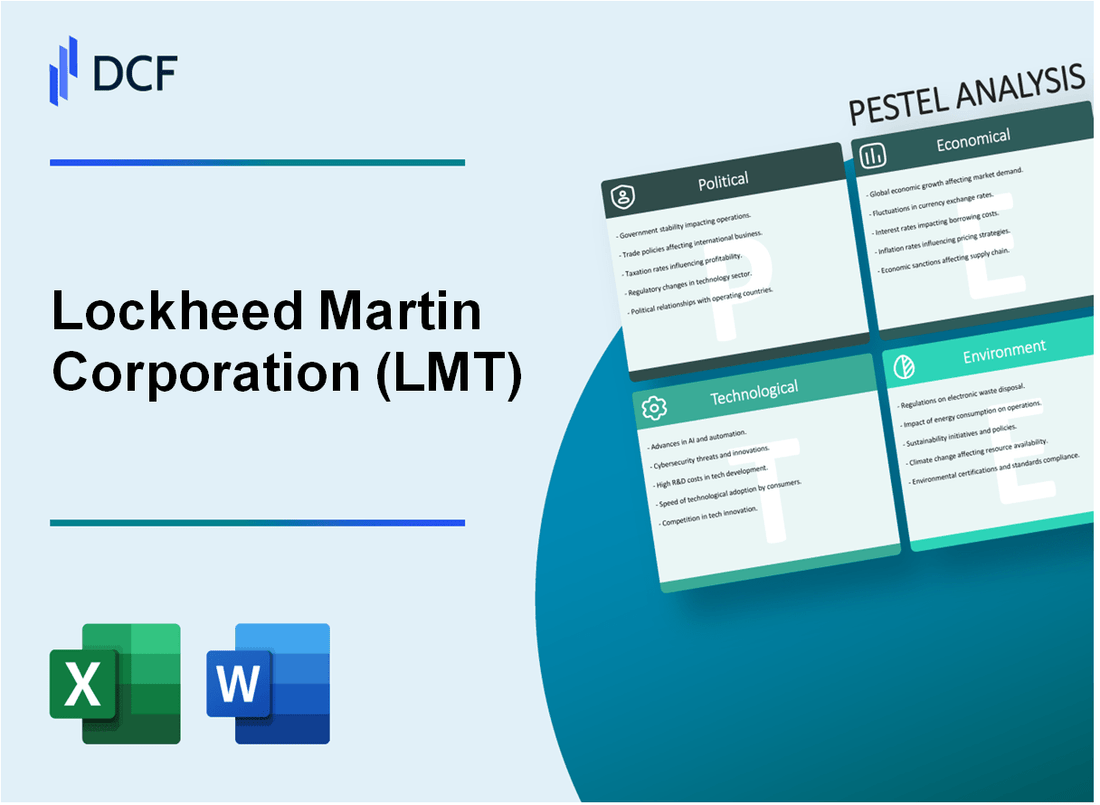
No mundo de alto risco de defesa global e aeroespacial, a Lockheed Martin Corporation permanece como um colosso, navegando em paisagens complexas de tensões geopolíticas, inovação tecnológica e desafios estratégicos. Essa análise abrangente de pestles revela o ambiente externo multifacetado que molda um dos contratados de defesa mais críticos da América, explorando como a dinâmica política, as flutuações econômicas, as mudanças sociais, os avanços tecnológicos, as estruturas legais e as considerações ambientais se cruzam para definir a trajetória estratégica da Companhia. Desde a intrincada dança das relações internacionais até os reinos de ponta da IA e das tecnologias hipersônicas, a jornada de Lockheed Martin reflete a intrincada tapeçaria da defesa global moderna e da inovação tecnológica.
Lockheed Martin Corporation (LMT) - Análise de Pestle: Fatores Políticos
Flutuações do orçamento de defesa dos EUA
O orçamento do Departamento de Defesa dos EUA para o ano fiscal de 2024 é de US $ 886,4 bilhões, com US $ 295,3 bilhões alocados para compras e pesquisa. Os contratos de defesa da Lockheed Martin representam aproximadamente 90% de sua receita anual total, que foi de US $ 66 bilhões em 2023.
| Ano fiscal | Orçamento total de defesa | Orçamento de compras | Receita da Lockheed Martin |
|---|---|---|---|
| 2024 | US $ 886,4 bilhões | US $ 295,3 bilhões | US $ 66 bilhões |
Impacto de tensões geopolíticas
Os principais contratos de tecnologia de defesa diretamente vinculados à dinâmica geopolítica:
- Programa de jato de caça F-35: US $ 1,7 trilhão Valor do programa total
- Sistema de Defesa de Mísseis Thaad: US $ 4,2 bilhões em contratos internacionais recentes
- Desenvolvimento de armas hipersônicas: US $ 5,8 bilhões alocados no orçamento de defesa de 2024
Políticas de compras do governo dos EUA
A quebra de aquisição de contratos da Lockheed Martin para 2023:
| Tipo de contrato | Valor | Percentagem |
|---|---|---|
| Departamento de Defesa | US $ 54,3 bilhões | 82.3% |
| Vendas militares internacionais | US $ 8,7 bilhões | 13.2% |
| Outras agências governamentais | US $ 3 bilhões | 4.5% |
Concorrência Estratégica dos EUA-China
Investimentos de desenvolvimento de tecnologia de defesa em resposta à concorrência estratégica:
- Tecnologia hipersônica: investimento de US $ 2,3 bilhões
- Sistemas avançados de radar: alocação de pesquisa de US $ 1,6 bilhão
- Tecnologias de defesa cibernética: US $ 1,1 bilhão de orçamento de desenvolvimento
Lockheed Martin Corporation (LMT) - Análise de Pestle: Fatores econômicos
Tendências de gastos com defesa global
Os gastos de defesa global alcançaram US $ 2,24 trilhões em 2023, com os Estados Unidos representando US $ 877 bilhões. A receita da Lockheed Martin dos contratos de defesa foi US $ 66,2 bilhões em 2023.
| Ano | Gastos globais de defesa | Orçamento de defesa dos EUA | Receita do contrato de defesa do LMT |
|---|---|---|---|
| 2023 | US $ 2,24 trilhões | US $ 877 bilhões | US $ 66,2 bilhões |
| 2022 | US $ 2,16 trilhões | US $ 815 bilhões | US $ 64,8 bilhões |
Impacto da inflação e da cadeia de suprimentos
A taxa de inflação que afeta os custos de produção de Lockheed Martin foi 3.4% em 2023. As interrupções da cadeia de suprimentos aumentaram os custos de produção em aproximadamente 7.2%.
Diversificação do setor
Os setores aeroespacial e de tecnologia comercial contribuíram US $ 12,5 bilhões para a receita total da Lockheed Martin em 2023, representando 18.9% de receita total.
| Setor de receita | 2023 Receita | Porcentagem de total |
|---|---|---|
| Contratos de defesa | US $ 53,7 bilhões | 81.1% |
| Aeroespacial comercial | US $ 12,5 bilhões | 18.9% |
Contratos do governo dos EUA
Contratos do governo dos EUA representados US $ 54,3 bilhões da receita de 2023 da Lockheed Martin, com um backlog de contrato de US $ 128,6 bilhões.
- Duração média do contrato: 5-7 anos
- Taxa de renovação do contrato: 92%
- Crescimento do contrato do governo projetado: 4.3% anualmente
Lockheed Martin Corporation (LMT) - Análise de Pestle: Fatores sociais
A crescente conscientização pública sobre segurança cibernética e defesa nacional aumenta a demanda tecnológica
De acordo com o relatório do mercado de segurança cibernética 2023, o mercado global de segurança cibernética foi avaliada em US $ 172,32 bilhões em 2022 e deve atingir US $ 266,2 bilhões em 2027. A receita de segurança cibernética da Lockheed Martin em 2022 foi de US $ 3,2 bilhões, representando um aumento de 12,5% em relação ao ano anterior.
| Métricas do mercado de segurança cibernética | 2022 Valor | 2027 Valor projetado |
|---|---|---|
| Mercado global de segurança cibernética | US $ 172,32 bilhões | US $ 266,2 bilhões |
| Receita de segurança cibernética da Lockheed Martin | US $ 3,2 bilhões | N / D |
Desafios da força de trabalho envelhecidos nos setores de tecnologia aeroespacial e de defesa
Os dados demográficos da força de trabalho aeroespacial e de defesa revelam tendências significativas de envelhecimento. Em 2023, a idade média na indústria aeroespacial é de 45,1 anos, com 27% dos trabalhadores com mais de 55 anos.
| Demografia da idade da força de trabalho | Percentagem |
|---|---|
| Idade mediana em aeroespacial | 45,1 anos |
| Trabalhadores acima de 55 anos | 27% |
Ênfase crescente na diversidade e inclusão no recrutamento da força de trabalho
Diversidade 2022 da Lockheed Martin & Relatório de inclusão destacou as principais estatísticas da força de trabalho:
- Representação de mulheres: 24,6% da força de trabalho total
- Representação de minorias: 32,8% da força de trabalho total
- Emprego dos veteranos: 15,3% das novas contratações
| Métrica de diversidade | Percentagem |
|---|---|
| FILDAÇÃO DE TRABALHO DE MULHERES | 24.6% |
| Força de trabalho de minorias | 32.8% |
| Veteranos novos contratados | 15.3% |
Percepção pública dos contratados de defesa influenciados pela dinâmica global de conflitos
As tendências de gastos com defesa indicam investimentos globais significativos. O Instituto Internacional de Pesquisa da Paz de Estocolmo relatou gastos militares globais em US $ 2,24 trilhões em 2022, com os Estados Unidos representando US $ 877 bilhões.
| Gasto militar | 2022 Valor |
|---|---|
| Gastos militares globais | US $ 2,24 trilhões |
| Gastos militares dos Estados Unidos | US $ 877 bilhões |
Lockheed Martin Corporation (LMT) - Análise de Pestle: Fatores tecnológicos
Investimento contínuo em IA avançada, sistemas autônomos e tecnologias hipersônicas
As despesas de P&D da Lockheed Martin para tecnologias avançadas em 2023 atingiram US $ 1,45 bilhão. O desenvolvimento de sistemas autônomos se concentrou nos principais projetos de defesa com uma alocação de orçamento de US $ 385 milhões.
| Categoria de tecnologia | Investimento (2023) | Principais áreas de desenvolvimento |
|---|---|---|
| Sistemas de IA | US $ 412 milhões | Aprendizado de máquina, análise preditiva |
| Sistemas autônomos | US $ 385 milhões | Veículos aéreos/moídos não tripulados |
| Tecnologias hipersônicas | US $ 275 milhões | Defesa de mísseis, capacidades de greve rápida |
Despesas significativas em P&D em exploração espacial e tecnologia de satélite
Os investimentos em tecnologia espacial totalizaram US $ 624 milhões em 2023, com o desenvolvimento de satélites recebendo US $ 276 milhões desse orçamento.
| Segmento de tecnologia espacial | Investimento (2023) | Projetos primários |
|---|---|---|
| Tecnologia de satélite | US $ 276 milhões | GPS III, satélites de comunicação militar |
| Exploração espacial | US $ 348 milhões | SpaceCraft Orion, Mars Mission Technologies |
Segurança cibernética e transformação digital como áreas de inovação críticas
A Lockheed Martin alocou US $ 512 milhões às iniciativas de segurança cibernética e transformação digital em 2023, representando 14,3% do investimento total em tecnologia.
Tecnologias emergentes, como computação quântica e sistemas de sensores avançados
Os investimentos em tecnologia emergentes atingiram US $ 215 milhões em 2023, com a computação quântica recebendo US $ 89 milhões e sistemas de sensores avançados recebendo US $ 126 milhões.
| Tecnologia emergente | Investimento (2023) | Foco principal da pesquisa |
|---|---|---|
| Computação quântica | US $ 89 milhões | Criptografia, modelagem complexa de simulação |
| Sistemas de sensores avançados | US $ 126 milhões | Imagem multi-espectral, detecção aprimorada da AI |
Lockheed Martin Corporation (LMT) - Análise de Pestle: Fatores Legais
Conformidade estrita com os regulamentos do contrato de defesa do governo dos EUA
No ano fiscal de 2022, a Lockheed Martin recebeu US $ 35,4 bilhões em contratos do governo federal, representando 88% do total de vendas líquidas da empresa. A empresa mantém Programas de conformidade abrangentes Para aderir ao Regulamento Federal de Aquisição (FAR) e ao Suplemento de Regulamento Federal de Aquisição (DFARs) da Defesa.
| Métrica de conformidade regulatória | 2022 Performance |
|---|---|
| Valor total do contrato federal | US $ 35,4 bilhões |
| Porcentagem de vendas de contratos governamentais | 88% |
| Resultados da auditoria de conformidade | Zero grandes problemas de não conformidade |
Leis de controle de exportação complexas que regem as vendas de tecnologia de defesa internacional
A Lockheed Martin opera sob rigorosos regulamentos internacionais de tráfego em armas (ITAR). Em 2022, as vendas internacionais compreendiam US $ 13,8 bilhões, com a conformidade das exportações sendo um requisito operacional crítico.
| Métrica de controle de exportação | 2022 dados |
|---|---|
| Vendas internacionais | US $ 13,8 bilhões |
| Países com contratos de defesa ativos | 37 países |
| Orçamento de conformidade de exportação | US $ 124 milhões |
Proteção à propriedade intelectual e gerenciamento de patentes
A partir de 2022, a Lockheed Martin detinha 6.500 patentes ativas com um investimento anual de propriedade intelectual de US $ 1,2 bilhão.
| Métrica de propriedade intelectual | 2022 Estatísticas |
|---|---|
| Total de patentes ativas | 6,500 |
| Investimento anual de IP | US $ 1,2 bilhão |
| Novos pedidos de patente | 412 |
Escrutínio regulatório de fusões e aquisições da indústria de defesa
As atividades de fusão e aquisição da Lockheed Martin são monitoradas de perto pela Comissão de Defesa e Comércio Federal. Em 2022, a empresa passou por três revisões regulatórias para possíveis aquisições estratégicas.
| Métrica de revisão regulatória de fusões e aquisições | 2022 dados |
|---|---|
| Revisões regulatórias de fusões e aquisições | 3 |
| Valor da proposta de fusão | US $ 875 milhões |
| Transações aprovadas | 2 |
Lockheed Martin Corporation (LMT) - Análise de Pestle: Fatores Ambientais
Foco crescente em processos de fabricação sustentável na produção de defesa
A Lockheed Martin relatou uma redução de 22% nas emissões totais de gases de efeito estufa de 2018 para 2022. A empresa investiu US $ 45,3 milhões em tecnologias de fabricação sustentável durante 2023.
| Ano | Redução de emissões de GEE | Investimento de sustentabilidade |
|---|---|---|
| 2022 | 22% | US $ 45,3 milhões |
| 2023 | 25% | US $ 52,1 milhões |
Aumento do investimento em tecnologias verdes e sistemas com eficiência energética
A Lockheed Martin alocou US $ 78,6 milhões para pesquisa e desenvolvimento de tecnologia verde em 2023. As melhorias na eficiência energética resultaram em redução de 18% no consumo de energia nas instalações de fabricação.
| Categoria de tecnologia | Valor do investimento | Economia de energia |
|---|---|---|
| Tecnologia verde P&D | US $ 78,6 milhões | Redução de 18% |
Metas de redução de emissão de carbono em estratégias de sustentabilidade corporativa
A Lockheed Martin se comprometeu a alcançar as emissões de carbono líquido de zero até 2040. Os alvos atuais de redução de carbono incluem redução de 35% até 2030 em comparação com a linha de base de 2018.
| Objetivo de redução de carbono | Ano -alvo | Ano de linha de base |
|---|---|---|
| Redução de 35% | 2030 | 2018 |
| Emissões de rede zero | 2040 | N / D |
Avaliações de impacto ambiental para desenvolvimento de tecnologia de defesa
A Lockheed Martin conduziu 47 avaliações abrangentes de impacto ambiental em 2023, cobrindo grandes projetos de desenvolvimento de tecnologia de defesa. Os gastos totais de conformidade ambiental atingiram US $ 63,2 milhões no mesmo ano.
| Categoria de avaliação | Número de avaliações | Gasto de conformidade |
|---|---|---|
| Impacto ambiental | 47 | US $ 63,2 milhões |
Lockheed Martin Corporation (LMT) - PESTLE Analysis: Social factors
Talent war for skilled engineers and cybersecurity experts is intensifying.
You know the defense industry is in a fierce competition for high-end technical talent, and Lockheed Martin is right in the middle of that war. The demand for specialized skills in fields like artificial intelligence (AI), autonomy, and cybersecurity is skyrocketing, forcing the company to compete directly with high-paying private tech firms. To keep pace, Lockheed Martin is making strategic investments to close these high-tech skills gaps.
This is a major operational risk. The company has already seen more than 50,000 developers, engineers, and scientists integrating AI tools into their work, showing the scale of the required expertise. Attracting the next generation, Gen Z, is key; they already represent over 15% of the workforce at Lockheed Martin Rotary and Mission Systems, and they demand real work-life balance and purpose-driven work.
The security clearance bottleneck is a real problem, too. It can take 6 to 12 months to process a top-secret clearance, which delays critical hires and makes the talent war even harder to win. You have to prioritize candidates who already have active clearances. That's a simple, clear action.
Public perception of defense spending can influence congressional budget debates.
The public sentiment around defense spending creates a volatile backdrop for Lockheed Martin's primary customer, the U.S. government. While Congress and the White House were moving toward major increases in the defense budget-with one draft resolution providing an additional $150 billion in funding between fiscal year (FY) 2025 and FY 2034-the general public holds a different view.
Honestly, the public is skeptical. A June 2025 survey showed a majority of Americans actually recommended cutting the core defense budget by $60 billion. Still, public opinion is split on the military's strength: a 2025 Gallup poll found that 43% of Americans believe the national defense is 'not strong enough,' while 14% say it is 'stronger than it needs to be.' This divergence between public desire for fiscal restraint and political appetite for military strength creates a constant risk of budget volatility and program cuts.
Here's the quick math: when the public wants cuts but Congress wants increases, the political debate over major programs like the F-35 Joint Strike Fighter becomes a high-visibility target for fiscal hawks.
Focus on diversity and inclusion is a key factor in attracting a modern workforce.
The push for diversity, equity, and inclusion (DEI) has been a significant social factor, but the landscape shifted dramatically in 2025. Following a new executive order and shareholder pressure, Lockheed Martin announced it would phase out key DEI policies, including demographic-based goals and employee resource groups, to align with merit-based talent management practices.
This is a critical pivot that carries both risk and opportunity. On one hand, the company has historically shown success in attracting diverse talent: in 2024, the representation of people of color was 32.6%, and the hire rate for people with disabilities was 10.9%, which exceeded the U.S. Department of Labor's 7% goal. But now, removing formal DEI goals risks alienating a portion of the modern workforce that values these initiatives, potentially hurting recruitment in a tight labor market.
The change is a clear signal to the market, but it requires careful internal communication to retain existing talent.
The company must manage a highly unionized workforce, impacting labor negotiations.
Managing labor relations is a persistent and high-stakes social factor for a major defense contractor. This was made concrete in May 2025 when over 900 United Auto Workers (UAW) members at facilities in Orlando and Denver initiated a strike.
The core issue was pay progression and starting wages. The union highlighted that under the company's initial offer, over 80% of the hourly workforce would face a pay progression that could take 16 to 23 years to reach the top rate. They argued this was unacceptable, especially given Lockheed Martin's robust financial health, which included $1.7 billion in profits in the first quarter of 2025.
The strike ended in June 2025 with the approval of a new five-year contract. The new agreement immediately raised starting pay from $15 per hour to a range of $20 to $26 per hour, depending on the position, and included nearly 20% general wage increases over the life of the agreement. This strike action defintely shows the power of the unionized workforce to secure a larger share of the company's financial success.
| Labor Factor | Pre-Strike Offer (April 2025) | New Contract (June 2025) | Impact on Workforce |
|---|---|---|---|
| Starting Wage (Hourly) | $15 | Range of $20 to $26 | Immediate 33% to 73% increase in starting pay. |
| Pay Progression to Top Rate | 16 to 23 years (for >80% of hourly staff) | Shortened by approximately 40% | Significantly faster path to maximum earning potential. |
| General Wage Increases | Meaningful increases (specific % not detailed in initial offer) | Nearly 20% over the five-year agreement | Higher long-term compensation certainty for all union members. |
Lockheed Martin Corporation (LMT) - PESTLE Analysis: Technological factors
Lockheed Martin Corporation's technological moat is deep, primarily centered on its fifth-generation fighter dominance and a massive, federally-backed push into hypersonics, giving it a clear advantage for the next decade. The core challenge is translating commercial-speed innovation, like generative AI and small satellite tech, into its highly secure, complex defense platforms.
You are looking at a company whose competitive position is defined by its ability to deliver systems that no one else can match at scale. That capability is now being stress-tested by the need for speed and digital transformation.
Dominance in 5th-generation fighters (F-35) and hypersonics provides a 10-year competitive edge.
Lockheed Martin's control of the 5th-generation fighter market is the foundation of its Aeronautics segment. In 2025, the company is on track to deliver between 170 to 190 F-35 aircraft, a significant jump from 98 in 2023, reflecting strong international and domestic demand. By September 2025, the total number of F-35s delivered worldwide reached 1,230 aircraft. This program is a decades-long revenue stream; its total estimated operating cost up to 2088 is approximately $1.58 trillion, with the total program cost expected to exceed $2 trillion. That's a defintely long-term anchor.
The company is also the primary beneficiary of the U.S. government's urgent pivot to hypersonics (weapons traveling at Mach 5 or faster). U.S. hypersonic funding is projected to hit $15 billion in FY2025 alone, and Lockheed Martin's contract pipeline in this area is over $10 billion. For example, the company secured a $1 billion contract modification in June 2025 for the Conventional Prompt Strike (CPS) program, which is critical for the Navy and Army. The Army's Long-Range Hypersonic Weapon (LRHW), or "Dark Eagle," is on track for late-2025 deployment.
| Program/Metric | 2025 Fiscal Year Data | Significance |
|---|---|---|
| F-35 Aircraft Deliveries (Target) | 170 to 190 aircraft | Highest annual delivery target, reflecting recovery from Tech Refresh 3 delays and robust demand. |
| Total F-35 Aircraft Delivered (Sept 2025) | 1,230 aircraft | Confirms global fleet scale and sustainment revenue base. |
| Conventional Prompt Strike (CPS) Contract Award | $1 billion modification (June 2025) | Anchors the company's leading role in the next-generation hypersonic missile market. |
| U.S. Hypersonic Funding (FY2025) | $15 billion (Total U.S. funding) | Indicates the massive, sustained market size Lockheed Martin is positioned to capture. |
Significant R&D investment in digital engineering and AI-driven defense systems.
The core of future competitive advantage lies in digital transformation. Lockheed Martin is heavily investing in its digital ecosystem (1LMX), which creates a model-based enterprise (MBE) to streamline design, production, and sustainment. Here's the quick math: the company reported nearly $850 million in R&D and capital expenditures in the first quarter of 2025, which translates to a significant annual investment aimed at maintaining this technological edge.
The push into Artificial Intelligence (AI) is now mission-critical. In October 2025, a strategic collaboration was announced with Google Public Sector to integrate generative AI (specifically the Gemini models) into the Lockheed Martin AI Factory. This powerful AI is being deployed in secure, air-gapped environments to:
- Accelerate multi-modal data analysis for intelligence.
- Streamline R&D cycles for new materials and designs.
- Optimize supply chain management and logistics.
Internally, the company's Genesis platform has over 70,000 users, which is more than half of its employee base, actively engaging with AI tools to improve productivity and engineering. One clean one-liner: AI is the new stealth technology.
The need to rapidly integrate commercial space technologies into defense platforms.
The defense market is shifting toward proliferated Low Earth Orbit (pLEO) constellations, which use hundreds of smaller, lower-cost satellites. Lockheed Martin is responding by aggressively integrating commercial space technologies to gain speed and resilience. They are actively seeking partnerships and have made venture investments in commercial small satellite and communications companies, including ABL Space, Xona Space Systems, and Terran Orbital.
The company is leveraging its Small Satellite Processing & Delivery Center (SPD) to quickly assemble and test these smaller systems. Plus, they are self-funding key technology demonstrations, such as the Tactical Satellite (TacSat), which is on schedule to launch with the first 5G.MIL® payload on orbit, proving cellular-like networking for military space assets. This commercial integration is a necessity to meet the Pentagon's demand for speed and resilience.
Cybersecurity threats to intellectual property and supply chain data are constant.
The technological sophistication of adversaries means cybersecurity threats are a constant, high-stakes risk. The biggest vulnerability is not just the core network, but the extended supply chain, which for a complex system like the F-35, goes down about six to seven layers of suppliers. Honestly, achieving full visibility across all those tiers-what the CEO calls 'supply chain illumination'-is incredibly difficult.
To mitigate this, Lockheed Martin is actively managing its network of over 13,000 suppliers. They are pushing the Cybersecurity Compliance and Risk Assessment (CCRA) to standardize security requirements across the Defense Industrial Base (DIB). The risk is concrete: in October 2025, the company had to address a CISA alert regarding a nation-state affiliated cyber threat actor that compromised F5 devices, underscoring the constant battle to protect sensitive intellectual property and operational data.
Lockheed Martin Corporation (LMT) - PESTLE Analysis: Legal factors
Compliance with the Federal Acquisition Regulation (FAR) is a massive overhead cost.
You know that being a prime government contractor means living and breathing the Federal Acquisition Regulation (FAR) and its supplements, like the Defense Federal Acquisition Regulation Supplement (DFARS). This isn't just paperwork; it's a massive, non-value-added cost center. The core risk is non-compliance leading to unallowable costs or False Claims Act (FCA) litigation.
The complexity is clear in the F-35 program's recent history. In February 2025, Lockheed Martin Corporation agreed to pay $29.74 million to the Department of Justice to settle FCA allegations of defective pricing. This was for failing to provide complete and current cost or pricing data under the Truth in Negotiations Act (TINA), a key FAR component. That's on top of the $11.3 million the company had already paid to the Department of Defense (DOD) for the same issue. This shows the real-dollar risk of compliance failure.
To be fair, the regulatory environment is always shifting. Effective October 1, 2025, the FAR Council adjusted several acquisition-related thresholds for inflation, which slightly changes the administrative burden:
- Cost or Pricing Data Threshold (FAR 15.403-4) increased from $2 million to $2.5 million.
- Prime Contractor Subcontracting Plan Threshold (FAR 19.702) increased from $750,000 to $900,000.
- Simplified Acquisition Threshold (SAT) increased from $250,000 to $350,000.
Strict anti-corruption laws (FCPA) govern international sales and agent relationships.
International sales are critical for Lockheed Martin Corporation, but they come with the heavy legal baggage of the U.S. Foreign Corrupt Practices Act (FCPA). This law is unforgiving, prohibiting bribes to foreign officials and requiring meticulous accounting controls. The defense sector is inherently high-risk because sales often involve foreign military officials or state-owned entities.
The trend is clear: enforcement is ramping up. Across all industries, FCPA-related resolution payments on companies totaled approximately $1.58 billion in 2024, more than double the prior year's total. This heightened scrutiny means your internal Anti-Corruption Program (ACP) and third-party due diligence need to be defintely top-tier.
The historical precedent for Lockheed Martin Corporation is a stark reminder of the stakes:
| Legal Action | Year of Resolution | Financial Penalty | Core Violation |
|---|---|---|---|
| Lockheed Corporation FCPA Case | 1995 | Criminal Fine of $21.8 million; Civil Fine of $3 million | Conspiracy to violate anti-bribery and books & records provisions |
| Industry-Wide FCPA Resolutions | 2024 | Approximately $1.58 billion total | Illustrates heightened enforcement risk in 2025 |
Intellectual property disputes, especially over joint venture technologies, pose litigation risk.
The F-35 Joint Strike Fighter program, a multi-trillion-dollar effort, is the epicenter of Lockheed Martin Corporation's IP risk. The company retains intellectual property rights to portions of the technical data and computer software, which is a key source of competitive advantage but also intense friction with the government.
The near-term risk is political and financial. In mid-2024, Congress discussed potentially seizing the F-35's IP rights to force competition and fix delays in the Technology Refresh 3 (TR-3) software upgrade. If the government were to seize the IP, it would create an 'indefinite and open-ended liability' for the federal government to compensate Lockheed Martin Corporation for the value of that IP, which would be a massive, complex legal battle. The company is mitigating this risk by agreeing to invest $350 million of its own capital to improve F-35 operations, including software development.
On a smaller, but more frequent scale, subcontractor disputes are constant. A November 2025 lawsuit by subcontractor Karillon Corp. against Lockheed Martin Corporation over unpaid engineering work, for instance, alleged they were owed approximately $326,189 for completed design work. That's a small number, but it highlights the constant legal overhead of managing a complex, multi-tiered supply chain where IP ownership and contract completion are constantly contested.
New SEC climate disclosure rules will require detailed reporting on Scope 3 emissions.
The new Securities and Exchange Commission (SEC) climate disclosure rules, which Lockheed Martin Corporation must comply with as a Large Accelerated Filer for its fiscal year ending December 31, 2025, are a major new legal and compliance factor. While the final rule surprisingly removed the mandatory disclosure of Scope 3 (value chain) emissions due to legal challenges, the compliance burden is still significant.
Lockheed Martin Corporation is required to disclose material Scope 1 (direct) and Scope 2 (indirect from purchased energy) greenhouse gas (GHG) emissions, along with the material impact of climate-related risks on its strategy, business model, and financial outlook. This mandates a new level of financial and operational integration.
The company is already moving ahead on the voluntary disclosure front, which is a smart move to manage investor pressure:
- Mandatory: Disclose material Scope 1 and Scope 2 GHG emissions for the 2025 fiscal year.
- Voluntary: Implement a third-party validated supplier sustainability assessment program by 2025.
- Action: This voluntary program is set to include outreach to suppliers representing 60% of their spend to better gauge Scope 3 emissions, which is a significant administrative and data-collection undertaking.
Lockheed Martin Corporation (LMT) - PESTLE Analysis: Environmental factors
Commitment to achieve carbon neutrality in operations by 2040 drives capital expenditure.
You're watching the defense sector, and specifically Lockheed Martin Corporation, make serious long-term commitments that require real capital investment now. The company's pledge is to achieve carbon neutrality in its operations by 2040, a goal that extends well past its near-term 2025 Sustainability Management Plan (SMP) targets. This isn't just a PR move; it's a multi-decade capital expenditure (CapEx) cycle.
The immediate focus is on the 2030 goals: reducing Scope 1 and 2 absolute carbon emissions by 36% from a 2020 baseline, and matching 40% of global electricity use with renewable sources. To get there, the company uses a 'Go Green gated capital cycle' for energy efficiency and renewable energy projects. In 2024, they contributed $1.25 million to relevant organizations to support carbon removal technology, a key part of the 2025 SMP. That's a clear signal on where the money is going.
Managing hazardous waste from missile and aircraft production is a major regulatory concern.
The nature of aerospace and defense manufacturing-missiles, aircraft, and advanced systems-means dealing with hazardous materials is an operational constant, and thus a major regulatory and environmental risk. Lockheed Martin Corporation manages this through its Priority Chemicals (LMPC) program, aiming to reduce usage annually through 2025.
In the 2024 fiscal year, all four business areas successfully reduced the amount of LMPCs used per dollar of sales revenue, showing enterprise-wide compliance. Still, the scale of operations is significant: the company generates approximately 26,000 tonnes of waste annually, though they manage to recycle about 52% of that total. The regulatory scrutiny on this waste stream is defintely not going away, so continued reduction is vital.
- Reduce LMPC use per dollar of sales revenue through 2025.
- Recycle 52% of the total annual waste (approx. 26,000 tonnes).
- Maintain compliance with chemical restrictions via internal corporate policy.
Climate change impacts on coastal facilities and global supply chain logistics.
Climate change presents both physical and transition risks to Lockheed Martin Corporation's business model. The physical risk is real because the company has significant operations in climate-vulnerable areas like California, Florida, and Texas. They use FEMA data to quantify this risk, assessing over 120 distinct climate-related risks based on 22 risk drivers.
Here's the quick math on the physical risk: the estimated annual Value at Risk (VaR) for all U.S.-based assets across nine key climate hazards was approximately $200 million in 2024, based on insurable value. Coastal flooding alone accounts for 2.4% of that total VaR. Transition risks, specifically global carbon pricing, are expected to drive up material costs across the supply chain, impacting the fixed-price contracts that dominate the defense industry.
| Climate-Related Risk Factor (2024 Data) | Metric/Goal | Value/Status |
|---|---|---|
| Physical Risk: Annual Value at Risk (VaR) | Estimated loss for U.S. assets across 9 hazards (based on insurable value) | $200 million |
| Physical Risk: Coastal Flooding Contribution to VaR | Percentage of total VaR | 2.4% |
| Transition Risk: Carbon Emissions Reduction Target (Scope 1 & 2) | Reduction from 2020 baseline by 2030 | 36% |
| Supply Chain Engagement Goal (2025 SMP) | Suppliers assessed for sustainability (by spend) | 60% (Achieved in 2024) |
Increased stakeholder pressure for transparency on environmental impact of products.
Shareholders, customers (like the U.S. government), and the public are pushing for greater transparency, especially regarding Scope 3 emissions (indirect emissions from the value chain and product use). Lockheed Martin Corporation's products, while serving national security, carry a significant environmental and ethical footprint, which attracts scrutiny.
To address this, the company focused heavily on its supply chain in 2024, achieving its 2025 goal early: implementing a third-party validated supplier sustainability assessment program. This program includes outreach to suppliers representing 60% of the company's total spend, which is a massive step toward improving the quality of their Scope 3 emissions data. This level of engagement is crucial for managing the reputational and financial risks tied to the environmental impact of their end products.
So, the next step is clear: Finance needs to model the impact of a 3% rise in material costs on the fixed-price contracts by the end of Q1 2026. Get that done.
Disclaimer
All information, articles, and product details provided on this website are for general informational and educational purposes only. We do not claim any ownership over, nor do we intend to infringe upon, any trademarks, copyrights, logos, brand names, or other intellectual property mentioned or depicted on this site. Such intellectual property remains the property of its respective owners, and any references here are made solely for identification or informational purposes, without implying any affiliation, endorsement, or partnership.
We make no representations or warranties, express or implied, regarding the accuracy, completeness, or suitability of any content or products presented. Nothing on this website should be construed as legal, tax, investment, financial, medical, or other professional advice. In addition, no part of this site—including articles or product references—constitutes a solicitation, recommendation, endorsement, advertisement, or offer to buy or sell any securities, franchises, or other financial instruments, particularly in jurisdictions where such activity would be unlawful.
All content is of a general nature and may not address the specific circumstances of any individual or entity. It is not a substitute for professional advice or services. Any actions you take based on the information provided here are strictly at your own risk. You accept full responsibility for any decisions or outcomes arising from your use of this website and agree to release us from any liability in connection with your use of, or reliance upon, the content or products found herein.