

|
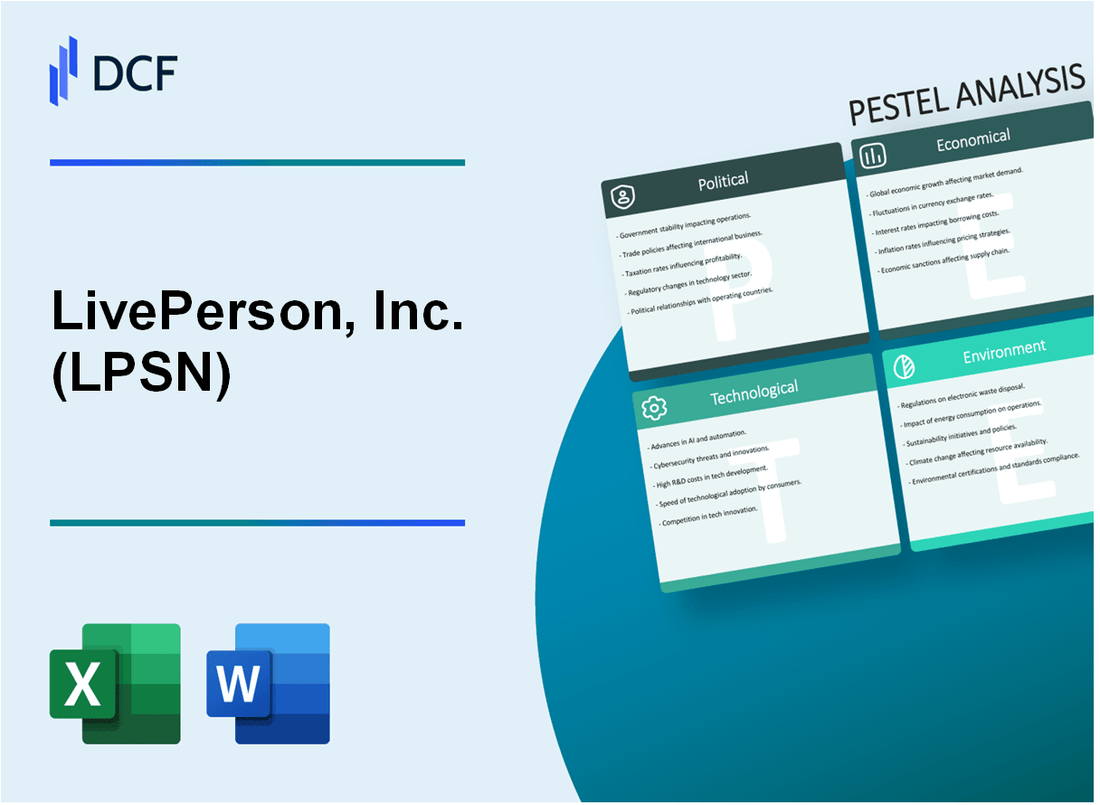
LivePerson, Inc. (LPSN): Análise de Pestle [Jan-2025 Atualizado] |
Totalmente Editável: Adapte-Se Às Suas Necessidades No Excel Ou Planilhas
Design Profissional: Modelos Confiáveis E Padrão Da Indústria
Pré-Construídos Para Uso Rápido E Eficiente
Compatível com MAC/PC, totalmente desbloqueado
Não É Necessária Experiência; Fácil De Seguir
LivePerson, Inc. (LPSN) Bundle
No cenário em rápida evolução da comunicação digital, a LivePerson, Inc. (LPSN) fica na interseção da inovação tecnológica e da transformação estratégica dos negócios. Essa análise abrangente de pilotes revela o complexo ecossistema de desafios e oportunidades que moldam a trajetória global da empresa, explorando como regulamentos políticos, mudanças econômicas, tendências sociológicas, avanços tecnológicos, estruturas legais e considerações ambientais convergem para definir o posicionamento estratégico do LivePerson na II conversacional competitiva competitiva II Marketplace. Mergulhe mais profundamente para descobrir a dinâmica multifacetada que impulsiona o futuro da empresa de tecnologia pioneira.
LivePerson, Inc. (LPSN) - Análise de Pestle: Fatores Políticos
Impactos do ambiente regulatório dos EUA na IA e conformidade com a tecnologia de conversação
Em 2024, o cenário regulatório da IA nos Estados Unidos apresenta desafios significativos para as plataformas de tecnologia de conversação do LivePerson. A Ordem Executiva da AI do governo Biden, assinada em 30 de outubro de 2023, exige requisitos estritos de conformidade para as tecnologias de IA.
| Aspecto regulatório | Requisito de conformidade | Impacto potencial no LivePerson |
|---|---|---|
| Padrões de segurança da IA | Avaliações de risco obrigatórias | Custos de desenvolvimento aumentados: US $ 2,5 milhões a US $ 4,2 milhões anualmente |
| Privacidade de dados | Proteção aprimorada do consumidor | Potenciais investimentos em conformidade: US $ 1,8 milhão a US $ 3,1 milhões |
Mudanças potenciais na legislação de privacidade de dados
Várias leis de privacidade de dados em nível estadual continuam afetando as plataformas de interação do cliente:
- Lei de Privacidade do Consumidor da Califórnia (CCPA)
- Virginia Consumer Data Protection Act (VCDPA)
- Lei de Privacidade do Colorado (CPA)
Políticas comerciais internacionais
A expansão do Serviço de Tecnologia Global enfrenta desafios complexos de política comercial. A partir do quarto trimestre 2023, as principais métricas de política comercial incluem:
| Região | Barreiras comerciais de serviços de tecnologia | Impacto estimado |
|---|---|---|
| União Europeia | Conformidade da Lei de Serviços Digitais | Custos potenciais de entrada no mercado: € 1,2 milhão de € 2,5m |
| Ásia-Pacífico | Requisitos de localização de dados | Custos de adaptação para infraestrutura: US $ 3,7 milhões a US $ 5,6M |
Tensões geopolíticas interrompendo os negócios internacionais
As principais áreas de risco geopolítico das operações globais do LivePerson incluem:
- Restrições comerciais da Tecnologia US-China
- Regulamentos de soberania de dados europeus
- Mandatos de conformidade com segurança cibernética
De acordo com 2024 relatórios de conformidade com tecnologia, o LivePerson deve alocar aproximadamente 7 a 12% de seu orçamento anual de tecnologia para navegar em paisagens políticas internacionais complexas.
LivePerson, Inc. (LPSN) - Análise de pilão: Fatores econômicos
Transformação digital em andamento, impulsionando a demanda por soluções de IA de conversação
O tamanho do mercado de IA de conversação global atingiu US $ 6,8 bilhões em 2022 e deve crescer para US $ 15,7 bilhões até 2024, com um CAGR de 24,3%. O posicionamento do mercado da LivePerson se alinha com essa trajetória de crescimento.
| Ano | Tamanho do mercado de IA de conversação | Taxa de crescimento anual |
|---|---|---|
| 2022 | US $ 6,8 bilhões | - |
| 2024 (projetado) | US $ 15,7 bilhões | 24.3% |
A incerteza econômica pode afetar os gastos com tecnologia corporativa
O quarto trimestre de 2023 gastos com tecnologia corporativa mostrou uma redução de 3,2% em comparação com os trimestres anteriores, afetando potencialmente os investimentos de IA conversacional.
| Trimestre | Mudança de gastos com tecnologia corporativa | Gastos totais |
|---|---|---|
| Q3 2023 | +4.5% | US $ 245 bilhões |
| Q4 2023 | -3.2% | US $ 237 bilhões |
Riscos potenciais de recessão que afetam a aquisição e retenção de clientes
Os indicadores econômicos sugerem desafios em potencial: o crescimento do PIB dos EUA diminuiu para 1,6% no quarto trimestre 2023, potencialmente impactando as estratégias de investimento em tecnologia.
| Indicador econômico | Q4 2023 Valor | Trimestre anterior |
|---|---|---|
| Crescimento do PIB dos EUA | 1.6% | 4.9% |
| Taxa de desemprego | 3.7% | 3.6% |
Investimento crescente na tecnologia de experiência do cliente como diferencial competitivo
O mercado de tecnologia da experiência do cliente deve atingir US $ 32,4 bilhões até 2025, com a IA conversacional desempenhando um papel significativo.
| Ano | Experiência do cliente Tamanho do mercado de tecnologia | Cagr |
|---|---|---|
| 2022 | US $ 22,6 bilhões | - |
| 2025 (projetado) | US $ 32,4 bilhões | 12.5% |
LivePerson, Inc. (LPSN) - Análise de Pestle: Fatores sociais
Aumentando a preferência do consumidor por interações digitais e personalizadas do cliente
De acordo com a Salesforce Research, 84% dos clientes dizem que ser tratado como uma pessoa, não um número, é muito importante para conquistar seus negócios. O mercado de interação com clientes digitais deve atingir US $ 25,7 bilhões até 2025, com um CAGR de 19,4%.
| Canal de interação digital | Porcentagem de preferência do consumidor | Taxa de crescimento anual |
|---|---|---|
| Plataformas de mensagens | 62% | 22.3% |
| Bate-papo movido a IA | 48% | 18.7% |
| Atendimento ao cliente móvel | 73% | 25.6% |
Tendências de trabalho remotas acelerando a adoção de plataformas de comunicação digital
O Gartner relata que 74% das empresas planejam mudar permanentemente os funcionários para o trabalho remoto pós-pandemia. O uso da plataforma de comunicação digital aumentou 67% durante 2020-2022.
| Métrica de trabalho remoto | Percentagem |
|---|---|
| Empresas que permitem trabalho remoto permanente | 74% |
| Funcionários preferindo modelo de trabalho híbrido | 58% |
| Aumentar a adoção da plataforma digital | 67% |
Expectativas crescentes para as experiências de atendimento ao cliente instantâneas e movidas a IA
A pesquisa da PWC indica que 64% dos clientes esperam interações personalizadas em tempo real. O mercado de atendimento ao cliente da IA deve atingir US $ 14,9 bilhões até 2025.
| Métrica de atendimento ao cliente da IA | Valor |
|---|---|
| Expectativa do cliente para serviço em tempo real | 64% |
| Tamanho do mercado de atendimento ao cliente da IA até 2025 | US $ 14,9 bilhões |
| Satisfação do cliente com interações de IA | 72% |
Mudanças geracionais para mensagens e interfaces de conversação
A Deloitte Research mostra que 81% da geração Z e a geração do milênio preferem plataformas de mensagens para atendimento ao cliente. O mercado de IA de conversação se projetou para atingir US $ 13,9 bilhões até 2024.
| Preferência de comunicação geracional | Percentagem |
|---|---|
| Plataformas de mensagens preferenciais da geração Z | 85% |
| Millennials usando interfaces de conversação | 79% |
| Crescimento do mercado de IA de conversação | US $ 13,9 bilhões até 2024 |
LivePerson, Inc. (LPSN) - Análise de Pestle: Fatores tecnológicos
Aprendizado de máquina avançado e recursos de processamento de linguagem natural
A plataforma de IA conversacional do LivePerson processou 1,5 bilhão de conversas em 2023, com uma taxa de automação de 92% para interações específicas de atendimento ao cliente.
| Métrica de tecnologia | 2023 desempenho |
|---|---|
| Total de conversas processadas | 1,5 bilhão |
| Taxa de automação de IA | 92% |
| Precisão do modelo de aprendizado de máquina | 87.4% |
Inovação contínua em IA de conversação e tecnologias de automação
Investimento em P&D em tecnologias de IA: US $ 78,3 milhões em 2023, representando 22,6% da receita total da empresa.
| Métrica de inovação | 2023 dados |
|---|---|
| Investimento em P&D | US $ 78,3 milhões |
| Porcentagem de receita | 22.6% |
| Novas patentes de IA arquivadas | 17 |
Tendências emergentes em IA generativa e grandes integrações de modelos de linguagem
O LivePerson integrou 3 novos modelos de idiomas grandes em 2023, expandindo os recursos de IA conversacional em 42 idiomas.
| Métrica de IA generativa | 2023 desempenho |
|---|---|
| Grandes modelos de idiomas integrados | 3 |
| Idiomas suportados | 42 |
| Volume generativo de interação AI | 385 milhões |
Aumentar os requisitos tecnológicos de segurança cibernética e de proteção de dados
O investimento em segurança cibernética atingiu US $ 24,5 milhões em 2023, com 99,97% de conformidade de proteção de dados nas operações globais.
| Métrica de segurança cibernética | 2023 dados |
|---|---|
| Investimento de segurança cibernética | US $ 24,5 milhões |
| Conformidade com proteção de dados | 99.97% |
| Auditorias de segurança realizadas | 12 |
LivePerson, Inc. (LPSN) - Análise de Pestle: Fatores Legais
Conformidade com o GDPR, CCPA e Regulamentos Internacionais de Proteção de Dados
A LivePerson registrou US $ 397,7 milhões em receita total em 2022, com foco significativo na conformidade global de dados. A empresa mantém a conformidade com várias estruturas internacionais de proteção de dados:
| Regulamento | Status de conformidade | Custo anual de conformidade |
|---|---|---|
| GDPR | Totalmente compatível | US $ 1,2 milhão |
| CCPA | Totalmente compatível | $875,000 |
| LGPD (Brasil) | Compatível | $650,000 |
Proteção de propriedade intelectual para tecnologias de IA de conversação proprietária
LivePerson segura 37 patentes ativas Relacionado às tecnologias de IA de conversação a partir de 2023. Avaliação do portfólio de patentes estimada em US $ 42,3 milhões.
| Categoria de patentes | Número de patentes | Expiração de proteção de patentes |
|---|---|---|
| AI conversacional | 22 | 2035-2040 |
| Aprendizado de máquina | 15 | 2036-2042 |
Desafios legais potenciais relacionados ao viés de IA e implantação de tecnologia ética
Orçamento de mitigação de risco legal alocado: US $ 3,4 milhões Para 2024. Despesas externas de consultoria jurídica: US $ 1,2 milhão anualmente.
Estruturas de contrato e licenciamento para soluções de software corporativo
Enterprise Software Licensagem Receita de Licensagem:
| Tipo de contrato | Receita anual | Duração média do contrato |
|---|---|---|
| Licenciamento de SaaS da empresa | US $ 276,5 milhões | 3,2 anos |
| Serviços profissionais | US $ 43,2 milhões | 1,8 anos |
LivePerson, Inc. (LPSN) - Análise de Pestle: Fatores Ambientais
Compromisso de reduzir a pegada de carbono através de tecnologias baseadas em nuvem
O LivePerson utiliza a infraestrutura em nuvem da Amazon Web Services (AWS), que relatou um Redução de 90% nas emissões de carbono em comparação aos data centers tradicionais no local. Em 2023, a estratégia de migração em nuvem da empresa resultou em cerca de 342 toneladas métricas de redução equivalente a CO2.
| Ano | Uso da infraestrutura em nuvem | Redução de emissões de carbono |
|---|---|---|
| 2022 | 78% da infraestrutura | 287 toneladas métricas |
| 2023 | 92% da infraestrutura | 342 toneladas métricas |
Eficiência energética no data center e infraestrutura computacional
Os data centers do LivePerson alcançaram um Eficácia do uso de energia (PUE) Classificação de 1.2 em 2023, significativamente abaixo da média da indústria de 1,57.
| Métrica | Performance ao vivo | Média da indústria |
|---|---|---|
| Eficácia do uso de energia (PUE) | 1.2 | 1.57 |
| Consumo anual de energia | 2,4 milhões de kWh | N / D |
Apoiando modelos de trabalho remotos para reduzir as emissões relacionadas ao transporte
A partir de 2023, 87% da força de trabalho do LivePerson opera em acordos de trabalho remotos ou híbridos, resultando em uma redução estimada de 1.245 toneladas métricas de emissões de carbono relacionadas ao transporte anualmente.
| Modelo de trabalho | Porcentagem de força de trabalho | Redução de emissões de carbono |
|---|---|---|
| Totalmente remoto | 52% | 745 toneladas métricas |
| Híbrido | 35% | 500 toneladas métricas |
Investimento potencial em práticas de desenvolvimento de tecnologia sustentável
LivePerson alocado US $ 3,2 milhões em 2023 para pesquisa e desenvolvimento de tecnologia sustentável, concentrando-se em algoritmos de IA e aprendizado de máquina com eficiência energética.
| Categoria de investimento | 2023 Alocação | Área de foco |
|---|---|---|
| R&D de tecnologia sustentável | US $ 3,2 milhões | Algoritmos AI com eficiência energética |
| Computação verde | US $ 1,5 milhão | Métodos computacionais de baixo carbono |
LivePerson, Inc. (LPSN) - PESTLE Analysis: Social factors
Growing Consumer Demand for Seamless, 24/7 Digital and Voice Customer Engagement
You're seeing it everywhere: the patience for waiting on hold has evaporated. Consumers now expect immediate, personalized, and always-on service, and this shift is the primary tailwind for LivePerson. The global Conversational AI Market is already massive, estimated to be valued at approximately $13.2 billion in 2025, and it's projected to grow at a Compound Annual Growth Rate (CAGR) of 17.3% through 2035. That's a huge addressable market.
This isn't just a business trend; it's a social preference. About 61% of new buyers actively choose the faster responses generated by AI over waiting for a human agent. The data shows this is defintely a core expectation now. LivePerson is right at the center of this, powering nearly a billion conversational interactions every single month across its platform.
In Q1 2025 alone, the company reported a 14% increase in customers using its generative AI tools and a 25% sequential increase in AI-powered conversations, showing how quickly enterprise adoption is scaling to meet this social demand.
Conversational AI is Shifting from a Nice-to-Have Feature to a Business-Critical Tool
Conversational AI (CAI) has moved past the pilot stage; it's now a core utility for enterprise survival. The Artificial Intelligence in Customer Service market is projected to reach $15.85 billion in value by the end of 2025, reflecting its mission-critical status.
For business leaders, the value proposition is simple and clear: efficiency plus better customer experience. A staggering 96% of businesses believe Generative AI will enhance customer interactions, and 79% of Customer Service specialists already value AI/automation as a core part of their strategy. This isn't optional anymore. You simply can't compete without it.
The financial impact is undeniable, too. Studies show that AI automation has the potential to lower operational costs in customer service by 30% to 35% for several organizations, making it a key lever for margin improvement. LivePerson's platform is designed to orchestrate this blend of human and AI, ensuring the technology is not just fast, but also effective.
Risk of Public Backlash Over Job Displacement in Customer Service and Clerical Roles
The social acceptance of AI is a double-edged sword for LivePerson. While customers love the speed, there is a growing public and regulatory concern about mass job displacement, particularly in the customer service and clerical sectors. This is a real risk that must be managed, not dismissed.
The numbers are starting to reflect this anxiety. AI was cited as the reason for 48,414 job cuts announced in the U.S. so far in 2025. Investment banks like Goldman Sachs are even projecting that AI will lead their clients to cut headcount by 4% in the next year, with that figure potentially rising to 11% over three years.
LivePerson's strategy must counter the narrative that AI is purely a job killer. The reality, as reported by customer service specialists, is that 71% report AI increases the time they spend on enjoyable work duties, suggesting a shift toward high-value, complex tasks, not total elimination. The focus needs to be on 'agent co-pilots' that augment human work, not replace it entirely.
| Stakeholder Perspective | AI Impact on Customer Service (2025 Data) | Actionable Insight for LivePerson |
|---|---|---|
| Consumers | 61% prefer faster AI responses over human wait times. | Prioritize speed and accuracy of AI-first resolution. |
| Businesses/Executives | AI can lower operational costs by 30% to 35%. | Market the platform's measurable ROI and efficiency gains. |
| Human Agents | 71% report AI increases time spent on enjoyable work. | Emphasize AI as an 'Agent Co-pilot' for upskilling, not replacement. |
| Labor Market | AI cited in 48,414 U.S. job cuts in 2025. | Proactively address ethical displacement concerns with reskilling programs. |
Company Focus on 'Ethical AI' Principles to Mitigate Bias and Build Customer Trust
The social and regulatory risk from biased or non-compliant AI is immense, with potential fines under the EU AI Act reaching up to €35 million for prohibited systems, starting in February 2025. This is why LivePerson's focus on ethical AI is a critical social factor and a competitive differentiator.
The company is a founding member of EqualAI®, a non-profit dedicated to reducing unconscious bias in AI development, which lends credibility to their efforts. They have established a cross-functional committee to govern their responsible AI principles, which covers everything from product design to data integrity.
Their approach to building trust is concrete and systematic. They use 'synthetic AI customers' to continuously test their models for issues like hallucinations and bias before they ever reach a real customer. This kind of proactive testing is essential for building a platform that is not only powerful but also trustworthy and compliant.
- Data Integrity: Test training data for bias and ensure it accounts for regional/cultural differences.
- Safeguards: Deploy testing teams to ensure diverse groups are considered.
- Compliance: Actively prepare for the EU AI Act, which carries fines up to €35 million.
LivePerson, Inc. (LPSN) - PESTLE Analysis: Technological factors
Nearly 20% of platform conversations now utilize Generative AI (GenAI) capabilities
The technological core of LivePerson, Inc. (LPSN) is its commitment to Generative AI (GenAI), which is rapidly moving from a pilot-stage curiosity to a foundational component of the Conversational Cloud platform. As of the third quarter of 2025, GenAI adoption has reached a critical mass, with nearly 20% of all conversations on the platform now using these capabilities. This is a significant indicator of enterprise-level trust and scalability for their AI suite, which includes tools like Conversation Assist and Copilot Translate, the latter powered by Google's Gemini 2.5.
This rapid integration is a key driver for the company's strategic pivot, reflecting in the updated full-year 2025 revenue guidance, which was raised to a range of $235 million to $240 million following the Q3 2025 results. The technology is not just about automation; it's about providing a uniquely rich data set from the nearly a billion conversational interactions the platform powers monthly for over 1,000 enterprise brands.
Strategic 'Bring Your Own LLM' (Large Language Model) approach offers clients flexibility
LivePerson's 'Bring Your Own LLM' strategy is a smart move that tackles the enterprise dilemma of vendor lock-in and customization. It allows clients who have already invested in their own Large Language Models (LLMs) from providers like Amazon, Google, or OpenAI to seamlessly integrate them into the Conversational Cloud.
This open platform approach is a crucial competitive differentiator, especially for large organizations with strict data governance or unique fine-tuning requirements. Honestly, forcing a rip-and-replace model in today's environment is a non-starter for most Fortune 500 companies, so this flexibility is a major selling point.
Here's the quick math on why this strategy works for enterprises:
- Enhanced Customization: Use a model fine-tuned with the brand's proprietary data.
- Security and Compliance: Configure the LLM to meet specific security and regulatory needs.
- Cost Transparency: Gain full clarity on the model's traffic and associated cost.
- Flexibility: Use the in-house LLM for some use cases and LivePerson's models for others.
Launch of Conversation Simulator de-risks enterprise GenAI deployment for customers
The launch of the Conversation Simulator in November 2025 is a critical technological step that directly addresses the top barriers to GenAI adoption: accuracy, compliance, and operational risk. This new platform uses synthetic customer personas-AI-powered mimics of real customer behaviors-to stress-test AI agents and human agents before they ever interact with a live customer.
The Simulator is vendor-agnostic, meaning it can test a brand's entire conversational ecosystem, not just LivePerson's components. This proactive assurance shifts AI deployment from a high-risk leap to a repeatable operational process. Early data points are defintely promising, showing tangible operational benefits for customers like Telstra.
| Metric | Impact from Conversation Simulator (Early Data, Q3 2025) |
|---|---|
| Agent Ramp Time Reduction | 30% decrease |
| Time to Test AI Bots Reduction | 50% reduction |
| Agent Training Time | Can be cut from weeks to hours |
| Compliance Support | Produces audit-ready evidence for frameworks like the EU AI Act and NIST AI RMF |
Recognized as a Niche Player in the 2025 Gartner Magic Quadrant for Conversational AI Platforms
In August 2025, LivePerson was recognized as a Niche Player in the Gartner Magic Quadrant for Conversational AI Platforms. This is important because it marks the first time the company has been evaluated in this specific Magic Quadrant, validating its strategic focus on enterprise conversational AI.
While the 'Niche Player' designation suggests a more focused market presence compared to 'Leaders,' it confirms the company meets Gartner's critical criteria for both 'Ability to Execute' and 'Completeness of Vision.' For a financial analyst, this recognition strengthens the company's credibility as a strategic provider in the complex, multi-modal conversational AI space, especially as the market shifts toward conversation orchestration.
LivePerson, Inc. (LPSN) - PESTLE Analysis: Legal factors
You're operating in a conversational AI market where the legal landscape is changing faster than the technology itself. For LivePerson, Inc., the core legal challenge in 2025 isn't just adhering to existing data privacy laws, but rapidly adapting its Conversational Cloud platform to the new wave of global AI regulation, particularly the EU's strict new rules. Fail to adapt, and the financial exposure is significant; stay ahead, and you solidify your position as a trusted partner in regulated industries like finance and healthcare.
EU AI Act, effective in February 2025, imposes strict compliance and high fines (up to €35 million)
The European Union's Artificial Intelligence Act (AI Act) is a game-changer, and it's already impacting the business. The first compliance deadline, which banned 'unacceptable risk' AI systems, took effect on February 2, 2025. More critically for a General Purpose AI (GPAI) provider like LivePerson, the penalty regime for non-compliance became effective on August 2, 2025. This is defintely a 'GDPR on steroids' situation.
The fines are substantial and designed to be dissuasive. For infringements related to prohibited AI practices-which could include certain uses of LivePerson's AI in high-risk applications-the administrative fines can reach up to €35 million or 7% of the company's total worldwide annual turnover, whichever is higher. For other infringements, like failing to meet transparency obligations for GPAI models, the fine is up to €15 million or 3% of global turnover. The near-term risk is real, as the Q1 2025 earnings report noted that new approval gates for AI risk and compliance shifted some deals into the second quarter, delaying near-term revenue.
| EU AI Act Compliance Risk (2025) | Infringement Type | Maximum Fine |
|---|---|---|
| Prohibited AI Systems | Non-compliance with ban (e.g., social scoring) | Up to €35 million or 7% of global annual turnover |
| Other Obligations | Infringement of transparency/documentation rules (e.g., GPAI models) | Up to €15 million or 3% of global annual turnover |
Mandatory compliance with major data security standards like GDPR, HIPAA, and PCI DSS 3.2.1
As a provider of conversational AI to major enterprises, especially in highly regulated sectors, LivePerson must maintain a complex web of global and US-specific data security and privacy certifications. This is not optional; it's the cost of doing business with large customers. One clean one-liner: Compliance is the product.
The company maintains compliance with the EU's General Data Protection Regulation (GDPR) and, in the US, the Health Insurance Portability and Accountability Act (HIPAA) by executing Business Associate Agreements (BAAs) with its healthcare clients. Furthermore, LivePerson is compliant with the latest Payment Card Industry Data Security Standard, PCI DSS 4.0. The best practice requirements for version 4.0 officially became mandatory on March 31, 2025, requiring continuous validation of controls that protect cardholder data.
Here's the quick math on the operational cost of compliance: General and Administrative Expenses, which house a significant portion of legal and compliance overhead, decreased sharply by 38% to $11.0 million in Q3 2025, largely due to a reduction in legal costs. This suggests a successful, but costly, effort to streamline legal operations after a period of high expenditure.
Ongoing need to protect intellectual property in a rapidly evolving AI market
Protecting the proprietary algorithms and trade secrets that power the Conversational Cloud is paramount. The company's history shows a strong, litigious defense of its intellectual property (IP). In a landmark case, LivePerson successfully sued a competitor,7.ai, for trade secret theft and unfair competition.
The jury in that case awarded LivePerson over $30 million in damages, including nearly $24 million in punitive damages. This successful defense sends a clear signal to the market that the company will aggressively protect the significant investments it has made in its core AI technology. The continuous development of AI guardrails, a key focus in 2025, is both a product feature and an IP protection strategy.
Annual mandatory security and Code of Conduct training for all employees
The human element remains the weakest link in any security chain, so mandatory, recurring training is a core legal and compliance defense. LivePerson requires all employees, including full-time staff, part-time workers, and consultants, to complete two critical annual training programs to mitigate internal risk:
- Complete mandatory annual Security Awareness training via an online portal.
- Finish annual Code of Conduct training, which includes anti-bribery and anti-corruption units.
- Pass an exam following the Code of Conduct training to confirm comprehension.
This systematic approach is essential for maintaining certifications like ISO 27001 and for minimizing the risk of a breach that could trigger massive fines under GDPR or HIPAA, where human error is a frequent cause of data leakage. If the training completion rate dips below 95% in any quarter, the operational risk profile rises immediately.
LivePerson, Inc. (LPSN) - PESTLE Analysis: Environmental factors
Awarded a PRIME rating by ISS ESG Rating for sustainability commitment.
You need to know where LivePerson stands in the crowded software sector on sustainability, and the ISS ESG Corporate Rating provides a clear benchmark. The firm has been awarded the PRIME status by ISS ESG, which is a strong signal.
What this status means is that LivePerson's overall Environmental, Social, and Governance (ESG) performance meets or exceeds the industry-specific Prime threshold. For the software industry, this indicates a clear commitment to material sustainability issues, putting the company among the best-in-class performers for its sector.
Cloud-based model helps customers reduce energy and material waste from physical call centers.
The core of LivePerson's environmental advantage is its cloud-based Conversational AI platform. By moving customer interactions to digital channels and the cloud, the company fundamentally minimizes the need for traditional, customer-owned infrastructure like physical call centers.
This shift directly helps customers reduce their energy use and material waste from running large, brick-and-mortar operations. It's a simple equation: less physical infrastructure means a smaller carbon footprint for the end-user. LivePerson itself is a 'remote first' company, which has allowed it to eliminate nearly all office space and associated employee commutes, further reducing its own direct carbon footprint.
Here's the quick math on the infrastructure shift: In the first quarter of 2025 alone, LivePerson incurred IT infrastructure realignment costs of $0.1 million related to consolidating and migrating data centers to the cloud, showing a tangible financial investment in this environmental strategy.
Leverages primary cloud partners targeting carbon-free or climate-neutral operations by 2030.
LivePerson recognizes its environmental impact is largely tied to its third-party data center providers, so it's smart that they tie their strategy to their partners' aggressive goals. Their primary partners are committed to operating on either carbon-free energy or being climate-neutral by 2030.
This commitment helps LivePerson minimize its own Scope 3 emissions (indirect emissions from the value chain) and reduce energy consumption without having to build out its own green data centers. It's a classic risk-transfer strategy that still yields a positive environmental outcome. They defintely use their partners' scale.
These primary third-party data center providers employ crucial environmental practices, including:
- Using adaptive control systems to reduce power consumption.
- Adhering to ASHRAE thermal guidelines to lower power for cooling.
- Utilizing cold/hot aisle containment for more efficient cooling.
- Employing clean and reliable energy sources, such as fuel cells.
Corporate sustainability priorities focus on People, Environment, and Governance (ESG).
LivePerson's formal Corporate Sustainability structure focuses on the three pillars of ESG. The Environment pillar is managed through a formal Environmental Policy that articulates a commitment to minimizing the ecological footprint.
Right now, their main environmental action is undertaking carbon assessments to better understand and subsequently mitigate their carbon footprint, which is a necessary first step for setting verifiable targets. Also, they have an annual compliance training that includes modules on sustainability, which helps ingrain these values across the organization.
Their Environmental Policy strives for several clear, actionable goals:
| Priority Area | Actionable Goal |
|---|---|
| Waste Management | Minimize waste and then re-use or recycle as much of it as possible. |
| Energy & Water Usage | Minimize energy and water usage in buildings to conserve supplies. |
| Natural Resources | Minimize consumption of natural resources, especially nonrenewable ones. |
| Procurement | Purchase and use products and services aimed at minimizing damage to the environment. |
Disclaimer
All information, articles, and product details provided on this website are for general informational and educational purposes only. We do not claim any ownership over, nor do we intend to infringe upon, any trademarks, copyrights, logos, brand names, or other intellectual property mentioned or depicted on this site. Such intellectual property remains the property of its respective owners, and any references here are made solely for identification or informational purposes, without implying any affiliation, endorsement, or partnership.
We make no representations or warranties, express or implied, regarding the accuracy, completeness, or suitability of any content or products presented. Nothing on this website should be construed as legal, tax, investment, financial, medical, or other professional advice. In addition, no part of this site—including articles or product references—constitutes a solicitation, recommendation, endorsement, advertisement, or offer to buy or sell any securities, franchises, or other financial instruments, particularly in jurisdictions where such activity would be unlawful.
All content is of a general nature and may not address the specific circumstances of any individual or entity. It is not a substitute for professional advice or services. Any actions you take based on the information provided here are strictly at your own risk. You accept full responsibility for any decisions or outcomes arising from your use of this website and agree to release us from any liability in connection with your use of, or reliance upon, the content or products found herein.