

|
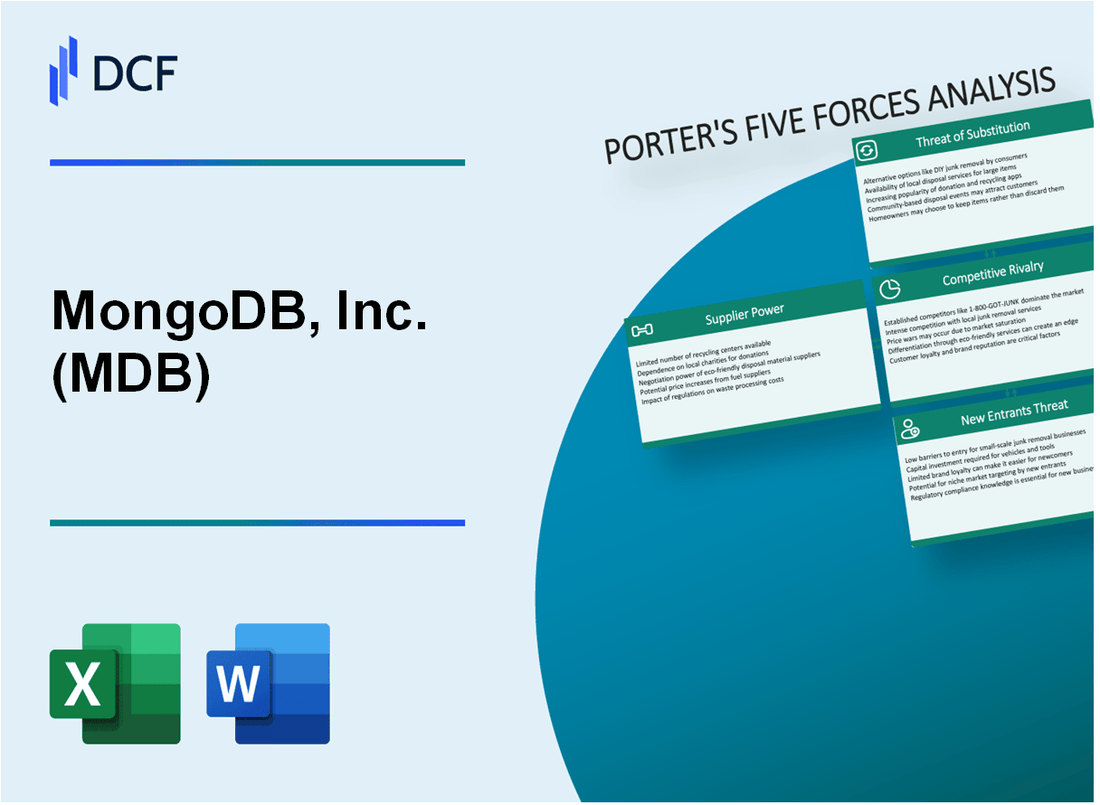
MongoDB, Inc. (MDB): 5 forças Análise [Jan-2025 Atualizada] |
Totalmente Editável: Adapte-Se Às Suas Necessidades No Excel Ou Planilhas
Design Profissional: Modelos Confiáveis E Padrão Da Indústria
Pré-Construídos Para Uso Rápido E Eficiente
Compatível com MAC/PC, totalmente desbloqueado
Não É Necessária Experiência; Fácil De Seguir
MongoDB, Inc. (MDB) Bundle
No cenário em rápida evolução da tecnologia de banco de dados, a MongoDB, Inc. está em um momento crítico, onde as forças estratégicas do mercado moldam sua trajetória competitiva. Ao dissecar a estrutura das cinco forças de Michael Porter, revelamos a intrincada dinâmica que desafiam e impulsiona essa plataforma inovadora de banco de dados. Desde a interação diferenciada dos provedores de infraestrutura em nuvem até as sofisticadas negociações com os clientes corporativos, o MongoDB navega em um complexo ecossistema de interrupção tecnológica, concorrência de mercado e posicionamento estratégico que determinará seu sucesso futuro no mercado global de banco de dados.
MONGODB, INC. (MDB) - As cinco forças de Porter: poder de barganha dos fornecedores
Provedores de infraestrutura em nuvem
O MongoDB conta com três provedores de infraestrutura em nuvem primária:
| Provedor | Quota de mercado | Receita em nuvem (2023) |
|---|---|---|
| Amazon Web Services (AWS) | 32% | US $ 80,1 bilhões |
| Microsoft Azure | 21% | US $ 54,3 bilhões |
| Google Cloud | 10% | US $ 23,5 bilhões |
Dependências de software de código aberto
O ecossistema do MongoDB envolve contribuições críticas de código aberto:
- O GitHub hospeda 31,5 milhões de repositórios relacionados a MongoDB
- Mais de 250.000 colaboradores ativos em comunidades de tecnologia de banco de dados
- A Apache Software Foundation suporta os principais componentes de infraestrutura
Fornecedores de hardware e semicondutores
As dependências críticas de hardware incluem:
| Fabricante | Participação de mercado de chips de servidor | Receita anual |
|---|---|---|
| Intel | 52.4% | US $ 63,1 bilhões |
| AMD | 20.3% | US $ 23,6 bilhões |
| Nvidia | 17.8% | US $ 40,9 bilhões |
Análise de concentração de fornecedores
Métricas de concentração -chave para a cadeia de suprimentos de tecnologia do MongoDB:
- 3 principais provedores de nuvem controlam 63% do mercado de infraestrutura
- 2 fabricantes de semicondutores produzem 72,7% dos chips de servidor
- Custos estimados de troca de fornecedores: 15-25% do total de despesas de infraestrutura
MONGODB, INC. (MDB) - As cinco forças de Porter: poder de barganha dos clientes
Comutação de comutação de clientes corporativos
A complexidade da migração de bancos de dados do MongoDB cria barreiras moderadas de comutação. A partir do quarto trimestre de 2023, os clientes corporativos enfrentam aproximadamente 4-6 semanas de potencial tempo de migração e desafios técnicos associados.
| Migração de migração | Custo/tempo estimado |
|---|---|
| Duração média da migração | 4-6 semanas |
| Custo estimado de migração | $75,000 - $250,000 |
| Risco potencial de inatividade | 12-48 horas |
Grande dinâmica de negociação do cliente
O segmento de clientes corporativos do MongoDB demonstra flexibilidade significativa de preços. Em 2023, os clientes de primeira linha negociaram termos do contrato representando 15-25% da receita recorrente anual total.
- Valor do contrato corporativo Faixa: US $ 100.000 - US $ 1.000.000
- Flexibilidade média da negociação do contrato: 17,3%
- Os maiores clientes empresariais recebem estruturas de preços personalizadas
Fatores de alavancagem do cliente
O modelo de assinatura do MongoDB permite Escala flexível e compromisso de longo prazo reduzido. Em 2023, 62% dos clientes corporativos utilizaram modelos de consumo flexíveis.
| Modelo de assinatura métrica | Percentagem |
|---|---|
| Adoção flexível do consumo | 62% |
| Modificações anuais do plano | 38% |
| Taxa de ajuste do plano de clientes | 24% |
Cenário competitivo de mercado
O MongoDB enfrenta a concorrência da Amazon Web Services, Microsoft Azure e Google Cloud, que afeta o poder de barganha do cliente. Em 2023, a concorrência do mercado de banco de dados aumentou os recursos de negociação do cliente em aproximadamente 22%.
- Participação de mercado competitiva de banco de dados: MongoDB 5,4%
- Crescimento do mercado de banco de dados em nuvem: 18,3%
- Alavancagem média de negociação do cliente: 22%
MONGODB, INC. (MDB) - As cinco forças de Porter: rivalidade competitiva
Cenário competitivo Overview
O MongoDB enfrenta intensa concorrência no mercado de sistemas de gerenciamento de banco de dados com os seguintes concorrentes -chave:
| Concorrente | Posição de mercado | 2023 Receita |
|---|---|---|
| Oráculo | Banco de dados corporativo estabelecido | US $ 44,7 bilhões |
| PostgreSQL | Banco de dados relacional de código aberto | US $ 329,4 milhões |
| Cassandra | Banco de dados NoSQL | US $ 214,6 milhões |
Dinâmica competitiva
O MongoDB compete em vários segmentos de mercado de banco de dados com desafios significativos:
- Tamanho do mercado global de banco de dados: US $ 68,2 bilhões em 2023
- Taxa de crescimento do mercado de banco de dados NoSQL: 22,3% anualmente
- Valor de mercado do segmento de banco de dados em nuvem: US $ 27,4 bilhões
Investimento de pesquisa e desenvolvimento
| Ano | Despesas de P&D | Porcentagem de receita |
|---|---|---|
| 2022 | US $ 388,4 milhões | 34.2% |
| 2023 | US $ 426,7 milhões | 37.5% |
Métricas de diferenciação de mercado
O posicionamento competitivo do MongoDB requer inovação contínua:
- Base total de clientes: 85.300 a partir do quarto trimestre 2023
- Clientes Global Enterprise: 39.700
- Valor médio do contrato do cliente: US $ 7.200 anualmente
MONGODB, INC. (MDB) - As cinco forças de Porter: ameaça de substitutos
Bancos de dados relacionais tradicionais Risco de substituição
A partir de 2024, o Oracle Database detém 41,7% de participação de mercado no mercado de sistemas de gerenciamento de banco de dados. O MySQL representa 15,6% do mercado de banco de dados. O PostgreSQL representa 11,8% do uso do banco de dados entre possíveis substitutos para o MongoDB.
| Plataforma de banco de dados | Quota de mercado | Potencial de substituição |
|---|---|---|
| Banco de dados Oracle | 41.7% | Alto |
| Mysql | 15.6% | Médio |
| PostgreSQL | 11.8% | Médio-alto |
Soluções de banco de dados nativas em nuvem
Os bancos de dados da Amazon Web Services (AWS) geram US $ 24,3 bilhões em receita anual. Os serviços de banco de dados do Microsoft Azure representam US $ 15,7 bilhões em receita anual. A Google Cloud Database Solutions representa US $ 8,2 bilhões em valor de mercado.
- AWS DynamoDB
- Azure Cosmos DB
- Google Cloud Firestore
Plataformas de banco de dados de código aberto
O mercado de banco de dados de código aberto deve atingir US $ 16,5 bilhões até 2025. A Apache Cassandra tem 35% de adoção entre substitutos no nível da empresa. A Redis detém 25% de participação de mercado nas alternativas de banco de dados-chave.
| Banco de dados de código aberto | Adoção da empresa | Potencial de substituição |
|---|---|---|
| Apache Cassandra | 35% | Alto |
| Redis | 25% | Médio |
Tecnologias alternativas de gerenciamento de dados
O mercado de banco de dados gráfico projetou para atingir US $ 5,7 bilhões até 2026. NEO4J Comandos 53% participação de mercado nas tecnologias de banco de dados gráficas. A Amazon Neptune gera US $ 340 milhões em receita anual de banco de dados de gráficos.
- Banco de dados de gráficos NEO4J
- Amazon Netuno
- Janusgraph
MONGODB, INC. (MDB) - As cinco forças de Porter: ameaça de novos participantes
Altas barreiras técnicas à entrada no mercado de tecnologia de banco de dados
O mercado de tecnologia de banco de dados do MongoDB apresenta barreiras técnicas substanciais para possíveis novos participantes. No quarto trimestre 2023, o mercado global de banco de dados foi avaliado em US $ 84,69 bilhões, com requisitos tecnológicos complexos impedindo a fácil penetração no mercado.
| Barreira técnica | Nível de complexidade | Impacto no mercado |
|---|---|---|
| Design de arquitetura do banco de dados | Alto | Requer experiência avançada de engenharia |
| Infraestrutura de escalabilidade | Muito alto | Exige capacidades técnicas significativas |
| Otimização de desempenho | Alto | Requer conhecimento especializado |
Requisitos significativos de investimento de capital
A entrada no mercado de tecnologia do banco de dados exige recursos financeiros substanciais. As despesas de pesquisa e desenvolvimento do MongoDB em 2023 foram de US $ 330,1 milhões, representando uma barreira significativa para potenciais concorrentes.
- Custos iniciais de desenvolvimento de infraestrutura: US $ 5 a 10 milhões
- Investimento de P&D em andamento: US $ 2-5 milhões anualmente
- Configuração da infraestrutura em nuvem: US $ 3-7 milhões
Requisitos complexos de regulamentação e conformidade
As soluções do banco de dados corporativas requerem padrões rigorosos de conformidade. Os investimentos em conformidade do MongoDB em 2023 totalizaram aproximadamente US $ 45,2 milhões, criando barreiras substanciais de entrada.
| Padrão de conformidade | Custo estimado de implementação | Complexidade |
|---|---|---|
| GDPR | US $ 1,5-2,5 milhão | Alto |
| HIPAA | US $ 2-3 milhões | Muito alto |
| SOC 2 | US $ 1-2 milhões | Alto |
Efeitos de rede estabelecidos e reconhecimento de marca
A posição de mercado do MongoDB é reforçada por fortes efeitos da rede. Em 2023, a empresa tinha mais de 40.000 clientes em todo o mundo, incluindo 68% das empresas da Fortune 100.
- Base total de clientes: 40.000+
- Fortuna 100 Penetração de clientes: 68%
- Participação de mercado da empresa global: 15,3%
MongoDB, Inc. (MDB) - Porter's Five Forces: Competitive rivalry
You're looking at a market where every dollar spent on data infrastructure is a battleground, and frankly, the intensity of competitive rivalry for MongoDB, Inc. is extremely high right now. This heat is directly fueled by the massive and growing Database-as-a-Service (DBaaS) market. Analysts size this cloud database and DBaaS market at around $24 billion in 2025. Forecasts suggest this market will expand at a CAGR of roughly 20% through 2030, meaning the fight for market share is only getting more expensive and more critical.
The rivalry is sharpest against the hyperscaler native services. Amazon DynamoDB and Google Cloud Firestore are not just alternatives; they are deeply integrated into the cloud ecosystems where many enterprises prefer to build. Here's a quick look at where mindshare stood in the Managed NoSQL Databases category as of October 2025, based on user engagement data:
| Competitor | Mindshare (Oct 2025) | Average Rating | Number of Reviews |
| Amazon DynamoDB | 13.1% | 8.2 | 44 |
| MongoDB Enterprise Advanced | 11.1% | 8.2 | 82 |
| Other | 75.8% | N/A | N/A |
Still, MongoDB, Inc. shows its platform strength in other metrics; for instance, in the broader NoSQL Databases category, MongoDB held an estimated 46.02% market share compared to Amazon DynamoDB's 10.98% in 2025.
Rivalry is centered on innovation, particularly for new AI workloads and vector search capabilities. This isn't just about CRUD operations anymore; it's about who can best serve the new generation of data-intensive applications. MongoDB, Inc. made moves like the Voyage AI acquisition to directly combine real-time data with sophisticated embedding and retrieval models right in the database, simplifying the development of trustworthy AI-powered apps.
Despite this intense competition, MongoDB, Inc. delivered strong financial results. Full year fiscal 2025 total revenue was $2.01 billion, up 19% year-over-year. MongoDB Atlas, the company's cloud offering, was the engine, accounting for 71% of total Q4 revenue and growing 24% year-over-year in that quarter. The customer base grew from over 54,500 as of January 31, 2025, to more than 59,900 by July 31, 2025.
The market includes established giants like Oracle and open-source alternatives like Couchbase and Redis, which compete on different vectors-cost, community, or specific feature sets. You see this in developer preference data from a 2025 survey:
- Python, the language often tied to data science and AI, showed high usage alongside MongoDB at 24%.
- Oracle usage among developers was reported at 10.6%.
- DynamoDB usage was reported at 9.8%.
- The significant growth in usage for Redis (+8% increase from 2024) highlights its growing importance for high-speed caching.
For the current fiscal year (FY2026), the company is guiding total revenue between $2.34 billion and $2.36 billion.
MongoDB, Inc. (MDB) - Porter's Five Forces: Threat of substitutes
You're looking at the competitive forces hitting MongoDB, Inc. right now, and the threat from substitutes is definitely a major factor you need to watch. It isn't as simple as it used to be; the lines between database types are blurring fast, which means more options for your customers to choose from instead of just MongoDB Atlas.
Relational databases, for example, aren't just for rigid tables anymore. PostgreSQL, with its JSONB type, now offers flexibility that used to be the exclusive domain of NoSQL. Still, this hybrid approach has its limits. We've seen reports from late 2025 where users found group operations on JSONB fields became prohibitively slow at scale, but for others, the cost savings were huge; one user noted their monthly database costs dropped from $3,000/month on Atlas to just $412 after migrating back to PostgreSQL, citing query performance stabilizing under 50ms.
Specialized NoSQL databases carve out niches where MongoDB might not be the absolute best fit for the workload. Apache Cassandra, for instance, is architecturally designed for write-heavy scenarios, reportedly capable of handling 1M+ writes/second with its multi-primary node support for writes, unlike MongoDB's limitation to one writable primary node per replica set.
The rise of integrated data warehouse/lakehouse platforms presents a different kind of substitution threat, often for analytical workloads. While MongoDB Atlas holds a 13.6% mindshare in the Database as a Service (DBaaS) market, competitors in the Cloud Data Warehouse space are substantial. Snowflake holds a 17.0% mindshare in its category and reported a $3.8 billion revenue run rate with 27% year-over-year growth in one 2025 report. Databricks, focusing on the lakehouse vision, commands an 8.67% market share in that segment.
MongoDB, Inc.'s reliance on its cloud offering is clear from the financials. MongoDB Atlas revenue was 71% of Q4 FY2025 revenue, which grew 24% Year-over-Year for that quarter, on total Q4 revenue of $548.4 million. This concentration shows how critical the core offering is, but it also highlights the direct exposure to substitution pressure in the cloud database market.
Here's a quick comparison of where these substitutes excel versus MongoDB's core strengths as of late 2025:
| Database Type/Platform | Key Strength/Optimization | Relevant Metric/Data Point |
|---|---|---|
| PostgreSQL (with JSONB) | Mixed relational/document workloads; SQL expertise | Reported cost reduction from $3,000/month to $412/month post-migration from Atlas |
| Apache Cassandra | Write-heavy, high-volume ingestion | Capable of handling 1M+ writes/second |
| Snowflake (Cloud Data Warehouse) | Cloud-native data warehousing, elasticity | Mindshare of 17.0% in Cloud Data Warehouse category |
| MongoDB Atlas (DBaaS) | Document model, flexible schema, AI-native tools | 71% of MongoDB, Inc.'s Q4 FY2025 Revenue |
You need to keep an eye on how these alternatives are closing feature gaps. The threat isn't just about one-to-one replacement; it's about workload consolidation onto platforms that offer better total cost of ownership or superior performance for a specific use case.
- PostgreSQL's pgvector encroaches on AI/ML database territory.
- Cassandra offers superior multi-primary write availability.
- Data warehouse platforms like Snowflake consolidate analytics workloads.
- MongoDB Atlas customer base reached over 54,500 as of January 31, 2025.
- Full Year Fiscal 2025 Total Revenue for MongoDB was $2.01 billion.
Finance: draft the sensitivity analysis on a 10% shift of Atlas revenue to PostgreSQL by Q4 FY2026 by next Tuesday.
MongoDB, Inc. (MDB) - Porter's Five Forces: Threat of new entrants
You're looking at the barriers to entry for a new database-as-a-service (DBaaS) provider trying to take on MongoDB, Inc. The threat here is defintely not zero, but it's tilted toward the lower end of the spectrum, primarily because of the sheer scale of investment required.
Building a global cloud infrastructure capable of competing with the hyperscalers-AWS, Microsoft Azure, and Google Cloud Platform-is a massive capital sink. For context, MongoDB, Inc. itself reported using $29.6 million of cash in capital expenditures for the full Fiscal Year 2025, ending January 31, 2025. A new entrant needs to fund not just software development but also the physical and virtual infrastructure to offer comparable global availability and performance.
Still, the market's growth potential is a huge magnet. The global Database as a Service Market size reached USD 29.6 Billion in 2024, and it is projected to grow at a 17.17% Compound Annual Growth Rate (CAGR) through 2033. That kind of expansion rate definitely attracts deep-pocketed challengers.
However, MongoDB, Inc. has built significant moats around its user base. Brand loyalty and the developer ecosystem lock-in are powerful deterrents. Developers often stick with what they know, especially when migrating data is complex. To illustrate the existing developer base, PostgreSQL, a major open-source competitor, is relied upon by 49 percent of all developers. Breaking that inertia is tough.
Also, the market is seeing consolidation, which raises the bar even higher for startups. For instance, in mid-2025, Snowflake announced its intent to acquire Crunchy Data, a move valued at $250 million, specifically to integrate enterprise-grade PostgreSQL capabilities into its AI Data Cloud. These moves by established giants signal that the path to scale involves massive M&A or pre-existing scale.
A new entrant would struggle mightily to replicate the multi-cloud reach MongoDB Atlas has established. This reach is a key differentiator for customers needing data residency or hybrid strategies. Here's a look at the current footprint:
| Cloud Provider | MongoDB Atlas Global Regions (as of early 2025) |
|---|---|
| Total Across All Clouds | 125+ cloud regions |
| Microsoft Azure | 48 regions globally |
| Google Cloud Platform (GCP) | 38 regions globally |
| Amazon Web Services (AWS) | 31 regions globally |
The ability to offer seamless multi-cloud clusters across these providers is a significant operational hurdle for any newcomer. The barriers to entry are less about the core database technology and more about the operational complexity of managing a truly global, multi-cloud data fabric.
The primary structural barriers new entrants face include:
- Massive upfront capital for global cloud infrastructure.
- The established developer mindshare and learning curve.
- The complexity of offering seamless cross-cloud replication.
- The need to match existing integrations with hyperscaler services.
- Consolidation plays by major competitors like Snowflake.
Disclaimer
All information, articles, and product details provided on this website are for general informational and educational purposes only. We do not claim any ownership over, nor do we intend to infringe upon, any trademarks, copyrights, logos, brand names, or other intellectual property mentioned or depicted on this site. Such intellectual property remains the property of its respective owners, and any references here are made solely for identification or informational purposes, without implying any affiliation, endorsement, or partnership.
We make no representations or warranties, express or implied, regarding the accuracy, completeness, or suitability of any content or products presented. Nothing on this website should be construed as legal, tax, investment, financial, medical, or other professional advice. In addition, no part of this site—including articles or product references—constitutes a solicitation, recommendation, endorsement, advertisement, or offer to buy or sell any securities, franchises, or other financial instruments, particularly in jurisdictions where such activity would be unlawful.
All content is of a general nature and may not address the specific circumstances of any individual or entity. It is not a substitute for professional advice or services. Any actions you take based on the information provided here are strictly at your own risk. You accept full responsibility for any decisions or outcomes arising from your use of this website and agree to release us from any liability in connection with your use of, or reliance upon, the content or products found herein.