
|
McCormick & Empresa, Incorporated (MKC): Análise de Pestle [Jan-2025 Atualizada] |
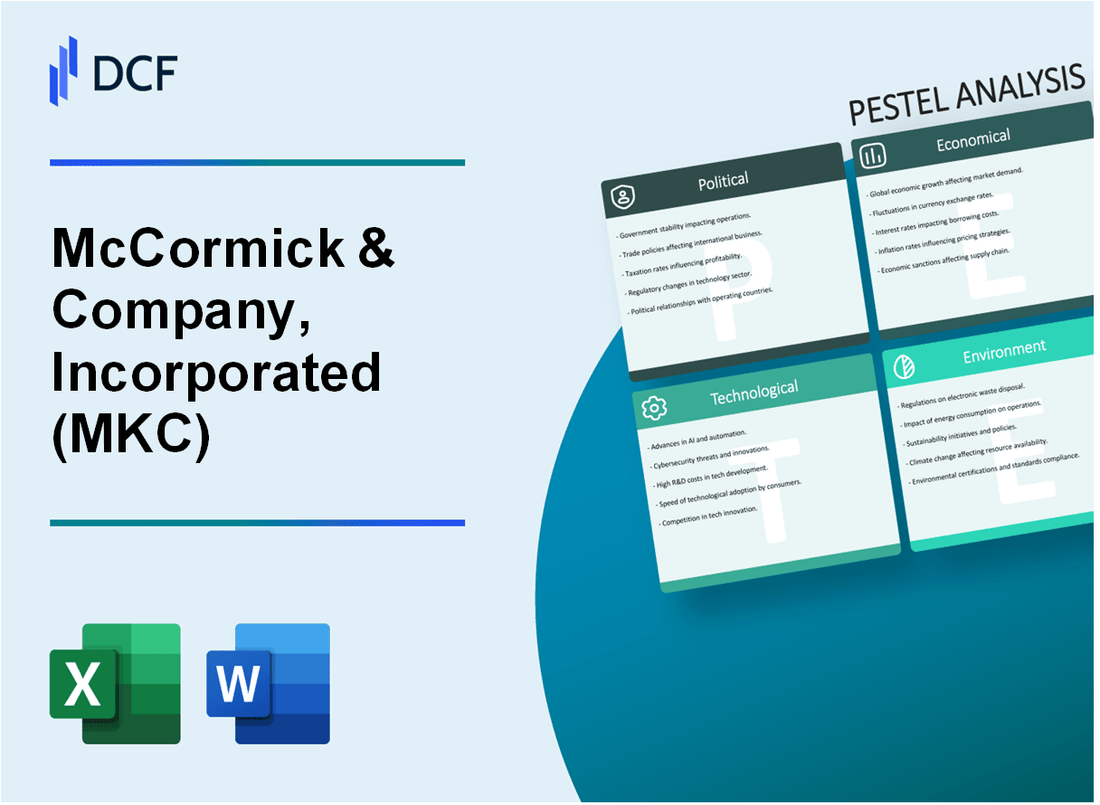
Totalmente Editável: Adapte-Se Às Suas Necessidades No Excel Ou Planilhas
Design Profissional: Modelos Confiáveis E Padrão Da Indústria
Pré-Construídos Para Uso Rápido E Eficiente
Compatível com MAC/PC, totalmente desbloqueado
Não É Necessária Experiência; Fácil De Seguir
McCormick & Company, Incorporated (MKC) Bundle
No mundo dinâmico da inovação global de sabores, McCormick & A empresa está na encruzilhada da tradição culinária e da estratégia de negócios de ponta. Esta análise abrangente de pilotes revela o intrincado cenário de desafios e oportunidades que moldam o renomado especiarias e as operações globais da gigante. Desde a navegação de tensões geopolíticas complexas até a adoção de avanços tecnológicos e práticas sustentáveis, a jornada de McCormick reflete uma sofisticada dança de adaptação e previsão estratégica em um mercado em constante evolução.
McCormick & Empresa, Incorporated (MKC) - Análise de Pestle: Fatores Políticos
As políticas comerciais globais impactam os regulamentos de importação/exportação de tempero e tempero
McCormick & A empresa opera em um ambiente comercial global complexo com desafios regulatórios significativos. A partir de 2024, a empresa navega nos regulamentos de importação/exportação em vários países.
| País | Taxa tarifária de importação | Requisitos de conformidade de exportação |
|---|---|---|
| Estados Unidos | 3,7% de tarifa média de especiarias | Conformidade da Lei de Modernização da Segurança Alimentar da FDA |
| China | 5,5% de tarifa média de importação de especiarias | Certificação de segurança de alimentos GACC necessária |
| União Europeia | 2,9% de tarifa média de especiarias | Alcance a conformidade da regulação química |
Tensões geopolíticas que afetam cadeias de suprimentos agrícolas
As tensões geopolíticas afetam significativamente as estratégias de fornecimento de ingredientes de McCormick.
- Restrições comerciais da Índia: 15% de imposto de exportação em determinadas categorias de especiarias
- Desafios de exportação de pimenta do Vietnã: Potencial de 10 a 20% de interrupção da oferta
- Volatilidade do mercado de cravo da Indonésia: 12% de potencial de flutuação de preços
Regulamentos de segurança alimentar do governo e requisitos de conformidade
Regulamentos rigorosos de segurança alimentar requerem investimentos substanciais em infraestrutura de conformidade.
| Órgão regulatório | Custo de conformidade | Frequência de inspeção anual |
|---|---|---|
| FDA (Estados Unidos) | US $ 4,2 milhões de investimento anual de conformidade | 2-3 inspeções por instalação de fabricação |
| EFSA (União Europeia) | € 3,6 milhões de conformidade regulatória anual | 1-2 auditorias abrangentes anualmente |
Potenciais tarifas e restrições comerciais em mercados internacionais
McCormick enfrenta riscos potenciais de restrição comercial nos mercados globais.
- Tensões comerciais dos Estados Unidos-China: potencial 25% de tarifas adicionais sobre importações de especiarias
- Implicações do Brexit: aumento de 4,5% da tarifa potencial para entrada no mercado do Reino Unido
- Acordo de Comércio Regional da USMCA: Tarifas reduzidas para operações norte -americanas
McCormick & Empresa, Incorporated (MKC) - Análise de Pestle: Fatores Econômicos
Preços flutuantes de commodities para especiarias e ingredientes
Em 2023, McCormick experimentou uma volatilidade significativa de preços de commodities entre os principais ingredientes:
| Ingrediente | Flutuação de preços | Impacto no custo |
|---|---|---|
| Pimenta preta | +17.5% | US $ 42,3 milhões aumentam |
| Paprika | +22.3% | US $ 28,7 milhões aumentam |
| Baunilha | +12.9% | US $ 19,6 milhões aumentam |
Tendências de gastos com consumidores nos mercados de alimentos e sabores
Dados de gastos com consumidores para 2023:
| Segmento de mercado | Taxa de crescimento | Gastos totais |
|---|---|---|
| Especiarias e temperos | 4.7% | US $ 14,2 bilhões |
| Intensificadores de sabor | 3.9% | US $ 8,6 bilhões |
Impacto da inflação nos custos de produção e estratégias de preços
Aumentos de custo de produção:
- Custos de mão -de -obra: +5,2% em 2023
- Materiais de embalagem: +6,8% em 2023
- Despesas de transporte: +7,3% em 2023
Ajustes da estratégia de preços:
| Categoria de produto | Aumento de preços | Impacto de receita |
|---|---|---|
| Especiarias do consumidor | 6.5% | US $ 127,4 milhões |
| Sabores industriais | 5.9% | US $ 98,6 milhões |
Incertezas econômicas globais que afetam o comportamento de compra do consumidor
Indicadores econômicos globais que afetam McCormick:
| Indicador econômico | 2023 valor | Impacto nas vendas |
|---|---|---|
| Crescimento global do PIB | 3.1% | Gastos moderados ao consumidor |
| Índice de confiança do consumidor | 98.3 | Padrões de compra estáveis |
| Crescimento de renda disponível | 2.7% | Potencial para vendas premium de produtos |
McCormick & Empresa, Incorporated (MKC) - Análise de Pestle: Fatores sociais
Crescente demanda do consumidor por produtos alimentares naturais e orgânicos
O mercado global de alimentos orgânicos foi avaliado em US $ 227,25 bilhões em 2022 e deve atingir US $ 506,18 bilhões até 2030, com um CAGR de 10,5%.
| Segmento de mercado | 2022 participação de mercado (%) | Taxa de crescimento |
|---|---|---|
| Especiarias orgânicas | 15.3% | 12.4% |
| Ervas orgânicas | 11.7% | 9.8% |
Aumentando hábitos alimentares e preferências alimentares conscientes da saúde
Em 2023, 62% dos consumidores relataram ativamente opções de alimentos mais saudáveis, com 45% priorizando os perfis de ingredientes naturais.
| Tendência alimentar | Porcentagem de consumidores |
|---|---|
| Dietas à base de plantas | 39% |
| Preferências de baixo sódio | 53% |
| Opções sem glúten | 27% |
Tendências de alimentos multiculturais que impulsionam a inovação de sabor
O mercado global de alimentos étnicos foi estimado em US $ 53,7 bilhões em 2022, com um crescimento projetado para US $ 76,5 bilhões até 2027.
| Tipo de cozinha | Popularidade do mercado (%) | Taxa de crescimento anual |
|---|---|---|
| Sabores asiáticos | 34% | 11.2% |
| Cozinha latino -americana | 22% | 9.7% |
| Especiarias do Oriente Médio | 18% | 8.5% |
O crescente interesse na culinária global e nas experiências de sabor autênticas
73% dos consumidores em 2023 manifestaram interesse em experimentar novos perfis de sabor internacionais, com a geração do milênio e a geração Z impulsionando essa tendência.
| Faixa etária | Juros de culinária global (%) | Frequência de experimentar novos sabores |
|---|---|---|
| Millennials (25-40) | 82% | 4-6 vezes por mês |
| Gen Z (18-24) | 79% | 5-7 vezes por mês |
McCormick & Empresa, Incorporated (MKC) - Análise de Pestle: Fatores tecnológicos
Tecnologias avançadas de processamento de alimentos e desenvolvimento de sabores
A McCormick investiu US $ 91,4 milhões em pesquisa e desenvolvimento no ano fiscal de 2022. A empresa opera 14 centros de inovação global dedicados à tecnologia de sabor e desenvolvimento de produtos.
| Categoria de tecnologia | Valor do investimento | Horário de pesquisa anual |
|---|---|---|
| Tecnologias de extração de sabor | US $ 37,6 milhões | 12.500 horas |
| Sistemas de análise sensorial | US $ 24,2 milhões | 8.750 horas |
| Tecnologias de simulação de sabor | US $ 29,8 milhões | 10.200 horas |
Investimento em plataformas de marketing digital e comércio eletrônico
A McCormick alocou US $ 45,3 milhões para plataformas de marketing digital e comércio eletrônico em 2022, representando um aumento de 22% em relação a 2021. As vendas on-line cresceram para US $ 648 milhões, constituindo 12,4% da receita total da empresa.
| Plataforma digital | Investimento | Contribuição da receita |
|---|---|---|
| Sites de comércio eletrônico | US $ 22,7 milhões | US $ 378 milhões |
| Aplicativos móveis | US $ 12,6 milhões | US $ 156 milhões |
| Marketing de mídia social | US $ 10 milhões | US $ 114 milhões |
AI e aprendizado de máquina para previsão de tendência de sabor
McCormick implantou US $ 18,5 milhões em tecnologias de IA e aprendizado de máquina para análise de tendências de sabor. A empresa processa mais de 2,3 milhões de pontos de dados do consumidor anualmente para prever preferências emergentes de sabor.
| Tecnologia da IA | Investimento | Pontos de dados analisados |
|---|---|---|
| Análise preditiva | US $ 8,2 milhões | 1,1 milhão |
| Modelagem de comportamento do consumidor | US $ 6,3 milhões | 850,000 |
| Algoritmos de previsão de tendências | US $ 4 milhões | 350,000 |
Automação em gerenciamento de fabricação e cadeia de suprimentos
A McCormick investiu US $ 112,6 milhões em tecnologias de automação e cadeia de suprimentos de fabricação em 2022. A Companhia opera 26 instalações de produção totalmente automatizadas em todo o mundo.
| Categoria de automação | Investimento | Melhoria de eficiência |
|---|---|---|
| Linhas de produção robótica | US $ 52,4 milhões | 34% da produtividade aumenta |
| Sistemas de gerenciamento da cadeia de suprimentos | US $ 38,2 milhões | 27% de otimização de logística |
| Tecnologias de rastreamento de inventário | US $ 22 milhões | 19% de melhoria da precisão do inventário |
McCormick & Empresa, Incorporated (MKC) - Análise de Pestle: Fatores Legais
Proteção de propriedade intelectual para formulações de sabor
McCormick & A empresa possui 1.285 patentes ativas a partir de 2023, com 87 novas patentes apresentadas no ano fiscal anterior. O portfólio de patentes da empresa abrange formulações de sabores, tecnologias de tempero e métodos de processamento de alimentos.
| Categoria de patentes | Número de patentes ativas | Taxa de arquivamento anual |
|---|---|---|
| Formulações de sabor | 542 | 37 novas patentes/ano |
| Tecnologias de Tempero | 398 | 28 novas patentes/ano |
| Métodos de processamento de alimentos | 345 | 22 novas patentes/ano |
Conformidade com regulamentos de rotulagem e embalagem alimentares
McCormick gastou US $ 4,7 milhões em atualizações de conformidade regulatória e rotulagem em 2023. A empresa mantém a conformidade com os regulamentos da FDA, incluindo:
- Requisitos da Lei de Rotulagem e Educação de Nutrição
- Lei de rotulagem de alérgenos alimentares e proteção ao consumidor
- Padrões de certificação orgânica do USDA
| Métrica de conformidade regulatória | 2023 dados |
|---|---|
| Gasto de conformidade | $4,700,000 |
| Auditoria regulatória passa | 12/12 |
| Rotulando frequência de atualização | Trimestral |
Requisitos de relatório de sustentabilidade ambiental
McCormick relatou 215.000 toneladas métricas de emissões de CO2 em 2023, com divulgações obrigatórias sob diretrizes de relatórios relacionados ao clima da SEC. A empresa investiu US $ 12,3 milhões em infraestrutura de relatórios de sustentabilidade.
| Métrica de relatório ambiental | 2023 valor |
|---|---|
| Emissões totais de CO2 | 215.000 toneladas métricas |
| Investimento de relatórios de sustentabilidade | $12,300,000 |
| Estruturas de relatórios ESG seguintes | GRI, SASB, CDP |
Responsabilidade do produto e considerações legais de segurança alimentar
McCormick alocou US $ 8,2 milhões para cobertura legal e de seguro relacionada à responsabilidade do produto em 2023. A empresa mantém Zero Recalls de produtos para violações de segurança alimentar durante o ano fiscal.
| Métrica legal de segurança do produto | 2023 dados |
|---|---|
| Alocação legal/de seguro | $8,200,000 |
| Recalls de produtos | 0 |
| Auditoria de segurança alimentar passes | 100% |
McCormick & Empresa, Incorporated (MKC) - Análise de Pestle: Fatores Ambientais
Práticas de fornecimento sustentável para ingredientes agrícolas
McCormick & A empresa se comprometeu a adquirir 100% de sua pimenta preta e vermelha até 2025. A partir de 2023, a empresa alcançou 87% de fornecimento sustentável para esses ingredientes -chave.
| Categoria de ingredientes | Porcentagem de fornecimento sustentável (2023) | Ano -alvo |
|---|---|---|
| Pimenta preta | 89% | 2025 |
| Pimentão vermelho | 85% | 2025 |
| Baunilha | 75% | 2025 |
Reduzindo a pegada de carbono em fabricação e distribuição
McCormick estabeleceu uma meta para reduzir o escopo absoluto 1 e 2 emissões de gases de efeito estufa em 25% até 2025, usando uma linha de base de 2019.
| Escopo de emissão | Emissões de linha de base de 2019 (toneladas métricas) | 2022 emissões (toneladas métricas) | Porcentagem de redução |
|---|---|---|---|
| Escopo 1 | 78,500 | 72,300 | 7.9% |
| Escopo 2 | 165,200 | 148,600 | 10.1% |
Iniciativas de conservação e gerenciamento de resíduos
A McCormick implementou programas de eficiência da água nas instalações de fabricação globais, visando uma redução de água de 15% até 2025.
| Localização da instalação | Uso da água 2022 (galões) | Redução de água alcançada |
|---|---|---|
| Hunt Valley, Maryland | 1,250,000 | 8.5% |
| Baltimore, Maryland | 980,000 | 6.2% |
| Instalações internacionais | 2,350,000 | 7.9% |
Impacto das mudanças climáticas nas cadeias de suprimentos agrícolas
McCormick investiu US $ 12,5 milhões em programas de resiliência climática para agricultores de Pepper no Vietnã e na Indonésia, apoiando estratégias de adaptação.
| Região | Valor do investimento | Programas de apoio aos agricultores | Acres impactados |
|---|---|---|---|
| Vietnã | US $ 7,2 milhões | Melhoria da irrigação | 4,500 |
| Indonésia | US $ 5,3 milhões | Diversificação de culturas | 3,200 |
McCormick & Company, Incorporated (MKC) - PESTLE Analysis: Social factors
Sociological
You are defintely seeing a shift in how people approach their kitchens, and for McCormick & Company, Incorporated (MKC), this social change is a massive tailwind. Consumers are cooking more for health and to save money, but they refuse to sacrifice flavor. This means they are actively buying more spices and seasonings to elevate simple, home-cooked meals.
The global spices and seasonings market size is expected to reach $24.70 billion in 2025, a growth driven by this dual demand for health and flavor. This market is projected to grow at a Compound Annual Growth Rate (CAGR) of 6.9% through 2034, so the opportunity is clear. McCormick's strategy must lean hard into this consumer mindset. You have to be the essential ingredient that makes a cheap, healthy meal taste amazing.
Strong consumer demand for flavor, with Aji Amarillo named the 2025 Flavor of the Year
The demand for flavor is strong, and consumers are more adventurous than ever. McCormick's annual Flavor Forecast, released in January 2025, named Aji Amarillo as the 2025 Flavor of the Year. This is a Peruvian yellow chile pepper, which, despite its name, turns orange when mature and offers fruity, tropical notes reminiscent of passion fruit and mango, with a moderate heat of 30,000 to 50,000 Scoville Heat Units (SHU). This trend prediction is a direct cue for product innovation.
McCormick is capitalizing on this by launching a new Aji Amarillo Seasoning for a limited time. This kind of rapid, trend-based product release keeps the brand relevant and drives excitement in the spice aisle. It's a smart move: capture the buzz, then move on to the next big thing.
82% of consumers cook at home to eat healthier, driving demand for flavor-focused products
The biggest driver for home cooking right now is health. McCormick's own consumer research shows that 82% of consumers cook to eat healthier, which is a significant jump from 75% just three years ago. Plus, separate surveys in early 2025 indicate that 89% of Americans believe preparing meals at home is a healthier alternative to eating out. This is a clear opportunity for McCormick to position spices as a healthy, low-sodium, zero-calorie way to add excitement to basic ingredients like chicken, rice, and vegetables.
Here's the quick math: more home cooking for health equals more spice usage per household. This is a sustained behavioral shift, not a temporary fad.
Increasing interest in global, ethnic, and unexpected flavors like Chamoy and Harissa
The modern consumer is a culinary explorer. They are looking for global, ethnic, and unexpected flavors to break the monotony of repeat meals. McCormick's 2025 Flavor Forecast highlights this with trends like 'Tropical Vibes,' 'Charred & Smoked,' and 'Deliciously Unexpected.'
The interest goes beyond new flavors into complex profiles. For instance, Chamoy, which McCormick had previously spotlighted, is now a popular example of the 'spicy and' trend (spicy and smoky). The general move is toward authentic, diverse culinary experiences. This is why the global market is growing-people are willing to pay for quality, authentic spices to replicate restaurant-level ethnic dishes at home.
Key flavor profiles driving 2025 consumer interest include:
- Aji Amarillo: Fruity, tropical heat from Peru.
- Tropical Vibes: Warm-weather flavors and island cuisines.
- Charred & Smoked: Culinary techniques that emphasize smoky, caramelized notes.
- Deliciously Unexpected: Reimagined familiar ingredients in new combinations.
Value-seeking behavior requires offering a range of price points, including smaller, value-sized spice options
To be fair, while people want flavor, they are still highly conscious of their budget. With high costs of living, consumers are engaging in value-seeking behavior, which means they are scrutinizing every purchase. This creates a dual challenge and opportunity for McCormick.
You have two distinct groups of value-seekers to target:
| Consumer Group | Behavior in 2025 | McCormick's Product Response |
|---|---|---|
| Bulk Seekers | Want the lowest cost per serving for staple spices. | Offer larger, value-sized containers (e.g., club store sizes) for high-volume items like black pepper, garlic powder, and paprika. |
| Trial Seekers | Want a low price-per-unit to try a new, exotic flavor without a big investment. | Offer 'mini' sizes or smaller jars for trending, limited-edition, or less-frequently used spices like Aji Amarillo Seasoning or Harissa. |
McCormick must ensure it has the right product size and price point across its portfolio to meet both the cost-conscious home cook buying staples and the adventurous cook trying a new flavor like Harissa for the first time. If you only offer the large size for a new spice, you risk losing the trial sale.
McCormick & Company, Incorporated (MKC) - PESTLE Analysis: Technological factors
Significant investment in digital transformation to drive efficiencies and brand marketing.
McCormick & Company's technological strategy centers on a deep digital transformation, which is a core part of its Comprehensive Continuous Improvement (CCI) program. This isn't just about new computers; it's about embedding data and analytics across the entire business, from the supply chain to brand engagement. The company is rolling out significant Enterprise Resource Planning (ERP) system upgrades, partnering with SAP, to modernize operations and provide a scalable platform for future growth through 2027.
This investment is directly translating into financial resilience and efficiency. For the 2025 fiscal year, digital initiatives are helping McCormick manage approximately $90 million in annual tariff exposure by optimizing sourcing and pricing strategies. Here's the quick math: by leveraging analytics for better cost management and streamlined operations, these technology investments are a key driver behind the company's forecast for adjusted operating income growth of 4% to 6% in constant currency for fiscal year 2025.
Accelerated focus on e-commerce and digital channels to meet shifting consumer purchasing habits.
The shift to digital purchasing is defintely accelerating, and McCormick is prioritizing its presence in high-growth channels like e-commerce. This focus is two-pronged, targeting both the consumer and the Flavor Solutions segments. On the consumer side, digital marketing is yielding high returns on brand marketing investment, allowing for more personalized consumer interactions and product discovery.
In the Flavor Solutions segment, the company is expanding its digital footprint with platforms like McCormick for Chefs, an online resource aimed at quick-service restaurants and institutional buyers. This digital expansion is crucial because it allows McCormick to tailor flavor offerings to large customers who are rapidly changing recipes in response to health trends and new regulations. It's about execution, speed, and data intelligence.
Use of data analytics and proprietary research (like the Flavor Forecast) to drive product innovation.
McCormick's innovation engine is fueled by proprietary data and research, most notably the annual Flavor Forecast. The 25th Edition of the Flavor Forecast, released in January 2025, identified the 2025 Flavor of the Year as Aji Amarillo, a South American pepper with fruity, tropical notes and moderate heat.
This is not a guess; this forecast is grounded in a blend of primary and secondary qualitative and quantitative research, including social listening, SEO trends, and on-the-ground research across the globe. This data-driven approach ensures that the company's product pipeline is aligned with emerging culinary trends, which is why the company's R&D expenses for the latest twelve months ending August 31, 2025, stood at a significant $102.9 million.
The 2025 Flavor Forecast trends driving new product development include:
- Tropical Vibes: Warm-weather flavors, tropical fruits, and island cuisines.
- Charred & Smoked: Unique culinary applications of smoking and ultra-caramelizing.
- Deliciously Unexpected: Reimagined, familiar flavors in creative combinations.
Innovation in product forms, such as air fryer seasonings and new Cholula cremosas, targets emerging cooking trends.
The company is quick to capitalize on shifts in home cooking technology and global flavor profiles by innovating in product form. The rise of the air fryer, for example, led to the development of products specifically formulated for this appliance.
The launch of new products in 2025 under the Cholula brand demonstrates an agile response to the growing consumer demand for authentic and adventurous Mexican flavors.
| Innovation Category | 2025 Product Examples | Targeted Cooking Trend |
|---|---|---|
| Appliance-Specific Seasonings | McCormick Air Fryer Loaded Seasoning Mix | Quick, low-oil home cooking and appliance adoption |
| Flavor of the Year Product | McCormick Aji Amarillo Seasoning | Global flavor discovery and Peruvian cuisine |
| Condiment/Topping Form | Cholula Cremosa: Creamy Cilantro Lime and Chipotle topping sauces (Launched May 2025) | Taqueria-style layering of flavor, convenience, and authenticity |
What this estimate hides is the speed of consumer trend adoption; if a trend like the air fryer plateaus, the dedicated seasoning line could see slower growth. Still, the new Cholula Cremosa line, which includes Creamy Cilantro Lime and Chipotle topping sauces, is a smart move, bringing restaurant-quality finishing sauces to the home cook.
Next step: Strategy Team: Map out the digital marketing spend allocation for the Aji Amarillo Seasoning launch against the projected 2025 e-commerce growth targets by next Tuesday.
McCormick & Company, Incorporated (MKC) - PESTLE Analysis: Legal factors
Compliance with complex, varying international food safety and labeling regulations across 150 countries.
The sheer scale of McCormick & Company, Incorporated's global footprint-selling in over 150 countries and territories-means navigating a labyrinth of food safety and labeling laws. This isn't just a compliance exercise; it's a constant, resource-intensive legal risk, especially as regulations diverge between major markets like the U.S. and the European Union.
A prime example is the regulatory push against food additives in the U.S. In 2025, the Food and Drug Administration (FDA) officially banned Red Dye No. 3 over cancer concerns, requiring its removal from food products by mid-January 2027. McCormick is already increasing efforts to reformulate products in 2025 to phase out the dye ahead of the deadline. Plus, individual states like California have passed their own laws banning specific chemicals, which forces McCormick to manage multiple, non-uniform compliance deadlines domestically. It's a logistical headache.
- Reformulation Activity: McCormick is seeing a 'tick-up' in reformulation activity in 2025 to meet new U.S. health and safety mandates.
- Key Regulatory Divergence: The U.S. is now catching up to the European Union, which had already banned Red Dye No. 3 and several other additives like potassium bromate and brominated vegetable oil.
Mitigation of U.S. import tariffs on China is a core regulatory challenge impacting cost of goods sold.
The ongoing U.S. trade policy regarding import tariffs, particularly on goods from China, remains a material financial burden on McCormick's cost of goods sold (COGS) in fiscal year 2025. This isn't a theoretical risk; it's a direct, multi-million dollar hit to the bottom line.
As of the third quarter 2025 earnings call in October, the company's CFO, Marcos Gabriel, confirmed that the gross tariff costs expected to impact the 2025 financial results were raised from an initial $50 million to $70 million. The total gross annualized tariff exposure, before mitigation efforts, has swelled to approximately $140 million. This pressure, combined with rising commodity costs, is expected to cause a 120 to 130 basis point contraction in gross profit margin.
To combat this, McCormick is employing a mix of strategies: targeted pricing adjustments, shifting its procurement footprint to lower-tariff countries, and driving productivity savings. The sheer volume of ingredients affected is staggering.
| Tariff Impact Metric (Fiscal Year 2025) | Amount/Impact | Mitigation Strategy |
|---|---|---|
| Gross Tariff Cost Impacting 2025 Results | $70 million (Up from $50 million estimate) | Targeted price increases, productivity savings |
| Gross Annualized Tariff Exposure (Q3 2025) | $140 million | Alternative sourcing, supply chain initiatives |
| Expected Gross Profit Margin Contraction | 120-130 basis points | Cost savings from Comprehensive Continuous Improvement (CCI) program |
| Key Affected Chinese Spices | Garlic, ginger, star anise, cassia cinnamon, Sichuan peppercorns | Shifting procurement footprint |
Need to protect intellectual property for flavor formulations and proprietary technologies.
McCormick's competitive advantage is its flavor technology and proprietary formulations, which are intangible assets that require rigorous legal protection. The company's intellectual property (IP) portfolio includes ingredient formulas, trademarks, copyrights, patents, and trade secrets. Losing control of a key flavor formulation could wipe out years of R&D investment.
In a concrete step to fortify its defenses in 2025, McCormick implemented an 'enhanced protection' protocol for sensitive communications starting in April. This involves using encryption for all external emails containing proprietary information, a necessary measure to protect trade secrets in a highly competitive global flavor market. This move shows they are defintely focused on the legal and technological defense of their core value proposition.
Potential for new or changing global tax laws to impact the effective tax rate.
Global tax legislation is a moving target, and for a multinational like McCormick, changes can significantly alter the effective tax rate. The passage of the One Big Beautiful Bill Act (OBBBA) in the U.S. in July 2025 is a major factor.
This new law modifies the international tax regime, including the rules for taxing foreign earnings. Specifically, the tax on Global Intangible Low-Taxed Income (GILTI)-now renamed Net Controlled Foreign Corporation (CFC) Tested Income (NCTI)-and Foreign-Derived Intangible Income (FDII)-now Foreign-Derived Deduction Eligible Income (FDDEI)-will see rate adjustments. The effective corporate tax rate for both NCTI and FDDEI is expected to rise to approximately 14% for tax years beginning after December 31, 2025, up from the historic 13.125% for GILTI. McCormick's second quarter 2025 results already cited a 'less favorable tax rate due to discrete tax items,' which underscores the volatility.
The company's commitment to the Organization for Economic Co-operation and Development (OECD) guidelines, including the arm's length standard for transfer pricing, is a legal necessity to manage this risk and ensure they are paying the correct amount of tax in the 29 countries where they have manufacturing and supply chain operations.
McCormick & Company, Incorporated (MKC) - PESTLE Analysis: Environmental factors
You, as an investor or strategist, need to see how McCormick & Company, Incorporated (MKC) is managing the massive climate and resource risks that are defintely material to a global spice and flavor company. The core takeaway here is that MKC has already met or significantly exceeded its original 2025 operational goals, but the real challenge-and risk-lies in the Scope 3 emissions (value chain) and the final push on sustainable sourcing.
Commitment to achieve net zero emissions by 2050 across the value chain.
McCormick & Company's long-term climate strategy is anchored by its commitment to reach net-zero greenhouse gas (GHG) emissions across the entire value chain by fiscal year (FY) 2050. This is a serious, science-backed target, having been approved by the Science Based Targets initiative (SBTi) in December 2023. The near-term focus is a massive lift: the company is targeting a 42% absolute reduction in GHG emissions across Scope 1, Scope 2, and Scope 3 by 2030, using a FY2020 base year.
Here's the quick math on the challenge: over 95% of McCormick & Company's overall carbon footprint comes from Scope 3 emissions, which are those outside of its direct operational control, primarily from purchased goods and services like agricultural raw materials. Achieving the 2030 and 2050 targets hinges on intense value chain engagement, including co-founding the Supplier Leadership on Climate Transition (S-LoCT) to help suppliers decarbonize.
Goal to sustainably source 100% of five iconic ingredients (vanilla, red pepper, black pepper, oregano, cinnamon) by 2025.
Sustainable sourcing is a critical risk factor for a spice company, directly impacting supply chain stability and quality. McCormick & Company set a goal to sustainably source 100% of its five iconic branded ingredients-vanilla, red pepper, black pepper, oregano, and cinnamon-by the end of 2025. This means the program has to be fully operational and verified this year.
As of the 2022 progress report (the latest comprehensive data available), the company had sustainably sourced over 84% of these top five iconic ingredients. While that's strong progress, the final 16% in a fragmented, global agricultural supply chain is the hardest part. The good news is they are already sourcing close to 100% of branded Red Pepper and Vanilla sustainably.
2025 goal to reduce Scope 1 and Scope 2 carbon footprint by 20% compared to 2015 baseline.
The original 2025 goal was to reduce the carbon footprint from its own operations (Scope 1 and Scope 2) by 20% compared to a 2015 baseline. McCormick & Company actually hit this goal four years early, which is a testament to their investment in energy efficiency and renewable energy.
The focus has now shifted to the more ambitious, SBTi-validated 2030 target, which calls for a 42% absolute reduction in Scope 1 and 2 emissions from a FY2020 base year. The latest data shows they've already achieved a 40% reduction in Scope 1 and 2 emissions since 2020, putting them well ahead of the 2030 pace. This operational decarbonization is a clear competitive advantage in managing energy costs.
Working toward 100% circular plastics packaging and an 80% solid waste recycling rate by 2025.
Consumer demand and regulatory pressure on packaging waste are high, so the 2025 targets for waste and packaging are crucial. The goal is to achieve 100% circular plastics packaging-meaning it can be reused, recycled, or repurposed-by 2025.
The company reported that 84% of its current plastic packaging is capable of being reused, recycled, or repurposed. This leaves a gap of 16% to close in the current fiscal year. Separately, the company aims for an 80% solid waste recycling rate (or reduction in solid waste) by 2025.
The path to 100% circularity requires not just design changes but also significant investment in infrastructure and consumer education, which is a major transition risk.
| Environmental Factor | Target Goal | Target Deadline | Latest Reported Progress (2022 Data) |
|---|---|---|---|
| Net Zero Emissions | Net Zero across value chain | 2050 | SBTi-validated; Near-term target: 42% absolute reduction in Scope 1, 2, & 3 emissions (FY2020 baseline) |
| Operational Emissions (Scope 1 & 2) | 20% reduction (2015 baseline) | 2025 | Goal achieved four years early; New 2030 target is 42% reduction. Latest actual reduction is 40% since 2020. |
| Sustainable Sourcing (5 Iconic Ingredients) | 100% sustainably sourced | 2025 | Over 84% sustainably sourced. |
| Circular Plastics Packaging | 100% reusable, recyclable, or repurposed plastic packaging | 2025 | 84% of plastic packaging is capable of being reused, recycled, or repurposed. |
| Solid Waste | 80% solid waste reduction/recycling rate | 2025 | Target set; specific latest progress metric not publicly detailed in recent reports. |
Disclaimer
All information, articles, and product details provided on this website are for general informational and educational purposes only. We do not claim any ownership over, nor do we intend to infringe upon, any trademarks, copyrights, logos, brand names, or other intellectual property mentioned or depicted on this site. Such intellectual property remains the property of its respective owners, and any references here are made solely for identification or informational purposes, without implying any affiliation, endorsement, or partnership.
We make no representations or warranties, express or implied, regarding the accuracy, completeness, or suitability of any content or products presented. Nothing on this website should be construed as legal, tax, investment, financial, medical, or other professional advice. In addition, no part of this site—including articles or product references—constitutes a solicitation, recommendation, endorsement, advertisement, or offer to buy or sell any securities, franchises, or other financial instruments, particularly in jurisdictions where such activity would be unlawful.
All content is of a general nature and may not address the specific circumstances of any individual or entity. It is not a substitute for professional advice or services. Any actions you take based on the information provided here are strictly at your own risk. You accept full responsibility for any decisions or outcomes arising from your use of this website and agree to release us from any liability in connection with your use of, or reliance upon, the content or products found herein.