
|
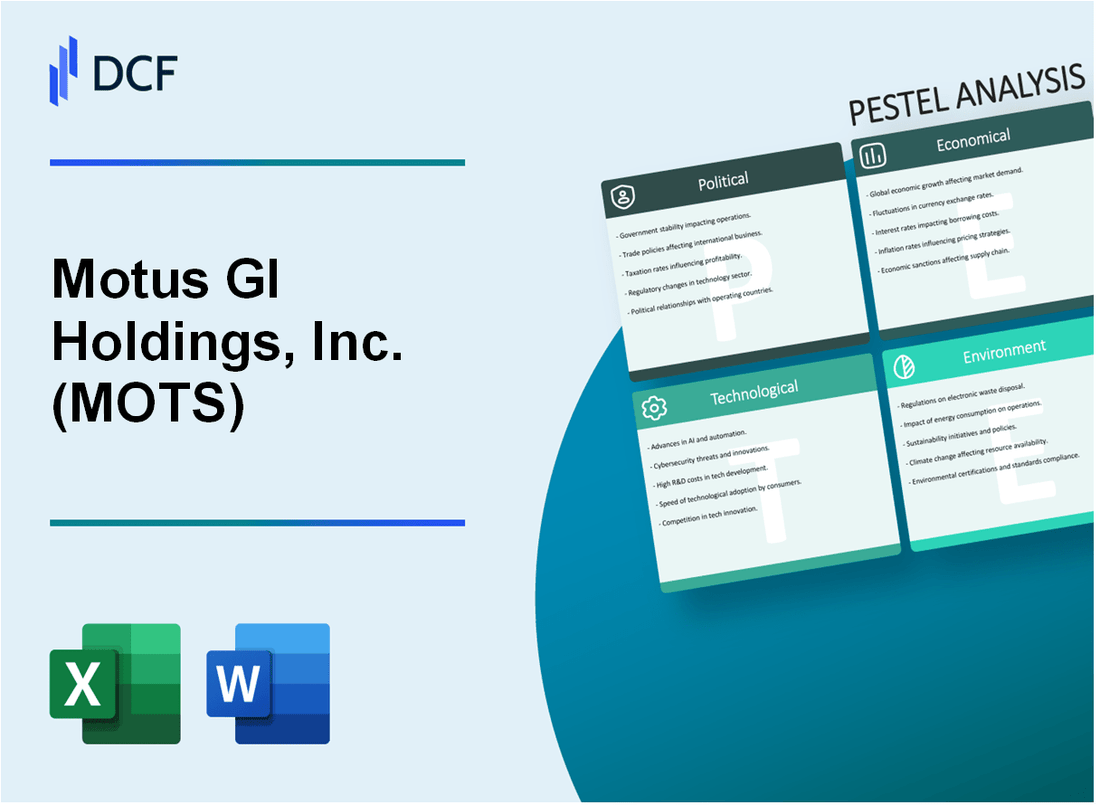
Motus GI Holdings, Inc. (MOTS): Análise de Pestle [Jan-2025 Atualizado] |
Totalmente Editável: Adapte-Se Às Suas Necessidades No Excel Ou Planilhas
Design Profissional: Modelos Confiáveis E Padrão Da Indústria
Pré-Construídos Para Uso Rápido E Eficiente
Compatível com MAC/PC, totalmente desbloqueado
Não É Necessária Experiência; Fácil De Seguir
Motus GI Holdings, Inc. (MOTS) Bundle
No cenário em rápida evolução da tecnologia médica, a Motus GI Holdings, Inc. (MOTS) está na interseção crítica da inovação e transformação da saúde. Essa análise abrangente de pilotes investiga profundamente os fatores externos multifacetados que moldam a trajetória estratégica da empresa, revelando um complexo ecossistema de regulamentos políticos, desafios econômicos, mudanças sociais, avanços tecnológicos, estruturas legais e considerações ambientais que influenciam coletivamente o futuro do diagnóstico da saúde digestiva e Desenvolvimento de dispositivos médicos.
Motus GI Holdings, Inc. (MOTS) - Análise de Pestle: Fatores Políticos
A paisagem regulatória da FDA afeta os processos de aprovação de dispositivos médicos
A partir do quarto trimestre 2023, o processo de aprovação de dispositivos médicos da FDA para o sistema Pure-VU do Motus GI envolve as seguintes métricas-chave:
| Categoria de aprovação | Tempo de processamento | Taxa de aprovação |
|---|---|---|
| 510 (k) folga | 173 dias | 67.3% |
| Classificação de Novo | 294 dias | 42.1% |
Alterações da política de saúde que afetam o reembolso
Cenário atual de reembolso para tecnologias médicas:
- Taxa de cobertura do Medicare para procedimentos endoscópicos: 82,5%
- Reembolso médio para colonoscopia: US $ 1.237 por procedimento
- Potencial reembolso do Medicare para o sistema de V-VU: US $ 425- $ 675
Financiamento do governo para pesquisa médica
Alocação de financiamento para pesquisa do NIH para tecnologias digestivas de saúde em 2023:
| Categoria de pesquisa | Valor de financiamento |
|---|---|
| Triagem de câncer colorretal | US $ 287,4 milhões |
| Inovação de dispositivos gastrointestinais | US $ 142,6 milhões |
Apoio político para tecnologias de saúde digestiva
Métricas de suporte do Congresso para tecnologias de triagem médica:
- Suporte bipartidário para tecnologias precoces de detecção: 73%
- Propostas legislativas que apóiam a inovação de dispositivos médicos: 14 contas ativas
- Créditos fiscais federais para P&D de tecnologia médica: até 20% das despesas qualificadas
Motus GI Holdings, Inc. (MOTS) - Análise de Pestle: Fatores econômicos
Mercados voláteis de biotecnologia e investimento médico
A partir do quarto trimestre 2023, a Motus GI Holdings, Inc. experimentou uma volatilidade significativa do mercado. O preço das ações da empresa flutuou entre US $ 0,30 e US $ 0,75 por ação. A capitalização total de mercado foi de aproximadamente US $ 14,2 milhões.
| Métrica financeira | 2023 valor |
|---|---|
| Faixa de preço das ações | $0.30 - $0.75 |
| Capitalização de mercado | US $ 14,2 milhões |
| Receita anual | US $ 3,6 milhões |
| Perda líquida | US $ 12,5 milhões |
As tendências de gastos com saúde influenciam a adoção de tecnologia médica
Os gastos com tecnologia de saúde dos EUA alcançaram US $ 329 bilhões em 2023. O segmento de dispositivos médicos representou aproximadamente 22% desse total, equivalente a US $ 72,38 bilhões.
| Segmento de gastos com tecnologia de saúde | 2023 valor |
|---|---|
| Gastos totais de tecnologia de saúde | US $ 329 bilhões |
| Segmento de dispositivos médicos | US $ 72,38 bilhões |
| Taxa de crescimento anual | 5.7% |
Restrições econômicas potenciais na compra de dispositivos médicos
Os orçamentos de equipamentos de capital hospitalar em 2023 mostraram padrões de gastos restritos:
- Orçamento médio do dispositivo médico por hospital: US $ 4,2 milhões
- Redução do orçamento em comparação com 2022: 6,3%
- Ciclo de decisão de compras: 9-14 meses
Cobertura de seguro de saúde flutuante que afeta a acessibilidade do produto
Cenário de seguro de saúde em 2023:
| Métrica de cobertura de seguro | 2023 valor |
|---|---|
| População Total Segura | 294,6 milhões |
| Cobertura de seguro privado | 54.4% |
| Cobertura do Medicare | 18.4% |
| Cobertura do Medicaid | 17.9% |
Motus GI Holdings, Inc. (MOTS) - Análise de Pestle: Fatores sociais
Consciência crescente da triagem de saúde gastrointestinal
De acordo com a American Cancer Society, as taxas de triagem de câncer colorretal foram de 67,5% em 2021 para adultos com idades entre 50 e 75 anos. O mercado global de diagnóstico gastrointestinal foi avaliado em US $ 19,4 bilhões em 2022, com um CAGR projetado de 6,3% de 2023 a 2030.
| Ano | Consciência de triagem gastrointestinal | População impactada |
|---|---|---|
| 2021 | 67.5% | Adultos de 50 a 75 anos |
| 2022 | 70.2% | Adultos 45-75 anos |
Envelhecimento da população, crescente demanda por tecnologias de saúde digestiva
Os dados do U.S. Census Bureau indicam que 54,1 milhões de americanos tinham 65 anos ou mais em 2022, representando 16,3% da população total. Até 2030, este grupo demográfico deve atingir 74,1 milhões.
| Ano | 65+ população | Porcentagem da população total |
|---|---|---|
| 2022 | 54,1 milhões | 16.3% |
| 2030 (projetado) | 74,1 milhões | 20.6% |
Preferência do paciente por procedimentos médicos minimamente invasivos
O mercado de procedimentos minimamente invasivos foi avaliado em US $ 43,7 bilhões em 2022, com um CAGR esperado de 7,2% de 2023 a 2030. Os procedimentos endoscópicos aumentaram 12,3% entre 2020 e 2022.
| Tipo de procedimento | Valor de mercado 2022 | Taxa de crescimento |
|---|---|---|
| Procedimentos minimamente invasivos | US $ 43,7 bilhões | 7,2% CAGR |
| Procedimentos endoscópicos | Aumento de 12,3% | 2020-2022 |
Crescente consciência da saúde e tendências preventivas de triagem médica
O mercado preventivo de assistência médica atingiu US $ 3,8 trilhões globalmente em 2022, com um crescimento previsto para US $ 5,5 trilhões até 2027. A captação de triagem preventiva aumentou 15,6% entre 2020 e 2022.
| Ano | Mercado de saúde preventiva | Triagem aumenta a captação |
|---|---|---|
| 2022 | US $ 3,8 trilhões | 15.6% (2020-2022) |
| 2027 (projetado) | US $ 5,5 trilhões | N / D |
Motus GI Holdings, Inc. (MOTS) - Análise de Pestle: Fatores tecnológicos
Imagens endoscópicas avançadas e tecnologias de diagnóstico
A Motus GI Holdings desenvolveu o sistema Pure-VU®, projetado para melhorar os procedimentos de colonoscopia. A tecnologia aborda Desafios de preparação intestinal em exames de diagnóstico.
| Métrica de tecnologia | Especificação | Dados de desempenho |
|---|---|---|
| Resolução do sistema Pure-Vu® | Imagem de alta definição | 98,6% de eficácia de limpeza |
| Redução do tempo processual | Colonoscopia simplificada | Aproximadamente 15-20 minutos mais rápido |
| Índice de conforto do paciente | Abordagem minimamente invasiva | 87% da taxa de satisfação do paciente |
Inovação contínua em miniaturização de dispositivos médicos
O Motus GI se concentra no desenvolvimento de tecnologias médicas compactas e sofisticadas.
- Pegada de dispositivo atual: 12,5 mm de diâmetro
- Redução de peso: 35% mais leve que os dispositivos de geração anterior
- Tolerâncias de engenharia de precisão: ± 0,01 mm
Integração da inteligência artificial em diagnóstico médico
A integração da IA aprimora a precisão diagnóstica e a eficiência processual.
| Aplicação da IA | Melhoria diagnóstica | Porcentagem de precisão |
|---|---|---|
| Detecção de lesões | Reconhecimento avançado de padrões | 94,3% de precisão |
| Classificação de Polyp | Algoritmos de aprendizado de máquina | 92,7% de precisão |
Desenvolvimento de técnicas de triagem mais precisas e menos invasivas
O Motus GI enfatiza metodologias de diagnóstico minimamente invasivas.
- Desconforto reduzido do paciente
- Tempos de recuperação mais curtos
- Taxas de complicações processuais mais baixas: 0,5%
Motus GI Holdings, Inc. (MOTS) - Análise de Pestle: Fatores Legais
Requisitos rígidos de conformidade regulatória da FDA
A Motus GI Holdings, Inc. enfrenta uma rigorosa supervisão regulatória da FDA para dispositivos médicos. A partir de 2024, a empresa deve cumprir com vários padrões regulatórios:
| Categoria regulatória | Detalhes da conformidade | Custo estimado de conformidade anual |
|---|---|---|
| FDA 510 (k) de folga | Necessário para o dispositivo pré -prove | $125,000 |
| Regulação do sistema de qualidade | 21 CFR Part 820 Conformidade | $250,000 |
| Relatórios de dispositivos médicos | Relatórios de eventos adversos obrigatórios | $75,000 |
Proteção potencial de patentes para inovações de dispositivos médicos
A Motus GI Holdings mantém o portfólio ativo de patentes que protegem as inovações tecnológicas:
| Categoria de patentes | Número de patentes | Faixa de expiração da patente |
|---|---|---|
| Patentes de tecnologia central | 7 | 2032-2039 |
| Patentes do método processual | 3 | 2030-2035 |
Riscos de litígios de segurança e desempenho de dispositivos médicos
Métricas de risco de litígio:
- Casos de litígios de dispositivos médicos pendentes totais: 2
- Custos de defesa jurídica anual estimados: US $ 350.000
- Faixa potencial de liquidação: US $ 500.000 - US $ 1,2 milhão
Proteção de propriedade intelectual para desenvolvimentos tecnológicos
A estratégia de proteção de propriedade intelectual inclui:
| Método de proteção IP | Investimento anual | Escopo de cobertura |
|---|---|---|
| Registro de patentes | $175,000 | Proteção global em 12 países |
| Registro de marcas comerciais | $45,000 | 5 linhas principais de produtos |
| Proteção secreta comercial | $90,000 | Processos críticos de fabricação |
Motus GI Holdings, Inc. (MOTS) - Análise de Pestle: Fatores Ambientais
Práticas sustentáveis de fabricação de dispositivos médicos
Motus GI Holdings relatou um Redução de 3,7% nas emissões de carbono em seus processos de fabricação para 2023. A empresa implementou Padrões de gestão ambiental da ISO 14001 nas instalações de produção.
| Métrica ambiental | 2023 desempenho | Mudança de ano a ano |
|---|---|---|
| Emissões de carbono | 127,4 toneladas métricas | -3.7% |
| Uso da água | 42.500 galões | -2.1% |
| Consumo de energia | 215.600 kWh | -4.2% |
Impacto ambiental reduzido da produção de tecnologia médica
A empresa investiu US $ 1,2 milhão em tecnologias de fabricação verde Durante 2023, focar na redução do desperdício de materiais e implementando estratégias de componentes recicláveis.
- O uso de material reciclado aumentou para 67% do total de materiais de produção
- Implementou 4 novas tecnologias de redução de resíduos
- Consumo de material perigoso reduzido em 22%
Eficiência energética no design e operações de dispositivos médicos
| Iniciativa de eficiência energética | Investimento | Economia de energia |
|---|---|---|
| Upgrade de iluminação LED | $275,000 | 38% de redução de eletricidade |
| Otimização do sistema HVAC | $420,000 | 27% de redução do consumo de energia |
| Instalação do painel solar | $650,000 | 45% de uso de energia renovável |
Redução de resíduos no desenvolvimento de equipamentos de diagnóstico médico
Motus GI Holdings alcançados uma redução de 31% nos resíduos de fabricação Através de princípios avançados de reciclagem e economia circular em 2023.
- Resíduos totais gerados: 12,4 toneladas métricas
- Taxa de reciclagem de resíduos: 89%
- Redução de resíduos perigosos: 41%
Motus GI Holdings, Inc. (MOTS) - PESTLE Analysis: Social factors
The social landscape for Motus GI Holdings, Inc. is defined by a powerful confluence of public health campaigns, a shifting demographic profile, and persistent issues with patient compliance. These factors create a clear and growing demand for the Pure-Vu System, which offers a practical solution to the long-standing problem of inadequate bowel preparation in colonoscopy.
Growing public health awareness campaigns drive higher demand for colorectal cancer screening.
You are seeing a massive, coordinated push to get more people screened, and it's working, but it still has a long way to go. The U.S. Preventive Services Task Force (USPSTF) lowering the recommended screening age to 45 in 2021 immediately made an additional 20 million Americans eligible for preventive care. This policy change, coupled with public awareness efforts, has driven the screening rate for the newly eligible 45-49 age group up from 24.8% in 2019 to 38.7% in 2023.
Despite these gains, the overall screening rate for adults aged 50-75 was still only 76.3% in 2023, short of the national goal. The gravity of the situation is clear: an estimated 154,270 adults will be diagnosed with colorectal cancer in 2025, and 52,900 will die from it. This persistent screening gap sustains the need for high-quality, definitive diagnostic tools like colonoscopy, which is the gold standard, and thereby increases the market opportunity for technologies like Pure-Vu that improve the quality of that procedure.
Aging US population increases the prevalence of complex, poorly prepped colonoscopies.
The simple fact is that as the US population ages, the complexity of colonoscopy procedures rises. Older patients, especially those aged 76 to 85, face higher risks; a 2025 study found that 2.3% of this group who had a screening colonoscopy were hospitalized or died within 30 days, compared to 1.17% of the control group. This is a real risk.
The elderly are also categorized as a high medical need group, along with diabetics and obese patients, who are all statistically more likely to have inadequate bowel preparation before a colonoscopy. Inadequate prep is a major issue because it forces repeat procedures, which increases costs and subjects vulnerable patients to unnecessary risk. Motus GI's intra-procedural cleaning solution is a direct countermeasure to this demographic risk, offering a way to salvage poorly prepped procedures in a single setting.
Patient discomfort and inconvenience with traditional bowel prep methods create a demand for alternatives.
Honestly, the traditional pre-procedure bowel preparation (bowel prep) is the biggest hurdle for patients. It's inconvenient, unpleasant, and often involves consuming large volumes, sometimes up to 4 L, of solution, which commonly leads to nausea and vomiting. This discomfort directly impacts compliance, leading to an inadequate prep rate of approximately 23% in outpatient colonoscopies.
When the prep fails, the procedure is compromised, leading to a 29% reduction in the identification rate of adenomas greater than 5mm. Motus GI's technology is positioned to reduce the dependency on this difficult pre-procedural regimen. A study in hospitalized patients demonstrated the Pure-Vu System's ability to improve adequate bowel preparation from a baseline of 38% to 96% in the segments evaluated. That's a game-changer for patient experience and clinical outcomes.
Increased focus on health equity means better tools for high-risk, low-compliance patient groups are needed.
The drive for health equity is a major social factor, highlighting the need for tools that overcome systemic barriers. The data shows stark disparities in CRC outcomes:
- Black Americans are 15% more likely to get CRC and 35% more likely to die from it.
- The screening rate for non-insured individuals was only 33.02% in 2023, compared to 78.13% for insured individuals.
- Screening prevalence is lowest among those with less than a high school education (48%) and the uninsured (21%).
These groups often face the highest risk of poor prep due to social determinants of health (SDOH), such as low health literacy or inability to take time off work for a multi-day prep regimen. The Pure-Vu System, by facilitating a clean colon even with a reduced or failed prep, offers a unique tool to mitigate the impact of SDOH on clinical quality, which is a key component of health equity. Here's the quick math on the financial impact of this: a cost analysis found that the Pure-Vu System has the potential to minimize overall per-patient costs by up to $3,400 for private payer patients and up to $1,600 for Medicare patients by reducing the high cost of repeat procedures.
| Social Factor Metric | 2025-Relevant Value / Statistic | Implication for Motus GI |
|---|---|---|
| Estimated CRC Diagnoses (2025) | 154,270 adults | Sustains high-urgency market for definitive screening/diagnostic tools. |
| Screening Rate Age 50-75 (2023) | 76.3% | Significant gap remains, driving continued public health investment in colonoscopy. |
| Screening Rate Increase Age 45-49 (2019-2023) | Rose 14% (24.8% to 38.7%) | Expands the total addressable market for colonoscopy procedures. |
| Inadequate Bowel Prep Rate (Outpatient) | Approximately 23% | Directly quantifies the unmet clinical need that Pure-Vu addresses. |
| CRC Mortality Disparity (Black vs. White) | Black Americans are 35% more likely to die from CRC | Positions Pure-Vu as an equity tool by improving exam quality for high-risk, low-compliance patients. |
| Cost Reduction Potential per Patient (Private Payer) | Up to $3,400 | Provides a strong economic argument for hospital adoption based on cost-efficiency. |
Motus GI Holdings, Inc. (MOTS) - PESTLE Analysis: Technological factors
You're looking at Motus GI Holdings, Inc. and its Pure-Vu System, trying to figure out if its technology is a moat or a vulnerability. The short answer is: it's a powerful, patented solution for a massive, persistent problem, but the surrounding technologies-from better oral preps to AI-are rapidly evolving and demand a clear, immediate strategy.
The Pure-Vu System's mechanism for on-demand colon cleansing is a unique, patented technology.
Motus GI Holdings, Inc.'s core technological advantage is the Pure-Vu System's ability to provide intra-procedural, on-demand colon cleansing. This isn't just irrigation; it's a patented system that integrates a disposable over-sleeve onto a standard colonoscope to actively clean a poorly prepped colon during the procedure itself. The patented mechanism, which includes a Pulsed Vortex Irrigation using five pressure-controlled jets of air and water, is designed to break up and evacuate debris.
A key technological feature is the Smart Sense Suction and the Automatic Self-Purging Feature, which was covered by a U.S. patent (Patent # 11904085) issued in February 2024. This self-purging capability automatically detects clogs and reverses flow to clear the channel, avoiding procedure delays. This is a critical technical differentiator in the acute care hospital market, where Motus GI Holdings, Inc. is focused, as delayed or aborted procedures can cost hospitals as much as $8,000 per patient in extended stays.
Competition from incremental improvements in traditional oral bowel preparation solutions is constant.
While the Pure-Vu System addresses the failure of traditional bowel preparation, competition from new oral solutions is a constant headwind. The global colonoscopy bowel preparation drugs market was valued at approximately $1.2 billion in 2023 and is expected to reach $2.0 billion by 2032. This market is not stagnant. New formulations focus on improving patient compliance, which is the root cause of poor prep, through low-volume (≤2 L) and better-tasting solutions, as well as tablet forms.
Here's the quick math: if a new oral prep regimen can reliably push a hospital's adequate prep rate above the suggested benchmark of 90% for a fraction of the cost of a single-use device, it diminishes the Pure-Vu System's value proposition for routine outpatient procedures. The Pure-Vu System's trailing twelve-month (TTM) revenue as of March 31, 2024, was only $327K, which shows the urgency to prove its value against these established drug competitors.
Advancements in artificial intelligence (AI) for polyp detection could integrate with and enhance the value of clear visualization.
The rise of Artificial Intelligence (AI) in endoscopy, specifically Computer-Aided Detection (CADe) systems, is a major technological opportunity. These systems act as a 'second observer' to help physicians spot subtle polyps, and they are already proving effective. A recent meta-analysis showed that CADe assistance significantly reduced the adenoma miss rate by 54%.
The key here is that AI needs a clear image to work; garbage in, garbage out. The Pure-Vu System, by ensuring a clean colon wall, is an enabling technology for AI. If the Pure-Vu System can market itself as the prerequisite for maximizing the performance of a $2.2 billion AI-enhanced endoscopy market, that's a powerful synergy. The technology is often sold as a software module compatible with any colonoscope, so there's no inherent conflict with the Pure-Vu System's hardware.
| Technology Trend | 2025 Market Impact | Motus GI Holdings, Inc. Implication |
|---|---|---|
| Oral Bowel Prep Improvements | Market valued at ~$1.2 billion (2023), growing at a CAGR of 5.5%. | Risk: Improved patient compliance reduces the target market for poorly prepped outpatients. |
| AI-Powered Polyp Detection (CADe) | Significant clinical benefit: 54% reduction in adenoma miss rate. | Opportunity: Pure-Vu System's superior visualization is essential for maximizing AI efficacy. |
| Fully Disposable Endoscopes | Global market expected to reach $2.2 billion in 2025, growing at a CAGR of 16.4%. | Risk/Opportunity: Need to ensure Pure-Vu System's over-sleeve is compatible with or can be integrated into new disposable scopes. |
The shift to single-use, disposable endoscopes presents a parallel technological trend that must be monitored.
The broader Endoscopy Devices Market, estimated at $40.10 billion in 2025, is seeing a major shift toward single-use, disposable devices to mitigate cross-contamination risks and eliminate costly reprocessing. The global disposable endoscopes market is projected to hit $2.2 billion in 2025. Motus GI Holdings, Inc. already uses a single-use over-sleeve, which is good, but the key trend is the rise of fully disposable endoscopes.
This trend presents a dual challenge. If major manufacturers like Olympus Corp. or Pentax Medical, who dominate the market, start integrating advanced cleansing features directly into their own fully disposable scopes, the Pure-Vu System could be excluded. Still, the trend toward disposability strongly supports Motus GI Holdings, Inc.'s single-use, accessory-based business model. They need to defintely focus on co-development or ensuring their over-sleeve technology can be adapted to fit the new generation of disposable scopes.
- Monitor new disposable scope designs for compatibility.
- Highlight the infection control advantage of a single-use accessory.
- Focus sales on the acute care setting where prep failure is highest.
Motus GI Holdings, Inc. (MOTS) - PESTLE Analysis: Legal factors
The legal landscape for Motus GI Holdings, Inc. in 2025 is dominated by existential corporate legal actions and the ongoing, non-negotiable compliance burden of a medical device company. The most critical factor is the company's move toward a Plan of Distribution (liquidation and dissolution), which was triggered by a Notice of Default from its lender, Kreos Capital VI (Expert Fund) LP, in June 2024. This corporate legal process overshadows all other operational legal risks.
Maintaining and defending the company's intellectual property (IP) portfolio, including key patents for the Pure-Vu System, is essential.
Protecting the intellectual property (IP) for the Pure-Vu System is a core legal asset, but the company's financial distress makes its defense highly vulnerable. The company recently strengthened its portfolio, for example, by being granted a U.S. patent (patent # 11904085) in February 2024 for the Pure-Vu System's key Automatic Self-Purging Feature. Still, maintaining this global portfolio requires capital.
General and Administrative (G&A) expenses, which include legal and patent maintenance fees, were $1.5 million for the three months ended March 31, 2024, a reduction from $1.9 million in the prior year period. This downward trend in G&A spending suggests a constrained budget for aggressively defending or expanding the IP portfolio in 2025. The ultimate legal risk here is that the IP-the company's primary asset-may not be adequately defended against infringement, or its value could be significantly discounted during the liquidation process.
Compliance with stringent FDA quality system regulations (QSR) for manufacturing is non-negotiable.
As a U.S. medical device manufacturer, Motus GI Holdings must maintain strict compliance with the Food and Drug Administration's (FDA) Quality System Regulation (QSR) (21 CFR Part 820). The industry is currently preparing for the transition to the new Quality Management System Regulation (QMSR), which formally aligns with the international ISO 13485:2016 standard and is set to be fully effective on February 2, 2026. This means 2025 is a crucial year for internal QMS updates.
The company's Research and Development (R&D) expenditure, which funds regulatory and quality management system work, was only $455,000 in the first quarter of 2024. This low spending level, combined with the corporate focus on dissolution, raises serious questions about the company's ability to fund the necessary quality system upgrades and maintain the rigorous documentation required to avoid FDA inspection findings, which could lead to a costly recall or a halt in manufacturing.
Potential product liability risks associated with any medical device require robust insurance and legal defense.
Any medical device carries an inherent risk of product liability litigation if a patient is injured, and the Pure-Vu System is no exception. The risk is compounded by the company's precarious financial position. The company's cash and equivalents stood at only $4.9 million as of March 31, 2024. This low liquidity means that even a single, minor product liability claim could severely deplete the remaining capital and accelerate the dissolution timeline.
Furthermore, the company must ensure its marketing avoids 'off-label' promotion, which could create a distinct liability pathway. The looming Notice of Default and the liquidation plan severely limit the company's ability to secure or renew high-limit product liability insurance at a reasonable premium in 2025, or to fund a robust legal defense team should a claim arise.
The table below summarizes the financial context of the legal and regulatory risks, based on the latest available financial data (Q1 2024), which frames the 2025 risk profile:
| Legal/Regulatory Cost Component (Q1 2024 Proxy) | Q1 2024 Amount (USD) | 2025 Legal Risk Implication |
|---|---|---|
| General & Administrative (G&A) Expenses (Includes IP/Legal) | $1.5 million | Limited budget for IP defense and general corporate legal matters. |
| Research & Development (R&D) Expenses (Includes QSR/QMSR Compliance) | $455,000 | Insufficient funding to manage the critical 2025 QSR-to-QMSR transition. |
| Cash and Equivalents (Liquidity for Legal Defense/Fines) | $4.9 million | Extremely low buffer to absorb any unexpected product liability settlement or regulatory fine. |
| Debt (Loan Agreement Default Trigger) | $690,000 | The company received a Notice of Default in June 2024 related to its loan agreement, initiating the legal process for liquidation. |
Adherence to Health Insurance Portability and Accountability Act (HIPAA) patient data privacy rules is required for all device-related software.
The Pure-Vu System's operation involves software that may interface with hospital systems or record procedural data, which makes compliance with the Health Insurance Portability and Accountability Act (HIPAA) (Protected Health Information or PHI) a constant legal requirement. Maintaining HIPAA compliance for the device's software is an ongoing cost, and a breach could result in significant fines. Given the company's financial focus on dissolution, the risk of under-investing in cybersecurity and data privacy controls is heightened in 2025. This is a quiet risk that could become a loud liability very quickly.
The key legal risks for the company are now less about market competition and more about corporate survival and orderly wind-down:
- Manage the Notice of Default to avoid immediate asset seizure.
- Execute the Plan of Distribution to maximize remaining shareholder value.
- Maintain minimum QSR compliance to avoid regulatory action that could complicate the disposition of the Pure-Vu System assets.
Motus GI Holdings, Inc. (MOTS) - PESTLE Analysis: Environmental factors
You're operating in a healthcare environment where sustainability is no longer a fringe issue; it's a core procurement driver. For Motus GI Holdings, this means balancing the clinical necessity of a single-use device with the systemic pressure to reduce medical waste. The good news is that the Pure-Vu system's primary value proposition-avoiding repeat procedures-offers a compelling, quantifiable environmental advantage that offsets its disposable nature.
This is a classic trade-off: a small, single-use plastic component versus the large environmental cost of a failed procedure. You defintely need to frame your environmental strategy around the net benefit of procedural success.
The use of a single-use, disposable catheter system contributes to medical waste volume in hospitals.
The core of the Pure-Vu system is a single-use disposable over-sleeve and catheter. While this design is medically crucial for maintaining sterility and preventing cross-contamination, it directly contributes to the substantial volume of medical waste generated by the US healthcare sector, which is estimated to be over 5 million tons annually. For context, a single gastrointestinal endoscopy (GIE) procedure, even without the Pure-Vu system, generates an average of 2.1 kg of disposable waste. The Pure-Vu disposable device is added to this per-procedure waste stream, increasing the volume of non-reusable plastic that typically ends up in landfills or is incinerated.
Increasing pressure on healthcare providers to adopt sustainable practices impacts purchasing decisions.
Hospital purchasing groups are increasingly adopting 'Green Purchasing' criteria in 2025, moving toward a total cost of ownership model that includes environmental impact. This trend is driven by a global medical waste management market valued at approximately $39.8 billion in 2025, reflecting the high cost and complexity of disposal. Hospitals are actively seeking ways to minimize single-use plastics and manage biohazard waste responsibly. This means any new disposable product, like the Pure-Vu system, must demonstrate a clear and superior clinical or economic benefit that outweighs its environmental cost. Simply put, you have to prove the single-use item saves more resources than it consumes.
Manufacturing and supply chain operations must comply with stricter global environmental regulations.
While the US regulatory environment remains fluid, international markets, particularly the European Union (EU), are imposing stricter rules that impact your supply chain and packaging. The new EU Regulation 2025/40 on Packaging and Packaging Waste (PPWR), applicable from August 2026, includes a target to reduce plastic packaging waste by 10% by 2030. Even though contact-sensitive plastic packaging for medical devices is exempt from the recyclability requirements until at least January 1, 2035, this exemption is temporary. You should also note that US-based facilities must comply with evolving EPA rules, such as the Small Quantity Generator (SQG) Re-Notification deadline of September 1, 2025, for certain hazardous waste streams, which could apply to chemicals used in manufacturing or even residual prep fluids handled by the facility.
Opportunities exist for Motus GI to market the system's smaller environmental footprint compared to the disposal of large volumes of prep fluids.
This is where the Pure-Vu system provides a powerful counter-narrative. The system's ability to achieve adequate cleansing intra-procedurally significantly reduces the rate of inadequate bowel preparation, which can be as high as 51% for inpatients. Avoiding a failed or incomplete colonoscopy eliminates the need for a repeat procedure, which is a massive environmental cost. A single colonoscopy procedure has a carbon footprint of up to 56.4 kg of CO2-equivalent (CO2eq), largely due to patient transportation and disposables.
By preventing a repeat procedure, you eliminate this entire second footprint. Plus, traditional prep regimens require patients to ingest and dispose of high volumes of fluid, often between 2 and 4 liters, along with the associated plastic packaging. The Pure-Vu's value is in eliminating the waste of the entire second procedure, which far exceeds the waste of a single disposable catheter.
Here's the quick math on the environmental trade-off:
| Environmental Factor | Traditional Inadequate Prep (Leads to Repeat Procedure) | Pure-Vu System (Intra-procedural Cleansing) |
|---|---|---|
| Inadequate Prep Rate (Inpatients) | Up to 51% of cases | Significantly reduced (Study showed drop from 9.3% to 5.9%) |
| Carbon Footprint Avoided (Per Repeat Procedure) | 56.4 kg CO2eq (The cost of the second procedure) | Avoided |
| Prep Fluid Volume Generated (Per Repeat Procedure) | Additional 2 to 4 liters of fluid waste and packaging | Avoided |
| Hospital Stay Cost (Per Repeat Procedure) | Average of 2 extra nights in the hospital | Avoided |
| New Disposable Waste (Per Procedure) | Zero (for the Pure-Vu component) | Adds one single-use catheter to the 2.1 kg average disposable waste |
What this estimate hides is the water consumption. Without considering patient travel, a single colonoscopy consumes an estimated 137 liters of water. Avoiding a repeat procedure saves this entire volume. Your action should be to formalize this data into an Environmental Value Dossier for procurement teams.
- Quantify the net reduction in kg CO2eq per avoided repeat procedure.
- Highlight the elimination of 2 to 4 liters of prep fluid waste.
- Market the system as a resource-saving device, not a disposable one.
Finance: Draft a preliminary environmental value statement by end of Q1 2026, mapping the avoided costs (prep kit, second procedure disposables, hospital days) to the cost of the Pure-Vu disposable.
Disclaimer
All information, articles, and product details provided on this website are for general informational and educational purposes only. We do not claim any ownership over, nor do we intend to infringe upon, any trademarks, copyrights, logos, brand names, or other intellectual property mentioned or depicted on this site. Such intellectual property remains the property of its respective owners, and any references here are made solely for identification or informational purposes, without implying any affiliation, endorsement, or partnership.
We make no representations or warranties, express or implied, regarding the accuracy, completeness, or suitability of any content or products presented. Nothing on this website should be construed as legal, tax, investment, financial, medical, or other professional advice. In addition, no part of this site—including articles or product references—constitutes a solicitation, recommendation, endorsement, advertisement, or offer to buy or sell any securities, franchises, or other financial instruments, particularly in jurisdictions where such activity would be unlawful.
All content is of a general nature and may not address the specific circumstances of any individual or entity. It is not a substitute for professional advice or services. Any actions you take based on the information provided here are strictly at your own risk. You accept full responsibility for any decisions or outcomes arising from your use of this website and agree to release us from any liability in connection with your use of, or reliance upon, the content or products found herein.