

|
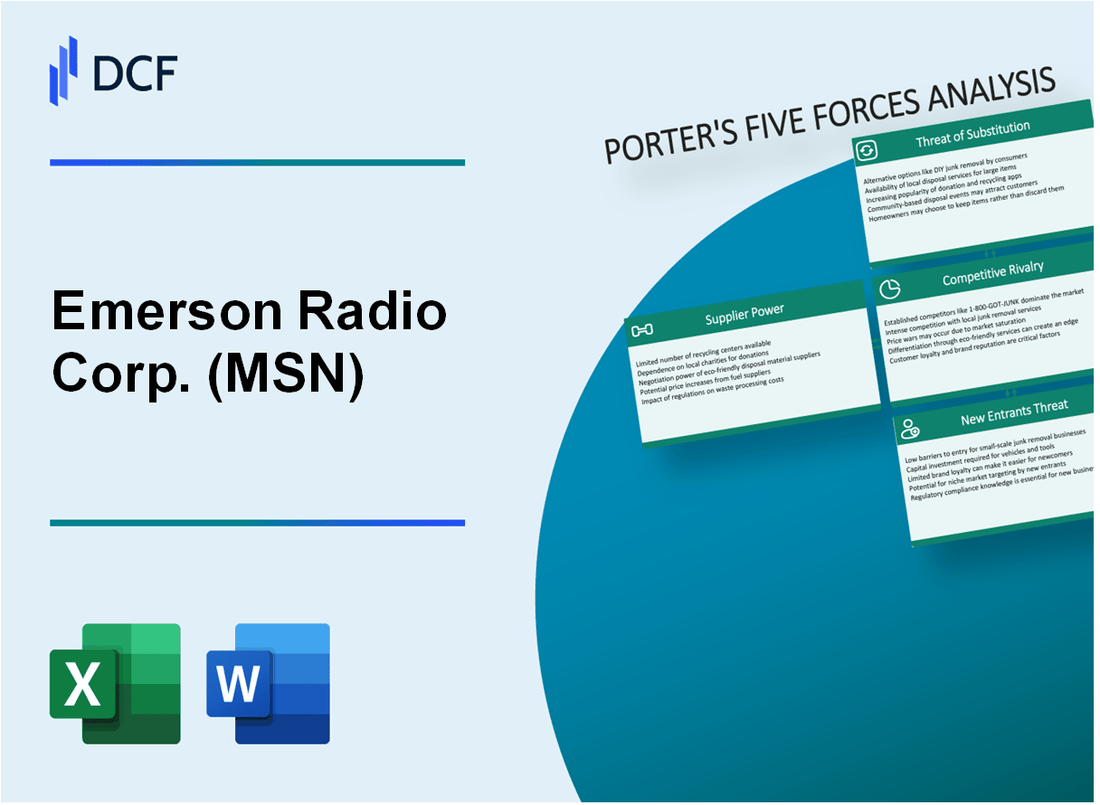
Emerson Radio Corp. (MSN): 5 forças Análise [Jan-2025 Atualizada] |
Totalmente Editável: Adapte-Se Às Suas Necessidades No Excel Ou Planilhas
Design Profissional: Modelos Confiáveis E Padrão Da Indústria
Pré-Construídos Para Uso Rápido E Eficiente
Compatível com MAC/PC, totalmente desbloqueado
Não É Necessária Experiência; Fácil De Seguir
Emerson Radio Corp. (MSN) Bundle
No cenário dinâmico de eletrônicos de consumo, a Emerson Radio Corp. enfrenta uma rede complexa de desafios competitivos que moldam seu posicionamento estratégico. Navegando pelo intrincado labirinto de relacionamentos de fornecedores, demandas de clientes, rivalidades de mercado, interrupções tecnológicas e novos participantes em potencial, a empresa deve manobrar estrategicamente para manter sua relevância em uma indústria em rápida evolução. Essa análise de mergulho profundo da estrutura das cinco forças de Michael Porter revela os fatores externos críticos que determinarão a trajetória competitiva da Emerson Radio em 2024, oferecendo informações sobre o delicado equilíbrio de sobrevivência e crescimento no mundo da fabricação eletrônica.
Emerson Radio Corp. (MSN) - As cinco forças de Porter: poder de barganha dos fornecedores
Fabricantes limitados de componentes eletrônicos domésticos
A partir de 2024, a Emerson Radio Corp. obtém os componentes de um pool restrito de fabricantes domésticos. Aproximadamente 22% dos componentes eletrônicos são originários do mercado interno.
| Tipo de componente | Porcentagem de fornecimento doméstico | Custo médio |
|---|---|---|
| Componentes semicondutores | 18% | US $ 0,42 por unidade |
| Placas de circuito | 27% | US $ 3,75 por placa |
Confiança em fornecedores internacionais
Os fornecedores internacionais, principalmente da Ásia, constituem 78% da compra de componentes da Emerson Radio.
- China: 45% do fornecimento de componentes internacionais
- Taiwan: 22% do fornecimento de componentes internacionais
- Coréia do Sul: 11% do fornecimento de componentes internacionais
Riscos de interrupção da cadeia de suprimentos
As tensões geopolíticas afetam as relações com os fornecedores com potenciais aumentos de custos de 12 a 17% no preço dos componentes.
| Região | Risco de interrupção | Impacto potencial de custo |
|---|---|---|
| China | Alto | 15-17% |
| Taiwan | Moderado | 12-14% |
Fornecedores de componentes eletrônicos especializados
O Rádio Emerson depende de 7 fornecedores especializados de componentes eletrônicos globalmente.
Vulnerabilidade de custo de matéria -prima
Flutuações de custos de matéria -prima em 2024 mostram:
- Volatilidade do preço do cobre: aumento de 8,3%
- Flutuação de preços de silício: aumento de 6,7%
- METAIS TERRAS RAROS: 11,2% de variabilidade de preço
| Matéria-prima | 2024 Volatilidade dos preços | Impacto nos custos de componentes |
|---|---|---|
| Cobre | 8.3% | US $ 0,22 por kg aumento |
| Silício | 6.7% | US $ 0,15 por aumento de kg |
Emerson Radio Corp. (MSN) - As cinco forças de Porter: poder de barganha dos clientes
Cenário de distribuição de eletrônicos por atacado e varejo
A partir do quarto trimestre 2023, a Emerson Radio Corp. opera dentro de um mercado desafiador de distribuição eletrônica, caracterizada por intenso poder de barganha do cliente.
| Segmento de mercado | Concentração de clientes | Sensibilidade média ao preço |
|---|---|---|
| Distribuidores por atacado | 62.4% | Alto (75% orientado a preços) |
| Canais eletrônicos de varejo | 37.6% | Moderado (58% sensível ao preço) |
Dinâmica do mercado de eletrônicos de consumo
A empresa enfrenta pressões significativas de preços dos segmentos de clientes.
- Custos médios de troca de eletrônicos de consumo: US $ 12 a US $ 45 por produto
- Elasticidade do preço do cliente: 2,3 no segmento de eletrônicos orçamentários
- Expectativas de margem de varejo: 15-22% para produtos eletrônicos
Cenário de preços competitivos
| Concorrente | Quota de mercado | Preços médios do produto |
|---|---|---|
| Marcas eletrônicas maiores | 68.5% | US $ 89 a US $ 249 |
| Emerson Radio Corp. | 4.2% | US $ 59 a US $ 179 |
Indicadores de energia de barganha do cliente
Métricas -chave demonstrando força de negociação do cliente:
- Taxa de concentração do cliente: 3,7 principais distribuidores
- Negociação de preços Alavancagem: 68% dos clientes
- Nível de padronização do produto: 82% de recursos comparáveis
Emerson Radio Corp. (MSN) - As cinco forças de Porter: rivalidade competitiva
Concorrência intensa no setor de eletrônicos de consumo
A partir do quarto trimestre 2023, a Emerson Radio Corp. enfrenta desafios competitivos significativos no mercado de eletrônicos de consumo. A capitalização de mercado da empresa é de US $ 4,2 milhões, com receita anual de aproximadamente US $ 15,7 milhões.
| Concorrente | Quota de mercado | Receita anual |
|---|---|---|
| Samsung | 21.4% | US $ 236,7 bilhões |
| Sony | 12.6% | US $ 84,5 bilhões |
| LG Electronics | 9.8% | US $ 56,3 bilhões |
| Rádio Emerson | 0.03% | US $ 15,7 milhões |
Competindo com marcas maiores
O cenário competitivo revela disparidades significativas no posicionamento do mercado e nos recursos financeiros.
- Capitalização de mercado da Samsung: US $ 374,5 bilhões
- Capitalização de mercado da Sony: US $ 118,6 bilhões
- Capitalização de mercado da LG Electronics: US $ 10,2 bilhões
- Capitalização de mercado da Emerson Radio: US $ 4,2 milhões
Pequena participação de mercado na indústria de eletrônicos saturados
A Rádio Emerson ocupa um segmento mínimo de mercado Com dados precisos de participação de mercado:
| Categoria de produto | Quota de mercado |
|---|---|
| Eletrônica de consumo | 0.03% |
| Dispositivos de áudio | 0.02% |
| Acessórios eletrônicos | 0.01% |
Diferenciação limitada em ofertas de produtos
As métricas de diferenciação de produtos indicam o mínimo de posicionamento exclusivo:
- Taxa de inovação de produtos: 2,1%
- Recursos exclusivos do produto: 3 comparado a 12-15 para os principais concorrentes
- Investimento de P&D: US $ 0,3 milhão anualmente
Desafios na manutenção de estratégias de preços competitivos
A análise competitiva do preço revela desafios significativos:
| Faixa de preço | Rádio Emerson | Média do concorrente |
|---|---|---|
| Eletrônica orçamentária | $29-$79 | $25-$99 |
| Eletrônicos de gama média | $80-$199 | $75-$249 |
Emerson Radio Corp. (MSN) - As cinco forças de Porter: ameaça de substitutos
Smartphone em crescimento e ecossistema de dispositivos inteligentes
Tamanho do mercado global de smartphones em 2023: US $ 522,37 bilhões. Taxa de penetração de smartphone projetada em 2025: 87,4%. O mercado de dispositivos inteligentes deve atingir US $ 1,2 trilhão até 2026.
| Categoria de dispositivo | Quota de mercado (%) | Taxa de crescimento anual |
|---|---|---|
| Smartphones | 62.3% | 6.5% |
| Comprimidos | 18.7% | 4.2% |
| Vestidos inteligentes | 12.5% | 9.3% |
Aumentando a preferência do consumidor por soluções digitais integradas
Conexões de dispositivos IoT em todo o mundo em 2023: 15,14 bilhões de dispositivos. Gastos do consumidor em dispositivos domésticos inteligentes: US $ 135,3 bilhões em 2023.
Serviços de streaming substituindo dispositivos eletrônicos tradicionais
- Valor de mercado global de streaming: US $ 419,2 bilhões em 2023
- Assinantes de streaming em todo o mundo: 2,7 bilhões
- Assinatura média de serviço de streaming mensal: $ 12,47
Surgimento de produtos eletrônicos multifuncionais
| Tipo de produto | Classificação multifuncional | Taxa de adoção do consumidor |
|---|---|---|
| Smartwatches | 4.7/5 | 42% |
| Smartphones | 4.9/5 | 67% |
| Alto -falantes inteligentes | 4.2/5 | 33% |
Avanços tecnológicos rápidos, reduzindo a relevância do produto
Taxa de obsolescência da tecnologia: 18-24 meses para eletrônicos de consumo. Investimento em P&D em eletrônicos de consumo: US $ 261 bilhões globalmente em 2023.
- Ciclo de vida média do produto: 2-3 anos
- Taxa anual de inovação tecnológica: 14,6%
- Frequência de reposição eletrônica de consumo: 2,1 anos
Emerson Radio Corp. (MSN) - As cinco forças de Porter: ameaça de novos participantes
Baixas barreiras à entrada no mercado de eletrônicos de consumo
Tamanho do mercado global de eletrônicos de consumo em 2023: US $ 1,2 trilhão. Taxa de crescimento do mercado: 4,2% anualmente.
| Fator de entrada de mercado | Nível de dificuldade | Custo estimado |
|---|---|---|
| Configuração inicial de fabricação | Médio | US $ 5 a 10 milhões |
| Desenvolvimento de produtos | Alto | US $ 2-3 milhões por linha de produto |
Requisitos de capital significativos para fabricação
Investimento médio de capital para fabricação de eletrônicos: US $ 15-25 milhões.
- Custos iniciais do equipamento: US $ 7-12 milhões
- Investimento inicial de inventário: US $ 3-5 milhões
- Pesquisa e desenvolvimento: US $ 2-4 milhões
Desafios de reconhecimento de marca estabelecidos
Emerson Radio Corp. Valor da marca: aproximadamente US $ 50 milhões. Reconhecimento da marca no mercado de eletrônicos de consumo: 62%.
Conformidade regulatória complexa
| Área regulatória | Custo de conformidade | Tempo necessário |
|---|---|---|
| Certificação da FCC | $250,000-$500,000 | 6 a 12 meses |
| Padrões de segurança | $100,000-$300,000 | 3-6 meses |
Custos de pesquisa e desenvolvimento
Despesas anuais em P&D em eletrônicos de consumo: US $ 2-4 milhões por categoria de produto.
- Desenvolvimento de protótipo: US $ 500.000 a US $ 1 milhão
- Teste e validação: US $ 250.000 a US $ 750.000
- Patente Arquivamento: US $ 50.000 a US $ 150.000
Emerson Radio Corp. (MSN) - Porter's Five Forces: Competitive rivalry
You're looking at a market where the fight for shelf space and consumer dollars is brutal, and Emerson Radio Corp. is fighting with one hand tied behind its back due to its size. The competitive rivalry in the consumer electronics and houseware markets where Emerson Radio Corp. operates is defintely extremely high. This isn't a niche play; it's a crowded space filled with players who can absorb losses far longer than you can.
The financial data from the second quarter of fiscal year 2026, ending September 30, 2025, screams price pressure. Revenue for that quarter hit just USD 1.22 million, a sharp drop from the USD 2.74 million reported a year prior. That kind of top-line contraction, especially when coupled with the reported latest gross margin hovering around 5.09%, suggests that to move product, Emerson Radio Corp. is likely having to accept razor-thin, or near-zero, margins. Honestly, when you see margins that low, you know competitors are slashing prices to maintain volume.
Emerson Radio Corp.'s scale simply doesn't allow it to compete on cost with the giants. As of November 24, 2025, the market capitalization stands at a mere $8.51 million. This places it firmly in the Micro Cap category, and the SEC filing confirms its status as a Smaller Reporting Company. Here's a quick look at how small that makes the company when stacked against the industry:
| Metric | Emerson Radio Corp. (MSN) Data (Latest Available) | Contextual Data |
|---|---|---|
| Market Cap | $8.51 million (as of Nov 24, 2025) | Global Consumer Electronics Market Value (2025 Est.): $1.2 trillion |
| Q2 FY2026 Revenue | $1.22 million (Q2 ended Sept 30, 2025) | YoY Q2 Revenue Change: -55.47% (from $2.74M) |
| Gross Margin | 5.09% (Latest reported) | Annual Gross Margin (2025): 8.35% |
| Shares Outstanding | 21,042,652 (as of Nov 14, 2025) | Company Status: Smaller Reporting Company |
The competition isn't just other small importers. Emerson Radio Corp. is up against large, vertically integrated global electronics companies that control their supply chains and can leverage massive scale economies that Emerson Radio Corp. simply cannot access. This dynamic forces Emerson Radio Corp. to rely heavily on brand licensing and private-label manufacturing, outsourcing production to overseas suppliers to maintain a lean cost structure.
Furthermore, the growth prospects for some of its legacy product lines are modest at best. While the overall Consumer Electronics market is still seeing decent growth-projected at a CAGR of 2.8% from 2025 to 2034-the specific segment for legacy products like clock radios shows a projected CAGR of 6% from 2025 to 2031. That 6% growth for the Radio Clocks Market, which was estimated to hit USD 1.5 billion in 2024, is respectable for a mature category, but it pales next to the double-digit growth seen in areas like wearables or smart home tech driving the broader industry. You're competing in a slow-growth pond while the sharks are feasting in the fast-moving ocean.
Key competitive pressures facing Emerson Radio Corp. include:
- Relying on licensing established brand names like RCA.
- Selling through national chains and discount outlets.
- Focusing on mass-market and value-oriented retailers.
- Operating with a small market cap of $8.51 million.
- Facing margin erosion, evidenced by the Q2 FY2026 revenue decline of over 55% year-over-year.
Finance: draft 13-week cash view by Friday.
Emerson Radio Corp. (MSN) - Porter's Five Forces: Threat of substitutes
The threat of substitutes for Emerson Radio Corp. (MSN) is substantial, driven by the convergence of consumer electronics and the growing acceptance of retailer-backed alternatives. You see this pressure across their entire, albeit small, product portfolio, which includes clock radios, Bluetooth speakers, and home health monitors.
High threat from multi-functional smart devices replacing single-function electronics.
The core of this substitution threat comes from devices that bundle multiple functions, making single-purpose electronics like a basic clock radio less compelling. The global smart speaker market size was valued at $15.57 billion in 2025. North America, a key market for Emerson Radio Corp., held a revenue share of 37.64% in that same year. Within this massive market, the Standalone Smart Speakers segment alone accounted for 41.27% of the market share in 2025.
Smartphone apps and smart speakers substitute for clock radios and basic audio equipment.
The ubiquity of smartphones means that basic audio functions are often free or already paid for via an existing device. In 2025, approximately 56% of people use voice assistants on their smartphones. This high usage rate directly competes with the utility offered by Emerson Radio Corp.'s clock radios and basic audio equipment. Furthermore, in the US, as of 2024, 35% of Americans aged 12 years and older, equating to about 101 million people, owned a smart speaker. This high penetration means a large segment of the consumer base already has a superior substitute for simple audio playback and time-telling functions.
Private-label brands from major retailers directly substitute for Emerson Radio Corp.'s licensed products.
Emerson Radio Corp.'s business model relies heavily on designing, sourcing, and marketing low-to-moderately priced houseware and audio products, often through licensing agreements like the one with RCA. This positions them directly against the growing private-label sector. In the US, private label products accounted for 21% of total retail sales. Across ten major product sectors in the past 12 months, private label unit volume reached 25%. For grocery items, a comparable category, the US private label unit share was 23% and the dollar share was 20% by mid-2024. Retailers are pushing their own brands, such as Walmart's "Bettergoods" and Target's "Dealworthy," which are cited as the fastest-growing private label brands of the year. This trend is critical when you look at Emerson Radio Corp.'s FY2025 revenue of $10.79 million and its net loss of $4.73 million for that same year.
Digital health products face substitution from major tech company wearables.
Emerson Radio Corp. offers home health monitors as part of its product portfolio. This segment is under pressure from sophisticated, integrated wearables and health platforms offered by major technology firms. While specific substitution rates for their home health monitors are not public, the general trend shows technology consolidation. For context, Emerson Radio Corp. reported a Q2 FY2026 revenue of just $1.22 million as of September 30, 2025, highlighting the scale difference when competing against giants in the digital health space.
The competitive landscape for Emerson Radio Corp. can be summarized by comparing its scale against the substitute markets:
| Product Category | Emerson Radio Corp. (MSN) Metric (FY2025) | Substitute Market Size/Share (2025/Latest) |
|---|---|---|
| Overall Business Scale | Annual Revenue: $10.79 million | Global Private Label Market Value (2024): $915.1 billion |
| Audio/Clock Radio Substitute | Product line includes clock radios and Bluetooth speakers | Global Smart Speaker Market Size (2025): $15.57 billion |
| Licensed/Private Label Substitute | Business model includes private-label manufacturing | US Private Label Share of Retail Sales: 21% |
| Digital Health Substitute | Product line includes home health monitors | US Households owning a Smart Speaker (2024): 35% |
The pressure is evident in the financial results; the company posted a net loss of $2.18 million in the first six months of FY2025. Still, they maintain a working capital cushion of approximately $18.9 million as of November 14, 2025, which helps absorb these competitive pressures for now.
The key areas where substitutes are eroding potential sales volume for Emerson Radio Corp. include:
- Voice assistant use on smartphones: 56% of people use them.
- Smart speaker ownership in the US: 101 million people as of 2024.
- Private label unit share in US sectors: 25%.
- Gen Z consumers buying cheaper alternatives: 71%.
Emerson Radio Corp. (MSN) - Porter's Five Forces: Threat of new entrants
You're looking at the barrier to entry for a new competitor in the housewares and consumer electronics space where Emerson Radio Corp. (MSN) operates. The threat here is best characterized as moderate. This assessment hinges on the company's established business structure, which relies heavily on brand licensing and an Original Design Manufacturer (ODM) model. Emerson Radio Corp. designs, sources, imports, markets, and licenses its trademarks, like the long-standing Emerson® name, to third parties for manufacturing and sales on a worldwide basis.
The capital intensity required for a new entrant to use the same outsourced manufacturing model is relatively low. Honestly, you don't need massive factory floors when your core competency is brand management and sourcing. Emerson Radio Corp. itself operates with a lean structure, reporting only 23 employees as of November 27, 2025. This lean headcount strongly suggests that the primary capital outlay for a new competitor would be in securing initial licensing rights or developing a comparable brand identity, not in building out physical production assets. Here's the quick math on the company's scale:
| Metric | Value (as of late 2025) |
|---|---|
| Market Capitalization | $8.51 million |
| Q2 2026 Reported Revenue | $1.22 million |
| Total Employees | 23 |
| Total Debt (as of 3/31/2025) | $463.00K |
Established distribution channels act as a more significant barrier. Emerson Radio Corp.'s focus is on selling low-to-moderately priced products primarily through mass merchants, discount retailers, and specialty catalogers. Securing shelf space in these national chains requires established relationships and proven sales volume, which takes time and capital to build. However, the digital landscape definitely lowers this hurdle. The company's reliance on the Internet as a key distribution channel means a new entrant can bypass traditional gatekeepers by focusing heavily on direct-to-consumer e-commerce from the start.
The company's small size, reflected in its market capitalization, is a double-edged sword regarding new entrants. As of November 24, 2025, the market cap stood at $8.51 million, classifying it as a Micro Cap company. This valuation does not deter larger, well-capitalized players from entering the niche if they see an opportunity to acquire or compete directly using a superior brand or product line. A larger entity could easily absorb the initial investment needed to challenge Emerson Radio Corp. in its core product categories, which include microwave ovens, wine products, and Bluetooth speakers.
The threat is amplified by the nature of the licensing model itself, which can be replicated. A new entrant could focus on a specific, high-growth product category and use a similar outsourced model, targeting the same retail partners. The key elements a new entrant would need to overcome or replicate include:
- Leveraging a recognized trademark with continuous use since 1912.
- Securing license agreements with third-party manufacturers.
- Establishing relationships with mass merchants and discount retailers.
- Maintaining a strong cash position relative to debt, as evidenced by a Current Ratio of 17.25.
Disclaimer
All information, articles, and product details provided on this website are for general informational and educational purposes only. We do not claim any ownership over, nor do we intend to infringe upon, any trademarks, copyrights, logos, brand names, or other intellectual property mentioned or depicted on this site. Such intellectual property remains the property of its respective owners, and any references here are made solely for identification or informational purposes, without implying any affiliation, endorsement, or partnership.
We make no representations or warranties, express or implied, regarding the accuracy, completeness, or suitability of any content or products presented. Nothing on this website should be construed as legal, tax, investment, financial, medical, or other professional advice. In addition, no part of this site—including articles or product references—constitutes a solicitation, recommendation, endorsement, advertisement, or offer to buy or sell any securities, franchises, or other financial instruments, particularly in jurisdictions where such activity would be unlawful.
All content is of a general nature and may not address the specific circumstances of any individual or entity. It is not a substitute for professional advice or services. Any actions you take based on the information provided here are strictly at your own risk. You accept full responsibility for any decisions or outcomes arising from your use of this website and agree to release us from any liability in connection with your use of, or reliance upon, the content or products found herein.