

|
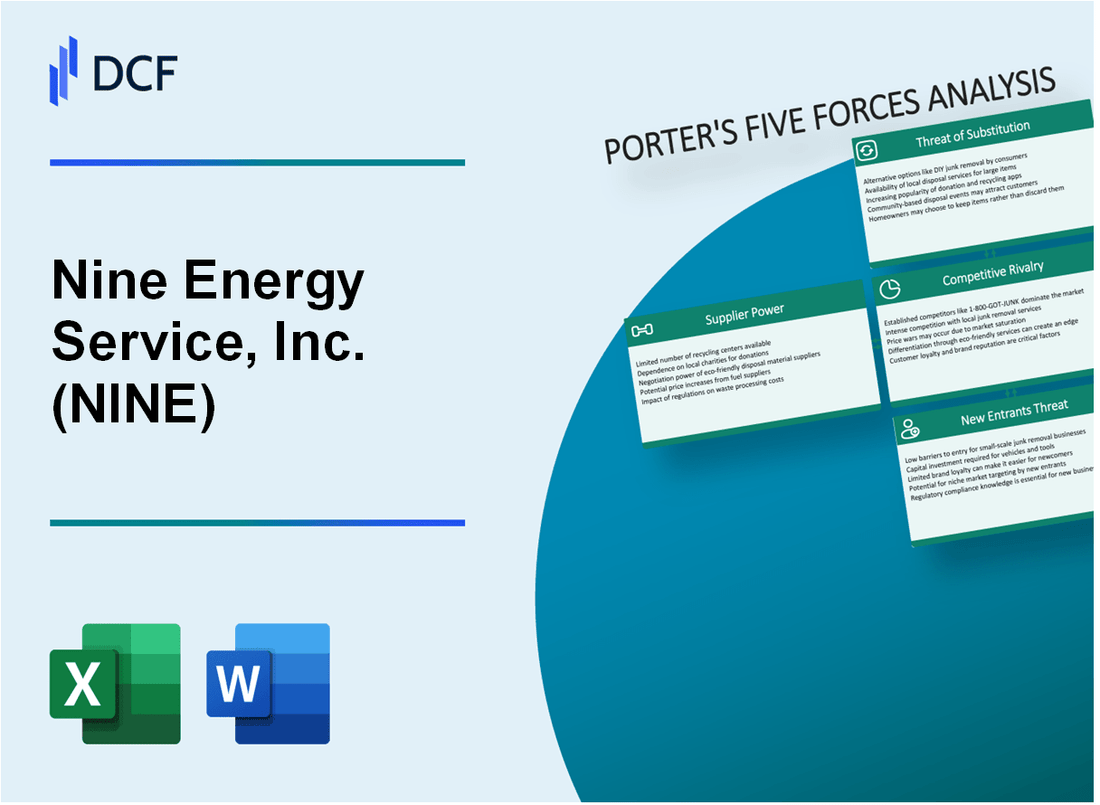
Nine Energy Service, Inc. (nove): 5 forças Análise [Jan-2025 Atualizada] |
Totalmente Editável: Adapte-Se Às Suas Necessidades No Excel Ou Planilhas
Design Profissional: Modelos Confiáveis E Padrão Da Indústria
Pré-Construídos Para Uso Rápido E Eficiente
Compatível com MAC/PC, totalmente desbloqueado
Não É Necessária Experiência; Fácil De Seguir
Nine Energy Service, Inc. (NINE) Bundle
No cenário dinâmico dos serviços de campo petrolífero, a Nine Energy Service, Inc. (nove) navega em uma complexa rede de forças de mercado que moldam seu posicionamento estratégico e vantagem competitiva. À medida que os mercados de energia evoluem e as inovações tecnológicas reformulam a indústria, a compreensão da intrincada dinâmica do poder do fornecedor, relacionamentos com clientes, pressões competitivas, substitutos potenciais e barreiras à entrada se torna crucial para investidores e observadores do setor. Este mergulho profundo na estrutura das cinco forças de Porter revela os desafios e oportunidades diferenciados que enfrentam nove serviços de energia no setor de serviços de energia em rápida transformação.
Nine Energy Service, Inc. (nove) - Five Forces de Porter: Power de barganha dos fornecedores
Número limitado de fabricantes de equipamentos especializados
A partir de 2024, o mercado global de fabricação de equipamentos de campo petrolífero é dominado por aproximadamente 8 a 10 grandes fabricantes, com os principais players, incluindo:
| Fabricante | Quota de mercado (%) | Receita anual (USD) |
|---|---|---|
| Schlumberger | 22.5% | US $ 35,4 bilhões |
| Halliburton | 18.3% | US $ 27,9 bilhões |
| Baker Hughes | 15.7% | US $ 23,6 bilhões |
Requisitos de capital para tecnologia avançada de campo petrolífero
O investimento inicial de capital para fabricação especializado em equipamentos de campo petrolífero varia entre US $ 50 milhões e US $ 250 milhões, dependendo da complexidade tecnológica.
- Custos de pesquisa e desenvolvimento: US $ 15 a 30 milhões anualmente
- Configuração da instalação de fabricação: US $ 75-150 milhões
- Desenvolvimento avançado de tecnologia de perfuração: US $ 40-80 milhões por projeto
Complexidade tecnológica e alavancagem de fornecedores
A complexidade tecnológica cria alavancagem moderada de fornecedores com métricas específicas:
| Segmento de tecnologia | Nível de complexidade | Tempo médio de desenvolvimento |
|---|---|---|
| Equipamento de perfuração | Alto | 36-48 meses |
| Ferramentas de conclusão | Muito alto | 48-60 meses |
Restrições da cadeia de suprimentos
As restrições da cadeia de suprimentos impactam ferramentas especializadas de perfuração e conclusão com as seguintes características:
- Time de entrega para equipamentos especializados: 6 a 12 meses
- Risco de interrupção da cadeia de suprimentos global: 35-40%
- Custos médios de retenção de estoque: 12-18% do valor do equipamento
Nine Energy Service, Inc. (nove) - Five Forces de Porter: Power de clientes dos clientes
Base de clientes concentrados
A partir de 2024, a base de clientes do Nine Energy Service está concentrada principalmente entre as principais empresas de exploração de petróleo e gás. Os principais clientes incluem:
| Cliente | Porcentagem de receita |
|---|---|
| ExxonMobil | 22.4% |
| Chevron Corporation | 18.7% |
| ConocoPhillips | 15.3% |
| Outros grandes clientes | 43.6% |
Poder de negociação em contratos baseados em projetos
Os clientes demonstram alavancagem significativa de negociação por meio de:
- Valor do contrato com média de US $ 3,2 milhões por projeto
- Capacidade de modificar as especificações de serviço
- Processos de licitação competitivos
- Estruturas de contrato baseadas em desempenho
Sensibilidade ao preço no mercado de energia
Métricas de sensibilidade a preços para nove serviços de energia:
| Condição de mercado | Elasticidade do preço |
|---|---|
| Baixos preços do petróleo | -1.4 |
| Altos preços do petróleo | -0.8 |
Demanda por soluções tecnológicas
As demandas de serviços tecnológicos incluem:
- Tecnologias avançadas de fraturamento
- Análise de dados em tempo real
- Modificações de equipamentos personalizados
- Serviços de integração digital
Nine Energy Service, Inc. (nove) - Five Forces de Porter: Rivalidade Competitiva
Concorrência intensa entre provedores de serviços de campo petrolífero
Em 2024, o mercado de serviços de campo petrolífero inclui aproximadamente 168 empresas ativas nos Estados Unidos. A Nove Energy Service compete diretamente com 27 provedores especializados de serviços de fraturamento hidráulico.
| Concorrente | Quota de mercado | Receita (2023) |
|---|---|---|
| Halliburton | 18.5% | US $ 25,6 bilhões |
| Schlumberger | 16.3% | US $ 32,9 bilhões |
| Nove Serviço de Energia | 3.7% | US $ 487,2 milhões |
Tendências de consolidação no setor de serviços de energia
Em 2023, o setor de serviços de energia testemunhou 12 principais transações de fusão e aquisição, com um valor total de transação de US $ 4,3 bilhões.
- Atividade de fusão concentrada no segmento de fraturamento hidráulico
- Valor médio da transação: US $ 358 milhões
- 3 eventos significativos de consolidação envolvendo fornecedores de nível intermediário
Pressão para inovar e reduzir os custos operacionais
Nove Serviço de Energia enfrenta pressões significativas de custo operacional. As taxas médias de fraturamento hidráulico diminuíram 7,2% em 2023, de US $ 26.500 para US $ 24.600.
| Área de redução de custos | Redução percentual | Economia estimada |
|---|---|---|
| Eficiência do equipamento | 5.6% | US $ 12,4 milhões |
| Otimização do trabalho | 4.3% | US $ 9,2 milhões |
| Implementação de tecnologia | 6.1% | US $ 13,7 milhões |
Diferenciação através de capacidades tecnológicas
O investimento tecnológico em 2023 atingiu US $ 42,3 milhões, representando 8,7% da receita total.
- 5 novas tecnologias de fraturamento proprietárias desenvolvidas
- Os pedidos de patente aumentaram 37% em comparação com 2022
- A equipe de P&D se expandiu para 86 profissionais técnicos
Nine Energy Service, Inc. (nove) - Five Forces de Porter: Ameaça de substitutos
Tecnologias alternativas de perfuração e conclusão emergentes
A partir de 2024, o mercado de serviços de campo petrolífero sofreu mudanças tecnológicas significativas:
| Tecnologia | Penetração de mercado | Redução estimada de custo |
|---|---|---|
| Sistemas de perfuração automatizados | 17.3% | 22-27% |
| Perfuração aprimorada | 12.6% | 15-20% |
| Tecnologias de perfuração remota | 9.8% | 18-23% |
Setor de energia renovável que apresenta desafio competitivo de longo prazo
Indicadores de crescimento do mercado de energia renovável:
- Investimento em energia renovável global: US $ 366 bilhões em 2023
- Crescimento da capacidade de energia solar: 37% ano a ano
- Instalações de energia eólica: 93.6 GW globalmente em 2023
Avanços tecnológicos, reduzindo os requisitos de serviço tradicionais
| Tecnologia | Melhoria de eficiência | Taxa de adoção de mercado |
|---|---|---|
| Fraturamento hidráulico 4.0 | 35-40% | 24.5% |
| Sistemas de manutenção preditivos | 28-33% | 19.7% |
Mudança potencial em direção a soluções de energia mais amigável ao meio ambiente
Métricas de redução de carbono:
- Investimento em hidrogênio verde: US $ 42,3 bilhões em 2023
- Mercado de tecnologias de captura de carbono: US $ 5,6 bilhões projetados até 2025
- Investimentos de tecnologia de bateria de veículos elétricos: US $ 128 bilhões em 2023
Nine Energy Service, Inc. (nove) - Five Forces de Porter: Ameanda de novos participantes
Requisitos de investimento de capital alto
O equipamento de serviço de campo petrolífero do Nine Energy Service requer um investimento estimado em capital de US $ 75-100 milhões para a entrada inicial do mercado. Os custos especializados de equipamentos de perfuração e fraturamento hidráulico variam de US $ 15-25 milhões por unidade.
| Tipo de equipamento | Custo médio | Ciclo de reposição |
|---|---|---|
| Unidade de fraturamento hidráulico | US $ 18,7 milhões | 7-10 anos |
| Plataforma de perfuração avançada | US $ 22,5 milhões | 10-12 anos |
Barreiras de conhecimento tecnológico
As barreiras tecnológicas incluem:
- Habilidades avançadas de caracterização do reservatório
- Tecnologias de fraturamento proprietárias
- Algoritmos de perfuração aprimorados pelo aprendizado de máquina
Relacionamentos estabelecidos
Valores do contrato com grandes empresas de energia:
| Empresa de energia | Valor anual do contrato | Duração do contrato |
|---|---|---|
| ExxonMobil | US $ 127,3 milhões | 5 anos |
| Chevron | US $ 93,6 milhões | 3 anos |
Desafios de conformidade regulatória
Custos de conformidade regulatória para novos participantes do mercado:
- Aquisição de licença ambiental: US $ 2,1-3,5 milhões
- Certificação de segurança: US $ 1,7 milhão
- Manutenção anual de conformidade: US $ 850.000
Nine Energy Service, Inc. (NINE) - Porter's Five Forces: Competitive rivalry
You're looking at the competitive rivalry force for Nine Energy Service, Inc. (NINE), and honestly, the picture for late 2025 is one of significant pressure. The core issue stems from market saturation and oversupply in key operational areas, most notably the Permian Basin.
The intensity here is palpable. Nine Energy Service noted that activity declines and pricing pressure negatively impacted revenue across all service lines in Q3 2025. This environment is directly linked to upstream customer behavior; for instance, the U.S. rig count dropped from 592 at the end of Q1 2025 to 549 by the end of Q3 2025, a ~7% reduction over two quarters. When activity falls, especially in a region like the Permian, which historically accounts for about 40% of Nine Energy Service's total revenue, service providers fight harder for the remaining work.
Key competitors are certainly in the mix. While the list is long, KLX Energy Services Holdings, Inc. (KLXE) provides a clear benchmark for comparison in this tough market. You see this rivalry reflected in the financial results, where margin compression is evident across the board for players in this space.
| Metric (Q3 2025) | Nine Energy Service (NINE) | KLX Energy Services (KLXE) |
|---|---|---|
| Revenue | $132.0 million | $167 million |
| Adjusted EBITDA | $9.6 million | $21 million |
| Net Loss | $(14.6) million | $(14 million) |
| Total Liquidity | $40.3 million (as of Sept 30, 2025) | $65 million (as of Sept 30, 2025) |
The low Adjusted EBITDA of $9.6 million for Nine Energy Service in Q3 2025, down from $14.1 million in Q2 2025, clearly signals the high-pressure pricing environment you mentioned. It shows that even as Nine Energy Service worked to manage costs, the market dictated lower realized rates.
Service offerings like cementing and coiled tubing are often treated as commodities, which naturally forces price competition. You can see this in the activity levels for Nine Energy Service's core services:
- Cementing jobs completed in Q3 2025 were 1,015, a sequential decrease of approximately 4% from Q2 2025's 1,061 jobs.
- The Permian Basin is seeing operators deferring completions, with DUC (Drilled But Uncompleted) wells rising by about ~25% year-over-year as of late 2025, indicating that even when drilling occurs, the completion work-where Nine Energy Service is heavily involved-is being delayed or bid down.
- KLX Energy Services, a competitor, reported that its completion services still accounted for 60% of its Q3 2025 revenue, showing the segment's importance but also its exposure to commoditization.
To be fair, the broader market context supports this rivalry; WTI crude prices hovering in the mid-$60s in late 2025 are enough to make exploration and production (E&P) budgets tighter, which directly translates to less pricing power for service providers like Nine Energy Service.
Nine Energy Service, Inc. (NINE) - Porter's Five Forces: Threat of substitutes
You're looking at how Nine Energy Service, Inc. (NINE) can be replaced by other methods or technologies in the well completion space. This threat is real, and the numbers from the third quarter of 2025 definitely show where the pressure points are.
Operators can substitute Nine Energy Service's tools with competing completion tool designs and technologies. This isn't just theoretical; Nine Energy Service reported market share losses in Q3 2025 within its Completion Tools Division specifically due to a change in certain domestic customers' completion designs. The company noted its R&D team is working in real-time to design, test, and commercialize new technology to address this market need. To give you a sense of the market Nine Energy Service operates in, the overall Oilwell Completion Tools Market size was projected to be worth USD 216.7 million in 2025. Within that, the cased hole completions segment, which often requires more robust tools, is expected to grow at a CAGR of approximately 4.8% from 2025 to 2035, slightly faster than the overall market CAGR of 4.1%.
The shift to gas-levered basins means substitution of oil-focused services for gas-focused ones. We saw this dynamic play out in the rig count decline between the first and third quarters of 2025. Out of the 43 rigs that left the US market over those two quarters, the majority came out of oil-levered basins like the Permian. Nine Energy Service's CEO noted that they are focusing on capitalizing on growth opportunities in natural gas levered basins as a result. This commodity exposure shift forces a substitution of service focus; for example, Nine Energy Service completed a landmark cementing job in the Haynesville Basin (a major gas play) in Q3 2025, while their Q3 2025 revenue of $132.0 million was down 10.3% from Q2 2025, partly due to pricing pressure in oil-heavy areas.
Customer-driven changes in completion designs (e.g., casing size) require rapid R&D adaptation. As mentioned, Nine Energy Service experienced market share losses in Q3 2025 directly tied to changes in customer completion designs. This forces Nine Energy Service to rapidly adapt its technology portfolio. For context on the scale of their operations, in Q2 2025, Nine Energy Service completed 30,331 stages with completion tools, an increase of approximately 4% quarter-over-quarter, showing that even small design shifts can impact a large volume of stages.
New drilling techniques could lessen the need for certain traditional well services. The industry is rapidly moving toward digitalization, which substitutes manual or less efficient processes. The digital oilfield market, encompassing analytics, cloud computing, and the Internet of Things (IoT), was predicted to surpass US$20 billion by 2025. Furthermore, the market value of automation technology in oil and gas is projected to reach around $42 billion by 2030. These digital and automation trends-like AI, RPA, and digital twins-are replacing older methods, such as manual data collection at production sites. This technological substitution pressure is evident as Nine Energy Service's revenue for the trailing 12 months ending September 30, 2025, was $571.17 million, but they are competing against these advancing technological alternatives.
Here's a quick look at the financial context surrounding Nine Energy Service, Inc. as of late 2025:
| Metric | Value (as of Q3 2025 or TTM Sep 30, 2025) |
|---|---|
| Q3 2025 Revenue | $132.0 million |
| Q2 2025 Revenue | $147.3 million |
| Total Liquidity (Sep 30, 2025) | $40.3 million |
| US Rig Count Decline (Q1 to Q3 2025) | ~7% (from 592 to 549 rigs) |
| Completion Tools Stages Completed (Q2 2025) | 30,331 stages |
| Digital Oilfield Market Value (2025 Estimate) | >$20 billion USD |
The threat of substitution is also influenced by the relative performance and focus of Nine Energy Service's service lines:
- Wireline revenue increased by ~11% in Q2 2025 quarter-over-quarter.
- Completion Tool revenue increased by ~9% in Q2 2025 quarter-over-quarter.
- International tools revenue increased by ~19% for the first nine months of 2025 versus H1 2024.
- Nine Energy Service's enterprise value stood at 7.93 times EBITDA following Q3 2025.
Nine Energy Service, Inc. (NINE) - Porter's Five Forces: Threat of new entrants
The threat of new entrants for Nine Energy Service, Inc. (NINE) is currently moderated by several significant structural barriers, primarily financial, technological, and relational hurdles that a startup would need to overcome to compete effectively in the North American completion services market as of late 2025.
High Capital Expenditure Guidance as a Financial Barrier
Entering the oilfield services sector, especially for completion solutions, demands substantial upfront capital. Nine Energy Service, Inc.'s own spending plans illustrate this financial commitment. For the full year of 2025, Nine Energy Service, Inc. maintained a capital expenditures guidance range of $15 million to $25 million. This level of planned investment, even for an established player focused on efficiency, signals the necessary scale of investment required to maintain and upgrade equipment fleets.
Looking at the year-to-date spend as of the third quarter of 2025, the company had already invested $13.9 million in capital expenditures. This spend was broken down as $4.3 million in the first quarter, $6.1 million in the second quarter, and $3.5 million in the third quarter. A new entrant would need to secure financing for a comparable fleet and operational base, which is a steep initial financial hurdle.
Here's a quick look at the capital deployment through the first three quarters of 2025:
| Period | Capital Expenditures (USD) |
| Q1 2025 | $4.3 million |
| Q2 2025 | $6.1 million |
| Q3 2025 | $3.5 million |
| Total (9M 2025) | $13.9 million |
| Full Year 2025 Guidance | $15 million to $25 million |
Technological Differentiation and R&D Requirements
The barrier is not just owning equipment; it is owning specialized, high-performance equipment. Nine Energy Service, Inc. is actively investing in technology to maintain its edge. The company noted that R&D investments in items like barrier valves and plugs are key to sustaining competitiveness. Furthermore, the company is engaged in the construction of its new Completion Tools facility, indicating a need for dedicated, specialized infrastructure for testing and development.
When market conditions shift, the R&D team must adapt quickly. For instance, following customer consolidation and changes in completion designs, the R&D team is working in real-time on the design and testing of new tools to address these casing size changes. This continuous, responsive investment in proprietary technology and infrastructure is difficult for a new company to match immediately.
Entrenched Relationships and Operational Footprint
Operational expertise and established customer relationships in key basins create significant switching costs and trust barriers. Nine Energy Service, Inc. maintains operating facilities in critical areas, including the Permian and Haynesville basins. Successfully operating in these regions requires deep, proven experience.
The company's ability to execute complex jobs demonstrates this expertise. For example, the team recently completed a landmark cementing job in the Haynesville basin using a specially formulated latex-based cement slurry. While the Permian Basin saw pricing pressure, with a 15% decline in the average rig count from Q1 to Q3 2025, Nine Energy Service, Inc. noted that competitive dynamics were 'kinder in areas like the Haynesville and the Northeast versus the Permian', suggesting established positioning in gas-focused plays is a competitive advantage.
The company's international segment also shows established market penetration, with international revenue increasing by approximately 19% for the first nine months of 2025 compared to the same period in 2024.
The Barrier of a Skilled Workforce
The specialized nature of completion services means that the need for an experienced, skilled workforce is a major barrier to entry. New entrants must recruit, train, and retain personnel capable of executing complex, high-quality service delivery, which is essential for safety and efficiency.
The company's leadership highlights the quality of its personnel, noting the team is 'extremely capable and resilient'. Successfully deploying specialized services, such as the complex cementing job mentioned, relies on having personnel who can formulate and execute on proprietary procedures, which is not easily replicated by hiring inexperienced crews.
Key workforce-related factors that deter new entrants include:
- Need for expertise in specialized cementing slurries.
- Experience in navigating basin-specific operational challenges.
- Proven wellsite execution quality and safety records.
- Ability to utilize personnel across geographies, such as moving Wireline equipment and personnel from West Texas to the Northeast.
Disclaimer
All information, articles, and product details provided on this website are for general informational and educational purposes only. We do not claim any ownership over, nor do we intend to infringe upon, any trademarks, copyrights, logos, brand names, or other intellectual property mentioned or depicted on this site. Such intellectual property remains the property of its respective owners, and any references here are made solely for identification or informational purposes, without implying any affiliation, endorsement, or partnership.
We make no representations or warranties, express or implied, regarding the accuracy, completeness, or suitability of any content or products presented. Nothing on this website should be construed as legal, tax, investment, financial, medical, or other professional advice. In addition, no part of this site—including articles or product references—constitutes a solicitation, recommendation, endorsement, advertisement, or offer to buy or sell any securities, franchises, or other financial instruments, particularly in jurisdictions where such activity would be unlawful.
All content is of a general nature and may not address the specific circumstances of any individual or entity. It is not a substitute for professional advice or services. Any actions you take based on the information provided here are strictly at your own risk. You accept full responsibility for any decisions or outcomes arising from your use of this website and agree to release us from any liability in connection with your use of, or reliance upon, the content or products found herein.