
|
NetApp, Inc. (NTAP): Análise de Pestle [Jan-2025 Atualizado] |
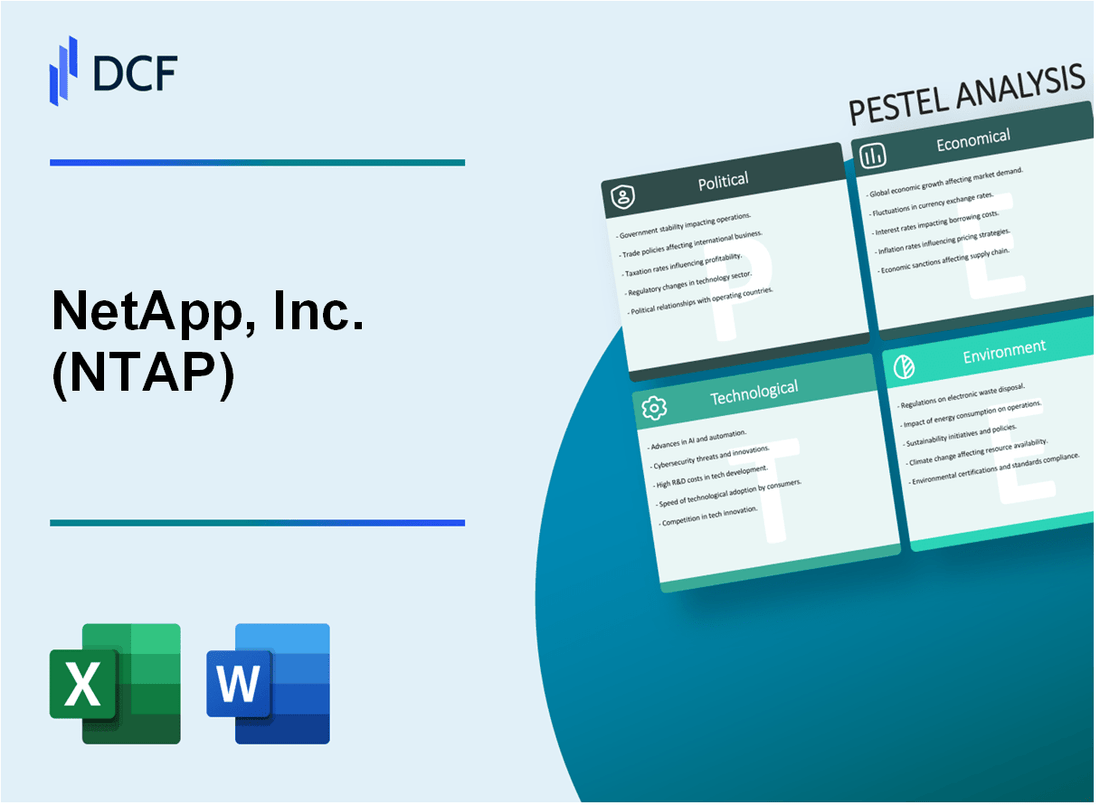
Totalmente Editável: Adapte-Se Às Suas Necessidades No Excel Ou Planilhas
Design Profissional: Modelos Confiáveis E Padrão Da Indústria
Pré-Construídos Para Uso Rápido E Eficiente
Compatível com MAC/PC, totalmente desbloqueado
Não É Necessária Experiência; Fácil De Seguir
NetApp, Inc. (NTAP) Bundle
No cenário dinâmico de tecnologia e gerenciamento de dados, a NetApp, Inc. (NTAP) fica na encruzilhada da inovação, desafios regulatórios e transformações globais no mercado. Essa análise abrangente de pilões revela os intrincados fatores externos que moldam a trajetória estratégica da empresa, explorando como as tensões políticas, mudanças econômicas, mudanças sociais, avanços tecnológicos, estruturas legais e considerações ambientais convergem para influenciar o ecossistema de negócios da NetApp. Mergulhe em uma exploração diferenciada das forças multifacetadas que impulsionam um dos fornecedores de armazenamento de dados e soluções em nuvem mais adaptáveis do setor de tecnologia.
NetApp, Inc. (NTAP) - Análise de Pestle: Fatores Políticos
Contratos de segurança cibernética do governo dos EUA e regulamentos de armazenamento de dados
NetApp possui vários contratos do governo federal, com US $ 487,3 milhões na receita federal do mercado no ano fiscal de 2023. A empresa garantiu 17 Contratos ativos federais de segurança cibernética e armazenamento de dados com várias agências governamentais.
| Tipo de contrato | Valor | Duração |
|---|---|---|
| Departamento de Contratos de Defesa | US $ 213,6 milhões | 2023-2025 |
| Soluções de armazenamento da agência civil | US $ 174,2 milhões | 2023-2024 |
Tensões comerciais de tecnologia americana-china
A receita internacional da NetApp afetou as restrições comerciais, com 12,4% de redução na receita do mercado chinês em 2023.
- A receita de mercado chinesa diminuiu de US $ 342 milhões em 2022 a US $ 299,8 milhões em 2023
- Custos de diversificação da cadeia de suprimentos estimados em US $ 47,6 milhões
- Investimento alternativo para locais de fabricação: US $ 63,2 milhões
Legislação de privacidade de dados impacto potencial
| Legislação | Custo potencial de conformidade | Linha do tempo da implementação estimada |
|---|---|---|
| Regulamentos aprimorados de proteção de dados | US $ 78,5 milhões | 2024-2026 |
| Alterações de privacidade de armazenamento em nuvem | US $ 52,3 milhões | 2024-2025 |
Tensões do setor de tecnologia geopolítica
A estratégia de expansão internacional da NetApp ajustada com US $ 114,7 milhões alocado para mitigação de riscos em mercados de tecnologia emergentes.
- Orçamento de expansão do mercado do Oriente Médio: US $ 42,6 milhões
- Investimento europeu de corredor de tecnologia: US $ 36,9 milhões
- Custos de entrada no mercado do Sudeste Asiático: US $ 35,2 milhões
NetApp, Inc. (NTAP) - Análise de Pestle: Fatores Econômicos
O crescimento contínuo do mercado de computação em nuvem oferece oportunidades significativas de expansão de receita
O tamanho do mercado global de computação em nuvem foi avaliado em US $ 490,3 bilhões em 2022 e deve atingir US $ 1.241,9 bilhões em 2028, com um CAGR de 16,7%.
| Segmento de mercado | 2022 Valor | 2028 Valor projetado | Cagr |
|---|---|---|---|
| Nuvem pública | US $ 272,8 bilhões | US $ 623,3 bilhões | 14.9% |
| Nuvem privada | US $ 131,5 bilhões | US $ 342,6 bilhões | 17.5% |
Flutuações econômicas no setor de tecnologia afetam potencialmente os padrões de gastos e investimentos de TI de TI
Os gastos da TI da empresa em 2023 foram estimados em US $ 4,84 trilhões globalmente, com crescimento projetado de 5,5% em 2024.
| Categoria de gastos | 2023 gastos | 2024 crescimento projetado |
|---|---|---|
| Software | US $ 911 bilhões | 7.2% |
| Serviços de TI | US $ 1,47 trilhão | 4.8% |
Alterações de inflação e taxa de juros afetam as despesas de capital para investimentos em infraestrutura de tecnologia
A taxa de juros do Federal Reserve dos EUA em janeiro de 2024 é de 5,25%-5,50%, impactando estratégias de investimento em infraestrutura de tecnologia.
| Investimento de infraestrutura de tecnologia | 2023 gastos | 2024 gastos projetados |
|---|---|---|
| Infraestrutura do data center | US $ 229 bilhões | US $ 247 bilhões |
As incertezas econômicas globais podem influenciar a modernização da tecnologia corporativa e os orçamentos de transformação digital
Os gastos com transformação digital em todo o mundo atingiram US $ 1,6 trilhão em 2022, com crescimento esperado para US $ 3,4 trilhões até 2026.
| Região | 2022 gastos de transformação digital | 2026 gastos projetados |
|---|---|---|
| América do Norte | US $ 584 bilhões | US $ 1,2 trilhão |
| Europa | US $ 392 bilhões | US $ 815 bilhões |
NetApp, Inc. (NTAP) - Análise de Pestle: Fatores sociais
Aumentar as tendências de trabalho remotas impulsionam a demanda por armazenamento de dados flexíveis e soluções de gerenciamento de nuvem
A partir do quarto trimestre 2023, 62,4% dos americanos empregados trabalhavam em casa pelo menos em período parcial. O mercado global de trabalho remoto deve atingir US $ 4,5 trilhões até 2026.
| Estatística de trabalho remoto | Porcentagem/valor |
|---|---|
| Trabalhadores remotos globais | 16,8% da força de trabalho global total |
| Crescimento do mercado de armazenamento em nuvem corporativa | 18,5% CAGR de 2022-2027 |
| Investimento médio de armazenamento em nuvem por empresa | US $ 3,2 milhões anualmente |
A crescente conscientização da cibersegurança aumenta o interesse corporativo em sofisticadas tecnologias de proteção de dados
Em 2023, Os gastos globais de segurança cibernética atingiram US $ 215 bilhões. Os violações de dados custam as empresas em média US $ 4,45 milhões por incidente.
| Métrica de segurança cibernética | Valor |
|---|---|
| Danos anuais de crimes cibernéticos | US $ 8,15 trilhões globalmente |
| Empresas implementando segurança avançada | 73% das empresas da Fortune 500 |
| Tendência de investimento de proteção de dados | 12,7% aumento ano a ano |
As mudanças geracionais no local de trabalho requerem infraestrutura tecnológica adaptável e plataformas de colaboração
Millennials e Gen Z constituem 46% da força de trabalho em tempo integral em 2024. O mercado de tecnologia de colaboração deve atingir US $ 69,5 bilhões até 2025.
| Demografia da força de trabalho | Percentagem |
|---|---|
| Millennials na força de trabalho | 35.8% |
| Gen Z na força de trabalho | 10.2% |
| Adoção da plataforma de colaboração digital | 87% das empresas |
A crescente consciência da sustentabilidade influencia as decisões de compras de tecnologia corporativa
78% dos consumidores preferem empresas ambientais responsáveis. O mercado global de tecnologia sustentável projetada em US $ 417,8 bilhões até 2028.
| Métrica de sustentabilidade | Valor |
|---|---|
| Investimento de sustentabilidade corporativa | US $ 23,9 bilhões em 2023 |
| Crescimento do mercado de TI verde | 16,3% CAGR |
| Alvo de redução de carbono | 45% até 2030 para empresas de tecnologia |
NetApp, Inc. (NTAP) - Análise de Pestle: Fatores tecnológicos
Investimento contínuo em inteligência artificial e tecnologias de gerenciamento de dados de aprendizado de máquina
A NetApp investiu US $ 702 milhões em P&D durante o ano fiscal de 2023, concentrando -se nas tecnologias de IA e aprendizado de máquina. As soluções de gerenciamento de dados orientadas pela AI da empresa geraram aproximadamente US $ 1,2 bilhão em receita em 2023.
| Categoria de investimento em tecnologia | Valor do investimento (2023) | Impacto de receita |
|---|---|---|
| Gerenciamento de dados da IA | US $ 352 milhões | US $ 612 milhões |
| Soluções de aprendizado de máquina | US $ 250 milhões | US $ 588 milhões |
Expandindo soluções híbridas em nuvem para atender aos diversos requisitos de infraestrutura de computação corporativa
O portfólio de nuvem híbrido da NetApp se expandiu para suportar 78% das empresas da Fortune 500 em 2023. A receita em nuvem da empresa atingiu US $ 2,4 bilhões, representando um crescimento de 22% ano a ano.
| Tipo de solução em nuvem | Taxa de adoção do cliente | Contribuição da receita |
|---|---|---|
| Infraestrutura em nuvem híbrida | 78% da fortuna 500 | US $ 1,6 bilhão |
| Serviços de dados em nuvem | 65% de penetração corporativa | US $ 800 milhões |
Foco aumentando na computação de borda e arquiteturas de armazenamento de dados distribuídos
A NetApp implantou soluções de computação de borda para 42% das empresas de telecomunicações e investiram US $ 215 milhões em desenvolvimento de tecnologia de Edge em 2023.
| Segmento de computação de borda | Penetração de mercado | Investimento |
|---|---|---|
| Telecomunicações | 42% de cobertura do mercado | US $ 125 milhões |
| Soluções de borda de fabricação | 35% de adoção no mercado | US $ 90 milhões |
Desenvolvimento de tecnologias avançadas de segurança cibernética e proteção de dados para ambientes corporativos complexos
A NetApp alocou US $ 180 milhões para o desenvolvimento de tecnologia de segurança cibernética em 2023, protegendo mais de 20.000 clientes corporativos em todo o mundo.
| Tecnologia de segurança cibernética | Investimento | Escopo de proteção ao cliente |
|---|---|---|
| Soluções de criptografia de dados | US $ 85 milhões | 15.000 clientes corporativos |
| Proteção de ransomware | US $ 95 milhões | 5.000 clientes corporativos |
NetApp, Inc. (NTAP) - Análise de Pestle: Fatores Legais
Conformidade com os regulamentos internacionais de proteção de dados
Métricas de conformidade do GDPR:
| Regulamento | Investimento de conformidade | Custos anuais de conformidade |
|---|---|---|
| GDPR | US $ 4,2 milhões | US $ 1,7 milhão por ano |
| CCPA | US $ 3,8 milhões | US $ 1,5 milhão por ano |
Proteção à propriedade intelectual
Estatísticas do portfólio de patentes:
| Categoria de patentes | Número de patentes | Investimento anual de P&D |
|---|---|---|
| Tecnologias de armazenamento | 287 | US $ 682 milhões |
| Gerenciamento de nuvem | 163 | US $ 412 milhões |
Considerações antitruste
Análise de participação de mercado:
| Segmento de mercado | Participação de mercado do NetApp | Participação de mercado da concorrente principal |
|---|---|---|
| Armazenamento corporativo | 12.4% | Dell Technologies (18,7%) |
| Armazenamento em nuvem | 8.6% | Amazon Web Services (33,2%) |
Riscos legais de privacidade e segurança de dados
Métricas de gerenciamento de riscos legais:
| Categoria de risco | Despesas legais anuais | Cobertura de seguro |
|---|---|---|
| Litígios de segurança cibernética | US $ 6,3 milhões | US $ 50 milhões |
| Potencial de violação de dados | US $ 4,9 milhões | US $ 35 milhões |
NetApp, Inc. (NTAP) - Análise de Pestle: Fatores Ambientais
Compromisso em reduzir a pegada de carbono por meio de tecnologias de data center com eficiência energética
O NetApp relatou uma redução de 32% no escopo absoluto 1 e 2 emissões de gases de efeito estufa até 2022 em comparação com a linha de base de 2019. A empresa alcançou 100% de compra de energia renovável para operações globais em 2022.
| Métrica | 2022 Valor | Alvo de redução |
|---|---|---|
| Redução de emissões de carbono | 32% | 50% até 2030 |
| Compras de energia renovável | 100% | Mantido anualmente |
| Melhoria da eficiência energética | 15% | 25% até 2025 |
Implementando práticas sustentáveis de gerenciamento de fabricação e ciclo de vida do produto
O NetApp implementou os princípios da economia circular, com 99,5% do hardware retornado através de programas de recuperação de ativos sendo reutilizados ou reciclados em 2022.
| Métrica de gerenciamento do ciclo de vida | 2022 Performance |
|---|---|
| Taxa de reutilização/reciclagem de hardware | 99.5% |
| Embalagem de produtos Conteúdo reciclado | 85% |
| Resíduos eletrônicos desviados de aterros sanitários | 97% |
Apoiando as metas de sustentabilidade dos clientes corporativos através de soluções de tecnologia verde
As tecnologias de eficiência de armazenamento da NetApp ajudaram os clientes a reduzir aproximadamente 1,3 milhão de toneladas de CO2 equivalentes em 2022 por meio de um melhor consumo de energia do data center.
| Impacto de sustentabilidade do cliente | 2022 Métricas |
|---|---|
| Redução equivalente a CO2 | 1,3 milhão de toneladas métricas |
| Economia de energia do cliente | US $ 42 milhões |
| Índice de eficiência de armazenamento | 5:1 |
Desenvolvendo infraestrutura de armazenamento e computação em nuvem com eficiência energética
As mais recentes soluções de armazenamento da NetApp demonstram eficiência de energia de 0,06 watts por terabyte, significativamente abaixo da média do setor de 0,15 watts por terabyte.
| Métrica de eficiência da infraestrutura | Desempenho do netApp | Média da indústria |
|---|---|---|
| Eficiência de poder | 0,06 watts/tb | 0,15 watts/tb |
| Redução da pegada de carbono em nuvem | 40% | 25% |
| Desempenho energético do data center | 85% de eficiência | 75% de eficiência |
NetApp, Inc. (NTAP) - PESTLE Analysis: Social factors
You're seeing the social landscape shift from a quiet backdrop to a major driver of enterprise IT spending, and NetApp, Inc. is right in the middle of it. The key takeaway for 2025 is that social pressures-from the talent crunch to ESG demands and the pervasive cyber threat-are no longer soft issues; they are hard-dollar risks and opportunities that directly influence product roadmaps and revenue growth.
Persistent talent war for specialized AI and Cloud engineering expertise.
The race for specialized Artificial Intelligence (AI) and cloud engineering talent is a massive headwind for every tech company, NetApp included. With the company's strategic focus on its AI Data Engine (AIDE) and the new NetApp AFX storage for AI workloads, the demand for engineers skilled in data pipelines, machine learning operations (MLOps), and hybrid cloud architecture is acute. Honestly, the best talent is commanding a premium, and that raises our operating costs.
To be fair, NetApp is making a move to build its own pipeline. In fiscal year 2025 (FY25), the company's social impact work focused on expanding access to data and AI literacy, reaching 500,000 students worldwide. Here's the quick math: that's a 452% increase in student outreach from the prior year, a clear long-term action to defintely address the talent gap.
Shift to remote/hybrid work increasing demand for secure, distributed data access.
The global shift to hybrid work is permanent, and it's driving a massive, sustained demand for NetApp's core hybrid cloud solutions. When your employees are working from a coffee shop, a home office, or a satellite location, the data needs to be accessible, fast, and secure everywhere. This social trend is a direct tailwind for NetApp's Public Cloud segment, which saw its revenue grow by a staggering 43% in FY25 to $665 million.
The company's product strategy is mapping directly to this need by creating a unified data experience across environments.
- Global Data Access: New FlexCache capabilities in NetApp Volumes unify data across on-premises and public cloud environments, giving users a single, low-latency access point.
- Operational Simplicity: The NetApp Console unifies the control plane for data services, storage, and resilience across hybrid and multi-cloud environments, simplifying management for lean IT teams.
- Workload Mobility: The Shift Toolkit allows customers to move virtual machines (VMs) between different hypervisors in minutes, a crucial feature for flexible, distributed workforces.
Growing investor and customer pressure on Environmental, Social, and Governance (ESG) metrics.
ESG is no longer a marketing exercise; it's a fiduciary duty that investors and major enterprise customers are scrutinizing. NetApp's 2025 Impact Report confirms this trend, detailing concrete progress that impacts the bottom line through efficiency and risk mitigation.
In FY25, the company's operational focus on sustainability led to a 6% year-over-year reduction in Scope 1 and 2 emissions, bringing the total reduction to 41% since 2020. This is a clear indicator that efficiency and environmental responsibility are now intertwined. Also, customers are demanding transparency, so NetApp now provides a sustainability dashboard within the NetApp Console to give them real-time insights into their own data storage energy use and greenhouse gas (GHG) emissions.
Increased focus on data resilience and security due to rising cyber-threat awareness.
Cyber-threat awareness is at an all-time high, driven by the sheer scale and sophistication of ransomware attacks. This social anxiety around data loss translates directly into higher spending on data resilience solutions. A NetApp report noted that 41% of global technology executives predicted a sharp increase in security threats in 2025 alongside the growing adoption of AI.
NetApp is responding by embedding security into the storage layer itself, moving beyond simple backup to a proactive, AI-driven defense posture. This is a must-have, not a nice-to-have, for any enterprise.
| NetApp FY25 Cyber Resilience Action | Key Capability | Impact on Customer |
|---|---|---|
| Enhanced Ransomware Resilience service (Oct 2025) | AI-driven data breach detection | Detects anomalous user/file behavior in primary storage in seconds to minutes, not hours. |
| Isolated Recovery Environments | Guided, malware-free workload restoration | Ensures a clean recovery point, preventing reinfection and minimizing downtime. |
| Ransomware Recovery Guarantee | Financial commitment to data recoverability | Provides a layer of financial and operational assurance against unrecoverable data loss. |
The goal is to make resilience a continuous posture built into the data platform, which is what customers need to sleep at night.
NetApp, Inc. (NTAP) - PESTLE Analysis: Technological factors
The technological landscape for NetApp, Inc. (NTAP) in 2025 is defined by three converging, high-growth vectors: the data requirements of Artificial Intelligence (AI), the imperative of hybrid multi-cloud deployment, and the non-negotiable need for cyber-resilience. NetApp's strategy is positioned to capitalize on these shifts, evidenced by its record performance in key growth areas during fiscal year 2025 (FY25).
Massive growth in unstructured data from Artificial Intelligence (AI) and Machine Learning (ML) workloads
The most significant technological tailwind is the explosion of unstructured data, driven by the scaling of Large Language Models (LLMs) and other AI/ML workloads. This isn't the data growth of past decades; it's a new challenge of machine-generated data that requires specialized, high-performance storage. Honesty, the real value in AI is shifting from compute power to the data infrastructure that feeds it.
NetApp is actively addressing this, with its CEO noting the company is positioned to lead in the enterprise AI market. This focus is translating into concrete deal flow: NetApp closed over 125 AI infrastructure and data lake modernization deals in the first quarter of fiscal year 2026 (Q1 FY26), a substantial increase from approximately 50 in the prior-year period. This shows a clear acceleration in customer adoption for AI-ready data solutions. What this estimate hides, however, is the long sales cycle and intense competition in these large-scale AI infrastructure deals.
To be fair, the industry is still in the early stages of scaling AI: 40% of global technology executives believe unprecedented investment in AI and data management will be required in 2025 to scale their AI capabilities. NetApp's core value proposition here is data unification, which 79% of global tech executives acknowledge as pivotal for achieving optimal AI outcomes, as AI models are worthless if they can't access all the necessary training data.
Dominance of hybrid and multi-cloud architectures requiring seamless data mobility
The hybrid cloud model-combining on-premises infrastructure with multiple public cloud services-is now the default enterprise architecture. The global hybrid cloud market is a massive opportunity, valued at approximately $172.77 billion in 2025, and is forecast to grow at a Compound Annual Growth Rate (CAGR) of 12.53% through 2030. Gartner projects that 90% of organizations will adopt a hybrid cloud approach through 2027. This shift is a direct opportunity for NetApp's Cloud Volumes and ONTAP software, which provide the data fabric (a unified data management layer) to move and manage data across these disparate environments.
NetApp's financial results reflect its success in this domain. Its first-party and marketplace Public Cloud services revenue for fiscal year 2025 reached a record $416 million, representing a sharp 43% year-over-year increase. This segment's growth significantly outpaced the company's overall net revenue growth of 5% to $6.57 billion in FY25, confirming the strategic importance of its cloud-agnostic data services. You need to focus on this growth rate; it's the fastest part of the business.
Rapid market transition to all-flash storage arrays for performance
The transition from mechanical hard disk drives (HDDs) to all-flash arrays (AFA) is accelerating, driven by the low-latency performance demands of AI, real-time analytics, and modern databases. The global AFA market size is estimated to be between $23.38 billion and $24.68 billion in 2025, with a robust CAGR of around 18.85% through 2030.
NetApp has been a major beneficiary of this trend. Its All-Flash Array Annualized Net Revenue Run Rate (ARR) hit a record $4.1 billion in fiscal year 2025, marking a 14% year-over-year increase. This strength propelled NetApp to achieve the number one market share position in the all-flash array market for calendar Q1 2025. This leadership position is critical, as AFA sales represent the modernization entry point for most enterprise storage deals.
| Metric (Fiscal Year 2025) | Value/Amount | Year-over-Year Growth |
|---|---|---|
| Total Net Revenues | $6.57 billion | 5% |
| All-Flash Array (AFA) ARR | $4.1 billion | 14% |
| Public Cloud Services Revenue | $416 million | 43% |
Innovation in cyber-resilience and ransomware recovery solutions
Ransomware remains the top organizational cyber risk for 2025, with 41% of global tech executives predicting a sharp increase in security threats alongside AI adoption. The financial stakes are enormous, as the average cost of post-cyberattack downtime exceeds $300K/hour for large enterprises. Consequently, the global ransomware protection market is growing rapidly, with a projected CAGR of 15.8% from 2025 to 2033.
NetApp is integrating cyber-resilience directly into its data infrastructure, moving beyond traditional backup. The company is focused on 'Innovation in cyber resilience with AI-driven threat detection,' which allows for real-time anomaly detection and rapid recovery. This strategic integration is crucial because customers are demanding immutable storage and automated recovery as a core feature, not an add-on. NetApp's product strategy is centered on making the storage system itself the final line of defense. The next step is for the Product team to defintely publish a clear ROI calculator showing the cost-avoidance of their recovery solutions versus the $300K/hour downtime figure.
- Ransomware remains the top organizational cyber risk in 2025.
- 41% of executives predict a sharp rise in security threats in 2025.
- Average downtime cost for large enterprises is over $300K/hour.
NetApp, Inc. (NTAP) - PESTLE Analysis: Legal factors
Expanding Global Data Sovereignty and Privacy Laws
The proliferation of global data privacy and sovereignty laws is fundamentally reshaping the data storage market, directly impacting NetApp's product strategy. You are seeing a clear regulatory push for data localization, where information must be stored and processed within the borders of its originating country.
For example, the European Union's General Data Protection Regulation (GDPR) and the California Consumer Privacy Act (CCPA), along with the California Privacy Rights Act (CPRA), necessitate sophisticated data classification and control. This is a massive operational challenge for global enterprises, but it's a clear opportunity for NetApp, whose products are designed to address this complexity. Specifically, 72% of European businesses in 2025 consider data sovereignty a top strategic priority, often favoring EU-based cloud solutions to mitigate risks from foreign laws like the US CLOUD Act.
The new EU Data Act, which becomes applicable starting September 2025, adds another layer by mandating greater data portability and interoperability, forcing cloud providers to facilitate seamless switching. NetApp's value proposition is now inextricably linked to its ability to manage data across these fragmented jurisdictions.
Increased Risk of Intellectual Property and Patent Litigation
The intense competition in the high-growth, all-flash array and cloud data management sectors means the risk of intellectual property (IP) and patent litigation is acutely high. The data storage industry is a battleground for proprietary technology, and the near-term is marked by significant legal action.
A concrete example from late 2025 illustrates this risk: NetApp filed a major federal lawsuit on November 6, 2025, against its former CTO, Jón Stefánsson, alleging he stole trade secrets to benefit a rival, Vast Data, which acquired his startup, Red Stapler. This litigation focuses on the alleged misuse of IP related to NetApp's cloud data management stack. Another ongoing patent dispute is NetApp, Inc. v. Valtrus Innovations Ltd. et al, with court filings dating to 2025, highlighting the continuous threat from non-practicing entities (NPEs) and competitors. This kind of litigation is expensive, distracting, and can result in significant financial exposure.
Compliance Costs Rising Due to Government-Mandated Data Retention and Audit Trails
The cost of compliance is not a discretionary expense; it's a non-negotiable operational cost that is rising globally due to stricter government mandates on data retention and audit trails. Regulations like the Sarbanes-Oxley Act (SOX), HIPAA (for healthcare data), and various financial regulations require immutable, long-term storage and detailed audit logs.
For a company like NetApp, the compliance burden is twofold: ensuring its own internal operations are compliant and, more importantly, building compliance features into its products for customers. NetApp addresses this with solutions like SnapLock Compliance software, which supports regulatory and legal requirements for data retention and immutability. While a precise, isolated compliance cost figure is not disclosed, the sheer scale of the legal and compliance function is a significant operational expenditure. For context, NetApp reported a GAAP net income of $1.19 billion and a non-GAAP operating profit of $1.86 billion for the full fiscal year 2025, indicating the magnitude of the business that must be protected by these rising compliance investments.
Cloud Service Liability Clauses Becoming a Major Point of Contract Negotiation
As customers shift mission-critical data to the cloud, the fine print of cloud service contracts, particularly liability clauses, is under intense scrutiny. The traditional shared responsibility model is evolving, with regulators now expecting customers to take greater ownership of third-party risk, meaning they push back harder on vendor liability limits.
Key contractual negotiation points for cloud storage in 2025 include:
- Service Level Agreements (SLAs): Tighter performance and uptime guarantees, often tied to financial penalties.
- Incident Reporting: The EU's NIS-2 Directive mandates cloud providers have robust risk management and incident reporting, often requiring notification within 24 hours of a significant incident.
- Data Egress Fees: A major commercial clause, as 89% of organizations with multi-cloud strategies are hindered by unpredictable egress fees. The trend is toward transparent pricing models with zero egress fees to avoid vendor lock-in.
This increased scrutiny means NetApp must defintely invest in clearer, more customer-favorable liability terms and detailed compliance documentation to win large enterprise contracts. The legal team's ability to negotiate these terms directly impacts sales velocity and customer lock-in.
Here's the quick math on the compliance-driven market shift:
| Legal/Regulatory Driver (2025) | NetApp Product/Response | Impact on Business/Risk |
|---|---|---|
| Data Sovereignty (GDPR, CCPA, EU Data Act) | BlueXP Classification, Cloud Volumes ONTAP | Opens new markets (e.g., 72% of EU firms prioritizing sovereignty); requires localized data infrastructure. |
| IP Litigation Risk | Internal Legal/Litigation Budget | Direct cost of litigation (e.g., November 2025 suit against former CTO); risk of losing key IP. |
| Data Retention Mandates (HIPAA, SOX) | SnapLock Compliance Software | Increases compliance feature revenue; raises internal operational and legal overhead. |
| Cloud Liability/NIS-2 Directive | Enhanced SLAs, Transparent Pricing Models | Contract negotiations become more complex; pressure to eliminate high egress fees for multi-cloud customers. |
NetApp, Inc. (NTAP) - PESTLE Analysis: Environmental factors
Data center energy consumption driving demand for power-efficient storage hardware.
The energy demands of data centers, especially with the surge in Artificial Intelligence (AI) workloads, are now a primary financial and environmental risk for every enterprise. Global data center electricity consumption, which was around 415 TWh annually in 2024, is anticipated to more than double to 945 TWh by 2030. This isn't just a green issue; it's a CapEx issue. You simply cannot afford to build out inefficient infrastructure when power costs are escalating.
NetApp is positioned to capitalize on this pressure by focusing on power efficiency as a core product feature. Their all-flash arrays, for instance, are engineered to consume up to 43% less energy than competitive offerings. Plus, the subscription-based Keystone service helps customers avoid overprovisioning, which is a major source of wasted energy, by allowing them to pay for performance and capacity tiers as needed. That's a clear return on investment for choosing the greener option.
Increased reporting requirements for Scope 3 emissions in the supply chain.
Regulators and investors are forcing companies to look beyond their own four walls, making Scope 3 emissions (value chain emissions) a critical metric. For a hardware and cloud-integrated company like NetApp, the largest component of this is the 'use of sold products' category. Honestly, this is where the real work is for the storage industry.
NetApp has made a significant, measurable commitment here, validated by the Science Based Targets initiative (SBTi) in January 2025. Their goal is to reduce Scope 3 emissions from the use of sold products by 51.6% per effective petabyte shipped by 2030, using a Fiscal Year 2023 baseline. In Fiscal Year 2025, they already achieved a 42% reduction in Scope 3 emissions. This progress is a strong signal of execution against a tough target.
| Emissions Scope | FY2025 Reduction Achieved (vs. Baseline) | FY2030 Target Reduction (vs. Baseline) | Baseline Year |
|---|---|---|---|
| Scope 1 & 2 (Operational) | 41% reduction | 50.8% absolute reduction | FY2020 |
| Scope 3 (Use of Sold Products) | 42% reduction | 51.6% per effective petabyte shipped | FY2023 |
Customer preference for vendors with clear, measurable sustainability goals.
The shift in customer preference isn't subtle; it's driving purchasing decisions. IDC research confirms that sustainability objectives are of high importance for 74% of organizations, and more than 60% will require data center providers to disclose energy usage and renewable energy sources by the end of 2025. This is a mandate, not a suggestion.
NetApp is responding by integrating sustainability directly into the customer experience. They provide detailed, product-level environmental data for hardware purchases. More importantly, the NetApp Console now includes a sustainability dashboard, giving customers real-time insights into the environmental impact of their data storage operations, including energy consumption and GHG emissions. This level of transparency is defintely becoming a competitive advantage.
- Transparency is key to winning new business.
- Provide product-level carbon footprint data.
- Offer a sustainability dashboard for real-time monitoring.
Pressure to improve E-waste management and hardware circularity.
E-waste management is a growing headache for the technology sector, and a critical component of a company's environmental footprint. The pressure is on to move from a linear 'take-make-dispose' model to a circular economy, which means designing products for longevity, repair, and end-of-life recovery.
NetApp addresses this with a global product take-back program that helps customers responsibly manage their e-waste, guiding old equipment to the correct channels for recycling and disposal. They also completed a two-year initiative to upgrade product packaging, which is now made from 98% recycled and renewable materials, greatly reducing the use of virgin foam and plastic. This focus on circularity reduces supply chain risk and appeals to customers with strict internal waste reduction mandates.
Finance: Track Cloud Services revenue growth against hyperscaler CapEx announcements weekly.
Disclaimer
All information, articles, and product details provided on this website are for general informational and educational purposes only. We do not claim any ownership over, nor do we intend to infringe upon, any trademarks, copyrights, logos, brand names, or other intellectual property mentioned or depicted on this site. Such intellectual property remains the property of its respective owners, and any references here are made solely for identification or informational purposes, without implying any affiliation, endorsement, or partnership.
We make no representations or warranties, express or implied, regarding the accuracy, completeness, or suitability of any content or products presented. Nothing on this website should be construed as legal, tax, investment, financial, medical, or other professional advice. In addition, no part of this site—including articles or product references—constitutes a solicitation, recommendation, endorsement, advertisement, or offer to buy or sell any securities, franchises, or other financial instruments, particularly in jurisdictions where such activity would be unlawful.
All content is of a general nature and may not address the specific circumstances of any individual or entity. It is not a substitute for professional advice or services. Any actions you take based on the information provided here are strictly at your own risk. You accept full responsibility for any decisions or outcomes arising from your use of this website and agree to release us from any liability in connection with your use of, or reliance upon, the content or products found herein.