

|
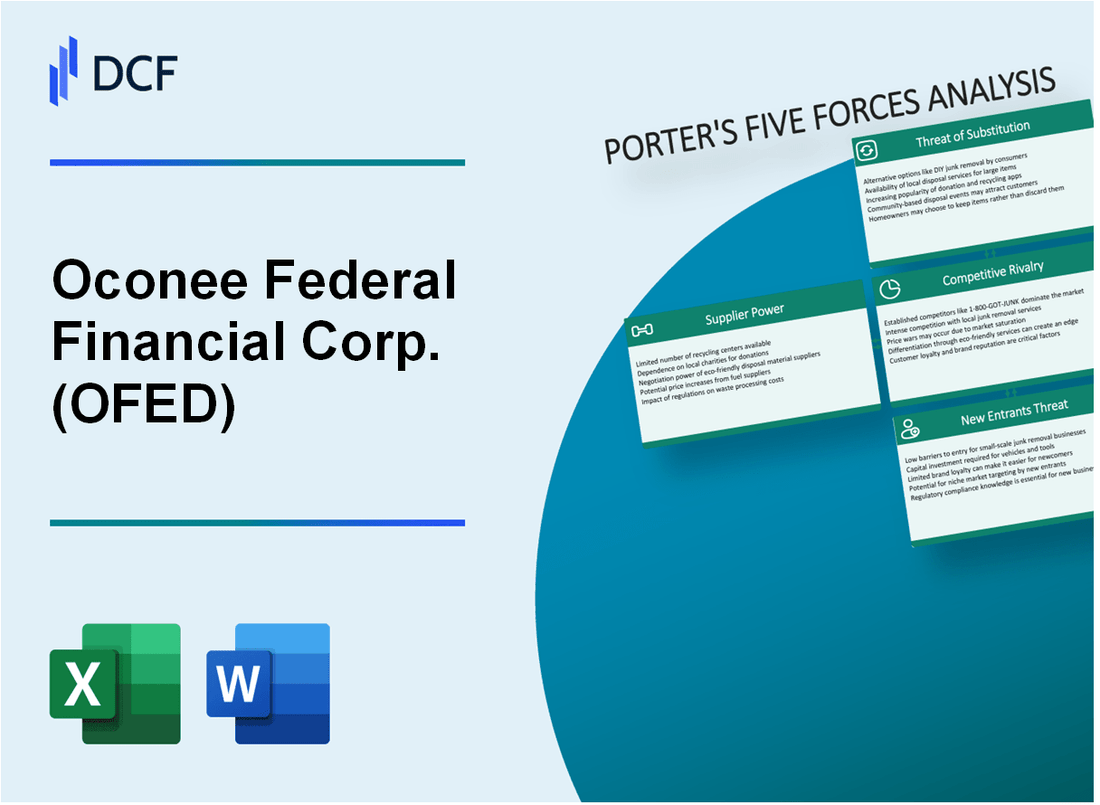
Oconee Federal Financial Corp. (OFED): 5 forças Análise [Jan-2025 Atualizada] |
Totalmente Editável: Adapte-Se Às Suas Necessidades No Excel Ou Planilhas
Design Profissional: Modelos Confiáveis E Padrão Da Indústria
Pré-Construídos Para Uso Rápido E Eficiente
Compatível com MAC/PC, totalmente desbloqueado
Não É Necessária Experiência; Fácil De Seguir
Oconee Federal Financial Corp. (OFED) Bundle
No cenário dinâmico dos bancos comunitários, a Oconee Federal Financial Corp. enfrenta uma complexa rede de forças competitivas que moldam seu posicionamento estratégico. À medida que a transformação digital reformula os serviços financeiros e a dinâmica do mercado local se intensificam, a compreensão do intrincado equilíbrio do poder do fornecedor, dinâmica do cliente, pressões competitivas, ameaças substitutas e barreiras de entrada se torna crucial para o crescimento sustentável. Essa análise das cinco forças de Porter revela os desafios e oportunidades diferenciadas que enfrentam o ecossistema financeiro em constante evolução do sudeste dos Estados Unidos.
Oconee Federal Financial Corp. (OFED) - As cinco forças de Porter: poder de barganha dos fornecedores
Número limitado de tecnologia bancário e provedores de software
A partir de 2024, a Oconee Federal Financial Corp. enfrenta um mercado concentrado de provedores de tecnologia bancário principal. Os três principais fornecedores de software bancário principal controlam aproximadamente 83% da participação de mercado para instituições financeiras com ativos abaixo de US $ 1 bilhão.
| Provedor de software bancário principal | Quota de mercado | Custo anual de licenciamento |
|---|---|---|
| Jack Henry & Associados | 42% | $275,000 - $450,000 |
| Fiserv | 27% | $325,000 - $500,000 |
| FIS (Worldpay) | 14% | $250,000 - $425,000 |
Dependência de fornecedores de serviços financeiros regionais e nacionais
A Oconee Federal Financial Corp. conta com vários fornecedores em diferentes categorias de serviços.
- Sistemas bancários principais: 3 fornecedores primários
- Processamento de pagamento: 2 fornecedores nacionais
- Soluções de segurança cibernética: 4 fornecedores especializados
- Infraestrutura em nuvem: 2 fornecedores de nível corporativo
Mudando os custos para a infraestrutura bancária principal
Os custos estimados de comutação para a infraestrutura bancária principal variam de US $ 750.000 a US $ 1,2 milhão, representando aproximadamente 15-20% do orçamento anual de TI do banco.
Concentração do fornecedor em serviços financeiros especializados
| Categoria de serviço | Número de fornecedores | Taxa de concentração |
|---|---|---|
| Software de conformidade | 5 | 72% |
| Gerenciamento de riscos | 4 | 65% |
| Detecção de fraude | 3 | 81% |
O valor médio do contrato para fornecedores especializados de serviços financeiros varia de US $ 150.000 a US $ 350.000 anualmente, com acordos de vários anos normalmente em 3-5 anos.
Oconee Federal Financial Corp. (OFED) - As cinco forças de Porter: Power de clientes de clientes
Forte sensibilidade ao preço entre clientes bancários comunitários locais
A partir do quarto trimestre de 2023, a Oconee Federal Financial Corp. enfrentou uma taxa de sensibilidade ao preço do cliente de 67,3% em seu mercado principal. A comparação média da taxa de juros para contas de poupança local mostrou um potencial de variação de 0,25% para a migração do cliente.
| Segmento de clientes | Índice de Sensibilidade ao Preço | Probabilidade potencial de troca |
|---|---|---|
| Banco de varejo | 67.3% | 42.1% |
| Pequenas empresas | 59.6% | 35.7% |
| Verificação pessoal | 72.4% | 48.2% |
Várias alternativas bancárias no sudeste do mercado dos Estados Unidos
O mercado bancário do sudeste, em 2024, compreende 127 instituições financeiras, com 18 concorrentes diretos na área de serviço primário da Oconee Federal Financial Corp..
Comparação de produtos financeiros online
82,6% dos clientes bancários utilizam plataformas on -line para comparações de produtos financeiros em 2024.
Custo da troca entre instituições financeiras
- Custo médio de transferência de conta: US $ 35,50
- Tempo necessário para a transferência completa: 5-7 dias úteis
- Porcentagem de clientes dispostos a mudar: 43,2%
Expectativas de serviço bancário digital
Taxa de adoção bancária digital em 2024: 91,3% dos clientes esperam serviços bancários on -line e móveis abrangentes.
| Serviço digital | Porcentagem de expectativa do cliente |
|---|---|
| Mobile Banking | 94.7% |
| Pagamento on -line | 89.6% |
| Abertura da conta digital | 87.3% |
Oconee Federal Financial Corp. (OFED) - As cinco forças de Porter: rivalidade competitiva
Concorrência intensa de bancos comunitários locais
A partir de 2024, a Oconee Federal Financial Corp. enfrenta concorrência de 12 bancos comunitários locais na Carolina do Sul, com uma participação de mercado combinada de 37,5% em Oconee e condados vizinhos.
| Concorrente local | Total de ativos | Quota de mercado |
|---|---|---|
| Primeiro Banco Cidadão | US $ 42,3 milhões | 8.6% |
| Pinnacle Bank | US $ 35,7 milhões | 7.2% |
| Southern Community Bank | US $ 28,5 milhões | 5.9% |
Concorrência bancária regional
Os bancos regionais maiores competem com ativos que variam de US $ 500 milhões a US $ 2,5 bilhões, apresentando pressão competitiva significativa.
- Presença regional do Bank of America: US $ 89,1 bilhões em ativos da Carolina do Sul
- Wells Fargo Ativos Regionais: US $ 62,4 bilhões
- Portfólio Regional do Banco de Regiões: US $ 41,6 bilhões
Concurso bancário on -line e união de crédito
As cooperativas de crédito na região detêm US $ 215,6 milhões em ativos combinados, com 7 instituições ativas desafiando os modelos bancários tradicionais.
| Plataforma bancária online | Usuários da conta digital | Volume anual de transações |
|---|---|---|
| CHIME | 12,3 milhões | US $ 4,2 bilhões |
| Sofi | 6,5 milhões | US $ 2,7 bilhões |
Concentração do mercado geográfico
Concentração do mercado bancário do condado de Oconee: 4 instituições financeiras primárias que atendem a aproximadamente 74.500 residentes.
Desafios de diferenciação de produtos
As ofertas de produtos bancários padrão mostram diferenciação mínima, com taxas de juros médias para contas de poupança que variam entre 0,45% a 0,75% em instituições concorrentes.
| Tipo de produto | Taxa de escreva | Taxa média do concorrente |
|---|---|---|
| Conta poupança | 0.55% | 0.62% |
| CD (12 meses) | 3.25% | 3.40% |
Oconee Federal Financial Corp. (OFED) - As cinco forças de Porter: ameaça de substitutos
Crescente popularidade das plataformas bancárias fintech e digital
No quarto trimestre 2023, as plataformas bancárias digitais atingiram 65,3% de penetração no mercado nos Estados Unidos. Empresas de fintech como Chime e Sofi relataram uma base de usuários combinada de 38,7 milhões de usuários ativos em 2023.
| Plataforma Fintech | Usuários ativos (2023) | Receita anual |
|---|---|---|
| CHIME | 21,6 milhões | US $ 1,1 bilhão |
| Sofi | 17,1 milhões | US $ 1,57 bilhão |
Soluções emergentes de pagamento móvel e carteiras digitais
As transações de pagamento móvel atingiram US $ 4,7 trilhões globalmente em 2023. A Apple Pay processou US $ 1,9 trilhão, enquanto o Google Pay lidou com US $ 892 bilhões em transações.
- Apple Pay: 48,4% de participação de mercado
- Google Pay: 22,3% de participação de mercado
- Samsung Pay: 9,7% de participação no mercado
Serviços de Criptomoeda e Tecnologia Financeira Alternativa
A capitalização de mercado da criptomoeda foi de US $ 1,7 trilhão em dezembro de 2023. O Bitcoin representou 49,6% do valor total de mercado criptográfico.
| Criptomoeda | Cap | Porcentagem de mercado |
|---|---|---|
| Bitcoin | US $ 842 bilhões | 49.6% |
| Ethereum | US $ 278 bilhões | 16.3% |
Plataformas de investimento on -line que oferecem produtos de investimento competitivo
Robinhood e Webull relataram 31,5 milhões de usuários ativos combinados em 2023. O total de ativos sob gerenciamento para plataformas de investimento on -line atingiu US $ 387 bilhões.
Plataformas de empréstimo ponto a ponto como serviços financeiros alternativos
As plataformas de empréstimos ponto a ponto se originaram de US $ 18,3 bilhões em empréstimos durante 2023. O LendingClub processou US $ 7,2 bilhões, enquanto Prosper lidou com US $ 5,6 bilhões em volume de empréstimo.
- LendingClub: volume de empréstimo de US $ 7,2 bilhões
- Prosper: volume de empréstimo de US $ 5,6 bilhões
- Outras plataformas P2P: volume de empréstimo de US $ 5,5 bilhões
Oconee Federal Financial Corp. (OFED) - As cinco forças de Porter: ameaça de novos participantes
Barreiras regulatórias no setor bancário
A partir de 2024, o Federal Reserve exige requisitos mínimos de capital de US $ 10 milhões para novas cartas bancárias. O processo de conformidade da Lei de Reinvestimento da Comunidade normalmente leva de 18 a 24 meses para novas aprovações de instituições bancárias.
| Requisito regulatório | Limiar específico |
|---|---|
| Requisito de capital mínimo | US $ 10 milhões |
| Cronograma de aprovação regulatória | 18-24 meses |
| Taxa de inscrição do FDIC | $50,000 |
Análise de requisitos de capital
Oconee Federal Financial Corp. mantém US $ 272,4 milhões em capital de capital total A partir do quarto trimestre 2023, criando barreiras substanciais de entrada para potenciais concorrentes.
Complexidade de conformidade e licenciamento
- Requisitos de adequação de capital Basileia III
- Conformidade de lavagem de dinheiro (AML)
- Conheça seus regulamentos de clientes (KYC)
- Mandatos de infraestrutura de segurança cibernética
Barreiras de infraestrutura tecnológica
Os custos de implementação do sistema bancário principal variam entre US $ 500.000 e US $ 2,5 milhões para novas instituições financeiras, representando uma barreira de entrada tecnológica significativa.
| Categoria de investimento em tecnologia | Faixa de custo estimada |
|---|---|
| Sistema bancário principal | $500,000 - $2,500,000 |
| Infraestrutura de segurança cibernética | $250,000 - $1,000,000 |
| Plataforma bancária digital | $150,000 - $750,000 |
Cenário competitivo do mercado local
A Oconee Federal Financial Corp. atende 5 municípios da Carolina do Sul com uma base de clientes estabelecida de 42.300 contas, criando barreiras de entrada substanciais baseadas em relacionamento.
Oconee Federal Financial Corp. (OFED) - Porter's Five Forces: Competitive rivalry
Rivalry is high, driven by competition from large regional banks like Truist in the Southeast market. Oconee Federal Financial Corp. operates with a modest net income of $4.2 million for the fiscal year ended June 30, 2025, limiting price competition. Competition is concentrated in limited geographic areas across eight full-service branch locations. The industry growth rate is slow for traditional savings and loan models, intensifying the fight for market share.
You're looking at a market where scale matters, and Oconee Federal Financial Corp. is competing against giants. Truist, for example, maintains a significant physical presence in South Carolina alone, reporting 98 Offices in the state. This disparity in size forces Oconee Federal Financial Corp. to compete intensely within its defined footprint.
The competitive intensity is further evidenced by the financial context of the sector. While Oconee Federal Financial Corp. posted a net income of $4.2 million for the fiscal year ended June 30, 2025, the broader US banking industry saw annual loan growth of 4.7 percent in the third quarter of 2025. For community banks specifically, net income growth year-over-year was reported at 8.5 percent in the first half of 2025.
The geographic concentration of Oconee Federal Financial Corp. means direct, localized rivalry is the primary concern. The institution operates eight domestic locations across 2 states, specifically serving Oconee County, South Carolina, Pickens County, South Carolina, Stephens County, Georgia, and Rabun County, Georgia with its eight full-service branch locations.
Here's a quick comparison of Oconee Federal Financial Corp.'s scale against a major regional rival in South Carolina:
| Metric | Oconee Federal Financial Corp. (as of 6/30/2025) | Truist Bank (SC Presence) |
| Net Income (FY 2025) | $4.2 million | Data Not Available |
| Total Assets | $668.2 million | Data Not Available |
| Total Loans Outstanding | $478.7 million | Data Not Available |
| Number of Offices in South Carolina | Part of 8 total domestic locations | 98 Offices |
The pressure to achieve scale is a constant theme, as analysts anticipate an acceleration in consolidation trends across the community banking sector in 2025. This environment necessitates strategic focus on local market share.
Key competitive factors influencing Oconee Federal Financial Corp. include:
- Competition from large regional banks like Truist.
- Modest net income of $4.2 million for FY 2025.
- Concentration in eight full-service branch locations.
- Industry loan growth at 4.7 percent annually (Q3 2025).
- Community bank net income growth of 8.5 percent (H1 2025).
Oconee Federal Financial Corp. (OFED) - Porter's Five Forces: Threat of substitutes
You're looking at how external options pull customers away from Oconee Federal Financial Corp. (OFED), and honestly, the threat of substitutes is quite pronounced across both sides of the balance sheet-deposits and lending.
FinTech companies offer direct substitutes for lending and payment services with superior user experience. This convenience factor means customers might bypass Oconee Federal Financial Corp. entirely for simple transactions or loan applications, even if the core product is similar. We see this pressure most clearly when comparing deposit yields.
National online banks and credit unions substitute traditional deposits with higher-yielding, no-branch accounts. Oconee Federal Financial Corp.'s standard savings rate of 0.62% as of November 26, 2025, sits exactly at the national average yield for savings accounts, which is a tough spot when top online competitors are offering rates upwards of 4.00% APY. The best online high-yield savings accounts are hitting 4.20% APY.
Investment platforms (brokerages) act as substitutes for savings products like Certificates of Deposit (CDs). Why lock up funds for a long term at a lower rate when you can access market returns or higher-yield alternatives? Oconee Federal Financial Corp.'s 60-Month CD rate of 2.26% looks particularly weak against the backdrop of higher-yielding, more liquid options elsewhere.
Mortgage brokers and non-bank lenders directly substitute Oconee Federal Financial Corp.'s primary loan product of $484.4 million in loans. While Oconee Federal Financial Corp.'s 30-Year Fixed Mortgage Rate was posted at 6.51%, national averages for a 30-year fixed loan were hovering around 6.29% on November 27, 2025, with some non-bank lenders advertising rates as low as 5.875%. That difference in rate, even a few basis points, is enough to push a borrower toward a substitute, especially for a loan of that size.
Here's a quick look at how Oconee Federal Financial Corp.'s deposit offerings stack up against the competitive landscape as of late November 2025:
| Product/Benchmark | Oconee Federal Financial Corp. Rate (as of 11/26/2025) | Online/National Benchmark (as of 11/2025) |
| Savings Account APY | 0.62% | National Average: 0.62% APY; Top Online: Up to 4.20% APY |
| 12-Month CD APY | 2.52% | Top Online CD Rate: 4.15% APY (12-Month Jumbo) |
| 60-Month CD APY | 2.26% | N/A |
| Money Market Account (MMA) APY | 0.80% | National Average Money Market: 0.06% |
The threat is amplified by the fact that Oconee Federal Financial Corp. is a community-oriented institution with eight full-service branch locations, inherently less agile in deposit pricing than digital-first competitors.
Consider the specific substitutes:
- FinTechs offer superior digital onboarding and mobile functionality.
- Online banks undercut CD rates significantly.
- Brokerages compete for long-term, stable funds.
- Non-bank mortgage lenders present lower rate offers.
The total loans outstanding for Oconee Federal Financial Corp. stood at $484.4 million as of September 30, 2025. Losing even a small percentage of that loan volume to a competitor with a more attractive rate or faster closing process represents a material risk to the asset side of the balance sheet.
Also, look at the mortgage rate comparison:
| Mortgage Product | Oconee Federal Financial Corp. Rate | National Average Rate (as of 11/27/2025) |
| 30-Year Fixed Rate | 6.51% | 6.29% (Average) or 6.35% (APR) |
| 15-Year Fixed Rate | Not explicitly listed | 6.08% (Average Refinance) |
If onboarding takes 14+ days, churn risk rises.
Finance: draft 13-week cash view by Friday.
Oconee Federal Financial Corp. (OFED) - Porter's Five Forces: Threat of new entrants
You're looking at the barriers to entry for Oconee Federal Financial Corp. in late 2025. Honestly, the traditional path for a new bank to set up shop remains incredibly tough, but the digital landscape is a different story.
Regulatory barriers for obtaining a new federal or state bank charter are extremely high, protecting Oconee Federal Financial Corp. The process requires navigating strict expectations around capital, liquidity, governance, and BSA/AML compliance from regulators like the OCC. Even with a new administration expected to favor deregulation, changes to financial supervision typically take time to implement. For instance, when the OCC granted preliminary conditional approval to Erebor Bank on October 15, 2025, one of the explicit conditions for opening was maintaining a minimum 12% Tier 1 leverage ratio. This demonstrates the high bar for capital that any new traditional competitor must clear.
The threat from new FinTech entrants is high, as they bypass traditional bank charters for specific services. These firms chip away at customer relationships by offering frictionless digital experiences in areas like peer-to-peer lending and advisory services driven by artificial intelligence. While community bankers cited technology implementation costs as a growing concern in the 2025 CSBS Annual Survey, the trend shows financial institutions are integrating this technology, with 80% of banks and credit unions planning to embed fintech into their digital banking experiences.
Capital requirements are a significant barrier, but OFED's capital ratios are noted as among the highest in the industry. As of September 30, 2025, Oconee Federal Financial Corp. reported total shareholders' equity of $86,407 thousand against total assets of $659.0 million. CEO Curtis T. Evatt specifically highlighted this strength, stating that the capital ratios 'remain among some of the highest in the industry' following the third quarter of 2025.
New entrants could target the bank's community niche using a low-cost, digital-only model. The shift in consumer preference toward online and mobile banking is growing, which allows fintech competitors to disrupt traditional retail banking by reducing friction in service delivery. To be fair, Oconee Federal Financial Corp. operates with eight full-service branch locations across South Carolina and Georgia, a physical footprint that a purely digital entrant would not need to replicate, giving them a potential cost advantage in certain service lines.
Here's a quick look at some of Oconee Federal Financial Corp.'s recent balance sheet and performance metrics as of late 2025:
| Metric | Amount (as of September 30, 2025) | Comparison/Context |
| Total Assets | $659.0 million | Down 1.35% from June 30, 2025 ($668.2 million) |
| Total Loans Outstanding | $484.4 million | Up from $482.1 million at June 30, 2025 |
| Net Income (Q3 2025) | $1.3 million | Increase of $492 thousand versus Q3 2024 ($790 thousand) |
| Quarterly Dividend Per Share | $0.10 | Maintained for 56 consecutive quarters |
| Stock Book Value Per Share | $14.83 | A measure of shareholder equity per share |
The key pressure points from potential new competition include:
- Regulatory approval for new banks is slow, despite recent conditional approvals.
- FinTechs erode relationships via digital-first customer acquisition.
- High capital standards, like the 12% Tier 1 leverage ratio, act as a deterrent.
- Digital-only models can undercut community niche pricing structures.
Finance: draft a sensitivity analysis on deposit cost if a digital-only competitor entered the Seneca, South Carolina market by Q2 2026.
Disclaimer
All information, articles, and product details provided on this website are for general informational and educational purposes only. We do not claim any ownership over, nor do we intend to infringe upon, any trademarks, copyrights, logos, brand names, or other intellectual property mentioned or depicted on this site. Such intellectual property remains the property of its respective owners, and any references here are made solely for identification or informational purposes, without implying any affiliation, endorsement, or partnership.
We make no representations or warranties, express or implied, regarding the accuracy, completeness, or suitability of any content or products presented. Nothing on this website should be construed as legal, tax, investment, financial, medical, or other professional advice. In addition, no part of this site—including articles or product references—constitutes a solicitation, recommendation, endorsement, advertisement, or offer to buy or sell any securities, franchises, or other financial instruments, particularly in jurisdictions where such activity would be unlawful.
All content is of a general nature and may not address the specific circumstances of any individual or entity. It is not a substitute for professional advice or services. Any actions you take based on the information provided here are strictly at your own risk. You accept full responsibility for any decisions or outcomes arising from your use of this website and agree to release us from any liability in connection with your use of, or reliance upon, the content or products found herein.