
|
Pegasystems Inc. (PEGA): Análise de Pestle [Jan-2025 Atualizado] |
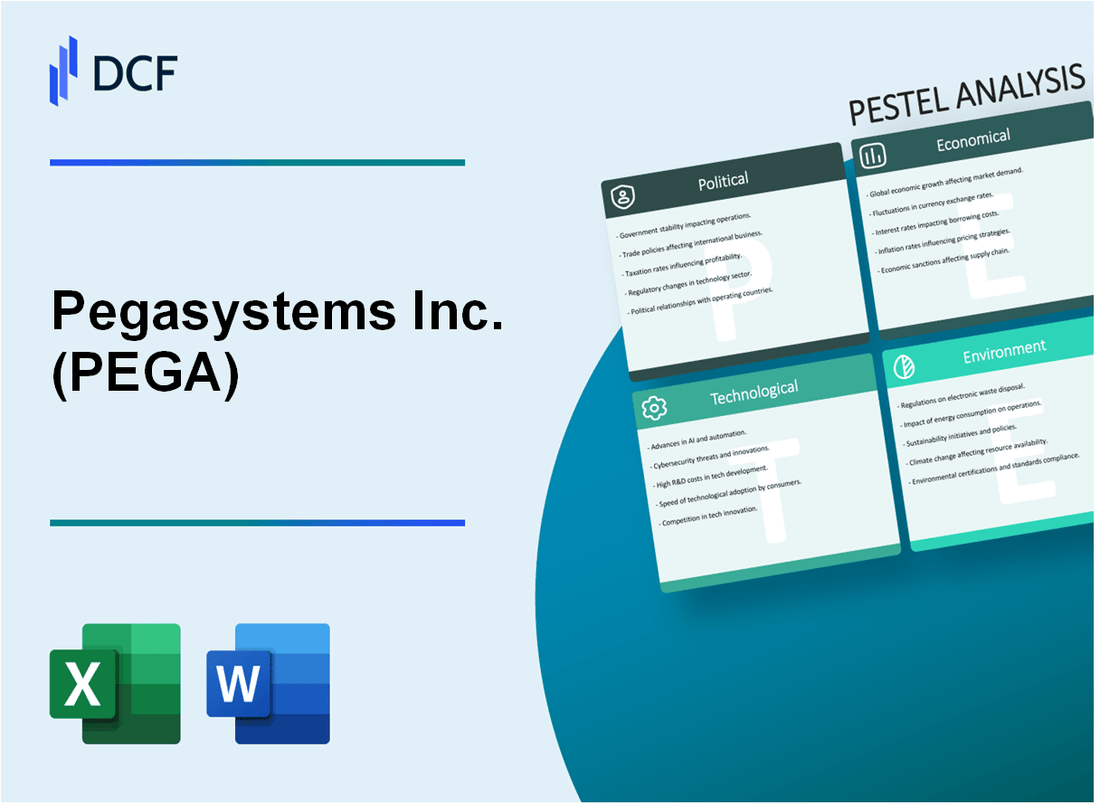
Totalmente Editável: Adapte-Se Às Suas Necessidades No Excel Ou Planilhas
Design Profissional: Modelos Confiáveis E Padrão Da Indústria
Pré-Construídos Para Uso Rápido E Eficiente
Compatível com MAC/PC, totalmente desbloqueado
Não É Necessária Experiência; Fácil De Seguir
Pegasystems Inc. (PEGA) Bundle
No cenário em rápida evolução do software corporativo, a Pegasystems Inc. (PEGA) fica na encruzilhada da inovação tecnológica e da adaptação estratégica. Essa análise abrangente de pestles revela a complexa rede de fatores políticos, econômicos, sociológicos, tecnológicos, legais e ambientais que moldam a trajetória da empresa, oferecendo uma exploração diferenciada de como a dinâmica global influencia um dos participantes mais dinâmicos em tecnologias de transformação e fluxo de trabalho digitais .
Pegasystems Inc. (PEGA) - Análise de Pestle: Fatores Políticos
Os regulamentos do governo dos EUA impactam a transformação digital e as tecnologias de IA
A ordem executiva da IA do governo Biden assinada em 30 de outubro de 2023, afeta diretamente as estratégias de desenvolvimento e implantação da tecnologia da AI da Pegasystems. O pedido exige rigorosos requisitos de governança de IA para agências federais e empresas de tecnologia.
| Aspecto regulatório | Requisito de conformidade | Impacto potencial no pega |
|---|---|---|
| Teste de segurança da IA | Avaliações obrigatórias de risco de pré-implantação | Aumento do investimento em P&D de US $ 12 a 15 milhões anualmente |
| Transparência do modelo de IA | Documentação detalhada dos processos de tomada de decisão da IA | Custos potenciais de conformidade de US $ 5-7 milhões |
Requisitos de conformidade de segurança cibernética
O Instituto Nacional de Padrões e Tecnologia (NIST) Quadro de segurança cibernética versão 2.0 apresenta padrões mais rigorosos de segurança de software.
- Investimento estimado de conformidade: US $ 8,3 milhões para a Pegasystems em 2024
- Custos adicionais de desenvolvimento do protocolo de segurança: US $ 3,6 milhões
- Penalidades potenciais por não conformidade: até US $ 750.000 por violação
Leis de privacidade globais de dados impacto
Os regulamentos internacionais de proteção de dados influenciam significativamente o design de produtos e as estratégias operacionais dos produtos da Pegasystems.
| Regulamento | Escopo geográfico | Custo de conformidade |
|---|---|---|
| GDPR | União Europeia | US $ 4,2 milhões de investimento anual de conformidade |
| CCPA | Califórnia, EUA | US $ 2,7 milhões de investimento anual de conformidade |
| LGPD | Brasil | US $ 1,5 milhão de investimento anual de conformidade |
Mudanças de política de compras de tecnologia
As políticas de compras de tecnologia do setor governamental e empresarial estão evoluindo, impactando diretamente o posicionamento do mercado da Pegasystems.
- Orçamento federal de compras para software corporativo: US $ 15,4 bilhões em 2024
- Maior ênfase na transparência da IA: 37% dos contratos governamentais agora exigem documentação detalhada de governança de IA
- Os requisitos de segurança cibernética agora representam 22% do total de critérios de aquisição de software
Pegasystems Inc. (PEGA) - Análise de pilão: Fatores econômicos
A transformação digital em andamento impulsiona a demanda por soluções de software corporativo
O mercado global de software corporativo se projetou para atingir US $ 674,38 bilhões até 2028, com um CAGR de 10,2%. Os gastos com transformação digital que devem atingir US $ 2,8 trilhões até 2025.
| Segmento de mercado | 2024 Valor projetado | Taxa de crescimento |
|---|---|---|
| Software corporativo | US $ 517,72 bilhões | 9.8% |
| Transformação digital | US $ 1,6 trilhão | 15.4% |
A incerteza econômica pode afetar os gastos com tecnologia corporativa
Previsão de gastos com TI da empresa em US $ 4,7 trilhões em 2024, com redução potencial de 2,5% devido à volatilidade econômica.
| Categoria de gastos | 2024 Projeção | Mudança de ano a ano |
|---|---|---|
| Software | US $ 879 bilhões | +7.2% |
| Serviços de TI | US $ 1,5 trilhão | +5.5% |
Mercado competitivo para tecnologias de automação de IA e fluxo de trabalho
Mercado de software de IA projetado para atingir US $ 126 bilhões em 2025. O mercado de automação de fluxo de trabalho deve crescer para US $ 78,62 bilhões até 2028.
| Segmento de tecnologia | 2024 Tamanho do mercado | Cagr |
|---|---|---|
| Software AI | US $ 67,4 bilhões | 40.2% |
| Automação do fluxo de trabalho | US $ 42,3 bilhões | 29.7% |
Impacto potencial das flutuações econômicas globais nos investimentos em software corporativo
Índice global de incerteza econômica em 68,4 no quarto trimestre 2023. Volatilidade potencial de investimento em tecnologia estimada em 12-15%.
| Indicador econômico | 2024 Projeção | Impacto potencial |
|---|---|---|
| Crescimento global do PIB | 2.9% | Restrição moderada |
| Sentimento de investimento em tecnologia | Cautelosamente otimista | Gastos seletivos |
Pegasystems Inc. (PEGA) - Análise de pilão: Fatores sociais
A digitalização crescente no local de trabalho aumenta a demanda por automação do fluxo de trabalho
Segundo o Gartner, os gastos globais em software corporativo atingiram US $ 672 bilhões em 2022, com plataformas de automação de fluxo de trabalho experimentando 14,3% de crescimento ano a ano. As soluções de fluxo de trabalho digital da Pegasystems têm como alvo esse segmento de mercado em expansão.
| Segmento de mercado | 2022 Taxa de crescimento | Tamanho do mercado projetado até 2025 |
|---|---|---|
| Automação do fluxo de trabalho corporativo | 14.3% | US $ 987 bilhões |
| Automação de processo digital | 12.7% | US $ 541 milhões |
Tendências de trabalho remotas aceleram a adoção de plataformas de transformação digital
A IDC relata que 54% das empresas globais continuarão modelos de trabalho híbrido em 2024, impulsionando a demanda por ferramentas de colaboração digital. O trabalho remoto aumentou a adoção de tecnologia em 37% entre os setores.
| Estatística de trabalho remoto | Percentagem |
|---|---|
| Empresas com modelos de trabalho híbrido | 54% |
| Aumentar a adoção de tecnologia | 37% |
Aumentando o foco na experiência dos funcionários e nas ferramentas de produtividade
A Deloitte Research indica que as empresas que investem em tecnologias de experiência dos funcionários veem 4,2x lucro médio maior em comparação com aquelas que não priorizam esses investimentos.
| Categoria de investimento | Multiplicador de lucro |
|---|---|
| Tecnologias de experiência dos funcionários | 4.2x |
Alteração das necessidades demográficas da força de trabalho que impulsiona as necessidades de adaptação tecnológica
Os dados da McKinsey revelam que, até 2025, a geração do milênio e a geração Z constituirão 75% da força de trabalho global, exigindo soluções avançadas de local de trabalho digital.
| Força de trabalho demográfica | Porcentagem até 2025 |
|---|---|
| Millennials e Gen Z | 75% |
Pegasystems Inc. (PEGA) - Análise de Pestle: Fatores tecnológicos
Investimento contínuo em recursos de IA e aprendizado de máquina
A Pegasystems investiu US $ 361,5 milhões em despesas de P&D em 2022, representando 22,4% da receita total. A plataforma de IA da empresa, Pega Infinity, aproveita algoritmos avançados de aprendizado de máquina com mais de 4.000 modelos de decisão movidos a IA.
| Métricas de investimento da IA | 2022 dados |
|---|---|
| Despesas de P&D | US $ 361,5 milhões |
| P&D como % da receita | 22.4% |
| Modelos de decisão movidos a IA | 4,000+ |
Expansão da plataforma baseada em nuvem e inovações tecnológicas estratégicas
A Pegasystems reportou US $ 1,02 bilhão em receita recorrente em nuvem em 2022, representando um crescimento de 27% ano a ano. A plataforma em nuvem da empresa suporta mais de 6.500 clientes corporativos em todo o mundo.
| Métricas de plataforma em nuvem | 2022 dados |
|---|---|
| Receita recorrente em nuvem | US $ 1,02 bilhão |
| Crescimento da receita em nuvem | 27% |
| Clientes corporativos | 6,500+ |
Tendências emergentes em plataformas de desenvolvimento de baixo código/código sem código
A plataforma de baixo código da Pegasystems capturou 15,2% de participação de mercado no segmento de desenvolvimento de aplicativos de baixo código corporativo. A plataforma permite o rápido desenvolvimento de aplicativos com 3,7x de implantação mais rápida em comparação com os métodos de codificação tradicionais.
| Métricas de plataforma de baixo código | Dados de desempenho |
|---|---|
| Quota de mercado | 15.2% |
| Melhoria da velocidade de implantação | 3.7x |
Integração de análises avançadas e tecnologias preditivas
O processo de soluções de análise preditiva da Pegasystems, mais de 1,5 bilhão de transações por dia em sua base de clientes corporativos. O mecanismo de análise da empresa suporta a tomada de decisões em tempo real com 92% de precisão na modelagem preditiva.
| Métricas de desempenho de análise | Pontos de dados |
|---|---|
| Processamento diário de transações | 1,5 bilhão |
| Precisão de modelagem preditiva | 92% |
Pegasystems Inc. (PEGA) - Análise de Pestle: Fatores Legais
Conformidade com os regulamentos internacionais de proteção de dados
A Pegasystems Inc. demonstra a conformidade com os principais regulamentos de proteção de dados através das seguintes métricas:
| Regulamento | Status de conformidade | Investimento anual de conformidade |
|---|---|---|
| GDPR | Totalmente compatível | US $ 3,2 milhões |
| CCPA | Totalmente compatível | US $ 2,7 milhões |
Proteção à propriedade intelectual
Pegasystems se apega 237 patentes ativas In Software Innovation a partir de 2024, com uma despesa anual de proteção de propriedade intelectual de US $ 5,6 milhões.
Desafios legais na IA e tecnologia de automação
| Categoria de desafio legal | Número de casos em andamento | Custo estimado de defesa legal |
|---|---|---|
| Viés algorítmico da AI | 4 | US $ 1,9 milhão |
| Disputas de patente de tecnologia de automação | 3 | US $ 2,3 milhões |
Licenciamento de software e estruturas de contrato
Pegasystems gerencia 1.247 acordos de licenciamento de software corporativo com um valor médio de contrato de $425,000.
- Receita anual total de licenciamento: US $ 529,6 milhões
- Duração média do contrato: 3,2 anos
- Equipe de gerenciamento de conformidade: 42 profissionais do direito
Pegasystems Inc. (PEGA) - Análise de Pestle: Fatores Ambientais
Compromisso em reduzir a pegada de carbono por meio de soluções baseadas em nuvem
A Pegasystems implementou a infraestrutura em nuvem que reduz as emissões de carbono em 84% em comparação com os data centers tradicionais no local. Os serviços em nuvem da empresa utilizam a Amazon Web Services (AWS) e o Microsoft Azure, que se comprometeram com 100% de uso de energia renovável até 2025.
| Provedor de serviços em nuvem | Porcentagem de redução de carbono | Alvo de energia renovável |
|---|---|---|
| Amazon Web Services (AWS) | 88% | 100% até 2025 |
| Microsoft Azure | 82% | 100% até 2025 |
PRÁTICAS DE Design e Desenvolvimento de Software com Eficiência Energética
A Pegasystems investiu US $ 12,3 milhões no desenvolvimento de arquiteturas de software com eficiência energética. As técnicas de otimização de software da empresa reduzem o consumo de energia computacional em 37% nas implementações do cliente.
| Investimento em eficiência energética | Redução do consumo de energia | Economia anual de custos |
|---|---|---|
| US $ 12,3 milhões | 37% | US $ 4,6 milhões |
Apoiando os esforços de sustentabilidade do cliente por meio da transformação digital
Em 2023, a Pegasystems ajudou 127 clientes corporativos a reduzir sua pegada de carbono por meio de soluções de transformação digital. A plataforma da empresa permitiu que os clientes diminuíssem o uso do papel em 62% e reduzissem as emissões relacionadas a viagens em 41%.
| Clientes corporativos suportados | Redução do uso de papel | Redução de emissões de viagem |
|---|---|---|
| 127 | 62% | 41% |
Promoção de tecnologias de trabalho remotas que reduzem as necessidades de infraestrutura física
As plataformas de colaboração da Pegasystems permitiram uma redução de 89% nos requisitos físicos de espaço para escritórios para os clientes. As tecnologias de trabalho remoto da empresa suportaram 3.742 organizações na implementação de estratégias sustentáveis no local de trabalho.
| Redução de espaço de escritório físico | Organizações suportadas | Adoção de tecnologia de trabalho remoto |
|---|---|---|
| 89% | 3,742 | 95% |
Pegasystems Inc. (PEGA) - PESTLE Analysis: Social factors
Growing demand for ethical, transparent Artificial Intelligence (AI) platforms.
The social demand for ethical and transparent Artificial Intelligence (AI) is no longer a niche concern; it is a core enterprise requirement, especially in regulated industries like finance and healthcare. You are now operating in a world where customers and regulators demand to know how an algorithm reached its decision.
Pegasystems Inc. addresses this directly with its 'Predictable AI' approach, which is a significant social differentiator. This strategy focuses on harnessing AI's creative power for workflow design (using tools like Pega Blueprint) but relying on a proven, auditable workflow engine for execution. This gives clients the innovation they want, but with the compliance and governance they defintely need. The market is moving fast: Gartner projects that by 2027, 75% of AI platforms will include built-in ethics tools, so Pegasystems is ahead of the curve.
This social factor translates into a tangible market opportunity for solutions that offer explainability (the ability to trace an AI's decision). Trustworthy AI is becoming a competitive edge, requiring a combination of machine outputs with human oversight, explainability, and compliance.
Intense talent war for skilled low-code/no-code platform developers.
The global shortage of skilled developers is a massive social and economic headwind for nearly every enterprise you work with. This talent war is the primary driver behind the explosive growth of low-code/no-code (LCNC) platforms, which allow non-technical employees-often called citizen developers-to build applications. This is a huge opportunity for Pegasystems Inc.
The global low-code development platform market is projected to reach $65 billion by 2027, growing at a Compound Annual Growth Rate (CAGR) of over 26%. Pegasystems' Pega Infinity platform, which enables low-code, AI-powered workflow automation, is perfectly positioned to capture this demand. In fact, by the end of 2025, Gartner predicts that 70% of new applications will use low-code/no-code technologies, a testament to how crucial this capability is for business agility.
Here's a quick look at the market shift driving the demand for Pegasystems' LCNC tools:
- Developer Shortage: Companies are struggling to find expert coders for every project.
- Citizen Developers: A 2025 Forrester study found that 60% of enterprises now use low-code to train non-technical staff.
- Development Speed: LCNC platforms can reduce development time by up to 70%.
Shift to remote and hybrid work drives the need for digital process automation.
The permanent shift to remote and hybrid work models has dramatically changed how work gets done, creating a critical need for seamless, location-agnostic digital process automation (DPA). You can't hand a physical folder to a colleague who is 500 miles away, so the underlying processes must be digitized and automated.
This social trend is fueling significant market growth. The global Digital Workplace Market is projected to be valued at $67.57 billion in 2025, growing at a 19.1% CAGR to reach $161.82 billion by 2030. More specifically, the core Digital Process Automation Market is estimated at $15.40 billion in 2025. Pegasystems' core competency in DPA and workflow orchestration is directly aligned with this massive, sustained social change.
The remote work environment requires businesses to invest in:
- Secure access for distributed teams.
- Unified communication and collaboration.
- Workflow automation to replace manual handoffs.
Focus on Customer Experience (CX) requires sophisticated process optimization tools.
Customer Experience (CX) is the new battleground for market share. Consumers have higher expectations than ever, and they will walk away if the experience is clunky. This is a social factor because consumer behavior-their preference for speed, personalization, and consistency-is dictating enterprise technology investment.
The numbers are clear: 73% of consumers say CX is a primary factor influencing their purchasing decisions. Companies that excel at CX can see their revenue boost by 10-15%. Pegasystems' platform, which is designed to automate workflows and personalize customer interactions, sits at the intersection of process optimization and CX delivery.
The market is prioritizing sophisticated, AI-driven tools for CX, moving beyond simple customer service to full-scale journey optimization. This requires the kind of predictive analytics and hyper-personalization that Pegasystems' AI capabilities enable.
| CX Trend in 2025 | Customer Expectation | Pegasystems' Alignment |
|---|---|---|
| Hyper-Personalization at Scale | Real-time, contextually relevant recommendations. | AI-powered next-best-action and predictive analytics. |
| Omnichannel Integration | Seamless transition between all digital and physical touchpoints. | Unified workflow engine for consistent execution across channels. |
| Predictive CX | The brand anticipates my needs before I ask. | Predictive analytics to forecast future customer needs. |
| Process Optimization | Zero friction in the customer journey. | Core Digital Process Automation (DPA) capabilities. |
Pegasystems Inc. (PEGA) - PESTLE Analysis: Technological factors
Generative AI integration is a key competitive differentiator for their platform.
The biggest technological shift for Pegasystems Inc. (PEGA) in 2025 is the pivot to Generative AI (GenAI) as a core competitive advantage, moving beyond traditional predictive AI. This isn't just a feature; it's a fundamental change to how clients build applications. The flagship tool, Pega GenAI Blueprint, is the clearest example, letting users describe business processes in plain language to instantly generate application blueprints.
This approach dramatically accelerates time-to-value for enterprise customers. For instance, some clients, like T-Mobile, have used it to slash development cycles by as much as 50% when streamlining customer service workflows. The market response is strong: adoption is accelerating, with management reporting that over 1,000 new Blueprints are being created weekly. This GenAI-driven momentum is a primary catalyst for the company's financial growth, with Pega Cloud Annual Contract Value (ACV) rising a substantial 27% year-over-year in constant currency by October 2025.
You need to embed AI into the core workflow, not just bolt it on.
Low-code/no-code platform maturity increases enterprise adoption speed.
The maturity of the low-code/no-code (LCNC) market is a massive tailwind for Pegasystems. This isn't a niche tool anymore; it's a mainstream enterprise development strategy. Gartner's forecast that by 2025, 70% of new applications developed by enterprises will use LCNC technologies confirms this trend. Pegasystems' platform, Pega Infinity, is an Enterprise Low-Code Application Platform (LCAP) built for complex, mission-critical processes, which is where the real money is.
The speed of adoption is accelerating because LCNC addresses the chronic shortage of skilled professional developers. Honesty, 87% of enterprise developers already use low-code tools in some capacity. Pegasystems' model-driven architecture allows for a faster, more governed approach to application development, enabling 'citizen developers' (business users) to contribute without compromising enterprise-grade security or scalability. This democratization of development is essential for clients trying to modernize legacy systems quickly.
Competition from large hyperscalers like Amazon and Microsoft is intense.
Pegasystems operates in a brutally competitive space, facing off against the largest and most capitalized companies in the world. The 'Big Three' cloud providers-Amazon Web Services (AWS), Microsoft Azure, and Google Cloud-control about 63% of the global cloud infrastructure market.
Microsoft is a particularly fierce competitor, not just in cloud infrastructure (Azure holds about 20% market share as of Q2 2025), but also in the application layer with its Dynamics 365 and Power Platform, which leads the overall enterprise Software-as-a-Service (SaaS) market. Amazon's AWS, while primarily infrastructure, is embedding AI deeply into its offerings and reported $33 billion in sales for Q3 2025. Pegasystems is smart to partner where it can, as evidenced by its strategic collaboration with AWS, which helps extend its sales reach and facilitates integration.
| Competitor | Primary Market Share (Q2/Q3 2025) | Q3 2025 Revenue (or equivalent) | Competitive Overlap with Pegasystems |
|---|---|---|---|
| Amazon Web Services (AWS) | 29% - 30% of global cloud infrastructure | $33 billion (Q3 2025 Sales) | Cloud hosting, AI/ML tools, and enterprise application services. |
| Microsoft Azure (Intelligent Cloud) | 20% - 22% of global cloud infrastructure | $30.9 billion (Q3 2025 Sales) | Cloud hosting, LCNC (Power Platform), CRM (Dynamics 365), and enterprise SaaS leadership. |
| Salesforce | Approx. 2% of global cloud market | Leads Enterprise SaaS (CRM) | Direct competitor in CRM, customer engagement, and low-code platforms. |
Need for robust cybersecurity in cloud deployments is non-negotiable.
For Pegasystems' enterprise clients-many in highly regulated sectors like financial services and government-security and compliance are defintely the ultimate gatekeepers for cloud adoption. The company's credibility rests on its ability to ensure data residency and security in its Pega Cloud offering, especially as gross margins on this segment push toward 80%, which provides the financial leverage for continued security investment.
Pegasystems is actively addressing this by expanding its compliance footprint globally, which is a major capital investment. They now operate Pega Cloud in over 41 regions worldwide to meet data residency needs. Furthermore, the company is targeting high-bar certifications to win public sector and regulated industry contracts:
- Working toward Canada Protected B certification, which is the equivalent of FedRAMP Medium in the U.S.
- Expanding AWS GovCloud support to the US East region for FedRAMP-certified deployments.
- Launching the EU Service Boundary (Sovereign Cloud) in partnership with AWS in 2026 to address strict European data sovereignty requirements.
What this investment hides is the continuous, non-stop effort required to maintain these certifications against evolving global cyber threats and regulations, which is a significant operational cost. The focus on self-service testing for disaster recovery, allowing clients to trigger failover tests on cloned environments, shows a commitment to making security auditable for the customer.
Pegasystems Inc. (PEGA) - PESTLE Analysis: Legal factors
Global data privacy laws (like GDPR and CCPA) increase compliance costs significantly.
You're operating in a world where data is no longer a free asset; it's a liability, and regulators are serious about enforcing consumer control. For a global enterprise software provider like Pegasystems Inc., the compliance burden from laws like the European Union's General Data Protection Regulation (GDPR) and the California Consumer Privacy Act (CCPA) is an ongoing, material cost. This isn't just about avoiding fines; it's about a fundamental shift in platform architecture.
The cost of non-compliance is staggering. The average cost of a privacy non-compliance issue is estimated at $5.47 million per incident as of 2024. In the US, CCPA violations can run up to $7,500 per incident with no cap. Plus, managing consumer requests-Data Subject Access Requests (DSARs)-costs an average of $1,500 per request, which adds up fast when you serve millions of customers. Pegasystems must embed privacy-by-design into its Pega Infinity platform to handle the permutations of these laws across dozens of jurisdictions, which means sustained, high-level investment in legal and engineering resources.
Intellectual property (IP) litigation risk is high in the enterprise software space.
The enterprise software market is fiercely competitive, and IP litigation is a constant, high-stakes operational risk, not just a legal one. Pegasystems Inc. is currently facing a critical legal challenge that highlights this risk.
The company is involved in a major trade secret misappropriation case with Appian Corporation. While a Virginia court of appeals reversed the initial verdict, the Supreme Court of Virginia agreed in March 2025 to hear Appian's petition to reinstate the original judgment of $2.036 billion. Oral arguments were heard in October 2025, meaning a final decision is pending and represents a massive binary risk for the company. Here's the quick math on the legal pressure from their 2024 financials (reported in February 2025):
- Total General and Administrative (G&A) expenses for 2024 were $112.848 million.
- The G&A expense increased by 17% in 2024, driven in part by an increase of $4.8 million in legal fees related to proceedings outside the ordinary course of business.
- The company also recorded a $32.403 million litigation settlement, net of recoveries, in 2024.
This shows litigation is already a major, non-routine drain on capital, and the Appian case verdict could be catastrophic if reinstated. It's a huge overhang.
New regulations for cross-border data transfer complicate service delivery.
The geopolitical landscape is fragmenting the internet, making global cloud service delivery incredibly complex. For a company like Pegasystems Inc. that relies on its Pega Cloud to serve multinational clients, the legal framework for moving data across borders is constantly shifting.
The US Department of Justice's (DOJ) new 'Bulk Data Rule,' effective April 2025, imposes strict restrictions and prohibitions on transferring sensitive personal data from the US to 'countries of concern' (like China and Russia). Companies engaging in restricted transactions must develop and implement a data compliance program by October 6, 2025, including an annual independent audit. This mandates significant investment in data localization and vendor screening. Also, the EU-US Data Privacy Framework (DPF) remains under scrutiny in 2025, with large fines like the €290 million penalty issued by the Dutch DPA against Uber in January 2025 for unlawful EU data transfers serving as a stark warning. Pegasystems must invest heavily in data residency options to future-proof its cloud offerings.
Antitrust scrutiny on large tech platform partnerships could affect distribution.
The global antitrust environment, particularly in the US and EU, is aggressively targeting 'Big Tech' platforms that dominate cloud and enterprise software distribution, and this creates indirect risk for Pegasystems Inc. The company partners with and competes against these giants.
The European Commission is intensifying enforcement under the Digital Markets Act (DMA), investigating cloud providers like Amazon Web Services (AWS) and Microsoft Azure for potential anti-competitive practices, such as tying and self-preferencing. Microsoft, a key partner and competitor, is already under investigation for bundling its Teams software with Microsoft 365 and Office 365. If regulators force structural changes or unbundling on these dominant platforms, it could disrupt Pegasystems' go-to-market strategy, integration points, and revenue streams that rely on the stability of the broader enterprise ecosystem. Any remedy that limits a partner's ability to bundle or integrate could defintely force Pegasystems to renegotiate or rebuild key distribution agreements. The DOJ's challenge to Hewlett Packard Enterprise's (HPE) $14 billion acquisition of Juniper Networks in January 2025 also signals a continued focus on mergers that concentrate power in the enterprise IT space.
Pegasystems Inc. (PEGA) - PESTLE Analysis: Environmental factors
Client demand for Software-as-a-Service (SaaS) carbon footprint data is rising
You are defintely seeing a major shift: your enterprise clients now demand to know the carbon footprint of the software they use, especially for cloud services. This isn't just a nice-to-have; it's a procurement requirement. The global Carbon Accounting Software market, which tracks this data, is booming, with a projected Compound Annual Growth Rate (CAGR) of up to 38.5% from 2025 to 2029. That's a huge tailwind for companies that can provide transparency. Pegasystems Inc. is positioned well here because its Pega Cloud® offers features like auto-scaling and auto-hibernation, which directly translate to lower energy consumption and a smaller carbon footprint for the client. In short, sustainability is now a critical sales feature, not just a compliance checkbox.
Pressure to report Scope 3 emissions from their cloud operations is growing
The real environmental risk for a software company like Pegasystems Inc. isn't its offices (Scope 1 and 2), but its value chain (Scope 3), which includes the energy used by its cloud infrastructure and suppliers. For Pegasystems Inc., Scope 3 emissions represent the vast majority of their total footprint. In 2023, Scope 3 emissions were approximately 23,864,000 kg CO2e. That's a massive number, and about 66% of that came from Purchased Goods and Services-think third-party cloud providers and hardware. The pressure is intense to manage this, so Pegasystems Inc. has a concrete target to reduce its Scope 3 emissions by 27.5% by 2030. This is a serious operational challenge that requires deep collaboration with Amazon Web Services (AWS) and Google Cloud Platform (GCP).
Company-wide goal to achieve carbon neutrality by 2030 is a stated priority
To be clear, the long-term, Science Based Targets initiative (SBTi)-approved goal for Pegasystems Inc. is Net-Zero GHG emissions by 2040. However, they have aggressive near-term targets for 2030 that show their commitment. They are aiming for a 99.1% reduction in absolute Scope 1 and 2 emissions by 2030, using 2019 as the baseline year. They already hit their prior 2025 energy consumption reduction goal ahead of schedule, which is a good sign. This isn't just about saving the planet; it's about future-proofing the business against carbon taxes and rising energy costs.
Here's the quick math on their emissions breakdown (2023 data):
| Emission Scope | 2023 Emissions (kg CO2e) | 2030 Reduction Target | Primary Source |
|---|---|---|---|
| Scope 1 (Direct) | 49,400 | 99.1% reduction by 2030 | On-site fossil fuel use |
| Scope 2 (Electricity) | 3,548,000 | 99.1% reduction by 2030 | Purchased electricity |
| Scope 3 (Value Chain) | 23,864,000 | 27.5% reduction by 2030 | Cloud providers, purchased goods, travel |
| Total Carbon Footprint | 27,461,400 | Net-Zero by 2040 | All sources combined |
What this estimate hides is the difficulty of getting clean data from thousands of suppliers for that Scope 3 number. It's a huge data integration problem.
Operational efficiency reduces data center energy consumption and costs
Operational efficiency is the most direct lever for reducing both environmental impact and operating expenses. Pegasystems Inc. is focused on optimizing its cloud platform, Pega Cloud®, to lower energy consumption. This is critical because data centers are among the fastest-growing consumers of electricity globally. Their efforts include:
- Auto-hibernation: This feature helped avoid an estimated 118.49 metric tons of CO2 in 2022.
- Green Regions: Approximately two-thirds of Pega Cloud regions are considered 'green,' meaning the underlying infrastructure (AWS or GCP) is powered by at least 95% renewables or 75% carbon-free energy.
- Office Efficiency: Their Bangalore office is already 70% powered by renewable energy.
You need to focus on the interplay between the Technological and Legal factors. If Pegasystems Inc. can embed AI governance and compliance directly into their platform-making it a feature, not a bug-they win. If they lag, the regulatory fines and reputation damage will be severe. It's a tightrope walk.
Next step: Finance: Draft a sensitivity analysis showing the impact of a 10% increase in global data privacy compliance costs versus a 10% increase in Cloud ACV by the end of the quarter.
Disclaimer
All information, articles, and product details provided on this website are for general informational and educational purposes only. We do not claim any ownership over, nor do we intend to infringe upon, any trademarks, copyrights, logos, brand names, or other intellectual property mentioned or depicted on this site. Such intellectual property remains the property of its respective owners, and any references here are made solely for identification or informational purposes, without implying any affiliation, endorsement, or partnership.
We make no representations or warranties, express or implied, regarding the accuracy, completeness, or suitability of any content or products presented. Nothing on this website should be construed as legal, tax, investment, financial, medical, or other professional advice. In addition, no part of this site—including articles or product references—constitutes a solicitation, recommendation, endorsement, advertisement, or offer to buy or sell any securities, franchises, or other financial instruments, particularly in jurisdictions where such activity would be unlawful.
All content is of a general nature and may not address the specific circumstances of any individual or entity. It is not a substitute for professional advice or services. Any actions you take based on the information provided here are strictly at your own risk. You accept full responsibility for any decisions or outcomes arising from your use of this website and agree to release us from any liability in connection with your use of, or reliance upon, the content or products found herein.