

|
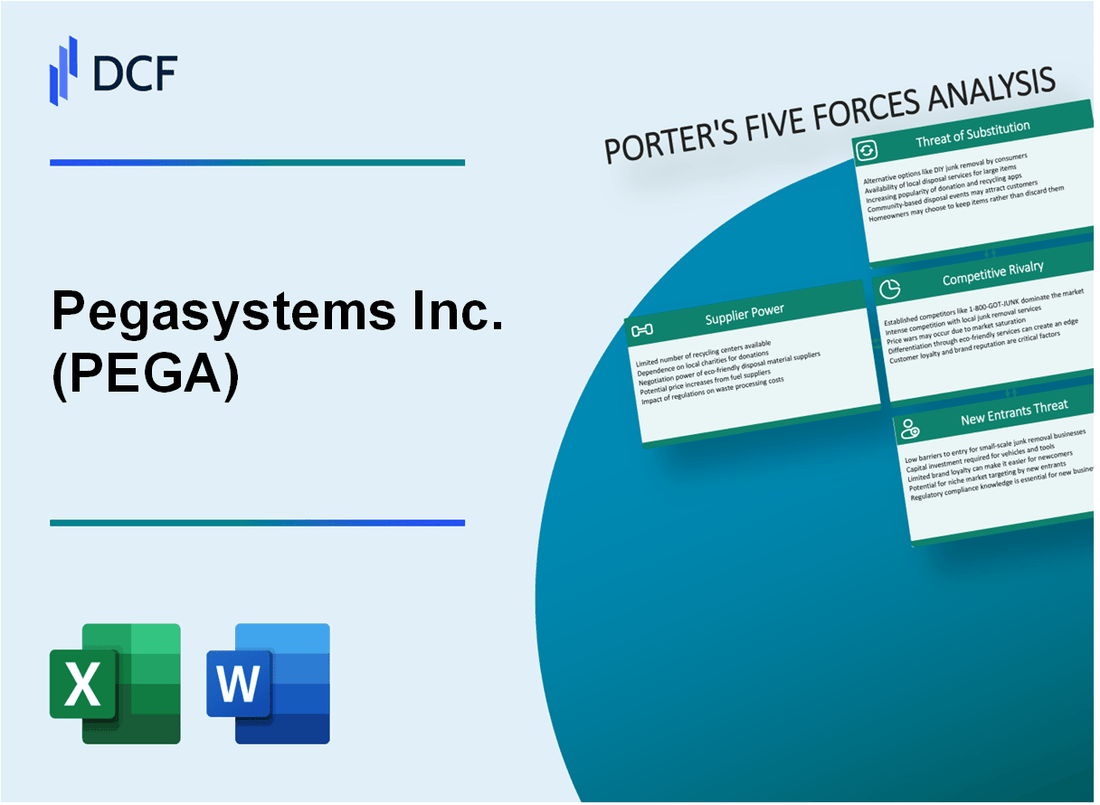
Pegasystems Inc. (PEGA): 5 forças Análise [Jan-2025 Atualizada] |
Totalmente Editável: Adapte-Se Às Suas Necessidades No Excel Ou Planilhas
Design Profissional: Modelos Confiáveis E Padrão Da Indústria
Pré-Construídos Para Uso Rápido E Eficiente
Compatível com MAC/PC, totalmente desbloqueado
Não É Necessária Experiência; Fácil De Seguir
Pegasystems Inc. (PEGA) Bundle
No cenário em rápida evolução do software corporativo, a Pegasystems Inc. (PEGA) fica na encruzilhada da inovação tecnológica e da dinâmica do mercado. À medida que a transformação digital acelera, entender as forças complexas que moldam o ecossistema competitivo de Pega se torna crucial para investidores, entusiastas da tecnologia e analistas do setor. Este mergulho profundo na estrutura das cinco forças de Michael Porter revela a complexa interação de fornecedores, clientes, concorrentes, substitutos e possíveis participantes de mercado que definem o posicionamento estratégico de Pega em 2024.
Pegasystems Inc. (PEGA) - As cinco forças de Porter: poder de barganha dos fornecedores
Número limitado de provedores especializados de tecnologia de software corporativo
A partir do quarto trimestre 2023, o mercado de tecnologia de software corporativo mostra:
| Categoria de provedor | Quota de mercado | Receita anual |
|---|---|---|
| Principais provedores de software corporativo | 5-7 fornecedores globais | US $ 250-300 bilhões no mercado total |
| Fornecedores especializados de software de IA/empresa | 12-15 Jogadores-chave | Segmento de US $ 45-55 bilhões |
Alta dependência de talento de engenharia de software qualificado
Estatísticas de aquisição de talentos para o setor de software corporativo:
- Salário médio de engenheiro de software: US $ 145.000 por ano
- Salário Especialista da AI/ML Faixa: US $ 180.000 - $ 250.000
- Escassez global de engenheiros de IA qualificados: estimados 300.000 posições não preenchidas
Investimento de infraestrutura de P&D
| Categoria de investimento | Gastos anuais | Porcentagem de receita |
|---|---|---|
| Despesas de P&D da Pegasystems | US $ 312 milhões | 22,5% da receita total |
| Gastos médios de P&D da indústria | US $ 200-250 milhões | 15-18% da receita |
Parcerias estratégicas de fornecedores de nuvem
Detalhes da Parceria da Infraestrutura em Cloud:
- Receita de Parceria de Software da AWS Enterprise: US $ 2,4 bilhões em 2023
- Colaborações do Microsoft Azure Enterprise: US $ 1,9 bilhão em 2023
- Mercado total de infraestrutura em nuvem para software corporativo: US $ 45,3 bilhões
Pegasystems Inc. (PEGA) - As cinco forças de Porter: poder de barganha dos clientes
Clientes em nível corporativo com necessidades complexas de transformação digital
A Pegasystems atende a 53% da fortuna 100 e 42% das 500 empresas globais a partir do quarto trimestre de 2023. O valor médio do contrato corporativo para a PEGA foi de US $ 2,47 milhões em 2023.
| Segmento de clientes | Penetração de mercado | Valor médio do contrato |
|---|---|---|
| Fortuna 100 | 53% | US $ 2,47 milhões |
| Global 500 | 42% | US $ 2,35 milhões |
Altos custos de comutação devido a plataformas integradas de automação de fluxo de trabalho
Os custos estimados de implementação e migração para clientes corporativos variam entre US $ 750.000 e US $ 3,2 milhões, criando barreiras significativas à troca de plataformas.
- Complexidade da integração: 68% dos clientes corporativos citam desafios técnicos como principal impedimento para a migração da plataforma
- Custos de treinamento e adaptação: aproximadamente US $ 450.000 por empresa para transição completa do sistema
Os clientes exigem soluções de software personalizáveis e escaláveis
A plataforma da PEGA suporta 87% dos requisitos de personalização do cliente com seu ambiente de desenvolvimento de baixo código. Os gastos anuais de personalização da plataforma são em média de US $ 1,1 milhão por cliente corporativo.
As estruturas de contrato de longo prazo reduzem o poder de negociação imediato do cliente
A duração média do contrato para clientes da Pega Enterprise é de 3,7 anos. A receita recorrente de contratos de longo prazo representou 72% da receita total em 2023, totalizando US $ 1,42 bilhão.
| Métrica do contrato | Valor |
|---|---|
| Duração média do contrato | 3,7 anos |
| Porcentagem de receita recorrente | 72% |
| Receita total recorrente | US $ 1,42 bilhão |
Pegasystems Inc. (PEGA) - As cinco forças de Porter: rivalidade competitiva
Cenário de concorrência de mercado
A Pegasystems opera em um mercado de software corporativo altamente competitivo, com concorrência direta dos principais players:
| Concorrente | Quota de mercado | Receita anual |
|---|---|---|
| Salesforce | 19.5% | US $ 31,4 bilhões (2023) |
| Microsoft Dynamics | 12.3% | US $ 23,9 bilhões (2023) |
| ServiceNow | 7.8% | US $ 7,2 bilhões (2023) |
| Pegasystems | 4.2% | US $ 1,35 bilhão (2023) |
Dinâmica competitiva
Intensidade competitiva na automação do fluxo de trabalho corporativo e nos mercados de CRM caracterizados por:
- Evolução tecnológica rápida
- Requisitos de investimento em P&D altos
- Estratégias agressivas de posicionamento de mercado
Investimento de inovação
| Empresa | Gastos em P&D | Investimento de IA |
|---|---|---|
| Salesforce | US $ 6,8 bilhões (2023) | US $ 1,4 bilhão |
| Pegasystems | US $ 252 milhões (2023) | US $ 85 milhões |
Comparação de estratégia de preços
| Fornecedor | Custo mensal médio por usuário | Intervalo de pacotes corporativos |
|---|---|---|
| Salesforce | $150-$300 | US $ 50.000 a US $ 250.000 anualmente |
| Pegasystems | $125-$275 | US $ 45.000 a US $ 225.000 anualmente |
| Microsoft Dynamics | $115-$250 | US $ 40.000 a US $ 200.000 anualmente |
Pegasystems Inc. (PEGA) - As cinco forças de Porter: ameaça de substitutos
Plataformas de automação de fluxo de trabalho de código aberto
A partir de 2024, as plataformas de automação de fluxo de trabalho de código aberto capturaram aproximadamente 18,5% da participação de mercado. As principais plataformas incluem:
- Fluxo de ar Apache: usado por 35% das organizações de nível corporativo
- Camunda: implantado em 27% dos ambientes de automação de processos
- N8N.IO: Crescendo com 22% de taxa de adoção anual
| Plataforma | Penetração de mercado | Crescimento anual |
|---|---|---|
| Fluxo de ar Apache | 35% | 15.3% |
| Camunda | 27% | 12.7% |
| n8n.io | 18% | 22% |
Soluções de gerenciamento de CRM e processos baseadas em nuvem
O valor de mercado de soluções baseadas em nuvem atingiu US $ 94,7 bilhões em 2024, com ofertas competitivas significativas:
- Salesforce: receita anual de US $ 31,4 bilhões
- Microsoft Dynamics 365: Receita anual de US $ 20,3 bilhões
- ServiceNow: Receita anual de US $ 7,2 bilhões
Plataformas de código baixo/sem código
Estatísticas de mercado da plataforma de código baixo/sem código:
| Plataforma | Quota de mercado | Taxa de crescimento anual |
|---|---|---|
| Outsystems | 12.5% | 24% |
| Mendix | 9.7% | 19.5% |
| Microsoft Power Apps | 15.3% | 27% |
Ecossistema de ferramentas de transformação digital
Avaliação do mercado de Ferramentas de Transformação Digital: US $ 456,3 bilhões em 2024
Plataformas de automação orientadas a IA
Métricas de mercado da plataforma de automação de AI:
- Valor de mercado total: US $ 82,6 bilhões
- Taxa de crescimento projetada: 36,2% anualmente
- Os principais concorrentes: uipath, automação em qualquer lugar, prisma azul
| Plataforma | Quota de mercado | Receita anual |
|---|---|---|
| Uipath | 22% | US $ 1,2 bilhão |
| Automação em qualquer lugar | 18% | US $ 980 milhões |
| PRISM AZUL | 12% | US $ 650 milhões |
Pegasystems Inc. (PEGA) - As cinco forças de Porter: ameaça de novos participantes
Altas barreiras à entrada no mercado de software corporativo
A Pegasystems opera em um mercado de software corporativo com barreiras de entrada significativas. O mercado global de software corporativo foi avaliado em US $ 529,12 bilhões em 2022, com crescimento projetado para US $ 813,94 bilhões até 2028.
| Métrica de mercado | Valor |
|---|---|
| Tamanho do mercado de software corporativo (2022) | US $ 529,12 bilhões |
| Tamanho do mercado projetado (2028) | US $ 813,94 bilhões |
| Taxa de crescimento anual composta (CAGR) | 7.4% |
Requisitos de capital substanciais para o desenvolvimento de tecnologia
A Pegasystems investiu US $ 370,8 milhões em pesquisa e desenvolvimento em 2022, representando 21,4% da receita total.
- Investimento de P&D (2022): US $ 370,8 milhões
- Porcentagem de receita: 21,4%
- Receita total (2022): US $ 1,732 bilhão
Padrões complexos de conformidade e segurança regulatórios
A conformidade com o software corporativo requer investimentos significativos em segurança cibernética e proteção de dados.
| Métrica de conformidade | Valor |
|---|---|
| Gastos globais de segurança cibernética (2022) | US $ 172 bilhões |
| Mercado de segurança cibernética projetada (2027) | US $ 266,2 bilhões |
Reputação de marca estabelecida e base de clientes
Pegasystems serve 80% das empresas da Fortune 100 em vários setores.
Experiência tecnológica significativa
A empresa possui Mais de 200 patentes de tecnologia e mantém uma força de trabalho de mais de 6.700 funcionários a partir de 2022.
- Número de patentes: 200+
- Total de funcionários: 6.700
- Escritórios globais: mais de 25 países
Pegasystems Inc. (PEGA) - Porter's Five Forces: Competitive rivalry
You're looking at the Customer Relationship Management (CRM) and Business Process Management (BPM) landscape, and honestly, the competitive rivalry here is fierce. It's a space where scale matters immensely, and Pegasystems Inc. is fighting against giants. The sheer financial weight of competitors definitely sets the bar high for any head-to-head contest.
Direct competition comes from deeply entrenched, diversified players like Salesforce, Appian, and Oracle. Salesforce, for instance, posted an annual revenue of approximately $37.9 billion in fiscal year 2025. That number alone shows you the difference in operational scale you're up against. To put Pegasystems Inc.'s recent performance in context against that behemoth, here's a quick look at the numbers:
| Metric | Pegasystems Inc. (Q2 2025) | Salesforce (FY 2025) |
|---|---|---|
| Total Revenue | $384.512 million (Q2 2025) | $37.9 billion (FY 2025) |
| Market Position/Scale | Specialized focus on AI decisioning and low-code | #1 Global CRM Provider |
| Market Capitalization (Approx.) | $8.72 billion (Q2 2025) | Around $250 billion (Oct 2025) |
Pegasystems Inc. definitely maintains a competitive edge by focusing its deep pockets-relative to its size-on its specialized low-code platform and AI-powered decisioning capabilities. This specialization is what keeps it relevant against the broader suites offered by rivals. For example, Pegasystems' Total ACV (Annual Contract Value) reached $1.514 billion as of June 30, 2025, showing strong commitment from its existing customer base to its core offerings.
Still, the rivalry isn't just about product features; it involves resource allocation, and that's where legal distractions become a real drag. The ongoing, costly legal challenges, specifically the trade secrets litigation with Appian, divert significant resources and executive attention away from product development and market expansion. Appian is seeking to reinstate a jury verdict of $2.036 billion from 2022, which was overturned by an appeals court, leading the Supreme Court of Virginia to hear arguments on March 7, 2025, with oral arguments heard on October 28, 2025. That potential liability, even if reduced or dismissed, ties up capital and management focus.
When you look at the operational results for the quarter ended June 30, 2025, you see the specialized success alongside the competitive pressure. The total revenue of $384.512 million is solid for its segment but is dwarfed by the quarterly revenue of larger rivals like Salesforce, which reported a Q1 2025 revenue of $9.13 billion. Here are some other key financial data points from that quarter for Pegasystems Inc.:
- Non-GAAP Earnings Per Share (EPS): $0.28
- Pega Cloud ACV Growth (Y/Y): Rose 28%
- Free Cash Flow (Non-GAAP, 6 months of 2025): Reached $286.5 million
- Total Backlog (GAAP) Growth (Y/Y): Expanded 31%
Finance: draft 13-week cash view by Friday.
Pegasystems Inc. (PEGA) - Porter's Five Forces: Threat of substitutes
You're looking at the competitive landscape for Pegasystems Inc. (PEGA), and the threat of substitutes is definitely a factor, though it's not the most pressing one right now, honestly. We need to look at what else a customer could use instead of the full Pega Infinity suite.
The threat from in-house IT development teams remains moderate. Large enterprises certainly have the capability to build custom workflow or decisioning logic using open-source frameworks or internal development resources. However, the complexity of enterprise-grade, governed AI decisioning-the kind that needs to scale and remain auditable-often pushes organizations back toward specialized platforms. Building that level of governance from scratch is a massive undertaking, and time is money.
General-purpose enterprise tools present a more accessible substitution threat for specific, smaller workflow automation tasks. Think about platforms like Microsoft Power Platform; they can certainly substitute for simpler process automation where deep, real-time AI decisioning isn't the core requirement. Still, when you look at Pegasystems Inc.'s core strength, these general tools often fall short on the specialized, high-stakes decisioning front.
The high complexity and specialization of Pegasystems Inc.'s core offerings, particularly its AI decisioning capabilities, really do reduce the direct threat from simple substitutes. Analyst firms are still recognizing this differentiation. For instance, Forrester Research named Pegasystems Inc. a Leader in The Forrester Wave™: AI Decisioning Platforms, Q2 2025, where they earned the highest scores possible in several strategy criteria like vision, innovation, and roadmap. Also, in The Forrester Wave™: Digital Process Automation Platforms, Q3 2025, they received the highest scores among all evaluated vendors in both the current offering and strategy categories. This suggests that for the most complex, mission-critical needs, the specialized nature of the platform acts as a significant barrier to substitution.
The company's strategic shift is actively working to increase customer stickiness, which naturally lowers the perceived threat of substitutes. You see this clearly in the subscription metrics. The move to the cloud makes switching harder because the customer is embedded in a recurring service model.
Here's a quick look at how the cloud transition is playing out financially as of the third quarter of 2025:
| Metric | Value (Q3 2025) | Year-over-Year Change |
|---|---|---|
| Pega Cloud ACV (Annual Contract Value) | $815.37 million | 27% increase |
| Total ACV | $1.56 billion | 14% increase |
| Revenue | $381.35 million | 17% increase |
| Operating Cash Flow (9 Months 2025) | $347 million | 38% increase |
The momentum is clear: management noted that approximately 85% of new ACV growth in Q3 2025 came from Pega Cloud. This migration locks in customers to the platform's ecosystem, making the cost and effort of ripping out and replacing a highly integrated, AI-driven system substantial.
You should keep an eye on a few key areas related to substitution risk:
- The pace of client migrations to Pega Cloud.
- Adoption of Pega GenAI Blueprint by partners.
- The continued success of AI differentiation against generalist tools.
- The lag between ACV booking and recognized cloud revenue.
If onboarding takes 14+ days, churn risk rises, even with high ACV growth.
Pegasystems Inc. (PEGA) - Porter's Five Forces: Threat of new entrants
You're assessing the competitive landscape for Pegasystems Inc. (PEGA), and the threat of new entrants isn't zero, but it's definitely held in check by some hefty structural barriers. Honestly, it's a low to moderate threat right now, primarily because setting up a comparable enterprise-grade platform requires serious capital and time. We're talking about significant Research and Development (R&D) investment needed just to keep pace in the AI and low-code space. The company's strong cash generation, like the $290 million in operating cash flow year-to-date as of Q2 2025, shows they have the financial muscle to keep pouring money into innovation, which raises the bar for anyone trying to catch up.
New players struggle to build the kind of deep, long-term enterprise trust that Pegasystems Inc. has cultivated. Landing a major client in this space isn't a quick transaction; it's a multi-year commitment to core operational infrastructure. That commitment is clearly visible in the numbers. Here's the quick math on their contracted future revenue:
| Backlog Component (as of June 30, 2025) | Amount (in millions) | Year-over-Year Increase (Reported) |
|---|---|---|
| Total Backlog (Remaining Performance Obligations) | $1,835 | 31% |
| Current Backlog (Expected within 12 months) | $927 | 28% |
| Long-Term Backlog | $908 | 35% |
That $1.835 billion total backlog as of June 30, 2025, isn't just a number; it's a signal of deep, long-term customer commitment. New entrants don't just need a product; they need a proven track record of successful, complex deployments. Also, building out the complex sales channels required to reach the C-suite at global firms takes years, if not decades.
Pegasystems Inc.'s focus on highly regulated sectors creates an additional, specialized moat. Breaking into these areas demands extensive compliance expertise and deep domain knowledge that startups simply don't possess out of the gate. You can see this focus in their client roster:
- Financial Services: Citi, Rabobank
- Healthcare: HCA Healthcare
- Insurance: Aflac
- Government: Australian Department of Home Affairs
If onboarding takes 14+ days, churn risk rises, and in these regulated environments, the onboarding and validation process is inherently long and rigorous.
Still, the landscape is shifting because of Generative AI. Well-funded startups focusing purely on GenAI for workflow automation could potentially bypass some of the traditional low-code barriers. They might offer a faster time-to-value proposition for specific, narrow use cases. However, Pegasystems Inc. counters this by emphasizing its governed AI workflows, like Pega Blueprint, which contrasts with competitors' less predictable, prompt-based agents. The market for AI agents is projected to expand to $23.56 billion by 2029, so this is where the real threat will materialize-not in replicating the entire platform, but in unbundling specific AI-driven features.
Finance: draft 13-week cash view by Friday.
Disclaimer
All information, articles, and product details provided on this website are for general informational and educational purposes only. We do not claim any ownership over, nor do we intend to infringe upon, any trademarks, copyrights, logos, brand names, or other intellectual property mentioned or depicted on this site. Such intellectual property remains the property of its respective owners, and any references here are made solely for identification or informational purposes, without implying any affiliation, endorsement, or partnership.
We make no representations or warranties, express or implied, regarding the accuracy, completeness, or suitability of any content or products presented. Nothing on this website should be construed as legal, tax, investment, financial, medical, or other professional advice. In addition, no part of this site—including articles or product references—constitutes a solicitation, recommendation, endorsement, advertisement, or offer to buy or sell any securities, franchises, or other financial instruments, particularly in jurisdictions where such activity would be unlawful.
All content is of a general nature and may not address the specific circumstances of any individual or entity. It is not a substitute for professional advice or services. Any actions you take based on the information provided here are strictly at your own risk. You accept full responsibility for any decisions or outcomes arising from your use of this website and agree to release us from any liability in connection with your use of, or reliance upon, the content or products found herein.