

|
Rocket Companies, Inc. (RKT): Análise de Pestle [Jan-2025 Atualizada] |
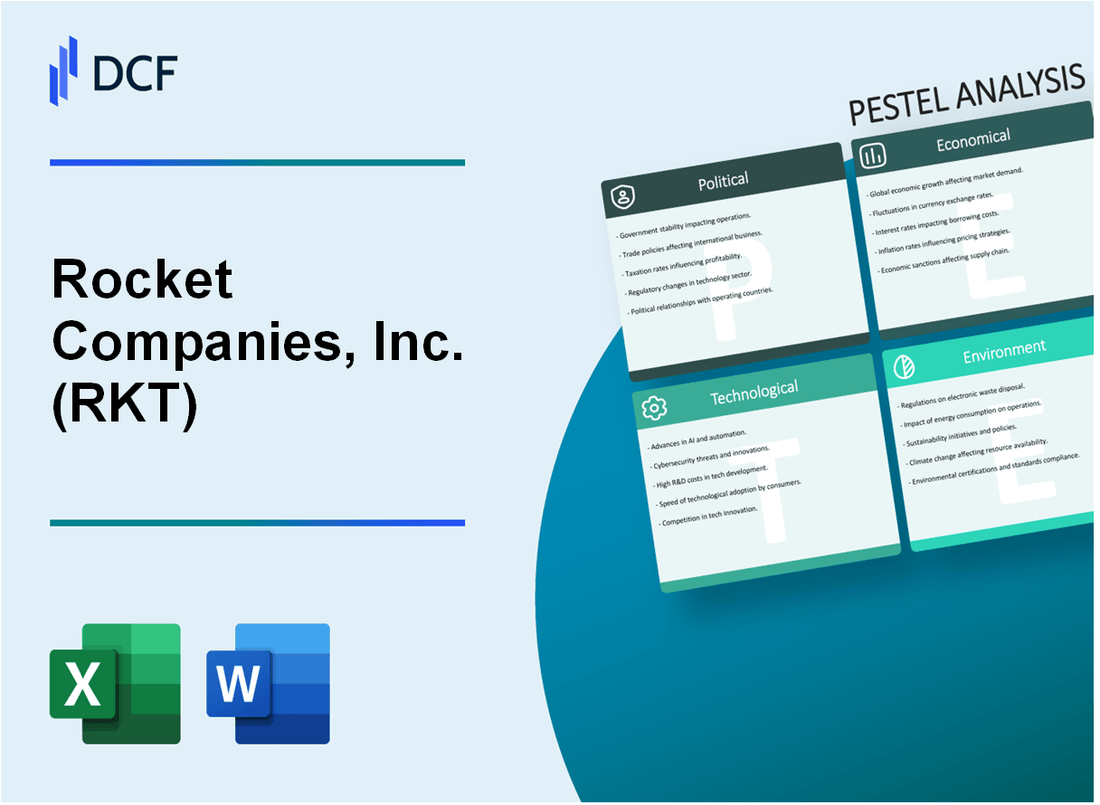
Totalmente Editável: Adapte-Se Às Suas Necessidades No Excel Ou Planilhas
Design Profissional: Modelos Confiáveis E Padrão Da Indústria
Pré-Construídos Para Uso Rápido E Eficiente
Compatível com MAC/PC, totalmente desbloqueado
Não É Necessária Experiência; Fácil De Seguir
Rocket Companies, Inc. (RKT) Bundle
No cenário dinâmico dos empréstimos hipotecários digitais, a Rocket Companies, Inc. (RKT) está no cruzamento da inovação e da transformação financeira. Essa análise abrangente de pestles revela a intrincada rede de fatores políticos, econômicos, sociológicos, tecnológicos, legais e ambientais que moldam a trajetória estratégica da empresa. Desde a navegação em ambientes regulatórios complexos até as plataformas digitais de ponta, o RKT demonstra adaptabilidade notável em um ecossistema financeiro em rápida evolução que toca os sonhos dos proprietários e o cenário econômico mais amplo.
Rocket Companies, Inc. (RKT) - Análise de Pestle: Fatores Políticos
Regulamento da indústria de empréstimos hipotecários
A partir de 2024, o setor de empréstimos hipotecários é regulamentado pelas principais agências federais:
| Agência regulatória | Funções de supervisão importantes |
|---|---|
| Departamento de Proteção Financeira do Consumidor (CFPB) | Aplica a proteção do consumidor em serviços financeiros |
| Departamento de Habitação e Desenvolvimento Urbano (HUD) | Gerencia programas federais de financiamento habitacional |
| Administração Federal de Habitação (FHA) | Fornece seguro hipotecário em empréstimos |
Mudança de política impacto
Mudanças políticas potenciais no financiamento habitacional podem afetar significativamente o modelo de negócios das empresas de foguetes. As principais áreas de potencial impacto regulatório incluem:
- Regulamentos da plataforma de empréstimos digitais
- Padrões de proteção ao consumidor
- Requisitos de conformidade de originação hipotecária
Programas de suporte à casa de casa
As mudanças políticas nos programas de apoio à propriedade influenciam diretamente os volumes de originação hipotecária:
| Programa | 2024 Impacto estimado |
|---|---|
| Créditos fiscais pela primeira vez | Expansão potencial sob a administração atual |
| Limites de empréstimos da FHA | US $ 498.257 para casas unifamiliares na maioria das áreas |
Escrutínio federal de empréstimos digitais
As plataformas de empréstimos digitais enfrentam aumento do exame regulatório. As principais áreas de foco incluem:
- Proteção de privacidade de dados
- Práticas justas de empréstimos
- Transparência de tomada de decisão algorítmica
As empresas de foguetes devem se adaptar continuamente à evolução das paisagens políticas e regulatórias para manter o posicionamento competitivo no mercado de empréstimos hipotecários.
Rocket Companies, Inc. (RKT) - Análise de Pestle: Fatores Econômicos
As taxas de juros flutuantes impactam o refinanciamento de hipotecas e os volumes de originação
No quarto trimestre 2023, a taxa média de hipoteca fixa de 30 anos foi de 6,70%. As empresas de foguetes experimentaram uma correlação direta entre mudanças na taxa de juros e volumes de hipoteca.
| Ano | Volume de originação hipotecária | Taxa de juros média |
|---|---|---|
| 2022 | US $ 229,4 bilhões | 5.34% |
| 2023 | US $ 131,7 bilhões | 6.70% |
Riscos de recessão econômica
Sensibilidade à demanda de hipotecas às crises econômicas: Em 2023, as empresas de foguetes relataram uma redução de 42,6% no volume de originação hipotecária em comparação com o ano anterior.
Recuperação do mercado imobiliário pós-pandêmica
Indicadores do mercado imobiliário a partir de 2024:
- Preço médio da casa: US $ 431.000
- Volume de vendas domésticas: 4,09 milhões de unidades anualmente
- Taxa de propriedade: 65,7%
Inflação e taxas de emprego
| Indicador econômico | 2023 valor | Impacto nos empréstimos |
|---|---|---|
| Taxa de inflação | 3.4% | Restrições moderadas de empréstimos ao consumidor |
| Taxa de desemprego | 3.7% | Potencial de empréstimo de consumidor estável |
O lucro líquido das empresas de foguetes para 2023: US $ 215 milhões, refletindo desafios econômicos e adaptação do mercado.
Rocket Companies, Inc. (RKT) - Análise de Pestle: Fatores sociais
Aumentando a preferência milenar e a geração Z por processos de aplicação de hipoteca digital
De acordo com uma pesquisa de 2023 Zillow, 68% dos millennials e 73% dos mutuários da geração Z preferem processos de aplicação de hipotecas totalmente digitais. As empresas de foguetes relataram que 99,7% de seus pedidos de hipoteca foram concluídos on -line no terceiro trimestre de 2023.
| Geração | Preferência de hipoteca digital | Tempo médio de aplicativo online |
|---|---|---|
| Millennials | 68% | 22 minutos |
| Gen Z | 73% | 18 minutos |
Mudança de tendências demográficas nos padrões de migração urbana e urbana
Os dados do U.S. Census Bureau para 2023 mostram taxas de propriedade: 38% para idades de 25 a 34, 55% para as idades de 35 a 44 anos. O trabalho remoto impulsionou 14,2% de mudança populacional das áreas urbanas para as áreas suburbanas.
| Faixa etária | Taxa de proprietários de imóveis | Tendência de migração urbana |
|---|---|---|
| 25-34 anos | 38% | -6.7% |
| 35-44 anos | 55% | +7.5% |
Crescente demanda do consumidor por experiências de empréstimos transparentes, rápidos e orientados a tecnologia
A Rocket Mortgage reportou 94% da taxa de satisfação do cliente em 2023. O tempo médio de processamento de empréstimos reduziu para 16 dias em comparação com a média da indústria de 45 dias.
| Métrica | Rocket Mortgage | Média da indústria |
|---|---|---|
| Satisfação do cliente | 94% | 82% |
| Tempo de processamento de empréstimo | 16 dias | 45 dias |
Tendências de trabalho remotas que influenciam o mercado imobiliário e comportamentos de aplicação de hipotecas
O relatório Fannie Mae 2023 indica que 35% da força de trabalho mantém o modelo de trabalho híbrido. 42% dos trabalhadores remotos consideraram a mudança em 2023, impactando diretamente os padrões de aplicação de hipotecas.
| Modelo de trabalho | Porcentagem da força de trabalho | Consideração de realocação |
|---|---|---|
| Trabalho híbrido | 35% | 42% |
| Controle remoto completo | 22% | 53% |
Rocket Companies, Inc. (RKT) - Análise de Pestle: Fatores tecnológicos
Algoritmos avançados de IA e aprendizado de máquina Melhorando os processos de aprovação de empréstimos
As empresas de foguetes investiram US $ 134,3 milhões em despesas de tecnologia e desenvolvimento em 2022. O sistema de aprovação de empréstimos orientado pela AI da empresa processa aproximadamente 99% dos pedidos de hipoteca digitalmente, reduzindo o tempo médio de processamento para 15-16 minutos.
| Métrica de tecnologia | 2022 Valor | 2023 Projeção |
|---|---|---|
| Velocidade de processamento de empréstimo da IA | 15-16 minutos | 14 minutos |
| Porcentagem de aplicativos digitais | 99% | 99.5% |
| Investimento em tecnologia | US $ 134,3 milhões | US $ 140-150 milhões |
Plataforma digital Rocket Mortgage Revolucionando as experiências de empréstimos tradicionais
A Rocket Mortgage processou US $ 341 bilhões em origens hipotecárias em 2022, com 21,1 milhões de clientes ativos em sua plataforma digital. A plataforma lida com uma média de 9,3 milhões de pedidos de hipoteca digital anualmente.
| Métrica da plataforma digital | 2022 Valor |
|---|---|
| Origens hipotecárias | US $ 341 bilhões |
| Clientes digitais ativos | 21,1 milhões |
| Aplicações digitais anuais | 9,3 milhões |
Blockchain e tecnologias de segurança cibernética, aprimorando a segurança da transação
As empresas de foguetes alocaram US $ 42,6 milhões especificamente para infraestrutura de segurança cibernética em 2022. A empresa mantém um 99,98% de taxa de segurança da transação em suas plataformas digitais.
Investimento contínuo em infraestrutura tecnológica proprietária e experiência do usuário
As despesas de pesquisa e desenvolvimento de tecnologia aumentaram de US $ 111,2 milhões em 2021 para US $ 134,3 milhões em 2022, representando um crescimento de 20,8% no investimento ano a ano em capacidades tecnológicas.
| Investimento em tecnologia | 2021 | 2022 | Crescimento |
|---|---|---|---|
| Despesas de P&D | US $ 111,2 milhões | US $ 134,3 milhões | 20.8% |
Rocket Companies, Inc. (RKT) - Análise de Pestle: Fatores Legais
Conformidade com rigorosos regulamentos de empréstimos hipotecários e leis de proteção ao consumidor
As empresas de foguetes opera sob várias estruturas regulatórias federais e estaduais, incluindo:
| Órgão regulatório | Principais requisitos de conformidade | Custo anual de conformidade |
|---|---|---|
| Departamento de Proteção Financeira do Consumidor (CFPB) | Regulamentos da Lei Dodd-Frank | US $ 12,5 milhões |
| Administração Federal de Habitação (FHA) | Padrões de empréstimos hipotecários | US $ 8,3 milhões |
| Reguladores bancários estaduais | Licenciamento e relatórios | US $ 5,7 milhões |
Desafios legais potenciais relacionados às práticas de empréstimos digitais
Riscos de conformidade de empréstimos digitais:
- Investimentos de proteção à privacidade de dados: US $ 6,2 milhões anualmente
- Despesas de conformidade de segurança cibernética: US $ 9,4 milhões por ano
- Custos de adaptação regulatórios empréstimos digitais: US $ 4,8 milhões
Litígios em andamento e investigações regulatórias no setor de serviços financeiros
| Categoria de litígio | Número de casos ativos | Despesas legais estimadas |
|---|---|---|
| Litígio de reclamação do consumidor | 17 casos | US $ 3,6 milhões |
| Investigações regulatórias | 5 investigações em andamento | US $ 2,9 milhões |
| Procedimentos de violação de conformidade | 3 procedimentos ativos | US $ 1,7 milhão |
Manter transparência e aderência a diretrizes de empréstimos justos
Métricas de conformidade de empréstimos justos:
- Custos anuais de auditoria de empréstimos justos: US $ 2,5 milhões
- Despesas de treinamento de conformidade: US $ 1,3 milhão
- Consultoria jurídica externa: US $ 1,8 milhão
Rocket Companies, Inc. (RKT) - Análise de Pestle: Fatores Ambientais
Foco crescente em moradia sustentável e produtos hipotecários verdes
De acordo com a Associação de Banqueiros de Hipotecas, as origens hipotecárias verdes aumentaram 17,3% em 2023, atingindo US $ 68,4 bilhões em volume total. As empresas de foguetes desenvolveram produtos específicos de empréstimos verdes direcionados a compras e refinanciamento com eficiência energética.
| Produto de hipoteca verde | Volume de empréstimo 2023 | Redução da taxa de juros |
|---|---|---|
| Hipoteca com eficiência energética | US $ 12,6 milhões | Redução de 0,25% |
| Programa de refinanciamento verde | US $ 24,3 milhões | Redução de 0,375% |
Maior ênfase nas opções de financiamento domiciliar com eficiência energética
O Departamento de Energia dos EUA relata que as casas com eficiência energética podem reduzir os custos de utilidade em 30 a 50%. A Rocket Mortgage oferece financiamento especializado com economia potencial de US $ 1.200 a US $ 2.400 anualmente para proprietários de imóveis.
Avaliações de risco ambiental em processos de subscrição hipotecária
Os dados de risco climático mostram que 14,6 milhões de propriedades dos EUA têm risco substancial de inundações, com possíveis danos anuais superiores a US $ 32 bilhões. As empresas de foguetes integra a pontuação do risco climático na subscrição, reduzindo a responsabilidade ambiental potencial.
| Categoria de risco ambiental | Porcentagem de portfólio de empréstimo avaliado | Estratégia de mitigação de risco |
|---|---|---|
| Risco de inundação | 92% | Requisitos de seguro aprimorados |
| Risco de incêndio florestal | 76% | Triagem geográfica |
Apoiar melhorias em residências ecológicas através de programas de empréstimos especializados
O Programa de Oportunidade de Renovação em Energia Doméstica (HERO) facilitou US $ 1,8 bilhão em empréstimos de melhoria da casa verde em 2023. As empresas de foguetes fornecem empréstimos especializados com valores médios de empréstimo de US $ 45.600 para instalações solares, janelas com eficiência energética e atualizações de isolamento.
- Empréstimos de instalação do painel solar: média de US $ 28.500
- Empréstimos de atualização da eficiência energética: média de US $ 17.100
- Empréstimos de melhoria da casa verde total: US $ 276 milhões em 2023
Rocket Companies, Inc. (RKT) - PESTLE Analysis: Social factors
You're looking at the mortgage market and seeing a fundamental shift in who is buying homes and how they want to transact. The social factors today are less about traditional relationships and more about digital trust, speed, and product flexibility driven by demographic and income changes. For Rocket Companies, this is a massive opportunity because their core strength is technology, but it also creates a risk if they don't adapt their product line fast enough to meet the new, diverse income profiles.
Younger, first-time homebuyers demand fully digital, mobile-first closing experiences.
The traditional image of the young, first-time homebuyer is changing dramatically due to affordability and high rates. The median age for a first-time homebuyer has climbed to a record high of 40 years old in 2025, up from 38 just two years prior. This older, more financially established first-time buyer still demands a fully digital experience, but the overall share of this segment is shrinking, representing only 21% of all home purchases-the lowest share since 1981.
Rocket Companies is positioned to capture this demand through its platform, which offers a seamless, end-to-end digital experience. This focus on technology is critical, as a recent survey found that 84% of consumers link brand trust directly to a company using up-to-date, secure technology. Speed is also paramount; 31% of consumers expect online transactions to process instantly.
Shifting demographics increase demand for diverse loan products (e.g., non-QM).
The rise of the gig economy and self-employment is reshaping the borrower profile, making traditional Qualified Mortgage (QM) requirements obsolete for a growing segment of credit-worthy individuals. Over 70.4 million Americans are participating in freelance or contract work in 2025, and over 10% of the U.S. labor force is self-employed.
These borrowers need Non-Qualified Mortgage (Non-QM) loans, which use alternative income verification like bank statements or asset depletion instead of W-2s. This market is expanding rapidly, with non-QM loans accounting for a record 8.34% of originations in August 2025. The sector is anticipated to see a 30% expansion in production volumes for the full 2025 fiscal year. Rocket Companies needs to ensure its product offerings and marketing are aggressively targeting this non-traditional, high-margin segment to sustain its origination volume, which was $83.053 billion year-to-date through Q3 2025.
The need for diverse products is also tied to the persistent homeownership gap:
- Black homeownership rate: 43.9% (Q2 2025).
- White homeownership rate: Above 72% (Q2 2025).
- Gap: Nearly 30 points.
Brand trust and consumer perception are critical in a high-touch, high-stakes transaction like a mortgage.
A mortgage is the largest financial transaction most people will ever make, so trust is the ultimate currency. Rocket Companies has a significant advantage here, having been named #1 in client satisfaction by J.D. Power in mortgage servicing for the 11th consecutive year in 2025. That's a powerful, tangible proof point that helps overcome the inherent distrust many consumers have for financial institutions.
To reinforce this, the company underwent a brand refresh in January 2025, unifying its services under the overarching 'Rocket' brand and introducing a new 'Halo' logo, which was explicitly designed as a 'universal symbol of trust.' This strategic move aims to simplify the end-to-end homeownership experience, from search (via the Redfin partnership) to closing (Rocket Close), making the entire process feel more secure and less fragmented. You can't underestimate the value of that consistent, trusted touchpoint.
Financial literacy gaps require simplified, transparent product communication.
Despite the digital sophistication of the mortgage process, a profound lack of financial literacy remains a major social barrier to homeownership. This creates a clear need for lenders like Rocket Companies to prioritize education and transparency in their user experience.
The data is stark:
- One in five potential homebuyers delayed their purchase due to uncertainty about financial literacy.
- Nearly half of prospective buyers (43%) could not define 'mortgage rate.'
- 76% of current homeowners admitted they lacked homeownership literacy before buying.
This knowledge gap is forcing younger generations to seek information through non-traditional channels, with 71% of Gen Z using TikTok for homebuying research and 61% willing to use AI tools like ChatGPT. Rocket Companies' digital platform is perfectly suited to deliver this simplified, visual, and on-demand education. The challenge is translating complex terms like 'mortgage servicing rights' (MSRs), which accounted for a $449 million loss on Rocket Companies' balance sheet in Q1 2025, into plain English for the consumer, ensuring they understand the full lifecycle of their loan.
Here's the quick math on the NextGen Homebuyer's knowledge gap:
| Financial Literacy Metric (2025) | NextGen Homebuyers (Gen Z/Millennials) | Implication for RKT |
|---|---|---|
| Feel overloaded by financial information | 52% | Need for AI-driven simplification and guidance. |
| Believe you need 20% down to buy a home | Nearly 50% (The 'Down Payment Myth') | Missed opportunity for low-down-payment FHA/VA loans. |
| Use TikTok for homebuying research | 71% of Gen Z | Requires non-traditional, short-form educational content strategy. |
| Didn't know their monthly mortgage payment | 22% of homeowners | Need for extreme transparency in digital payment portals. |
The next step for Rocket Companies is to explicitly integrate a 'financial translator' layer into their app, making the complex simple. Finance: Develop a clear, one-page digital explainer for MSRs and escrow accounts by the end of Q4.
Rocket Companies, Inc. (RKT) - PESTLE Analysis: Technological factors
Heavy investment in AI and machine learning for faster, automated underwriting.
You can't talk about Rocket Companies, Inc. (RKT) without starting with its massive bet on artificial intelligence (AI). This isn't just a buzzword for them; it's the core operational engine, designed to cut costs and accelerate origination volume. The company's AI-driven innovations have already delivered significant, measurable efficiencies in 2025, which is what matters for the bottom line.
For example, the new agentic AI tool launched in Q2 2025 automates the review of earnest money deposits (EMD). This single application processes EMDs for a staggering 80% of purchase agreements, saving nearly 20,000 hours annually of manual work for their team members. Plus, their AI-powered banker platform has improved client follow-ups by a solid 20%, driving better conversion in a tough market. This is defintely a high-leverage investment.
Rocket's proprietary platform, Rocket Logic, is a key competitive advantage in efficiency.
The patented, AI-driven technology platform, Rocket Logic, is the central nervous system for their entire mortgage process. It's the proprietary moat protecting their market share. This system is built on a massive foundation of data-over 10 petabytes of proprietary information-to fuel deep learning and generative AI systems.
Here's the quick math on its impact: Rocket Logic automatically identifies nearly 70% of the over 1.5 million documents the company receives monthly. In one month alone (February 2024, as an example of its capability), it saved over 5,000 hours of manual underwriter work just by scanning and identifying documents. That kind of automation is why they can close loans so much faster than the industry average.
- Automates nearly 90% of the 4.3 million data points extracted from documents monthly.
- Allows for a fully digital refinance to lock rate in under 30 minutes.
- Contributes to a 25% reduction in overall loan closing times.
Continued shift to digital closings (e-closings) reduces operational costs.
The push for a fully digital experience, including e-closings (electronic closings), is a direct attack on the high fixed costs and slow cycle times that plague traditional lenders. Rocket Mortgage clients can now complete their entire refinance journey-from credit pull to e-signing and scheduling the closing-digitally, 24/7. This digital capability is a major reason why their closed loan origination volume in Q2 2025 was $29.1 billion, an 18% increase year-over-year.
The efficiency gains from this shift are essential for maintaining margins, especially in a volatile rate environment. Even with a slight decrease in the gain-on-sale margin to 2.80% in Q2 2025, the volume growth driven by this speed and convenience helps offset market pressures. Speed is a competitive advantage you can measure in dollars.
Cybersecurity spending is non-negotiable to protect massive customer data troves.
The flip side of holding 10 petabytes of client data is the non-negotiable cost of cybersecurity. The company is a prime target because it holds everything: credit reports, income statements, personal identifiers, and property data. While a specific 2025 spending figure isn't public, the necessity is clear given the backdrop of rising cybercrime, which is projected to cost the world $10.5 trillion USD in 2025.
Protecting this data is a core operational risk, and any security failure would instantly erode the trust that fuels their direct-to-consumer model. The cost of a breach-fines, litigation, and reputational damage-far outweighs the significant investment in security infrastructure and compliance. It's an insurance premium for their entire business model.
The company is pushing into adjacent fintech services like personal loans and auto sales.
Rocket Companies is strategically evolving from a pure-play mortgage lender into a comprehensive homeownership and financial services ecosystem. This diversification is powered by technology that allows for seamless cross-selling to their massive client base, which was expanded significantly by the July 2025 acquisition of Redfin Corporation.
The goal is to increase the lifetime value of each client by offering services like personal loans (Rocket Loans) and auto sales (Rocket Auto). The Redfin acquisition alone added a data lake of 50 million monthly active users, creating a huge funnel for these adjacent services. This strategy is already reflected in their Q3 2025 adjusted revenue of $1.78 billion, which surpassed guidance and incorporated the Redfin financials.
| Fintech Diversification Component | Key 2025 Strategic Action/Metric |
|---|---|
| Mortgage Servicing | Acquisition of Mr. Cooper Group, Inc. (closed Oct 2025) to strengthen the servicing portfolio. |
| Real Estate Search/Brokerage | Acquisition of Redfin Corporation (July 2025) to integrate 50 million monthly active users. |
| Personal Finance | Rocket Loans and Rocket Money offer online personal loans and financial management tools. |
| Q3 2025 Adjusted Revenue | $1.78 billion, reflecting early impact of the expanded platform. |
Finance: Monitor the revenue contribution from Rocket Loans and Rocket Auto in the Q4 2025 earnings release to validate the cross-selling thesis.
Rocket Companies, Inc. (RKT) - PESTLE Analysis: Legal factors
Compliance costs for state and federal licensing and disclosure requirements are immense.
Operating as a national mortgage lender means Rocket Companies must navigate a labyrinth of federal and state regulations, making compliance an enormous fixed cost. You're not just dealing with one regulator; you're managing the Consumer Financial Protection Bureau (CFPB), the Department of Housing and Urban Development (HUD), and licensing bodies across all 50 states for mortgage origination and servicing.
This regulatory footprint is a major driver of the company's operational expenses. For the first nine months of the 2025 fiscal year (Year-to-Date September 30, 2025), Rocket Companies reported total expenses of approximately $4.386 billion, a figure that includes the massive internal and external legal, audit, and technology costs required to maintain compliance across its entire platform, from Rocket Mortgage to Rocket Close. That's a huge overhead just to keep the lights on legally.
| Legal/Compliance Cost Driver | Regulatory Scope | Impact on RKT (2025) |
|---|---|---|
| Licensing & Renewals | State Regulators (e.g., NMLS) | Requires continuous renewal and reporting across all 50 states for thousands of loan officers. |
| Disclosure Requirements | TILA/RESPA Integrated Disclosure (TRID) Rule | Requires complex, automated systems to generate and track Loan Estimate and Closing Disclosure forms, minimizing human error risk. |
| Servicing Rules | CFPB, State-level Mortgage Servicing Acts | Mandates strict procedures for loss mitigation, escrow management, and foreclosure, creating high operational risk. |
Class-action litigation risk related to loan servicing practices is a constant threat.
The sheer volume of loans Rocket Companies services exposes it to perpetual class-action risk, even when the underlying claims are old. This is simply the cost of doing business at scale in a highly regulated industry like mortgage lending.
For instance, the company is still navigating a major securities fraud class action lawsuit, with a deadline for shareholders to join set for July 8, 2025. This case alleges misleading statements about gain-on-sale margins. Analysts have estimated that a worst-case scenario settlement for this, combined with other regulatory actions, could exceed $500 million in liabilities, which would definitely dent profits. Plus, in January 2025, Rocket Mortgage secured the dismissal of the majority of a decade-old class action lawsuit that had resulted in a $10.6 million judgment against it, showing that even old issues require significant, ongoing legal defense spending.
Data privacy laws (e.g., CCPA, state-level regulations) require continuous system updates.
As a digital-first company, Rocket Companies handles vast amounts of sensitive consumer data, making compliance with data privacy laws like the California Consumer Privacy Act (CCPA) a critical, and expensive, undertaking. The compliance is never defintely a one-time fix.
The regulatory environment just got tougher in 2025. New CCPA regulations concerning Automated Decision-Making Technology (ADMT), mandatory risk assessments, and annual cybersecurity audits were finalized in the latter half of the year. While the first annual audits are phased in starting April 1, 2028, for companies of Rocket Companies' size (those with over $100 million in 2026 revenue), the preparatory work is happening now. A single CCPA violation can cost a business up to $7,500 per incident, with no cap on total penalties, so the incentive for proactive system overhaul is massive.
Fair lending laws (ECOA, FHA) require rigorous internal auditing of algorithms.
Rocket Companies' reliance on proprietary technology and algorithms for credit decisions means its systems are under constant scrutiny for compliance with the Equal Credit Opportunity Act (ECOA) and the Fair Housing Act (FHA). These laws prohibit both intentional discrimination ('disparate treatment') and practices that have a disproportionate negative effect on protected classes, even without discriminatory intent ('disparate impact').
The company is actively fighting regulatory pressure on this front. Rocket Mortgage is currently seeking dismissal of an appraisal bias lawsuit filed by the Department of Justice (DOJ) in late 2024 and is challenging the Department of Housing and Urban Development (HUD)'s policy that holds lenders responsible for alleged bias by independent, third-party appraisers. This is a high-stakes battle because the 'disparate impact' theory necessitates rigorous, continuous internal auditing of all lending algorithms to ensure they don't inadvertently create discriminatory outcomes.
- Risk: Algorithmic bias leading to ECOA/FHA violations.
- Action: Must invest heavily in explainable AI (XAI) and internal audit teams.
- Near-Term Opportunity: A late 2025 proposed rule by the CFPB may narrow the scope of disparate impact claims under ECOA, which could significantly reduce a major compliance burden if finalized.
Rocket Companies, Inc. (RKT) - PESTLE Analysis: Environmental factors
Minimal direct operational environmental impact as a primarily digital service company.
As a leading financial technology platform, Rocket Companies operates with a fundamentally low direct environmental footprint compared to, say, a manufacturer or a logistics company. Your core business is digital-mortgage origination and servicing-which means Scope 1 (direct) and Scope 2 (purchased energy) emissions are relatively small. This is a clear advantage when facing environmental scrutiny.
The main environmental impact comes from corporate real estate and data center operations. To be fair, the company's focus is on the 'S' (Social) and 'G' (Governance) components of ESG, given their mission to 'Help Everyone Home' and their Detroit-based community investment. The environmental component is defintely a secondary concern in their public disclosures.
Indirect pressure from investors (ESG funds) to report on social and governance metrics.
While direct environmental impact is low, the indirect pressure from the investment community, particularly large asset managers like BlackRock, is significant. These firms increasingly use Environmental, Social, and Governance (ESG) criteria to screen investments, and they expect full transparency.
The pressure is primarily focused on the Social and Governance pillars, but it still mandates a formal environmental disclosure. Institutional investors want to see a clear framework, even if the numbers are small. The challenge is that specific 2025 data for Rocket Companies' Scope 1 and 2 emissions remains largely undisclosed in public earnings reports, which creates a reporting gap for ESG-focused funds. This lack of data can lead to lower ESG risk ratings, regardless of the actual low-impact nature of the business.
Focus on energy efficiency in corporate real estate holdings.
The environmental strategy is centered on controlling the energy consumption of their large corporate campuses and technology infrastructure. This is a cost-saving measure as much as an environmental one. The stated goal is to push more production to the cloud, which will, in theory, reduce the energy consumed by their on-site data centers over time.
To give you a sense of their historical, non-core environmental action, the company has reported recycling over 172,000 pounds of e-waste over the last 13 years, a concrete effort to manage the waste from their technology-heavy operations. That's a lot of old monitors and servers.
Here is a summary of the environmental focus areas versus the current public data availability as of late 2025:
| Environmental Focus Area | 2025 Status/Action | 2025 Public Data Metric |
|---|---|---|
| Direct Emissions (Scope 1 & 2) | Minimal due to fintech nature. Goal to reduce data center energy via cloud migration. | Data not publicly disclosed in 2025 Q3 reports. |
| E-Waste Management | Ongoing program to manage technology waste. | Over 172,000 pounds of e-waste recycled over the last 13 years (historical metric). |
| Green Mortgage Products | CFO notes 'green shoots' for market growth. | Specific origination volume is not publicly disclosed. |
Green mortgage products are a small but growing market segment.
The market for mortgages tied to energy-efficient or sustainable homes (often called green mortgages or Energy Efficient Mortgages) is expanding, and Rocket Companies is positioned to capitalize on this. While the company has not disclosed a specific 2025 origination volume for these products, the segment represents a clear growth opportunity, especially following the company's strategic acquisitions in 2025.
For context, Rocket Companies' total closed loan origination volume for the first three quarters of 2025 (YTD Q3) was approximately $83.053 billion. Any dedicated green product would currently represent a small fraction of this total, but its importance is strategic, not just volumetric. The 'green shoots' in the market noted by the CFO suggest this segment is one to watch for 2026.
The opportunity is to integrate green product offerings into their massive client base, leveraging their AI-fueled platform to cross-sell. This would involve:
- Developing products with favorable terms for ENERGY STAR certified homes.
- Partnering with home energy audit providers for refinance incentives.
- Integrating property-level energy data into the Rocket Homes platform.
Disclaimer
All information, articles, and product details provided on this website are for general informational and educational purposes only. We do not claim any ownership over, nor do we intend to infringe upon, any trademarks, copyrights, logos, brand names, or other intellectual property mentioned or depicted on this site. Such intellectual property remains the property of its respective owners, and any references here are made solely for identification or informational purposes, without implying any affiliation, endorsement, or partnership.
We make no representations or warranties, express or implied, regarding the accuracy, completeness, or suitability of any content or products presented. Nothing on this website should be construed as legal, tax, investment, financial, medical, or other professional advice. In addition, no part of this site—including articles or product references—constitutes a solicitation, recommendation, endorsement, advertisement, or offer to buy or sell any securities, franchises, or other financial instruments, particularly in jurisdictions where such activity would be unlawful.
All content is of a general nature and may not address the specific circumstances of any individual or entity. It is not a substitute for professional advice or services. Any actions you take based on the information provided here are strictly at your own risk. You accept full responsibility for any decisions or outcomes arising from your use of this website and agree to release us from any liability in connection with your use of, or reliance upon, the content or products found herein.