
|
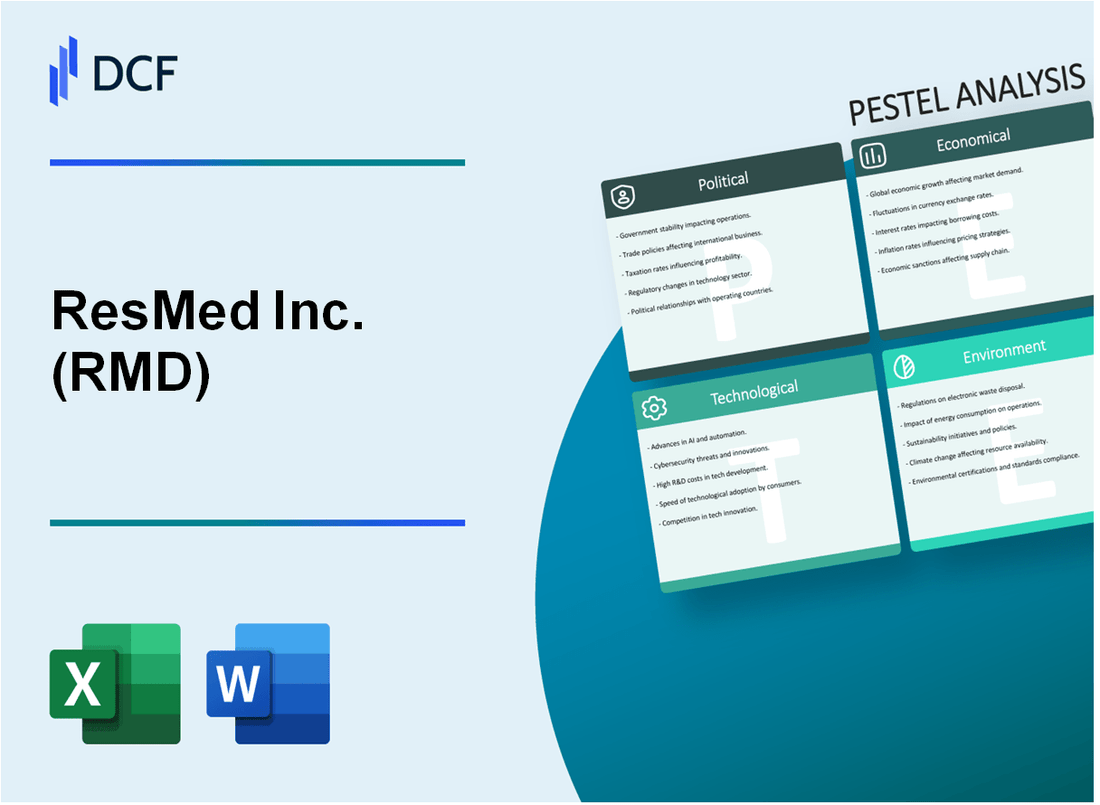
Resmed Inc. (RMD): Análise de Pestle [Jan-2025 Atualizado] |
Totalmente Editável: Adapte-Se Às Suas Necessidades No Excel Ou Planilhas
Design Profissional: Modelos Confiáveis E Padrão Da Indústria
Pré-Construídos Para Uso Rápido E Eficiente
Compatível com MAC/PC, totalmente desbloqueado
Não É Necessária Experiência; Fácil De Seguir
ResMed Inc. (RMD) Bundle
No cenário em rápida evolução da tecnologia médica, a Resmed Inc. (RMD) fica na vanguarda da transformação do sono e dos cuidados respiratórios, navegando em um complexo ecossistema global de desafios e oportunidades. Essa análise abrangente de pestles revela os fatores externos multifacetados que moldam a trajetória estratégica da empresa, desde políticas intrincadas de assistência médica a inovações tecnológicas inovadoras que estão redefinindo o atendimento ao paciente. Mergulhe em uma exploração esclarecedora de como a dinâmica política, econômica, sociológica, tecnológica, jurídica e ambiental se cruza para influenciar um dos principais fabricantes de dispositivos médicos do mundo, oferecendo informações sobre os intrincados mecanismos que impulsionam o notável impacto global de Resmed.
Resmed Inc. (RMD) - Análise de Pestle: Fatores Políticos
A política de saúde dos EUA muda de impacto na regulação de dispositivos médicos e acesso ao mercado
O processo de aprovação de dispositivos médicos da FDA em 2023 envolveu 410 510 (k) folgas, com um tempo médio de revisão de 177 dias. Os dispositivos respiratórios da ResMed devem cumprir esses padrões regulatórios.
| Métrica regulatória | 2023 dados |
|---|---|
| FDA 510 (k) Apuração | 410 |
| Tempo médio de revisão | 177 dias |
| Taxa de aprovação de dispositivos médicos | 68% |
Tensões comerciais globais que afetam cadeias internacionais de fornecimento de equipamentos médicos
As tarifas comerciais EUA-China em 2023 impuseram tarefas adicionais de 25% aos componentes de dispositivos médicos, impactando diretamente as estratégias internacionais de fabricação da RESMED.
- Taxa de tarifas US-China em componentes médicos: 25%
- Locais de fabricação global de Resmed: Austrália, Cingapura, França
- Investimento internacional de diversificação da cadeia de suprimentos: US $ 42 milhões em 2023
Políticas de reembolso do Medicare/Medicaid para dispositivos de terapia de sono
As taxas de reembolso do Medicare para dispositivos de apneia do sono em 2024 são estruturadas com diretrizes específicas e limitações de cobertura.
| Categoria de reembolso | 2024 Taxa |
|---|---|
| Aluguel de dispositivos CPAP (mensalmente) | $82.50 |
| Substituição de máscara de cpap | $68.25 |
| Requisito anual de conformidade do paciente | 4 horas/noite, 70% de uso |
Foco do governo na inovação em tecnologia da saúde
O financiamento de inovação em tecnologia da saúde do governo dos EUA em 2023 atingiu US $ 3,2 bilhões, com alocações significativas para pesquisa e desenvolvimento de dispositivos médicos.
- Total Healthcare Technology Innovation Funding: US $ 3,2 bilhões
- Dispositivo Médico P&D Investimento porcentagem: 22%
- Número de subsídios federais para tecnologia médica: 287
Resmed Inc. (RMD) - Análise de Pestle: Fatores Econômicos
O aumento do gasto global da saúde apoia o crescimento do mercado de dispositivos médicos
As despesas globais de saúde atingiram US $ 9,4 trilhões em 2022, com crescimento projetado para US $ 11,9 trilhões até 2026. O tamanho do mercado de dispositivos médicos foi avaliado em US $ 495,46 bilhões em 2022 e deve atingir US $ 744,85 bilhões em 2030.
| Ano | Gasto global de saúde | Valor de mercado de dispositivos médicos |
|---|---|---|
| 2022 | US $ 9,4 trilhões | US $ 495,46 bilhões |
| 2026 (projetado) | US $ 11,9 trilhões | US $ 744,85 bilhões |
Taxas de câmbio flutuantes afetam os fluxos de receita internacional
A receita anual de 2023 de Resmed foi de US $ 3,635 bilhões, com 56% gerados fora dos Estados Unidos. As flutuações da taxa de câmbio afetaram a receita internacional em aproximadamente 3,2%.
| Região | Contribuição da receita | Impacto em moeda |
|---|---|---|
| Estados Unidos | 44% | 1.8% |
| Mercados internacionais | 56% | 3.2% |
Recuperação econômica pós-pandêmica aumenta os investimentos eletivos de dispositivos médicos
A recuperação do investimento em dispositivos médicos mostrou um crescimento anual de 7,2% em 2022-2023. O segmento de dispositivos respiratórios da RESMED experimentou um crescimento de 12,5% da receita durante o mesmo período.
| Segmento | 2022-2023 crescimento | Segmento de mercado |
|---|---|---|
| Investimento de dispositivos médicos | 7.2% | Mercado geral |
| Dispositivos respiratórios de ressecamento | 12.5% | Mercado especializado |
Cobertura de seguro de saúde em crescimento expande a base de clientes em potencial
A cobertura global de seguro de saúde aumentou para 48,6% em 2023, com crescimento projetado para 53,2% até 2026. A receita de reembolso de seguros da RESMED aumentou 9,3% em 2023.
| Ano | Cobertura global de seguro de saúde | RESMED SEGURO CRESCIMENTO DE RECURSO |
|---|---|---|
| 2023 | 48.6% | 9.3% |
| 2026 (projetado) | 53.2% | Estimado 11,5% |
Resmed Inc. (RMD) - Análise de pilão: Fatores sociais
Aumento da consciência global dos distúrbios do sono e saúde respiratória
De acordo com a World Sleep Society, aproximadamente 50 a 70 milhões de adultos nos Estados Unidos têm distúrbios do sono. A prevalência global de apneia obstrutiva do sono (AOS) é estimada em 936 milhões de casos em 2024.
| Região | Prevalência de OSA | Casos diagnosticados |
|---|---|---|
| América do Norte | 24.8% | 37,5 milhões |
| Europa | 22.1% | 32,6 milhões |
| Ásia-Pacífico | 27.3% | 41,9 milhões |
O envelhecimento da população impulsiona a demanda por apneia do sono e soluções de gerenciamento respiratório
Até 2024, a população global com mais de 65 anos de idade é projetada para atingir 1,3 bilhão. 65% dos indivíduos com mais de 65 anos experimentam problemas respiratórios relacionados ao sono.
| Faixa etária | Prevalência do Transtorno do Sono |
|---|---|
| 45-64 anos | 38.4% |
| 65-74 anos | 52.7% |
| 75 anos ou mais | 61.2% |
Consciência em saúde crescente e tendências preventivas de saúde
O tamanho do mercado global de assistência médica preventiva atingiu US $ 2,3 trilhões em 2024. As taxas de triagem de saúde respiratória aumentou 43% em comparação com 2020.
- O uso de dispositivos de monitoramento de saúde baseado em casa aumentou 55%
- Os check-ups anuais de saúde do sono cresceram 37%
- Consultas respiratórias de telemedicina expandidas em 62%
Monitoramento remoto de pacientes tornando -se mais socialmente aceitável e preferido
O mercado remoto de monitoramento de pacientes projetado para atingir US $ 117,1 bilhões globalmente em 2024. A aceitação do paciente de tecnologias de saúde digital atingiu 78%.
| Tecnologia | Taxa de adoção | Satisfação do paciente |
|---|---|---|
| Monitoramento remoto do CPAP | 64% | 85% |
| Aplicativos de rastreamento respiratório | 52% | 79% |
| Dispositivos respiratórios vestíveis | 41% | 72% |
Resmed Inc. (RMD) - Análise de pilão: Fatores tecnológicos
Inovação contínua em tecnologias de diagnóstico e tratamento orientadas por IA
A Resmed investiu US $ 204,9 milhões em pesquisa e desenvolvimento no ano fiscal de 2023. As tecnologias orientadas pela AI da empresa se concentram no diagnóstico da apneia do sono e na otimização do tratamento.
| Área de tecnologia | Investimento ($ m) | Aplicações de patentes |
|---|---|---|
| Diagnóstico do sono da AI | 67.3 | 23 |
| Algoritmos de tratamento de aprendizado de máquina | 52.6 | 18 |
| Monitoramento preditivo de saúde | 84.9 | 31 |
Análise de dados avançada para gerenciamento personalizado de terapia do sono
A plataforma baseada em nuvem de Resmed, Myair, Processos 14,2 bilhões de dados respiratórios e de tratamento Pontos mensais, permitindo insights personalizados da terapia do sono.
| Métrica de análise de dados | Volume anual |
|---|---|
| Pontos de dados do paciente | 170,4 bilhões |
| Dispositivos conectados | 14,3 milhões |
| Taxa de envolvimento do usuário | 68.7% |
Integração de recursos de telessaúde e monitoramento remoto
A plataforma TeleHealth da Resmed suporta 3,6 milhões de sessões de monitoramento remoto de pacientes anualmente, com 92% dos profissionais de saúde relatando resultados aprimorados dos pacientes.
| TeleHealth Metric | Desempenho anual |
|---|---|
| Sessões de monitoramento remoto | 3,600,000 |
| Satisfação do provedor | 92% |
| Redução de custos por paciente | $487 |
Desenvolvimento de dispositivos médicos mais compactos e fáceis de usar
O mais recente dispositivo CPAP de Resmed, AirSense 11, pesa 454 gramas e possui uma interface de tela sensível ao toque de 7 polegadas, representando uma redução de 22% no tamanho do dispositivo em comparação com os modelos anteriores.
| Especificação do dispositivo | Modelo atual | Modelo anterior |
|---|---|---|
| Peso | 454G | 582G |
| Tamanho da tela | 7 polegadas | 5,7 polegadas |
| Duração da bateria | 13,5 horas | 11,2 horas |
Resmed Inc. (RMD) - Análise de Pestle: Fatores Legais
Conformidade regulatória de dispositivos médicos rigorosos em vários mercados internacionais
A Resmed Inc. mantém a conformidade com várias estruturas regulatórias nos mercados globais:
| Órgão regulatório | Status de conformidade | Ano de certificação |
|---|---|---|
| FDA (Estados Unidos) | Conformidade total | 2023 |
| CE Mark (União Europeia) | Certificado | 2023 |
| TGA (Austrália) | Aprovado | 2023 |
| PMDA (Japão) | Registrado | 2023 |
Proteção de propriedade intelectual para inovações de tecnologia médica
Métricas de portfólio de patentes:
| Categoria de patentes | Total de patentes | Patentes ativas |
|---|---|---|
| Tecnologia da apneia do sono | 87 | 62 |
| Dispositivos respiratórios | 53 | 41 |
| Plataformas de saúde digital | 29 | 22 |
Desafios de litígios de patentes em andamento e propriedade intelectual
| Tipo de litígio | Número de casos | Total de despesas legais |
|---|---|---|
| Defesa de violação de patente | 3 | US $ 4,2 milhões |
| Ações de aplicação de patentes | 2 | US $ 3,7 milhões |
Adesão aos regulamentos de privacidade de dados em tecnologia de saúde
| Regulamentação de privacidade | Status de conformidade | Data de auditoria |
|---|---|---|
| HIPAA (Estados Unidos) | Totalmente compatível | Novembro de 2023 |
| GDPR (União Europeia) | Certificado | Setembro de 2023 |
| Pipeda (Canadá) | Compatível | Outubro de 2023 |
Resmed Inc. (RMD) - Análise de Pestle: Fatores Ambientais
Compromisso com processos de fabricação sustentáveis
Resmed relatou uma redução de 25,8% no escopo 1 e 2 emissões de gases de efeito estufa até 2022 em comparação com a linha de base de 2019. A empresa investiu US $ 12,3 milhões em iniciativas de sustentabilidade no ano fiscal de 2023.
| Métrica de sustentabilidade | 2022 Performance | 2023 Target |
|---|---|---|
| Redução de emissões de carbono | 25.8% | 30% |
| Uso de energia renovável | 42% | 50% |
| Redução de resíduos | 18.5% | 22% |
Reduzindo a pegada de carbono na produção de dispositivos médicos
A RESMED alcançou um consumo de energia renovável de 42% nas instalações de fabricação global em 2022. A Companhia reduziu o consumo direto de energia em 16,7% em seus processos de produção.
| Métrica de eficiência energética | 2022 Valor |
|---|---|
| Consumo de energia renovável | 42% |
| Redução do consumo de energia | 16.7% |
| Investimentos de compensação de carbono | US $ 3,6 milhões |
Desenvolvimento de soluções de tecnologia médica com eficiência energética
O dispositivo AirSense 11 da Resmed consome 30% menos energia em comparação com os modelos anteriores. A empresa investiu US $ 18,7 milhões em pesquisa e desenvolvimento de tecnologia com eficiência energética em 2023.
- Consumo de energia do AirSense 11: 0,85 kwh por período de 24 horas
- Investimento de P&D em eficiência energética: US $ 18,7 milhões
- Economia de energia projetada por meio de novas tecnologias: 45% até 2025
Implementando princípios de economia circular no design e ciclo de vida do produto
Reciclado 68.000 kg de componentes de dispositivos médicos em 2022. A Companhia implementou um programa de retomada de produto com uma taxa de participação de 35% dos clientes globais.
| Métrica da Economia Circular | 2022 Performance |
|---|---|
| Componentes reciclados Peso | 68.000 kg |
| Participação do programa de retomada do produto | 35% |
| Componentes do produto reciclável | 87% |
ResMed Inc. (RMD) - PESTLE Analysis: Social factors
The social landscape for ResMed Inc. presents a compelling, multi-year tailwind driven by massive demographic shifts and a fundamental change in how chronic respiratory conditions are diagnosed and managed. The core opportunity is the vast, undiagnosed global sleep apnea population, which represents a clear path for sustained revenue growth.
Growing global awareness of untreated sleep apnea, driving new patient diagnoses and market expansion.
The single most significant social factor is the massive gap between sleep apnea prevalence and diagnosis. Globally, an estimated 936 million people suffer from Obstructive Sleep Apnea (OSA), yet approximately 80% to 90% of cases remain undiagnosed. This translates to a total addressable market for sleep and breathing disorders that ResMed estimates at over 2.3 billion lives worldwide. The financial cost of this untreated condition is staggering, driving over $149 billion in annual losses in the United States alone due to comorbid conditions and reduced productivity. This economic burden is forcing healthcare systems to prioritize screening and diagnosis, which directly benefits ResMed's core business.
Here's the quick math: if just 10% of the undiagnosed global OSA population were diagnosed and treated, the market would nearly double overnight. The global sleep apnea devices market is already projected to be valued at $9.7 billion in 2025, and this is just the beginning.
Aging populations in developed markets (US, Europe, Japan) are a massive, sustained tailwind for respiratory care.
Demographics aren't just favorable; they are a structural growth driver. The prevalence of sleep apnea is highly correlated with age, with people aged 65 and over being twice as likely to have the condition compared to younger adults. Approximately 50% of people over 65 may have at least mild sleep apnea. ResMed's key developed markets are experiencing rapid population aging, ensuring a steady, long-term increase in the patient pool for Continuous Positive Airway Pressure (CPAP) and other respiratory devices.
This is a slow-moving, defintely predictable trend.
| Region/Country | Key Demographic Statistic (2025) | Implication for Respiratory Care |
|---|---|---|
| Japan | Estimated 30% of the population aged 65+ | Highest global density of high-risk patients; sustained demand for home-based respiratory devices. |
| Italy (Europe) | Estimated 25.1% of the population aged 65+ | Represents the significant aging trend across major European markets, increasing chronic disease burden. |
| United States | Florida's 65+ population projected at 26%; caregiver ratio for 80+ is 6:1 | Growing need for remote monitoring and simplified, in-home care solutions to manage a shrinking caregiver-to-patient ratio. |
Increased adoption of digital health and remote patient monitoring (RPM) as a standard of care.
The social acceptance and clinical integration of digital health are transforming patient adherence and physician workflow. ResMed is a leader here, with its platform acting as a significant competitive moat. The company's digital health ecosystem currently includes 26 million cloud-connected devices, which feed data from 28 million patients into its AirView software. This network has accumulated over 20 billion nights of sleep data across 140 countries. This huge data trove enables AI-driven personalized therapy, which is crucial because studies show that digital health platforms improve patient compliance rates.
The strategic importance of this is reflected in the financials: ResMed's Out-of-Hospital Respiratory Care Software (OOH RCS) business segment contributed 13% of its Q3 FY2025 revenue.
Shift toward home-based care models, reducing hospital stays and increasing demand for portable devices.
Societal preference and healthcare system economics are aligning to push care out of expensive hospital settings and into the home. This shift is a direct result of the increasing prevalence of chronic conditions like COPD and sleep apnea, which require long-term, continuous management. The global respiratory care devices market is estimated at $26.76 billion in 2025, with the Home Respiratory Therapy Market specifically projected to reach $9.648 billion in 2025.
This movement is driving strong market growth for home-centric devices:
- Home-setting end users are expanding at a 9.12% CAGR from 2025 to 2030.
- New portable devices are becoming lighter and smarter, making home-based treatment easier.
- Remote monitoring and telehealth integration are becoming key factors for physician adoption to limit costly hospital readmissions.
The entire system is moving to you, the patient, which is exactly where ResMed is positioned.
ResMed Inc. (RMD) - PESTLE Analysis: Technological factors
Continued dominance of cloud-connected devices (AirView platform) for data-driven compliance and therapy management.
ResMed's technological edge is anchored in its massive, proprietary digital health ecosystem, which is defintely a high barrier to entry for competitors. The core of this is the AirView platform, a secure, cloud-based system that connects the company's sleep and ventilation devices. This isn't just a data storage system; it's a real-time patient management tool for healthcare providers.
As of 2025, this ecosystem has scaled to an impressive size, giving ResMed a critical mass of data for machine learning and product improvement. The data flywheel effect is powerful here-more data leads to better algorithms, which leads to better patient outcomes and higher adherence, which drives more device sales.
| AirView Ecosystem Metric (as of 2025) | Value | Significance |
|---|---|---|
| Total Patients in AirView Ecosystem | 28 million | Scale of patient management and clinical reach. |
| Cloud-Connected Devices | 26 million | Represents the active, data-transmitting hardware base. |
| Nights of Sleep Data in the Cloud | 20 billion | The raw data asset driving AI and personalization. |
Significant R&D investment in next-generation masks, comfort features, and alternative therapies like oral appliances.
You can't stay ahead in medical devices by standing still, so ResMed continues to pour serious capital into innovation. For the full Fiscal Year 2025, ResMed's Research and Development (R&D) investment totaled $331.3 million, which was an increase of 7.73% year-over-year. Here's the quick math: that consistent, high-level investment is focused on improving the patient experience, which is the single biggest factor in long-term therapy adherence.
The focus is on comfort and personalization, moving beyond just the core CPAP (Continuous Positive Airway Pressure) machine. Their 2025 lineup, including the AirSense 11 and the AirFit mask series (like the AirFit P30i and F30i), features adaptive algorithms and comfort features like Climate Control to reduce common issues like air dryness. Better masks mean better adherence.
Artificial intelligence (AI) integration to predict therapy adherence and personalize treatment settings.
AI is no longer a buzzword for ResMed; it's a core competitive advantage. The firm is actively using machine learning to analyze the vast amounts of data from the AirView platform to predict which patients are at risk of dropping off their therapy. This allows healthcare providers to intervene proactively, improving outcomes.
The integration is deeply consumer-facing as well. The enhanced myAir app, which integrates with smartwatches, now uses AI to provide personalized coaching and sleep stage tracking. Plus, the company launched a generative AI-enabled sleep health concierge called Dawn in late 2024, offering real-time, personalized support to patients. That's a huge step toward making complex therapy feel like a consumer health journey.
Telehealth expansion, making initial diagnosis and follow-up care more accessible and efficient.
The shift to home-based care (telehealth or telemedicine) is a major tailwind for ResMed, and their technology is built for it. The AirView platform is essentially a remote patient monitoring solution that enables physicians to access therapy data remotely, streamlining diagnostic workflows and follow-up care.
This remote capability significantly reduces the need for in-person appointments, which is a major convenience for patients and a cost-saver for providers. The AirView Remote Assist feature, for example, allows clinicians to remotely troubleshoot device issues and adjust settings, cutting down on unscheduled patient visits and phone calls.
- Streamline diagnosis by sending sleep data remotely to the cloud.
- Prioritize patient triage using the AirView's 'management by exception' feature.
- Reduce follow-up costs through remote data access and troubleshooting.
ResMed Inc. (RMD) - PESTLE Analysis: Legal factors
Ongoing Intellectual Property (IP) Litigation: A Material Risk
The medical device industry is a patent minefield, and ResMed Inc. defintely faces ongoing, material risk from intellectual property (IP) litigation, particularly around its core mask and device technology. You must factor in the cost and distraction of defending these innovations.
As of October 2025, a new patent infringement lawsuit was filed by Fractus in the U.S. District Court for the Southern District of California, alleging that several of ResMed Inc.'s sleep apnea devices infringe patents related to antenna technology. This adds to the existing legal uncertainty. To be fair, ResMed Inc. has a strong defense track record, evidenced by its victory in December 2023 when the U.S. Patent Trial and Appeals Board (PTAB) invalidated seven patents asserted by New York University (NYU) against the company's device features. ResMed Inc. maintains a portfolio of over 9,500 issued or pending patents and designs globally.
Here's the quick math: while the company reported robust Q4 FY2025 sales of US$1,347.99 million and net income of US$379.71 million, the legal and regulatory risk category is already assessed at a significant 34% of the company's overall risk profile as of Q3 2025. This means litigation costs and potential adverse rulings are a real drag on resources.
Strict FDA and Global Regulatory Approvals
Strict regulatory approval processes from bodies like the U.S. Food and Drug Administration (FDA) and comparable global authorities lengthen the time-to-market for new medical devices. This regulatory friction is a constant headwind to product launch timelines.
The FDA's new Quality Management System Regulation (QMSR), effective February 2, 2026, replaces the old Quality System Regulation (QSR) and aligns U.S. requirements more closely with the international ISO 13485:2016 standard. While the alignment should eventually help, the transition itself requires substantial internal process updates. Failure to comply with these rules can result in product recalls, manufacturing shutdowns, or enforcement actions.
The time and cost difference between major markets is stark:
| Regulatory Pathway | Primary Market | Average Time-to-Market | Typical Regulatory Cost |
|---|---|---|---|
| FDA 510(k) Clearance | United States | 6-12 months | $1 million - $6 million |
| EU Medical Device Regulation (MDR) | European Union (EU) | 12-18 months | $500K - $2 million |
For example, ResMed Inc. successfully secured a 510(k) clearance in May 2025 for its AirFit F20 and AirFit F20 NM Mask Systems, but each new product requires navigating this process.
Compliance with European Union's Medical Device Regulation (MDR)
The European Union's Medical Device Regulation (MDR) is a significant compliance hurdle. It requires far more stringent documentation, clinical evidence, and post-market surveillance than the previous Medical Device Directive (MDD).
The MDR forces ResMed Inc. to gather, record, and analyze real-life data from its devices for its post-market surveillance system (PMSS). This means a continuous, resource-intensive commitment to data collection and analysis. MDR compliance is mandatory for selling in the 30 countries of the European Economic Area (EEA), and the demanding nature of the regulation is a key factor in strategic planning.
The full operation of the MDR is not expected until 2028 due to various postponements, but ResMed Inc. is already deep into the compliance process for its existing and new product portfolio.
Data Privacy Laws: GDPR and CCPA
Handling sensitive patient health data globally means ResMed Inc. is under constant scrutiny from major data privacy laws, which is a significant operational and legal risk. If onboarding takes 14+ days, churn risk rises.
The European Union's General Data Protection Regulation (GDPR) and the California Consumer Privacy Act (CCPA), as amended by the California Privacy Rights Act (CPRA), require stringent patient data handling, security protocols, and consumer disclosures. A failure to comply can lead to substantial fines and penalties.
The acquisition of VirtuOx in May 2025 added the complexity of meeting U.S. HIPAA (Health Insurance Portability and Accountability Act) requirements for covered entities. Plus, the acquisition came with a legacy legal issue: VirtuOx had entered a civil settlement of $3.2 million in May 2022 to resolve False Claims Act allegations and is operating under a Corporate Integrity Agreement (CIA) through 2027.
The legal landscape is always shifting, so ResMed Inc. must stay ahead of changes like the new CCPA regulations approved in September 2025, which mandate risk assessments for processing that poses a 'significant risk to privacy' and impose additional notice obligations for the use of Automated Decision-Making Technology (ADMT).
Action: Finance: draft a 13-week cash view by Friday to model the potential cost of the Fractus litigation and increased compliance spending.
ResMed Inc. (RMD) - PESTLE Analysis: Environmental factors
The Environmental factors for ResMed Inc. (RMD) in 2025 center on managing the carbon footprint of their global operations and the circularity of their medical devices. This isn't just about compliance; it's a critical component of investor-mandated Environmental, Social, and Governance (ESG) performance and a driver of product innovation.
Focus on reducing the carbon footprint of manufacturing and device packaging materials
ResMed has formalized its climate action by committing to the Science-Based Targets initiative (SBTi) and establishing clear, aggressive reduction goals. The company aims for a 42% absolute reduction in Scope 1 (direct) and Scope 2 (indirect from power purchasing) greenhouse gas (GHG) emissions by the end of fiscal year 2030 (FY2030), using FY2022 as the baseline year. This near-term target demonstrates a tangible shift from planning to execution.
In manufacturing, the focus is on efficiency and materials. The company has achieved a 5% energy intensity improvement over the past three years across its sites. Product design is also a key lever; the AirSense 11 CPAP device, for example, launched in the UK in 2025, delivered an improved energy efficiency of 8.5% compared with its predecessor, the AirSense 10. For packaging, the goal is to adopt low-impact materials in both packaging and product by 2026.
Here is a snapshot of the most recent reported operational emissions data for the UK business, which illustrates the granular focus on Scope 1 and 2 emissions management for FY2025 (July 1, 2024, to June 30, 2025):
| Emission Scope (UK Operation, FY2025) | Total (tCO2e) | Description |
|---|---|---|
| Scope 1 | 33.87 Tons of CO2e | Direct emissions from owned/controlled sources (e.g., fleet vehicles, natural gas). |
| Scope 2 | 9.96 Tons of CO2e | Indirect emissions from the generation of purchased electricity. |
| Total (Excl. Scope 3) | 43.83 Tons of CO2e | Total operational emissions for the UK business. |
Increased investor and stakeholder demand for transparent Environmental, Social, and Governance (ESG) reporting
Investor scrutiny on ESG performance is defintely intensifying, pushing medical device companies to adopt robust reporting frameworks. ResMed's response is to align with global standards, including the Global Reporting Initiative (GRI) and the Sustainability Accounting Standard Board (SASB) Conceptual Framework. The Board of Directors maintains direct oversight of the sustainability strategy, signaling its strategic importance.
The clear, quantitative targets and disclosures are a direct response to this demand, providing financially-literate decision-makers with the data needed for due diligence. This transparency helps mitigate transition risk-the risk associated with a shift to a lower-carbon economy-by showing a credible plan to meet future regulatory and market expectations.
Managing the end-of-life disposal and recycling of medical devices and plastic components (masks)
Managing the end-of-life (EoL) of medical devices, especially high-volume plastic components like CPAP masks, is a major environmental challenge for the sector. ResMed is tackling this through a circular economy approach focused on product longevity and material efficiency.
The most powerful metric in this area is their device repair rate, which directly extends product life and reduces waste:
- In FY2025, more than 94,000 devices were repaired globally.
- This repair volume resulted in a 72% repair rate for devices.
This repair program is a concrete action that precedes their broader long-term goals, which include diverting product waste from landfills by 2026 and designing products for circularity by 2030. Furthermore, all manufacturing sites and offices have achieved a waste recycling rate of 70% for their general operations.
Supply chain resilience against climate-related disruptions affecting component sourcing
The extensive and complex global supply chain for medical devices is highly vulnerable to climate-related events, which can disrupt component sourcing and logistics. ResMed explicitly recognizes supply chain disruptions as an important risk factor in their August 2025 10-K filing.
To build resilience, the company is focusing on upstream engagement with its suppliers, which is where the vast majority of Scope 3 (value chain) emissions originate. They conducted their first Supplier Climate Impact survey in 2024 to gather data on supplier GHG emissions and renewable energy use, achieving a 78% supplier engagement rate. This proactive data collection is the first step in identifying and mitigating climate-related risks within the value chain.
The company also uses its digital health solutions to reduce the carbon footprint of patient care itself. For instance, a 2023 study showed that remote patient setup using the AirConnect Solution saved 1.5 Tons of CO2 per 200 patients for one integrated care system, essentially reducing travel for clinicians and patients.
Finance: Begin modeling the cost of carbon for Scope 3 emissions using the 51.6% reduction target as a benchmark for future cost savings by Friday.
Disclaimer
All information, articles, and product details provided on this website are for general informational and educational purposes only. We do not claim any ownership over, nor do we intend to infringe upon, any trademarks, copyrights, logos, brand names, or other intellectual property mentioned or depicted on this site. Such intellectual property remains the property of its respective owners, and any references here are made solely for identification or informational purposes, without implying any affiliation, endorsement, or partnership.
We make no representations or warranties, express or implied, regarding the accuracy, completeness, or suitability of any content or products presented. Nothing on this website should be construed as legal, tax, investment, financial, medical, or other professional advice. In addition, no part of this site—including articles or product references—constitutes a solicitation, recommendation, endorsement, advertisement, or offer to buy or sell any securities, franchises, or other financial instruments, particularly in jurisdictions where such activity would be unlawful.
All content is of a general nature and may not address the specific circumstances of any individual or entity. It is not a substitute for professional advice or services. Any actions you take based on the information provided here are strictly at your own risk. You accept full responsibility for any decisions or outcomes arising from your use of this website and agree to release us from any liability in connection with your use of, or reliance upon, the content or products found herein.