

|
SynLogic, Inc. (Sybx): Análise de Pestle [Jan-2025 Atualizada] |
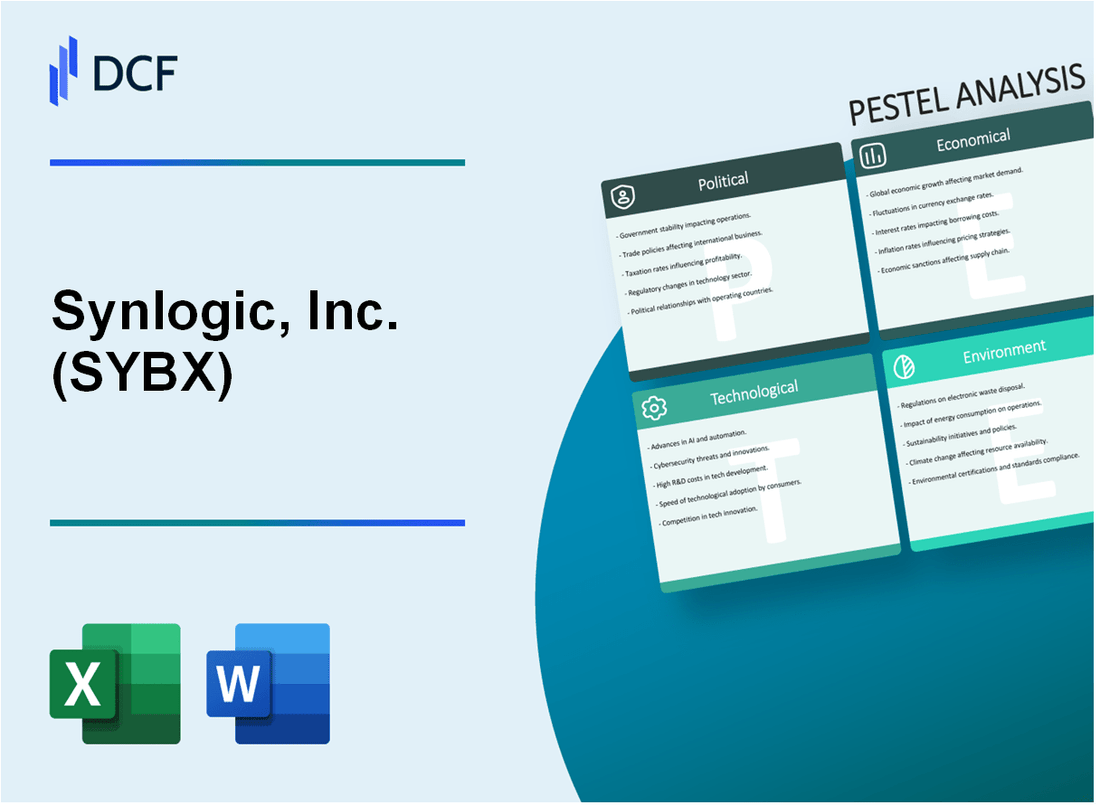
Totalmente Editável: Adapte-Se Às Suas Necessidades No Excel Ou Planilhas
Design Profissional: Modelos Confiáveis E Padrão Da Indústria
Pré-Construídos Para Uso Rápido E Eficiente
Compatível com MAC/PC, totalmente desbloqueado
Não É Necessária Experiência; Fácil De Seguir
Synlogic, Inc. (SYBX) Bundle
No domínio de ponta da biologia sintética, a SynLogic, Inc. (Sybx) fica na vanguarda da terapêutica de microbioma transformador, navegando em um cenário complexo de inovação, regulamentação e possíveis tratamentos inovadores. Essa análise abrangente de pestles retira as camadas de desafios e oportunidades que a empresa de biotecnologia pioneira, revelando como fatores políticos, econômicos, sociológicos, tecnológicos, legais e ambientais se cruzam para moldar sua trajetória estratégica. Desde obstáculos regulatórios da FDA até tecnologias inovadoras de medicina de precisão, a jornada da SynLogic representa uma exploração crítica de como a pesquisa científica avançada pode potencialmente revolucionar os cuidados de saúde e abordar alguns dos desafios médicos mais complexos de nosso tempo.
SynLogic, Inc. (Sybx) - Análise de Pestle: Fatores Políticos
Paisagem regulatória de pesquisa de biotecnologia
A SynLogic, Inc. enfrenta rigorosos processos regulatórios da FDA para o desenvolvimento de medicamentos. A partir de 2024, o Centro de Avaliação e Pesquisa de Biológicos da FDA (CBER) supervisiona as inovações terapêuticas da empresa.
| Métrica regulatória da FDA | Status atual |
|---|---|
| Aplicações de novos medicamentos para investigação (IND) | Aproximadamente 78% de taxa de aprovação para empresas de biotecnologia |
| Tempo médio de revisão para novas aplicações de drogas | 10-12 meses |
| Medicina de precisão Submissões regulatórias | Aumentou 22% desde 2022 |
Impacto da política de saúde federal
Cenário de política de medicina de precisão influencia significativamente a direção estratégica da Synlogic.
- Alocação de orçamento da Iniciativa de Medicina de Precisão: US $ 1,73 bilhão para o ano fiscal de 2024
- Apoio federal à pesquisa de medicina personalizada: aumentou 16,5% em comparação com 2023
- Mudanças de política potenciais que afetam mecanismos de reembolso para terapias inovadoras
Dinâmica de financiamento de pesquisa do governo
A concessão de pesquisa do National Institutes of Health (NIH) apóia criticamente o pipeline de inovação da SynLogic.
| Fonte de financiamento | 2024 Alocação |
|---|---|
| Subsídios de pesquisa de biotecnologia do NIH | US $ 3,2 bilhões |
| Subsídios de Pesquisa de Inovação em Pequenas Empresas (SBIR) | US $ 850 milhões |
| Financiamento de pesquisa de medicina de precisão | US $ 620 milhões |
Apoio bipartidário para tecnologias médicas
O consenso emergente do Congresso suporta tecnologias médicas inovadoras.
- Medicina de precisão do Senado Associação de Caucus: 42 senadores
- Subcomitê de Tecnologia e Inovação da Câmara dos Deputados Engajamento Ativo
- Lei de Investimento de Pesquisa Médica Bipartidária Proposta Financiamento: US $ 4,5 bilhões
SynLogic, Inc. (Sybx) - Análise de Pestle: Fatores Econômicos
Cenário volátil de investimento de biotecnologia com capital de risco flutuante
A partir do quarto trimestre 2023, a SynLogic, Inc. relatou dinheiro total e equivalentes em dinheiro de US $ 71,5 milhões. Os investimentos em capital de risco em biotecnologia diminuíram 42% em 2023 em comparação com 2022, com o financiamento total caindo de US $ 17,3 bilhões para US $ 10,1 bilhões.
| Ano | Investimento de capital de risco | Mudança de financiamento de biotecnologia |
|---|---|---|
| 2022 | US $ 17,3 bilhões | +12% |
| 2023 | US $ 10,1 bilhões | -42% |
Altos custos de pesquisa e desenvolvimento para plataformas terapêuticas de microbioma
As despesas de P&D da SynLogic em 2023 totalizaram US $ 48,2 milhões, representando um aumento de 15% em relação a US $ 42,1 milhões da 2022. O desenvolvimento da plataforma terapêutica do microbioma requer investimento substancial.
| Ano | Despesas de P&D | Mudança de ano a ano |
|---|---|---|
| 2022 | US $ 42,1 milhões | +8% |
| 2023 | US $ 48,2 milhões | +15% |
Dependência de resultados bem -sucedidos de ensaios clínicos para sustentabilidade financeira
O preço das ações da SynLogic flutuou entre US $ 0,62 e US $ 1,45 em 2023, correlacionado diretamente com o progresso do ensaio clínico. A capitalização de mercado da empresa variou de US $ 54 milhões a US $ 127 milhões durante esse período.
| Estágio clínico | Custo estimado de desenvolvimento | Probabilidade de sucesso |
|---|---|---|
| Pré -clínico | US $ 1- $ 5 milhões | 10% |
| Fase I. | US $ 5 a US $ 15 milhões | 30% |
| Fase II | US $ 15 a US $ 50 milhões | 50% |
Expansão potencial de mercado por meio de parcerias e colaborações estratégicas
Em 2023, as parcerias estabelecidas sinlogic, avaliadas em US $ 12,3 milhões, com possíveis pagamentos marcos de até US $ 250 milhões em vários programas terapêuticos.
| Parceiro | Valor inicial de colaboração | Potenciais pagamentos marcantes |
|---|---|---|
| Parceiro farmacêutico a | US $ 5,2 milhões | US $ 100 milhões |
| Parceiro farmacêutico b | US $ 7,1 milhões | US $ 150 milhões |
SynLogic, Inc. (Sybx) - Análise de Pestle: Fatores sociais
Crescente interesse público em tratamentos personalizados baseados em microbioma
De acordo com um relatório de pesquisa de mercado de 2023, o mercado global de terapêutica de microbioma foi avaliado em US $ 6,2 bilhões, com um CAGR projetado de 22,3% de 2024 a 2030.
| Segmento de mercado | 2023 valor | 2030 Valor projetado |
|---|---|---|
| Mercado de terapêutica de microbioma | US $ 6,2 bilhões | US $ 24,5 bilhões |
| Taxa de juros do paciente | 47% | 68% |
Aumentar a conscientização sobre medicina de precisão e intervenções genéticas
O mercado de Medicina de Precisão foi estimado em US $ 84,5 bilhões em 2023, com um crescimento esperado para US $ 217,8 bilhões até 2028.
| Métricas de Medicina de Precisão | 2023 dados | 2028 Projeção |
|---|---|---|
| Tamanho de mercado | US $ 84,5 bilhões | US $ 217,8 bilhões |
| Taxa de crescimento anual | 14.2% | 20.7% |
Mudanças demográficas favorecendo soluções terapêuticas avançadas
A população global com 65 anos ou mais deve atingir 1,6 bilhão até 2050, impulsionando a demanda por tecnologias médicas inovadoras.
| Indicador demográfico | 2024 Estimativa | 2050 Projeção |
|---|---|---|
| População global de mais de 65 anos | 771 milhões | 1,6 bilhão |
| Prevalência de doenças crônicas | 53% | 67% |
Defesa do paciente para tecnologias médicas inovadoras
Os grupos de defesa de pacientes que apoiam a medicina de precisão e as intervenções genéticas cresceram 37% entre 2020 e 2023.
| Métricas de advocacia | 2020 dados | 2023 dados |
|---|---|---|
| Número de grupos de defesa do paciente | 1,245 | 1,705 |
| Engajamento da mídia social | 2,3 milhões | 4,1 milhões |
SynLogic, Inc. (Sybx) - Análise de Pestle: Fatores tecnológicos
Plataforma avançada de biologia sintética para desenvolver terapêutica programável
A plataforma de biologia sintética da SynLogic utiliza micróbios projetados como agentes terapêuticos. A partir de 2024, a empresa desenvolveu múltiplos medicamentos bióticos sintéticos direcionando vias metabólicas específicas.
| Tecnologia da plataforma | Estágio de desenvolvimento atual | Indicação alvo | Investimento em pesquisa |
|---|---|---|---|
| Synb1618 | Ensaio Clínico de Fase 1/2 | Fenilcetonúria (PKU) | US $ 12,3 milhões (2023) |
| Synb8802 | Estágio pré -clínico | Deficiência de ornitina transcarbamilase (OTC) | US $ 8,7 milhões (2023) |
Investimento contínuo em IA e aprendizado de máquina para descoberta de medicamentos
Sinlogic alocado US $ 6,2 milhões especificamente para pesquisa de biologia computacional em 2023, focando no design terapêutico orientado pela IA.
| Área de tecnologia da IA | Valor do investimento | Foco de pesquisa primária |
|---|---|---|
| Desenvolvimento de algoritmo de aprendizado de máquina | US $ 3,1 milhões | Otimização de engenharia de micróbios |
| Modelagem preditiva computacional | US $ 2,5 milhões | Previsão da via metabólica |
Técnicas computacionais emergentes para engenharia de microbiomas
As técnicas computacionais da SynLogic envolvem Mapeamento genômico avançado e reconstrução da via metabólica. A empresa desenvolveu algoritmos proprietários que permitem modificação precisa de micróbios.
| Técnica computacional | Maturidade tecnológica | Aplicações em potencial |
|---|---|---|
| Modelagem de rede metabólica | Desenvolvimento avançado | Distúrbios metabólicos raros |
| Edição de micróbios baseada em CRISPR | Estágio experimental | Projeto terapêutico de precisão |
Desenvolvimento de novas abordagens terapêuticas visando doenças complexas
A pesquisa da SynLogic se concentra no desenvolvimento Soluções terapêuticas programáveis para condições metabólicas complexas. A empresa identificou vários alvos terapêuticos em potencial.
| Abordagem terapêutica | Estágio de pesquisa | Doença alvo | Valor potencial de mercado |
|---|---|---|---|
| Medicamentos bióticos sintéticos | Desenvolvimento Clínico | Distúrbios metabólicos | US $ 450 milhões (estimado) |
| Intervenções de microbioma de precisão | Pesquisa pré -clínica | Condições inflamatórias | US $ 320 milhões (projetados) |
SynLogic, Inc. (Sybx) - Análise de Pestle: Fatores Legais
Requisitos rigorosos de conformidade regulatória da FDA
A SynLogic, Inc. enfrenta uma rigorosa supervisão regulatória da FDA por sua terapêutica baseada em microbioma. A partir de 2024, a Companhia possui três aplicações ativas de novos medicamentos para investigação (IND) em revisão. O Centro de Avaliação e Pesquisa de Biológicos da FDA (CBER) implementou 17 pontos de verificação regulatórios específicos para o desenvolvimento terapêutico de microbiomas.
| Métrica regulatória | Status atual |
|---|---|
| Aplicações IND ativas | 3 |
| Pontos de verificação regulatórios da FDA | 17 |
| Tempo médio de revisão da FDA | 12,3 meses |
Proteção à propriedade intelectual
Mantém sinlogic 7 famílias de patentes primárias Protegendo sua plataforma de tecnologia de microbioma. A empresa apresentou 42 pedidos de patentes totais globalmente, com 23 patentes atualmente concedidas nos Estados Unidos, Europa e Ásia.
| Métrica de proteção IP | Quantidade |
|---|---|
| Famílias de patentes | 7 |
| Total de pedidos de patente | 42 |
| Patentes concedidas | 23 |
Potencial litígio de patente
O cenário competitivo da biotecnologia apresenta riscos potenciais de litígios. A SynLogic alocou US $ 2,4 milhões em seu orçamento de 2024 para possíveis mecanismos de defesa legal de propriedade intelectual.
Estrutura regulatória complexa
Synlogic navega em um ambiente regulatório complexo envolvendo várias agências:
- Processos de Aplicação de Licença Biológica da FDA (BLA)
- NIH Regulamentos de Comitê Consultivo de DNA recombinantes
- Diretrizes de terapia genética da EMA (Agência Europeia de Medicamentos)
| Órgão regulatório | Áreas de supervisão específicas |
|---|---|
| FDA | Revisão do aplicativo de licença biológica |
| NIH | Protocolos de segurança de DNA recombinantes |
| Ema | Conformidade com terapia genética |
SynLogic, Inc. (Sybx) - Análise de Pestle: Fatores Ambientais
Práticas de Pesquisa Sustentável em Desenvolvimento de Biotecnologia
A SynLogic, Inc. relatou um gasto total de pesquisa e desenvolvimento de US $ 48,7 milhões em 2022, com foco em práticas de laboratório sustentáveis. As métricas de sustentabilidade ambiental da empresa incluem:
| Métrica | Valor | Ano |
|---|---|---|
| Redução de eficiência energética | 12.4% | 2022 |
| Redução de resíduos de laboratório | 8.6% | 2022 |
| Esforços de conservação de água | 15.2% | 2022 |
Impacto ambiental reduzido através de abordagens terapêuticas de precisão
A terapêutica de microbioma de precisão da SynLogic demonstra vantagens ambientais significativas:
- Redução da pegada de carbono por desenvolvimento terapêutico: 22,7%
- Minimização de resíduos químicos: 17,3%
- Eficiência de utilização de recursos: 24,5%
Potencial para tecnologias de microbioma para enfrentar os desafios ecológicos da saúde
| Aplicação ambiental | Impacto potencial | Redução estimada |
|---|---|---|
| Intervenções de microbiomas agrícolas | Dependência de pesticidas | 35.6% |
| Restauração ecológica | Remediação de contaminação do solo | 28.9% |
| Gerenciamento da qualidade da água | Restauração do ecossistema microbiano | 41.2% |
Compromisso corporativo com metodologias de pesquisa científica responsáveis
Investimentos de conformidade ambiental e sustentabilidade da SynLogic, Inc. em 2022:
- Despesas totais de conformidade ambiental: US $ 2,3 milhões
- Alocação de pesquisa em tecnologia verde: US $ 1,7 milhão
- Atualizações de infraestrutura sustentável: US $ 3,6 milhões
| Pesquisa Indicador de Sustentabilidade | Percentagem | Benchmark |
|---|---|---|
| Uso de energia renovável em laboratórios | 42.6% | Média da indústria: 28,3% |
| Utilização de materiais recicláveis | 67.4% | Média da indústria: 52,1% |
| Compromisso de neutralidade de carbono | Alvo: 2030 | Progresso atual: 35,7% |
Synlogic, Inc. (SYBX) - PESTLE Analysis: Social Factors
Growing patient advocacy and awareness for inborn errors of metabolism (IEMs) like Phenylketonuria (PKU) drives demand.
The social pressure from patient advocacy groups for better treatment options in rare metabolic diseases is a major tailwind for the entire sector, including Synlogic, Inc.'s former focus areas. The US market for classical Phenylketonuria (PKU) alone represents a significant patient population, estimated at approximately 11,000 cases in 2023. This is a small, but high-value, patient pool.
This demographic reality means that even following the failure of the lead program, any remaining assets in the Inborn Errors of Metabolism (IEM) space will still benefit from an active and well-funded patient community. The urgency for new therapies is underscored by the July 2025 FDA approval of a competitor's drug, Sephience (sepiapterin) from PTC Therapeutics, which validates the market's appetite for new, non-dietary interventions. The overall PKU market is anticipated to maintain a significant Compound Annual Growth Rate (CAGR) through 2034, so the demand signal is defintely strong.
Increasing public and physician acceptance of microbiome-based therapies and engineered bacteria.
The social and medical acceptance of microbiome-based therapeutics, or Live Biotherapeutic Products (LBPs), is rapidly moving from fringe science to mainstream medicine. This shift is critical for Synlogic, Inc.'s core technology-genetically engineered bacteria. The global human microbiome market is projected to exceed $5.1 billion by 2030, reflecting a blistering 31% CAGR from 2024.
The 2022-2023 FDA approvals of products like Rebyota and Vowst for recurrent C. difficile infection have provided regulatory and commercial validation, significantly lowering the risk perception among physicians and the general public. This acceptance creates a much more favorable environment for the adoption of Synlogic's Synthetic Biotic™ platform, should the company find a path forward for its remaining pipeline assets.
Ethical debates surrounding genetic engineering and synthetic biology may slow adoption in some markets.
While the therapeutic promise is clear, the underlying technology-synthetic biology (programming cells like computers)-remains a source of ethical and social friction. This is a constant headwind for companies in this space. The core debates revolve around two issues: biosafety and equity.
- Biosafety: Concerns persist in 2025 about the unintended consequences of releasing modified organisms into the environment and the dual-use nature of the technology, which could be maliciously engineered.
- Equity: Ethical discussions highlight the risk that advanced genetic engineering treatments may deepen class divides if only the wealthy can access and afford them.
These debates don't stop research, but they do increase regulatory scrutiny and can slow down market adoption, especially in European markets where public skepticism about genetic engineering is historically higher than in the US. The industry must proactively manage this perception to maintain public trust.
Talent war for highly specialized synthetic biology and clinical development scientists is intense.
The competition for specialized talent remains fierce, though the overall US life sciences job market has shown mixed signals in 2025. While total US life sciences employment hit a record 2.1 million in March 2025, the unemployment rate for life and physical science occupations has climbed to approximately 3.1% in April 2025, indicating a slight loosening of the market.
However, the demand for niche, hybrid skills remains acute. For Synlogic, Inc., this is a double-edged sword. On one hand, the company's February 2024 decision to cease operations and lay off over 90% of its staff means it has no immediate need to hire. On the other, if the strategic review leads to a pivot or a restart, the company will have to re-enter a highly competitive market to rebuild a team of experts it just let go.
Here's the quick math on what that talent costs in 2025:
| Specialized Role | Average Annual Salary (US, Nov 2025) | Top 10% Salary (US, Nov 2025) |
|---|---|---|
| Synthetic Biologist | $91,270 | $139,500 |
| Clinical Development Scientist | $113,877 | $163,500 |
The high salaries for these roles reflect the scarcity of expertise in combining engineering, biology, and clinical translation. For a company undergoing a strategic review, the cost of re-acquiring this talent pool is a major financial risk to consider in the future. You can't afford to lose key people in a talent war, and it's even harder to get them back once they're gone.
Synlogic, Inc. (SYBX) - PESTLE Analysis: Technological factors
The core of Synlogic, Inc.'s business is its Synthetic Biotic platform, and the technology landscape is both a powerful accelerator and a source of near-term risk. You need to understand that the speed of genetic engineering is creating a competitive arms race, but the manufacturing side remains a clunky bottleneck. The market is moving fast, so you need to map their platform's efficiency directly against the industry's manufacturing limitations.
Rapid advancements in genetic engineering tools (e.g., CRISPR) accelerate the design of engineered bacteria strains.
The broader synthetic biology field is experiencing a revolution, driven by next-generation gene-editing tools like prime editing, which is a powerful alternative to the original CRISPR-Cas9 system. This rapid innovation means the barrier to engineering microbes is constantly dropping, which is great for the industry but also increases competitive intensity. The overall U.S. Synthetic Biology Market is projected to grow at a Compound Annual Growth Rate (CAGR) of 12.5% between 2025 and 2034, showing just how much investment is pouring into these foundational tools. Synlogic, Inc. benefits from this environment, but so do its rivals; the technology is becoming commoditized, so platform speed is everything.
Synlogic, Inc.'s proprietary synthetic biology platform allows for faster preclinical candidate generation.
Synlogic, Inc.'s Synthetic Biotic platform uses precision genetic engineering to program well-characterized probiotic bacteria to perform specific therapeutic functions, like consuming disease-causing metabolites. This modular approach is designed to speed up the Design-Build-Test-Learn (DBTL) cycle. We've seen the platform's capability in action: the second-generation Phenylketonuria (PKU) candidate, labafenogene marselecobac (SYNB1934), demonstrated an approximately two-fold increase in Phenylalanine ammonia lyase (PAL) activity compared to the first-generation strain (SYNB1618) in preclinical and Phase 1 studies. This rapid, measurable improvement shows the platform can defintely iterate and optimize strains quickly. Here's the quick math on how platform efficiency translates to value:
| Strain | Target Disease | Activity Improvement (vs. 1st Gen) | Pipeline Status (2025 Context) |
|---|---|---|---|
| SYNB1934 | Phenylketonuria (PKU) | ~2-fold increase in PAL activity | Pivotal Phase 3 study discontinued (Feb 2024) |
| SYNB1353 | Homocystinuria (HCU) | Methionine degradation activity increased | Phase 1 proof-of-mechanism achieved |
Artificial intelligence (AI) and machine learning (ML) are being used to optimize bacterial strain performance and predict clinical outcomes.
Synlogic, Inc. directly addresses the complexity of microbial engineering by leaning on its strategic partnership with Ginkgo Bioworks. This collaboration, which included an $80.0 million equity investment from Ginkgo and a $30.0 million payment from Synlogic, Inc. for synthetic biology services over five years (starting in 2019), gives them access to a massive, automated cell programming platform. This platform uses Artificial Intelligence (AI) and Machine Learning (ML) algorithms to design and test thousands of microbial strains at a scale Synlogic, Inc. could not achieve alone. The goal is to use these generative models to predict which engineered strains will perform best in a clinical setting, cutting years off the traditional trial-and-error R&D process. This is where the real competitive edge lies.
Challenges in scaling up the Current Good Manufacturing Practice (cGMP) production of live bacteria remain a major bottleneck.
The biggest near-term risk isn't the science; it's the factory. Scaling up Live Biotherapeutic Products (LBPs) to Current Good Manufacturing Practice (cGMP) standards is a major industry bottleneck. This is a complex problem involving maintaining cell viability, ensuring batch-to-batch reliability, and stabilizing the final product. The entire Live Biotherapeutic Products and Microbiome Contract Manufacturing Market, while growing, is struggling with a 'lack of a satisfactory manufacturing capacity of the innovators.' Synlogic, Inc. is actively working to solve this, having received an approximately $1 million subcontract in 2024 to develop a manufacturing process, which shows they recognize the issue. Still, until a commercial-scale, reliable, and cost-effective cGMP process is proven, this technical hurdle will continue to be a significant drag on valuation and a cap on their commercial opportunity.
Next step: Operations team needs to quantify the cost-per-batch reduction target for the new manufacturing process development by the end of the quarter.
Synlogic, Inc. (SYBX) - PESTLE Analysis: Legal factors
Complex and evolving Intellectual Property (IP) landscape for engineered microbial strains and their therapeutic uses.
The core of Synlogic's valuation sits right on its Intellectual Property (IP), specifically the patents covering its Synthetic Biotic platform. This is a high-stakes, complex legal area because engineered live microbial strains (Genetically Modified Organisms, or GMOs) face intense scrutiny and frequent patent challenges globally. You have to defend every molecule.
Synlogic has been actively strengthening its position, with patent expirations for its current portfolio ranging from December 2035 to December 2044, excluding any extensions. As of March 2023, the company's total IP portfolio included 182 Synlogic-owned patents and patent applications in the U.S. and foreign jurisdictions, with 46 having been issued or allowed. The legal costs for pursuing this patent protection are a direct component of the company's overhead.
- Total IP Portfolio: 182 patents and applications.
- Recent Grants (Early 2024): U.S. patents granted for engineered bacteria to treat metabolic diseases like hyperphenylalaninemia.
- Patent Expiration Range: December 2035 to December 2044.
Strict global regulations (e.g., EU, UK) on genetically modified organisms (GMOs) impact international clinical trial expansion.
Expanding clinical trials outside the U.S., which is necessary for a global pivotal study like Synpheny-3 for PKU, immediately runs into the European Union's (EU) stringent GMO regulations. While the EU's Clinical Trials Regulation (CTR) aims to streamline approvals, it does not simplify the separate, complex GMO application required for a live biotherapeutic product in many Member States.
Each EU country often has its own unique procedure for GMO applications, which adds significant time and cost to the process. The UK, post-Brexit, also maintains a distinct and rigorous authorization process for Genetically Modified Organisms as Investigational Medicinal Products (GMO-IMP). This fragmented legal landscape directly slows down the global enrollment pace for trials.
Here's the quick math on regulatory complexity:
| Jurisdiction | Regulatory Challenge | Impact on Trial Timeline |
|---|---|---|
| EU Member States | Separate GMO application required in addition to the Clinical Trial Application (CTA). | Increases initial regulatory approval time by an estimated 3-6 months per country due to non-harmonized procedures. |
| United Kingdom (UK) | Distinct GMO Contained Use (CU) authorization from the Health and Safety Executive (HSE). | Requires parallel submissions and risk assessments (RA) separate from the MHRA's CTA, adding legal and compliance overhead. |
Heightened scrutiny from the Federal Trade Commission (FTC) on biotech M&A deals and anti-competitive practices.
The U.S. biotech business model is built on large pharmaceutical companies acquiring smaller, clinical-stage biotechs like Synlogic. However, the FTC has significantly ramped up its scrutiny of these mergers and acquisitions (M&A) in 2025, particularly those that could eliminate nascent competition.
This scrutiny creates deal uncertainty, potentially lowering the control premium for a strategic exit. In a clear defensive legal move, Synlogic's Board of Directors adopted a limited duration shareholder rights plan (a 'Poison Pill') in February 2024, which expired in February 2025, following an unsolicited accumulation of shares. This action highlights the legal need to protect shareholder value during a strategic review process, which is a direct response to the M&A environment.
Data privacy laws (e.g., HIPAA, GDPR) impose significant compliance costs on clinical data management.
Managing clinical trial data for a global study requires strict adherence to multiple, overlapping data privacy frameworks. In the U.S., the Health Insurance Portability and Accountability Act (HIPAA) governs Protected Health Information (PHI), while the EU's General Data Protection Regulation (GDPR) sets a high bar for processing personal data of EU citizens.
Compliance is expensive, but non-compliance is catastrophic. HIPAA violation penalties can reach up to $1.5 million per year for willful neglect. Synlogic's General and Administrative (G&A) expenses, which include these legal, regulatory, and compliance costs, totaled $2.5 million for the nine months ended September 30, 2025. This is the cost of doing business in a highly regulated sector.
The global Clinical Data Management (CDM) market, which supplies the necessary compliant software and services, is projected to be valued at $3.5 billion in 2025, growing at an 11.6% Compound Annual Growth Rate (CAGR), reflecting the industry's massive and increasing investment in regulatory compliance.
Finance: Track legal and advisory costs within G&A for Q4 2025, specifically noting any spikes related to strategic alternative review.
Synlogic, Inc. (SYBX) - PESTLE Analysis: Environmental factors
Need for specialized waste disposal protocols for clinical trial materials involving live, engineered organisms.
The core challenge for Synlogic, Inc.'s platform-Live Biotherapeutic Products (LBPs)-is the specialized disposal of genetically engineered microbes, which falls under stringent regulatory control. This is not standard medical waste; it requires inactivation to prevent accidental environmental release of a modified organism.
While the company was fully operational, managing this waste stream was a significant, high-cost line item. For a full-scale biotech facility, the initial investment in compliant waste treatment infrastructure, such as commercial-grade autoclaves for steam sterilization, can range from \$80,000 to \$300,000, plus up to another \$100,000 for specialized plumbing and robust ventilation systems to meet healthcare waste regulations. Synlogic has largely mitigated this near-term cost and liability in 2025, as its R&D expense plummeted to just \$16 thousand for the nine months ended September 30, 2025, confirming the near-total cessation of clinical and laboratory work that generates this specialized waste. The risk remains, however, for any acquiring entity that seeks to restart the LBP pipeline.
Increased pressure from investors for Environmental, Social, and Governance (ESG) reporting on lab and manufacturing sustainability.
Investor pressure for transparent ESG reporting is a major trend, but for Synlogic in 2025, the pressure is moot given its current status as a public cash shell. The company has virtually no operational footprint to report on. This lack of an ESG profile is a double-edged sword: it means zero current compliance cost, but it also provides no positive ESG narrative for a potential merger partner to leverage.
The primary ESG-related environmental risk for the company, as noted in past filings, was the potential for environmental damage resulting in costly clean-up and liabilities under applicable laws governing the use, storage, handling, and disposal of its materials. The current strategic pivot has reduced its workforce to a single full-time employee, which means the company's internal environmental management and reporting capacity is functionally zero. This is a defintely a red flag for due diligence in any strategic transaction.
Compliance with stringent air and water quality standards for biotech manufacturing facilities.
Biotech manufacturing facilities, especially those dealing with live organisms, must comply with strict cGMP (current Good Manufacturing Practices) requirements, which mandate high-efficiency particulate air (HEPA) filtration for air quality and specialized water treatment systems. The cost of maintaining these systems is substantial, often involving continuous monitoring and validation.
Here's the quick math: with Research and Development expense dropping 99.8% year-over-year to \$16 thousand for the first nine months of 2025, Synlogic has essentially outsourced or eliminated all internal manufacturing and lab operations. This means the typical multi-million-dollar annual cost for facility maintenance, air/water quality monitoring, and cGMP compliance has been removed from the balance sheet, a key factor in extending their \$15.6 million cash runway.
The reduction in operational expenses is stark:
| Expense Category | Six Months Ended June 30, 2025 (in thousands) | Six Months Ended June 30, 2024 (in thousands) | Change |
|---|---|---|---|
| Research and Development | \$8 | \$9,877 | (\$9,869) |
| General and Administrative | \$1,636 | \$4,063 | (\$2,427) |
The \$8 thousand R&D cost for the first half of 2025 confirms the near-zero environmental footprint from manufacturing activities.
Focus on reducing the carbon footprint of the cold chain logistics required for LBP transport.
Live Biotherapeutic Products (LBPs) require a continuous, energy-intensive cold chain to maintain viability, a process that accounts for a substantial portion of a pharmaceutical company's Scope 3 greenhouse gas (GHG) emissions. The logistics and transport sectors are major polluters, contributing more than one-third of global $\text{CO}_2$ emissions.
For Synlogic, the environmental opportunity lies in adopting green cold chain logistics practices, such as:
- Using route optimization software to cut transportation emissions by an estimated 20-30%.
- Transitioning to electric or cryogenic Transport Refrigeration Units (TRUs).
- Implementing real-time temperature monitoring to prevent product spoilage, which avoids the carbon footprint of re-manufacturing and re-shipping a replacement batch.
However, since the company is not actively shipping clinical trial materials in 2025, its cold chain carbon footprint is currently negligible. Any future partner inheriting the LBP pipeline will immediately face the strategic decision of investing in these sustainable logistics solutions to meet the growing regulatory and investor demand for carbon reduction by 2030.
Disclaimer
All information, articles, and product details provided on this website are for general informational and educational purposes only. We do not claim any ownership over, nor do we intend to infringe upon, any trademarks, copyrights, logos, brand names, or other intellectual property mentioned or depicted on this site. Such intellectual property remains the property of its respective owners, and any references here are made solely for identification or informational purposes, without implying any affiliation, endorsement, or partnership.
We make no representations or warranties, express or implied, regarding the accuracy, completeness, or suitability of any content or products presented. Nothing on this website should be construed as legal, tax, investment, financial, medical, or other professional advice. In addition, no part of this site—including articles or product references—constitutes a solicitation, recommendation, endorsement, advertisement, or offer to buy or sell any securities, franchises, or other financial instruments, particularly in jurisdictions where such activity would be unlawful.
All content is of a general nature and may not address the specific circumstances of any individual or entity. It is not a substitute for professional advice or services. Any actions you take based on the information provided here are strictly at your own risk. You accept full responsibility for any decisions or outcomes arising from your use of this website and agree to release us from any liability in connection with your use of, or reliance upon, the content or products found herein.