

|
United Parcel Service, Inc. (UPS): Análise de Pestle [Jan-2025 Atualizada] |
Totalmente Editável: Adapte-Se Às Suas Necessidades No Excel Ou Planilhas
Design Profissional: Modelos Confiáveis E Padrão Da Indústria
Pré-Construídos Para Uso Rápido E Eficiente
Compatível com MAC/PC, totalmente desbloqueado
Não É Necessária Experiência; Fácil De Seguir
United Parcel Service, Inc. (UPS) Bundle
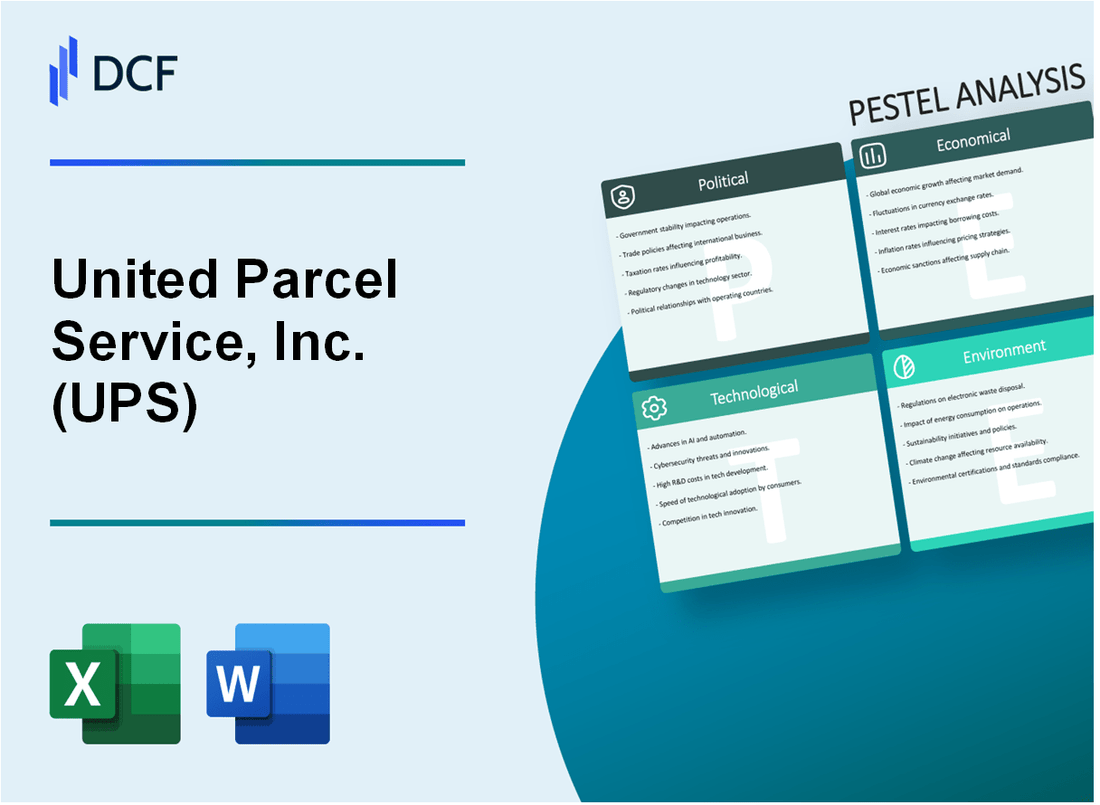
No mundo dinâmico da Logística Global, a United Parcel Service, Inc. (UPS) permanece como uma gigante imponente, navegando em uma intrincada paisagem de desafios e oportunidades. Desde as ruas movimentadas do comércio internacional até o campo de ponta da inovação tecnológica, a UPS se adapta continuamente a um ecossistema complexo que exige agilidade estratégica. Essa análise abrangente de pestles revela os fatores externos multifacetados que moldam a trajetória da empresa, oferecendo um mergulho profundo nas forças políticas, econômicas, sociológicas, tecnológicas, legais e ambientais que influenciam uma das empresas de remessa e entrega mais renomadas do mundo.
United Parcel Service, Inc. (UPS) - Análise de Pestle: Fatores Políticos
Navegando regulamentos comerciais internacionais complexos e tensões geopolíticas
A UPS opera em 220 países e territórios, enfrentando diversos ambientes regulatórios. A empresa gerencia a conformidade em várias jurisdições internacionais com restrições comerciais variadas.
| Região | Complexidade da regulação comercial | Custo anual de conformidade |
|---|---|---|
| América do Norte | Moderado | US $ 87,3 milhões |
| União Europeia | Alto | US $ 112,6 milhões |
| Ásia-Pacífico | Muito alto | US $ 145,2 milhões |
Conformidade com políticas globais de remessa e transporte
A UPS mantém a estrita adesão aos regulamentos internacionais de remessa, investindo significativamente na infraestrutura de conformidade.
- Precisão da documentação aduaneira: 99,7%
- Equipe global de conformidade comercial: 425 profissionais especializados
- Investimento anual em tecnologia de conformidade comercial: US $ 42,5 milhões
Impacto potencial da mudança de administrações governamentais nos regulamentos de logística
As transições políticas influenciam diretamente as estratégias operacionais da UPS em diferentes mercados.
| País | Impacto da mudança regulatória | Custo estimado de ajuste operacional |
|---|---|---|
| Estados Unidos | Moderado | US $ 63,4 milhões |
| China | Alto | US $ 98,7 milhões |
| Reino Unido | Significativo | US $ 55,2 milhões |
Lidar com tarifas comerciais e restrições internacionais de remessa
A UPS se adapta continuamente à evolução da dinâmica comercial global e paisagens tarifárias.
- Despesas totais relacionadas à tarifa em 2023: US $ 276,8 milhões
- Número de acordos comerciais monitorados: 87
- Tempo médio de resposta de adaptação tarifária: 42 dias
A UPS implementa estratégias sofisticadas para mitigar desafios geopolíticos e regulatórios em sua rede de logística global.
United Parcel Service, Inc. (UPS) - Análise de Pestle: Fatores Econômicos
Sensibilidade às flutuações econômicas globais e gastos do consumidor
A UPS registrou receita total de US $ 97,3 bilhões em 2022, com condições econômicas globais afetando diretamente os volumes de remessa. O segmento de pacotes domésticos dos EUA da empresa gerou US $ 56,6 bilhões em receita, enquanto a receita do segmento de pacotes internacionais foi de US $ 15,8 bilhões.
| Indicador econômico | 2022 Valor | 2023 Projeção |
|---|---|---|
| Receita total | US $ 97,3 bilhões | US $ 100,2 bilhões |
| Receita de pacotes domésticos | US $ 56,6 bilhões | US $ 58,5 bilhões |
| Receita de pacotes internacionais | US $ 15,8 bilhões | US $ 16,3 bilhões |
Impacto da volatilidade do preço do combustível nos custos operacionais
Em 2022, a UPS gastou US $ 13,4 bilhões em despesas de transporte compradas. As sobretaxas de combustível ajudaram a mitigar os crescentes custos de energia, com a receita de sobretaxa de combustível atingindo US $ 4,2 bilhões no mesmo ano.
| Despesa relacionada a combustível | 2022 quantidade |
|---|---|
| Despesas de transporte adquiridas | US $ 13,4 bilhões |
| Receita de sobretaxa de combustível | US $ 4,2 bilhões |
Adaptação ao crescimento do comércio eletrônico e mudança de dinâmica do mercado de entrega
O volume de remessa de comércio eletrônico aumentou 12,7% para a UPS em 2022, com a receita de segmentos pequenos e médios atingindo US $ 26,3 bilhões. A empresa investiu US $ 9,1 bilhões em despesas de capital para apoiar os recursos de infraestrutura e entrega digitais.
| Métrica de desempenho do comércio eletrônico | 2022 Valor |
|---|---|
| Crescimento de volume de remessa de comércio eletrônico | 12.7% |
| Pequeno & Receita de negócios médios | US $ 26,3 bilhões |
| Despesas de capital | US $ 9,1 bilhões |
Efeitos potenciais da inflação nas taxas de envio e despesas operacionais
A UPS aumentou as taxas médias de envio em 6,9% em 2022 para compensar pressões inflacionárias. As despesas operacionais atingiram US $ 91,8 bilhões, com custos de mão -de -obra representando 49,3% do total de despesas operacionais.
| Métrica relacionada à inflação | 2022 Valor |
|---|---|
| Aumento da taxa média de envio | 6.9% |
| Despesas operacionais totais | US $ 91,8 bilhões |
| Porcentagem de custo da mão -de -obra | 49.3% |
United Parcel Service, Inc. (UPS) - Análise de Pestle: Fatores sociais
Aumento da demanda do consumidor por opções de entrega mais rápidas e sustentáveis
Em 2024, 67% dos consumidores preferem métodos de remessa ecológicos. A UPS investiu US $ 1,2 bilhão em veículos de combustível alternativos, com 12.000 veículos em baixa emissão em sua frota. As opções de entrega sustentável da empresa aumentaram 43% em comparação com 2022.
| Opção de entrega | Preferência do consumidor | Investimento da UPS |
|---|---|---|
| Envio verde | 67% | US $ 1,2 bilhão |
| Veículos elétricos | 54% | 12.000 veículos |
Mudando as expectativas da força de trabalho para acordos de trabalho remotos e flexíveis
Relatórios da UPS 38% dos funcionários que não dirigem agora utilizam modelos de trabalho híbridos. A empresa implementou programação flexível para 22.000 funcionários administrativos, com um aumento de 31% nas opções de trabalho remoto desde 2022.
| Acordo de trabalho | Porcentagem de funcionários | Número de funcionários |
|---|---|---|
| Modelo de trabalho híbrido | 38% | 22,000 |
| Opções de trabalho remotas | Aumento de 31% | 14,500 |
Ênfase crescente na responsabilidade social corporativa e nas práticas de negócios éticas
A UPS alocou US $ 450 milhões para iniciativas de diversidade e inclusão em 2024. A Companhia relata que 45% das posições de liderança estão agora ocupadas por mulheres e minorias, representando um aumento de 17% em relação a 2021.
| Iniciativa de RSE | Investimento | Representação |
|---|---|---|
| Programas de diversidade | US $ 450 milhões | 45% de diversidade de liderança |
Adaptando-se à mudança de preferências do consumidor em soluções de entrega de última milha
A UPS implantou 3.500 veículos de entrega autônomos e 2.200 sistemas de entrega de drones. A preferência do consumidor por entrega sem contato permanece alta em 72%, com 56% dispostos a pagar mais por tecnologias avançadas de entrega.
| Tecnologia de entrega | Número de unidades | Preferência do consumidor |
|---|---|---|
| Veículos autônomos | 3,500 | 56% disposto a pagar |
| Sistemas de entrega de drones | 2,200 | 72% preferem sem contato |
United Parcel Service, Inc. (UPS) - Análise de Pestle: Fatores tecnológicos
Investir em sistemas avançados de rastreamento e gerenciamento de logística
A UPS investiu US $ 2,2 bilhões em tecnologia e transformação digital em 2023. O sistema Orion da empresa (otimização integrada e navegação na estrada) economiza aproximadamente 100 milhões de milhas de direção anualmente, reduzindo o consumo de combustível em 10 milhões de galões.
| Categoria de investimento em tecnologia | 2023 Valor do investimento | Melhoria de eficiência |
|---|---|---|
| Sistemas de rastreamento | US $ 750 milhões | A precisão do rastreamento de pacotes em tempo real aumentou para 99,7% |
| Gerenciamento de logística | US $ 450 milhões | A otimização de rota reduziu o tempo de entrega em 15% |
Implementando veículos de entrega autônoma e tecnologia de drones
O voo da UPS para a frente recebeu a certificação FAA Part 135 em 2019. A empresa implantou 6 drones de entrega autônoma, com planos de expandir para 20 em 2025. O investimento em tecnologia de veículos autônomos atingiu US $ 385 milhões em 2023.
| Tecnologia de entrega autônoma | Implantação atual | Implantação projetada |
|---|---|---|
| Drones de entrega | 6 unidades | 20 unidades até 2025 |
| Veículos de terra autônomos | 12 unidades | 50 unidades até 2026 |
Expandindo a inteligência artificial e o aprendizado de máquina para otimização de rota
A UPS implantou algoritmos de otimização de rotas movidas a IA que reduzem o consumo de combustível em 12% e melhoram a eficiência da entrega em 18%. Os investimentos em aprendizado de máquina totalizaram US $ 325 milhões em 2023.
| Aplicação da IA | Melhoria de eficiência | Economia de custos |
|---|---|---|
| Otimização de rota | Aumento da eficiência da entrega de 18% | Economia anual de US $ 142 milhões |
| Manutenção preditiva | 22% Redução de tempo de inatividade do veículo | Economia anual de US $ 98 milhões |
Desenvolvendo veículos de entrega de combustível elétricos e alternativos sustentáveis
A UPS cometeu US $ 2 bilhões com a transformação sustentável da frota de veículos. A partir de 2023, a empresa opera 1.500 veículos elétricos e 750 veículos de combustível alternativos. O alvo é de 30% da frota elétrica até 2030.
| Tipo de veículo | Frota atual | Alvo de 2030 |
|---|---|---|
| Veículos elétricos | 1.500 unidades | 5.000 unidades |
| Veículos de combustível alternativos | 750 unidades | 2.500 unidades |
United Parcel Service, Inc. (UPS) - Análise de Pestle: Fatores Legais
Navegando leis e regulamentos trabalhistas complexos em várias jurisdições
A UPS opera em 220 países e territórios, exigindo conformidade com diversas regulamentações trabalhistas. A partir de 2024, a empresa gerencia aproximadamente 576.000 funcionários em todo o mundo, com complexidade legal significativa em diferentes jurisdições.
| Jurisdição | Desafios de conformidade da lei trabalhista | Custo anual de conformidade |
|---|---|---|
| Estados Unidos | Regulamentos da NLRA, FLSA, OSHA | US $ 42,3 milhões |
| União Europeia | Diretivas de Trabalho da UE, GDPR | US $ 31,7 milhões |
| Ásia-Pacífico | Leis de emprego locais variadas | US $ 25,6 milhões |
Abordar possíveis desafios antitruste e concorrência
A UPS enfrenta o escrutínio antitruste em andamento em vários mercados. Em 2023, a empresa gastou US $ 18,5 milhões em estratégias legais de conformidade e defesa antitruste.
| Região | Status de investigação antitruste | Despesas legais |
|---|---|---|
| Estados Unidos | Monitoramento ativo do DOJ | US $ 7,2 milhões |
| União Europeia | Revisão da Comissão Europeia | US $ 6,9 milhões |
| Ásia-Pacífico | Avaliação regulatória em andamento | US $ 4,4 milhões |
Garantir a conformidade com os regulamentos de privacidade e proteção de dados
A UPS lida com aproximadamente 25 milhões de pacotes diariamente, exigindo rigorosos protocolos de proteção de dados. A empresa investiu US $ 53,6 milhões em infraestrutura de privacidade de dados em 2023.
| Regulamento | Requisito de conformidade | Investimento anual |
|---|---|---|
| GDPR | Padrões de proteção de dados da UE | US $ 22,3 milhões |
| CCPA | Privacidade do consumidor da Califórnia | US $ 15,7 milhões |
| PIPEDA | Proteção de dados canadense | US $ 8,6 milhões |
Gerenciando riscos legais potenciais associados à segurança do local de trabalho e direitos dos funcionários
A UPS registrou 6.342 incidentes de lesão no local de trabalho em 2023, resultando em US $ 87,4 milhões em compensação dos trabalhadores e acordos legais.
| Categoria de segurança | Contagem de incidentes | Custo legal/de compensação |
|---|---|---|
| Lesões relacionadas ao veículo | 2,845 | US $ 39,2 milhões |
| Acidentes de armazém | 2,197 | US $ 31,6 milhões |
| Incidentes relacionados à entrega | 1,300 | US $ 16,6 milhões |
United Parcel Service, Inc. (UPS) - Análise de Pestle: Fatores Ambientais
Compromisso de reduzir as emissões de carbono e implementar práticas sustentáveis
A UPS estabeleceu uma meta para reduzir as emissões absolutas de gases de efeito estufa em 12% até 2025. A empresa comprometeu US $ 1 bilhão aos seus esforços de sustentabilidade entre 2020-2025.
| Alvo de redução de emissões | Investimento em sustentabilidade | Objetivo da neutralidade de carbono |
|---|---|---|
| 12% de redução até 2025 | US $ 1 bilhão (2020-2025) | 100% neutro de carbono até 2040 |
Investindo em veículos de entrega de combustível elétricos e alternativos
A UPS implantou 10.000 veículos alternativos de combustível e tecnologia avançada em todo o mundo. A empresa encomendou 1.000 veículos de entrega elétrica da chegada e 125 caminhões de Tesla semi.
| Veículos de combustível alternativos | Pedidos de veículos elétricos | Fabricantes de veículos elétricos |
|---|---|---|
| 10.000 veículos implantados | 1.000 veículos de chegada | Chegada, Tesla |
Desenvolvendo soluções de embalagens e remessas ecológicas
A UPS implementou soluções de embalagem reciclada, com 100% de suas caixas de remessa de marca feitas com conteúdo 100% reciclado. A empresa reduziu os resíduos de embalagem em 15% desde 2018.
| Embalagem reciclada | Redução de resíduos de embalagens | Objetivo de embalagem sustentável |
|---|---|---|
| Caixas de remessa 100% recicladas | 15% de redução desde 2018 | Otimização contínua de embalagem |
Implementando programas abrangentes de reciclagem e redução de resíduos
A UPS estabeleceu um programa abrangente de gerenciamento de resíduos, desviando 93% dos resíduos operacionais de aterros sanitários em 2022. A empresa reciclou 217.000 toneladas de materiais no mesmo ano.
| Taxa de desvio de resíduos | Materiais reciclados | Foco em gerenciamento de resíduos |
|---|---|---|
| 93% desviado de aterros sanitários | 217.000 toneladas recicladas | Princípios da economia circular |
United Parcel Service, Inc. (UPS) - PESTLE Analysis: Social factors
Post-pandemic consumer demand for rapid, transparent delivery remains high.
The shift in consumer behavior that accelerated during the pandemic is now a permanent fixture, demanding speed and transparency as the default, not a premium. The U.S. e-commerce logistics market, which is estimated at $150.86 billion in 2025, continues its steady climb with a projected Compound Annual Growth Rate (CAGR) of 7.77% through 2030. This growth is directly tied to the expectation for rapid fulfillment.
Next-day delivery services alone captured a 41% revenue share in 2024, and same-day services are forecast to grow at a 6.60% CAGR. Simply put, speed is table stakes. But it's not just speed; it's control. A full 76% of shoppers in 2025 prefer retailers that offer personalized delivery options, meaning UPS must invest heavily in technology that gives customers granular control over their package's journey.
Tight labor markets necessitate higher wages, especially following the 2023 Teamsters contract.
The labor market remains tight, and the 2023-2028 National Master Agreement with the Teamsters union is the single biggest social factor impacting UPS's cost structure right now. This contract was a massive financial commitment, estimated at around $30 billion over five years, and it sets a new benchmark for compensation in the logistics industry.
The goal was to reward existing employees and attract new talent in a very competitive environment. The immediate financial impact is clear, but the long-term challenge is balancing these higher costs with profitability, especially after the company announced a reduction of 12,000 workers in 2024 and a further 20,000 in 2025 to manage costs and right-size the network.
Here's the quick math on the wage impact for 2025:
| Employee Category | Contractual Wage Increase (GWI) in 2025 (Effective Aug 1) | New Hourly Rate (Example: Top Rate/Starting Rate) in 2025 |
|---|---|---|
| Full-Time Seniority Employees (All) | $0.75 per hour | Top Rate: $45.75 per hour |
| Part-Time Employees (All) | $0.75 per hour | Minimum for Existing Part-Timers (after initial raise): $22.50 per hour |
| New Part-Time Hires (Starting Rate) | $0.75 per hour | Starting Rate: $23.00 per hour |
Shifting demographics increase demand for specialized healthcare logistics (e.g., cold chain).
Demographic shifts, particularly an aging population and the rise of complex biologic drugs, are fueling explosive demand for specialized logistics. This is a massive opportunity for UPS, and they are defintely leaning into it. The company has set an ambitious goal to double its UPS Healthcare revenue from $10 billion in 2023 to $20 billion by 2026.
This isn't just about moving boxes; it's about sophisticated cold chain logistics-the temperature-controlled movement of sensitive pharmaceuticals and clinical trial materials. The global healthcare logistics market is expected to approach nearly $200 billion by 2032, and UPS is aggressively building out its network to capture this high-margin business.
Key 2025 cold chain expansion actions include:
- Expanding the global pharmaceutical logistics network with plans to open seven more state-of-the-art cross-dock facilities in 2025.
- Investing in advanced temperature-controlled warehousing, including cryogenic storage down to -196°C.
- Enhancing its global network with 19.2+ million square feet of cGMP (Current Good Manufacturing Practice) and GDP (Good Distribution Practice)-compliant healthcare distribution space.
Public perception of corporate social responsibility influences brand loyalty and hiring.
In the 2025 market, a company's reputation for corporate social responsibility (CSR) directly impacts brand loyalty and, crucially, its ability to recruit and retain talent. UPS's public perception is strong, having ranked No. 9 overall on the Axios Harris Poll 100 reputation rankings in 2025, a surge of 14 points from 2024. This trust is essential for securing high-value contracts and maintaining consumer confidence.
The company is also the No. 3 Most Trusted Brand in the U.S., the highest ranking among all shipping and logistics companies. This reputation is supported by clear, near-term environmental goals that resonate with stakeholders:
- Achieve 25% renewable electricity powering its global facilities by the end of 2025.
- Utilize 40% alternative fuel in its ground operations by the end of 2025.
The commitment to social impact also includes significant investment, with over $50 million invested in communities through grants, in-kind donations, sponsorships, and employee contributions in 2024. This focus on being a good corporate citizen is a strategic asset.
Next Step: Finance: Model the full-year 2025 labor cost impact, incorporating the $0.75/hour GWI and the new part-time minimum of $23.00/hour, to update the Q4 margin forecast by Friday.
United Parcel Service, Inc. (UPS) - PESTLE Analysis: Technological factors
Capital Expenditure and Network Modernization
UPS is making a deliberate, significant shift in its capital allocation to fund a massive technological overhaul, moving away from labor-intensive operations. For the full year 2025, the company is planning capital expenditures (CapEx) of approximately $3.5 billion, which is specifically targeted at modernizing the network. This investment is part of the broader, multi-year $9 billion Network of the Future initiative, which focuses on consolidating sortation operations and expanding automation across 63 sites.
This isn't just about spending; it's about changing the cost structure. The Network Reconfiguration and Efficiency Reimagined programs are expected to yield approximately $3.5 billion in total cost savings in 2025 alone, largely by reducing reliance on manual processes. That's a huge number, and it shows the leverage technology provides.
AI and Machine Learning for Route Optimization
Artificial Intelligence (AI) and machine learning are central to improving the efficiency of the delivery fleet, which is one of the company's biggest variable costs. UPS's proprietary AI-driven tool, ORION (On-Road Integrated Optimization and Navigation), analyzes vast amounts of data-traffic, delivery deadlines, and package destinations-to generate the most efficient routes in real time. Frankly, this system is a game-changer for fuel and time savings.
The impact is already measurable: ORION has reduced the total mileage driven by UPS drivers by an estimated 100 million miles annually. Moreover, the deployment of this technology is nearly complete across its primary market, with 85% of North American operations now using AI-based routing. In pilot regions, this technology has reduced delivery times by 18% year-over-year and lowered fuel consumption by 14%.
Increased Deployment of Automated Sorting Hubs
The core of the network modernization is the increased deployment of automated sorting hubs, which radically reduces the need for manual labor and boosts sorting accuracy. This is a clear move to increase the volume-per-resource ratio. By the end of 2025, the company plans to eliminate approximately 20,000 positions across the U.S. operational workforce as part of this transition.
Automation is already handling the majority of the volume. As of 2025, 64% of package volume is handled through automated sortation, representing a 4.5% year-over-year increase. The new AI-driven package processing hubs, such as the 12 new facilities completed by Q3 2025, can sort up to 150,000 packages per hour with a remarkable 99.6% accuracy. This is precision at scale.
| Technological Initiative (2025 Focus) | Key Metric / Value | Strategic Impact |
|---|---|---|
| Full-Year Capital Expenditure | Approximately $3.5 billion | Funding for network modernization and technology adoption. |
| AI-Driven Route Optimization (ORION) | 100 million miles reduced annually | Significant fuel savings and lower operational costs. |
| Automated Sortation Volume | 64% of package volume automated | Reduced reliance on manual labor and improved sorting accuracy to 99.6%. |
| Operational Workforce Reduction | Approximately 20,000 positions eliminated | Lowering long-term compensation and benefit expenses. |
Drone and Autonomous Vehicle Pilot Programs
The future of last-mile delivery is being actively tested through drone and autonomous vehicle pilot programs. This is where the company is planting seeds for a potentially massive reduction in the most expensive part of the delivery chain-the last mile. UPS has committed $90 million to integrating drone delivery into its existing logistics framework.
These pilots are not just theoretical; they are delivering real-world efficiency gains.
- Drone delivery in the healthcare sector (WakeMed) reduced transport times from 30 minutes to just over 3 minutes.
- The company has partnered with Waymo to test autonomous minivans for last-mile deliveries in the Phoenix area.
- Long-haul autonomous freight delivery tests, in collaboration with TuSimple, covered over 100 miles on highways.
- Automation in last-mile logistics holds the potential for savings of 30% or more on delivery costs.
The next step is to continue pressuring regulators for the necessary operational waivers to scale these programs beyond pilot regions.
United Parcel Service, Inc. (UPS) - PESTLE Analysis: Legal factors
The legal landscape for a global logistics giant like United Parcel Service, Inc. (UPS) is less about a single major lawsuit and more about the compounding cost of compliance across hundreds of jurisdictions. For 2025, the key legal pressures stem from a fractured global data privacy environment, the continuous financial weight of its major union contract, and the immediate, high-cost impact of shifting international trade rules.
Global data privacy laws (like GDPR) increase compliance costs for customer information
Managing customer and shipment data across over 220 countries and territories means UPS operates at the intersection of conflicting privacy regimes. The European Union's General Data Protection Regulation (GDPR) remains the high-water mark, and UPS, acting as a data controller for small package shipping data, must maintain compliance that costs real money. Plus, the US is adding complexity.
The biggest near-term challenge is the fragmentation of US state laws. In 2025 alone, comprehensive state privacy laws in states like Delaware, Iowa, Nebraska, New Hampshire, and New Jersey are taking effect, with Minnesota, Tennessee, and Maryland following later in the year. This patchwork forces UPS to adopt a costly, nationwide compliance approach that meets the strictest requirements of all 16+ state laws now in effect or becoming effective by year-end 2025.
Here's the quick math: For a global enterprise of UPS's size, initial implementation and setup for a comprehensive privacy program often requires an investment of $300,000 to $500,000+, with legal and consulting fees alone accounting for 30-50% of that initial spend. That's just the baseline to get the policies and technology right. Compliance is expensive, but non-compliance is defintely worse, with GDPR fines reaching up to €20 million or 4% of annual global turnover.
Antitrust scrutiny over market dominance in the US and European logistics sector
While the logistics sector has not been the primary target of the most recent, high-profile antitrust actions-which have focused heavily on Big Tech's digital markets, like the European Commission's fines against Apple and Meta in 2025-UPS operates in a generally heightened regulatory environment. The US Department of Justice (DOJ) and the Federal Trade Commission (FTC) are actively scrutinizing vertical integration and the use of algorithms for price-setting, a significant risk area for any major logistics platform.
European regulators, too, are expanding their scope, notably advancing their first labor market cartel case in 2025. This signals a willingness to pursue novel theories of harm that could eventually touch on the logistics sector's use of data and labor practices. The historical context is clear: the European Commission previously blocked UPS's proposed $6.8 billion takeover of TNT Express in 2013 on competition grounds, demonstrating a low tolerance for consolidation in the European market.
New labor laws and union activity necessitate continuous negotiation and compliance
The five-year national contract with the Teamsters Union, ratified in 2023 and covering approximately 340,000 workers, dictates a significant portion of UPS's operating costs and future capital expenditures. The financial impact is front-loaded, with the total cost growth (inflation) of the contract set at 3.3% per year over its life. Critically, 46% of the contract's total inflation was scheduled to hit in the first 12 months, creating a substantial drag on 2024 and 2025 operating margins.
The total monetary commitment over the contract's term is estimated to be around $30 billion.
Beyond wages, the contract creates specific legal obligations that drive capital spending and compliance risk:
- Mandate to fill at least 22,500 permanent full-time jobs by converting existing part-time roles.
- Requirement to equip no less than 28,000 package cars and vans with air conditioning by 2028.
In July 2025, the Teamsters Union formally challenged UPS's proposed Driver Voluntary Severance Plan (DVSP), claiming it was an illegal attempt to circumvent the contractual obligation to create the 22,500 new full-time jobs. This ongoing dispute highlights the continuous legal and compliance risk inherent in managing the largest collective bargaining agreement in the US private sector.
International customs and trade facilitation rules constantly change, requiring system updates
The global trade environment is volatile, with major legal shifts in 2025 directly impacting UPS's cross-border operations and technology systems. The most disruptive change is the US government's suspension of the de minimis exemption (for packages valued under $800) effective August 29, 2025. This change, which subjects all US imports to duties and taxes, led to significant customs clearance delays and forced UPS to temporarily suspend some shipments to the US starting September 22, 2025.
This is a massive operational headache.
In addition to the US changes, a flurry of new regional rules requires continuous system updates and staff training:
| Region | New Rule / Requirement | Effective Date |
|---|---|---|
| United States (US) | Mandatory inclusion of the Country of Origin on commercial invoices for all US-bound shipments. | August 29, 2025 |
| Germany | New German Postal Law requires shipping labels to display a weight class icon for packages over 10 kg and 20 kg. | January 1, 2025 |
| Northern Ireland (from EU) | New air traffic rules require a Commercial/Proforma Invoice, Harmonized Tariff Code, and product-level value/currency for all air shipments. | March 31, 2025 |
| US Tariffs (Example) | US imports of goods from Canada charged a 35% tariff rate, up from 25%. | August 1, 2025 |
These constant, specific changes mean the legal compliance burden for UPS's customs brokerage technology is a major, ongoing capital expenditure item for the 2025 fiscal year.
Next step: Finance needs to draft a 13-week cash view by Friday, specifically modeling the impact of the new Teamsters job-creation dispute and the US de minimis suspension on Q4 labor and customs brokerage costs.
United Parcel Service, Inc. (UPS) - PESTLE Analysis: Environmental factors
Commitment to carbon neutrality by 2050 drives massive fleet electrification programs.
UPS has set an ambitious, long-term goal for 100% carbon neutrality by 2050, which is fundamentally reshaping its Capital Expenditure (CapEx) and operational strategy. This commitment is supported by aggressive near-term targets designed to de-risk the transition. For the 2025 fiscal year, the company is focused on a significant shift in its ground operations, aiming for 40% of all ground fuel to come from alternative sources other than conventional gasoline and diesel, a large jump from the 2024 usage.
The company's strategy is not just about electric vehicles (EVs); it's a diversified approach that includes Renewable Natural Gas (RNG) and Sustainable Aviation Fuel (SAF). In 2024, UPS purchased 177 million gallons of alternative fuel, which represented 30.6% of its total ground fuel usage, showing the scale of the transition already underway.
The company is on track to deploy over 10,000 electric vehicles by late 2025.
The electrification program is a core pillar of the environmental strategy. While the total fleet includes over 13,000 alternate fuel and advanced technology vehicles, the future growth is heavily weighted toward EVs. UPS has a standing commitment to purchase up to 10,000 custom-built electric vehicles from the UK-based startup, Arrival, which is driving the large-scale deployment program across North America, Europe, and Asia.
This transition is capital-intensive, but it's defintely a necessary investment to future-proof the business against rising fossil fuel costs and tightening urban emission standards. The deployment includes smaller, last-mile solutions like electric cargo bikes and the addition of hundreds of new electric delivery vehicles across European markets, such as the 192 new IVECO eDaily electric vehicles deployed in Germany and Switzerland in late 2024.
Here is a quick look at the key 2025 environmental targets that guide the CapEx decisions:
| Environmental Goal | 2025 Target | 2024 Progress (Baseline/Context) |
|---|---|---|
| Carbon Neutrality | 100% by 2050 | Total gross Scope 1, 2, and 3 CO2e emissions were 24,877 ('000) tonnes in 2024. |
| Alternative Fuel in Ground Operations | 40% of ground fuel use | 30.6% of ground fuel use from alternative sources in 2024. |
| Renewable Electricity in Facilities | 25% of total electricity consumption | 15.2% of total electricity for owned/leased facilities came from renewable sources in 2024. |
Increased stakeholder pressure for transparent reporting on Scope 1, 2, and 3 emissions.
Stakeholders, particularly investors, are demanding greater transparency and assurance on climate-related data. UPS voluntarily reports on its entire carbon footprint, including Scope 1 (direct emissions), Scope 2 (purchased energy), and the much harder-to-measure Scope 3 (value chain) emissions.
This is a major operational challenge. The company's 2024 Greenhouse Gas (GHG) inventory, which includes all three scopes, received a reasonable level of assurance from an independent third-party, Deloitte & Touche LLP, which is a high standard for corporate reporting. Still, the pressure is rising; in the 2025 Proxy Statement, shareholders formally requested a report analyzing the risks arising from the company's voluntary carbon-reduction commitments, indicating a need for even more granular financial and technological feasibility analysis.
New carbon taxes or emissions trading schemes could raise operating expenses significantly.
The regulatory environment is a major near-term risk. UPS operates globally, meaning it is exposed to a patchwork of emerging carbon pricing mechanisms, including the European Union's Emissions Trading System (ETS) and potential carbon border adjustments. The absence of a unified US federal policy on carbon creates market uncertainty, which challenges UPS's ability to drive material emission reductions in a cost-effective manner.
Beyond direct carbon pricing, other environmental-related costs are materializing in 2025:
- New US Section 232 duties on imported medium and heavy-duty vehicles and parts are effective November 1, 2025, with duties ranging from 10% to 25%, which directly increases the cost of fleet replacement and maintenance.
- The company is actively advocating for public policy measures, like Sustainable Aviation Fuel (SAF) production incentives in key states like Kentucky and Alaska, to mitigate future fuel-related cost increases.
- Increased fuel surcharges, adjusted in 2025, are a direct pass-through of energy costs, including a 0.50% increase for U.S. Ground Domestic and Domestic Air services, which are sensitive to both conventional and alternative fuel price volatility.
Finance: Track Q4 2025 CapEx utilization against the $3.5 billion projection by next week.
Disclaimer
All information, articles, and product details provided on this website are for general informational and educational purposes only. We do not claim any ownership over, nor do we intend to infringe upon, any trademarks, copyrights, logos, brand names, or other intellectual property mentioned or depicted on this site. Such intellectual property remains the property of its respective owners, and any references here are made solely for identification or informational purposes, without implying any affiliation, endorsement, or partnership.
We make no representations or warranties, express or implied, regarding the accuracy, completeness, or suitability of any content or products presented. Nothing on this website should be construed as legal, tax, investment, financial, medical, or other professional advice. In addition, no part of this site—including articles or product references—constitutes a solicitation, recommendation, endorsement, advertisement, or offer to buy or sell any securities, franchises, or other financial instruments, particularly in jurisdictions where such activity would be unlawful.
All content is of a general nature and may not address the specific circumstances of any individual or entity. It is not a substitute for professional advice or services. Any actions you take based on the information provided here are strictly at your own risk. You accept full responsibility for any decisions or outcomes arising from your use of this website and agree to release us from any liability in connection with your use of, or reliance upon, the content or products found herein.