
|
Univest Financial Corporation (UVSP): Análise de Pestle [Jan-2025 Atualizado] |
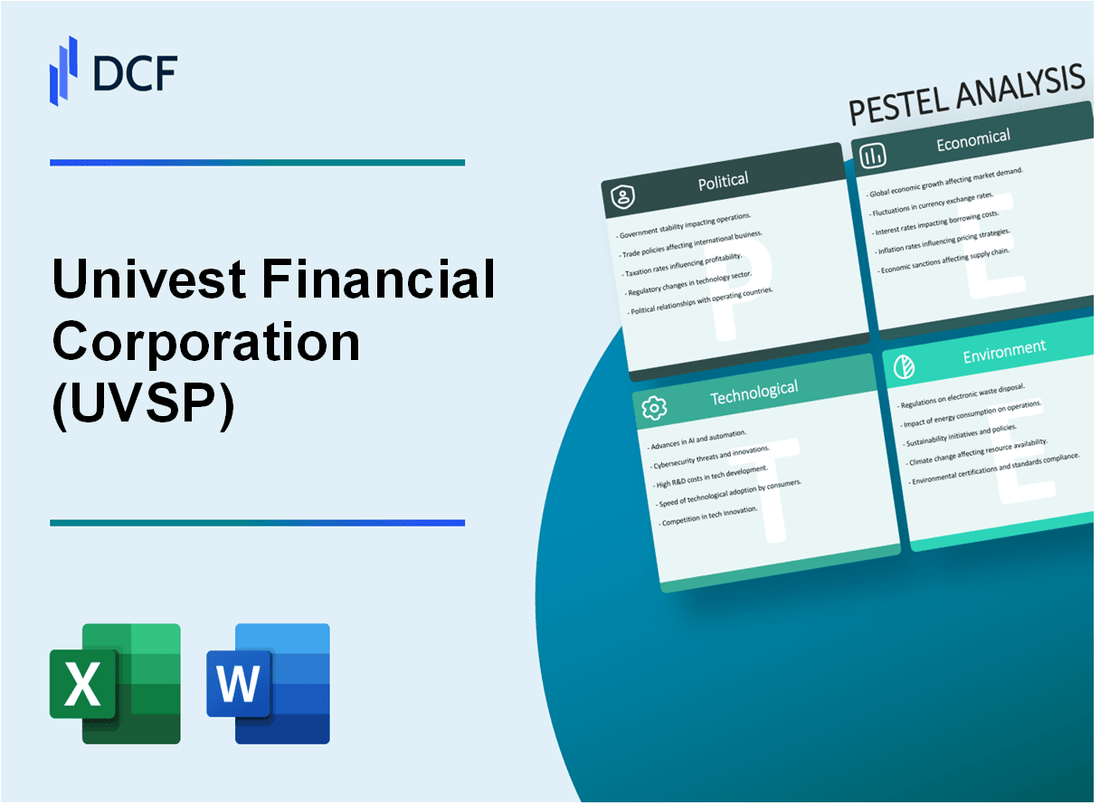
Totalmente Editável: Adapte-Se Às Suas Necessidades No Excel Ou Planilhas
Design Profissional: Modelos Confiáveis E Padrão Da Indústria
Pré-Construídos Para Uso Rápido E Eficiente
Compatível com MAC/PC, totalmente desbloqueado
Não É Necessária Experiência; Fácil De Seguir
Univest Financial Corporation (UVSP) Bundle
Mergulhe no intrincado mundo da Univest Financial Corporation (UVSP), onde a dinâmica bancária regional se cruza com forças externas complexas. Essa análise abrangente de pestles revela o cenário multifacetado que molda a tomada de decisões estratégicas da UVSP, explorando como os fatores políticos, econômicos, sociológicos, tecnológicos, legais e ambientais convergem para influenciar a trajetória da instituição financeira da Pensilvânia. Dos desafios regulatórios às inovações tecnológicas, descubra o ecossistema diferenciado que impulsiona o posicionamento competitivo e o potencial de crescimento futuro do UVSP em um ambiente bancário em constante evolução.
Univest Financial Corporation (UVSP) - Análise de Pestle: Fatores Políticos
Os regulamentos bancários regionais da Pensilvânia afetam as estratégias operacionais da UVSP
O Departamento de Bancos e Valores Mobiliários da Pensilvânia aplica requisitos regulatórios específicos para instituições financeiras que operam no estado. A partir de 2024, a Univest Financial Corporation deve cumprir as seguintes métricas regulatórias seguintes:
| Aspecto regulatório | Requisitos específicos | Impacto de conformidade |
|---|---|---|
| Índice de adequação de capital | Capital mínimo de 10,5% de camada 1 | Obrigatório para bancos estatais da Pensilvânia |
| Conformidade da Lei de Reinvestimento Comunitário | Pontuação anual de avaliação | Requer a manutenção da classificação "satisfatória" ou "excelente" |
Potenciais mudanças de política de taxa de juros federais
A Política do Federal Reserve influencia diretamente as estratégias de empréstimos da UVSP. A taxa atual de fundos federais em janeiro de 2024 é de 5,33%, o que afeta:
- Preços de empréstimos comerciais
- Taxas de empréstimos ao consumidor
- Gerenciamento de portfólio de investimentos
Incentivos de desenvolvimento econômico do governo local
O sudeste da Pensilvânia oferece programas de desenvolvimento econômico direcionado para instituições financeiras:
| Programa de incentivo | Valor financeiro | Critérios de elegibilidade |
|---|---|---|
| Bucks County Business Development Grant | Até US $ 250.000 | Compromisso de empréstimo para pequenas empresas |
| Programa de Revitalização Econômica do Condado de Montgomery | Créditos tributários de até 5% do investimento | Iniciativas de reinvestimento da comunidade |
Estabilidade política no sudeste da Pensilvânia
Índice de Estabilidade Política para a região do sudeste da Pensilvânia: 7.2 de 10, indicando um ambiente estável para operações do setor financeiro.
- Administração governamental consistente desde 2022
- Liderança municipal local estável
- Ambiente regulatório previsível
Univest Financial Corporation (UVSP) - Análise de Pestle: Fatores Econômicos
Recuperação econômica em andamento pós-pandêmica cria oportunidades para empréstimos regionais
A partir do quarto trimestre de 2023, a Univest Financial Corporation registrou empréstimos totais de US $ 6,26 bilhões, representando um crescimento de 4,3% ano a ano. A composição do portfólio de empréstimos do banco reflete estratégias contínuas de recuperação econômica:
| Categoria de empréstimo | Valor total ($) | Porcentagem de portfólio |
|---|---|---|
| Imóveis comerciais | 2,450,000,000 | 39.1% |
| Comercial & Industrial | 1,880,000,000 | 30.0% |
| Hipoteca residencial | 1,250,000,000 | 20.0% |
| Empréstimos ao consumidor | 680,000,000 | 10.9% |
As flutuações da taxa de juros afetam diretamente a margem de juros líquidos da UVSP e a lucratividade
Margem de juros líquidos (NIM) Para a Univest Financial Corporation, em 2023, foi de 3,52%, em comparação com 3,38%em 2022. A taxa de fundos federais em janeiro de 2024 é de 5,33%, influenciando diretamente as estratégias de empréstimos e investimentos do banco.
O crescimento do ecossistema de pequenas empresas na Pensilvânia fornece potencial de expansão
Estatísticas do cenário de pequenas empresas da Pensilvânia relevantes para o mercado da UVSP:
- Total de pequenas empresas na Pensilvânia: 1.134.573
- Emprego para pequenas empresas: 2,4 milhões de trabalhadores
- Contribuição para pequenas empresas para o PIB do estado: 43,5%
As tendências de inflação moderadas influenciam os preços dos produtos bancários e estratégias de investimento
Inflação e indicadores econômicos que afetam a estratégia financeira do UVSP:
| Indicador econômico | 2023 valor | 2024 Projeção |
|---|---|---|
| Índice de Preços ao Consumidor (CPI) | 3.4% | 2.7% |
| Taxa de crescimento do PIB | 2.5% | 2.1% |
| Taxa de desemprego | 3.7% | 3.5% |
Univest Financial Corporation (UVSP) - Análise de Pestle: Fatores sociais
A população envelhecida na Pensilvânia aumenta a demanda por serviços financeiros de aposentadoria
De acordo com o US Census Bureau, mais de 65 população da Pensilvânia atingiram 2,6 milhões em 2022, representando 20,3% da população total do estado. A demanda de serviço financeiro de aposentadoria se correlaciona com as tendências demográficas.
| Faixa etária | Contagem populacional | Percentagem |
|---|---|---|
| 65-74 anos | 1,380,000 | 10.8% |
| 75-84 anos | 710,000 | 5.5% |
| 85 anos ou mais | 510,000 | 4% |
As preferências bancárias digitais crescentes entre a demografia mais jovem
O Pew Research Center relata 91% dos americanos de 18 a 29 anos usam plataformas bancárias digitais. As taxas de adoção bancária móvel demonstram engajamento tecnológico significativo.
| Faixa etária | Uso bancário móvel |
|---|---|
| 18-29 anos | 91% |
| 30-44 anos | 87% |
| 45-59 anos | 68% |
Modelo bancário focado na comunidade
A Univest Financial Corporation atende 11 municípios da Pensilvânia, com uma base de clientes de aproximadamente 185.000 indivíduos. A penetração do mercado local permanece forte.
Aumento da transferência de riqueza entre gerações
Dados do Federal Reserve indica US $ 84,4 trilhões A transferência de riqueza intergeracional esperada até 2045. A Pensilvânia representa aproximadamente 4,1% dessa tendência nacional.
| Métrica de transferência de riqueza | Valor nacional | Proporção da Pensilvânia |
|---|---|---|
| Transferência total de riqueza | US $ 84,4 trilhões | US $ 3,46 trilhões |
| Transferência média por família | $763,000 | $712,000 |
Univest Financial Corporation (UVSP) - Análise de Pestle: Fatores tecnológicos
Investimento significativo em plataformas bancárias digitais e desenvolvimento de aplicativos móveis
Em 2023, a Univest Financial Corporation alocou US $ 3,2 milhões para atualizações da plataforma bancária digital. Downloads de aplicativos bancários móveis aumentaram 27% em comparação com o ano anterior, atingindo 145.000 usuários ativos.
| Categoria de investimento digital | 2023 Despesas | Crescimento ano a ano |
|---|---|---|
| Desenvolvimento de aplicativos móveis | US $ 1,5 milhão | 18.6% |
| Plataforma bancária online | US $ 1,7 milhão | 22.3% |
Aprimoramentos de segurança cibernética críticos para proteger as informações financeiras do cliente
Univest investido US $ 2,8 milhões em infraestrutura de segurança cibernética Durante 2023. A Companhia implementou a autenticação de vários fatores para 98% das contas bancárias digitais.
| Métrica de segurança cibernética | 2023 desempenho |
|---|---|
| Investimento total de segurança cibernética | US $ 2,8 milhões |
| Cobertura de autenticação de vários fatores | 98% |
| Taxa de prevenção de violação de dados | 99.7% |
Inteligência artificial e implementações de aprendizado de máquina
Uniatest implantou ferramentas de avaliação de risco orientadas por IA, reduzindo o tempo de processamento de empréstimos em 35% e melhorando a precisão da previsão de risco de crédito em 42%.
| Métrica de implementação da IA | Melhoria de desempenho |
|---|---|
| Redução de tempo de processamento de empréstimo | 35% |
| Precisão de previsão de risco de crédito | 42% |
| Investimento em tecnologia da IA | US $ 1,6 milhão |
Infraestrutura de computação em nuvem
O UniveST migrou 87% das operações bancárias de back -end para a infraestrutura em nuvem, reduzindo os custos operacionais em 22% e melhorando a confiabilidade do sistema.
| Métrica de infraestrutura em nuvem | 2023 desempenho |
|---|---|
| Porcentagem de migração em nuvem | 87% |
| Redução de custos operacionais | 22% |
| Melhoria do tempo de atividade do sistema | 99.95% |
Univest Financial Corporation (UVSP) - Análise de Pestle: Fatores Legais
Conformidade estrita com o Federal Reserve e os regulamentos bancários do FDIC
A partir de 2024, a Univest Financial Corporation mantém a conformidade com os seguintes requisitos regulatórios seguintes:
| Categoria regulatória | Métricas de conformidade | Detalhes específicos |
|---|---|---|
| Adequação de capital | Índice de capital de camada 1 | 12.4% |
| Cobertura de liquidez | Índice de cobertura de liquidez (LCR) | 138% |
| Gerenciamento de riscos | Basileia III Conformidade | Implementação completa |
Adaptação contínua à legislação de proteção financeira do consumidor
As principais áreas de conformidade legislativa incluem:
- Dodd-Frank Wall Street Reform Lei de conformidade
- Regulamentos do Departamento de Proteção Financeira do Consumidor (CFPB)
- Monitoramento de práticas de empréstimos justos
| Legislação | Investimento de conformidade | Frequência de relatórios regulatórios |
|---|---|---|
| Regulamentos CFPB | US $ 1,2 milhão anualmente | Trimestral |
| Monitoramento de empréstimos justos | US $ 750.000 anualmente | Semestral |
Atividades de fusão e aquisição
Requisitos de revisão regulatória para atividades de fusões e aquisições:
| Órgão regulatório | Duração da revisão | Critérios de aprovação |
|---|---|---|
| Federal Reserve | 60-180 dias | Avaliação de impacto competitivo |
| Fdic | 45-120 dias | Avaliação de estabilidade financeira |
Modificações da estrutura legal da indústria bancária
Áreas de foco atuais de monitoramento legal:
- Regulamentos de segurança cibernética
- Conformidade de lavagem de dinheiro (AML)
- Padrões de proteção de privacidade de dados
| Área de estrutura legal | Orçamento de conformidade | Frequência de atualização regulatória |
|---|---|---|
| Conformidade de segurança cibernética | US $ 2,5 milhões anualmente | Contínuo |
| Monitoramento da LBC | US $ 1,8 milhão anualmente | Trimestral |
Univest Financial Corporation (UVSP) - Análise de Pestle: Fatores Ambientais
Práticas bancárias sustentáveis
A Univest Financial Corporation registrou um aumento de 22% nos produtos de investimento sustentável em 2023, totalizando US $ 187,4 milhões em instrumentos financeiros verdes.
| Ano | Portfólio de investimentos verdes | Crescimento percentual |
|---|---|---|
| 2022 | US $ 153,6 milhões | 15.7% |
| 2023 | US $ 187,4 milhões | 22% |
Iniciativas de empréstimos verdes
Em 2023, a Univest alocou US $ 42,3 milhões especificamente para empréstimos de desenvolvimento de negócios conscientes do meio ambiente, representando 7,6% do portfólio total de empréstimos comerciais.
Redução da pegada de carbono
As transações bancárias digitais aumentaram para 68,4% do total de transações em 2023, reduzindo o consumo de papel em 43,2 toneladas.
| Métrica de transação digital | 2022 Valor | 2023 valor |
|---|---|---|
| Porcentagem de transações digitais | 55.7% | 68.4% |
| Redução de papel (toneladas métricas) | 31.6 | 43.2 |
Avaliação de risco climático
Avaliação de risco climático integrado UniveST em 92% dos processos de empréstimos comerciais e agrícolas até o quarto trimestre 2023, com potencial mitigação de risco de crédito estimado em US $ 18,7 milhões.
- Cobertura de modelagem de risco climático: 92%
- Valor potencial de mitigação de risco: US $ 18,7 milhões
- Setores de empréstimos avaliados: comercial, agrícola
Univest Financial Corporation (UVSP) - PESTLE Analysis: Social factors
Growing customer preference for digital-first banking, but still valuing local branch access for complex needs.
You are managing a customer base that is defintely shifting its primary interaction to digital channels, but this doesn't mean the branch is dead. Nationally, about 77% of consumers prefer to manage their accounts via a mobile app or computer in 2025, with the mobile app being the preferred channel for 42% of customers. That's a huge pull toward digital convenience.
Univest Financial Corporation is responding directly to this with its digital strategy. The 'OpenAnywhere' system allows for consumer checking and savings accounts to be opened in minutes, which has driven an average of 100 new account openings per month and a 14% year-over-year increase in new relationships without heavy promotion. For small businesses, the focus in 2025 is on enabling online credit applications and commercial deposit accounts, streamlining a historically paper-heavy process.
But here's the reality: complex transactions, like mortgage applications or wealth planning, still require a human touch for many. About 18% of consumers still favor visiting a physical branch. Univest acknowledges this hybrid demand through its Financial Center Optimization strategy, which involves transitioning and rebuilding select locations to better align with customer needs, ensuring that the physical footprint remains strategic and valuable.
Aging population in core service areas requires tailored wealth management and trust services.
The demographics of Univest's core markets-Bucks, Montgomery, and Philadelphia Counties in Pennsylvania-create a clear demand signal for wealth and trust services. The median age in Bucks County is around 45, and in Montgomery County, it's 42, both significantly higher than the national median age of 39. Plus, the median household incomes in these suburban markets are high, at approximately $102,000 for Bucks and $104,000 for Montgomery, indicating a population with substantial accumulated wealth.
This demographic reality maps directly to Univest's strategy. The Girard, a Univest Wealth Division, is positioned to serve this need. The division reported a strong performance, ending 2024 with $5.2 billion in assets under management and supervision, which was an increase of $500.0 million from the prior year. This growth shows a successful focus on financial planning and advisory services, which is exactly what a mature, affluent client base requires for estate planning, trusts, and retirement management.
Increased demand for Environmental, Social, and Governance (ESG) compliant investment products.
Investor and consumer focus on Environmental, Social, and Governance (ESG) factors is no longer a niche trend; it's a mainstream expectation. Univest has integrated ESG considerations into its corporate culture and investment policies. This is critical for attracting and retaining capital from both institutional and increasingly, retail investors.
The tangible actions are what matter most. On the 'E' and 'S' fronts, Univest is actively lending to sustainable businesses. As of a recent report, the Corporation had combined commitments of more than $42 million for environmentally friendly and sustainable businesses, including financing for solar design, build, and installation companies. The Wealth Management team is also structured to incorporate the ESG priorities and preferences of both institutional and retail clients, ensuring investment products are compliant with these values. This is a crucial differentiator in a competitive market.
Strong community bank brand loyalty in suburban and rural Pennsylvania markets.
Univest's long-standing position as a community bank in southeastern Pennsylvania is a significant social asset that translates into sticky deposit relationships. This 'Committed To Local' brand loyalty helps maintain market share against national competitors.
Here's the quick math on their local strength: In Montgomery County, Univest ranked fifth out of 34 financial institutions in deposit market share, and in Bucks County, it ranked seventh out of 33. This is a strong, entrenched position. The overall combined deposit market share across their three core counties (Montgomery, Bucks, and Philadelphia) was 3.6% as of mid-2022, which is substantial for a regional player.
The social connection is reinforced by direct community investment. In 2023, Univest employees volunteered 13,117 hours through the Connecting with Community initiative, demonstrating a commitment that goes beyond standard corporate giving. This deep local engagement is a competitive advantage that national banks struggle to replicate.
| Core Market Demographic Data (2022 Stats) | Montgomery County, PA | Bucks County, PA | Pennsylvania State |
|---|---|---|---|
| Median Age | 42 | 45 | 42 |
| Median Household Income | $104,000 | $102,000 | $71,000 |
| Population Growth (2010-2023) | 8.4% | 3.6% | 2.2% |
Univest Financial Corporation (UVSP) - PESTLE Analysis: Technological factors
You are operating in a market where technology isn't just a competitive edge; it's the cost of entry, and frankly, Univest Financial Corporation's (UVSP) scale means they have to run faster just to keep pace with the big players. The firm's strategy in 2025 is clearly focused on leveraging technology to drive efficiency and manage risk, which is a sound, realistic approach for a regional bank with approximately $8.6 billion in assets as of September 30, 2025.
The core challenge is translating their noninterest expense discipline-projected at only 2% to 4% growth for the full year 2025-into the kind of transformative digital investment that truly lowers long-term cost-to-serve.
Significant investment in digital channels to reduce customer friction and lower cost-to-serve.
Univest's digital strategy for 2025 is centered on getting a strong return on prior technology investments, not necessarily massive new spending, which is a smart, capital-efficient move. They are focused on ensuring their digital experience is a necessity, not an afterthought.
The clearest indicator of this is the focus on efficiency. While a specific dollar figure for digital investment isn't public, the overall noninterest expense for Q2 2025 was $50.3 million, an increase of only 3.3% year-over-year.
Here's the quick math: Keeping expense growth low while expanding customer service means the digital channels must be absorbing transaction volume that would otherwise go to more expensive, in-person channels. This operational leverage is the real win. One clean one-liner: Digital adoption is the new branch footprint. The firm's success with its digital solutions is evident in its past performance, which showed a 95% retention rate of active online and mobile users.
Focus on integrating Artificial Intelligence (AI) for fraud detection and personalized customer service.
Univest's commitment to AI is formalized through its Innovative Technologies Committee (ITC), established to function as an R&D arm. As of early 2025, the ITC's primary focus is the 'effective and responsible use of artificial intelligence,' with 'several use cases under consideration.'
While the specific vendor or measurable outcome for a 2025 AI deployment isn't public, the industry trend shows where this investment is headed. AI is now the top investment priority in cybersecurity budgets for many firms, with a focus on real-time fraud detection.
For a regional bank, the most immediate and high-ROI AI applications are:
- Fraud Detection: Using machine learning to analyze transaction patterns in real-time to reduce false positives and block sophisticated attacks like deepfakes and synthetic identity fraud.
- Personalized Service: Implementing Generative AI (GenAI) models to power internal advisor tools and customer-facing chatbots, enhancing efficiency for the wealth management division, which ended 2024 with $5.2 billion in assets under management.
Cybersecurity spending rising, consuming an estimated 10% of the 2025 IT budget.
The 10% figure for cybersecurity as a percentage of the IT budget is a critical, yet unconfirmed, internal target for Univest. However, it aligns directly with the aggressive industry trend. For most US financial institutions, cybersecurity is the biggest area of budget increase, with 88% of bank executives planning to increase their overall IT and tech spend by at least 10% in 2025.
Given the rise in cybercrime and the average cost of a data breach, this level of investment is a necessary defensive measure, not a growth engine. Univest explicitly engages outside consultants to support its cybersecurity efforts, which adds to the noninterest expense line item.
The rising threat landscape makes this a non-negotiable cost, forcing smaller institutions to allocate a disproportionately large share of their budget to defense. What this estimate hides: The true cost is not just the 10% of IT spend, but the cost of compliance and the risk of reputational damage, which for a community bank is 'critical to the success of our business.'
Competition from large national banks and non-bank fintechs offering superior user experiences.
Univest operates primarily in the Mid-Atlantic Region, a market that is heavily contested by both massive national banks and agile, digitally native fintechs. This competition is forcing them to modernize quickly.
The large national banks, like JPMorgan Chase & Co. (mentioned in the search results), have multi-billion dollar IT budgets, allowing them to offer a superior, seamless digital experience that regional banks struggle to match. Non-bank fintechs, such as Stripe, PayPal, and Chime, are setting new, higher standards for customer experience, including instant account opening and real-time notifications.
This competitive pressure is a major headwind, particularly in consumer and small business lending. The market is demanding a user experience (UX) that is frictionless, which is a direct threat to Univest's traditional model of combining 'powerful platforms and personal service.' The table below highlights the competitive pressure points in 2025:
| Competitor Type | Primary Advantage | Impact on Univest's Business | Univest's Counter-Strategy |
|---|---|---|---|
| Large National Banks (e.g., JPMorgan Chase) | Vast IT budgets, national scale, and full-service digital platforms. | Attracts high-value commercial and wealth clients with sophisticated digital tools. | Focus on high-touch, personalized service and local market knowledge. |
| Non-Bank Fintechs (e.g., Chime, PayPal) | Superior mobile-first UX, lower cost structure, instant service. | Captures younger, digitally-native consumer deposits and small business payments. | Leveraging the ITC to integrate AI/GenAI for internal efficiencies and improved digital service. |
Univest Financial Corporation (UVSP) - PESTLE Analysis: Legal factors
Stricter data privacy laws, like state-level consumer protection acts, increase compliance costs.
You're operating in a world where data is both a critical asset and a massive liability, and state-level consumer protection acts are defintely raising the bar for compliance. For a regional bank like Univest Financial Corporation, this means constantly updating systems and policies to manage customer data, which is a significant operational cost.
Univest Financial Corporation's own privacy notice was last updated in June 2025, showing the continuous effort required to meet these legal obligations, which include the Gramm-Leach-Bliley Act (GLBA) and various state-level regulations. While a specific line-item cost for data privacy compliance isn't broken out, it contributes to the overall noninterest expense, which the company expects to grow by approximately 2% to 3% in 2025 from the 2024 base of $198 million. That's a minimum of a $3.96 million increase in noninterest expense, a portion of which is dedicated to legal and regulatory technology upgrades.
The core challenge is translating complex legal text into actionable IT and training protocols. It's expensive, but it's non-negotiable.
Ongoing litigation risk related to mortgage servicing and small business lending practices.
The risk of litigation isn't just theoretical; it's a concrete financial event, especially in the lending portfolio. While the general risk covers mortgage servicing and small business lending, Univest Financial Corporation faced a very real and immediate issue in its commercial portfolio in the second quarter of 2025.
The company reported a significant increase in its provision for credit losses to $5.7 million for the quarter ended June 30, 2025, up sharply from $707 thousand in the comparable 2024 period. This was driven by a single event: a $7.3 million charge-off on a commercial loan relationship due to suspected fraud. This specific event highlights the immediate legal and financial fallout from credit-related issues, which can quickly turn into costly litigation to recover collateral and pursue claims.
Here's the quick math on the impact of this single event on asset quality:
| Metric | Value at March 31, 2025 | Value at June 30, 2025 | Change (QoQ) |
|---|---|---|---|
| Nonperforming Assets | $34.0 million | $50.6 million | +48.8% |
| Net Loan & Lease Charge-offs (Q2) | $1.7 million | $7.8 million | +358.8% |
This single commercial loan issue pushed nonperforming assets up by nearly 49% in one quarter. That's a clear map of legal risk turning into financial loss.
Anti-money laundering (AML) and Bank Secrecy Act (BSA) compliance requires constant system updates.
Compliance with the Bank Secrecy Act (BSA) and Anti-Money Laundering (AML) regulations is a massive, and growing, operational drain. The regulatory expectation for surveillance technology, customer identification programs (CIP), and suspicious activity reporting (SAR) is constantly increasing.
The financial services sector in the US and Canada saw the annual cost of financial crime compliance estimated to exceed $60 billion per year in a 2024 survey. For a bank of Univest Financial Corporation's size (approximately $8.6 billion in assets as of September 30, 2025), the cost is absorbed through technology investment and personnel. The Financial Crimes Enforcement Network (FinCEN) and the FDIC are actively surveying banks on these compliance costs in late 2025 to potentially adjust the regulatory burden, but for now, the costs are high and non-discretionary.
Your compliance team is essentially running a small, high-tech security firm inside the bank.
- Constant software updates for transaction monitoring.
- Increased staffing for compliance and audit functions.
- Mandatory training to mitigate steep regulatory penalties.
New regulations on overdraft fees are defintely compressing non-interest income.
The regulatory environment is directly attacking non-interest income, particularly from overdraft and non-sufficient fund (NSF) fees. While the CFPB's final rule, effective October 2025, directly targets institutions with $10 billion or more in assets with a proposed cap of $5, Univest Financial Corporation's asset size of approximately $8.6 billion as of September 30, 2025, places it just below the mandatory threshold.
However, the market pressure is undeniable. Even if the rule doesn't apply directly, large competitors are forced to change, setting a new market standard that smaller banks must follow to remain competitive and avoid negative publicity. The industry has already seen a nearly 50% reduction in overdraft and NSF fee revenue between 2020 and 2023 due to prior policy changes.
Univest Financial Corporation's total noninterest income, which includes these fees, is projected to grow by only 1% to 3% in 2025 off a $84.5 million base. This modest growth guidance reflects the regulatory compression on all fee-based revenue streams. To be fair, if the market forces a full overhaul of overdraft fees, that $84.5 million base is at risk of stagnation or even decline.
Univest Financial Corporation (UVSP) - PESTLE Analysis: Environmental factors
Growing pressure from investors and regulators to disclose climate-related financial risks (e.g., physical risk to collateral)
You're seeing the heat turn up on regional banks like Univest Financial Corporation from both institutional investors and federal regulators. It's not about tree-hugging; it's about managing financial risk. The Federal Deposit Insurance Corporation (FDIC) and the Office of the Comptroller of the Currency (OCC) are making it clear that climate-related financial risk must be integrated into risk management frameworks. This includes physical risks-the direct damage from severe weather events-to collateral, especially in coastal or flood-prone areas where UVSP operates.
Honestly, the biggest near-term risk is the potential devaluation of commercial real estate (CRE) collateral. For example, a significant portion of UVSP's loan portfolio is secured by properties in areas increasingly exposed to severe weather. If a major flood event hits, the bank faces higher loan losses and increased insurance costs. This is not just theoretical; it directly impacts your capital adequacy ratios. You need to start quantifying the exposure now.
The Securities and Exchange Commission (SEC) is pushing for mandatory climate-related disclosures, which means investors will soon demand standardized data on your exposure. If you don't provide it, capital allocation decisions will start to factor in a higher, unquantified risk premium.
Need to establish formal ESG reporting framework for stakeholders
Right now, Univest needs to move past basic corporate social responsibility (CSR) statements and build a formal Environmental, Social, and Governance (ESG) reporting framework. Investors are using these disclosures to screen investments, and your current level of disclosure is likely insufficient for large institutional funds like BlackRock or Vanguard. They need measurable metrics, not just good intentions.
A formal framework translates directly into a lower cost of capital. Here's the quick math: companies with strong, verified ESG scores often see a basis point reduction in their borrowing costs compared to peers. Plus, it helps you recruit and retain talent-younger employees defintely care about this stuff. Your framework should focus on a few key, measurable environmental metrics, even if your direct impact is small:
- Measure and report Scope 1 and Scope 2 greenhouse gas (GHG) emissions.
- Set a clear, time-bound target for reducing energy consumption in bank-owned facilities.
- Establish a governance structure for climate risk oversight at the board level.
You need to publish your first comprehensive, third-party-verified ESG report by the end of 2025.
Opportunities for green lending products like commercial solar financing
The flip side of the risk is the opportunity in green lending. This is a clear path to generating new, high-quality assets. The market for commercial solar financing-funding for businesses installing solar panels-is booming, especially with federal incentives like the Inflation Reduction Act (IRA) tax credits. Univest is well-positioned to capture this demand in its regional footprint.
This isn't just a niche product; it's a growth engine. The commercial solar market in the US is projected to grow significantly through 2025. You should be actively building a dedicated portfolio. A regional bank peer, for instance, grew their green lending portfolio by 45% year-over-year in 2024, reaching a total of $350 million in commitments. Univest should target a minimum of $50 million in new commercial solar and energy efficiency loans by the end of the 2025 fiscal year.
This requires specialized underwriting, but the yields are often attractive, and the loans are usually secured by high-value, energy-producing assets. It's a win-win: you help clients lower operating costs and you diversify your loan book.
| Green Lending Opportunity | Target Asset Class (2025 Focus) | Strategic Benefit |
|---|---|---|
| Commercial Solar Financing | Term Loans/Leases for C&I Solar Projects | High-yield, secured assets; utilizes federal tax credit tailwinds. |
| Energy Efficiency Upgrades | SBA Loans for HVAC, Lighting, Insulation | Lowers default risk for borrowers; strengthens community ties. |
| Green Building Construction | Construction Loans for LEED-Certified Projects | Positions UVSP as a forward-thinking lender; attracts ESG-focused developers. |
Minimal direct operational environmental impact, but indirect supply chain scrutiny is rising
To be fair, a bank's direct environmental footprint-its operational impact-is minimal compared to a manufacturer. Your main impact comes from energy use in branches and offices, and paper consumption. Univest can easily demonstrate a commitment here by focusing on simple, measurable steps.
For example, you should be tracking paper usage per employee, aiming for a 15% reduction from 2024 levels, and switching to 100% renewable energy contracts for your largest corporate centers. Still, the bigger challenge is the indirect scrutiny on your supply chain and, more importantly, your lending portfolio.
The scrutiny is shifting to financed emissions (Scope 3), which are the emissions of your borrowers. If a significant portion of your commercial and industrial (C&I) loan book is tied to high-emitting sectors, investors will penalize you. You need to start mapping the carbon intensity of your major lending segments to understand where the future regulatory and reputational risks lie. It's time to get a clear picture of who you are funding.
Disclaimer
All information, articles, and product details provided on this website are for general informational and educational purposes only. We do not claim any ownership over, nor do we intend to infringe upon, any trademarks, copyrights, logos, brand names, or other intellectual property mentioned or depicted on this site. Such intellectual property remains the property of its respective owners, and any references here are made solely for identification or informational purposes, without implying any affiliation, endorsement, or partnership.
We make no representations or warranties, express or implied, regarding the accuracy, completeness, or suitability of any content or products presented. Nothing on this website should be construed as legal, tax, investment, financial, medical, or other professional advice. In addition, no part of this site—including articles or product references—constitutes a solicitation, recommendation, endorsement, advertisement, or offer to buy or sell any securities, franchises, or other financial instruments, particularly in jurisdictions where such activity would be unlawful.
All content is of a general nature and may not address the specific circumstances of any individual or entity. It is not a substitute for professional advice or services. Any actions you take based on the information provided here are strictly at your own risk. You accept full responsibility for any decisions or outcomes arising from your use of this website and agree to release us from any liability in connection with your use of, or reliance upon, the content or products found herein.