

|
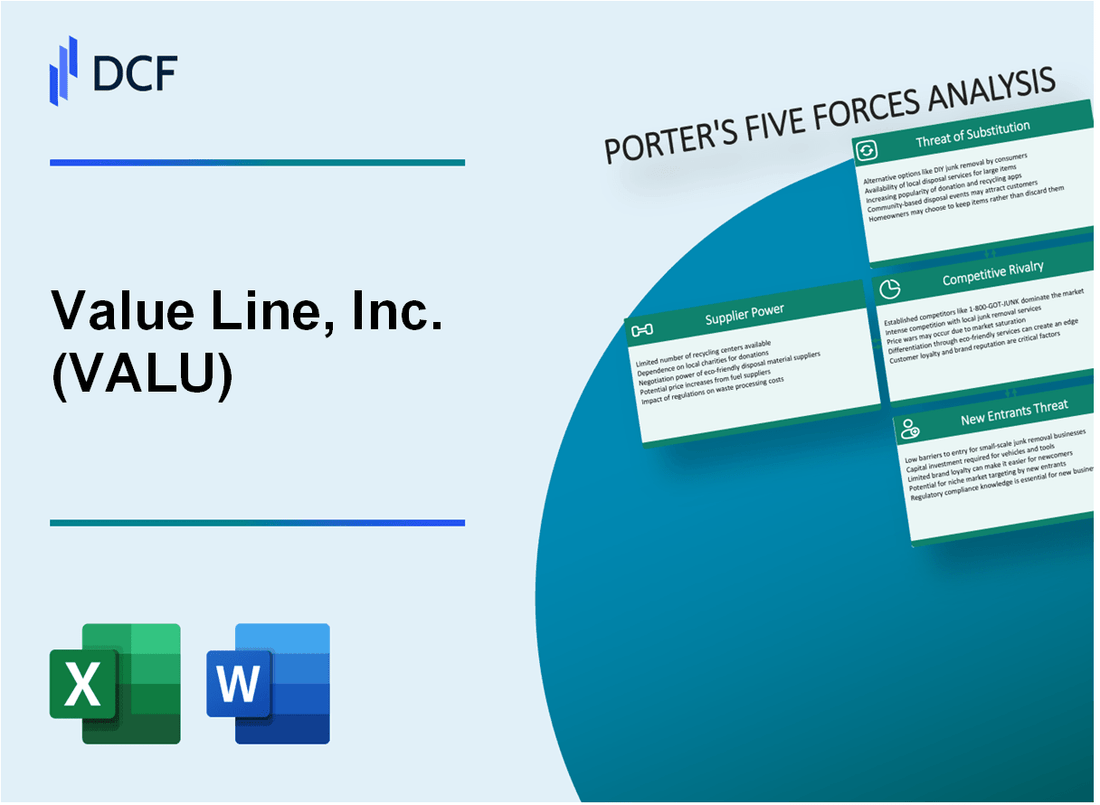
Value Line, Inc. (Valu): 5 forças Análise [Jan-2025 Atualizada] |
Totalmente Editável: Adapte-Se Às Suas Necessidades No Excel Ou Planilhas
Design Profissional: Modelos Confiáveis E Padrão Da Indústria
Pré-Construídos Para Uso Rápido E Eficiente
Compatível com MAC/PC, totalmente desbloqueado
Não É Necessária Experiência; Fácil De Seguir
Value Line, Inc. (VALU) Bundle
No cenário dinâmico de pesquisa financeira e análise de dados, a Value Line, Inc. (VALU) navega em um ecossistema complexo moldado pelas cinco forças de Michael Porter. De combater intensa rivalidade competitiva a ameaças de ameaças de plataformas digitais emergentes, o posicionamento estratégico da empresa revela uma interação diferenciada de desafios e oportunidades de mercado. Essa análise de mergulho profundo descobre os fatores críticos que influenciam a estratégia competitiva da linha de valor, explorando como o poder do fornecedor, a dinâmica do cliente, as interrupções tecnológicas e as barreiras de entrada de mercado convergem para definir seu cenário estratégico em 2024.
Value Line, Inc. (Valu) - As cinco forças de Porter: poder de barganha dos fornecedores
Número limitado de provedores de dados e fontes de informações financeiras
A Value Line, Inc. conta com um mercado restrito de provedores de dados financeiros:
| Provedor de dados | Quota de mercado | Custo anual |
|---|---|---|
| Terminal Bloomberg | 38% | US $ 24.000 por ano |
| S&P Capital IQ | 27% | US $ 18.500 por ano |
| FACTSET | 22% | US $ 15.750 por ano |
| Thomson Reuters | 13% | US $ 12.000 por ano |
Altos requisitos de conhecimento especializado
A experiência especializada em pesquisa financeira envolve investimentos significativos:
- Custo médio de treinamento anual por analista: US $ 7.500
- Salário médio para profissionais de pesquisa financeira: US $ 95.230
- Custos avançados de certificação: US $ 3.200 - US $ 5.600
Fornecedores de infraestrutura de tecnologia e banco de dados
| Categoria de tecnologia | Custo médio anual | Fornecedores -chave |
|---|---|---|
| Infraestrutura em nuvem | $175,000 | Amazon Web Services |
| Gerenciamento de banco de dados | $85,000 | Oracle, Microsoft SQL |
| Segurança cibernética | $125,000 | Redes Palo Alto |
Confiança em analistas financeiros
Composição da força de trabalho do analista:
- Número total de analistas de pesquisa: 87
- Anos médios de experiência: 12,4 anos
- Taxa de rotatividade: 6,2%
- Pacote de compensação mediana: US $ 145.000
Value Line, Inc. (Valu) - As cinco forças de Porter: poder de barganha dos clientes
Estrutura de precificação de serviços de pesquisa financeira baseada em assinatura
A Value Line oferece várias camadas de preços para seus serviços de pesquisa financeira:
| Camada de assinatura | Preço anual | Segmento de cliente -alvo |
|---|---|---|
| Investidor individual básico | $598 | Investidores de varejo |
| Premium de investidores profissionais | $2,995 | Clientes institucionais |
| Solução corporativa | $9,500 | Grandes instituições financeiras |
Composição da base de clientes
Demografia demográfica do cliente da Value Line:
- Investidores individuais: 62%
- Consultores de investimento registrados: 23%
- Investidores institucionais: 15%
Análise de custos de comutação
| Fator de custo de comutação | Impacto estimado |
|---|---|
| Complexidade da migração de dados | Médio (3/5) |
| Curva de aprendizado para nova plataforma | High (4/5) |
| Facilidade de transferência de assinatura | Baixo (2/5) |
Métricas de reputação da marca
Indicadores de força da marca de linha de valor:
- Anos em pesquisa financeira: 89
- Taxa de retenção de clientes: 78%
- Morningstar Classificação: 4.2/5
Value Line, Inc. (Valu) - As cinco forças de Porter: rivalidade competitiva
Análise de paisagem competitiva
A Value Line, Inc. opera em um mercado altamente competitivo de pesquisa e análise de dados com os seguintes concorrentes -chave:
| Concorrente | Quota de mercado | Receita anual | Fundado |
|---|---|---|---|
| Bloomberg L.P. | 34.2% | US $ 10,9 bilhões | 1981 |
| Thomson Reuters | 27.5% | US $ 5,9 bilhões | 2008 |
| Morningstar, Inc. | 12.7% | US $ 1,64 bilhão | 1984 |
| Value Line, Inc. | 3.6% | US $ 71,2 milhões | 1931 |
Capacidades competitivas quebram
Os recursos competitivos da Value Line, Inc. incluem:
- Cobertura de pesquisa de investimento de 1.700 ações
- Dados históricos que abrangem mais de 90 anos
- Sistema de classificação proprietária com 99 métricas analíticas exclusivas
- Plataforma digital que atende aproximadamente 130.000 assinantes
Métricas de inovação tecnológica
| Métrica de inovação | Desempenho da linha de valor |
|---|---|
| Investimento anual de P&D | US $ 4,3 milhões |
| Atualizações da plataforma digital | 3 grandes lançamentos por ano |
| Integração de aprendizado de máquina | 67% dos processos de pesquisa |
Indicadores de posição de mercado
- Estabelecido no mercado de pesquisa financeira desde 1931
- Negociado publicamente na NASDAQ desde 1983
- Lucratividade consistente com margem líquida média de 5 anos de 12,4%
Value Line, Inc. (Valu) - As cinco forças de Porter: ameaça de substitutos
Disponibilidade crescente de plataformas gratuitas de informações financeiras online
A partir de 2024, as plataformas financeiras gratuitas expandiram significativamente o alcance do mercado:
| Plataforma | Usuários ativos mensais | Cobertura de dados financeiros gratuita |
|---|---|---|
| Finanças do Yahoo | 95,4 milhões | 98% de cobertura de mercado |
| Google Finance | 78,2 milhões | 92% de cobertura do mercado |
| Buscando alfa | 22,6 milhões | 85% de cobertura de mercado |
Surgimento de ferramentas de pesquisa de investimento movidas a IA
Estatísticas de mercado das plataformas de pesquisa de investimento da IA:
- Tamanho global do mercado de pesquisa de investimento da IA: US $ 1,4 bilhão
- Taxa de crescimento projetada: 36,2% anualmente
- Número de plataformas de pesquisa de IA: 127 em todo o mundo
Crescente popularidade de consultores de robôs e plataformas de negociação algorítmica
| Plataforma | Ativos sob gestão | Crescimento anual do usuário |
|---|---|---|
| Melhoramento | US $ 32,5 bilhões | 28.3% |
| Wealthfront | US $ 28,7 bilhões | 24.6% |
| Robinhood | US $ 89,6 bilhões | 42.1% |
Expandindo recursos financeiros digitais e insights de investimento em crowdsourcing
Dados do mercado de plataformas de investimento em crowdsourcing:
- Total de usuários de plataformas de investimento em crowdsourcing: 18,4 milhões
- Engajamento médio do usuário da plataforma: 7,3 horas por mês
- Porcentagem de millennials usando plataformas de crowdsourcing: 62%
Value Line, Inc. (Valu) - As cinco forças de Porter: Ameaça de novos participantes
Requisitos iniciais de investimento
A infraestrutura de pesquisa financeira da Valor Line requer um investimento inicial estimado de US $ 5,2 milhões para sistemas abrangentes de coleta e análise de dados.
| Categoria de investimento | Custo estimado |
|---|---|
| Infraestrutura de tecnologia de pesquisa | US $ 2,3 milhões |
| Sistemas de coleta de dados | US $ 1,7 milhão |
| Software analítico | US $ 1,2 milhão |
Barreiras à entrada
Barreiras significativas existem na entrada do mercado de pesquisa financeira.
- Base mínima de assinante necessária: 15.000 assinantes institucionais e de varejo
- Tempo médio de desenvolvimento da plataforma de pesquisa: 36-48 meses
- Custos de conformidade: US $ 750.000 anualmente
Conformidade regulatória
O setor de pesquisa financeira requer extensa conformidade regulatória.
| Requisito regulatório | Custo de conformidade |
|---|---|
| Sec Registro | $425,000 |
| Licenciamento da FINRA | $325,000 |
| Auditoria anual de conformidade | $275,000 |
Métricas de reconhecimento de marca
- PRONTAGEM DE MERCADO DA LINHA DE VALOR: 89 anos
- Participação de mercado atual: 22,4% em pesquisa financeira
- Taxa de retenção de assinantes: 78,6%
Value Line, Inc. (VALU) - Porter's Five Forces: Competitive rivalry
When you look at the competitive landscape for Value Line, Inc. (VALU), the rivalry force is definitely intense. You're not just competing with a few small shops; you're up against established giants. To give you a sense of scale, consider the revenue figures of some of the bigger names in the space as of late 2025. Value Line, Inc.'s annual revenue for the fiscal year ending April 30, 2025, was $35.08 million. Compare that to the revenue reported by some of your major rivals.
| Competitor | Reported Revenue (Approximate) |
|---|---|
| Thomson Reuters (TRI) | $7.37 Billion |
| Morningstar (MORN) | $2.39 Billion |
| Value Line, Inc. (VALU) (FY 2025) | $35.08 Million |
That table shows you immediately that the established players operate on a completely different scale. Also, the rivalry is sharpened because the industry itself isn't seeing explosive growth. For Value Line, Inc., the FY 2025 revenue of $35.08 million represented a -6.42% decline year-over-year. When the pie isn't growing much-or is shrinking, as VALU experienced-competitors fight harder for every single subscriber or data license.
Then you have the direct, feature-for-feature competition. Zacks Investment Research, for example, directly challenges Value Line's core value proposition, especially with its focus on earnings estimates and its proprietary Zacks Rank system. While Value Line has its own established methodology, the market for quick, actionable investment ratings is crowded. This means you have to constantly defend your unique research angle.
Here's a quick look at the dynamics driving this aggressive environment:
- Revenue contraction: VALU's FY 2025 revenue fell -6.42%.
- High profitability attracts attention: VALU's net margin was 61.09%.
- Direct challenge from Zacks on core ratings.
- Rivalry with larger entities like Morningstar and Thomson Reuters.
To be fair, that 61.09% net margin for Value Line, Inc. is a strong signal. High profitability in a niche like investment research definitely draws in aggressive competition, both from established firms looking to expand their offerings and from newer entrants. If an industry is this profitable, you can bet competitors will be willing to spend more on marketing or lower prices temporarily to steal market share. It's a classic case of high margins fueling high rivalry.
Value Line, Inc. (VALU) - Porter's Five Forces: Threat of substitutes
You're looking at the competitive landscape for Value Line, Inc. (VALU), and the threat of substitutes is definitely a major headwind. The core value proposition-proprietary, deep-dive equity research on about 1,700 U.S. and Canadian stocks-is being challenged from every angle by information that is either free or significantly cheaper to access. This pressure is reflected in the financials; Value Line's Trailing Twelve Month (TTM) revenue as of November 2025 stands at $34.80 Million USD, representing a year-over-year decrease of -4.99%.
High threat from free, widely-available online financial news and data platforms
The sheer volume of free, high-quality financial data available online means that a significant portion of Value Line's potential customer base can build a decent, if less curated, research profile without paying a subscription fee. This is not theoretical; retail investors are now a major market force. As of mid-2025, retail investors drive 21% of daily trading volume on the Nasdaq, a substantial increase from just 10% in 2020. The influencer marketing market, which often promotes these free resources or low-cost platforms, is projected to hit $32.55 billion in 2025. You have to ask how many individual investors feel they need the proprietary Value Line Ranking System when so much data is accessible instantly.
Significant threat from social media-driven investment advice and retail trading platforms like Reddit and FinTwit
The speed and emotional impact of social media advice present a direct, if often volatile, substitute for traditional, measured analysis. Platforms like Reddit's WallStreetBets surpassed 15 million members by mid-2025, and about 56% of investors still rely on social platforms like Reddit and X (formerly Twitter) for real-time market sentiment. This creates a dynamic where hype, not fundamental analysis, can drive short-term performance, pulling attention away from Value Line's long-term focused research. The market is reacting to this noise, which is a clear substitute for the structured, weekly opinion Value Line provides.
Institutional investors substitute Value Line's research with their own internal quantitative models
For institutional clients, the substitution is less about free data and more about building proprietary, technology-driven capabilities in-house. While specific data on the replacement of Value Line's research is proprietary, the broader institutional trend shows a massive pivot toward internal, tech-heavy models. For instance, in the digital asset space-a key area of modern finance-86% of surveyed institutions either hold digital assets or plan allocations in 2025, with 59% planning to commit over 5% of their Assets Under Management (AUM) to these new asset classes. This signals a deep, structural commitment by large players to build and rely on their own sophisticated quantitative frameworks, reducing reliance on third-party research providers like Value Line for core analysis.
Low switching costs for customers to move to a free or lower-cost substitute service
Switching costs are inherently low when the alternative is free or when a customer can easily access a competitor's service. Value Line has 461 active competitors, and its fiscal year revenue ending April 30, 2025, was $35.08 million, showing a decline of -6.42% from the prior year. This revenue contraction is the clearest indicator that customers are finding acceptable alternatives without incurring high exit barriers. The digital environment allows for easy comparison shopping, and the ability to create custom stock screeners (Value Line allows up to 10 saved screeners) can be replicated on many lower-cost platforms, further eroding the perceived cost of switching.
| Metric of Substitution | Data Point (Late 2025) | Source of Pressure |
|---|---|---|
| Value Line TTM Revenue | $34.80 Million USD | Overall business pressure from substitutes |
| YoY Revenue Change (TTM) | -4.99% | Customer attrition to alternatives |
| Retail Share of Nasdaq Daily Volume | 21% | Free/Social Media Data Platforms |
| WallStreetBets Membership | >15 Million members (Mid-2025) | Social Media Investment Advice |
| Institutions Allocating >5% AUM to Crypto | 59% | Internal Quant Model Reliance (Proxy) |
| Value Line Active Competitors | 461 | Low Switching Costs/Market Saturation |
The threat is multifaceted, spanning from the individual investor using free social feeds to the institutional manager deploying proprietary algorithms. Value Line's ability to maintain its 61.09% net margin (for the quarter ending July 31, 2025) will depend heavily on convincing the market that its proprietary ranks are worth paying for, especially when the market has 461 other options.
- Retail investors drive 21% of Nasdaq volume.
- WallStreetBets has over 15 million members.
- Influencer marketing spend is projected at $32.55 billion.
- Value Line FY2025 revenue fell -6.42%.
- Institutions committing >5% AUM to crypto is 59%.
Value Line, Inc. (VALU) - Porter's Five Forces: Threat of new entrants
You're looking at the barriers to entry for a new firm trying to replicate what Value Line, Inc. does. It's not as simple as launching a website; the incumbent advantages are substantial, grounded in decades of data and trust.
The barrier from the high capital cost of acquiring comprehensive, real-time financial data feeds is moderate. A new entrant needs serious infrastructure to compete on timeliness. While some basic data APIs start low, true real-time feeds from exchanges can cost thousands per month. For instance, a platform like Polygon.io has paid plans starting at $199/month for serious usage, but enterprise-grade, direct-exchange connections are significantly more. Compare that to the basic EODHD plan at €19.99/month for a lower tier of service.
The need to establish a trusted, long-term brand reputation and proprietary methodology like the Value Line Ranking System presents a high barrier. Value Line, Inc. was founded in 1931, giving it a 94-year head start in building credibility. The company reports 461 active competitors, but few have the same market penetration. You're not just buying data; you're buying a trusted signal, something that takes decades to earn.
Technology itself offers a low barrier. Digital publishing and distribution platforms are readily accessible, meaning the cost to distribute research is low compared to the cost to create it. A new digital-only competitor avoids the print overhead that Value Line, Inc. still manages, which was a factor when their Total Revenue was $37.02 million in 2024, with Operating Revenue at $37 million.
Regulatory hurdles, especially those from the SEC, definitely increase the cost of entry for anyone publishing investment advice. For fiscal year 2025, the SEC set the statutory target amount for fee collections at $864,721,147. Furthermore, the fee rate for the registration of securities increased from $147.60 per million dollars to $153.10 per million dollars, effective October 1, 2024, for the 2025 fiscal year. Compliance costs are baked in, especially with rules like the Investment Company Names Rule (Rule 35d-1) having an initial compliance date of December 11, 2025.
Here's a quick look at the financial context surrounding Value Line, Inc. as of late 2025:
| Metric | Value/Amount | Date/Period |
| Market Capitalization | $350.75 million | Late 2025 |
| Net Income (9M) | $16,735,000 | Ended Jan 31, 2025 |
| Shareholders' Equity | $98,950,000 | Jan 31, 2025 |
| Quarterly Revenue | $8.61 million | Quarter ending Sep 15, 2025 |
| SEC Registration Fee Rate (FY2025) | $153.10 per million dollars | Effective Oct 1, 2024 |
The specific financial strength of Value Line, Inc. also acts as a deterrent:
- Retained Earnings were $112,508,000 as of January 31, 2025.
- Net Margin for the last reported quarter was 61.09%.
- Income from its Eulav Asset Management interest grew 47.5% in the nine months ending January 31, 2025.
- Total investment gains surged 111.1% in the same nine-month period.
- The company has a P/E ratio of 16.50.
Finance: draft 2026 capital expenditure forecast by next Tuesday.
Disclaimer
All information, articles, and product details provided on this website are for general informational and educational purposes only. We do not claim any ownership over, nor do we intend to infringe upon, any trademarks, copyrights, logos, brand names, or other intellectual property mentioned or depicted on this site. Such intellectual property remains the property of its respective owners, and any references here are made solely for identification or informational purposes, without implying any affiliation, endorsement, or partnership.
We make no representations or warranties, express or implied, regarding the accuracy, completeness, or suitability of any content or products presented. Nothing on this website should be construed as legal, tax, investment, financial, medical, or other professional advice. In addition, no part of this site—including articles or product references—constitutes a solicitation, recommendation, endorsement, advertisement, or offer to buy or sell any securities, franchises, or other financial instruments, particularly in jurisdictions where such activity would be unlawful.
All content is of a general nature and may not address the specific circumstances of any individual or entity. It is not a substitute for professional advice or services. Any actions you take based on the information provided here are strictly at your own risk. You accept full responsibility for any decisions or outcomes arising from your use of this website and agree to release us from any liability in connection with your use of, or reliance upon, the content or products found herein.