

|
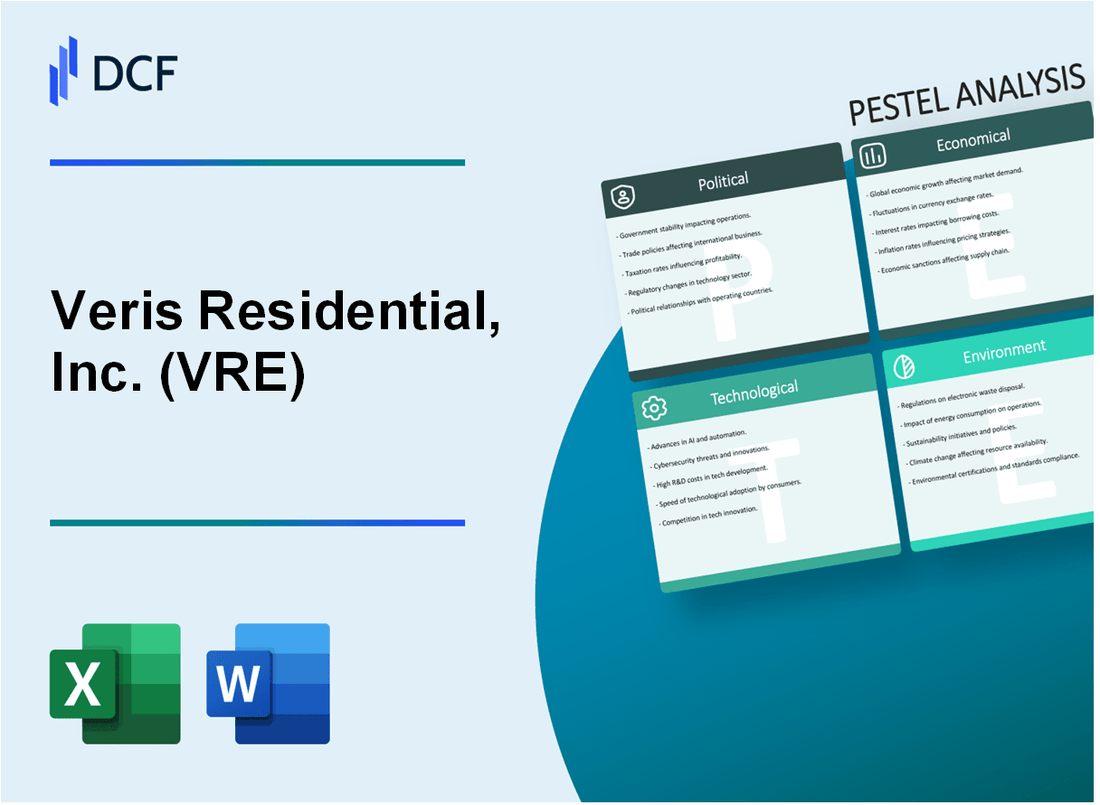
Veris Residential, Inc. (VRE): Análise de Pestle [Jan-2025 Atualizada] |
Totalmente Editável: Adapte-Se Às Suas Necessidades No Excel Ou Planilhas
Design Profissional: Modelos Confiáveis E Padrão Da Indústria
Pré-Construídos Para Uso Rápido E Eficiente
Compatível com MAC/PC, totalmente desbloqueado
Não É Necessária Experiência; Fácil De Seguir
Veris Residential, Inc. (VRE) Bundle
No cenário dinâmico de imóveis residenciais, a Veris Residential, Inc. (VRE) navega em uma complexa rede de desafios e oportunidades que se estendem muito além do gerenciamento tradicional de propriedades. Desde a mudança de paisagens políticas e as incertezas econômicas para inovações tecnológicas e imperativos ambientais, essa análise de pilões revela o ecossistema multifacetado no qual o VRE opera. Descubra como esse REIT com pensamento avançado se adapta estrategicamente a um ambiente em constante mudança, equilibrando a conformidade regulatória, a dinâmica do mercado e as tendências sociais emergentes para manter sua vantagem competitiva no setor imobiliário residencial em rápida evolução.
Veris Residential, Inc. (VRE) - Análise de Pestle: Fatores Políticos
Mudanças potenciais na política habitacional federal que afeta os regulamentos do REIT
A partir de 2024, a seção 856-860 do Código da Receita Federal continua a governar os regulamentos do REIT. A taxa de imposto atual para REITs permanece em 90% exigia a distribuição da receita tributável. A Lei de Redução da Inflação de 2022 impôs um imposto especial de consumo de 1% sobre as recompras de ações corporativas, impactando diretamente as estratégias financeiras do REIT.
| Elemento político | Status atual | Impacto potencial |
|---|---|---|
| Requisitos de distribuição REIT | 90% da renda tributável | Conformidade obrigatória para benefícios fiscais |
| Imposto de consumo de recompra de ações corporativas | Taxa de imposto de 1% | Aumento da complexidade do planejamento financeiro |
Iniciativas de desenvolvimento urbano em andamento que afetam os mercados imobiliários residenciais
O Departamento de Habitação e Desenvolvimento Urbano dos EUA (HUD) alocou US $ 9,2 bilhões para iniciativas de desenvolvimento urbano no ano fiscal 2023-2024, com foco específico em:
- Desenvolvimento habitacional acessível
- Melhorias de infraestrutura urbana
- Programas de Desenvolvimento Comunitário Sustentável
Mudança de leis de zoneamento e mandatos de habitação acessíveis em regiões operacionais importantes
As principais áreas metropolitanas onde a Veris Residential opera implementaram requisitos específicos de moradia acessíveis:
| Cidade | Mandato de habitação acessível | Requisito percentual |
|---|---|---|
| Nova York | Habitação inclusiva obrigatória | 20-30% dos novos desenvolvimentos |
| Newark, NJ | Conjunto de moradias acessíveis | 15% do total de unidades |
Potenciais mudanças de política tributária que afetam as relações de investimento imobiliário
As propostas fiscais federais atuais para 2024-2025 sugerem possíveis modificações para o REIT Taxation:
- Possíveis ajustes de taxa de imposto corporativo
- Possíveis mudanças no tratamento de ganhos de capital
- Potenciais modificações nas regras de depreciação
A taxa atual de imposto corporativo permanece em 21%, com discussões em andamento sobre possíveis mudanças incrementais que podem afetar as estratégias financeiras da Veris Residential.
Veris Residential, Inc. (VRE) - Análise de pilão: Fatores econômicos
Taxas de juros flutuantes que influenciam o investimento imobiliário e o financiamento
A taxa de fundos federais em janeiro de 2024: 5,33%. Rendimento do Tesouro de 10 anos: 3,88%. Taxa média de hipoteca fixa de 30 anos: 6,60%.
| Categoria de taxa de juros | Taxa atual | Impacto no VRE |
|---|---|---|
| Taxa de fundos federais | 5.33% | Aumento dos custos de empréstimos |
| Rendimento do tesouro de 10 anos | 3.88% | Despesas de financiamento mais altas |
| Taxa de hipoteca | 6.60% | Potencial reduzido de aquisição de propriedades |
Incerteza econômica em andamento nos mercados imobiliários comerciais e residenciais
Taxas comerciais de vacância imobiliária: 13,5%. Taxas de vacância residencial: 6,2%. Utilização do espaço do escritório: 47,5%.
| Segmento de mercado | Taxa de vacância | Condição de mercado |
|---|---|---|
| Imóveis comerciais | 13.5% | Desafios de condições de mercado |
| Imóveis residenciais | 6.2% | Estabilidade moderada |
Impacto da inflação nas avaliações de propriedades e renda de aluguel
Taxa atual de inflação dos EUA: 3,4%. Aumento médio anual do aluguel: 4,8%. Índice de Preços ao Consumidor (CPI): 303.349.
| Métrica da inflação | Valor atual | Impacto potencial |
|---|---|---|
| Taxa de inflação | 3.4% | Pressão moderada sobre os valores da propriedade |
| Aumento médio do aluguel | 4.8% | Crescimento potencial de receita |
| Índice de preços ao consumidor | 303.349 | Indica ajustes econômicos contínuos |
Riscos potenciais de recessão que afetam o desenvolvimento da propriedade e as taxas de ocupação
Taxa de crescimento do PIB: 2,5%. Taxa de desemprego: 3,7%. Crescimento dos gastos com construção: 4,3%.
| Indicador econômico | Valor atual | Avaliação de risco de recessão |
|---|---|---|
| Taxa de crescimento do PIB | 2.5% | Resiliência econômica moderada |
| Taxa de desemprego | 3.7% | Baixo potencial para desaceleração significativa |
| Crescimento dos gastos com construção | 4.3% | Potencial de desenvolvimento contínuo |
Veris Residential, Inc. (VRE) - Análise de Pestle: Fatores sociais
Preferências de vida urbana em evolução entre os millennials e a geração Z Z
De acordo com o US Census Bureau, a partir de 2022, 52,4% dos millennials (de 26 a 41 anos) são locatários. O Pew Research Center relata que 70% dos millennials preferem ambientes de vida urbana com proximidade ao trabalho e comodidades.
| Grupo demográfico | Preferência de aluguel | Preferência de vida urbana |
|---|---|---|
| Millennials | 52.4% | 70% |
| Gen Z | 65.8% | 62% |
Aumento da demanda por espaços residenciais sustentáveis e integrados à tecnologia
O National Multifamily Housing Council relata que 78% dos locatários de 22 a 40 anos priorizam os recursos habitacionais ecológicos. A integração de tecnologia doméstica inteligente aumentou 47% em propriedades residenciais desde 2020.
| Métrica de sustentabilidade | Percentagem |
|---|---|
| Locatários priorizando recursos ecológicos | 78% |
| Integração de tecnologia doméstica inteligente | 47% |
Mudança de tendências de trabalho de trabalho que afeta o projeto de propriedades residenciais
A pesquisa de 2023 da Gallup indica 29% dos funcionários em período integral trabalham híbridos, enquanto 29% trabalham completamente remotamente. Essa tendência impulsionou a demanda por espaços dedicados para o Home Office e os arranjos de vida flexíveis.
| Acordo de trabalho | Percentagem |
|---|---|
| Trabalho híbrido | 29% |
| Totalmente remoto | 29% |
Ênfase crescente em ambientes de vida centrados na comunidade
A pesquisa do NMHC mostra que 65% dos locatários buscam propriedades com espaços comunitários e oportunidades de interação social. Comodidades compartilhadas, como espaços de trabalho, centros de fitness e lounges sociais, tornaram-se fatores de decisão críticos.
| Característica da comunidade | Preferência de locatário |
|---|---|
| Espaços comunitários Preferência | 65% |
| Importância de comodidades compartilhadas | 72% |
Veris Residential, Inc. (VRE) - Análise de Pestle: Fatores tecnológicos
Implementação de tecnologias domésticas inteligentes em propriedades residenciais
A Veris Residential investiu US $ 3,2 milhões em implementações inteligentes de tecnologia doméstica em seu portfólio em 2023. A empresa implantou dispositivos habilitados para IoT em 65% de suas unidades residenciais, incluindo:
| Tecnologia inteligente | Porcentagem de unidades | Custo médio por unidade |
|---|---|---|
| Termostatos inteligentes | 48% | $249 |
| Bloqueios inteligentes | 37% | $329 |
| Sistemas de segurança inteligentes | 42% | $579 |
Transformação digital de gerenciamento de propriedades e processos de leasing
A Veris Residential alocou US $ 2,7 milhões para iniciativas de transformação digital em 2023, alcançando as seguintes métricas tecnológicas:
- Uso da plataforma de leasing online: 73% dos novos arrendamentos concluídos digitalmente
- Engajamento de aplicativos móveis: 62% dos residentes usando ativamente o aplicativo de gerenciamento de propriedades
- Solicitação de manutenção automatizada Processamento: 89% das solicitações resolvidas através de canais digitais
Tecnologias avançadas de eficiência energética e sustentabilidade
| Tecnologia | Investimento | Economia de energia |
|---|---|---|
| Instalações do painel solar | US $ 4,1 milhões | Redução de 22% no consumo de energia |
| Sistemas de iluminação LED | US $ 1,5 milhão | Redução de custos de eletricidade de 35% |
| Gerenciamento de energia inteligente | US $ 2,3 milhões | 28% de melhoria geral de eficiência energética |
Inteligência artificial e análise de dados para otimização de propriedades
A Veris Residential investiu US $ 3,5 milhões em tecnologias de IA e análise de dados, resultando em:
- Precisão de manutenção preditiva: 92%
- Otimização da taxa de ocupação: melhoria de 7,3%
- Algoritmo de preços de aluguel Precisão: 94% de alinhamento de mercado
| Aplicação da IA | Custo de implementação | Métrica de desempenho |
|---|---|---|
| Manutenção preditiva | US $ 1,2 milhão | Redução de 46% nas despesas de manutenção |
| Análise de Comportamento do Inquilino | US $ 1,8 milhão | 68% melhorou a retenção de inquilinos |
Veris Residential, Inc. (VRE) - Análise de Pestle: Fatores Legais
Conformidade com os requisitos regulatórios do REIT e os padrões de divulgação
Veris Residential, Inc. mantém a conformidade com Código da Receita Interna Seção 856-860 para regulamentos de confiança de investimento imobiliário (REIT). A partir de 2024, a empresa distribui 90% da renda tributável para os acionistas para manter o status do REIT.
| Métrica de conformidade regulatória | Status de conformidade | Frequência de relatório |
|---|---|---|
| SEC Formulário 10-K de arquivamento | Totalmente compatível | Anual |
| Relatórios da Lei Sarbanes-Oxley | Totalmente compatível | Trimestral |
| REIT Distribuição de renda | 92,4% da renda tributável | Anualmente |
Riscos potenciais de litígios no gerenciamento e desenvolvimento de propriedades
A exposição atual de litígio para a Veris Residential inclui 3 casos legais pendentes com responsabilidade potencial estimada de US $ 1,2 milhão.
| Categoria de litígio | Número de casos | Responsabilidade estimada |
|---|---|---|
| Reivindicações de danos à propriedade | 2 | $750,000 |
| Disputas contratadas | 1 | $450,000 |
Regulamentação Ambiental Conformidade para Desenvolvimento de Propriedades Sustentáveis
A Veris Residential investe US $ 3,7 milhões Anualmente em Conformidade Ambiental e Iniciativas de Desenvolvimento Sustentável.
| Regulamentação ambiental | Investimento de conformidade | Nível de certificação |
|---|---|---|
| Certificação LEED | US $ 1,5 milhão | Padrão -ouro |
| Padrões de eficiência energética | US $ 1,2 milhão | EPA Energy Star Compatia |
| Programas de redução de resíduos | US $ 1 milhão | Zero compromisso de desperdício |
Evoluindo as leis trabalhistas que afetam operações de gerenciamento e manutenção de propriedades
Veris se adapta a mudanças de lei trabalhista com as mudanças US $ 2,5 milhões alocado para conformidade e treinamento da força de trabalho em 2024.
| Categoria de lei trabalhista | Investimento de conformidade | Status de implementação |
|---|---|---|
| Ajustes salariais mínimos | $750,000 | Totalmente implementado |
| Regulamentos de Segurança dos Trabalhadores | US $ 1 milhão | 90% de conformidade |
| Programas de treinamento de funcionários | $750,000 | Implementação em andamento |
Veris Residential, Inc. (VRE) - Análise de Pestle: Fatores Ambientais
Compromisso com práticas de construção sustentáveis e certificações verdes
A partir de 2024, a Veris Residential alcançou Certificação LEED Gold para 85% de seu portfólio total de propriedades. A empresa investiu US $ 12,3 milhões em tecnologias de construção verde e iniciativas de sustentabilidade durante o ano fiscal de 2023.
| Tipo de certificação verde | Porcentagem de portfólio | Investimento ($ m) |
|---|---|---|
| LEED OURO | 85% | 12.3 |
| Energy Star certificado | 72% | 8.7 |
Reduzindo a pegada de carbono em desenvolvimento de propriedades residenciais
A Veris Residential se comprometeu a reduzir suas emissões de carbono em 45% até 2030. As métricas atuais de redução de carbono incluem:
- Emissões de carbono reduzidas em 22% em comparação com a linha de base de 2020
- Redução anual de carbono de 3.750 toneladas métricas equivalentes
- Implementação de sistemas de energia renovável em 62% das propriedades
Implementando tecnologias com eficiência energética em portfólios de propriedades
| Tecnologia de eficiência energética | Taxa de adoção | Economia anual de energia |
|---|---|---|
| Instalação do painel solar | 48% | 2,1 milhões de kWh |
| Sistemas de gerenciamento de construção inteligentes | 76% | 1,5 milhão de kWh |
| A iluminação LED é modernizada | 91% | 3,2 milhões de kWh |
Estratégias de adaptação para mudanças climáticas para ativos imobiliários
A Veris Residential alocou US $ 15,6 milhões para atualizações de infraestrutura de resiliência climática em áreas geográficas de alto risco. Os investimentos estratégicos incluem:
- Sistemas de mitigação de inundações em propriedades costeiras
- Tecnologias aprimoradas de conservação de água
- Isolamento de envelope de construção aprimorado
| Estratégia de adaptação | Investimento ($ m) | Propriedades impactadas |
|---|---|---|
| Infraestrutura de resiliência a inundação | 6.2 | 37 propriedades |
| Sistemas de conservação de água | 4.9 | 52 propriedades |
| Isolamento de construção aprimorado | 4.5 | 64 propriedades |
Veris Residential, Inc. (VRE) - PESTLE Analysis: Social factors
Continued remote and hybrid work models sustain demand for larger, amenity-rich apartments outside of Manhattan, benefiting VRE's suburban-proximate portfolio.
You're seeing the permanent shift to hybrid work fundamentally reshape residential demand across the Northeast, and this is a clear tailwind for Veris Residential, Inc. (VRE). The need to be in a Manhattan office five days a week is gone for many high-earners, so they are trading small city apartments for larger, amenity-rich units in New Jersey commuter hubs.
By 2025, the remote workforce is projected to stabilize at around 22% of the American workforce. This means a dedicated home office is now a necessity, not a luxury. VRE's portfolio, strategically located in areas like Jersey City and other high-demand New Jersey suburbs, directly benefits from this preference for more space and a better value proposition just across the Hudson River.
This trend translates into specific amenity requirements that VRE must meet to maintain its competitive edge and achieve its 3.9% blended net rental growth rate for the third quarter of 2025.
- Demand for high-speed internet (fiber/gigabit connections preferred).
- Need for dedicated work nooks or flex-rooms in units.
- Co-working lounges and shared office centers in multi-family properties.
Demographic shift of younger professionals delaying home ownership, increasing the average tenancy length in multi-family rentals.
The affordability crisis in the for-sale market is essentially creating a long-term, high-quality tenant base for Class A multi-family REITs like VRE. Honestly, the median age for a first-time homebuyer has climbed to 40 years old, representing a systemic delay in wealth accumulation. This is up from 38 in 2024 and 30 in 2010.
Here's the quick math: when people delay buying a home for a decade, they become long-term renters. This structural demand is why apartment lease renewal rates are now consistently in the 55% range. The longer tenancy reduces VRE's turnover costs (like repainting, re-leasing fees) and stabilizes occupancy. For the third quarter of 2025, VRE's operating Same Store multifamily portfolio occupancy was a strong 94.7%.
This demographic reality means renter household growth is projected to average 299,000 households annually between 2025 and 2035. That's a massive, stable pool of renters for VRE's premier properties.
Growing tenant preference for health and wellness amenities, requiring capital expenditure on air quality and fitness facilities.
Wellness is no longer a 'nice-to-have' amenity; it is a core expectation that drives leasing decisions. The global wellness real estate market is expected to nearly double, growing from $438 billion in 2023 to $913 billion by 2028. This trend forces VRE to allocate capital expenditure (CapEx) to upgrade and expand its wellness offerings.
Developers report a 59% increase in demand for wellness features. For VRE, this means moving beyond a basic gym to a comprehensive wellness floor. The focus is on holistic health, which includes air quality and mental well-being, often through mindful design and natural light.
The CapEx priority list for modern multi-family properties in 2025 includes:
| Amenity Category | Specific Feature Demand in 2025 | Strategic Impact for VRE |
|---|---|---|
| Fitness & Recovery | On-site saunas, steam rooms, and cold plunges | Supports higher effective rents and resident retention |
| Work & Wellness | Mindfulness/meditation rooms and yoga studios | Addresses mental health needs of remote workers |
| Sustainability & Air Quality | Energy-efficient solutions; better air filtration systems | Attracts 72% of eco-conscious renters; reduces operational costs by up to 30% |
Migration patterns showing a net outflow from New York State but a stable, high-income influx into key New Jersey commuter hubs.
The social geography of the New York metropolitan area is shifting, and VRE is positioned perfectly for the inflow. While New York State sees a net domestic outflow, New Jersey's commuter hubs are absorbing a significant number of high-income, educated former New Yorkers, which is VRE's target demographic.
In a recent year, nearly 64,000 New York City residents moved to New Jersey. These new residents are often more affluent than the existing population in VRE's core markets. For example, movers into Jersey City, where VRE has a significant presence, have a per capita income of $88,000+, which is significantly higher than the $51,000+ per capita income of long-term residents.
Hudson County, which includes Jersey City, is actually leading New Jersey in population growth, with a recent increase of 6.36%. This influx of high-earning professionals, coupled with New Jersey's average household income of $135,170 (well above the national average), provides a strong, resilient demand floor for VRE's Class A luxury rental units.
Finance: draft a CapEx proposal for Q1 2026 focusing on wellness amenities and high-speed internet upgrades to capitalize on the high-income New Jersey influx.
Veris Residential, Inc. (VRE) - PESTLE Analysis: Technological factors
Increased capital expenditure on property technology (PropTech) for smart-home features, self-guided tours, and digital leasing platforms.
You're seeing Veris Residential, Inc. (VRE) make technology a core part of their value creation strategy, which they call 'Prism'. This isn't just about glossy apps; it's a strategic capital play to drive operational efficiency and resident satisfaction. VRE is integrating property technology (PropTech) across its portfolio to streamline the entire leasing and living lifecycle. This investment falls under their 'value-enhancing CapEx programs'.
This push is centered on reducing friction for both prospective and current residents. For instance, the deployment of self-guided tours and comprehensive virtual tours means leasing agents spend less time on initial showings and more time closing deals. The focus is on a technology-enabled, vertically integrated operating platform.
Here's a snapshot of VRE's 2025 PropTech focus areas:
- Deploying Virtual & Self-Guided Tours for 24/7 property access.
- Implementing Virtual Leasing Agents for prospect and resident communication.
- Integrating smart-home features to elevate the resident experience.
Use of predictive analytics and AI to optimize dynamic pricing, aiming for a 20-50 basis point increase in revenue per available unit (RevPAR).
The most direct financial impact of VRE's technology strategy comes from using predictive analytics and Artificial Intelligence (AI) for dynamic pricing. They call this their 'DYNAMIC PRICING INTELLIGENCE'. This system constantly monitors market comparables, occupancy trends, and internal data to set optimal rental rates in real-time. This is a crucial tool in maximizing revenue per available unit (RevPAR).
While the company doesn't isolate the exact basis point contribution from the AI, the results are clear: VRE reported a year-over-year Same Store Blended Net Rental Growth Rate of 3.9% for the third quarter of 2025, with a year-to-date rate of 3.5%. That's a strong number, and the industry benchmark for this kind of dynamic pricing optimization is an expected increase in RevPAR of between 20 and 50 basis points, or 0.2% to 0.5%. The AI is designed to capture that marginal revenue that human pricing models often miss.
Here's the quick math on their operational strength as of Q3 2025:
| Metric (YTD 2025) | Value | Source |
| Same Store Blended Net Rental Growth Rate | 3.5% | |
| Same Store NOI Growth Rate | 1.6% | |
| Same Store Occupancy (Including Liberty Towers) | 94.7% |
Cybersecurity risks increase as VRE manages more sensitive tenant data through integrated property management systems.
As VRE integrates more technology-from virtual leasing agents to smart-home features-the volume of sensitive tenant data (personally identifiable information) they manage grows exponentially. This creates a non-negotiable increase in cybersecurity risk. Honestly, the more seamless the digital experience, the larger the attack surface becomes. A data breach could severely damage their brand reputation and trigger significant legal costs.
To be fair, VRE has a 'robust cybersecurity program' and a defensive-in-depth approach. They consult with outside cybersecurity firms and employ a number of measures.
Key Cybersecurity Mitigation Measures in 2025:
- Mandatory data encryption for sensitive data.
- Frequent password change events and least privileged access.
- Enhanced payment authorization procedures for treasury functions.
Need to integrate energy-efficient building management systems (BMS) to meet internal and external ESG targets.
Technology isn't just for revenue; it's a critical component of VRE's Environmental, Social, and Governance (ESG) strategy. The need to integrate advanced Building Management Systems (BMS) is driven by internal goals and external incentives, such as their sustainability-linked financing. VRE has already achieved significant results, reducing like-for-like Scope 1 and 2 emissions by 58% below 2019 levels in 2024, far exceeding their original 2030 target.
The CapEx here is concrete. In 2025, VRE began implementing an approximately $825,000 solar project at Portside II, which is expected to deliver a mid-teens Internal Rate of Return (IRR). Plus, their new credit facility includes a leverage-based pricing grid with a potential 5-basis-point spread reduction for meeting certain sustainability Key Performance Indicators (KPIs). Integrating smart meters and thermostats into the BMS helps them manage energy peaks and participate in demand response events.
This is a smart move; the technology pays for itself through lower operating costs and cheaper debt. They've already achieved Green Certifications (LEED or equivalent) across 79% of their managed multifamily portfolio.
Veris Residential, Inc. (VRE) - PESTLE Analysis: Legal factors
You're operating a premier multifamily portfolio in a state, New Jersey, where the legal landscape for landlords is getting tougher and more fragmented. This isn't a slow burn; it's a near-term cost driver and a significant operational risk, demanding specialized, proactive compliance, especially around tenant rights and digital access.
Complex and evolving landlord-tenant laws across multiple New Jersey municipalities require defintely specialized legal compliance teams.
The biggest legal challenge for Veris Residential, Inc. isn't a single federal law, but the patchwork of hyper-local regulations across New Jersey. You have state-level laws on security deposits and habitability, but then you layer on municipal-level rent control ordinances and tenant-protection rules that can vary drastically from Jersey City to Hoboken or other towns.
This complexity means your legal and property management teams can't rely on a one-size-fits-all playbook. Here's the quick math on the overhead: Veris Residential, Inc.'s General and Administrative (G&A) expenses for the nine months ended September 30, 2025, stood at $28,190 thousand. A material portion of this goes directly to legal and compliance staff, specialized software, and outside counsel to navigate this municipal maze. If you miss a local filing deadline or misinterpret a rent control calculation, the cost isn't just a fine; it's a protracted legal battle.
The state's aggressive stance is clear: in April 2025, the New Jersey Attorney General filed a major lawsuit against multiple landlords and the software company RealPage over the alleged use of algorithmic pricing to inflate rents. While Veris Residential, Inc. was not explicitly named, this action signals a clear regulatory focus on rent-setting practices and market fairness that impacts every large multifamily operator in the state. You need to be defintely sure your pricing models are legally defensible.
Heightened scrutiny from the Securities and Exchange Commission (SEC) on climate-related disclosures in financial reporting.
The SEC's focus on climate-related disclosures (CRD) is a material legal factor for a large-accelerated filer like Veris Residential, Inc., even with the recent legal uncertainty. The SEC finalized rules in March 2024, and the initial compliance date for annual reports is as early as December 31, 2025. While the SEC voted to withdraw its defense of the rules in March 2025 amidst litigation, the underlying pressure for transparency remains.
For a REIT with Class A properties in the Northeast, you must disclose the material impacts of physical climate risks (like coastal flooding in New Jersey) and transition risks (like new building performance standards). What this estimate hides is the internal cost of data collection, auditing, and governance structure required to meet these standards. You still need to prepare for this, because state-level and international standards (like the EU's Corporate Sustainability Reporting Directive, or CSRD, which impacts global investors) are moving forward regardless.
- Action: Prepare for material climate risk disclosure in the 2025 annual report.
- Risk: Litigation over misstated or omitted climate-related financial impacts.
Compliance with the Americans with Disabilities Act (ADA) regarding digital accessibility for all online platforms and applications.
The Americans with Disabilities Act (ADA) compliance for your digital platforms is a growing area of litigation risk for all real estate companies. Title III of the ADA applies to private entities considered 'places of public accommodations,' and legal precedent firmly extends this to websites, mobile apps, and online portals used by tenants and prospective tenants.
The standard you must meet is essentially the Web Content Accessibility Guidelines (WCAG) 2.1 Level AA. If your online leasing portal, resident service app, or corporate website is not fully accessible to users with visual, auditory, or motor impairments, you face a high risk of 'drive-by' lawsuits or demand letters. The cost to remediate a non-compliant website after a lawsuit is almost always higher than the cost of a proactive audit and fix. Honestly, you can't afford to be non-compliant. Industry data shows that in 2025, only about 4% of websites are actually ADA compliant, making the real estate sector a prime target.
Increased litigation risk related to habitability and maintenance standards driven by tenant advocacy groups.
New Jersey law provides tenants with strong rights regarding habitable housing, allowing them to withhold rent or 'repair and deduct' if the landlord fails to make prompt, necessary repairs. This is a direct legal lever for tenant advocacy groups, especially in a state facing a severe housing affordability crisis.
The legal risk here translates directly into operational costs and potential revenue loss from rent withholding. Veris Residential, Inc.'s operational performance reflects this pressure. For the nine months ended September 30, 2025, the company's Controllable Expenses-which include maintenance and operating services-were $34,219 thousand, up 1.9% from the comparable period in 2024. This steady rise in controllable costs is a direct consequence of maintaining Class A standards under heightened tenant and regulatory scrutiny. The table below shows the cost pressure points:
| Expense Category (9 Months Ended Sep 30, 2025) | Amount (in thousands) | YoY Change in Q3 2025 (approx.) |
|---|---|---|
| Controllable Expenses | $34,219 | +5.7% (Q3 2025 vs Q3 2024) |
| Operating services | $36,688 | +26.1% (Q3 2025 vs Q3 2024) |
| Real estate taxes (Non-Controllable) | $29,446 | +18.2% (Q3 2025 vs Q3 2024) |
The jump in operating services, from $10,156 thousand in Q3 2024 to $12,808 thousand in Q3 2025, shows the immediate financial impact of increased maintenance, which is often tied to avoiding habitability claims and maintaining premium property status. This is a clear legal-to-financial risk conversion.
Next Step: Legal/Compliance: Conduct a full audit of all resident-facing digital platforms against WCAG 2.1 Level AA standards by year-end 2025, with a remediation budget drafted by Finance.
Veris Residential, Inc. (VRE) - PESTLE Analysis: Environmental factors
You need to see the environmental landscape not just as a compliance headache, but as a core driver of asset value and operating efficiency. Veris Residential, Inc. (VRE) has already made this pivot, and their 2025 numbers show a clear competitive edge. This isn't about feel-good marketing; it's about hard returns and risk mitigation in a market that increasingly prices in climate and sustainability performance.
Here's the quick math: lower emissions mean lower operating costs, and high Green Building Certifications attract a premium tenant base. You can't afford to ignore these factors.
Focus on achieving high Green Building Certifications (e.g., LEED, Energy Star)
Veris Residential has positioned itself as a leader by making Green Building Certifications (like LEED or Energy Star) a foundational part of its portfolio strategy. As of the 2024 reporting period, a substantial 79% of their managed multifamily portfolio has achieved a Green Certification (LEED or equivalent). This is a powerful metric that directly addresses the rising demand from environmentally conscious tenants and institutional investors.
This commitment translates into a tangible competitive advantage, serving as a non-price differentiator in the highly competitive Northeast Class A multifamily market. Plus, these certifications are a prerequisite for accessing certain pools of capital, like the $500 million sustainability-linked financing Veris Residential secured, which provided a 5-basis-point margin reduction due to successful KPI achievement. That's real money saved, not just a badge.
Significant capital investment required for climate resilience
Operating in coastal markets like New Jersey means climate resilience is not a theoretical risk; it's a capital expenditure line item. Veris Residential has acknowledged this by conducting a complete Physical Risk Assessment across all multifamily properties as of 2023, which informs their long-term capital planning. While the total, ongoing capital expenditure for flood mitigation isn't a single disclosed figure, their actions show strategic investment.
For example, the company is actively investing in on-site renewable energy, which reduces reliance on a vulnerable grid. They initiated an approximately $825,000 solar project at their Portside II property, which is a concrete step toward both decarbonization and operational resilience. This kind of proactive investment is crucial for protecting asset value against increasing physical risks, especially in flood-prone areas of New Jersey.
Ongoing pressure to reduce Scope 1 and Scope 2 greenhouse gas emissions
The regulatory and investor pressure to reduce operational carbon emissions (Scope 1 and Scope 2) remains intense, but Veris Residential is already ahead of the curve. They achieved their ambitious 2030 carbon reduction goals, validated by the Science Based Targets initiative (SBTi), eight years early in 2022. The latest data shows their like-for-like Scope 1 and Scope 2 greenhouse gas (GHG) emissions are now 58% below 2019 levels.
This massive reduction is a direct result of deep energy retrofits and smart operational choices. They have reduced overall energy consumption by 13% from the 2019 baseline. Also, since 2021, they procure 100% of the operationally controlled electricity within their multifamily portfolio from renewable sources, which significantly minimizes their Scope 2 footprint. This performance translates directly to lower utility expenses, which is a major win for net operating income (NOI).
- Scope 1 & 2 GHG Reduction: 58% below 2019 levels.
- Energy Consumption Reduction: 13% below 2019 levels.
- Renewable Electricity Procurement: 100% of controlled electricity since 2021.
Reporting requirements for environmental, social, and governance (ESG) metrics
The standardization of ESG reporting via frameworks like the Global Real Estate Sustainability Benchmark (GRESB) is no longer optional; it is a gatekeeper for institutional capital. Veris Residential has consistently used this to its advantage, demonstrating top-tier performance.
Their 2025 GRESB score improved to 90, maintaining a 5 Star Rating and a Green Star designation. This score ranked them first in their peer group and earned them the designation of a 2025 Regional Listed Sector Leader and Top Performer. This high-level external validation is a critical tool for investor relations and capital raising, showing a defintely mature approach to disclosure.
| Environmental Metric | 2025 Fiscal Year Data (or most recent) | Significance |
| Green Certified Portfolio Share | 79% of managed multifamily portfolio | Attracts premium tenants, qualifies for green financing. |
| Scope 1 & 2 GHG Emissions Reduction (vs. 2019) | 58% reduction | Exceeded 2030 goal; translates to lower operating costs. |
| Energy Consumption Reduction (vs. 2019) | 13% reduction | Direct cost savings from energy efficiency retrofits. |
| GRESB Score (2025) | 90 (5 Star Rating, Green Star) | Highest U.S. listed residential multifamily score in 2024; critical for investor confidence. |
| Portside II Solar Project Investment | Approximately $825,000 | Concrete example of capital deployed for resilience and decarbonization. |
Disclaimer
All information, articles, and product details provided on this website are for general informational and educational purposes only. We do not claim any ownership over, nor do we intend to infringe upon, any trademarks, copyrights, logos, brand names, or other intellectual property mentioned or depicted on this site. Such intellectual property remains the property of its respective owners, and any references here are made solely for identification or informational purposes, without implying any affiliation, endorsement, or partnership.
We make no representations or warranties, express or implied, regarding the accuracy, completeness, or suitability of any content or products presented. Nothing on this website should be construed as legal, tax, investment, financial, medical, or other professional advice. In addition, no part of this site—including articles or product references—constitutes a solicitation, recommendation, endorsement, advertisement, or offer to buy or sell any securities, franchises, or other financial instruments, particularly in jurisdictions where such activity would be unlawful.
All content is of a general nature and may not address the specific circumstances of any individual or entity. It is not a substitute for professional advice or services. Any actions you take based on the information provided here are strictly at your own risk. You accept full responsibility for any decisions or outcomes arising from your use of this website and agree to release us from any liability in connection with your use of, or reliance upon, the content or products found herein.