

|
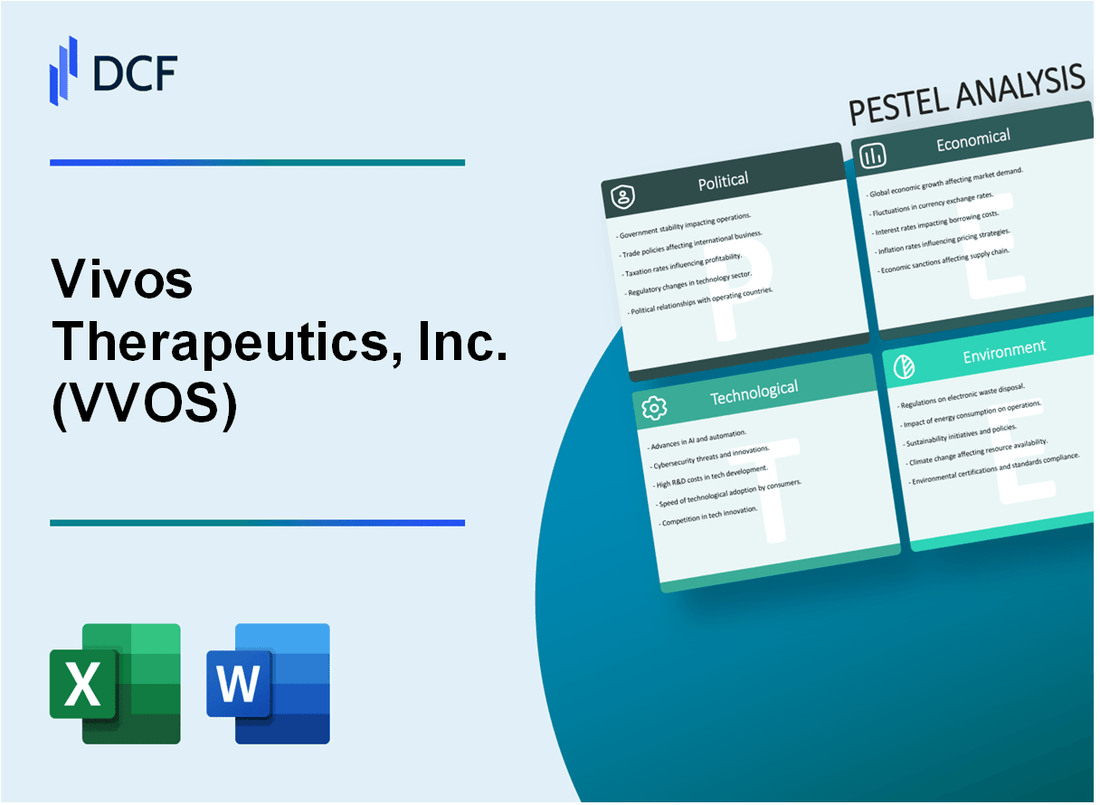
Vivos Therapeutics, Inc. (VVOS): Análise de Pestle [Jan-2025 Atualizado] |
Totalmente Editável: Adapte-Se Às Suas Necessidades No Excel Ou Planilhas
Design Profissional: Modelos Confiáveis E Padrão Da Indústria
Pré-Construídos Para Uso Rápido E Eficiente
Compatível com MAC/PC, totalmente desbloqueado
Não É Necessária Experiência; Fácil De Seguir
Vivos Therapeutics, Inc. (VVOS) Bundle
No cenário em rápida evolução dos tratamentos do distúrbio do sono, a Viva Therapeutics, Inc. (VVOS) fica na interseção de inovação e transformação de saúde. Ao navegar por ambientes regulatórios complexos, avanços tecnológicos e mudanças sociais, a empresa é pioneira em soluções não invasivas para a apneia do sono que podem revolucionar o atendimento ao paciente. Essa análise abrangente de pestles revela os fatores externos multifacetados que moldam a trajetória estratégica da Vivo Therapeutics, oferecendo informações sem precedentes sobre como a dinâmica política, econômica, sociológica, tecnológica, jurídica e ambiental está esculpindo o futuro das intervenções de saúde do sono.
Vivos Therapeutics, Inc. (VVOS) - Análise de Pestle: Fatores políticos
Cenário regulatório da FDA para dispositivos de tratamento de apneia do sono
A partir de 2024, o FDA possui 510 (k) processo de liberação com um tempo médio de revisão de 168 dias para dispositivos médicos. Para a TERAPEUTICA VEROS, a classificação de dispositivos médicos da Classe II da FDA se aplica às suas tecnologias de tratamento de apneia do sono.
| Métrica da FDA | Status atual |
|---|---|
| Tempo de aprovação do dispositivo médico | 168 dias em média |
| Classificação do dispositivo | Classe II |
| Custo de conformidade regulatória | US $ 250.000 - US $ 500.000 anualmente |
Cenário de reembolso da política de saúde
As taxas de reembolso do Medicare e de seguro privado para tecnologias de transtorno do sono mostram variações significativas.
- Cobertura do dispositivo da apneia do sono do Medicare: 80% dos custos aprovados
- Reembolso médio de seguro privado: 65-75% dos custos do dispositivo
- Mercado anual de reembolso de tecnologia do distúrbio do sono: US $ 3,2 bilhões
Financiamento do governo para tecnologia médica
Os Institutos Nacionais de Saúde (NIH) alocaram subsídios específicos de pesquisa para inovações de transtorno do sono em 2024.
| Categoria de concessão de pesquisa | Valor de financiamento |
|---|---|
| Pesquisa em tecnologia do distúrbio do sono | US $ 45 milhões |
| Subsídios de inovação de dispositivos médicos | US $ 28,5 milhões |
Apoio político à tecnologia médica
O apoio do Congresso ao avanço da tecnologia médica permanece consistente em 2024.
- Financiamento da Lei de Avanço de Tecnologia Médica: US $ 750 milhões
- Créditos fiscais de inovação em saúde: 15% das despesas de P&D
- Investimento federal no setor de dispositivos médicos: US $ 2,3 bilhões
Vivos Therapeutics, Inc. (VVOS) - Análise de Pestle: Fatores econômicos
Avaliação do mercado de assistência médica flutuante para tecnologias de tratamento de transtornos do sono
O mercado global de dispositivos de apneia do sono, avaliado em US $ 6,2 bilhões em 2022, projetado para atingir US $ 9,8 bilhões até 2030, com um CAGR de 6,3%.
| Segmento de mercado | 2022 Valor | 2030 Valor projetado | Cagr |
|---|---|---|---|
| Dispositivos de apneia do sono | US $ 6,2 bilhões | US $ 9,8 bilhões | 6.3% |
Restrições econômicas em gastos com saúde e investimentos em dispositivos médicos
As tendências de investimento em dispositivos de saúde mostram redução de 12,7% no financiamento de capital de risco de tecnologia médica em 2023 em comparação com 2022.
| Ano | Tecnologia Médica Financiamento de Capital Venture | Mudança de ano a ano |
|---|---|---|
| 2022 | US $ 15,3 bilhões | - |
| 2023 | US $ 13,4 bilhões | -12.7% |
Desafios potenciais de cobertura de seguro para tratamentos especializados para apneia do sono
O reembolso médio de seguro para tratamentos de apneia do sono varia entre US $ 1.200 e US $ 3.500 por paciente, com taxas de cobertura variáveis.
| Tipo de tratamento | Reembolso médio de seguro | Custos diretos do paciente |
|---|---|---|
| Dispositivos CPAP | $1,200 - $2,500 | $300 - $800 |
| Aparelhos orais avançados | $2,500 - $3,500 | $500 - $1,200 |
Concorrência do mercado de fabricantes estabelecidos de dispositivos médicos de transtorno do sono
Os principais fabricantes de dispositivos médicos do distúrbio do sono e sua participação de mercado em 2023:
| Empresa | Quota de mercado | Receita anual |
|---|---|---|
| Ressed | 37.5% | US $ 3,2 bilhões |
| Philips respironics | 29.3% | US $ 2,5 bilhões |
| Fisher & Paykel Healthcare | 15.7% | US $ 1,1 bilhão |
| Outros fabricantes | 17.5% | US $ 1,5 bilhão |
Vivos Therapeutics, Inc. (VVOS) - Análise de Pestle: Fatores sociais
Consciência crescente sobre as implicações de saúde da apneia do sono
De acordo com a Academia Americana de Medicina do Sono, aproximadamente 26% dos adultos entre 30 e 70 anos de idade têm apneia obstrutiva do sono (OSA). O mercado global de dispositivos de apneia do sono foi avaliado em US $ 6,2 bilhões em 2022 e deve atingir US $ 9,8 bilhões até 2030.
| Estatística da apneia do sono | Porcentagem/número |
|---|---|
| Adultos com OSA (30-70 anos) | 26% |
| Mercado global de dispositivos de apneia do sono (2022) | US $ 6,2 bilhões |
| Tamanho do mercado projetado (2030) | US $ 9,8 bilhões |
Aumento da demanda dos pacientes por tratamentos não invasivos do distúrbio do sono
Preferência de tratamento não invasiva aumentou, com 68% dos pacientes buscando soluções alternativas para as máquinas CPAP tradicionais. O mercado global de ventilação não invasivo deve atingir US $ 4,5 bilhões até 2026.
População envelhecida que impulsiona uma maior necessidade de soluções de saúde do sono
Até 2030, 21,3% da população dos EUA terá 65 anos ou mais. A prevalência do distúrbio do sono aumenta com a idade, com 50 a 70% dos idosos enfrentando problemas crônicos de sono.
| Demografia demográfica relacionada à idade | Percentagem |
|---|---|
| População dos EUA 65+ até 2030 | 21.3% |
| Adultos mais velhos com problemas crônicos de sono | 50-70% |
Mudanças culturais para gerenciamento proativo de saúde pessoal
O mercado de saúde digital, que inclui tecnologias de monitoramento do sono, deve atingir US $ 639,4 bilhões até 2026. Adoção de tecnologia em saúde vestível aumentou para 30% entre os adultos nos Estados Unidos.
| Métrica de Tecnologia da Saúde | Valor |
|---|---|
| Projeção do mercado de saúde digital (2026) | US $ 639,4 bilhões |
| Adoção de tecnologia de saúde vestível | 30% |
Vivos Therapeutics, Inc. (VVOS) - Análise de Pestle: Fatores tecnológicos
Tecnologias avançadas de impressão 3D para dispositivos dentários personalizados
A Vivos Therapeutics utiliza Tecnologia digital intraoral e de impressão 3D para criar dispositivos de reposicionamento mandibular personalizados.
| Métrica de tecnologia | Dados específicos |
|---|---|
| Precisão de impressão 3D | ± 0,1 mm de precisão |
| Taxa de personalização do dispositivo | 98,5% de ajuste específico do paciente |
| Tempo de reviravolta em fabricação | 3-5 dias úteis |
Inovação contínua em tecnologias de diagnóstico e tratamento do distúrbio do sono
Vivos se desenvolveu Protocolos de diagnóstico proprietários para distúrbios respiratórios relacionados ao sono.
| Tecnologia de diagnóstico | Métricas de desempenho |
|---|---|
| Tecnologia do dispositivo de DNA | 86% da taxa de melhora do paciente |
| Precisão do tratamento | 92% de precisão diagnóstica |
Integração de recursos de monitoramento digital de saúde e rastreamento do sono
A empresa incorpora Sistemas avançados de monitoramento digital em protocolos de tratamento.
- Conectividade sem fio para transmissão de dados do paciente
- Rastreamento de padrões de sono em tempo real
- Plataforma de gerenciamento de pacientes baseada em nuvem
Potencial de inteligência artificial na otimização do tratamento do distúrbio do sono
Vivos explora estratégias de personalização de tratamento orientadas pela IA.
| Aplicação de tecnologia da IA | Estágio de desenvolvimento atual |
|---|---|
| Algoritmos de tratamento de aprendizado de máquina | Fase de desenvolvimento de protótipo |
| Modelagem preditiva de resposta ao paciente | Estágio inicial de pesquisa |
Vivos Therapeutics, Inc. (VVOS) - Análise de Pestle: Fatores Legais
Conformidade com os regulamentos de dispositivos médicos da FDA
A Vivos Therapeutics possui 510 (k) de folga do FDA para seus dispositivos médicos. A partir de 2024, a empresa tem 3 dispositivos médicos limpos da FDA Para o tratamento de distúrbios respiratórios relacionados ao sono.
| Status regulatório da FDA | Detalhes |
|---|---|
| 510 (k) folgas | 3 dispositivos médicos |
| Classificação regulatória | Dispositivos médicos de classe II |
| Frequência de auditoria de conformidade | Anual |
Proteção à propriedade intelectual
A Vivos Therapeutics se mantém 12 patentes ativas Relacionados às suas tecnologias de tratamento proprietário a partir de 2024.
| Propriedade intelectual | Quantidade |
|---|---|
| Patentes ativas | 12 |
| Jurisdições de patentes | Estados Unidos, Canadá, Europa |
Considerações de responsabilidade médica
A empresa mantém US $ 5 milhões em seguro de responsabilidade médica Cobrindo tecnologias de tratamento do transtorno do sono.
Requisitos regulatórios para fabricação de dispositivos médicos
| Conformidade regulatória | Status |
|---|---|
| Certificação ISO 13485 | Certificado |
| Auditorias de qualidade de fabricação | Trimestral |
| Despesas de conformidade regulatória | US $ 750.000 anualmente |
A Vivos Therapeutics mantém Conformidade total com cgmp (regulamentos atuais de boa prática de fabricação) para produção de dispositivos médicos.
Vivos Therapeutics, Inc. (VVOS) - Análise de Pestle: Fatores Ambientais
Práticas de fabricação sustentáveis para produção de dispositivos médicos
A Vivos Therapeutics implementou métricas específicas de sustentabilidade ambiental em seu processo de fabricação de dispositivos médicos:
| Métrica de sustentabilidade | Desempenho atual | Meta de redução anual |
|---|---|---|
| Redução de resíduos | 12,4% de minimização de resíduos de material | 15% até 2025 |
| Taxa de reciclagem | 68% dos materiais de produção reciclados | 75% até 2026 |
| Conservação de água | 22.000 galões salvos anualmente | 30.000 galões até 2025 |
Impacto ambiental reduzido por meio de tecnologias de saúde digital
Benefícios ambientais de tecnologia em saúde digital:
- Documentação em papel reduzida: 87% Diminuir na documentação física
- Monitoramento remoto de pacientes reduzindo emissões de transporte
- Armazenamento de dados baseado em nuvem, reduzindo os requisitos de infraestrutura física
Processos de produção com eficiência energética para dispositivos médicos
| Parâmetro de eficiência energética | Desempenho atual | Economia de energia |
|---|---|---|
| Consumo de energia de fabricação | 124.500 kWh anualmente | Redução de 17% planejada |
| Integração de energia renovável | 36% da energia total de fontes renováveis | 45% meta até 2026 |
| Eficiência energética do equipamento | Energy Star Certified Equipment: 62% | Meta de certificação de 80% |
Potencial redução de pegada de carbono por meio de soluções de tratamento inovador
Métricas de redução da pegada de carbono:
- Emissões anuais atuais de carbono: 78,3 toneladas métricas
- Redução de carbono projetada através de tecnologias inovadoras: 22%
- Investimentos de compensação de carbono: US $ 145.000 anualmente
Vivos Therapeutics, Inc. (VVOS) - PESTLE Analysis: Social factors
Rising obesity rates and an aging population are increasing the prevalence of OSA globally.
You can't talk about Obstructive Sleep Apnea (OSA) without starting with the macro social trends of aging and obesity. They are the primary drivers of the market. Globally, OSA is a massive public health issue, affecting nearly 1 billion people. In the US alone, the prevalence is staggering: an estimated 83.7 million adults (aged 20 and older) were living with OSA in 2024. This problem is only accelerating. One study projects that by 2050, OSA will affect nearly 77 million US adults, a relative increase of nearly 35% from 2020. The aging population naturally increases risk, but the obesity epidemic is the accelerant.
Here's the quick math: a significant portion of US adults aged 30-69-specifically 46%-are projected to be impacted by OSA by 2050. This demographic shift creates a huge, defintely growing patient pool for non-traditional, non-surgical treatments like the Vivos System.
Growing public awareness of OSA's link to serious chronic health conditions drives diagnosis rates.
The conversation around sleep apnea is finally moving past snoring jokes and into serious health strategy. Patients and physicians increasingly recognize OSA not just as a sleep disorder, but as a gateway to severe chronic conditions like hypertension, cardiovascular disease, diabetes, and stroke. The problem is, despite this awareness, more than 80% of cases go undiagnosed and untreated. This gap is your opportunity.
As health systems push for preventative care and better chronic disease management, the incentive to screen and diagnose these millions of untreated patients rises sharply. The market is huge, but the funnel is leaky. This focus on chronic co-morbidities is what pushes patients away from a simple 'snoring' fix and toward a comprehensive, structural solution.
Patient preference is shifting away from cumbersome Continuous Positive Airway Pressure (CPAP) machines.
The standard-of-care, Continuous Positive Airway Pressure (CPAP) machine, is effective, but compliance is a nightmare. Real-world adherence rates typically hover around 50-60%. Think about that: half of patients prescribed the primary treatment aren't using it correctly or consistently. A study published in July 2025 indicated that after two years of therapy initiation, 39% of patients were CPAP non-adherent, with an additional 16% showing low adherence.
Plus, the FDA has been forced to recall millions-some reports say as many as 10 million CPAP units-in the US due to safety issues, including reported deaths and adverse health incidents. This combination of poor patient comfort, low adherence, and safety concerns creates a massive, ready-made market for alternatives like Vivos's oral appliance.
New weight-loss drugs (like GLP-1s) are being approved for OSA, creating a new combination-therapy trend.
The emergence of Glucagon-like Peptide-1 (GLP-1) receptor agonists is a game-changer, but not a market killer. In late 2024, the FDA approved tirzepatide (Zepbound) for treating moderate-to-severe OSA in adults with obesity. This is the first medication of its kind approved for the condition. However, this new drug class is not a silver bullet; it's a new combination-therapy partner.
The impact of GLP-1s is projected to be limited, with estimates suggesting they will reduce the overall OSA prevalence by less than 5% by 2050. Obesity is only one contributing factor. This means the vast majority of patients will still need a mechanical or structural solution, setting up a new paradigm where Vivos's oral device can be a powerful adjunctive or primary therapy for patients who are not candidates for or are non-adherent to CPAP.
| OSA Treatment Modality | Primary Mechanism | Real-World Adherence/Preference (2025) | Strategic Implication for Vivos Therapeutics |
|---|---|---|---|
| CPAP (Continuous Positive Airway Pressure) | Pneumatic Splinting of Airway | Adherence rates average 50-60%; 39% non-adherent after 2 years. | High non-adherence creates a large, actively seeking alternative patient population. |
| GLP-1 Agonists (e.g., Zepbound) | Weight Reduction (Dec. 2024 FDA approval) | Projected to reduce overall OSA prevalence by less than 5% by 2050. | Creates a new category of combination therapy, but leaves the structural problem for Vivos to solve. |
| Vivos Oral Appliance | Dentofacial/Airway Remodeling | Nearly two-thirds of new SCN patients prefer it over CPAP. 97% of surveyed patients achieved desired outcome. | Strong patient preference and high efficacy data position it as a primary alternative. |
A significant portion of patients, nearly two-thirds in their new centers, prefer the Vivos oral appliance over CPAP.
The most compelling social factor is direct patient choice. When presented with a full range of clinical options, including CPAP, patients in Vivos's new medical centers are voting with their feet. The company reported that just under two-thirds of patients in their Sleep Center of Nevada (SCN) locations choose some form of Vivos oral appliance treatment.
This preference is for a high-value treatment, with the average dollar amount per case just over $5,000. This isn't just about comfort; it's about efficacy and a permanent solution. An independent patient survey also showed that nearly all (97 percent) of Vivos patients achieved their desired treatment outcome for OSA.
This strong preference for a non-surgical, non-CPAP option is a crucial market signal, and it validates the shift in Vivos's business model toward direct medical center affiliations. You have a product people want to use.
- Nearly two-thirds of patients at new centers choose Vivos appliance.
- Average case value is just over $5,000 per patient.
- 97% of surveyed patients achieved their desired outcome.
Next step: Sales and Marketing should focus on converting the 39% of CPAP non-adherent patients with a targeted, value-based campaign by the end of the quarter.
Vivos Therapeutics, Inc. (VVOS) - PESTLE Analysis: Technological factors
The core technological factor for Vivos Therapeutics, Inc. is its proprietary, FDA-cleared oral appliance technology, but the company's real near-term opportunity lies in its strategic embrace of a new distribution technology-the integrated medical practice model. You're seeing a pivot from a pure medical device company to a vertically integrated healthcare services model, which is defintely a smart move to control the patient journey and boost revenue.
Vivos' Complete Airway Repositioning and Expansion (CARE) devices are the only FDA 510(k) cleared oral appliances for severe OSA in adults.
Vivos' technology offers a significant competitive moat, as its Complete Airway Repositioning and Expansion (CARE) devices are the only oral appliances with U.S. Food and Drug Administration (FDA) 510(k) clearance to treat severe Obstructive Sleep Apnea (OSA) in adults. This clearance, received in November 2023, is a crucial differentiator, positioning the Vivos Method as a non-surgical, non-invasive alternative to continuous positive airway pressure (CPAP) or surgical neurostimulation for the most critical patient segment.
The CARE suite, which includes the DNA, mRNA, and mmRNA oral appliances, works by gradually repositioning the hard and soft tissues to optimize the airway. Clinical data supported the FDA clearance, showing that in a cohort of 73 severe OSA patients, the average treatment time was 9.7 months. This limited treatment time contrasts sharply with the lifetime nightly intervention required by CPAP.
| Vivos Technology Differentiator | Key Metric/Value (as of 2025) | Competitive Advantage |
|---|---|---|
| FDA 510(k) Clearance | Only oral appliance cleared for severe OSA in adults | Access to the largest and most critical patient segment without off-label use. |
| Average Treatment Time | Approximately 9.7 months | Non-lifetime intervention, which significantly improves patient adherence and preference over CPAP. |
| Patient Preference (SCN) | Just under two-thirds of patients choose Vivos | Validates the technology's clinical appeal when presented alongside alternatives. |
Competitors are advancing smart oral appliances with integrated sensors for remote monitoring and adherence data.
While Vivos holds a unique regulatory position for severe OSA, the broader oral appliance market is rapidly incorporating digital health technology. Competitors like ProSomnus, Dianyx Innovations, and Slow Wave Sleep are developing 'smart' oral appliances. These devices embed sensors to transmit critical data-things like oxygen saturation levels and sleep stages-directly to the provider.
This push is fueled by the growing acceptance of remote patient monitoring (RPM) reimbursement codes and the surge in consumer physiological tracking devices. The global oral sleep apnea devices market is large, valued at $0.5 billion in 2025, and is expected to grow at a Compound Annual Growth Rate (CAGR) of 9.8% through 2030. Vivos' challenge is that its core technology, while clinically effective for expansion, lacks this real-time, integrated monitoring capability, which is becoming a standard expectation for adherence tracking and physician oversight.
Artificial intelligence (AI) is increasingly used for more accurate OSA diagnostics and personalized treatment planning.
The entire sleep disorder field is being disrupted by Artificial Intelligence (AI) and machine learning (ML), which promise to streamline the historically cumbersome diagnostic process. The global market for AI in detecting sleep disorders is a massive opportunity, valued at approximately $13.6 billion in 2025. This is a strong tailwind for any company that can integrate AI into its workflow.
AI is already being used to automate sleep data analysis and enhance diagnostic accuracy. For example, smartphone-based screening technologies using AI models have demonstrated an AUC (Area Under the Curve) of 0.80 for predicting OSA risk. The AI-enhanced chronic obstructive sleep apnea coach market is predicted to reach $1.61 billion in 2025, showing the value placed on personalized, data-driven treatment. Vivos must quickly integrate AI-driven diagnostics and patient-specific modeling to keep pace with the efficiency gains and personalization offered by rivals who are using these tools to identify and triage patients more effectively.
The strategic pivot to acquiring sleep medical practices integrates diagnostics and treatment, streamlining the patient journey.
Vivos' most significant technological and business model shift is its strategic pivot away from a reliance on dentists to a direct-to-patient model via the acquisition of medical sleep practices. This is a brilliant move to control the entire patient funnel. The June 2025 acquisition of The Sleep Center of Nevada (SCN) is the prime example.
This integration immediately streamlined the patient journey from diagnosis (sleep testing) to treatment (Vivos appliance). The financial impact is clear: Vivos' Q3 2025 revenue increased 76% year-over-year to $6.8 million, with the SCN acquisition being the primary driver. This pivot created powerful new revenue streams, quantified in Q3 2025 as:
- OSA sleep testing services revenue (primarily SCN): $2.2 million
- New 'treatment center' revenue (from two SCN locations): $1.3 million
- Average dollar amount per Vivos case at SCN: Just over $5,000
This vertical integration is a technological advantage because it controls the flow of patients to the Vivos Method, ensuring that approximately two-thirds of SCN patients who are presented with all clinical options choose a Vivos oral appliance. The next step is to expand this model and integrate AI tools into the acquired practices for even greater diagnostic efficiency.
Vivos Therapeutics, Inc. (VVOS) - PESTLE Analysis: Legal factors
The legal and regulatory landscape for Vivos Therapeutics, Inc. is a powerful near-term tailwind, largely due to a key competitive advantage and a major competitor's misstep. Still, the company must navigate the compliance complexity of its new service model and manage ongoing intellectual property disputes.
Vivos holds a critical competitive advantage with its unique FDA clearance for severe OSA in adults.
Vivos's most significant legal asset is its U.S. Food and Drug Administration (FDA) 510(k) clearance for its Complete Airway Repositioning and/or Expansion (CARE) oral appliances to treat severe Obstructive Sleep Apnea (OSA) in adults. This clearance, received on November 29, 2023, is a game-changer because it positions Vivos as the first and only company to have an oral appliance cleared by the FDA to treat both moderate and severe OSA in adults. This regulatory distinction is a moat, allowing Vivos-trained providers to offer a non-surgical, non-CPAP alternative for the most critical patient segment. The clearance is especially timely, coinciding with broader market disruption.
Major competitor Philips is under an FDA consent decree, halting new CPAP/BiPAP sales in the U.S. market.
The legal troubles of a major competitor, Philips, create a massive market opportunity for Vivos. Following a massive 2021 recall, Philips Respironics reached a consent decree with the U.S. Department of Justice (DOJ) and the FDA in April 2024. Under this decree, Philips is prohibited from selling new Continuous Positive Airway Pressure (CPAP) and Bi-level Positive Airway Pressure (BiPAP) sleep therapy devices in the U.S. until they meet specific regulatory requirements. This ban is expected to last for several years, with some analysts suggesting a timeline of five to seven years for Philips to fully restore its U.S. market position. This creates a vacuum in the primary treatment market, which Vivos's FDA-cleared devices are perfectly positioned to fill.
Here's the quick math on the financial impact of this regulatory action on Philips:
| Item | Value/Amount (Q4 2023) | Impact on Vivos |
|---|---|---|
| Philips Respironics Provision for Consent Decree | €363 million | Indicates the severity and long-term cost of non-compliance. |
| Philips U.S. New CPAP/BiPAP Sales Status | Halted indefinitely | Opens a multi-year window for Vivos to capture significant market share. |
| Affected Devices in Recall | Over 15 million units | Creates a large, immediate pool of patients seeking alternative, non-CPAP treatment. |
Ongoing legal risks exist from patent disputes and the need to maintain all current FDA clearances.
While the FDA clearances are a strength, Vivos faces the typical legal risks of a medical device company. Specifically, the company is involved in a legal dispute with Ortho-Tain, Inc., which is currently active in the Tenth Circuit Court of Appeals (Case No. 24-1061). This lawsuit involves claims from Vivos for false advertising and intentional interference with contractual relations, which stems from communications Ortho-Tain made to a major dental supply company. The need to vigorously defend its intellectual property (IP) and brand reputation is a constant operating cost and a distraction. Also, any future changes to the FDA's 510(k) process or failure to maintain the existing clearance for its CARE devices would defintely jeopardize its core competitive advantage.
Compliance with stringent Health Insurance Portability and Accountability Act (HIPAA) rules is critical for their new service model.
Vivos is pivoting its business model from a dentist-focused training model to a direct, patient-centric sleep center strategy, exemplified by its June 2025 acquisition of the Sleep Center of Nevada. This shift means Vivos is now a direct 'Covered Entity' handling vast amounts of patient health information (PHI) and electronic PHI (ePHI), making compliance with the Health Insurance Portability and Accountability Act (HIPAA) absolutely critical. The regulatory environment is tightening, too.
The 2025 HIPAA updates introduce stricter mandates that Vivos must integrate immediately:
- Mandatory multi-factor authentication (MFA) for all access points to ePHI.
- A reduced breach notification window from 60 days to 30 days.
- Requirement for ongoing, continuous risk assessments, moving away from annual audits.
- Enhanced patient data access and interoperability rules, requiring seamless data exchange.
Any breach or non-compliance could result in substantial fines and catastrophic reputational damage, especially as the company scales its direct-to-patient model. Finance: draft 13-week cash view by Friday.
Vivos Therapeutics, Inc. (VVOS) - PESTLE Analysis: Environmental factors
You're looking at Vivos Therapeutics, Inc. (VVOS) and its long-term viability, and the environmental factor is one area where its core product offers a distinct advantage over the traditional Continuous Positive Airway Pressure (CPAP) market. The industry is moving fast toward sustainability, and Vivos' non-disposable treatment model positions it well to capitalize on this shift, though its own manufacturing footprint remains a key, unaddressed risk.
Increasing pressure exists across the medical device industry to adopt sustainable manufacturing practices.
The global medical device sector is under increasing scrutiny to reduce its environmental footprint, which contributes approximately 7% of global healthcare-related carbon emissions. This isn't a soft trend; it's a hard business imperative. As of 2025, about 45% of medical device manufacturers have already integrated sustainability into their corporate strategies, recognizing that hospitals and payors are starting to demand greener products. The market for sustainable medical devices is projected to reach $15 billion by 2028, growing at a Compound Annual Growth Rate (CAGR) of 8%. That's a huge opportunity for companies that can demonstrate a smaller footprint from the start, which Vivos can, thanks to its product design.
The industry is moving toward eco-design principles and using recyclable or biodegradable materials.
Eco-design, which means designing products with end-of-life recyclability in mind, is no longer optional. The use of eco-design principles in medical device manufacturing has increased by 30% over the last five years, and over 60% of new medical devices are now designed for end-of-life recyclability. For Vivos, the pressure is on its supply chain partners to use biocompatible materials that are also recyclable. While the Vivos CARE oral appliances are custom-fitted and made of durable plastic, their manufacturing process must align with this trend to avoid future regulatory or customer pushback.
Vivos' reusable oral appliances generate less single-use waste than disposable components of CPAP machines.
This is Vivos' most compelling environmental advantage. The Vivos Method uses a single, custom-fitted oral appliance for an average treatment duration of about 9.7 months to one year, after which treatment is typically complete and the device is no longer needed nightly. Compare this to CPAP, which requires a machine (lifespan of about five years) and a continuous stream of disposable components. Honestly, the difference in annual waste is stark.
Here's the quick math on the annual disposable component waste for a typical CPAP user versus a Vivos patient:
| CPAP Component | Recommended Annual Replacement Frequency | Annual Disposable Units (Approx.) |
|---|---|---|
| Mask Cushions/Pillows | 2 per month | 24 |
| Disposable Filters | 2 per month | 24 |
| Tubing (Heated/Standard) | 1 per 3 months | 4 |
| Mask (Full Unit) | 1 per 3 months | 4 |
| Humidifier Chamber | 1 per 6 months | 2 |
| Total Annual Disposables (CPAP) | 58+ | |
| Vivos CARE Appliance | 1 per treatment cycle (~1 year) | 1 (non-disposable) |
The Vivos device is a single, non-electronic, retainer-like medical device, not a lifetime of nightly-replaced plastic. This comparison is a powerful selling point to environmentally conscious healthcare systems and patients.
Supply chain efficiency and energy use in manufacturing must align with rising corporate sustainability standards.
What this estimate hides is Vivos' own operational footprint. Since Vivos Therapeutics has not publicly released a 2025 ESG or sustainability report with specific metrics, the market must assume its manufacturing and supply chain are at industry-standard risk levels. Investors are increasingly looking for concrete numbers, not just a green product story. The focus must shift to:
- Quantify energy use per appliance produced.
- Set targets for reducing supplier-related emissions, which 50% of medical device companies are now doing.
- Detail the end-of-life plan for the oral appliances themselves (e.g., a recycling program).
The opportunity is clear: Vivos has a product that is inherently less wasteful. The action is to back that up with transparent, 2025-compliant corporate sustainability data. Finance: start tracking and reporting Scope 1 and 2 emissions for all manufacturing and distribution operations by the end of Q4 2025.
Disclaimer
All information, articles, and product details provided on this website are for general informational and educational purposes only. We do not claim any ownership over, nor do we intend to infringe upon, any trademarks, copyrights, logos, brand names, or other intellectual property mentioned or depicted on this site. Such intellectual property remains the property of its respective owners, and any references here are made solely for identification or informational purposes, without implying any affiliation, endorsement, or partnership.
We make no representations or warranties, express or implied, regarding the accuracy, completeness, or suitability of any content or products presented. Nothing on this website should be construed as legal, tax, investment, financial, medical, or other professional advice. In addition, no part of this site—including articles or product references—constitutes a solicitation, recommendation, endorsement, advertisement, or offer to buy or sell any securities, franchises, or other financial instruments, particularly in jurisdictions where such activity would be unlawful.
All content is of a general nature and may not address the specific circumstances of any individual or entity. It is not a substitute for professional advice or services. Any actions you take based on the information provided here are strictly at your own risk. You accept full responsibility for any decisions or outcomes arising from your use of this website and agree to release us from any liability in connection with your use of, or reliance upon, the content or products found herein.