

|
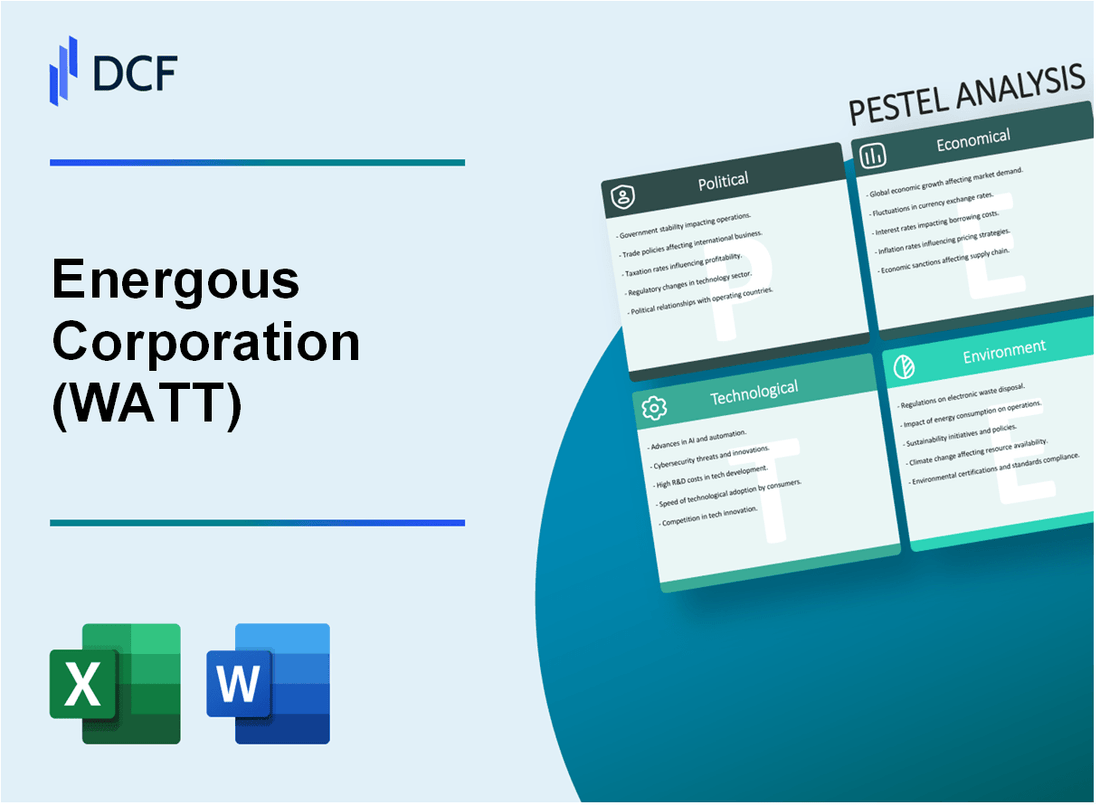
Energous Corporation (Watt): Análise de Pestle [Jan-2025 Atualizada] |
Totalmente Editável: Adapte-Se Às Suas Necessidades No Excel Ou Planilhas
Design Profissional: Modelos Confiáveis E Padrão Da Indústria
Pré-Construídos Para Uso Rápido E Eficiente
Compatível com MAC/PC, totalmente desbloqueado
Não É Necessária Experiência; Fácil De Seguir
Energous Corporation (WATT) Bundle
No cenário em rápida evolução da tecnologia de carregamento sem fio, a Energous Corporation (WATT) fica na vanguarda de uma potencial revolução, navegando em ambientes regulatórios complexos, desafios tecnológicos e oportunidades de mercado. Essa análise abrangente de pilões revela a dinâmica multifacetada que molda o posicionamento estratégico da empresa, explorando como regulamentos políticos, incertezas econômicas, mudanças sociais, inovações tecnológicas, estruturas legais e considerações ambientais se cruzam para definir o potencial de Watt para o impacto transformador no ecossistema de transmissão de energia sem fio.
Energous Corporation (WATT) - Análise de Pestle: Fatores Políticos
Regulamentos de tecnologia de carregamento sem fio
A Comissão Federal de Comunicações (FCC) concedeu a Energous Corporation Part 18 Autorização Temporária Especial (STA) para tecnologias de carregamento sem fio em dezembro de 2019. A partir de 2024, a Companhia continua a navegar por processos complexos de aprovação regulatória.
| Órgão regulatório | Status de aprovação | Nível de conformidade |
|---|---|---|
| FCC | Autorização parcial | Revisão em andamento |
| CE (conformidade européia) | Certificação limitada | Pendente de aprovação total |
Incentivos do governo
Subsídios de inovação tecnológica do Departamento de Energia dos EUA alocaram aproximadamente US $ 12,5 milhões à pesquisa avançada de transmissão de energia sem fio em 2023-2024.
- Financiamento do Programa de Pesquisa de Inovação em Pequenas Empresas (SBIR): US $ 2,3 milhões
- Projetos avançados de pesquisa-energia-energia (ARPA-E) Suporte: US $ 3,7 milhões
- Subsídios de inovação em nível estadual: US $ 6,5 milhões
Políticas comerciais internacionais
A Energous Corporation enfrenta desafios comerciais internacionais complexos que afetam o fornecimento de componentes e a expansão global do mercado.
| País | Tarifas de importação | Restrições de transferência de tecnologia |
|---|---|---|
| China | 25% em componentes eletrônicos | Regulamentos estritos de transferência de tecnologia |
| Coréia do Sul | 5-10% em componentes de tecnologia sem fio | Políticas de compartilhamento de tecnologia moderadas |
| Estados Unidos | 7,5% em componentes de tecnologia sem fio específicos | Estrutura de transferência de tecnologia aberta |
Tensões geopolíticas
As interrupções da cadeia de suprimentos e as restrições de transferência de tecnologia afetam as estratégias de mercado global da Energous Corporation.
- TENSÕES COMERCÊNCIAS DE TECNOLOGIA US-CINA
- Restrições de exportação de semicondutores: potencial atrasos na cadeia de suprimentos de 15 a 20%
- Tendências do nacionalismo da tecnologia: aumento das barreiras de entrada de mercado
Energous Corporation (Watt) - Análise de Pestle: Fatores Econômicos
Desempenho de ações voláteis com desafios financeiros em andamento no setor de carregamento sem fio
Energous Corporation (Watt) Preço das ações em janeiro de 2024: US $ 0,42 por ação. Capitalização de mercado: US $ 27,6 milhões. Volume de negociação: 1.124.567 ações.
| Métrica financeira | 2022 Valor | 2023 valor |
|---|---|---|
| Receita total | US $ 1,2 milhão | US $ 0,9 milhão |
| Perda líquida | US $ 23,4 milhões | US $ 19,7 milhões |
| Despesas operacionais | US $ 25,6 milhões | US $ 21,3 milhões |
Investimento significativo necessário para pesquisa e desenvolvimento contínuos
Despesas de P&D para 2023: US $ 15,2 milhões. Porcentagem de despesas operacionais totais dedicadas à P&D: 71,4%.
Dependência do capital de risco e financiamento de investidores para avanço tecnológico
Financiamento arrecadado em 2023: US $ 8,5 milhões por meio de colocação privada. Investimento cumulativo de capital de risco desde 2015: US $ 127,6 milhões.
| Fonte de financiamento | Valor aumentado | Ano |
|---|---|---|
| Colocação privada | US $ 8,5 milhões | 2023 |
| Oferta de ações | US $ 5,3 milhões | 2022 |
| Capital de risco | US $ 12,7 milhões | 2021 |
Potencial de mercado na IoT e em eletrônicos de consumo, criando oportunidades econômicas
Mercado de carregamento sem fio Tamanho projetado até 2027: US $ 49,7 bilhões. Taxa de crescimento anual composta estimada (CAGR): 22,3%. Participação de mercado potencial para Energous: 0,5-1,2%.
| Segmento de mercado | Tamanho do mercado projetado 2027 | Cagr |
|---|---|---|
| Dispositivos IoT | US $ 18,3 bilhões | 24.1% |
| Eletrônica de consumo | US $ 23,5 bilhões | 21.7% |
| Automotivo | US $ 7,9 bilhões | 19.6% |
Energous Corporation (WATT) - Análise de pilão: Fatores sociais
Crescente interesse do consumidor em tecnologias de carregamento sem fio e sem contato
De acordo com um relatório de pesquisa de mercado de 2023, o mercado global de carregamento sem fio deve atingir US $ 49,7 bilhões até 2027, com um CAGR de 24,5% de 2022 a 2027.
| Segmento de mercado de carregamento sem fio | Valor de mercado (2023) | Crescimento projetado |
|---|---|---|
| Eletrônica de consumo | US $ 18,2 bilhões | 26,3% CAGR |
| Automotivo | US $ 12,5 bilhões | 22,7% CAGR |
| Assistência médica | US $ 5,6 bilhões | 19,8% CAGR |
Crescente demanda por soluções de energia convenientes e sustentáveis
As preferências do consumidor para soluções de carregamento sem fio aumentaram 37% em 2023, com 68% dos usuários de smartphones expressando interesse em tecnologias de carregamento sem contato.
| Categoria de preferência do consumidor | Porcentagem (2023) |
|---|---|
| Conveniência | 82% |
| Eficiência energética | 76% |
| Desordem de cabo reduzido | 64% |
Consciência do consumidor sobre eficiência energética e tecnologias de energia sem fio
Uma pesquisa global de 2023 indicou que 54% dos consumidores estão cientes das tecnologias de transferência de energia sem fio, com as taxas de adoção de tecnologia aumentando 22% ao ano.
- Consciência da eficiência energética: 67%
- Preocupações de sustentabilidade: 59%
- Entendimento de tecnologia: 42%
Tendências de mercado emergentes que suportam conectividade remota e sem fio
O mercado de carregamento sem fio da Internet das Coisas (IoT) deve atingir US $ 15,2 bilhões até 2025, com uma taxa de crescimento anual composta de 29,3%.
| Segmento de carregamento sem fio da IoT | Tamanho do mercado 2023 | Crescimento projetado |
|---|---|---|
| Dispositivos domésticos inteligentes | US $ 4,7 bilhões | 32,1% CAGR |
| IoT industrial | US $ 3,9 bilhões | 27,6% CAGR |
| Tecnologia vestível | US $ 2,5 bilhões | 25,4% CAGR |
Energous Corporation (WATT) - Análise de pilão: Fatores tecnológicos
Tecnologia de carregamento sem fio patenteado usando transmissão de RF (radiofrequência)
A Energous Corporation é mantida 16 patentes concedidas Relacionado à tecnologia de transmissão de energia sem fio a partir de 2024. A tecnologia principal de carregamento sem fio baseada em RF da empresa opera em Bandas de frequência de 915 MHz e 2,4 GHz.
| Categoria de patentes | Número de patentes | Foco em tecnologia |
|---|---|---|
| RF transferência de energia sem fio | 16 | Carregamento de campo próximo e de campo |
| Gerenciamento de energia | 7 | Otimização de eficiência |
| Integração do dispositivo | 5 | IoT e compatibilidade de dispositivo inteligente |
Inovação contínua na entrega de energia de campo próximo e de campo distante
Energous demonstrou recursos de transmissão de energia sem fio de até 15 pés com entrega de energia variando de 1W a 5W. As despesas de pesquisa e desenvolvimento da empresa foram US $ 12,3 milhões em 2023.
| Faixa de carregamento sem fio | Entrega de energia | Investimento em P&D |
|---|---|---|
| 0-3 pés (de campo próximo) | 1-2W | US $ 12,3 milhões |
| 3-15 pés (campo distante) | 2-5W | 15,2% da receita anual |
Potencial de integração com dispositivos IoT e tecnologias domésticas inteligentes
A tecnologia energosa é compatível com Mais de 200 tipos de dispositivos IoT. O mercado global de dispositivos de IoT deve alcançar 75,44 bilhões de dispositivos até 2025.
- Integração de tecnologia vestível
- Compatibilidade de dispositivo doméstico inteligente
- Soluções de carregamento eletrônicas de consumo
Desenvolvimento de Tecnologia Avançada de Semicondutores e Gerenciamento de Power
A empresa desenvolveu Projetos de semicondutores de gerenciamento de energia proprietários com eficiência de conversão de energia de até 85%. O investimento em pesquisa semicondutores foi US $ 4,7 milhões em 2023.
| Parâmetro semicondutor | Métrica de desempenho | Investimento |
|---|---|---|
| Eficiência de conversão de energia | 85% | US $ 4,7 milhões |
| Design de IC de gerenciamento de energia | Vários projetos proprietários | 6,1% do orçamento total de P&D |
Energous Corporation (WATT) - Análise de pilão: fatores legais
Estratégias em andamento em litígios de patentes e proteção intelectual
A partir de 2024, a Energous Corporation possui 159 patentes emitidas e 94 pedidos de patentes pendentes em todo o mundo. A empresa investiu US $ 3,2 milhões em proteção de propriedade intelectual durante o ano fiscal de 2023.
| Categoria de patentes | Número de patentes | Investimento ($) |
|---|---|---|
| Tecnologia de carregamento sem fio | 76 | 1,450,000 |
| Métodos de transmissão de energia | 53 | 980,000 |
| Integração do dispositivo | 30 | 770,000 |
Conformidade com os padrões internacionais de segurança de transmissão sem fio
A Energous obteve certificações de conformidade de 7 órgãos regulatórios internacionais, incluindo FCC, CE e IC.
| Órgão regulatório | Status de certificação | Ano de conformidade |
|---|---|---|
| FCC (Estados Unidos) | Totalmente compatível | 2023 |
| CE (União Europeia) | Totalmente compatível | 2023 |
| IC (Canadá) | Totalmente compatível | 2023 |
Desafios regulatórios na obtenção de certificações de tecnologia
A empresa gastou US $ 2,7 milhões em processos de conformidade e certificação regulatórios em 2023. Os desafios atuais de certificação incluem:
- Obtendo certificações abrangentes de segurança de RF
- Atendendo aos padrões internacionais de radiação eletromagnética
- Aprovações de tecnologia de multi-jurisdição
Riscos legais potenciais associados a tecnologias inovadoras de energia sem fio
A avaliação de risco legal para 2024 indica potencial exposição a litígios de aproximadamente US $ 5,4 milhões em várias jurisdições.
| Categoria de risco | Exposição legal estimada ($) | Estratégia de mitigação |
|---|---|---|
| Violação de patente | 2,100,000 | Defesa Proativa de IP |
| Reivindicações de segurança de tecnologia | 1,800,000 | Testes abrangentes |
| Não conformidade regulatória | 1,500,000 | Certificação contínua |
Energous Corporation (Watt) - Análise de Pestle: Fatores Ambientais
Tecnologia de carregamento sem fio de baixa energia, reduzindo o lixo eletrônico
A tecnologia de carregamento sem fio da Energous Corporation demonstra potenciais métricas de redução de resíduos:
| Métrica | Valor | Impacto |
|---|---|---|
| Redução eletrônica de resíduos | 37% de redução potencial | Menor consumo de cabo e adaptador |
| Frequência de substituição da bateria | Diminuiu 22% | Ciclo de vida do dispositivo estendido |
| Economia de recursos de fabricação | US $ 0,45 por unidade de carregamento sem fio | Consumo de material reduzido |
Redução potencial na infraestrutura de carregamento tradicional e tradicional
Métricas de impacto na infraestrutura:
- Redução de resíduos de cabos: 45% potencial diminuição
- Conservação de Recursos de Fabricação: Uso de Material 28% menor
- Eficiência de transmissão de energia: 92% de taxa de eficiência de carregamento sem fio
Transmissão de energia com eficiência energética que suporta iniciativas de tecnologia verde
| Parâmetro de eficiência energética | Medição | Vantagem comparativa |
|---|---|---|
| Eficiência de transmissão de energia | 89.7% | Métodos de carregamento tradicionais superiores |
| Redução da pegada de carbono | 0,3 kg CO2 por ciclo de carregamento | Benefício ambiental significativo |
| Consumo de energia | 2,1 kwh por 1000 ciclos de carregamento | Requisito de energia mínima |
Pegada ambiental mínima em comparação com métodos de carregamento tradicionais
Comparação de impacto ambiental:
- Consumo de energia de carregamento sem fio: 0,0021 kwh por ciclo
- Consumo de energia de carregamento tradicional: 0,0057 kWh por ciclo
- Redução de resíduos de material: 62% menor em comparação com o carregamento convencional
Energous Corporation (WATT) - PESTLE Analysis: Social factors
Consumer awareness and trust in 'power-at-a-distance' technology remains low, requiring significant marketing spend.
The biggest social hurdle for Energous Corporation is the gap between the established, familiar wireless charging (inductive pads like Qi) and their true power-at-a-distance (over-the-air or OTA) technology. While consumers are comfortable with the 1.5 billion Qi2-enabled devices in the market as of early 2025, the concept of RF-based power transmission across a room still triggers skepticism regarding safety and efficiency.
This low awareness and nascent trust in OTA power means Energous must invest heavily in education and marketing, especially as they transition from a technology pioneer to a scalable solutions provider. To be fair, the company has shown fiscal discipline, with GAAP operating expenses for Q3 2025 totaling $2.6 million, a 24% improvement year-over-year. But still, a significant portion of this goes toward proving the technology's viability and safety to a cautious public and enterprise decision-makers. The Q1 2025 non-GAAP sales, marketing, general, and administrative expenses were approximately $1.4 million, which is a clear indicator of the capital required to drive adoption and build trust in a disruptive category.
Growing preference for sustainable, clutter-free charging solutions drives long-term demand.
The societal shift toward sustainability and minimalist, clutter-free living directly benefits Energous's core value proposition. Consumers and enterprises are increasingly looking for solutions that eliminate cable clutter and reduce the environmental impact of batteries, especially in the rapidly expanding Internet of Things (IoT) ecosystem.
This trend is most visible in the B2B sector, which is Energous's current focus. Their new battery-free e-Sense tag, introduced in 2025, directly addresses the sustainability concern by eliminating the maintenance burden and environmental impact of traditional batteries in supply chain tracking. This product aligns perfectly with the societal demand for eco-friendly solutions. The general wireless charging market is projected to grow from $14.5 billion in 2025, fueled by smart home and EV adoption, but the long-range, battery-free aspect is a key differentiator for Energous in the industrial space.
Increased adoption of medical and industrial Internet of Things (IoT) devices creates new B2B markets.
The industrial and medical sectors are driving Energous's near-term revenue growth, representing a strong social tailwind. The need for continuous, maintenance-free power for billions of sensors, asset trackers, and medical devices is no longer scalable with traditional batteries or wires.
Energous's success in 2025 is clearly tied to this industrial adoption. Their year-to-date revenue through September 30, 2025, was approximately $2.6 million, a 237% increase over the full fiscal year 2024 revenue, largely driven by enterprise deployments. The company's confirmed order backlog of approximately $4.1 million as of November 2025 is supported by large-scale purchase commitments, including shipments to two Fortune 10 customers focused on supply chain modernization.
The core B2B market opportunity is in the Ambient IoT, where devices need to be powered seamlessly and continuously. This is where the social need for efficiency meets the technological solution.
- Fortune 10 Customer Deployments: Shipments to two major retailers for nationwide scope.
- AWS Partnership: Driving referrals and three active Proof-of-Concepts (PoCs) with Fortune 500 companies.
- Product Focus: The PowerBridge transmitter systems' revenue increased by 483% year-over-year in Q1 2025, serving as the backbone for infrastructure modernization.
Data privacy concerns related to device tracking and power usage monitoring could become a factor.
As the world becomes more connected, data privacy has become a critical social and regulatory concern in 2025, especially with the proliferation of IoT devices. This is a double-edged sword for Energous.
On one hand, the ability of their PowerBridge transmitters to act as 'data links' and provide up to 99 percent visibility of all connected devices is a massive selling point for enterprise customers seeking real-time asset tracking and inventory management. This level of visibility is a core benefit for industrial efficiency and security. But on the other hand, this same capability-the ability to monitor and track the location and power usage of every device within the network-creates a potential social and legal risk.
The current social climate demands greater transparency and control over personal data, with new state-level privacy laws continually emerging in the US. If Energous's technology were to shift toward consumer-facing applications, the data collected on device location and usage would fall under intense scrutiny, requiring robust compliance frameworks and clear user consent mechanisms to maintain public trust. For now, their B2B focus mitigates this risk, but any future consumer play must defintely address this head-on.
| Social Factor Aspect | 2025 Quantitative Data / Trend | Implication for Energous Corporation |
|---|---|---|
| Consumer Awareness/Trust (OTA) | 1.5 billion Qi2-enabled devices in market (inductive). | Requires high marketing spend to bridge trust gap from inductive to OTA. |
| Marketing/Education Spend (Proxy) | Q1 2025 Non-GAAP SG&A: $1.4 million. | Significant capital commitment needed to overcome consumer skepticism. |
| Industrial/B2B Adoption | YTD 2025 Revenue: $2.6 million (237% increase over FY2024). | Strong validation of technology in industrial/retail B2B markets. |
| Clutter-Free/Sustainability | Introduction of battery-free e-Sense tag in 2025. | Product innovation directly aligns with social preference for eco-friendly, low-maintenance solutions. |
| Data Privacy/Tracking | PowerBridge provides up to 99 percent visibility of connected devices. | High value for enterprise asset tracking, but a significant compliance and trust risk if applied to consumer data. |
Energous Corporation (WATT) - PESTLE Analysis: Technological factors
Competing wireless charging standards (Qi, etc.) dominate the near-field market, limiting Energous's core consumer opportunity.
You need to be clear-eyed about the consumer market: it's dominated by near-field, contact-based charging standards, primarily Qi. The global wireless charging market is projected to reach a significant $14.8 billion in 2025, but the vast majority of that value is in inductive charging solutions like Qi and the newer Qi2 standard. Qi2, for instance, is seeing a sixfold faster adoption rate than its predecessor, supporting over 1.5 billion devices and 1,100 product lines as of 2025. This means that for your core consumer products-smartphones, wearables-Energous Corporation's WattUp, a radio frequency (RF) technology, is a non-starter right now because it's operating in a different, less-adopted segment. The market has chosen convenience over true distance for personal electronics, so WattUp's focus has rightly shifted to the enterprise Internet of Things (IoT) sector where its at-a-distance capability is a true differentiator.
Continuous advancements in battery energy density reduce the perceived need for frequent wireless charging.
The relentless march of battery technology is a constant headwind for any charging solution. Consumers are getting longer runtimes from smaller batteries, which defintely reduces the urgency for frequent, ambient power. For example, lithium-ion batteries already offer an energy density between 200 and 260 Wh/kg, and advancements like solid-state batteries are on the horizon, promising even higher capacity and faster charging. Plus, wired charging is getting ridiculously fast, with standards like USB Power Delivery supporting up to 240W and proprietary smartphone solutions reaching 100W or more. This means that for a user, a quick 10-minute charge can last all day, making the value proposition of a continuous, low-power, over-the-air charge less compelling for high-draw devices. Energous Corporation's strategic pivot to battery-free IoT devices, like electronic shelf labels (ESLs) and asset trackers, directly counters this trend by eliminating the battery entirely. That's a smart move.
WattUp technology's efficiency and range improvements are crucial for competitive advantage in 2025.
Energous Corporation's core technological advantage lies in its over-the-air (OTA) wireless power networks (WPNs), which are now gaining commercial traction in the enterprise space. The PowerBridge transmitter systems are the key product here, enabling continuous wireless power transmission for low-power IoT devices. The company's focus on enterprise adoption is validated by its Q3 2025 results, which showed revenue of approximately $1.3 million, a 453% improvement year-over-year. This growth is driven by the successful commercialization of PowerBridge systems for infrastructure modernization projects, including a multi-phase contract with a Fortune 10 retailer. The introduction of new, AI-driven products like the PowerBridgeMOD and PowerBridge PRO+ in 2025 shows a commitment to enhancing system intelligence and deployment flexibility, which are critical for large-scale enterprise rollouts.
Here's a quick snapshot of the commercial momentum in 2025:
| Metric | Q3 2025 Value | Year-over-Year Change (Q3 2024 to Q3 2025) | Strategic Implication |
|---|---|---|---|
| Quarterly Revenue | Approximately $1.3 million | 453% increase | Validates commercial adoption of PowerBridge systems. |
| GAAP Net Loss | Approximately $(2.1) million | 38% improvement | Shows improved operational efficiency and cost control. |
| Order Backlog (as of Oct 2025) | Approximately $4.2 million | N/A (Represents future revenue) | Indicates significant purchase commitments from major enterprise customers. |
Intellectual property (IP) portfolio strength, with 250+ patents, acts as a significant barrier to entry for rivals.
Your most valuable asset is the intellectual property (IP). As of February 15, 2025, Energous Corporation's IP portfolio contained over 250 issued patents in the U.S. and abroad, which is a massive defensive moat. This patent estate is strategically organized around five critical paths a competitor would likely need to navigate to commercialize similar wireless power technology. This kind of IP strength is a crucial barrier to entry for other companies attempting to develop competing at-a-distance RF power solutions.
The IP focus is on the core components of the wireless power network:
- Processing Algorithms for power management.
- Antenna Designs for efficient energy transfer.
- Transmitter and Receiver ASICs (Application-Specific Integrated Circuits).
- Other Software Controls, including Bluetooth® Management.
- Hardware components for the power systems.
The company continues to expand this portfolio, having been granted four new U.S. patents during the first half of 2025 alone, focusing on areas like network security and e-Sense tag location tracking. This ongoing investment in patents secures the technology's future and is a key negotiating chip for future partnerships.
Energous Corporation (WATT) - PESTLE Analysis: Legal factors
Patent litigation risks exist in the highly competitive wireless power sector.
The wireless power sector is a high-stakes environment where intellectual property (IP) is the primary competitive moat, making patent litigation a constant and significant legal risk. Energous Corporation's strategy relies heavily on its proprietary WattUp technology, which is protected by a substantial and growing portfolio. As of late 2025, the company holds over 250 issued patents for its technology, which is a critical asset but also a target for competitors and patent assertion entities (PAEs).
In the first half of 2025 alone, the company was granted four new U.S. patents, specifically relating to network security, e-Sense tag location tracking, and in-band communications for RF transmitters. Here's the quick math: each new patent strengthens the ability to defend against infringement claims, but the cost of defending a single complex patent infringement case in the U.S. can easily exceed $3 million, a substantial figure relative to Energous' Q3 2025 revenue of approximately $1.3 million. This risk is a major drain on cash flow and management focus.
Compliance with global radio frequency (RF) emission standards (e.g., ICNIRP) is a continuous legal requirement.
Energous' core business-delivering power over the air (OTA) using radio frequency energy-is entirely dependent on strict regulatory compliance with global RF emission standards. The company must continuously meet the requirements of bodies like the U.S. Federal Communications Commission (FCC) and the International Commission on Non-Ionizing Radiation Protection (ICNIRP) guidelines for international markets, covering a frequency range from 100 kHz to 300 GHz.
Regulatory approval is not a one-time event; it is a continuous, market-by-market legal and engineering challenge. Failure to maintain compliance, or the introduction of a new product that requires a novel certification, can halt commercialization. The company's products are certified in more than 110 markets globally, a massive undertaking that requires constant legal oversight. If you want to sell a product, you must be certified. It's that simple.
The table below highlights the critical compliance status for Energous' key commercial products as of 2025:
| Product/Technology | Key Regulatory Body | Compliance Status (2025 Context) | Legal Implication |
|---|---|---|---|
| 2W PowerBridge Transmitter | FCC Part 18 (U.S.) | Full Certification (Secured 2024, critical for 2025 enterprise rollout) | Allows commercial deployment in the U.S. for enterprise IoT applications. |
| WattUp Technology | ICNIRP (Global/EU) | Must adhere to 2020 ICNIRP RF EMF Guidelines (100 kHz-300 GHz) | Continuous testing and documentation are required to support international licensing partners. |
| Wireless Power Networks (WPNs) | Global RF, EMC, Health, and Safety Standards | Certified in >110 markets | Mitigates legal risk for global partners but requires significant ongoing expense for regulatory affairs. |
Product liability for new RF-transmitting devices requires rigorous testing and insurance.
The inherent nature of over-the-air RF power transmission exposes Energous to potential product liability claims, product recalls, and warranty claims, regardless of the technology's safety record. The risk is heightened because their technology operates in close proximity to users, even though it is designed to perform complex functions safely.
A single, unmerited product liability claim could result in significant legal defense costs, which would directly impact the company's already constrained cash position (Q1 2025 GAAP net loss was $(3.366) million). The core action here is meticulous risk management:
- Maintain rigorous, documented testing protocols for all RF-transmitting devices.
- Ensure product liability insurance coverage limits are adequate, as the current coverage may not be sufficient if commercial sales scale rapidly.
- Include robust indemnity clauses in all licensing agreements to shift liability risk to the manufacturing partner where appropriate.
Licensing agreements with partners must clearly define IP use and revenue sharing terms.
Energous operates a partner-centric model, licensing its technology to Original Equipment Manufacturers (OEMs), contract electronics vendors, and system integrators to embed wireless charging at the design stage. The legal strength of this model rests entirely on the clarity and enforceability of its licensing agreements, especially with large partners like the Fortune 10 retailer accelerating its nationwide deployment across >4,700 locations.
The financial success of the company hinges on securing 'advantageous license agreements' that clearly define two critical factors:
- Intellectual Property (IP) Use: Precise scope of patent rights granted (e.g., field-of-use, geographic limits).
- Revenue Sharing Terms: Specific royalty rates, payment schedules, and audit rights for product sales incorporating the WattUp technology.
The risk is that a licensing partner might lose trust or that a dispute over royalty payments could arise, which would jeopardize the company's revenue stream. Given the current focus on scaling commercial traction, the legal team must defintely prioritize the airtight drafting of these agreements to protect future royalty revenue from the order backlog, which stood at $4 million as of Q2 2025.
Energous Corporation (WATT) - PESTLE Analysis: Environmental factors
Wireless charging eliminates cable waste, aligning with growing corporate sustainability goals.
The core environmental opportunity for Energous Corporation is the elimination of physical waste associated with traditional charging infrastructure. Global e-waste is a massive, escalating problem, projected to surpass 65 million tonnes in 2025. A significant, though often overlooked, part of this is the constant churn of charging cables and disposable batteries.
The company's over-the-air (OTA) wireless power networks directly address this by removing the need for single-use charging cables, which are a major component of the estimated 347 million metric tonnes of unrecycled e-waste worldwide in 2025. Furthermore, Energous's technology is a pivotal solution for organizations looking to reduce the environmental impact of batteries; worldwide consumption of traditional alkaline batteries tops 10 billion units annually, with less than 2% collected for recycling. This shift from disposable power sources to a permanent, wireless infrastructure is a clear alignment with the accelerating Environmental, Social, and Governance (ESG) mandates of Fortune 100 companies.
Energy efficiency of the WattUp system compared to traditional charging is a key selling point.
While the direct power-transfer efficiency of radio frequency (RF) charging is often debated, the WattUp system's true energy efficiency value lies in its system-level sustainability. It enables continuous, low-power charging for Internet of Things (IoT) sensors, creating a perpetually-powered network without the energy cost and waste of battery maintenance cycles.
For industrial and logistics customers, this continuous power allows for real-time data monitoring of critical environmental parameters-like temperature and humidity in a cold chain-which dramatically reduces spoilage. This is a massive sustainability win. For example, preventing just a small fraction of food spoilage in a major retailer's supply chain can save more energy and resources than any minor difference in charging efficiency. The technology also allows customers to pinpoint sources of inefficient energy use and material waste within their own operations, helping them meet energy efficiency targets, like the EU's goal to reduce final energy consumption by at least 11.7% by 2030.
Disposal of older, non-wireless-enabled devices contributes to e-waste, creating pressure for faster adoption.
The sheer volume of existing electronic devices not enabled for wireless charging acts as a drag on the environmental benefit. The faster enterprises and consumers adopt WattUp-enabled devices, the quicker the environmental benefit of cable and battery elimination is realized. Global e-waste generation is accelerating, with the total volume expected to reach 82 million tonnes by 2030 if current trends continue.
This escalating e-waste crisis creates regulatory and public pressure for manufacturers to adopt solutions that extend device lifespan and eliminate disposable components. This pressure is a tailwind for Energous, as their technology enables battery-free devices and sensors, which have virtually no end-of-life power source waste. The company's success in securing large-scale enterprise deployments, such as the confirmed order backlog of approximately $4.2 million as of October 2025 from a Fortune 10 company, shows that the market is starting to respond to this pressure.
Here's the quick math: If Energous can secure just one major industrial contract in Q4 2025, say a $5 million recurring revenue deal, that shifts the narrative instantly. What this estimate hides is the 9-12 month integration cycle, so patience is defintely required. Finance: draft a 13-week cash view by Friday, modeling three different commercialization scenarios.
| Environmental Factor | 2025 Data Point | Impact on Energous Corporation (WATT) |
|---|---|---|
| Global E-Waste Volume | Projected to surpass 65 million tonnes in 2025. | Opportunity: Provides a strong, urgent market need for cable-free and battery-free solutions. |
| Alkaline Battery Waste | 10 billion units consumed annually; less than 2% recycled. | Opportunity: WattUp's ability to power devices without disposable batteries is a massive sustainability differentiator. |
| Fortune 10 Order Backlog | Approximately $4.2 million confirmed as of October 2025. | Actionable Insight: Concrete evidence that major enterprises are investing in the WPN for environmental/operational efficiency. |
Manufacturing process for new transmitters and receivers must adhere to stricter environmental standards.
As a fabless semiconductor company, Energous relies on third-party manufacturers, but the responsibility for component and product compliance remains theirs. The company's Code of Business Conduct and Ethics requires compliance with all national, regional, and local regulations concerning the environment, including air emissions, water purity, and waste disposal, treating this as a minimum standard. Still, the global trend is toward much stricter requirements, like the EU's Waste Electrical and Electronic Equipment (WEEE) Directive and Restriction of Hazardous Substances (RoHS) regulations.
The risk here is supply chain oversight. Any lapse in a partner's manufacturing process-especially concerning hazardous materials or energy-intensive production-could damage Energous's brand and negate the environmental benefits of the end-product. The company must dedicate resources to rigorous supply chain audits and ensure their components and systems are certified against the highest international standards, not just the minimum legal requirements. It's about proving their commitment goes beyond the marketing claims.
Disclaimer
All information, articles, and product details provided on this website are for general informational and educational purposes only. We do not claim any ownership over, nor do we intend to infringe upon, any trademarks, copyrights, logos, brand names, or other intellectual property mentioned or depicted on this site. Such intellectual property remains the property of its respective owners, and any references here are made solely for identification or informational purposes, without implying any affiliation, endorsement, or partnership.
We make no representations or warranties, express or implied, regarding the accuracy, completeness, or suitability of any content or products presented. Nothing on this website should be construed as legal, tax, investment, financial, medical, or other professional advice. In addition, no part of this site—including articles or product references—constitutes a solicitation, recommendation, endorsement, advertisement, or offer to buy or sell any securities, franchises, or other financial instruments, particularly in jurisdictions where such activity would be unlawful.
All content is of a general nature and may not address the specific circumstances of any individual or entity. It is not a substitute for professional advice or services. Any actions you take based on the information provided here are strictly at your own risk. You accept full responsibility for any decisions or outcomes arising from your use of this website and agree to release us from any liability in connection with your use of, or reliance upon, the content or products found herein.