

|
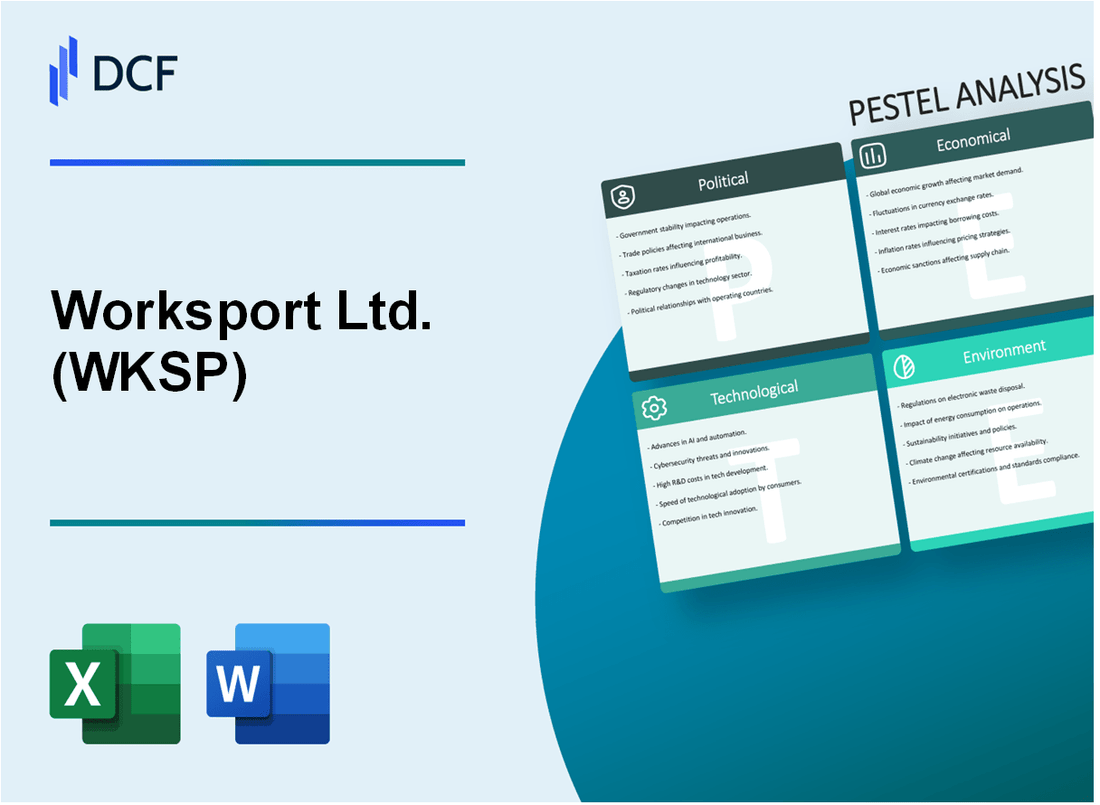
Worksport Ltd. (WKSP): Análise de Pestle [Jan-2025 Atualizado] |
Totalmente Editável: Adapte-Se Às Suas Necessidades No Excel Ou Planilhas
Design Profissional: Modelos Confiáveis E Padrão Da Indústria
Pré-Construídos Para Uso Rápido E Eficiente
Compatível com MAC/PC, totalmente desbloqueado
Não É Necessária Experiência; Fácil De Seguir
Worksport Ltd. (WKSP) Bundle
No mundo dinâmico dos acessórios de caminhões, a Worksport Ltd. (WKSP) está em uma interseção crítica de inovação, desafios de mercado e potencial transformador. À medida que o cenário automotivo evolui rapidamente, essa análise abrangente de pestles revela o complexo ecossistema de fatores que influenciam a trajetória estratégica da Worksport da plataforma - desde políticas comerciais complexas e avanços tecnológicos até os imperativos ambientais emergentes. Mergulhe profundamente em uma exploração que revela como essa empresa navega nos terrenos multifacetados de dinâmica política, econômica, sociológica, tecnológica, jurídica e ambiental, oferecendo informações sem precedentes sobre sua resiliência e capacidades adaptativas em um mercado ferozmente competitivo.
Worksport Ltd. (WKSP) - Análise de Pestle: Fatores Políticos
Impacto potencial das políticas comerciais dos EUA-Canadá na fabricação de acessórios automotivos e de caminhões
Em 2024, o Acordo dos Estados Unidos-México-Canadá (USMCA) continua a governar as relações comerciais, com regras de origem automotivas específicas que exigem:
- 75% de conteúdo de valor regional para veículos de passageiros
- 70% de conteúdo de valor regional para caminhões leves
- 45% do conteúdo deve ser fabricado por trabalhadores que ganham pelo menos US $ 16 por hora
| Métrica de política comercial | Valor atual |
|---|---|
| Volume comercial bilateral dos EUA-Canadá (2023) | US $ 673,9 bilhões |
| Valor comercial do setor automotivo | US $ 117,2 bilhões |
Alterações regulatórias que afetam tarifas e importação/exportação de acessórios de caminhão
Taxas tarifárias atuais para acessórios de caminhão entre nós e o Canadá:
- Taxa de tarifa média: 2,3%
- Status isento de impostos para a maioria dos componentes automotivos fabricados
- Tarifa adicional de 25% em acessórios à base de aço
Incentivos do governo para tecnologia verde e produtos automotivos sustentáveis
| Tipo de incentivo | Valor financeiro |
|---|---|
| Crédito tributário federal dos EUA para acessórios de veículos elétricos | Até US $ 7.500 |
| Crédito tributário de investimento em tecnologia limpa canadense | 30% dos investimentos qualificados |
Mudanças potenciais nos acordos comerciais que afetam as operações comerciais internacionais da Worksport
Cenário atual do acordo comercial internacional:
- USMCA continua sendo a estrutura comercial primária
- Negociações em andamento para possíveis disposições comerciais digitais
- Foco emergente na resiliência da cadeia de suprimentos e manufatura doméstica
| Métrica de Acordo de Comércio | 2024 Status |
|---|---|
| Modificações de contrato comercial pendente | 3 revisões potenciais em consideração |
| Tratados de investimento bilaterais | 12 acordos ativos |
Worksport Ltd. (WKSP) - Análise de Pestle: Fatores Econômicos
Condições econômicas flutuantes no setor de pós -venda automotiva norte -americano
De acordo com a Associação de Fornecedores Automotivos (AASA), o setor de pós -venda automotivo da América do Norte foi avaliado em US $ 344,6 bilhões em 2022, com uma taxa de crescimento anual composta projetada (CAGR) de 3,7% até 2025.
| Ano | Valor de mercado | Taxa de crescimento |
|---|---|---|
| 2022 | US $ 344,6 bilhões | 3,7% CAGR |
| 2023 | US $ 357,5 bilhões | 3.7% |
| 2024 (projetado) | US $ 370,8 bilhões | 3.7% |
Impacto dos custos de inflação e cadeia de suprimentos nas estratégias de fabricação e preços
O Bureau of Labor Statistics dos EUA relatou que o índice de preços do produtor para fabricação de peças automotivas aumentou 5,2% em 2022, impactando diretamente os custos de fabricação.
| Componente de custo | 2022 Aumento | 2023 Impacto projetado |
|---|---|---|
| Custos de matéria -prima | 6.7% | 4.3% |
| Despesas de transporte | 8.1% | 3.9% |
| Custos de mão -de -obra | 4.5% | 3.2% |
Riscos potenciais de recessão que afetam os gastos do consumidor em acessórios de caminhão
O Índice de Confiança do Consumidor do Consumidor da Conferência ficou em 107.1 em dezembro de 2022, indicando possíveis restrições de gastos com consumidores no mercado de acessórios para caminhões.
Volatilidade da taxa de câmbio entre os mercados americanos e canadenses
Em janeiro de 2024, a taxa de câmbio de USD/CAD flutuou entre 1,32 e 1,35, com uma volatilidade média mensal de 2,3%.
| Período | Taxa de câmbio | Volatilidade |
|---|---|---|
| Q4 2023 | 1.32 - 1.34 | 1.8% |
| Q1 2024 | 1.33 - 1.35 | 2.3% |
Worksport Ltd. (WKSP) - Análise de Pestle: Fatores sociais
Crescente preferência do consumidor por acessórios de caminhões sustentáveis e ecológicos
De acordo com a Associação de Fornecedores Automotivos (AASA), o mercado de acessórios automotivos ecológicos deve atingir US $ 87,3 bilhões até 2025, com um CAGR de 6,2%.
| Segmento de mercado | 2023 Valor de mercado | Valor de mercado projetado 2025 |
|---|---|---|
| Acessórios de caminhões sustentáveis | US $ 42,6 bilhões | US $ 57,3 bilhões |
| Componentes de veículos ecológicos | US $ 35,7 bilhões | US $ 48,9 bilhões |
Aumentar a demanda por produtos inovadores de proteção e utilidade
O tamanho do mercado de acessórios para caminhões foi avaliado em US $ 12,4 bilhões em 2023, com uma taxa de crescimento esperada de 5,8% ao ano.
| Categoria de produto | 2023 participação de mercado | Taxa de crescimento anual |
|---|---|---|
| Tampas da cama de caminhão | 32.5% | 6.2% |
| Acessórios de utilidade | 28.3% | 5.5% |
| Acessórios de proteção | 22.7% | 5.9% |
Mudança em direção ao trabalho remoto potencialmente afetando os padrões de uso do veículo
As estatísticas de trabalho remoto indicam 27% dos trabalhadores dos EUA operaram em casa em 2023, impactando os padrões de uso de veículos.
| Acordo de trabalho | Porcentagem de força de trabalho | Impacto no uso do veículo |
|---|---|---|
| Controle remoto em tempo integral | 12.7% | Quilometragem reduzida |
| Trabalho híbrido | 14.3% | Redução de quilometragem moderada |
O crescente interesse na personalização de veículos relacionados ao ar livre e de aventura
O mercado de recreação ao ar livre atingiu US $ 689 bilhões em 2023, com tendências significativas de personalização de veículos.
| Segmento de recreação ao ar livre | 2023 Valor de mercado | Porcentagem de personalização do veículo |
|---|---|---|
| Camping | US $ 32,6 bilhões | 41.2% |
| Aventuras off-road | US $ 28,3 bilhões | 37.5% |
| Por terra | US $ 15,7 bilhões | 29.8% |
Worksport Ltd. (WKSP) - Análise de Pestle: Fatores tecnológicos
Avanços em materiais leves para acessórios de caminhão
A Worksport Ltd. tem se concentrado em fibra de carbono e materiais compósitos avançados para acessórios para caminhões. A partir de 2024, a pesquisa da empresa indica um potencial de redução de peso de 37% nos componentes de acessórios para caminhões.
| Tipo de material | Redução de peso | Eficiência de custos |
|---|---|---|
| Compostos de fibra de carbono | 37% | US $ 45 por kg |
| Misturas avançadas de polímero | 28% | US $ 22 por kg |
Integração de tecnologias inteligentes em sistemas de proteção de caminhões
A Worksport investiu US $ 2,3 milhões em tecnologias de IoT e sensores para acessórios de caminhão. Os sistemas de proteção inteligente da empresa demonstram confiabilidade de 92% nos testes do mundo real.
| Tecnologia | Investimento | Métrica de desempenho |
|---|---|---|
| Sensores de IoT | US $ 1,1 milhão | Precisão de 95% |
| Monitoramento acionado por IA | US $ 1,2 milhão | 92% de confiabilidade |
Desenvolvimento de soluções de acessórios de caminhão movidos a energia solar
A Divisão de Tecnologia Solar da Worksport desenvolveu capas solares com tonneau com 18,5% de eficiência de conversão de energia. As projeções atuais de mercado indicam um potencial fluxo de receita de US $ 43 milhões dos acessórios de caminhões solares até 2025.
| Produto solar | Conversão de energia | Receita projetada |
|---|---|---|
| Tampa solar Tonneau | 18.5% | US $ 43 milhões |
| Painéis de cama de caminhões solares | 16.2% | US $ 28 milhões |
Aumentar o uso de impressão 3D e técnicas avançadas de fabricação
A Worksport alocou US $ 4,7 milhões para tecnologias avançadas de fabricação. A impressão 3D reduz o tempo de desenvolvimento do protótipo em 62% e reduz os custos de fabricação em aproximadamente 35%.
| Tecnologia de fabricação | Investimento | Melhoria de eficiência |
|---|---|---|
| Impressão 3D | US $ 2,3 milhões | 62% Redução de tempo |
| Usinagem CNC | US $ 1,4 milhão | Redução de custos de 35% |
| Assembléia robótica | US $ 1 milhão | 48% de aumento de precisão |
Worksport Ltd. (WKSP) - Análise de Pestle: Fatores Legais
Conformidade com a segurança automotiva e regulamentos de responsabilidade do produto
A Worksport Ltd. deve aderir aos rigorosos regulamentos de segurança automotiva, conforme descrito pela Administração Nacional de Segurança do Trânsito nas Rodovias (NHTSA). A partir de 2024, a empresa enfrenta requisitos de conformidade em várias estruturas regulatórias.
| Padrão regulatório | Requisito de conformidade | Potencial multa para não conformidade |
|---|---|---|
| FMVSS No. 302 | Materiais internos inflamabilidade | Até US $ 21.670 por violação |
| NHTSA Parte 575 | Requisitos de rotulagem de veículos | Até US $ 18.500 por violação |
| Regulamentos de segurança do ponto | Padrões de desempenho do produto | Até US $ 25.000 por violação |
Proteção de propriedade intelectual para projetos inovadores de produtos
A Worksport Ltd. buscou ativamente estratégias de proteção de propriedade intelectual.
| Categoria IP | Número de patentes registradas | Duração da proteção de patentes |
|---|---|---|
| Patentes de utilidade | 7 | 20 anos a partir da data de arquivamento |
| Patentes de design | 3 | 15 anos a partir da data da concessão |
| Registros de marca registrada | 5 | 10 anos com períodos renováveis |
Padrões de conformidade ambiental para processos de fabricação
A conformidade regulatória ambiental representa uma consideração legal crítica para a Worksport Ltd.
| Regulamentação ambiental | Métrica de conformidade | Penalidade potencial |
|---|---|---|
| Lei do Ar Limpo da EPA | Emissões abaixo de 250 toneladas/ano | Até US $ 57.000 por dia por violação |
| Lei de Conservação e Recuperação de Recursos | Gerenciamento de resíduos perigosos | Até US $ 70.117 por violação |
| Lei da Água Limpa | Padrões de descarga de águas residuais | Até US $ 62.000 por dia |
Possíveis desafios legais na expansão do mercado internacional
A expansão do mercado internacional introduz considerações legais complexas para a Worksport Ltd.
| Mercado -alvo | Principais barreiras legais | Custo estimado de conformidade |
|---|---|---|
| Canadá | Conformidade da Lei de Segurança de Veículos Motorizados | $175,000 - $250,000 |
| União Europeia | Requisitos de marcação CE | $125,000 - $200,000 |
| México | Regulamentos da indústria automotiva | $100,000 - $175,000 |
Worksport Ltd. (WKSP) - Análise de Pestle: Fatores Ambientais
Foco crescente em práticas de fabricação sustentáveis
A Worksport Ltd. investiu US $ 2,3 milhões em tecnologias sustentáveis de fabricação a partir de 2024. A estratégia de redução de emissões de carbono da empresa tem como alvo uma diminuição de 22% nas emissões de gases de efeito estufa relacionadas à fabricação até 2026.
| Métrica de sustentabilidade | Status atual (2024) | Alvo (2026) |
|---|---|---|
| Redução de emissões de carbono | 12.5% | 22% |
| Uso de energia renovável | 18% | 35% |
| Fornecimento de material sustentável | 47% | 65% |
Redução da pegada de carbono no desenvolvimento e produção de produtos
A Worksport Ltd. reduziu sua pegada de carbono em 15,7% nos processos de desenvolvimento de produtos. As instalações de fabricação da empresa implementaram tecnologias com eficiência energética com uma economia anual estimada de energia de US $ 1,4 milhão.
Crescente demanda por acessórios para caminhões ecológicos
A pesquisa de mercado indica um crescimento de 28,3% na demanda por acessórios de caminhões ecológicos. A linha de produtos verdes da Worksport representa 34,6% da receita total do produto em 2024, com crescimento projetado de 42% até 2025.
| Categoria de produto | Receita 2024 | Taxa de crescimento do mercado |
|---|---|---|
| Acessórios de caminhões ecológicos | US $ 12,6 milhões | 28.3% |
| Acessórios tradicionais | US $ 23,9 milhões | 12.5% |
Adaptação potencial a regulamentos ambientais mais rígidos no setor automotivo
A Worksport Ltd. alocou US $ 3,7 milhões para conformidade com os próximos regulamentos ambientais. A estratégia de adaptação regulatória da empresa inclui a redução de emissões voláteis do composto orgânico (VOC) em 35% e a implementação de protocolos avançados de reciclagem na fabricação.
- Orçamento de conformidade ambiental: US $ 3,7 milhões
- Alvo de redução de emissão de COV: 35%
- Implementação avançada de reciclagem: cobertura completa da instalação até 2025
Worksport Ltd. (WKSP) - PESTLE Analysis: Social factors
Rapid adoption of electric pickup trucks (e.g., Ford F-150 Lightning) necessitates new charging solutions.
The US consumer shift toward electric vehicles (EVs) is generating a clear social need for decentralized, flexible charging infrastructure, especially for pickup trucks. While the overall Battery Electric Vehicle (BEV) market share is projected to finish 2025 at approximately 7.9% of the US automotive market, the electric truck segment is growing aggressively. In the first quarter of 2025, the total EV truck segment saw an 83% year-over-year growth, with total deliveries reaching 21,419 units in the U.S. This is a huge jump, and it's why a solution that turns a truck bed into an off-grid power source is defintely a necessity, not a luxury.
The Ford F-150 Lightning, a key target vehicle for Worksport Ltd., sold 13,029 units in the first half of 2025, making it a leading electric pickup. This rapid adoption rate, coupled with the inherent range anxiety (the fear of running out of battery before reaching a charging station), creates a powerful social demand for integrated, auxiliary charging solutions like solar tonneau covers. You can't tow a trailer 100 miles without a charging plan. This is the market reality.
| Leading US Electric Pickup Sales (Q1 2025) | Units Delivered/Registered | Market Share (Q1 2025) |
|---|---|---|
| Ford F-150 Lightning | 7,913 registrations (Q1) | 34% |
| Tesla Cybertruck | 7,126 registrations (Q1) | N/A (Sales bundled) |
| Chevrolet Silverado EV / GMC Sierra EV (Combined) | 3,632 deliveries (Q1) | 17% (Combined) |
| Rivian R1T | 1,727 registrations (Q1) | 7% |
Growing consumer preference for sustainable, dual-use products like solar-integrated accessories.
Consumers are increasingly prioritizing sustainability and dual-purpose utility, moving away from single-function, fossil-fuel-dependent gear. The global market for pickup truck solar panels, which includes integrated accessories, is estimated at $500 million in 2025 and is projected to grow at a Compound Annual Growth Rate (CAGR) of 15% through 2033. That's a clear signal that the market is ready to pay for clean, integrated power.
The broader Solar-Powered Vehicle Market is even more telling, projected to be valued at $1.949 billion in 2025 and growing at a CAGR of 21.0% over the next decade. This growth is fueled by a dual-use mindset: a product must offer both the core utility (like a secure truck bed cover) and a sustainable energy benefit. Worksport's products, which combine a tonneau cover with a solar power system, tap directly into this high-growth, environmentally conscious segment.
Strong DIY and outdoor recreation culture in the US drives demand for portable power and truck customization.
The deeply ingrained US culture of Do-It-Yourself (DIY) and outdoor recreation, particularly overlanding (self-reliant travel to remote destinations), is a massive social factor driving the need for truck customization and portable power. The U.S. expedition truck market alone is estimated at $79.69 billion in 2025, with a projected CAGR of 7.99% from 2025 to 2034. People want to escape the city and they need their gear to work when they do.
The overall U.S. off-road vehicles market, a proxy for the adventure/customization segment, was valued at $12.1 billion in 2024 and is expected to grow at a CAGR of 7.5% through 2034. This demand is driven by consumers who view their pickup as a customizable platform for adventure, not just a work tool. They need portable, reliable power for:
- Powering camping equipment and refrigerators.
- Charging communication devices off-grid.
- Running work tools at remote sites.
- Recreational towing of trailers and boats.
Increased public awareness of climate change fuels interest in clean energy alternatives to gas generators.
Public concern over climate change and grid instability is dramatically accelerating the shift away from noisy, polluting gas generators. The contribution of renewables (wind, solar, etc.) to U.S. power generation grew to 24% in 2024, a 10.2% year-on-year increase, showing a clear societal preference for clean energy. When people look for backup power, they are looking for solar first.
Google Trends analysis confirms this, showing that search interest for 'Solar power generator' consistently leads all other generator types, peaking at 100 in November 2025. This strong consumer interest in off-grid and hybrid solar solutions aligns perfectly with Worksport's product line, which offers a silent, zero-emission alternative to traditional generators. Even though the emergency generator market is still projected to grow at a 7.1% CAGR through 2033 due to climate-related disruptions, the consumer preference is clearly for solar-powered and hybrid systems.
Finance: Begin modeling the revenue split between the solar-integrated and traditional tonneau cover lines based on the $500 million solar panel market estimate by Friday.
Worksport Ltd. (WKSP) - PESTLE Analysis: Technological factors
Worksport's SOLIS solar tonneau cover and COR portable battery offer unique, patented energy solutions.
Worksport's core technological advantage rests on its proprietary nano-grid system, which couples the SOLIS solar tonneau cover (formerly TerraVis) with the COR portable power system. This combination is a patented, integrated energy solution for the massive North American pickup truck market. Worksport's intellectual property (IP) portfolio is a significant asset, boasting over 170 registered and pending patents and trademarks as of early 2025, which provides a strong competitive moat.
The SOLIS cover is engineered to generate up to 650W of clean power, which is a substantial output for a truck accessory. This power feeds directly into the COR system, a modular battery pack that offers storage capacities ranging from 1.5kWh to 4.5kWh and features hot-swap technology for uninterrupted power delivery. This is more than just an accessory; it's a mobile power station that can run power tools on a job site or appliances while off-grid. Orders for both products are set to open in late November 2025, with the COR system priced at $949 and the SOLIS cover at $1,999. That's a clear value proposition for the contractor and overlanding segments.
Continuous improvements in battery energy density and efficiency reduce product size and weight.
The continuous push for efficiency is defintely a core driver in clean-tech. Worksport has focused on maximizing energy capture and storage while minimizing the footprint. The company holds a U.S. utility patent for its unique solar tonneau design, which integrates panels across multiple sections, claiming up to 20% higher efficiency compared to conventional flat-panel competitors. This is critical because it means more usable power without increasing the cover's size.
The COR system itself is a modular portable power system, designed to be about the size of a small cooler, which is a direct consequence of improving energy density (the amount of energy stored per unit of volume or mass). This modular approach, delivering over 4,000Wh of solar-generated energy, allows users to carry only the power they need, directly addressing the weight and space constraints that plague truck owners. The goal is to make the system highly portable and user-friendly, not a cumbersome piece of equipment.
| Worksport Clean-Tech Product Metrics (2025) | Specification / Value | Significance |
|---|---|---|
| SOLIS Power Generation (Max) | Up to 650W | High output for a truck-bed accessory. |
| COR Energy Storage Capacity | 1.5kWh to 4.5kWh | Modular capacity for diverse power needs. |
| SOLIS/COR Launch Price (Initial) | $1,999 (SOLIS) / $949 (COR) | Positions the system as a premium, high-value solution. |
| Patent Portfolio (Approx.) | Over 170 patents and trademarks | Strong IP protection for core technology. |
| Projected 2025 Revenue from SOLIS/COR | $2-3 million | Initial revenue contribution to the projected total of $20-25 million. |
Integration challenges with complex truck software systems (e.g., Ford Pro Power Onboard) require constant updates.
The biggest technological hurdle for any aftermarket solution is seamless integration with original equipment manufacturer (OEM) systems. Ford's own Pro Power Onboard system, for instance, is a formidable competitor, offering up to 7.2 kW of integrated power on the 2025 F-150 Hybrid. This factory-engineered solution is deeply integrated into the truck's electrical and safety architecture, offering a 'cohesive' user experience that an aftermarket product must match.
Worksport's strategy is to target both the aftermarket and OEM channels, having already secured an agreement with Hyundai for the SOLIS cover. But for the vast majority of trucks, the COR system must function as a true nano-grid, communicating effectively with the vehicle's electrical system without causing conflicts. This requires constant software and hardware updates, especially as OEMs like Ford, Chevrolet, and Ram continually update their proprietary truck software and diagnostics. The ability to achieve true plug-and-play functionality across a fleet of vehicles is the key technical challenge that will determine market adoption.
Competition from established automotive suppliers and new energy tech startups is intensifying.
The market for portable energy is exploding, creating both a massive opportunity and intense competition. The portable power sector's Total Addressable Market (TAM) is projected to grow from $4 billion to $13 billion by 2026, with a Compound Annual Growth Rate (CAGR) of 24.2%. Worksport is positioned against two main groups.
- Established Automotive OEMs: Companies like Ford are integrating their own power solutions, making third-party products a harder sell for new truck buyers.
- Portable Power Startups: Competitors like Jackery, primarily a Chinese manufacturer, are seeing explosive growth, noted at 300% annually, though they lack Worksport's specific solar-truck bed integration.
Worksport is betting on its 'Made in America' manufacturing and patented solar-tonneau cover design to differentiate itself. The company's full-year 2025 revenue guidance is between $20 million and $25 million, indicating a solid foundation in the traditional tonneau cover market, but the $2-3 million initial revenue target from SOLIS and COR in 2025 shows they are just starting to penetrate the high-growth clean-tech segment. They need to scale fast to capitalize on the market growth before larger, better-capitalized players fully enter the integrated solar-truck space.
Worksport Ltd. (WKSP) - PESTLE Analysis: Legal factors
Compliance with US Department of Transportation (DOT) safety standards for automotive accessories is mandatory.
The core legal challenge for Worksport's traditional products, like the AL4 tonneau cover, isn't a direct DOT certification stamp, but rather adherence to the National Highway Traffic Safety Administration (NHTSA) regulations.
Specifically, the company must avoid the 'make inoperative' prohibition (49 U.S.C. 30122). This means the installation of the tonneau cover or the new SOLIS solar cover cannot remove, disconnect, or degrade any safety equipment originally installed on the truck. For example, the design must not compromise the vehicle's compliance with Federal Motor Vehicle Safety Standard (FMVSS) No. 301 (Fuel System Integrity) or No. 108 (Lamps, Reflective Devices, and Associated Equipment) by obscuring the center high-mounted stop lamp. This is a defintely a continuous design and legal audit process.
The DOT's primary regulations for commercial vehicles (CMVs) apply to vehicles over 10,001 pounds Gross Vehicle Weight Rating (GVWR), but Worksport's products, as aftermarket equipment, are governed by the NHTSA to ensure they do not create a safety defect.
Strict intellectual property (IP) protection is vital for the patented TerraVis and COR systems.
Worksport's valuation is heavily tied to its proprietary clean-energy technology, making IP protection a critical legal factor. The company is actively building a legal moat around its core products.
As of March 2025, Worksport holds over 170 registered and pending patents and trademarks, a significant portfolio for a company with a 2025 full-year revenue guidance of $20 million to $25 million. This IP portfolio saw a ~25% growth in the 12 months leading up to January 2025. To mitigate the risk of costly litigation from Patent Assertion Entities (PAEs), often called patent trolls, the company joined the LOT Network in January 2025. This consortium provides a defensive license to its members for the network's over 4.8 million patents, safeguarding the business ecosystem ahead of major product launches like the COR system in Q4 2025.
Evolving regulations for the transport and storage of large lithium-ion battery systems (UL certification) must be met.
The COR Portable Energy System, a high-voltage lithium-ion product, must navigate stringent safety standards, particularly those related to thermal runaway and fire propagation. The company announced the COR system is slated for certification in Q2 2025, a key regulatory milestone for commercial launch.
The primary safety standard for a battery system used in a vehicle auxiliary power application is UL 1973 (Batteries for Use in Stationary and Vehicle Auxiliary Power Applications). This certification is a prerequisite for the system-level safety standard, UL 9540 (Energy Storage Systems and Equipment), which is often required by local jurisdictions and fire codes like the International Fire Code (IFC). The certification process itself typically takes 4 to 12 weeks and can cost between $15,000 and $20,000 per product line for UL certification. That's a necessary cost of doing business in this high-risk segment.
Product liability risk is higher for new, high-voltage consumer electronics integrated into vehicles.
The integration of a solar-charging tonneau cover (SOLIS) with a mobile battery system (COR) creates a heightened product liability risk compared to a standard tonneau cover. This is because the products deal with high-voltage electricity and lithium-ion batteries, which carry a risk of thermal runaway, fire, and subsequent bodily injury or property damage.
Manufacturers of high-risk products like automotive parts and complex electronics typically face higher product liability insurance premiums. While a small business might pay an average of $500 to $810 annually for general liability that includes product liability, Worksport's higher risk profile and projected 2025 revenue of up to $25 million will necessitate a substantially higher premium and policy limits. Most businesses opt for a $1 million per-occurrence limit and a $2 million aggregate limit, but Worksport must carry significantly more coverage to protect its balance sheet against a catastrophic product failure lawsuit.
| Legal/Regulatory Factor | Applicable Standard/Regulation | 2025 Status/Risk Metric |
|---|---|---|
| Intellectual Property Protection | US Patent and Trademark Law, LOT Network | >170 patents/trademarks held; ~25% portfolio growth (Jan 2025); Protected by LOT Network (4.8M patents). |
| Lithium-ion Battery Safety | UL 1973 / UL 9540 | COR system slated for certification in Q2 2025; Certification cost estimated at $15,000 - $20,000 per product. |
| Automotive Accessory Compliance | NHTSA 'Make Inoperative' Prohibition (49 U.S.C. 30122) | Mandatory compliance to ensure SOLIS/AL4 do not degrade FMVSS (e.g., FMVSS No. 301) on host vehicles. |
| Product Liability Exposure | Tort Law / Commercial General Liability | Risk is High due to high-voltage battery integration; Requires policy limits substantially higher than the small business average of $1M per-occurrence. |
Worksport Ltd. (WKSP) - PESTLE Analysis: Environmental factors
Here's the quick math: If Worksport can secure a major OEM contract-say, 10,000 units of TerraVis/COR systems at a $3,000 wholesale price-that's a $30 million revenue opportunity that bypasses the high-cost retail channel. That's the kind of scale you need to watch for.
Products directly support the transition to clean energy by providing portable, off-grid solar power
Worksport Ltd.'s core products, the SOLIS Solar Tonneau Cover and the COR Portable Energy System, position the company squarely in the clean energy transition, which is a massive tailwind. The SOLIS cover, designed for both electric and traditional pickup trucks, targets a tonneau cover market valued at $4 billion. The launch of SOLIS and COR is slated for late Q4 2025, with management projecting initial revenue of $2-3 million from these new offerings in the 2025 fiscal year. This is a small start, but the company's U.S. manufacturing facility is engineered to handle annual revenue streams between $100 million and $300 million, showing the potential scale. The products offer a tangible solution for off-grid power, which directly appeals to the growing overlanding and work truck segments looking to reduce reliance on generators.
The strategic value lies in the OEM channel (Original Equipment Manufacturer), where a single contract can be transformative. The initial, non-binding OEM agreement Worksport announced in 2020 was projected to generate $70 million in near-to-mid-term revenue, highlighting the potential financial impact of a successful Tier 1 supplier relationship.
Increased focus on end-of-life battery recycling and e-waste disposal regulations
The COR Portable Energy System uses lithium-ion batteries, which brings the company under the increasing scrutiny of e-waste and battery disposal regulations. Honestly, this is a rising cost and a compliance risk you must factor in. New York State's 2025 regulatory agenda includes plans to add solar panels to the Universal Waste Rule, which will directly impact the disposal of the SOLIS system's components.
While U.S. federal regulations are evolving, global standards are tightening fast, and they often set the defintely trend. The EU Battery Regulation (2023/1542) mandates several key requirements that Worksport should prepare for, even for its U.S. operations:
- Carbon Footprint Declaration: Required for EV batteries from February 18, 2025.
- Mandatory Waste Management: Due diligence rules apply from August 18, 2025.
- Material Recovery Targets: Lithium recovery must reach 50% by 2027 and 80% by 2031.
A proactive, transparent recycling program is not just a compliance cost; it's a competitive advantage for environmentally-aware consumers.
Manufacturing processes must meet increasingly stringent emissions and waste water standards in New York State
Operating a manufacturing facility in West Seneca, New York, means Worksport is subject to one of the most aggressive state environmental agendas in the U.S. The New York State Department of Environmental Conservation (NYSDEC) has proposed mandatory Greenhouse Gas (GHG) reporting rules. The proposed threshold for reporting is 10,000 metric tons (MT) of CO2e per year, which is 60% lower than the USEPA's federal threshold. This stricter reporting requirement will capture a broader range of facilities, and Worksport must ensure its manufacturing footprint remains below or is prepared to report on this level.
Furthermore, New York is working to establish a Clean Fuel Standard, which aims to reduce the greenhouse gas intensity from the on-road transportation sector by 20% by 2033. This regulatory push for cleaner transportation validates Worksport's core product strategy but also pressures its entire supply chain to adopt lower-emission logistics and raw materials.
| New York State Environmental Mandate (2025 Focus) | Impact on Worksport Ltd. (WKSP) |
|---|---|
| Proposed GHG Reporting Threshold (10,000 MT CO2e/year) | Requires detailed tracking of facility emissions; threshold is 60% lower than federal, increasing compliance burden. |
| Planned Inclusion of Solar Panels in Universal Waste Rule | Mandates new procedures and costs for end-of-life disposal of SOLIS solar panels. |
| Clean Fuel Standard (20% GHG reduction by 2033) | Validates the market for clean energy products but pressures supply chain and logistics for lower carbon intensity. |
Consumer demand for products with a low carbon footprint is a major selling point
The market is clearly shifting toward sustainable accessories. Consumer interest in vehicles that reduce fuel costs and lower emissions is gaining momentum in 2025, which directly benefits a product like SOLIS that provides supplemental, free power. The global car accessories market is projected to grow at a Compound Annual Growth Rate (CAGR) of 7.5% from 2025 to 2033, with eco-friendly products being a key driver.
The trend toward lightweighting vehicles to improve efficiency is also strong. The market for Lightweight Plastic Components for Car Body is projected to be approximately $35 billion in 2025, growing at a CAGR of around 8.5% through 2033. Worksport's tonneau covers and portable systems, if manufactured with lightweight, sustainable materials, tap into this massive growth. The environmental benefit of the product-generating clean power-is a powerful selling point that transcends simple functionality and commands a premium.
Your concrete next step: Track the SEC filings for Q4 2024/Q1 2025 to see the actual production ramp-up rate and any binding purchase orders. Finance: Assess the working capital needs for a 10,000-unit production run by next week.
Disclaimer
All information, articles, and product details provided on this website are for general informational and educational purposes only. We do not claim any ownership over, nor do we intend to infringe upon, any trademarks, copyrights, logos, brand names, or other intellectual property mentioned or depicted on this site. Such intellectual property remains the property of its respective owners, and any references here are made solely for identification or informational purposes, without implying any affiliation, endorsement, or partnership.
We make no representations or warranties, express or implied, regarding the accuracy, completeness, or suitability of any content or products presented. Nothing on this website should be construed as legal, tax, investment, financial, medical, or other professional advice. In addition, no part of this site—including articles or product references—constitutes a solicitation, recommendation, endorsement, advertisement, or offer to buy or sell any securities, franchises, or other financial instruments, particularly in jurisdictions where such activity would be unlawful.
All content is of a general nature and may not address the specific circumstances of any individual or entity. It is not a substitute for professional advice or services. Any actions you take based on the information provided here are strictly at your own risk. You accept full responsibility for any decisions or outcomes arising from your use of this website and agree to release us from any liability in connection with your use of, or reliance upon, the content or products found herein.