
|
Waste Management, Inc. (WM): Modelo de Negócios Canvas [Jan-2025 Atualizado] |
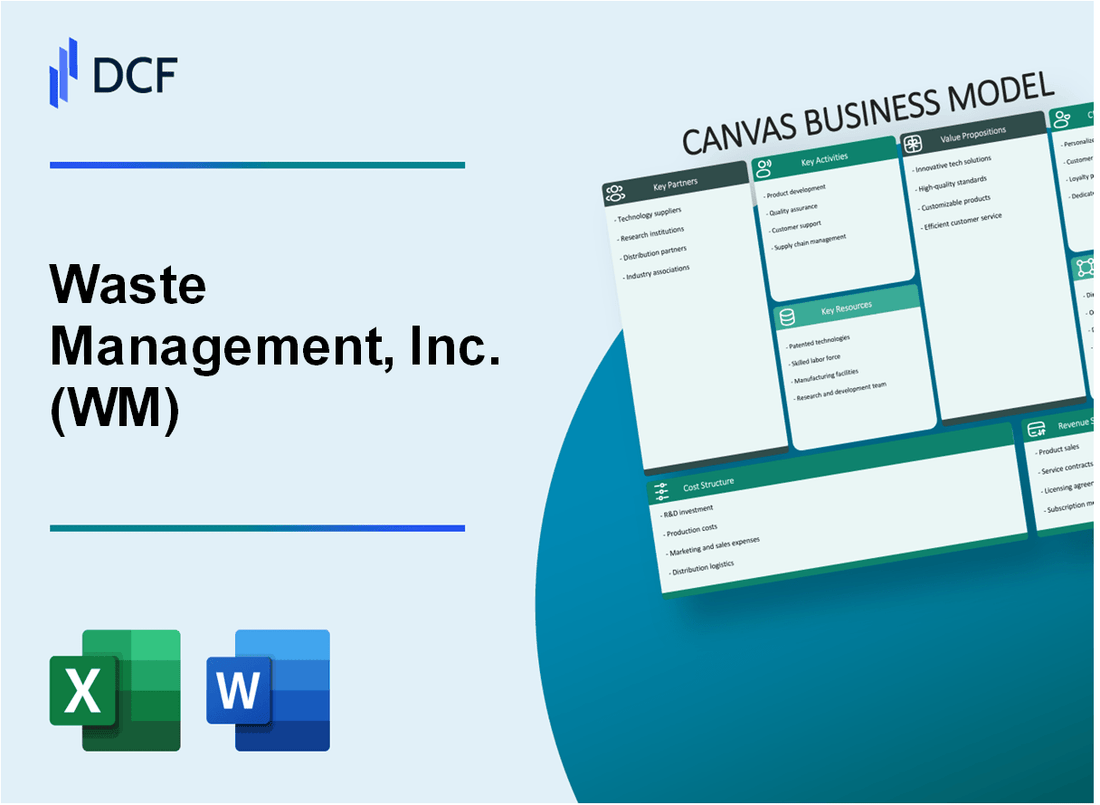
Totalmente Editável: Adapte-Se Às Suas Necessidades No Excel Ou Planilhas
Design Profissional: Modelos Confiáveis E Padrão Da Indústria
Pré-Construídos Para Uso Rápido E Eficiente
Compatível com MAC/PC, totalmente desbloqueado
Não É Necessária Experiência; Fácil De Seguir
Waste Management, Inc. (WM) Bundle
No complexo mundo da gestão de resíduos, a Waste Management, Inc. (WM) permanece como uma potência transformadora, revolucionando como as sociedades lidam com seus desafios ambientais. Essa gigante da indústria criou meticulosamente um modelo de negócios que transcende o descarte tradicional de resíduos, integrando tecnologias de ponta, práticas sustentáveis e soluções de serviço abrangentes que tocam todos os setores de bairros residenciais a complexos industriais maciços. Ao reimaginar os resíduos não como um problema, mas como um recurso em potencial, a WM se posicionou na vanguarda da inovação ambiental, criando valor por meio de parcerias estratégicas, tecnologias avançadas de reciclagem e uma abordagem holística para o gerenciamento de resíduos que promete eficiência econômica e responsabilidade ecológica.
Waste Management, Inc. (WM) - Modelo de Negócios: Principais Parcerias
Municípios e governos locais para contratos de cobrança de resíduos
A Waste Management, Inc. possui contratos de coleta de resíduos diretos com 2.325 municípios nos Estados Unidos a partir de 2023. A empresa gerencia serviços de resíduos para aproximadamente 20 milhões de clientes residenciais e 5,1 milhões de clientes comerciais.
| Tipo de contrato | Número de municípios | Valor anual do contrato |
|---|---|---|
| Coleta municipal de resíduos | 2,325 | US $ 3,4 bilhões |
| Serviços de Resíduos Comerciais | 5.100 cidades | US $ 2,9 bilhões |
Instalações de reciclagem e centros de recuperação de materiais
A WM opera 146 instalações de recuperação de materiais (MRFs) com uma capacidade total de processamento de 24,5 milhões de toneladas de materiais recicláveis anualmente.
- Facilidades totais de reciclagem: 146
- Capacidade anual de processamento de reciclagem: 24,5 milhões de toneladas
- Receita de reciclagem em 2023: US $ 1,6 bilhão
Operadores de descarte de resíduos e aterros sanitários
| Propriedade de aterros sanitários | Número de sites | Capacidade total |
|---|---|---|
| Aterradores de propriedade | 244 | 1,8 bilhão de jardas cúbicas |
| Aterros gerenciados | 98 | 0,7 bilhões de jardas cúbicas |
Provedores de tecnologia para soluções de gerenciamento de resíduos
A WM investiu US $ 287 milhões em tecnologia e infraestrutura digital em 2023, em parceria com 42 empresas de tecnologia especializadas em soluções de gerenciamento de resíduos.
- Investimento de tecnologia: US $ 287 milhões
- Número de parceiros de tecnologia: 42
- Principais áreas de foco em tecnologia: sensores de IoT, otimização de rotas, sistemas de rastreamento digital
Empresas de consultoria ambiental e sustentabilidade
O gerenciamento de resíduos colabora com 28 empresas de consultoria ambiental para aprimorar as iniciativas de sustentabilidade e desenvolver estratégias inovadoras de gerenciamento de resíduos.
| Foco em parceria | Número de parceiros | Investimento anual de sustentabilidade |
|---|---|---|
| Consultoria Ambiental | 28 | US $ 124 milhões |
| Pesquisa de sustentabilidade | 15 | US $ 76 milhões |
Waste Management, Inc. (WM) - Modelo de Negócios: Atividades -chave
Serviços de coleta de resíduos residenciais e comerciais
A Waste Management, Inc. opera 367 locais de coleta na América do Norte. Em 2023, a empresa gerenciou:
| Tipo de serviço | Volume anual |
|---|---|
| Coleção de resíduos residenciais | 93,4 milhões de toneladas |
| Coleta de resíduos comerciais | 62,7 milhões de toneladas |
Operações de reciclagem e classificação de resíduos
A empresa mantém:
- 259 Instalações de recuperação de materiais
- Processos 20,3 milhões de toneladas de materiais recicláveis anualmente
- Opera tecnologias avançadas de classificação em 42 estados
Gerenciamento de aterros e conformidade ambiental
| Métricas de aterro | 2023 dados |
|---|---|
| Total de aterros possuídos | 247 instalações |
| Capacidade total do aterro | 8,4 bilhões de jardas cúbicas |
| Descarte anual de resíduos | 131,5 milhões de toneladas |
Geração de energia renovável de resíduos
O gerenciamento de resíduos gera energia renovável através de:
- 293 Projetos de gás para energia de aterros sanitários
- Geração anual de eletricidade: 550 megawatts
- Serve aproximadamente 462.000 casas com energia renovável
Desenvolvimento de tecnologias sustentáveis de gerenciamento de resíduos
| Investimento em tecnologia | 2023 Métricas |
|---|---|
| Despesas de P&D | US $ 87,3 milhões |
| Novos projetos piloto de tecnologia | 16 iniciativas ativas |
| Tecnologias de redução de carbono | 9 Soluções implementadas |
Waste Management, Inc. (WM) - Modelo de negócios: Recursos -chave
Extensa frota de veículos de coleta de resíduos
A partir de 2023, a Waste Management, Inc. opera uma frota de aproximadamente 26.000 coleta e veículos especializados. A frota inclui:
| Tipo de veículo | Quantidade |
|---|---|
| Caminhões de carga traseira | 8,500 |
| Caminhões de carga frontal | 6,200 |
| Caminhões de carga lateral | 5,300 |
| Caminhões de rolagem | 4,000 |
| Veículos de reciclagem especializados | 2,000 |
Instalações avançadas de processamento e reciclagem de resíduos
O gerenciamento de resíduos mantém 260 aterros ativos de resíduos sólidos, 5 instalações de resíduos em energia e 146 instalações de reciclagem em toda a América do Norte.
- Área total de aterros sanitários: 41.000 acres
- Capacidade anual de processamento de resíduos: 96 milhões de toneladas
- Capacidade anual de processamento de reciclagem: 15,3 milhões de toneladas
Tecnologias proprietárias de gerenciamento de resíduos
Os principais investimentos tecnológicos incluem:
- Conversão de frota de GNV: 8.000 veículos a gás natural
- Sistemas de captura de gás de aterro: 130 Projetos ativos de aterro sanitário ativo
- Sistemas de rastreamento de resíduos digitais: Plataformas de otimização de rota em tempo real e gerenciamento de ativos
Força de trabalho qualificada e experiência ambiental
Composição da força de trabalho a partir de 2023:
| Categoria de funcionários | Número de funcionários |
|---|---|
| Total de funcionários | 50,600 |
| Drivers de coleção | 18,500 |
| Técnicos de instalação | 12,300 |
| Equipe de gerenciamento e suporte | 19,800 |
Rede extensa de sites de descarte e reciclagem
Cobertura geográfica e distribuição do site:
- Presença dos Estados Unidos: Operações em 48 estados
- Operações canadenses: 6 províncias
- Sites totais de descarte e reciclagem: 413
Waste Management, Inc. (WM) - Modelo de Negócios: Proposições de Valor
Soluções abrangentes de gerenciamento de resíduos
A Waste Management, Inc. gerou US $ 20,1 bilhões em receita total em 2022, com serviços de coleta de resíduos representando uma parcela significativa de seu modelo de negócios.
| Categoria de serviço | Receita anual | Quota de mercado |
|---|---|---|
| Coleção de resíduos residenciais | US $ 7,4 bilhões | 35% |
| Coleta de resíduos comerciais | US $ 6,8 bilhões | 32% |
| Serviços de Resíduos Industriais | US $ 4,9 bilhões | 23% |
Sustentabilidade ambiental e redução de pegada de carbono
Em 2022, a Waste Management, Inc. relatou:
- Emissões reduzidas de gases de efeito estufa em 1,8 milhão de toneladas métricas
- Gerou 7,5 milhões de megawatts-horas de energia renovável a partir de gás de aterro sanitário
- Desviado 20,4 milhões de toneladas de materiais de aterros de aterros através da reciclagem
Serviços de coleta de resíduos eficientes e confiáveis
Estatísticas operacionais para 2022:
- Locais de coleção 367 operados
- Manteve uma frota de 26.000 veículos de coleta
- Serviu mais de 21 milhões de clientes residenciais e comerciais
Reciclagem inovadora e tecnologias de desperdício em energia
| Tecnologia | Capacidade anual | Impacto ambiental |
|---|---|---|
| Aterro sanitário de aterro a energia | 550 MW | Equivalente a alimentar 440.000 casas |
| Processamento de reciclagem | 16,3 milhões de toneladas | Emissões de carbono reduzidas em 1,2 milhão de toneladas métricas |
Estratégias de gerenciamento de resíduos econômicas
Métricas de eficiência financeira para 2022:
- Receita operacional: US $ 2,6 bilhões
- Lucro líquido: US $ 1,7 bilhão
- Margem operacional: 13,2%
Waste Management, Inc. (WM) - Modelo de Negócios: Relacionamentos do Cliente
Contratos de serviço municipal e comercial de longo prazo
A Waste Management, Inc. opera aproximadamente 261 operações de coleta em toda a América do Norte. Em 2023, a empresa atende mais de 20 milhões de clientes residenciais, comerciais e industriais.
| Tipo de contrato | Número de contratos | Receita anual |
|---|---|---|
| Contratos municipais | 147 | US $ 3,2 bilhões |
| Contratos comerciais | 114 | US $ 5,7 bilhões |
Suporte ao cliente e consultoria de gerenciamento de resíduos
O gerenciamento de resíduos fornece suporte ao cliente dedicado por meio de vários canais:
- 24/7 de atendimento ao cliente Centers
- Suporte de bate -papo online
- Gerenciamento de conta dedicado para grandes clientes comerciais
- Serviços de consultoria de gerenciamento de resíduos técnicos
Plataformas digitais para gerenciamento de serviços
Recursos de plataforma digital a partir de 2024:
| Serviço digital | Taxa de adoção do usuário | Transações por mês |
|---|---|---|
| Aplicativo móvel | 68% | 1,2 milhão |
| Gerenciamento de contas on -line | 72% | 2,3 milhões |
Engajamento comunitário e educação ambiental
A gestão de resíduos investiu US $ 12,3 milhões em programas de educação ambiental em 2023, atingindo mais de 500.000 estudantes e membros da comunidade.
Soluções de gerenciamento de resíduos personalizados
As ofertas de serviços especializadas incluem:
- Gerenciamento de resíduos industriais
- Manuseio de resíduos perigosos
- Programas de otimização de reciclagem
- Consultoria de Sustentabilidade
| Tipo de solução | Número de clientes | Receita anual |
|---|---|---|
| Soluções de Resíduos Industriais | 1,247 | US $ 1,8 bilhão |
| Otimização de reciclagem | 876 | US $ 942 milhões |
Waste Management, Inc. (WM) - Modelo de Negócios: Canais
Equipe de vendas diretas para clientes comerciais e municipais
A partir de 2024, o gerenciamento de resíduos mantém uma força de vendas dedicada de aproximadamente 3.500 representantes de vendas diretas direcionadas aos clientes comerciais e municipais.
| Tipo de canal de vendas | Número de representantes | Receita anual média por representante |
|---|---|---|
| Serviços de Resíduos Comerciais | 2,250 | US $ 1,2 milhão |
| Serviços de Resíduos Municipais | 1,250 | US $ 1,5 milhão |
Portal de clientes on -line e aplicativos móveis
As plataformas digitais da Waste Management atendem aproximadamente 8,5 milhões de usuários ativos em 2024.
- Downloads de aplicativos móveis: 3,2 milhões
- Usuários ativos mensais do portal online: 5,3 milhões
- Transações de serviço digital: 62% do total de interações com os clientes
Centros de atendimento ao cliente
| Métrica de call center | 2024 Performance |
|---|---|
| Tota de call centers | 12 em todo o país |
| Volume anual de chamada | 18,6 milhões de ligações |
| Tempo médio de resposta | 2,7 minutos |
Centros locais de coleta e descarte de resíduos
O gerenciamento de resíduos opera 293 centros de coleta ativos nos Estados Unidos em 2024.
- Estações de transferência: 146
- Instalações de reciclagem: 97
- Sites de aterro: 50
Plataformas de marketing e comunicação digital
| Plataforma digital | Seguidores/engajamento |
|---|---|
| 185.000 seguidores | |
| 76.500 seguidores | |
| 210.000 seguidores | |
| 95.000 seguidores |
Waste Management, Inc. (WM) - Modelo de negócios: segmentos de clientes
Clientes de coleta de resíduos residenciais
A partir de 2023, o gerenciamento de resíduos atende a aproximadamente 21 milhões de clientes residenciais na América do Norte. A base de clientes inclui:
| Tipo de cliente | Número de clientes |
|---|---|
| Casas unifamiliares | 16,5 milhões |
| Unidades residenciais multifamiliares | 4,5 milhões |
Governos municipais e entidades públicas
Contratos de gerenciamento de resíduos com mais de 2.800 municípios e organizações do setor público, fornecendo serviços abrangentes de gerenciamento de resíduos.
- Valor anual de contratos municipais: US $ 1,2 bilhão
- Duração média do contrato: 5-7 anos
- Regiões de serviço: 50 estados e 5 províncias canadenses
Empresas comerciais e industriais
A WM atende a aproximadamente 260.000 clientes comerciais comerciais e industriais em vários setores.
| Segmento da indústria | Porcentagem de clientes comerciais |
|---|---|
| Varejo | 22% |
| Fabricação | 18% |
| Assistência médica | 15% |
| Serviços de alimentação | 12% |
| Outras indústrias | 33% |
Geradores de resíduos de construção e demolição
O gerenciamento de resíduos lida com aproximadamente 40 milhões de toneladas de resíduos de construção e demolição anualmente.
- Volume de resíduos de construção: 25 milhões de toneladas
- Volume de desperdício de demolição: 15 milhões de toneladas
- Taxa de reciclagem para resíduos de construção: 35%
Buscadores de serviços de gerenciamento de resíduos especializados
A WM fornece serviços especializados de gerenciamento de resíduos para necessidades exclusivas do cliente.
| Serviço especializado | Receita anual |
|---|---|
| Gerenciamento de resíduos perigosos | US $ 450 milhões |
| Descarte de resíduos médicos | US $ 280 milhões |
| Reciclagem de resíduos eletrônicos | US $ 180 milhões |
Waste Management, Inc. (WM) - Modelo de negócios: estrutura de custos
Manutenção da frota de veículos e despesas de combustível
Em 2023, a Waste Management, Inc. registrou despesas totais relacionadas à frota de US $ 1,2 bilhão. A empresa opera aproximadamente 26.000 veículos de cobrança e descarte, com custos anuais de combustível atingindo US $ 480 milhões.
| Categoria de despesa | Custo anual |
|---|---|
| Manutenção do veículo | US $ 720 milhões |
| Despesas de combustível | US $ 480 milhões |
| Total de despesas de frota | US $ 1,2 bilhão |
Operação de aterro e custos de conformidade ambiental
As despesas operacionais de conformidade e aterro ambiental para gerenciamento de resíduos totalizaram US $ 675 milhões em 2023.
- Manutenção do aterro: US $ 425 milhões
- Monitoramento e conformidade ambiental: US $ 250 milhões
Salários trabalhistas e de funcionários
Os custos totais de mão -de -obra para gerenciamento de resíduos em 2023 foram de US $ 3,1 bilhões, cobrindo aproximadamente 50.000 funcionários.
| Categoria de funcionários | Salário médio anual |
|---|---|
| Drivers de coleção | $68,500 |
| Operadores de aterro | $62,300 |
| Equipe administrativo | $85,200 |
Investimentos de tecnologia e infraestrutura
A gestão de resíduos investiu US $ 425 milhões em tecnologia e infraestrutura em 2023.
- Sistemas de rastreamento de resíduos digitais: US $ 125 milhões
- Atualizações das instalações de reciclagem: US $ 200 milhões
- Melhorias da tecnologia da frota: US $ 100 milhões
Despesas operacionais de reciclagem e processamento de resíduos
Os custos operacionais totais de reciclagem e processamento de resíduos foram de US $ 850 milhões em 2023.
| Categoria de processamento | Custo operacional anual |
|---|---|
| Processamento de reciclagem | US $ 525 milhões |
| Instalações de classificação de resíduos | US $ 225 milhões |
| Manuseio especializado em resíduos | US $ 100 milhões |
Waste Management, Inc. (WM) - Modelo de negócios: fluxos de receita
Taxas de serviço de cobrança de resíduos
Em 2023, a Waste Management, Inc. relatou receitas totais de serviço de US $ 19,74 bilhões em serviços de cobrança. O colapso inclui:
| Segmento de serviço | Receita ($ m) |
|---|---|
| Coleção residencial | 6,850 |
| Coleção comercial | 8,230 |
| Coleção industrial | 4,660 |
Vendas de materiais de reciclagem
As vendas de materiais de reciclagem geraram US $ 1,2 bilhão em receita para 2023, com a seguinte quebra de material:
- Papel reciclado: US $ 420 milhões
- Plásticos reciclados: US $ 350 milhões
- Metais reciclados: US $ 280 milhões
- Outros materiais reciclados: US $ 150 milhões
Geração de eletricidade de desperdício em energia
A geração de eletricidade de desperdício em energia produziu US $ 540 milhões em receita para 2023, com:
| Fonte de energia | Receita ($ m) | Megawatts gerados |
|---|---|---|
| Gás de aterro | 310 | 285 |
| Resíduos sólidos municipais | 230 | 210 |
Acusações de descarte de aterros sanitários
As acusações de descarte de aterros totalizaram US $ 3,6 bilhões em 2023, com a seguinte distribuição geográfica:
| Região | Receita ($ m) |
|---|---|
| Estados Unidos do sul | 1,450 |
| Oeste dos Estados Unidos | 980 |
| Nordeste dos Estados Unidos | 720 |
| Centro -Oeste dos Estados Unidos | 450 |
Receitas de serviço de consultoria e sustentabilidade
Os serviços de consultoria e sustentabilidade geraram US $ 420 milhões em receita para 2023, incluindo:
- Consultoria Ambiental: US $ 210 milhões
- Serviços de estratégia de sustentabilidade: US $ 150 milhões
- Consultoria de redução de resíduos: US $ 60 milhões
Fluxos totais de receita para 2023: US $ 25,46 bilhões
Waste Management, Inc. (WM) - Canvas Business Model: Value Propositions
You're looking at the core reasons customers choose Waste Management, Inc. (WM) over competitors, grounded in their massive scale and strategic moves like the Stericycle purchase. This isn't just trash hauling; it's about integrated environmental services delivery across the continent.
Integrated, single-source environmental solutions across North America
Waste Management, Inc. offers a comprehensive suite of services, leveraging its position as North America's largest waste hauler. The company holds a mid-to-high teens percentage market share across North America's largest landfill network, which helps enable higher internalization rates for their collected waste streams. This scale is reflected in their market dominance, with a reported 35.47% U.S. market share as of Q1 2025. The Collection segment remains the backbone, contributing $3.86 billion in revenue in Q2 2025.
Here's a snapshot of the operational scale supporting this single-source claim:
| Metric | Value (As of late 2025 Data) | Source Context |
| Q2 2025 Total Revenue | $6.43 billion | Year-over-year growth of 19.0% |
| North America Waste Management Market Size (Est.) | USD 210.31 billion | Expected size for 2025 |
| Collection Segment Revenue Share (2024) | 64.69% | Largest service type segment |
| U.S. Market Share (Q1 2025) | 35.47% | Underscores market dominance |
This sheer size means Waste Management, Inc. can manage complex, multi-faceted waste needs for large customers who prefer one provider for collection, recycling, and disposal.
Reliable, essential service with high regulatory compliance standards
The essential nature of the service is reinforced by high barriers to entry, largely due to strict regulations and the company's established asset base. The company's legacy business achieved an operating EBITDA margin of 32% in Q3 2025. Waste Management, Inc. has demonstrated consistent operational performance, with operating expenses as a percentage of revenue at 60.5% in Q1 2025. The company's commitment to compliance is a key differentiator, especially as new regulations like Extended Producer Responsibility (EPR) programs accelerate adoption of circular economy models, with 15+ U.S. states expected to implement them by year-end 2025.
Key elements of reliability include:
- Achieving a gross profit margin of nearly 40% over the last twelve months.
- Maintaining a stable customer churn rate around 9% in Q1 2025.
- Anticipating a 2027 revenue target of up to $29 billion.
Leadership in sustainability via RNG production and advanced recycling
Sustainability is a core growth engine, not just a compliance function. The WM Renewable Energy segment surged 36.2% YoY in Q2 2025. Landfill gas utilization has expanded to 6.5 million MMBtu annually. Furthermore, by 2024, 74% of their alternative fuel collection fleet ran on Renewable Natural Gas (RNG). The company sees significant upside here, with planned RNG facility buildout potentially netting an adjusted operating EBITDA of up to $500 million by 2027 from RNG investments alone. The company expects RNG innovations to help reach a $29 billion revenue target by 2027.
Specialized medical and hazardous waste management (post-Stericycle)
The November 2024 acquisition of Stericycle for a total enterprise value of approximately $7.2 billion instantly elevated Waste Management, Inc.'s capabilities in regulated medical waste. This integration created the WM Healthcare Solutions division, which reported $646 million in revenue in Q2 2025. The deal is expected to boost EBITDA margins to the mid-20% range over the medium to long term. Cost synergy expectations from the deal were raised to $250 million, with cross-selling opportunities expected to contribute $50 million in incremental adjusted operating EBITDA by 2027. This move positions Waste Management, Inc. to capitalize on the projected $3.6 billion to $3.8 billion U.S. medical waste management market by 2028 and beyond.
Predictable, disciplined pricing for long-term customer budgeting
Waste Management, Inc. leverages its scale and data analytics to offer pricing that reflects value while maintaining customer retention, which aids in long-term budgeting for clients. In Q1 2025, the company achieved a core price yield of 6.5% across its revenue streams. This disciplined approach is supported by operational excellence, as evidenced by the company raising its dividend for 28 consecutive years. The dividend has grown at a compound annual growth rate of 7.2% over the past 10 years, reaching a quarterly payment of $0.825 per share as of late 2025. This history of consistent dividend growth signals management's confidence in predictable, long-term cash flows, which translates to more stable service pricing for customers. Honestly, that kind of payout history is hard to ignore. Finance: draft 13-week cash view by Friday.
Waste Management, Inc. (WM) - Canvas Business Model: Customer Relationships
You're looking at how Waste Management, Inc. (WM) keeps its diverse customer base locked in and growing their value over time. It's all about tailored service and long-term commitment, which is key when you run an essential service business.
Dedicated National Accounts teams for large commercial/industrial clients
For your biggest commercial and industrial customers, WM relies on dedicated teams to manage those relationships, often under service agreements that typically run for about three years. These contracts are structured to reflect the value of WM's advantaged disposal network, which is evident in the core business performance. The Collection and Disposal business, which houses these commercial services, achieved an adjusted operating EBITDA margin of 37.9% in the second quarter of 2025. To be fair, the legacy business overall hit a 30% margin for the fourth quarter in a row in Q1 2025, showing the strength of these core customer relationships.
Digital self-service tools and apps for residential and small business
WM is pushing technology to optimize service delivery, which indirectly supports customer satisfaction and retention. While specific app adoption numbers aren't public, the industry trend shows a strong push toward digital. Over two-thirds of surveyed professionals believe real-time waste and equipment tracking sensors will significantly impact waste management practices in 2025. The global Digital Waste Management Solution Market size was valued at $2.99 billion in 2025. This investment in tech helps create an optimized cost to serve, which supports better pricing and service reliability for smaller accounts.
Long-term, often exclusive, contracts with municipal governments
Municipal relationships are the bedrock of long-term stability, often secured through exclusive franchise agreements. These contracts are typically structured for longer durations than commercial deals. Here's a look at the typical contract lengths you see in this space, which WM often exceeds:
| Customer Segment | Typical Contract Length | Average Contract Value (ACV) Indication |
| Municipal Government | three to ten years (sometimes 10+ years for facility operation) | Frequently reach multi-million USD |
| Commercial | three years | Tens of thousands to the low hundreds of thousands of USD over the term |
| Industrial | Around two to four years | Specialized, often mid-six to seven figures |
Generally, contracts based on an index price are often municipal contracts, with about 60% of residential contracts increasing based on an index price.
Cross-selling WM Healthcare Solutions to existing solid waste customers
The integration of WM Healthcare Solutions, following the Stericycle acquisition, is a major focus for cross-selling. The company has identified opportunities for cross-selling solid waste and medical waste solutions that are expected to contribute $300 million in incremental operating EBITDA by 2027. By the second quarter of 2025, $11 million of annualized operating EBITDA from these cross-selling opportunities was already secured. For context, WM Healthcare Solutions contributed $110 million to adjusted operating EBITDA in Q2 2025 alone, and management noted a 20 basis point margin improvement in the segment in just one quarter.
Focus on customer lifetime value to drive retention
WM explicitly focuses on growing customer lifetime value, which is directly tied to retention metrics. For commercial and industrial customers, the churn rate is about 9%, which implies that, on average, these customers stay with Waste Management, Inc. for more than 10 years. This focus on retention drives organic growth; for instance, in Q1 2025, revenue growth was supported by a collection and disposal yield of 4.0% and core price of 6.5%, all while keeping that churn stable at around 9%. The strategy includes shedding low-margin residential customers to optimize the mix, which helped the residential margin grow over 130 basis points to reach 20% in Q1 2025.
Finance: draft 13-week cash view by Friday.
Waste Management, Inc. (WM) - Canvas Business Model: Channels
Direct collection fleet routes to residential and commercial sites move the waste and recyclables collected from approximately 50 million customers across the United States and Canada. The Collection and Disposal business saw volumes grow 1.6% compared to the second quarter of 2024, with industrial collection volumes showing growth. For the third quarter of 2025, Collection and Disposal volumes grew 0.2% year-over-year, driven by strong landfill volumes. Core price in the Collection and Disposal segment was 6.0% in the third quarter of 2025, with a yield of 3.8%. Waste Management, Inc. operates the largest collection fleet in North America, including the largest heavy-duty natural gas truck fleet in the industry. The U.S. generated more than 274.02 million metric tons of municipal waste in 2024, with per capita waste generation estimated at about 5.9 pounds per person per day in 2025. The company expects its 2025 core price to be in the range of 5.8% to 6.2%.
Network of transfer stations and owned/operated landfills forms the backbone of Waste Management, Inc.'s disposal channel. Waste Management, Inc. has the largest disposal network in North America. The company is on track to close over $500 million in solid waste acquisitions in 2025, which adds to the integrated network and disposal options. In 2024, Waste Management, Inc. brought five new WM-owned renewable natural gas facilities online, helping to expand access to lower-emission energy sources. The company leverages advanced technology at its modern, highly engineered landfills. In 2024, landfill gas collection and conversion to renewable energy supported GHG emission reductions.
Digital platforms for service scheduling and billing allow customers to set up service in minutes, entirely online, with no annual contract required for residential garbage and recycling pickup. Customers can easily access their pickup schedule and view their truck's ETA in their My WM account. This digital channel supports the company's focus on maximizing customer lifetime value. The company is driving toward achieving $250 million in annual run-rate synergies from WM Healthcare Solutions by 2027, with a significant ramp-up expected in the second half of 2025.
Direct sales force for large industrial and healthcare accounts targets specialized waste streams. The WM Healthcare Solutions segment reported operating revenues of $108 million for the three months ended September 30, 2025. This segment provides collection and disposal services of regulated medical waste and secure information destruction services in the U.S., Canada, and Western Europe. The company is on track to achieve the upper end of its targeted synergies for WM Healthcare Solutions of $80 to $100 million in 2025.
Brokerage services for third-party recyclable materials are impacted by commodity markets. The Recycling Processing and Sales segment saw a revenue decline of $60 million in the third quarter of 2025, driven by lower market prices for recycled commodities. The blended average price received for single stream recycled commodities sold during the third quarter of 2025 was about $68 per ton, compared to about $101 per ton in the prior year period. Waste Management, Inc. now expects single stream commodity prices to average approximately $75 per ton in 2025. The company expects a decrease of $15 million in Recycling EBITDA due to commodity prices.
Here's a quick look at some key financial and operational metrics related to Waste Management, Inc.'s 2025 performance and outlook:
| Metric Category | Specific Data Point | Value (as of late 2025 data) |
| Revenue (LTM ending 9/30/2025) | Twelve Months Revenue | $24.784B |
| Revenue (Q3 2025) | Quarterly Revenue | $6.44B |
| Financial Outlook (2025) | Affirmed Adjusted Operating EBITDA Guidance | $7.475B to $7.625B |
| Financial Outlook (2025) | Free Cash Flow Guidance | $2.8B to $2.9B |
| Collection & Disposal Performance (Q3 2025) | Core Price | 6.0% |
| Recycling Channel Impact (2025 Expectation) | Expected Average Single Stream Commodity Price | $75 per ton |
| M&A Activity (2025) | Expected Solid Waste Acquisitions | Over $500 million |
| Healthcare Segment (Q3 2025) | Operating Revenues | $108 million |
- WM has the largest disposal network and collection fleet in North America.
- WM has the largest heavy-duty natural gas truck fleet in the industry.
- WM completed upgrades or new builds of 12 recycling facilities in 2024.
- WM expects to increase annual recycling capacity by 2.8 million tons (future target).
- WM Healthcare Solutions synergy target ramp-up expected in the second half of 2025.
Finance: draft 13-week cash view by Friday.
Waste Management, Inc. (WM) - Canvas Business Model: Customer Segments
You're looking at the core of Waste Management, Inc.'s revenue engine-the diverse set of entities that pay for moving, managing, and processing their waste streams. This isn't a one-size-fits-all business; it's a collection of specialized services built on massive scale.
Residential customers form the base of the volume pyramid. Waste Management, Inc. serves more than 20 million residential, commercial, industrial, and municipal customers across the U.S. and Canada. For residential collection, contracts are often franchise agreements with a municipality or local authority, and about 60% of these contracts adjust pricing based on an index. In Q3 2025, residential pricing was a leader in driving the 6% core price increase seen across the business.
Commercial businesses represent a significant portion of the revenue, typically secured under three-year service agreements. This segment, along with industrial, generates the bulk of revenue in developed markets. The focus here is on service level agreements (SLAs) and managing contamination rules to maintain retention.
Industrial clients, spanning manufacturing, construction, and energy sectors, are crucial for volume stability. In Q3 2025, industrial volume saw positive growth of 1.2%, marking the first positive quarter for this segment since 2022. These clients often require specialized handling for complex waste streams.
Municipalities and local governments provide the most stable, long-term revenue through exclusive franchise arrangements. These contracts are usually for three to ten years, and pricing often fluctuates with an index. The company's success in managing these contract structures contributed to the WM Legacy Business achieving an operating EBITDA margin of 32% in Q3 2025, surpassing the long-standing ambition of sustained margins above 30%.
Healthcare providers and regulated waste generators are served through the WM Healthcare Solutions segment, which Waste Management, Inc. has built into a premier medical waste platform. While this segment's integration presented an expected margin headwind following acquisition, the overall company achieved its best quarterly result in history with a total operating EBITDA margin of 30.6% in Q3 2025. This segment deals with highly regulated waste, including medical and hazardous materials, commanding premium pricing due to compliance complexity.
Here's a quick look at the operational performance underpinning these segments through the first nine months of 2025:
| Metric | Value/Rate | Period/Context |
| Cash from Operations | $4.35 billion | 9M 2025 (12% increase YoY) |
| WM Legacy Business Revenue Growth | 7.1% | Q3 2025 |
| Collection and Disposal Adjusted Margin | 37.9% | Q3 2025 |
| Recycling Segment Operating EBITDA Growth | 18% | Year-over-year (as of Oct 2025) |
| Recycled Commodity Price Decline | Nearly 35% | Compared to last year (as of Oct 2025) |
The service offerings tailored to these segments are varied, reflecting the different needs of each customer group. Waste Management, Inc. uses its extensive infrastructure to serve this broad base effectively. The company operates over 250 landfills in the U.S. and Canada, which is critical for internalizing disposal costs and realizing higher margins.
The specific services provided across these customer segments include:
- Weekly curbside trash and recycling collection for residential customers.
- Bulk trash pickup and The Bagster® Bag service.
- Collection, processing, and disposal of regulated waste via WM Healthcare Solutions.
- Roll-off dumpster rental for commercial and construction needs.
- Specialized services like electronic waste and common hazardous waste collection.
- Managing the marketing of recyclable materials for third parties via recycling brokerage services.
The company's ability to serve the widest range of customers is supported by its transportation capabilities, moving material by road, rail, and water. Finance: draft 13-week cash view by Friday.
Waste Management, Inc. (WM) - Canvas Business Model: Cost Structure
When you look at Waste Management, Inc.'s (WM) cost structure, you're looking at a business built on owning massive, long-term assets. The fixed costs here are substantial, stemming directly from owning and maintaining the landfill and facility infrastructure that forms the backbone of their disposal network. These aren't small, easily shed costs; they are commitments that run for decades. You see this commitment reflected in their capital spending, which is a direct investment in keeping that infrastructure modern and compliant. Capital expenditures (CapEx) tracking at about $2.34 billion through the first nine months of 2025 shows they are still heavily investing in the business, including landfill infrastructure and sustainability growth projects, even as they move toward harvesting returns from those investments.
Beyond the fixed assets, the day-to-day grind involves significant operating costs. Labor, fuel for that massive fleet, and vehicle maintenance are the big variable hitters you have to manage constantly. Honestly, logistics-getting the waste from point A to point B-can easily eat up 25-30% of total operating expenses in this industry, so efficiency here is defintely key. The total operating expenses for the twelve months ending September 30, 2025, hit $20.712 Billion, which was a 18.64% increase year-over-year. Even looking at just the third quarter of 2025, Operating Expenses were $5.23 Billion.
To give you a clearer picture of where some of those operating dollars went, especially considering the Stericycle integration, let's look at the Selling, General, and Administrative (SG&A) expenses from earlier in the year. For the first quarter of 2025, SG&A costs rose significantly to $687 million, representing 11.4% of revenues, up from 9.5% the prior year, largely due to integration and labor expenses. Here's a quick breakdown of some key cost metrics around the time of the Q3 2025 reporting:
| Metric | Amount (Q3 2025) | Amount (TTM Sep 2025) |
| Total Operating Expenses | $5.23 Billion | $20.712 Billion |
| Interest Expense on Debt | $225 Million | $890 Million (as expense) |
| Capital Expenditures (YTD Q3 2025) | $2.34 Billion | N/A |
The Stericycle acquisition, a major strategic move, immediately impacted the financing costs. You can see the interest expense jump as a direct result of the debt taken on to fund that $7.2 billion purchase. For the quarter ending September 2025, the Interest Expense on Debt was $225 Million. Through the first nine months of 2025, the company specifically noted that net cash provided by operating activities was partially offset by higher cash interest due to the debt funding of the Stericycle acquisition. Total debt remained elevated, sitting around $23.36 Billion as of September 2025.
Finally, you can't ignore the long tail of environmental responsibility. This includes the costs associated with environmental compliance and the massive post-closure liabilities for their landfills. WM sets aside cash in restricted trust funds to cover final capping, closure, and post-closure obligations. As of March 31, 2025, the total of these restricted trust and escrow accounts stood at $428 Million. Furthermore, the ongoing expense of managing these long-term obligations is reflected in the financial statements, with interest accretion on landfill and environmental remediation liabilities being a recurring, non-cash cost that still impacts the P&L. The company is actively managing these statutory requirements, which adds a layer of non-negotiable cost to their operations.
Waste Management, Inc. (WM) - Canvas Business Model: Revenue Streams
You're looking at how Waste Management, Inc. converts its operations into hard dollars as of late 2025. The numbers show a clear pivot toward sustainability-linked revenue streams, though the core business still dominates the top line.
For the trailing twelve months ending September 30, 2025, Waste Management, Inc. reported total revenue of approximately $24.784 billion. This follows a full fiscal year 2024 revenue of $22.063 billion. Looking ahead, the company's 2025 revenue guidance, as updated in July 2025, projected total company revenue to be between $25.275 billion and $25.475 billion.
The revenue generation is heavily weighted toward traditional services, but the growth narrative is increasingly tied to its environmental solutions. Here is a breakdown based on the most recent detailed segment data, which reflects the fiscal year ending December 31, 2024, alongside key 2025 operational metrics.
| Revenue Stream Component | FY 2024 Revenue Amount (Approximate) | FY 2024 Revenue Percentage |
| Collection And Disposal Operating Segments | $19.7 billion | 89.4% |
| Recycling Processing And Sales Operating Segment | $1.6 billion | 7.3% |
| WM Healthcare Solutions Segment | $403 million | 1.8% |
| Renewable Energy Segment | $318 million | 1.4% |
| Corporate Segment And Other Operating Segment | $23 million | 0.1% |
The Collection and Disposal segment is the engine, which includes the core service fees and tipping fees. In the second quarter of 2025, revenue growth in the overall WM Legacy Business was 7.1%, driven by a core price increase of 6.4% and a Collection and Disposal yield of 4.1%. This focus on pricing discipline is key for this high-margin business.
For the sale of recycled commodities, market prices directly impact revenue variability. The company adjusted its full-year 2025 expectation for the blended average price received for single stream recycled commodities down to about $80 per ton, from a prior expectation of $85 per ton. This volatility is why the segment's contribution remains smaller than the core service revenue.
Revenue from Renewable Natural Gas (RNG) and energy sales is a major growth area. Waste Management, Inc. is investing heavily, planning to spend roughly $1.215 billion on its RNG portfolio buildout between 2022 and 2025. The company anticipates free cash flow from this category turning positive in 2025. Furthermore, the company projects that its planned RNG facility buildout could generate up to $600 million in adjusted operating EBITDA by 2026.
Specialized service fees from WM Healthcare Solutions, which includes the integration of Stericycle, are also a growing component. For 2025, the WM Healthcare Solutions business was expected to grow about 9% before accounting for synergies. In the second quarter of 2025, this segment contributed $110 million to adjusted operating EBITDA. The company is also targeting up to $300 million in incremental adjusted operating EBITDA from cross-selling opportunities within this area by 2027.
You should note the strategic capital allocation supporting these streams:
- Committed about US$1.40 billion to new recycling infrastructure across North America.
- The combined Recycling Processing and Sales and WM Renewable Energy businesses contributed $36 million to adjusted operating EBITDA growth in Q2 2025.
- The company had 25 out of 39 planned recycling automation and new market projects completed as of the end of 2024.
Disclaimer
All information, articles, and product details provided on this website are for general informational and educational purposes only. We do not claim any ownership over, nor do we intend to infringe upon, any trademarks, copyrights, logos, brand names, or other intellectual property mentioned or depicted on this site. Such intellectual property remains the property of its respective owners, and any references here are made solely for identification or informational purposes, without implying any affiliation, endorsement, or partnership.
We make no representations or warranties, express or implied, regarding the accuracy, completeness, or suitability of any content or products presented. Nothing on this website should be construed as legal, tax, investment, financial, medical, or other professional advice. In addition, no part of this site—including articles or product references—constitutes a solicitation, recommendation, endorsement, advertisement, or offer to buy or sell any securities, franchises, or other financial instruments, particularly in jurisdictions where such activity would be unlawful.
All content is of a general nature and may not address the specific circumstances of any individual or entity. It is not a substitute for professional advice or services. Any actions you take based on the information provided here are strictly at your own risk. You accept full responsibility for any decisions or outcomes arising from your use of this website and agree to release us from any liability in connection with your use of, or reliance upon, the content or products found herein.