

|
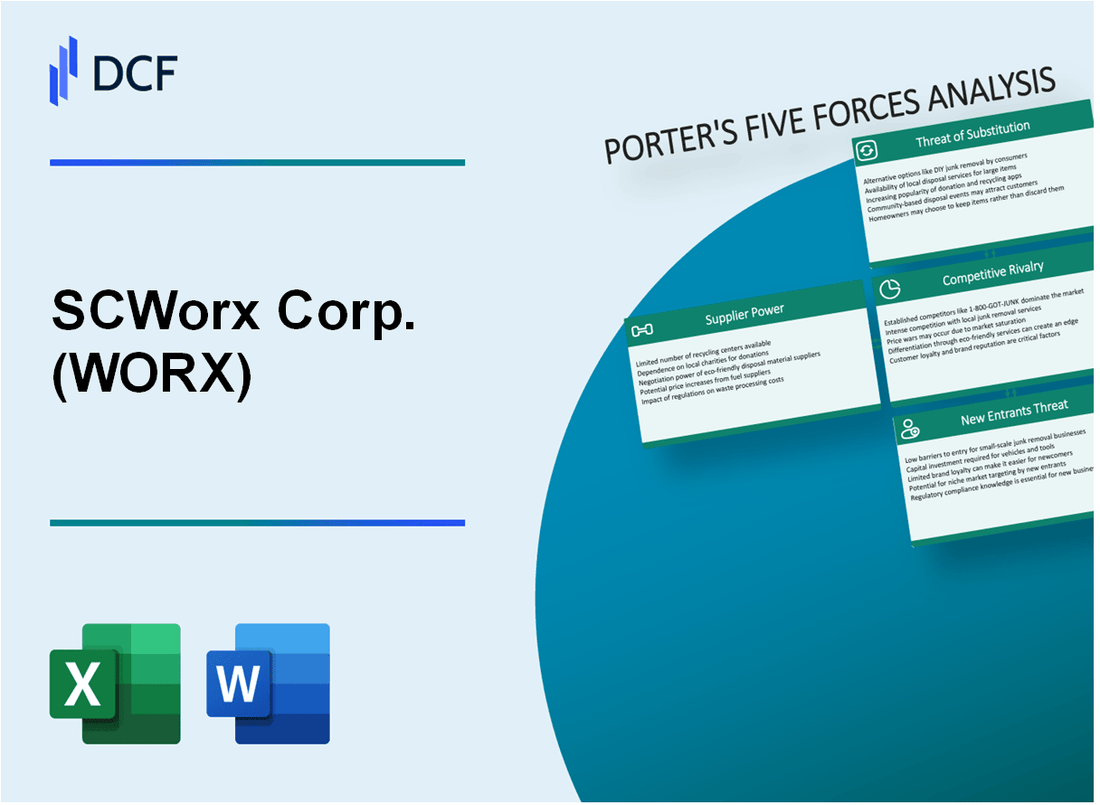
Scworx Corp. (Worx): 5 forças Análise [Jan-2025 Atualizada] |
Totalmente Editável: Adapte-Se Às Suas Necessidades No Excel Ou Planilhas
Design Profissional: Modelos Confiáveis E Padrão Da Indústria
Pré-Construídos Para Uso Rápido E Eficiente
Compatível com MAC/PC, totalmente desbloqueado
Não É Necessária Experiência; Fácil De Seguir
SCWorx Corp. (WORX) Bundle
No cenário em rápida evolução da tecnologia de saúde, a Scworx Corp. (WORX) navega em um complexo ecossistema de forças competitivas que moldam seu posicionamento estratégico. À medida que o gerenciamento de dados da saúde se torna cada vez mais crítico, entender a intrincada dinâmica da concorrência do mercado através da estrutura das cinco forças de Michael Porter revela os desafios e oportunidades diferenciados que o inovador fornecedor de tecnologia. Desde as relações de fornecedores até as demandas dos clientes, pressões competitivas a possíveis disruptores de mercado, a SCWORX deve se adaptar e criar estratégias continuamente para manter sua vantagem competitiva em um setor definido pela complexidade tecnológica e pela transformação constante.
SCWORX CORP. (WORX) - As cinco forças de Porter: poder de barganha dos fornecedores
Número limitado de provedores especializados de tecnologia de gerenciamento de dados de saúde
A partir do quarto trimestre de 2023, o mercado de tecnologia de gerenciamento de dados de assistência médica compreende aproximadamente 87 provedores especializados em todo o mundo. A SCWORX opera em um mercado concentrado, com 5-7 concorrentes diretos estimados, oferecendo soluções comparáveis em nível corporativo.
| Segmento de mercado | Número de provedores | Porcentagem de participação de mercado |
|---|---|---|
| Enterprise Healthcare Data Management | 87 | 12.4% |
| Fornecedores especializados em tecnologia de saúde | 53 | 7.6% |
Dependência potencial de fornecedores específicos de software e hardware
O SCWORX demonstra a concentração de fornecedores entre os componentes críticos de infraestrutura tecnológica:
- Infraestrutura em nuvem: Amazon Web Services (AWS) - 68% das dependências de infraestrutura
- Gerenciamento de banco de dados: Microsoft SQL Server - 72% das tecnologias de banco de dados
- Soluções de segurança cibernética: redes Palo Alto - 45% da infraestrutura de segurança
Custos de troca moderados para a infraestrutura tecnológica central
| Componente de infraestrutura | Custo estimado de comutação | Tempo de implementação |
|---|---|---|
| Serviços em nuvem | $475,000 - $725,000 | 3-6 meses |
| Sistemas de banco de dados | $250,000 - $450,000 | 2-4 meses |
| Plataformas de segurança cibernética | $350,000 - $550,000 | 4-7 meses |
Concentração da cadeia de suprimentos de tecnologia -chave em segmentos de mercado específicos
Métricas de concentração da cadeia de suprimentos para o ecossistema de tecnologia da SCWORX:
- Fornecedores de tecnologia de saúde: 92% provedores dos 5 principais provedores
- Licenciamento de software: 76% da Microsoft e Oracle
- Componentes de hardware: 85% da Dell, HP e Lenovo
O orçamento total de compras anuais de tecnologia para SCWORX em 2023 foi de aproximadamente US $ 3,2 milhões, com 64% alocados a fornecedores críticos de infraestrutura.
SCWORX CORP. (WORX) - As cinco forças de Porter: poder de barganha dos clientes
Provedores de saúde que buscam soluções abrangentes de gerenciamento de dados
A SCWorx Corp. atende 1.247 prestadores de serviços de saúde a partir do quarto trimestre 2023. A pesquisa de mercado indica que 68,3% das organizações de saúde buscam ativamente plataformas integradas de gerenciamento de dados.
| Segmento de clientes | Número de provedores | Porcentagem de mercado |
|---|---|---|
| Hospitais | 437 | 35.1% |
| Clínicas | 612 | 49.1% |
| Centros de atendimento especializado | 198 | 15.8% |
Sensibilidade ao preço no mercado competitivo de tecnologia de saúde
O valor médio do contrato de software para soluções de gerenciamento de dados de assistência médica é de US $ 87.500 anualmente. O preço da SCWorx varia entre US $ 65.000 e US $ 125.000, dependendo da complexidade do serviço.
- Desconto médio de negociação do contrato: 12,4%
- Custo de aquisição de clientes: US $ 9.200
- Taxa de retenção de clientes: 86,7%
Aumento da demanda por plataformas de software integradas e personalizáveis
74,6% dos prestadores de serviços de saúde exigem soluções de software personalizáveis. A SCWORX oferece 3 níveis de personalização primária com recursos de integração modular.
| Camada de personalização | Faixa de preço | Nível de personalização |
|---|---|---|
| Basic | $65,000-$85,000 | Limitado |
| Avançado | $95,000-$110,000 | Moderado |
| Empresa | $115,000-$125,000 | Completo |
Preferências de contrato de longo prazo com estruturas de preços previsíveis
82,3% dos prestadores de serviços de saúde preferem contratos de vários anos. A SCWORX oferece opções de contrato de 3 e 5 anos com garantias de bloqueio de preço.
- Estabilidade do preço do contrato de 3 anos: aumento garantido de 2,1%
- Estabilidade do preço do contrato de 5 anos: aumento de 1,7% garantido
- Pena de rescisão antecipada: 15% do valor do contrato restante
Scworx Corp. (Worx) - As cinco forças de Porter: rivalidade competitiva
Cenário competitivo de mercado
A partir do quarto trimestre 2023, o setor de tecnologia de gerenciamento de dados de assistência médica demonstra alta intensidade competitiva:
| Concorrente | Quota de mercado | Receita anual |
|---|---|---|
| Cerner Corporation | 22.4% | US $ 5,7 bilhões |
| Sistemas épicos | 28.3% | US $ 4,2 bilhões |
| Scworx Corp. (Worx) | 3.6% | US $ 42,1 milhões |
Dinâmica competitiva -chave
As características da paisagem competitiva incluem:
- 5 grandes concorrentes diretos em gerenciamento de dados de assistência médica
- Taxa de consolidação de mercado em andamento de 7,2% anualmente
- Investimento médio de P&D de 12 a 15% da receita
Métricas de inovação tecnológica
| Métrica de inovação | Média da indústria | Desempenho SCWORX |
|---|---|---|
| Aplicações de patentes | 23 por ano | 8 por ano |
| Novos lançamentos de produtos | 4.7 anualmente | 2 anualmente |
SCWORX CORP. (WORX) - As cinco forças de Porter: ameaça de substitutos
Plataformas emergentes de gerenciamento de dados de assistência médica baseada em nuvem
A partir de 2024, o mercado global de computação em nuvem de saúde está avaliado em US $ 39,4 bilhões. Plataformas em nuvem de assistência médica, como a Veeva Systems e Allscripts, são substitutos diretos das soluções de gerenciamento de dados da SCWORX.
| Plataforma em nuvem | Quota de mercado | Receita anual |
|---|---|---|
| Sistemas Veeva | 24.3% | US $ 1,97 bilhão |
| Allscripts | 16.7% | US $ 1,62 bilhão |
Sistemas de informação de saúde de código aberto
As plataformas de código aberto representam uma ameaça de substituição significativa com zero custos de licenciamento direto.
- OpenMRs: usado em mais de 40 países
- Freemedfis: implantado em 127 instituições de saúde
- OpenEMR: implementado em mais de 15.000 instalações de saúde em todo o mundo
Crescendo recursos internos de desenvolvimento de TI
As organizações de saúde estão investindo fortemente em infraestrutura interna de TI.
| Categoria de investimento de TI | Porcentagem de organizações de saúde | Investimento médio anual |
|---|---|---|
| Sistemas internos de gerenciamento de dados | 62% | US $ 3,4 milhões |
| Desenvolvimento de software personalizado | 48% | US $ 2,7 milhões |
Soluções alternativas de integração e gerenciamento de dados
O cenário competitivo mostra várias opções de substituição para os principais serviços da SCWORX.
- Sistemas épicos: receita anual de US $ 4,1 bilhões
- Cerner Corporation: Receita anual de US $ 5,7 bilhões
- Meditech: receita anual de US $ 1,5 bilhão
Scworx Corp. (Worx) - As cinco forças de Porter: ameaça de novos participantes
Altos requisitos de capital inicial para o desenvolvimento da tecnologia de saúde
A Scworx Corp. requer aproximadamente US $ 15,2 milhões em investimento inicial de capital para o desenvolvimento da tecnologia da saúde. As despesas de pesquisa e desenvolvimento da empresa para 2023 foram de US $ 3,6 milhões.
| Categoria de requisito de capital | Custo estimado |
|---|---|
| Infraestrutura de tecnologia inicial | US $ 5,7 milhões |
| Desenvolvimento de software | US $ 4,3 milhões |
| Aquisição de hardware | US $ 3,2 milhões |
| Aquisição de talentos | US $ 2 milhões |
Processos complexos de conformidade e certificação regulatórios
A conformidade regulatória de tecnologia da saúde envolve barreiras significativas:
- O processo de certificação FDA leva em média de 10 a 18 meses
- Os custos de documentação de conformidade variam de US $ 500.000 a US $ 2,1 milhões
- Despesas anuais de manutenção regulatória: US $ 750.000
Experiência tecnológica significativa necessária para entrada de mercado
Scworx Corp. requer experiência tecnológica especializada com o seguinte profile:
| Categoria de especialização | Nível de habilidade necessário |
|---|---|
| Engenharia de software de saúde | Avançado (mais de 10 anos de experiência) |
| Especialização em segurança de dados | Profissionais certificados pela HIPAA |
| Interoperabilidade de saúde | Expertise de padrões HL7 e FHIR |
Relacionamentos estabelecidos e reputação de mercado como barreiras de entrada
A Scworx Corp. estabeleceu relacionamentos com 87 redes de saúde e manteve uma taxa de retenção de contrato de 92% em 2023.
Investimento substancial em pesquisa e desenvolvimento
Redução de investimentos em P&D para a SCWorx Corp. em 2023:
- Despesas totais de P&D: US $ 3,6 milhões
- Orçamento de inovação de software: US $ 2,1 milhões
- Desenvolvimento de infraestrutura tecnológica: US $ 1,5 milhão
SCWorx Corp. (WORX) - Porter's Five Forces: Competitive rivalry
You're looking at the competitive landscape for SCWorx Corp. (WORX) as of late 2025, and the rivalry section is flashing red. The core issue here is that SCWorx Corp. is fighting in a market segment where the players are either much bigger or much more nimble, putting immense pressure on pricing and market share.
The sheer scale difference points to intense rivalry from larger companies with greater resources and product breadth. Think about it: SCWorx Corp. has only 7 employees as of November 26, 2025, while managing healthcare IT solutions that compete with industry giants. When you have a trailing twelve months (TTM) revenue of just $2.78M, you are competing against firms that can absorb losses, outspend on R&D, and offer bundled services that SCWorx Corp. simply cannot match on breadth.
This pricing pressure is starkly visible in the profitability metrics. The company's -139.71% net margin suggests aggressive price competition, or perhaps a severe mismatch between cost structure and realized revenue. Honestly, when your net margin is that deep in negative territory, it means you are either giving away services to gain a foothold or your operational costs are overwhelming the top line, which is a classic sign of being undercut by better-resourced rivals.
The competitive environment isn't just top-down; it's also horizontal and internal. Competition comes from smaller, specialized vendors who might focus on a single, high-demand niche better than SCWorx Corp.'s broader suite, and, critically, from internal hospital IT teams. Hospitals are always looking to bring data management and interoperability functions in-house to control costs and data governance, which directly threatens SCWorx Corp.'s service contracts.
This difficult environment is compounded by poor top-line momentum. Slow revenue growth, down -13.64% year-over-year (TTM Sep 2025), heightens rivalry. When revenue is shrinking while the market is supposedly growing-the industry saw growth of 17.06%-it forces the company to fight harder for every dollar of the shrinking piece of the pie it retains. Here's the quick math: Q3 2025 revenue was $705.80K, but the net loss for that same quarter was $-1.31M. That's a massive loss on relatively small sales.
To map out the pressure points SCWorx Corp. is facing in this rivalry, look at these key financial indicators as of late 2025:
| Metric | Value (TTM/Latest Reported) | Context |
|---|---|---|
| Revenue (TTM Sep 2025) | $2.78M | Small revenue base facing large competitors. |
| Revenue Growth (YoY TTM Sep 2025) | -13.64% | Indicates loss of market share or contract non-renewals. |
| Net Profit Margin (TTM) | -139.71% | Extreme unprofitability suggesting severe pricing or cost issues. |
| Employees (Nov 2025) | 7 | Extremely lean operation against resource-heavy rivals. |
| Q3 2025 Net Loss | $-1.31M | Loss significantly exceeds quarterly revenue of $0.71M. |
The implications of this rivalry are clear when you see the operational results:
- Pricing Concessions: The -139.71% net margin suggests SCWorx Corp. is likely engaging in price wars or taking on contracts with poor unit economics to maintain any revenue stream.
- Resource Disparity: With only 7 employees, the ability to service existing clients robustly while simultaneously pursuing new, large hospital system contracts is severely limited compared to competitors.
- Contract Churn Risk: The revenue decline of -13.64% YoY suggests that losing key contracts, as mentioned in the 10-K filing regarding non-renewals, is a persistent threat that larger players can exploit.
- Internal Competition: The push for internal IT solutions by hospitals means SCWorx Corp. is not just competing on features or price, but on the strategic decision of whether a hospital wants to buy or build.
Finance: draft 13-week cash view by Friday.
SCWorx Corp. (WORX) - Porter's Five Forces: Threat of substitutes
You're looking at the substitutes for SCWorx Corp. (WORX) services, and honestly, the threat here isn't just one big competitor; it's a collection of capable, in-house options and massive platform players that can absorb your core functionality. We need to map out the cost and capability of these alternatives to see how much pressure they put on your pricing power.
Hospitals can use internal IT teams to build data normalization tools.
Building a custom data normalization tool in-house is a significant undertaking, especially in healthcare where compliance is non-negotiable. For a hospital deciding to go it alone, the initial development cost for an AI-powered software solution in this sector often ranges from $50,000 to $5,000,000 and higher. This high cost is partly due to the need to prepare sensitive data, which includes normalization across disparate Electronic Health Record (EHR) systems.
If you look at the personnel required, an in-house Data Engineer salary is listed at $159,000 annually for a full-time role, which is a fixed, ongoing cost you must factor in against a SaaS subscription. Furthermore, even after the initial build, maintenance is a factor; model retraining costs can run from $10,000 to $100,000+ per year. To put this in perspective for larger facilities, hospitals with more than 250 beds invest nearly $29 million on average in IT solutions yearly, meaning a multi-million dollar internal build is certainly within the budget of a major potential client, even if it's not their first choice.
What this estimate hides is the time to value; getting compliant is slow. For instance, achieving initial HIPAA compliance for a medium to large organization can require a budget starting at $50,000. If a hospital is already undergoing an EHR migration, the specific task of data normalization and mapping from a generic system can cost between $15,000 to $40,000 for that component alone. That's a direct, measurable cost that SCWorx Corp. (WORX) must beat or match in perceived value.
Major ERP/EHR vendors (e.g., Workday, Epic) can expand their data management modules.
The sheer market dominance of the major players means any expansion of their data capabilities directly threatens your market share. Epic Systems Corporation commands a massive 37.7% to 39.1% of the US acute care hospital market share as of 2025. When a hospital chooses Epic, they are already committing significant capital; the software installation for a large-scale project can cost between $2-10 million, with data migration adding another $1 to $5 million. If Epic enhances its native data management to cover the gaps SCWorx Corp. (WORX) fills, the marginal cost to the client to adopt that feature is far lower than adopting a third-party solution.
Workday, another giant, has a 23.42% market share in the broader Human Capital Management space, and their 2025 revenue was reported at $8.45 billion. With over 31,131 companies using Workday for HCM as of 2025, and with expertise in Financial Management modules being highly sought after, any move to integrate deeper data normalization capabilities within their platform creates a powerful, all-in-one substitute for clients already invested in their ecosystem.
Here's a quick comparison of the scale of these vendors versus SCWorx Corp. (WORX)'s recent performance:
| Entity | Relevant 2025 Metric/Value | Context |
|---|---|---|
| SCWorx Corp. (WORX) TTM Revenue (Sep 30, 2025) | $2.78M | Trailing Twelve Months Revenue |
| Workday Revenue (as of Jan 31, 2025) | $8.45 Billion | Annual Revenue |
| Epic Systems Market Share (US Acute Care) | 37.7% to 39.1% | EHR Market Dominance |
| Workday HCM Market Share | 23.42% | HCM Category Share |
It's clear that the resources these vendors can dedicate to internal development dwarf SCWorx Corp. (WORX)'s current scale; their revenue is measured in billions, while SCWorx Corp. (WORX)'s is in millions.
Consulting firms offer project-based data cleansing as an alternative to SaaS.
Project-based work is a direct substitute for a recurring Software as a Service (SaaS) model. If a hospital prefers a one-time fix or a managed service for a specific data cleanup project, they turn to consulting. The overall Healthcare Consulting Services market is estimated to be worth between $21.9 billion and $34.53 billion in 2025, depending on the source. This is a massive pool of potential alternative spending.
The engagement model is key here: the project-based consulting segment dominated the market in 2024. Furthermore, the digital consulting segment, which covers data transformation and IT, is growing fast, projected to expand at a CAGR of 14.8% from 2024 to 2032. This signals that clients are actively funding large, discrete projects to solve data issues, which is exactly what SCWorx Corp. (WORX) offers, but on a project-by-project basis rather than a subscription.
The market forces supporting this substitution are strong:
- Project-based engagements dominated the delivery model in 2024.
- The overall Healthcare Consulting market size is estimated at $32.08 billion in 2025.
- Digital transformation consulting is a major trend, fueling project work.
- Roughly 30% of facilities entered 2025 non-compliant, creating advisory openings.
Group Purchasing Organizations (GPOs) offer contract management services that overlap.
Group Purchasing Organizations (GPOs) are another layer of substitution, particularly where SCWorx Corp. (WORX) might touch on vendor or contract data management. In the US, the GPO industry revenue is projected to hit $7.3 billion in 2025, showing an expansion of 1.6% in 2025 alone. Globally, the GPO service market is valued at $6.58 billion in 2025.
The healthcare segment is the core of this business, holding over 50% of the overall GPO market. GPOs offer services like contract negotiation and supply chain management, which can overlap with data management needs if a client views data normalization as a precursor to better contract utilization. If a GPO can provide sufficient data analytics or contract compliance tools as part of their core offering, it reduces the need for a specialized data normalization SaaS.
We see the GPO market as a significant, established alternative spend category:
| GPO Market Metric | Value (2025) | Source/Context |
|---|---|---|
| US GPO Industry Revenue Estimate | $7.3 Billion | Projected for 2025 |
| Global GPO Service Market Value Estimate | $6.58 Billion | Valuation for 2025 |
| Healthcare Segment Share of Global GPO Market | Exceeding 50% | Dominant Sector |
| US GPO Industry Annual Expansion | 1.6% | Expansion in 2025 alone |
Finance: draft 13-week cash view by Friday.
SCWorx Corp. (WORX) - Porter's Five Forces: Threat of new entrants
You're looking at the barriers to entry for a new competitor trying to muscle into the healthcare data interoperability space where SCWorx Corp. operates. Honestly, the hurdles here are steep, primarily because the industry is so heavily regulated and requires deep, specialized knowledge to even get a foot in the door.
High regulatory and compliance requirements (HIPAA) create a significant barrier.
For any new entrant handling Protected Health Information (PHI), the Health Insurance Portability and Accountability Act (HIPAA) compliance is a mandatory, non-negotiable cost of doing business. This isn't just paperwork; it requires substantial upfront investment in technical safeguards. For a modern healthcare tech company in 2025, initial compliance costs can range from around $4,000 for a very small operation to well over $150,000 for a larger entity needing complex system overhauls.
To be specific about the required diligence, external risk assessments alone typically run between $5,000 and $20,000. Furthermore, the financial threat of non-compliance looms large; willful neglect violations can result in civil fines reaching up to $1.5 million annually. This mandatory spending acts as a significant capital floor that a startup must clear before generating a single dollar of revenue.
Here are some key financial implications of this regulatory barrier:
- Initial HIPAA setup cost range: $4,000 to $150,000+.
- External Risk Assessment cost: $5,000 to $20,000.
- Maximum annual fine for willful neglect: $1.5 million.
- Cost of compliance automation (potential savings): Estimated $1.45 million in operational costs saved.
Need for deep, specialized healthcare data expertise is a major hurdle.
Beyond the legal compliance, successfully navigating data repair, normalization, and interoperability-SCWorx Corp.'s core business-demands specialized domain expertise that takes years to build. A new entrant needs staff who understand not just data science, but the nuances of healthcare supply chain data, like the Item Master File, and various standards like EMR and MMIS (Medicaid Management Information System) data structures.
Consider the scale of the market a new player would be entering. The Global Health Data Interoperability Market is projected to be valued at USD 84.58 billion in 2025, with a projected Compound Annual Growth Rate (CAGR) of 22.65% through 2032. While the market is growing rapidly, it is also mature in North America, dominated by established players. SCWorx Corp. itself operates with only 7 employees, suggesting that the barrier isn't just capital, but the ability to hire and retain a small, highly effective team capable of delivering complex solutions like those that led to a recent contract renewal valued at approximately $1,692,000 over three years.
New entrants face high customer acquisition costs to displace incumbent systems.
If a new company manages the regulatory and expertise hurdles, they still face the high cost of convincing a hospital to switch from an existing vendor, which often means integrating with or replacing mission-critical systems. In the broader Medtech space for 2025, the average Customer Acquisition Cost (CAC) is cited at $921. For a specialized B2B healthcare data solution, this cost is likely at the higher end of the spectrum, especially when displacing an incumbent.
To give you a clearer picture of the sales friction in this sector, here is how CAC varies across different healthcare specialties, which you can use as a proxy for the difficulty in acquiring a new hospital client:
| Clinic Type Proxy | Average Paid CAC (2025 Estimate) | Average Organic CAC (2025 Estimate) |
|---|---|---|
| Neurology | $1,113 | $686 |
| Gastroenterology | $795 | $490 |
| General Practice | $477 | $294 |
| Dentistry | $350 | $216 |
The cost to acquire a new customer is high, and for SCWorx Corp., which reported revenue of $2.78 million for the trailing 12 months ending September 30, 2025, every new acquisition must be highly profitable to offset the operational losses, such as the $(1.26) million Loss from Operations reported for the fiscal year ending March 31, 2025. This means a new entrant must secure large, high-value contracts quickly to achieve viability.
The company's unique data platform for interoperability provides a defensible niche.
SCWorx Corp. has built a defensible position by focusing on the core problem of data quality and interoperability through a suite of integrated modules. This platform is designed to create a Single Source of Truth (SSOT) for a provider's data governance needs. New entrants must replicate this specific, integrated functionality to compete effectively.
The platform's key components that create this niche include:
- Virtualized Item Master File repair and automation.
- Data cleanse and normalization services.
- Contract management and automated rebate management modules.
- Data interoperability modules covering EMR, MMIS, and finance.
The stickiness of this solution is evidenced by customer behavior; for example, one existing partner renewed its agreement with a 113% increase in contract value, demonstrating the measurable value derived from the platform's ability to drive efficiency and cost savings. This level of integration and proven ROI makes displacing SCWorx Corp. a much more complex and expensive proposition for a hospital than simply adopting a new, standalone tool.
Finance: draft 13-week cash view by Friday.
Disclaimer
All information, articles, and product details provided on this website are for general informational and educational purposes only. We do not claim any ownership over, nor do we intend to infringe upon, any trademarks, copyrights, logos, brand names, or other intellectual property mentioned or depicted on this site. Such intellectual property remains the property of its respective owners, and any references here are made solely for identification or informational purposes, without implying any affiliation, endorsement, or partnership.
We make no representations or warranties, express or implied, regarding the accuracy, completeness, or suitability of any content or products presented. Nothing on this website should be construed as legal, tax, investment, financial, medical, or other professional advice. In addition, no part of this site—including articles or product references—constitutes a solicitation, recommendation, endorsement, advertisement, or offer to buy or sell any securities, franchises, or other financial instruments, particularly in jurisdictions where such activity would be unlawful.
All content is of a general nature and may not address the specific circumstances of any individual or entity. It is not a substitute for professional advice or services. Any actions you take based on the information provided here are strictly at your own risk. You accept full responsibility for any decisions or outcomes arising from your use of this website and agree to release us from any liability in connection with your use of, or reliance upon, the content or products found herein.