
|
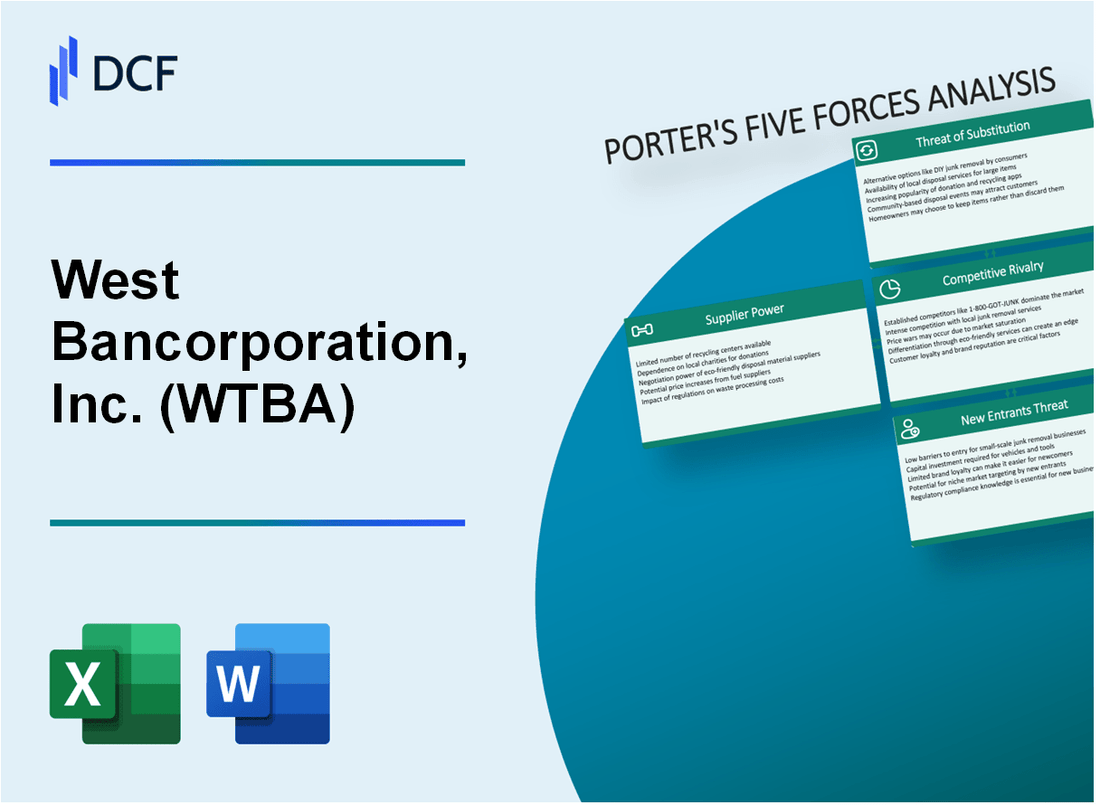
West Bancorporation, Inc. (WTBA): 5 forças Análise [Jan-2025 Atualizada] |
Totalmente Editável: Adapte-Se Às Suas Necessidades No Excel Ou Planilhas
Design Profissional: Modelos Confiáveis E Padrão Da Indústria
Pré-Construídos Para Uso Rápido E Eficiente
Compatível com MAC/PC, totalmente desbloqueado
Não É Necessária Experiência; Fácil De Seguir
West Bancorporation, Inc. (WTBA) Bundle
No cenário dinâmico do setor bancário regional, a West Bancorporation, Inc. (WTBA) navega em um complexo ecossistema de forças competitivas que moldam seu posicionamento estratégico. À medida que a transformação digital reformula os serviços financeiros e os mercados regionais se tornam cada vez mais competitivos, entender a intrincada dinâmica do poder do fornecedor, preferências do cliente, rivalidade de mercado, substitutos tecnológicos e novos participantes potenciais se torna crucial para o crescimento sustentável e a resiliência estratégica. Essa análise das cinco forças de Porter fornece uma lente abrangente sobre os desafios e oportunidades estratégicas que o WTBA enfrenta no setor bancário em evolução de 2024.
West Bancorporation, Inc. (WTBA) - As cinco forças de Porter: poder de barganha dos fornecedores
Provedores de tecnologia bancária principal
O West Bancorporation baseia -se em um número limitado de fornecedores de tecnologia bancária. A partir de 2024, os principais provedores de tecnologia incluem:
| Fornecedor | Quota de mercado | Valor anual do contrato |
|---|---|---|
| Fiserv | 38% | US $ 2,4 milhões |
| Jack Henry & Associados | 29% | US $ 1,8 milhão |
| FIS Global | 22% | US $ 1,5 milhão |
Dependências do fornecedor de infraestrutura de serviço financeiro
O West Bancorporation demonstra concentração significativa de fornecedores em serviços críticos de infraestrutura:
- Core Banking System Dependência: 87% de confiança nos 3 principais fornecedores
- Período médio de bloqueio do fornecedor: 5-7 anos
- Custos estimados de troca: US $ 3,2 milhões a US $ 4,5 milhões
Comutação de tecnologia Complexidade
A troca de custos para os principais sistemas bancários envolve várias dimensões:
| Categoria de custo de comutação | Despesa estimada |
|---|---|
| Migração de tecnologia | US $ 2,1 milhões |
| Transferência de dados | $650,000 |
| Reciclagem de funcionários | $450,000 |
| Interrupção operacional | $750,000 |
Concentração do mercado de tecnologia bancária regional
O mercado regional de tecnologia bancário exibe concentração moderada de fornecedores:
- Os 4 principais fornecedores controlam 89% da participação de mercado
- Duração média do contrato do fornecedor: 6,2 anos
- Gastos anuais de infraestrutura de tecnologia: US $ 5,7 milhões
West Bancorporation, Inc. (WTBA) - As cinco forças de Porter: poder de barganha dos clientes
Análise de base de clientes diversificada
A West Bancorporation, Inc. atende 54.321 clientes no total de clientes em segmentos bancários pessoais e comerciais a partir do quarto trimestre 2023, com a seguinte quebra:
| Segmento de clientes | Número de clientes | Percentagem |
|---|---|---|
| Bancos pessoais | 37,892 | 69.7% |
| Bancos comerciais | 16,429 | 30.3% |
Expectativas de serviço bancário digital
As preferências bancárias digitais do cliente demonstram expectativas tecnológicas significativas:
- 82,4% dos clientes utilizam plataformas bancárias móveis
- 63,7% preferem métodos de transação digital
- 45,2% usam ativamente os serviços bancários online semanalmente
Dinâmica de custo de troca
A troca de custos entre instituições bancárias regionais em média de US $ 127,50 por cliente, com barreiras mínimas:
| Componente de custo de comutação | Custo médio |
|---|---|
| Taxas de transferência de conta | $57.25 |
| Nova configuração de conta | $42.75 |
| Reconfiguração de depósito direto | $27.50 |
Métricas de sensibilidade ao preço
Indicadores de sensibilidade ao preço do mercado bancário:
- Tolerância à variação da taxa de juros: ± 0,25%
- Limite de sensibilidade à taxa: US $ 15 mensalmente
- Taxa média de retenção de clientes: 76,3%
West Bancorporation, Inc. (WTBA) - As cinco forças de Porter: rivalidade competitiva
Cenário competitivo Overview
Em 2024, o West Bancorporation enfrenta rivalidade competitiva de várias instituições bancárias nos mercados de Oregon e Washington.
| Tipo de concorrente | Número de concorrentes | Impacto na participação de mercado |
|---|---|---|
| Bancos regionais | 12 | 38.5% |
| Cadeias bancárias nacionais | 7 | 45.3% |
| Bancos comunitários locais | 23 | 16.2% |
Fatores de intensidade competitivos
O West Bancorporation encontra uma pressão competitiva significativa em várias dimensões.
- Total de ativos bancários nos mercados -alvo: US $ 4,2 bilhões
- Taxa média de retenção de clientes: 72,4%
- Custo anual de aquisição do cliente: US $ 385 por nova conta
Estratégias de diferenciação de mercado
O West Bancorporation implementa estratégias direcionadas para mitigar pressões competitivas.
| Estratégia de diferenciação | Valor do investimento | ROI esperado |
|---|---|---|
| Atendimento ao cliente personalizado | US $ 1,2 milhão | 7.5% |
| Conhecimento do mercado local | $850,000 | 6.3% |
Análise de pressão competitiva
As métricas de paisagem competitivas detalhadas demonstram intensa dinâmica de mercado.
- Número de concorrentes bancários diretos: 42
- Taxa média de troca de clientes: 8,6%
- Índice de Intensidade Competitiva Anual: 0,76
West Bancorporation, Inc. (WTBA) - As cinco forças de Porter: ameaça de substitutos
Crescente popularidade das plataformas bancárias fintech e digital
A partir de 2024, as plataformas bancárias digitais capturaram 65,3% das interações bancárias. O mercado global de bancos digitais deve atingir US $ 8,97 trilhões até 2027, com um CAGR de 13,5%.
| Métrica bancária digital | 2024 Valor |
|---|---|
| Usuários bancários móveis | 1,75 bilhão globalmente |
| Taxa de penetração bancária digital | 72.4% |
| Volume anual de transação bancária digital | US $ 4,6 trilhões |
Surgimento de sistemas de pagamento móvel e carteiras digitais
O volume de transações de pagamento móvel atingiu US $ 4,8 trilhões em 2024, com mudanças significativas de participação de mercado.
- Apple Pay: 43,9 milhões de usuários
- Google Pay: 39,2 milhões de usuários
- Samsung Pay: 16,5 milhões de usuários
Soluções de tecnologia financeira alternativas e de criptomoeda e alternativa
A capitalização de mercado da criptomoeda é de US $ 1,7 trilhão em 2024, apresentando uma tecnologia financeira alternativa substancial.
| Métrica de criptomoeda | 2024 Valor |
|---|---|
| Bitcoin Market Cap | US $ 855 bilhões |
| Cap de mercado Ethereum | US $ 279 bilhões |
| Usuários globais de criptomoeda | 420 milhões |
Plataformas de investimento on -line e empréstimos
As plataformas de empréstimos on -line processaram US $ 329 bilhões em empréstimos durante 2024, desafiando os modelos bancários tradicionais.
- Crescimento do mercado de empréstimos ponto a ponto: 14,2%
- Taxas médias de juros de empréstimos online: 7,3% - 12,5%
- Total de ativos da plataforma de investimento on -line: US $ 672 bilhões
West Bancorporation, Inc. (WTBA) - As cinco forças de Porter: ameaça de novos participantes
Altas barreiras regulatórias para entrar na indústria bancária
O West Bancorporation enfrenta barreiras regulatórias substanciais que restringem significativamente os novos participantes do mercado. A partir de 2024, o Federal Reserve exige:
- Taxa de capital mínimo de nível 1 de 8%
- Conformidade da Lei da Lei de Holdura Bancária Abrangente
- Implementação de padrões bancários internacionais de Basileia III
Requisitos de capital significativos
| Categoria de requisito de capital | Quantidade mínima |
|---|---|
| Capital de charter bancário inicial | US $ 20-50 milhões |
| Capital mínimo baseado em risco | 10.5% |
| Reservas operacionais de inicialização | US $ 75-100 milhões |
Processos complexos de conformidade e licenciamento
Requisitos de licenciamento:
- FDIC APLICATION HORM
- A aprovação da Comissão Bancária Estadual necessária
- Verificações abrangentes de antecedentes para liderança
Requisitos de investimento tecnológico
| Área de investimento em tecnologia | Custo estimado |
|---|---|
| Sistema bancário principal | US $ 5 a 10 milhões |
| Infraestrutura de segurança cibernética | US $ 2-4 milhões anualmente |
| Plataforma bancária digital | US $ 3-7 milhões |
West Bancorporation, Inc. (WTBA) - Porter's Five Forces: Competitive rivalry
The competitive rivalry facing West Bancorporation, Inc. in its core Iowa and Minnesota markets is intense. You're operating in a state, Iowa, where there are more banks per capita than in most of the nation, which naturally drives down average net interest margins due to the competitive interest rate environment for both consumers and businesses. As of the second quarter of 2025, there were 233 Iowa-domiciled banks, all vying for a piece of the state's $108.9 billion in total deposits reported for the third quarter of 2025.
West Bancorporation, Inc. competes directly with a mix of locally controlled institutions, credit unions, and much larger regional, national, or international banks. These larger competitors definitely have a structural advantage; they possess the capacity for substantial advertising campaigns and, critically, much higher legal lending limits than West Bank. This means that for the largest regional or global commercial customers, West Bancorporation, Inc. may not be able to service the full credit need, pushing those large deals toward bigger players.
Still, West Bancorporation, Inc. is demonstrating operational discipline that provides a counter-lever. The bank posted an efficiency ratio of 54.06% for the third quarter of 2025. This metric-which measures how much it costs to generate a dollar of revenue-suggests a cost advantage relative to peers who may be weighed down by legacy systems or less disciplined expense management.
The rivalry is only intensifying as the industry undergoes structural shifts. You are seeing a clear trend toward consolidation, with the first half of 2025 seeing 72 M&A transactions totaling $10.39 billion, putting the year on pace for the largest deal count in over five years. This drive for scale puts pressure on mid-tier banks like West Bancorporation, Inc. Furthermore, the largest U.S. banks are aggressively investing in technology, outspending regional competitors by a ratio of 10-to-1 on technology investment. Over 75% of banks, generally, plan to increase investments in data management and cloud consumption to advance their generative AI strategy.
West Bancorporation, Inc. holds a mid-tier position in its primary market, which is a double-edged sword. While it suggests a meaningful presence, it also places the bank squarely in the middle of the competitive fray between local community banks and the national giants. Based on data from June 30, 2022, West Bank ranked 8th in the state of Iowa in terms of deposit share, a position that requires constant vigilance to maintain against both smaller, nimble competitors and larger entities seeking market share.
Here's a quick look at the key competitive and operational metrics we have for West Bancorporation, Inc. and its environment as of late 2025:
| Metric | West Bancorporation, Inc. (WTBA) Data | Iowa Banking Industry Context (Latest Available) |
|---|---|---|
| Q3 2025 Efficiency Ratio | 54.06% | N/A (WTBA's figure shows internal cost control) |
| Iowa Deposit Share Ranking (Historical Basis) | Ranked 8th (as of June 30, 2022) | 233 Iowa-domiciled banks (Q3 2025) |
| Total Iowa Deposits (Q3 2025) | N/A (WTBA's Q3 2025 deposits fell $85.5M QoQ) | $108.9 billion |
| Industry Consolidation Trend (2025) | Mid-tier position facing pressure to scale | H1 2025 saw 72 M&A transactions totaling $10.39 billion |
| Digital Investment Disparity | Must compete with larger players | Largest banks outspend regionals by 10-to-1 on technology |
The competitive pressures manifest in several ways you need to watch:
- High density of banks per capita in Iowa.
- Larger banks have superior legal lending capacity.
- Intensified rivalry due to industry M&A activity.
- Need to match aggressive digital investment by peers.
- Maintaining cost advantage is key to profitability.
The fact that West Bancorporation, Inc. achieved that 54.06% efficiency ratio while deposits saw a quarter-over-quarter decline of $85.5 million in Q3 2025 shows management is focused on controlling costs even when facing deposit outflows. Finance: draft 13-week cash view by Friday.
West Bancorporation, Inc. (WTBA) - Porter's Five Forces: Threat of substitutes
You're looking at how external options can pull business away from West Bancorporation, Inc. (WTBA). The threat of substitutes is real, especially as technology makes non-bank options more accessible. For a community bank focused on relationship-based lending and deposits, these substitutes directly target both sides of the balance sheet.
FinTech companies offer direct digital lending and deposit products.
FinTechs are a major substitute because they offer speed and convenience, especially for consumer lending. The U.S. digital lending market reached a size of $303.07 billion in 2025, showing the scale of this alternative channel. To give you a sense of their penetration, digital lending now accounts for about 63% of personal loan origination volume in the U.S. as of 2025. For the business side, an estimated 55% of small businesses in developed regions like the U.S. accessed loans via fintech platforms in 2025. While West Bancorporation, Inc. is focused on small- to medium-sized businesses, these platforms compete for both loan demand and, increasingly, for operating cash deposits.
Credit unions provide tax-advantaged alternatives for both loans and deposits.
Credit unions remain a persistent, relationship-focused substitute, often appealing to members with slightly different tax or fee structures. As of the second quarter of 2025, the total insured shares and deposits across the entire U.S. credit union system grew 4.0 percent year-over-year, reaching $1.83 trillion. TruStage is forecasting 6% growth in credit union share/deposit growth for the full year 2025, indicating continued, if competitive, funding growth for this segment. With U.S. credit union membership hitting 143.8 million in Q2 2025, West Bancorporation, Inc.'s local market presence in Iowa and Minnesota faces direct competition for the consumer deposit dollar.
Capital markets offer a defintely viable funding substitute for large commercial real estate loans.
For the larger commercial real estate (CRE) loans that might sit outside West Bancorporation, Inc.'s typical community bank focus, capital markets offer a direct substitute for balance sheet funding. While the environment is mixed, activity is picking up. Commercial and multifamily mortgage loan originations overall were 66 percent higher in the second quarter of 2025 compared to the year prior. However, the specific channel of Commercial Mortgage-Backed Securities (CMBS) lending, a key capital markets outlet, actually declined 10% in Q2 2025, suggesting some caution remains in securitized debt. West Bancorporation, Inc.'s total loan outstandings were just over $3 billion as of Q3 2025; thus, any large CRE loan that bypasses the bank for securitization or private placement directly reduces West Bancorporation, Inc.'s origination opportunity.
Money market funds and government securities substitute for bank deposits.
This is a massive pool of substitute funding, especially for institutional or corporate operating cash that West Bancorporation, Inc. targets with its treasury management services. Total money market fund (MMF) assets hit a record high of $7.930 trillion in October 2025. The vast majority of this is in government-backed securities, with Government & Treasury MMFs alone totaling $6.447 trillion, representing 81.3% of all MMF assets that month. West Bancorporation, Inc. saw its own brokered deposits drop from $425.9 million in Q3 2024 to $204.8 million in Q3 2025, illustrating that large, rate-sensitive funds can easily flow out of the bank and into these highly liquid, low-risk MMFs.
Mortgage brokers substitute for direct bank consumer real estate lending.
Mortgage brokers compete directly for consumer real estate lending business, offering access to a wider array of wholesale rates than a single bank can provide. The U.S. Loan Brokers industry revenue for 2025 is estimated at $16.6 billion, though this figure is anticipated to decline by 0.6% in 2025 alone. Despite this slight projected contraction, brokers still represent a significant channel. For context, conventional conforming mortgages-a core area for consumer lending-still accounted for 64.6% of the mortgage/loan brokers market share in 2024. West Bancorporation, Inc. is primarily a commercial lender, but consumer real estate lending is a key component of a full-service community bank's portfolio, meaning brokers siphon off this activity.
- West Bancorporation, Inc.'s core deposits (excluding brokered funds) grew 8.7 percent year-over-year as of September 30, 2025, but core balances still fell $82 million sequentially in Q3 2025.
- The total U.S. MMF market size is approximately $7.930 trillion (October 2025).
- Fintech digital lending in the U.S. market size is $303.07 billion in 2025.
- The Loan Brokers industry revenue is $16.6 billion in 2025.
- West Bancorporation, Inc.'s total loan balances were approximately $3,009 million in Q3 2025.
West Bancorporation, Inc. (WTBA) - Porter's Five Forces: Threat of new entrants
The threat of new entrants for West Bancorporation, Inc. is generally considered low to moderate, primarily due to the significant structural hurdles inherent in the commercial banking industry. These barriers are rooted in regulation, capital needs, and the time required to establish trust.
Significant regulatory and capital requirements create a high entry barrier. Launching a new bank, or de novo institution, is not like starting a typical business. Regulators maintain strict standards to ensure safety and soundness, which acts as a powerful deterrent to casual competition. For a community bank like West Bancorporation, Inc., this means any potential entrant must navigate a complex gauntlet of federal and state oversight.
WTBA's asset base of $3.985 billion requires substantial initial capital to compete. While West Bancorporation, Inc. is not one of the largest global banks, its scale still demands significant backing. As of the latest reported quarter in 2025, West Bancorporation, Inc.'s total assets stood at $3.985 billion. A new entrant aiming to compete on a similar scale must raise capital far exceeding the initial seed money required just to file applications. Furthermore, regulators are actively considering adjustments for smaller institutions; for instance, a proposed rule seeks to reduce the community bank leverage ratio, applicable to banks with less than $10 billion in assets, from 9% to 8%. While this is a potential easing, the underlying requirement for substantial capital remains absolute.
Building a 130-year-old relationship-based brand takes decades. West Bank, the primary subsidiary of West Bancorporation, Inc., was originally organized in 1893. This longevity translates into deep, established relationships within its core markets across Iowa and Minnesota. Trust in banking is earned over time, especially for relationship-focused community banking, which is West Bancorporation, Inc.'s stated focus. A new entrant has no immediate way to replicate this institutional history and community embeddedness.
FinTech entrants bypass traditional branch networks, lowering the cost of entry for specific services. The nature of the threat is evolving. While full-service de novo banks face high barriers, FinTech companies can target specific, profitable banking functions-like payments or digital lending-without needing a full charter or extensive physical infrastructure. This allows them to enter specific service segments with a lower initial capital outlay, putting pressure on specific revenue streams for West Bancorporation, Inc. However, the path to becoming a chartered, deposit-taking bank remains difficult for these firms, as evidenced by the general difficulty FinTechs have had in obtaining charters.
Chartering a new bank (de novo) is a costly and lengthy regulatory process. The sheer time and expense involved in securing a charter are perhaps the most concrete barriers to entry. The overall de novo process can take 12-24 months, sometimes longer. The financial commitment starts early; legal fees alone can run $200,000 or more for charter applications and compliance setup, with total preparation costs often exceeding seven figures. Even with a stated willingness from regulators to consider new applications, as seen with the preliminary conditional approval granted to Erebor Bank on October 15, 2025, the process is far from simple.
Here's a quick look at how the regulatory environment has historically suppressed new bank formation compared to earlier periods:
| Metric | Period 2000-2007 (Pre-Crisis) | Period 2010-2023 (Post-Crisis) |
| Average Annual Charter Approvals | 144 | 5 |
| Estimated Time to Approval | Less than a year (Implied) | Well in excess of a year |
| Estimated Minimum Initial Legal/Prep Cost | N/A | $\ge$ $200,000 |
The regulatory environment still favors established players like West Bancorporation, Inc. by making the entry point for direct competitors extremely high. Still, you need to watch for niche FinTechs that partner with existing institutions rather than seeking full charters.
- Chartering a national bank requires OCC approval.
- Deposit insurance requires separate FDIC application.
- Organizers must secure seed money early on.
- Management team hiring often follows preliminary approval.
- Regulators scrutinize capital adequacy and management competence.
Finance: draft a sensitivity analysis on the impact of a 100-basis-point drop in loan yield on Q4 2025 net interest income by Friday.
Disclaimer
All information, articles, and product details provided on this website are for general informational and educational purposes only. We do not claim any ownership over, nor do we intend to infringe upon, any trademarks, copyrights, logos, brand names, or other intellectual property mentioned or depicted on this site. Such intellectual property remains the property of its respective owners, and any references here are made solely for identification or informational purposes, without implying any affiliation, endorsement, or partnership.
We make no representations or warranties, express or implied, regarding the accuracy, completeness, or suitability of any content or products presented. Nothing on this website should be construed as legal, tax, investment, financial, medical, or other professional advice. In addition, no part of this site—including articles or product references—constitutes a solicitation, recommendation, endorsement, advertisement, or offer to buy or sell any securities, franchises, or other financial instruments, particularly in jurisdictions where such activity would be unlawful.
All content is of a general nature and may not address the specific circumstances of any individual or entity. It is not a substitute for professional advice or services. Any actions you take based on the information provided here are strictly at your own risk. You accept full responsibility for any decisions or outcomes arising from your use of this website and agree to release us from any liability in connection with your use of, or reliance upon, the content or products found herein.