

|
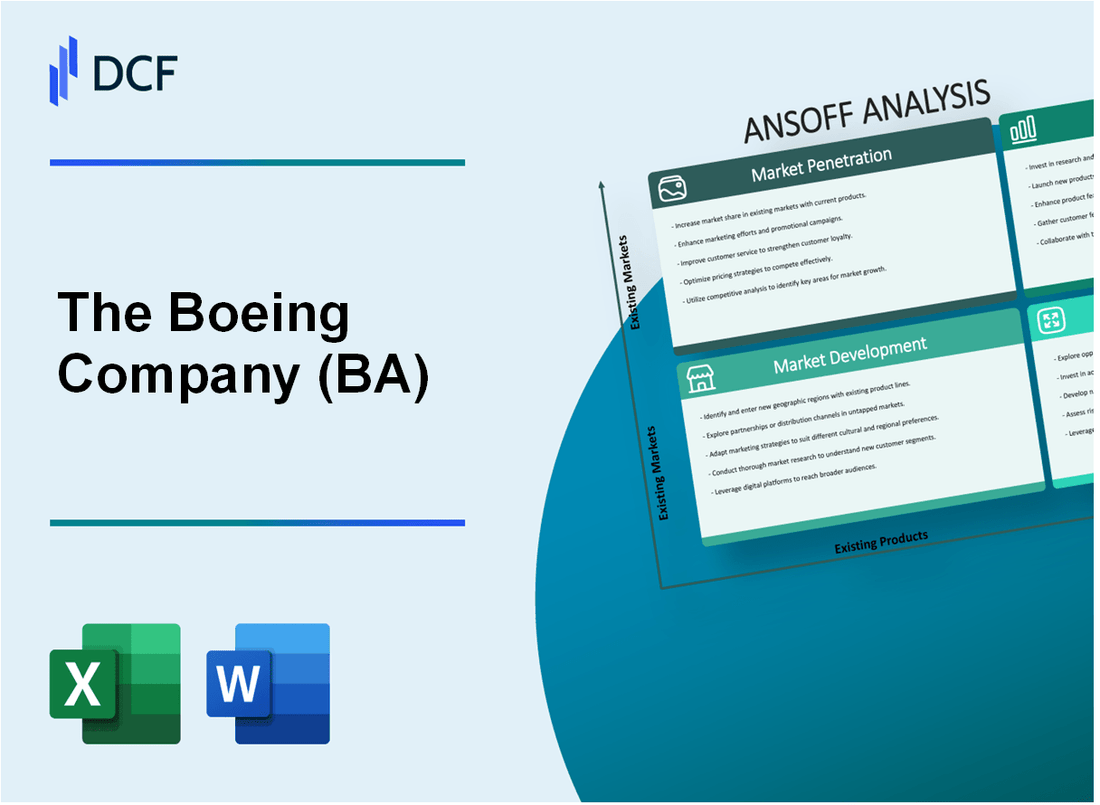
The Boeing Company (BA): ANSOFF-Matrixanalyse |
Fully Editable: Tailor To Your Needs In Excel Or Sheets
Professional Design: Trusted, Industry-Standard Templates
Investor-Approved Valuation Models
MAC/PC Compatible, Fully Unlocked
No Expertise Is Needed; Easy To Follow
The Boeing Company (BA) Bundle
In der dynamischen Welt der Luft- und Raumfahrtinnovationen steht Boeing am Scheideweg der strategischen Transformation und nutzt die leistungsstarke Ansoff-Matrix als Kompass, um sich in komplexen Marktlandschaften zurechtzufinden. Von modernsten nachhaltigen Luftfahrttechnologien bis hin zu ehrgeizigen Vorstößen in die urbane Luftmobilität und Weltraumforschung positioniert sich das Unternehmen strategisch, um die Grenzen der Luft- und Raumfahrt neu zu definieren. Durch das gleichzeitige Streben nach Marktdurchdringung, Entwicklung, Produktinnovation und mutiger Diversifizierung passt sich Boeing nicht nur an Branchenveränderungen an, sondern gestaltet proaktiv die Zukunft des globalen Transportwesens und des technologischen Fortschritts.
The Boeing Company (BA) – Ansoff-Matrix: Marktdurchdringung
Erweitern Sie Angebote für Verteidigungsverträge mit vorhandenen Militärflugzeugmodellen
Im Jahr 2022 erwirtschaftete Boeings Verteidigungs-, Raumfahrt- und Sicherheitssegment einen Umsatz von 26,5 Milliarden US-Dollar. Das Unternehmen sicherte sich mehrere Militärverträge, darunter einen 3,2-Milliarden-Dollar-Vertrag über 179 F-15EX-Kampfflugzeuge für die US-Luftwaffe.
| Militärflugzeugmodell | Vertragswert | Menge |
|---|---|---|
| F-15EX | 3,2 Milliarden US-Dollar | 179 Jets |
| AH-64 Apache | 1,5 Milliarden US-Dollar | 96 Hubschrauber |
Steigern Sie den Verkauf von Verkehrsflugzeugen durch aggressive Preisstrategien
Boeing lieferte im Jahr 2022 480 Verkehrsflugzeuge aus, mit einem Gesamtauftragsbestand von 4.439 Flugzeugen. Der durchschnittliche Verkaufspreis für eine Boeing 737 MAX liegt zwischen 99,7 und 134,9 Millionen US-Dollar.
- Auslieferungen von Verkehrsflugzeugen: 480 Einheiten
- Gesamtbestand an Verkehrsflugzeugen: 4.439 Einheiten
- Durchschnittliche Preisspanne für die 737 MAX: 99,7 bis 134,9 Millionen US-Dollar
Verbessern Sie den Kundenservice und Support für die bestehende Boeing-Flugzeugflotte
Das Global Services-Segment von Boeing erwirtschaftete im Jahr 2022 einen Umsatz von 16,7 Milliarden US-Dollar und konzentrierte sich auf Aftermarket-Support und Wartungsdienste.
| Servicekategorie | Einnahmen | Wachstum |
|---|---|---|
| Kommerzielle Dienstleistungen | 8,9 Milliarden US-Dollar | 12 % Steigerung |
| Globale Dienste | 16,7 Milliarden US-Dollar | 4 % Steigerung |
Optimieren Sie die Produktionseffizienz, um Kosten zu senken und die Wettbewerbsfähigkeit zu verbessern
Boeing hat Kostensenkungsmaßnahmen umgesetzt und die Betriebskosten im Jahr 2022 um 2,3 Milliarden US-Dollar gesenkt. Das Unternehmen möchte die Produktionseffizienz des 737 MAX-Programms verbessern.
- Reduzierung der Betriebskosten: 2,3 Milliarden US-Dollar
- Produktionsziel für 737 MAX: 38 Flugzeuge pro Monat
- Arbeitskostenoptimierung: Reduzierung um 10 % geplant
Stärken Sie Aftermarket-Services und Wartungsverträge
Die Wartungs-, Reparatur- und Überholungsdienste (MRO) von Boeing erwirtschafteten einen Umsatz von 6,2 Milliarden US-Dollar, wobei der Schwerpunkt auf langfristigen Serviceverträgen lag.
| Servicetyp | Einnahmen | Vertragsdauer |
|---|---|---|
| Kommerzielle MRO | 6,2 Milliarden US-Dollar | 5-10 Jahre |
| Militärische Unterstützungsverträge | 4,5 Milliarden US-Dollar | Mehrjährige Verträge |
The Boeing Company (BA) – Ansoff-Matrix: Marktentwicklung
Zielen Sie mit aktuellen Flugzeugmodellen auf aufstrebende Luftfahrtmärkte in Asien und Afrika
Boeings Auslieferungen von Verkehrsflugzeugen im Asien-Pazifik-Raum im Jahr 2022: 302 Flugzeuge. Die Marktdurchdringung in Afrika stieg im Jahr 2022 um 7,3 %.
| Region | Marktwachstum | Flugzeuglieferungen |
|---|---|---|
| Asien-Pazifik | 12.4% | 302 |
| Afrika | 7.3% | 41 |
Ausbau der Präsenz von Verkehrsflugzeugen in Entwicklungsländern
Boeings Marktanteil in Entwicklungsländern: 48,6 % im Jahr 2022. Der gesamte Auftragsbestand an Verkehrsflugzeugen wird auf 377 Milliarden US-Dollar geschätzt.
- Marktpotenzial Indien: 290 Milliarden US-Dollar bis 2030
- Flugzeugnachfrage in Südostasien: 4.200 neue Flugzeuge bis 2040
- Erwartetes Wachstum der Flotte im Nahen Osten: 2.510 Flugzeuge
Entdecken Sie neue Regierungs- und Militärverträge
Boeing-Verteidigungseinnahmen 2022: 26,9 Milliarden US-Dollar. Die internationalen Militärverkäufe stiegen um 9,2 %.
| Vertragsregion | Vertragswert | Jahr |
|---|---|---|
| Naher Osten | 14,3 Milliarden US-Dollar | 2022 |
| Asien-Pazifik | 8,7 Milliarden US-Dollar | 2022 |
Entwickeln Sie strategische Partnerschaften
Internationale Partnerschaftsabkommen 2022: 17 neue Kooperationen. Gesamtes Partnernetzwerk: 86 globale Partner.
- Emirates-Fluggesellschaft: Bestellung von 90 Boeing 777X-Flugzeugen
- Air India: Kaufvertrag für 470 Flugzeuge
- China Eastern Airlines: 292 Flugzeuge in der aktuellen Flotte
Verstärken Sie den Fokus auf kleinere regionale Märkte
Wachstum des Regionaljet-Marktsegments: 6,5 % im Jahr 2022. Boeing 737 MAX ist für die regionale Marktexpansion angestrebt.
| Marktsegment | Wachstumsrate | Flugzeugtyp |
|---|---|---|
| Regionaljets | 6.5% | Boeing 737 MAX |
| Kurzstrecken | 4.2% | Boeing 787 |
The Boeing Company (BA) – Ansoff-Matrix: Produktentwicklung
Investieren Sie in nachhaltige Luftfahrttechnologien und umweltfreundliche Flugzeugdesigns
Boeing investierte im Jahr 2022 33 Millionen US-Dollar in nachhaltige Luftfahrttechnologien. Das Unternehmen verpflichtete sich, bis 2030 3 % nachhaltigen Flugtreibstoff zu verbrauchen.
| Technologieinvestitionen | Betrag | Jahr |
|---|---|---|
| Nachhaltige Luftfahrtforschung | 33 Millionen Dollar | 2022 |
| Umweltfreundliche Designforschung und -entwicklung | 45 Millionen Dollar | 2022 |
Entwickeln Sie fortschrittliche autonome und unbemannte Luftfahrzeugsysteme
Boeings Abteilung für autonome Systeme erwirtschaftete im Jahr 2022 einen Umsatz von 1,2 Milliarden US-Dollar. Das Unternehmen verfügt über 127 aktive unbemannte Luftfahrzeugprojekte.
- Autonome Fahrzeugprojekte: 127
- Umsatz mit unbemannten Systemen: 1,2 Milliarden US-Dollar
- Budget für die Entwicklung militärischer Drohnen: 275 Millionen US-Dollar
Erstellen Sie treibstoffeffiziente Verkehrs- und Militärflugzeuge der nächsten Generation
| Flugzeugmodell | Verbesserung der Kraftstoffeffizienz | Entwicklungskosten |
|---|---|---|
| Boeing 787 Dreamliner | 20 % kraftstoffeffizienter | 32 Milliarden Dollar |
| Boeing 737 MAX | Steigerung der Kraftstoffeffizienz um 14 % | 2,5 Milliarden US-Dollar |
Verbessern Sie die digitale Integration und intelligente Technologien in Flugzeugplattformen
Boeing stellte im Jahr 2022 567 Millionen US-Dollar für die digitale Transformation und die Integration intelligenter Technologien bereit.
- Investition in digitale Technologie: 567 Millionen US-Dollar
- Forschung und Entwicklung im Bereich KI und maschinelles Lernen: 215 Millionen US-Dollar
- Vernetzte Flugzeugtechnologien: 124 Millionen US-Dollar
Ausbau der Elektro- und Hybridantriebsforschung für zukünftige Flugzeugmodelle
Boeing hat im Jahr 2022 412 Millionen US-Dollar für die Forschung zu Elektro- und Hybridantrieben bereitgestellt.
| Antriebstechnik | Forschungsinvestitionen | Zielumsetzung |
|---|---|---|
| Elektrischer Antrieb | 247 Millionen Dollar | 2030-2035 |
| Hybridantrieb | 165 Millionen Dollar | 2035-2040 |
The Boeing Company (BA) – Ansoff-Matrix: Diversifikation
Steigen Sie in die Marktsegmente Urban Air Mobility und Drone Delivery ein
Boeing NeXt investierte im Jahr 2020 495 Millionen US-Dollar in die Entwicklung autonomer Passagierluftfahrzeuge. Der Prototyp des Passagierluftfahrzeugs (PAV) des Unternehmens absolvierte seinen ersten Testflug im Januar 2019.
| Marktsegment | Investition | Prognostizierte Marktgröße bis 2030 |
|---|---|---|
| Urbane Luftmobilität | 495 Millionen US-Dollar | 1,5 Billionen Dollar |
| Drohnenlieferung | 287 Millionen Dollar | 39 Milliarden Dollar |
Entwickeln Sie Angebote für Weltraumforschung und Satellitentechnologie
Die Raumfahrttechnologiesparte von Boeing erwirtschaftete im Jahr 2021 einen Umsatz von 5,8 Milliarden US-Dollar. Der Auftragswert der NASA für das Commercial Crew Program erreichte 4,2 Milliarden US-Dollar.
- Entwicklungskosten des Starliner-Raumschiffs: 1,1 Milliarden US-Dollar
- Investitionen in Forschung und Entwicklung in Satellitentechnologie: 672 Millionen US-Dollar
- Vertrag mit der Internationalen Raumstation: 3,1 Milliarden US-Dollar
Entdecken Sie fortschrittliche Verteidigungs- und Cybersicherheitstechnologielösungen
Der Umsatz des Segments Verteidigungstechnologie erreichte im Jahr 2022 26,4 Milliarden US-Dollar. Die Investitionen in Cybersicherheit beliefen sich auf insgesamt 412 Millionen US-Dollar.
| Bereich Verteidigungstechnologie | Einnahmen | Wachstumsrate |
|---|---|---|
| Autonome Systeme | 8,7 Milliarden US-Dollar | 12.3% |
| Cybersicherheitslösungen | 3,2 Milliarden US-Dollar | 9.6% |
Investieren Sie in autonome Transport- und Robotertechnologien
Die Investitionen in autonome Technologie erreichten im Jahr 2021 783 Millionen US-Dollar. Forschungs- und Entwicklungsausgaben für Robotik: 456 Millionen US-Dollar.
- Entwicklung eines autonomen Fahrzeugprototyps: 287 Millionen US-Dollar
- Finanzierung der Robotik-Forschung: 169 Millionen US-Dollar
- Integration der KI-Technologie: 214 Millionen US-Dollar
Erstellen Sie innovative Luft- und Raumfahrtberatungs- und Technologieintegrationsdienste
Das Technologieberatungssegment erwirtschaftete im Jahr 2022 einen Umsatz von 1,2 Milliarden US-Dollar. Die Technologieintegrationsdienste wuchsen um 15,7 %.
| Beratungsdienst | Einnahmen | Wachstumsprozentsatz |
|---|---|---|
| Beratung im Bereich Luft- und Raumfahrttechnik | 1,2 Milliarden US-Dollar | 15.7% |
| Digitale Transformationsdienste | 687 Millionen US-Dollar | 11.3% |
The Boeing Company (BA) - Ansoff Matrix: Market Penetration
You're looking at how The Boeing Company is pushing harder in its existing markets-selling more of the planes it already builds to the airlines it already serves. This is pure volume play, focused on execution and delivery speed.
The immediate focus is on ramping up production to chip away at that massive order book. The Federal Aviation Administration (FAA) gave the green light in October 2025 to increase the 737 MAX production rate to 42 aircraft per month, up from the previous cap of 38 per month. This move is critical, as the 737 program stabilized at 38 per month during the third quarter of 2025.
On the widebody side, The Boeing Company is also pushing the 787 Dreamliner. Production has stabilized at around seven aircraft per month, which was the stated goal for the end of 2025. This is a climb from the five per month rate seen at the start of 2025. For context, The Boeing Company delivered seven 787s in September 2025.
Regaining control over the supply chain is a major part of this penetration strategy, which is why the acquisition of Spirit AeroSystems is key. The definitive agreement, announced in July 2024, valued the all-stock transaction at an equity value of approximately $4.7 billion, with an expected closing by the end of 2025. Shareholders approved the deal in January 2025.
The core metric for restoring customer trust is delivery volume against the backlog. As of the end of the third quarter of 2025, The Boeing Company's total company backlog stood at $636 billion. Specifically, the Commercial Airplanes backlog, which represents the bulk of the current production push, was valued at $535 billion, comprising over 5,900 airplanes. This backlog is expected to last approximately 11.1 years based on 2025 production estimates.
To maximize revenue from existing customers, The Boeing Company is emphasizing its services arm. The Global Services division reported revenue of $5.3 billion in the second quarter of 2025, achieving an operating margin of 19.9 percent for that quarter. Looking forward, The Boeing Company projects the entire commercial aviation support and services market to be worth $4.7 trillion across the 20-year period between 2025 and 2044.
Here is a snapshot of the production ramp-up targets and key financial figures:
| Metric | Target/Actual Rate (2025) | Reference Point/Period |
| 737 MAX Production Rate | 42 per month (Approved) | October 2025 |
| 787 Dreamliner Production Rate | 7 per month (Stabilized) | Year-End 2025 Target |
| Commercial Airplanes Backlog Value | $535 billion | End of Q3 2025 |
| Total Company Backlog Value | $636 billion | End of Q3 2025 |
| Global Services Revenue | $5.3 billion | Q2 2025 |
The push for market penetration is also supported by the planned integration of Spirit AeroSystems, which is intended to tighten quality control over the 737 MAX and 787 fuselages. The deal, valued at an equity stake of about $4.7 billion, is expected to close by the end of 2025.
The focus on existing customers is also evident in the delivery performance, with Commercial Airplanes delivering 160 airplanes in the third quarter of 2025. Year-to-date deliveries through October 31st, 2025, reached 493 aircraft.
You can see the scale of the service opportunity through these numbers:
- Global Services Q2 2025 operating margin was 19.9 percent.
- The 20-year commercial services market outlook (2025-2044) is valued at $4.7 trillion.
- The 737 MAX backlog represents 4,775 unfilled orders (excluding older models) as of October 2025.
- The 787 program has production slots sold out until around 2030.
The Boeing Company (BA) - Ansoff Matrix: Market Development
You're looking at how The Boeing Company can push its existing platforms into new geographic territories or new customer segments, which is the essence of Market Development. This strategy relies heavily on validated products finding new buyers, so let's look at the hard numbers driving this expansion.
The commercial fleet outlook clearly points toward growth outside established regions. Boeing projects that emerging markets will account for over 50% of the global commercial fleet by 2044, a significant jump from nearly 40% in 2024. The total global fleet is expected to nearly double to 49,600 aircraft by 2044. Specifically, 22,500 new airplanes are projected to be needed to address rising demand in China and these emerging markets over the next two decades. This growth is underpinned by a forecasted annual passenger growth rate of 4.2%.
For defense platforms, the focus is on expanding the reach of established systems like the KC-46A Pegasus tanker. As of November 2025, there are 183 KC-46A Pegasus tankers on contract or in service worldwide. This includes 98 delivered to the U.S. Air Force (USAF), six delivered to the Japan Air Self-Defense Force (JASDF), and four aircraft under contract for the Israel Air Force (IAF). Israel has a stated plan to acquire two of these aircraft for an estimated $500 million. The USAF's original deal has an absolute maximum of 288 tankers if all options are exercised. Furthermore, a recent Lot 12 contract was secured for 15 additional tankers valued at $2,469,937,348.
The cargo market presents a clear opportunity for converting existing passenger airframes. The requirement is set to meet a cargo demand estimated at 2,900 units [cite: User Prompt Requirement]. In 2023, over 120 narrowbody aircraft were converted to freighters, which fell to just over 70 in 2024. For widebody conversions, numbers dropped from around 55 in 2023 to under 40 in 2024. As of mid-2025, the in-service freighter fleet includes over 1,400 widebody units and more than 800 narrowbody units. The current conversion backlog across all types stands at about 320 units. To give you a sense of asset value, a 21-year-old converted 767-300ERBDSF was valued at $25 million in July 2024, with its lease rate dropping by 2.4% to below $290,000 per month in the same period.
The T-7A Red Hawk trainer jet is actively being positioned for international sales beyond the USAF. Boeing and its partners have set a global sales goal of over 2,700 Red Hawks. The initial USAF contract covers 351 T-7As and 46 simulators, with options for up to 475 total aircraft. The company has incurred approximately $1.3 billion in charges on this fixed-price contract so far. International interest includes a teaming effort with BAE Systems to offer the jet to the United Kingdom's Royal Air Force, and pitches made to the Brazilian Air Force. Australia and Serbia are also listed as potential customers.
In the space sector, the $2.8 billion contract won by The Boeing Company from the US Space Force for the Evolved Strategic Satellite Communications (ESS) program is a key lever for future international space service opportunities. This initial award is for two satellites, with options for two more, which could bring the total value to $3.75 billion. The entire ESS Space Segment acquisition is a $12 billion initiative. The government obligated $100 million in fiscal year 2025 funds for this contract. The first satellite delivery is targeted for 2031, with work extending through the end of December 2033. The ESS design leverages technology proven on the WGS-11, WGS-12, and commercial O3b mPOWER constellations.
Here is a summary of key defense and space figures:
| Program/Metric | Value/Quantity | Context/Date Reference |
|---|---|---|
| KC-46A Israel Order (Announced) | 2 aircraft for $500 million | International Defense Sale |
| KC-46A Total on Contract/Service (Nov 2025) | 183 units | Worldwide Fleet Status |
| T-7A Global Sales Goal | Over 2,700 units | International Target |
| ESS Contract Value (Initial) | $2.8 billion | US Space Force Award |
| ESS Total Program Value (Space Segment) | $12 billion | Overall Initiative Scope |
The company's Defense, Space & Security unit backlog stood at $61 billion as of the first quarter of 2024, with 31% representing non-U.S. orders.
For the commercial side, here are the fleet projections:
- Global Fleet Projection (2044): Nearly 50,000 aircraft.
- Emerging Market Share (2044): Over 50%.
- New Aircraft Needed for Emerging Markets (to 2044): 22,500 units.
- Widebody Fleet Projection (2044): Approximately 8,320 airplanes.
- Widebody Fleet Size (2024): Roughly 4,400 airplanes.
Finance needs to track the execution of the ESS contract, specifically the $100 million obligated in fiscal year 2025 funds.
The Boeing Company (BA) - Ansoff Matrix: Product Development
The Product Development quadrant for The Boeing Company (BA) centers on bringing new, technologically advanced aircraft to market and enhancing existing platforms through significant engineering investment.
The 777-9 widebody jet, initially targeted for service entry in 2020, has seen its entry-into-service prediction shift to 2027 after navigating protracted certification trials, including the third of five major phases of Type Inspection Authorization (TIA) testing. This delay prompted The Boeing Company (BA) to record a $4.9 billion non-cash pre-tax charge in its third quarter, contributing to a $5.3 billion third-quarter loss. To support the certification process, The Boeing Company (BA) has already produced 26 units of the 777-9; 4 aircraft support active test campaigns, while 22 remain in storage at Seattle Paine Field International Airport (SEA). As of the Paris Air Show in June, the 777-9 backlog stood at 449 units.
Investment in future designs remains substantial. For the twelve months ending September 30, 2025, The Boeing Company (BA)'s research and development expenses totaled $3.487B. This level of investment supports the development of next-generation, fuel-efficient aircraft concepts.
Regarding sustainable aviation fuel (SAF) compatibility, the development of the X-66A Sustainable Flight Demonstrator (SFD) program has seen an 'updated approach' where the flight demonstrator is paused, focusing instead on a ground-based testbed to demonstrate thin-wing technology. NASA pledged $425 million for the SFD project, with The Boeing Company (BA) and its partners expected to contribute up to $725 million. The Pratt & Whitney GTF engines intended for the X-66A offer up to 20% better fuel efficiency. Ground and flight tests for the X-66A were slated to start in 2028.
New variants of the 737 MAX family are nearing service entry following resolution of the engine anti-ice system issue. The 737 MAX 7 and MAX 10 variants are now anticipated to achieve Federal Aviation Administration (FAA) certification in 2026. Currently, The Boeing Company (BA) has approximately 35 aircraft of these types in storage. The combined backlog for the MAX 7 and MAX 10 exceeds 1,500 unfilled orders. Specifically, Southwest Airlines holds 249 orders for the MAX 7, and the MAX 10 has 1,285 unfilled orders as of September 30.
The integration of AI and digital twin technology is reshaping design and production efficiency across platforms, including the 787 Dreamliner and future aircraft. Digital twins allow engineers to simulate entire production cycles digitally, leading to faster prototyping. This approach has been shown to yield a 75% improvement in first-time quality and an 80% decrease in assembly time on one program, while also halving the duration needed for software development. The digital replica of the MQ-28 Ghost Bat was 'flown' thousands of times under various scenarios using these digital models.
Key metrics for Product Development initiatives:
| Product/Initiative | Key Metric/Value | Status/Date Reference |
| 777-9 Entry-Into-Service | 2027 | Latest expectation |
| 777X Program Charge | $4.9 billion | Non-cash pre-tax charge |
| 777-9 Units Produced | 26 | Pre-certification count |
| Twelve Months R&D Expense (to Sep 30, 2025) | $3.487B | Latest reported figure |
| 737 MAX 7/10 Certification Target | 2026 | Anticipated year |
| 737 MAX 7/10 Combined Orders | Over 1,500 | Unfilled orders |
| X-66A NASA Funding Commitment | $425 million | Pledged by NASA |
| AI/Digital Twin Quality Improvement | 75% | First-time quality improvement |
The use of digital twins allows for process refinement before physical manufacturing, reducing unexpected errors. The GTF engine technology, relevant to future designs, offers up to 20% better fuel efficiency.
The Boeing Company (BA) - Ansoff Matrix: Diversification
The Diversification quadrant of the Ansoff Matrix for The Boeing Company involves moving into new markets with new products, which is evident in its strategic focus on advanced technologies and services beyond traditional commercial aircraft manufacturing.
Accelerate development of autonomous systems and unmanned aerial vehicles (UAS) for military and commercial use.
The Boeing venture-capital arm, HorizonX Ventures, led a funding round for Robotic Skies, a services provider connecting commercial Unmanned Aircraft Systems (UAS) manufacturers and operators with a network of over 170 civil aviation authority-certified repair stations. This investment builds on prior deals to enhance commercial UAS services. Furthermore, Boeing's NeXt unit prototyped electric vertical takeoff and landing (eVTOL) cargo air vehicles. Wisk, a Boeing entity, is noted as a top-rated firm for achieving certification for passenger transport in the Advanced Air Mobility (AAM) space. The global AAM market was estimated at $13.9 billion in 2025E, with a forecast Compound Annual Growth Rate (CAGR) of 20.6% through 2035.
Partner with Palantir to integrate AI across the Defense, Space & Security division for operational efficiency.
On September 23, 2025, The Boeing Company and Palantir Technologies announced a partnership to integrate Palantir's AI-enabled Foundry platform across Boeing Defense, Space & Security (BDS) factories. This integration aims to standardize data analytics and insights across geographically dispersed defense factories to improve operations and speed up production. Boeing Defense, Space & Security CEO Steve Parker stated the goal is to make decisions in days and hours, not weeks, through AI synthesizing data for production planning and supply chain management.
Invest in Advanced Air Mobility (AAM) technologies like air taxis, focusing on urban mobility solutions.
The pursuit of AAM technologies aligns with the demand for efficient urban mobility solutions. Boeing HorizonX Ventures previously partnered with Near Earth Autonomy to explore applications for autonomous flight in emerging markets like urban mobility. The electric propulsion segment held a revenue share of around 60.50% in the AAM market in 2024.
Expand the Global Services portfolio into new, high-margin areas like data analytics and predictive maintenance for non-Boeing fleets.
The Global Services division has been a focus for profitable growth, securing awards for C-17 sustainment and F-15 Japan Super Interceptor upgrade services from the U.S. Air Force during the fourth quarter of 2024. The division's operating margin has shown consistent improvement, rising from 2.9% in 2020 to 18.13% in 2024. In the second quarter of 2025, Global Services generated revenue of $5.28 billion, achieving the highest operating margin among all segments at 19.9%. The global Maintenance, Repair, and Overhaul (MRO) market was valued at $85 billion in 2024.
Here's a quick look at the segment performance around the transition to 2025:
| Segment | FY 2024 Revenue (Billions USD) | Q2 2025 Revenue (Millions USD) | Q2 2025 Operating Margin (%) |
| Defense, Space & Security | $23.92 | $6,617 | 1.7 |
| Global Services | $19.95 | $5,281 | 19.9 |
The Global Services segment's Q2 2025 operating margin of 19.9% significantly outpaces the Defense, Space & Security segment's 1.7% margin for the same period.
Pursue new space exploration and satellite constellation contracts to compete with emerging players.
The Boeing Defense, Space & Security unit secured a $2.8 billion contract in July 2025 from the Space Force for the Evolved Strategic Satellite Communications (ESS) program, which includes the development and production of two initial jam-resistant satellites, with options for two more. This work is part of the broader $12 billion ESS program, which will replace the Advanced Extremely High Frequency constellation. The total company backlog at the end of Q2 2025 grew to $619 billion. The backlog at Defense, Space & Security specifically grew to $74 billion at the end of Q2 2025.
Key financial and operational metrics as of late 2025 include:
- Total company backlog at the end of Q2 2025: $619 billion.
- Total company revenue for Q2 2025: $22.75 billion.
- Global Services Q2 2025 revenue: $5.28 billion.
- ESS satellite contract value: $2.8 billion.
- Boeing HorizonX Ventures invested in Robotic Skies, a UAS services provider.
- The company achieved a positive free cash flow of $238 million in Q3 2025.
Disclaimer
All information, articles, and product details provided on this website are for general informational and educational purposes only. We do not claim any ownership over, nor do we intend to infringe upon, any trademarks, copyrights, logos, brand names, or other intellectual property mentioned or depicted on this site. Such intellectual property remains the property of its respective owners, and any references here are made solely for identification or informational purposes, without implying any affiliation, endorsement, or partnership.
We make no representations or warranties, express or implied, regarding the accuracy, completeness, or suitability of any content or products presented. Nothing on this website should be construed as legal, tax, investment, financial, medical, or other professional advice. In addition, no part of this site—including articles or product references—constitutes a solicitation, recommendation, endorsement, advertisement, or offer to buy or sell any securities, franchises, or other financial instruments, particularly in jurisdictions where such activity would be unlawful.
All content is of a general nature and may not address the specific circumstances of any individual or entity. It is not a substitute for professional advice or services. Any actions you take based on the information provided here are strictly at your own risk. You accept full responsibility for any decisions or outcomes arising from your use of this website and agree to release us from any liability in connection with your use of, or reliance upon, the content or products found herein.