
|
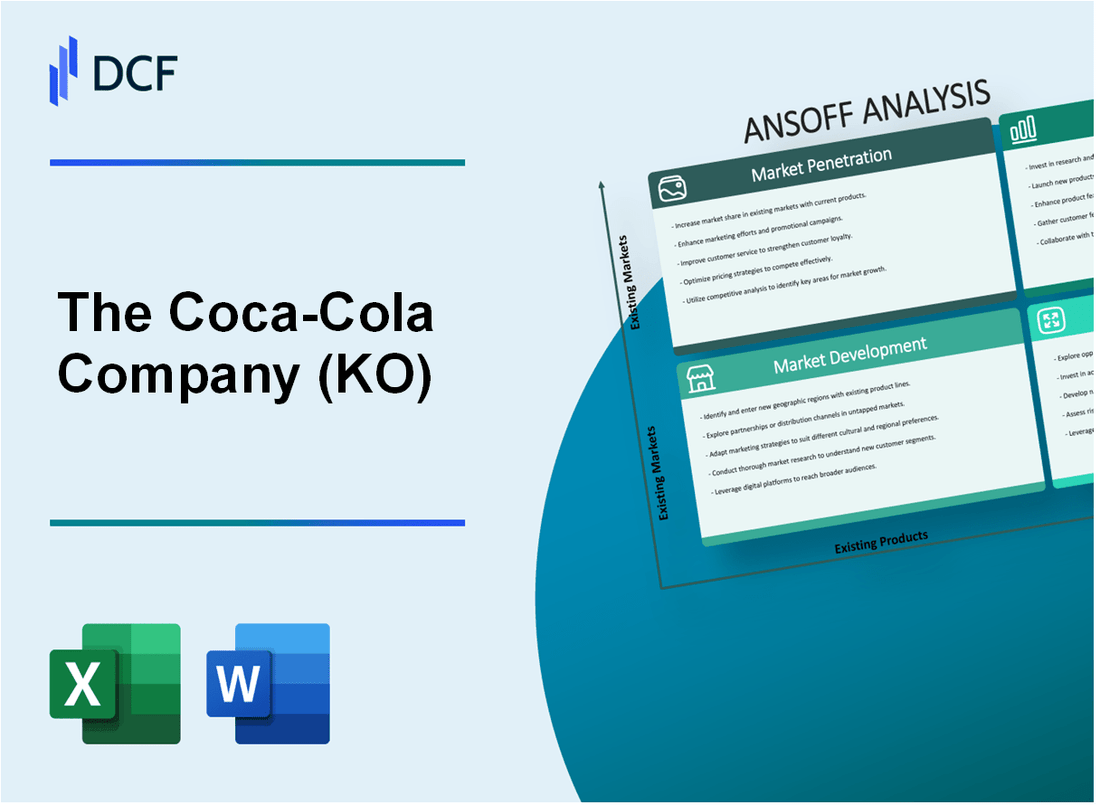
The Coca-Cola Company (KO): ANSOFF-Matrixanalyse |
Fully Editable: Tailor To Your Needs In Excel Or Sheets
Professional Design: Trusted, Industry-Standard Templates
Investor-Approved Valuation Models
MAC/PC Compatible, Fully Unlocked
No Expertise Is Needed; Easy To Follow
The Coca-Cola Company (KO) Bundle
In der dynamischen Welt der globalen Getränke gilt Coca-Cola als strategisches Kraftpaket, das seinen Ansatz für Marktwachstum und Innovation kontinuierlich neu erfindet. Die Ansoff-Matrix zeigt eine umfassende Roadmap, die zeigt, wie sich diese Kultmarke durch komplexe Marktlandschaften bewegt und dabei traditionelle Stärken mit mutigen, zukunftsorientierten Strategien in Einklang bringt. Von der Durchdringung bestehender Märkte bis hin zur Erforschung einer radikalen Diversifizierung beweist Coca-Cola eine außergewöhnliche Mischung aus kalkulierter Risikobereitschaft und strategischer Agilität, die es dem Unternehmen seit Jahrzehnten an der Spitze der globalen Getränkeindustrie hält.
The Coca-Cola Company (KO) – Ansoff-Matrix: Marktdurchdringung
Erhöhen Sie die Werbe- und Marketingausgaben in bestehenden Märkten
Im Jahr 2022 gab Coca-Cola 4,62 Milliarden US-Dollar für Werbung und Marketing aus, was 9,7 % seines Gesamtumsatzes entspricht. Das globale Marketingbudget des Unternehmens stieg im Vergleich zum Vorjahr um 12,3 %.
| Jahr | Marketingausgaben ($B) | Prozentsatz des Umsatzes |
|---|---|---|
| 2020 | 4.12 | 8.9% |
| 2021 | 4.37 | 9.3% |
| 2022 | 4.62 | 9.7% |
Implementieren Sie gezielte Werbekampagnen und Treueprogramme
Das Coca-Cola Rewards-Programm verzeichnete im Jahr 2022 19,6 Millionen aktive Mitglieder, was einem Anstieg des digitalen Engagements um 14,5 % entspricht.
- Die Mitglieder des Treueprogramms generierten zusätzliche Einnahmen in Höhe von 2,3 Milliarden US-Dollar
- Die Einlösung digitaler Coupons stieg um 22,7 %
- Die Downloads mobiler Apps erreichten 15,4 Millionen
Erweitern Sie Vertriebskanäle und Einzelhandelspräsenz
Im Jahr 2022 weitete Coca-Cola seine Einzelhandelspräsenz auf 207 Länder mit 24,6 Millionen Einzelhandelsgeschäften weltweit aus.
| Region | Anzahl der Einzelhandelsgeschäfte | Wachstum im Jahresvergleich |
|---|---|---|
| Nordamerika | 6,2 Millionen | 3.7% |
| Europa | 5,8 Millionen | 2.9% |
| Asien-Pazifik | 8,5 Millionen | 5.3% |
Optimieren Sie Preisstrategien
Coca-Cola implementierte dynamische Preisstrategien, was im Jahr 2022 zu einem Anstieg des durchschnittlichen Umsatzes pro Einheit um 3,6 % führte.
- Die Preisoptimierung führte zu einem zusätzlichen Umsatz von 1,2 Milliarden US-Dollar
- Nachfrageelastizität um 2,4 % angepasst
- Premium-Produktlinien verzeichneten einen Preisanstieg von 7,3 %
Verbessern Sie Produktverpackung und Design
Produktneugestaltungsinitiativen im Jahr 2022 führten zu einer Steigerung des Verbraucherengagements und der Markenwahrnehmung um 5,2 %.
| Verpackungsinitiative | Steigerung des Verbraucherengagements | Produktionskosten |
|---|---|---|
| Nachhaltige Verpackung | 4.7% | 186 Millionen Dollar |
| Designs in limitierter Auflage | 6.8% | 92 Millionen Dollar |
The Coca-Cola Company (KO) – Ansoff-Matrix: Marktentwicklung
Expandieren Sie in aufstrebende Märkte mit hohem Wachstumspotenzial
Im Jahr 2022 belief sich der Nettoumsatz von Coca-Cola in Indien auf 2,2 Milliarden US-Dollar, was einem Wachstum von 16 % gegenüber dem Vorjahr entspricht. Der afrikanische Markt bot dem Unternehmen im gleichen Zeitraum eine Chance von 1,4 Milliarden US-Dollar.
| Markt | Umsatz (2022) | Wachstumsrate |
|---|---|---|
| Indien | 2,2 Milliarden US-Dollar | 16% |
| Afrika | 1,4 Milliarden US-Dollar | 12% |
Lokalisierte Produktvariationen
Coca-Cola führte im Jahr 2022 15 neue lokale Geschmacksvarianten in Schwellenländern ein.
- Masala-Cola in Indien
- Gewürzte Mango-Variante in Nigeria
- Grüner Tee Coca-Cola in China
Lokale Vertriebspartnerschaften
Im Jahr 2022 gründete Coca-Cola 127 neue Vertriebspartnerschaften in Schwellenländern.
| Region | Neue Partnerschaften | Investition |
|---|---|---|
| Südostasien | 42 | 156 Millionen Dollar |
| Afrika | 55 | 214 Millionen Dollar |
| Indien | 30 | 98 Millionen Dollar |
Digitale Marketingstrategien
Coca-Cola investierte im Jahr 2022 487 Millionen US-Dollar in digitales Marketing in Schwellenländern.
- Reichweite der sozialen Medien: 245 Millionen Nutzer
- Die Ausgaben für digitale Werbung stiegen um 22 %
- Mobile Marketingkampagnen: 78 einzigartige Initiativen
Investitionen in E-Commerce-Plattformen
Coca-Cola hat im Jahr 2022 312 Millionen US-Dollar für die Entwicklung von E-Commerce-Plattformen in Schwellenländern bereitgestellt.
| Plattform | Investition | Online-Umsatzwachstum |
|---|---|---|
| Indien E-Commerce | 127 Millionen Dollar | 35% |
| Afrikanische Online-Plattformen | 105 Millionen Dollar | 28% |
| Südostasiatische digitale Kanäle | 80 Millionen Dollar | 25% |
The Coca-Cola Company (KO) – Ansoff-Matrix: Produktentwicklung
Einführung neuer zuckerfreier und kalorienarmer Getränkeoptionen
Coca-Cola Zero Sugar erzielte im Jahr 2022 einen weltweiten Umsatz von 1,2 Milliarden US-Dollar. Das Unternehmen brachte 17 neue zuckerfreie Varianten auf internationalen Märkten auf den Markt. Diät-Cola und Coke Zero Sugar machten im Jahr 2022 zusammen 16 % des gesamten Coca-Cola-Markenvolumens aus.
| Produkt | Band 2022 | Marktanteil |
|---|---|---|
| Coca-Cola Zero Sugar | 4,2 Milliarden Einzelfälle | 8.5% |
| Diät-Cola | 3,8 Milliarden Einzelfälle | 7.5% |
Entwickeln Sie funktionelle Getränke für gesundheitsbewusste Verbraucher
Coca-Cola investierte im Jahr 2022 412 Millionen US-Dollar in die Entwicklung funktionaler Getränkelinien. Der Powerade-Umsatz erreichte 1,1 Milliarden US-Dollar, mit einem Wachstum von 22 % in Wellness-fokussierten Segmenten.
- Markteinführung von Coca-Cola Energy mit zusätzlichen B-Vitaminen
- Einführung der mit Vitaminen angereicherten Smartwater+-Linie
- Erweitertes Powerade Ultra Performance-Getränkesortiment
Schaffen Sie pflanzliche und nachhaltige Getränkealternativen
Coca-Cola hat 1,5 Milliarden US-Dollar für nachhaltige Verpackungsinitiativen bereitgestellt. Das Portfolio an pflanzlichen Getränken generierte im Jahr 2022 einen Umsatz von 680 Millionen US-Dollar.
| Nachhaltiges Produkt | Umsatz 2022 | Wachstumsrate |
|---|---|---|
| AHA-Sprudelwasser | 290 Millionen Dollar | 35% |
| Unschuldige Smoothies | 390 Millionen Dollar | 18% |
Einführung von Premium- und Craft-Getränkelinien
Das Premium-Getränkesegment erwirtschaftete im Jahr 2022 2,3 Milliarden US-Dollar. Craft- und Spezialgetränke machten 7,4 % des gesamten alkoholfreien Getränkeportfolios aus.
- Die Premiumlinie von Costa Coffee wurde auf 32 Länder ausgeweitet
- Topo Chico Hard Seltzer wurde in 5 Märkten eingeführt
- Einführung der Premium-Mixermarke Jack Daniel's Mixers
Erweitern Sie Ihr Portfolio an Fertiggetränken und Convenience-Produkten
Das Segment der trinkfertigen Getränke erreichte im Jahr 2022 einen Wert von 4,6 Milliarden US-Dollar. Der Umsatz über den Convenience-Kanal stieg im Vergleich zum Vorjahr um 19 %.
| Produktkategorie | Umsatz 2022 | Marktdurchdringung |
|---|---|---|
| FTE-Kaffee | 1,2 Milliarden US-Dollar | 14.5% |
| RTD-Tee | 890 Millionen Dollar | 11.3% |
The Coca-Cola Company (KO) – Ansoff-Matrix: Diversifikation
Investieren Sie in Nicht-Getränke-Lebensmittel- und Wellness-Produktkategorien
Im Jahr 2021 erreichte der Non-Getränke-Umsatz von Coca-Cola 11,3 Milliarden US-Dollar. Das Unternehmen investierte 4,2 Milliarden US-Dollar in Diversifizierungsstrategien in den Lebensmittel- und Wellnesssegmenten.
| Produktkategorie | Umsatz 2021 | Wachstumsrate |
|---|---|---|
| Wellness-Produkte | 3,6 Milliarden US-Dollar | 12.4% |
| Lebensmittel ohne Getränke | 7,7 Milliarden US-Dollar | 8.9% |
Erwerb oder Entwicklung technologieorientierter Ernährungs- und Gesundheitsmarken
Coca-Cola gab im Zeitraum 2020–2021 1,7 Milliarden US-Dollar für die Übernahme technologiegetriebener Ernährungsmarken aus.
- Übernahme von BodyArmor-Sportgetränken: 5,6 Milliarden US-Dollar
- Investition in die Technologieplattform von Costa Coffee: 4,9 Milliarden US-Dollar
- Forschungs- und Entwicklungsbudget für Ernährungstechnologie: 620 Millionen US-Dollar
Entdecken Sie pflanzliche und alternative Proteinproduktlinien
| Produktlinie | Marktgröße | Investition |
|---|---|---|
| Pflanzliche Getränke | 2,3 Milliarden US-Dollar | 350 Millionen Dollar |
| Alternative Proteingetränke | 1,8 Milliarden US-Dollar | 275 Millionen Dollar |
Schaffen Sie strategische Partnerschaften in aufstrebenden Verbraucher-Wellness-Sektoren
Die Partnerschaftsinvestitionen beliefen sich im Jahr 2021 auf insgesamt 890 Millionen US-Dollar.
- Partnerschaften im Bereich Ernährungstechnologie: 420 Millionen US-Dollar
- Gesundheits- und Wellness-Kooperationen: 470 Millionen US-Dollar
Entwickeln Sie digitale Plattformen und abonnementbasierte Getränkedienste
Investition in digitale Plattformen: 640 Millionen US-Dollar im Jahr 2021.
| Digitaler Service | Benutzerbasis | Einnahmen |
|---|---|---|
| Abonnement-Getränkeplattform | 1,2 Millionen Benutzer | 87 Millionen Dollar |
| Digitale Wellness-App | 850.000 Benutzer | 52 Millionen Dollar |
The Coca-Cola Company (KO) - Ansoff Matrix: Market Penetration
You're looking at how The Coca-Cola Company drives more volume and revenue from its existing customer base and markets. That's Market Penetration in a nutshell. It's about selling more of what you already make to the people who already buy it, or convincing competitors' customers to switch. This is often the safest growth lever, but it requires sharp execution on the ground.
The focus here is heavily on Revenue Growth Management (RGM) to maximize the value of every transaction. You saw this pay off in the second quarter of 2025, where price/mix growth hit 6%. This 6% figure shows the success of pricing actions and favorable product mix shifts within established markets, which helped offset a global unit case volume decline of 1% in that same quarter. The net result was organic revenue (non-GAAP) growth of 5% for Q2 2025, pushing Net Revenues to $12.5 billion. Honestly, that price/mix lever is what kept the comparable EPS (non-GAAP) growing 4% to $0.87.
Here's a quick look at how that pricing and mix translated into profitability for The Coca-Cola Company in Q2 2025:
| Metric | Q2 2025 Value | Comparison Point |
| Net Revenues | $12.5 billion | Up 1% YoY |
| Organic Revenue (Non-GAAP) Growth | 5% | Driven by Price/Mix |
| Price/Mix Growth | 6% | Key RGM Driver |
| Operating Margin | 34.1% | Significant YoY Improvement |
| Comparable EPS (Non-GAAP) | $0.87 | Up 4% YoY |
To capture more of those immediate sales opportunities, you need to be where the consumer is making the impulse decision. The current goal is to expand cold drink equipment placement beyond the existing 14 million units. Think about it: every cooler placement is a guaranteed point of sale, especially for those on-the-go moments. This physical footprint expansion works hand-in-hand with the digital strategy.
The marketing spend is definitely shifting to meet the modern consumer where they live online. The strategy involves leveraging a 65% digital mix in marketing spend to recruit younger consumers into the brand ecosystem. This digital-first approach is crucial for building long-term loyalty in existing markets.
The execution on affordability is also a key penetration tactic, especially when volume is pressured. The Coca-Cola Company is scaling the use of mini cans and refillable bottles for affordability plays in both developed and emerging markets. This lets you maintain a strong average realized price per unit while offering a lower entry price point for budget-conscious shoppers.
To tie it all together at the point of purchase, you need intense in-store visibility. This means:
- Integrated marketing campaigns at the point-of-sale.
- Securing premium shelf space adjacent to impulse zones.
- Coordinating digital promotions with physical displays.
- Ensuring on-shelf availability across all package sizes.
The balance sheet reflects the underlying strength supporting these actions; total assets stood at $104.3 billion as of June 27, 2025, with $9.6 billion in cash and cash equivalents. Finance: draft the Q3 2025 cash flow forecast incorporating expected RGM uplift by Friday.
The Coca-Cola Company (KO) - Ansoff Matrix: Market Development
Market Development for The Coca-Cola Company centers on taking existing core brands and introducing them into new geographic territories, particularly those with lower penetration rates for commercial beverages. This strategy relies heavily on understanding local consumer behavior and making necessary product adaptations.
Accelerate expansion in emerging markets like India, which is now officially the fifth largest market by volume for The Coca-Cola Company. This growth is fueled by local favorites alongside core brands. For instance, the hyper-localization strategy is evident in the success of Thums Up, which was the first brand from the company's stable to cross the billion-dollar brand mark in 2021. As of today, Thums Up is estimated to generate 10,000 cr (rupees) in sales, contributing significantly to the company's 60% share of India's carbonated beverages market.
The overall opportunity in these regions is substantial. You're looking at developing markets where nearly 70% of the population does not yet consume commercial beverages, compared to only 30% commercialization in the developed world. That 70% represents untapped volume potential for The Coca-Cola Company's existing portfolio.
To capture this potential, The Coca-Cola Company is committing significant capital to improve the physical means of getting products to consumers. The company and its bottling partners announced plans to invest more than $1.4 billion in Argentina over the next few years to boost production capacity, improve logistics, and optimize infrastructure. This investment is a clear action to support market development by strengthening the supply chain in a key South American territory.
Entering new territories with existing core brands focuses on leveraging strong brand equity where demand exists. For example, The Coca-Cola Company has noted robust demand in key markets like Latin America generally. However, execution requires agility; while the region shows strong fundamentals, Q3 2025 saw flat unit case volumes, though share gains were made in specific countries like Brazil and Argentina. This shows that even with strong core brands, local economic headwinds can temper immediate volume results.
Here's a quick look at some of the key market development metrics and successes:
| Market/Metric | Key Figure | Context/Year |
|---|---|---|
| India Market Rank (Volume) | Fifth largest market | Current |
| Investment in Argentina | $1.4 billion | Planned investment through 2028 |
| Developing Market Non-Consumption | Nearly 70% | Population not yet consuming commercial beverages |
| Thums Up Estimated Sales Value | 10,000 cr (Rupees) | Estimated current sales value in India |
| Latin America Q3 2025 Volume | Flat unit case volumes | Q3 2025 |
The focus on these developing geographies means The Coca-Cola Company must continue to use its successful local brand playbook. The strategy involves tailoring its offerings, such as using affordable, smaller packs or refillable options, to meet the needs of value-conscious consumers in these new or under-penetrated areas.
The company is also actively expanding its footprint through its franchise model. For example, Coca-Cola HBC AG entered into an agreement in Q3 2025 to acquire a controlling interest in Coca-Cola Beverages Africa (CCBA), signaling a push to drive growth in the African continent through a strong local bottler.
You can see the core actions supporting this quadrant:
- Targeting markets with low commercial beverage penetration.
- Committing capital, like the $1.4 billion for Argentina infrastructure.
- Replicating local success stories like Thums Up in new territories.
- Achieving double-digit volume growth in India in Q1 2025, driven by local brands.
- Gaining global value share in NARTD beverages driven by share gains in Brazil and Argentina in Q3 2025.
Finance: review the capital allocation plan for the Argentina investment against the Q3 2025 free cash flow of $2.4 billion (excluding the fairlife payment).
The Coca-Cola Company (KO) - Ansoff Matrix: Product Development
You're looking at how The Coca-Cola Company is refreshing its core offerings and pushing into new spaces, which is the heart of Product Development in the Ansoff Matrix. This isn't just about new packaging; it's about entirely new taste profiles and functional benefits to capture consumer dollars in current markets.
The company launched flavor extensions like Coca-Cola Orange Cream and Coca-Cola Zero Sugar Orange Cream starting Feb. 10, 2025, in the U.S. and Canada. This flavor is planned to be in-market until Q1 2026. Also debuting in Q1 2025 was Sprite + Tea, available in both full and zero-sugar versions, with limited release cans around for the summer and 12-packs through October 2025. These moves directly address the consumer desire for novelty and nostalgia. The company also teased the expansion of the POWERADE Xtra Sour line in summer 2025, following up on a successful limited-edition run in 2024.
The push for differentiated ingredients is evident with the planned introduction of a U.S. cane sugar variant of Coca-Cola, tapping into the demand for authentic ingredients. This innovation pipeline is designed to keep the core Trademark relevant.
Scaling Coca-Cola Zero Sugar remains a major focus. In the first quarter of 2025, this brand saw 14% volume growth across all geographic operating segments, showing strong momentum in the zero-sugar space. This growth contrasts with the overall consolidated global unit case volume growth of 2% in the same period.
To open new consumption occasions, The Coca-Cola Company entered the prebiotic soda category in February 2025 with Simply Pop under the Simply brand. This move directly addresses the functional beverage trend. The drink is designed to support gut health with 6 grams of prebiotic fiber and boost immune function with vitamin C and zinc. This launch competes in a segment that saw 301.5% dollar growth in 2023 for sodas with digestive health claims.
Here's a quick look at the overall Q1 2025 performance that underpins these innovation investments:
| Metric | Performance (Q1 2025) |
| Organic Revenue Growth | 6% |
| Price/Mix Growth | 6% |
| Consolidated Unit Case Volume Growth | 2% |
| Coca-Cola Zero Sugar Volume Growth | 14% |
| Net Revenues | $11.1 billion (decline of 2%) |
| Operating Margin | 32.9% |
These product development actions are supported by a broader strategy to have a beverage for every occasion, which includes continuing to innovate in adjacent categories. The focus on functional benefits and fiber-enriched options is a direct response to evolving consumer health priorities.
The specific product development activities in Q1 2025 included:
- Launch of Coca-Cola Orange Cream and Coca-Cola Zero Sugar Orange Cream.
- Launch of Sprite + Tea and its zero-sugar option.
- Introduction of Simply Pop with 6 grams of prebiotic fiber.
- Continued scaling of Coca-Cola Zero Sugar, up 14% in volume.
- Plans for new POWERADE Xtra Sour flavors in summer 2025.
The company's overall price/mix growth in Q1 2025 was 5%, which helped drive the 6% organic revenue growth, showing that consumers are accepting price increases alongside new product offerings. Still, not all categories saw volume gains; for example, Sports drinks declined 1% globally in the quarter, highlighting the need for innovations like the new POWERADE Xtra Sour.
Finance: review the projected marketing spend allocation for the Q2 2025 flavor launches by end of next week.
The Coca-Cola Company (KO) - Ansoff Matrix: Diversification
You're looking at how The Coca-Cola Company is pushing beyond its core sparkling soft drinks, which still account for about 60% of total earnings. This diversification strategy is about planting seeds in adjacent and new markets, aiming for growth where the core business might be slowing. For instance, while Trademark Coca-Cola only posted a 1% increase in sales in Q3 2025, other categories are key to the overall picture.
Expanding the Coffee Footprint with Costa
The move into coffee via the acquisition of Costa Coffee for $5.1 billion in 2019 is a major diversification play. The plan isn't just to maintain; it's to aggressively expand the retail presence. You should watch for the execution of the plan to expand Costa Coffee into 10 to 15 new markets by 2026. This signals a commitment to capturing global retail coffee demand outside of the established base, which saw its coffee unit volume grow 9% in the first three months of 2023.
Scaling High-Growth Dairy: fairlife
The investment in fairlife milk is significant, with the total projected price tag reaching approximately US$7.4 billion over five years. This ultra-filtered, high-protein brand has become The Coca-Cola Company's fastest-growing U.S. brand, with retail sales exceeding $1 billion in 2022. While the broader juice, dairy, and plant-based beverages segment saw a 3% decline in Q3 2025, fairlife's volume growth is still strong, aligning with the functional beverage segment expected to grow at 6-8% annually through 2030. The focus now is on increasing capacity and distribution to keep up that momentum.
Tapping the Alcoholic Beverage Market
To capture the Gen Z segment, which often seeks convenient, flavor-forward formats like ready-to-drink (RTD) options, The Coca-Cola Company is leaning into hard seltzers. A prime example is the launch of Topo Chico Hard Seltzer in China, which contains 4.7% alcohol. This move is part of a strategy to diversify offerings for consumers wanting a lighter lifestyle. Gen Z consumers, while drinking less overall, are attracted to new flavors and formats.
Strategic Acquisitions and Partnerships in Adjacent Categories
The company manages a portfolio of 30 billion-dollar brands, and diversification involves adding more in fast-growing, adjacent spaces. Beyond coffee and dairy, this includes looking at plant-based beverages. The strategy involves acquiring or partnering to secure a foothold in these areas, which often command premium pricing, as seen with the 10% price rise in the last quarter that drove overall financial performance, even as volume sales declined by 1%.
Diversifying Revenue with Sparkling Water
Investing in brands like Topo Chico is a direct effort to shift revenue streams away from traditional carbonated soft drinks. While the company's Q1 2025 net sales declined 2% to $11.1 billion, organic revenues grew 6%, showing pricing power across the portfolio. Topo Chico is specifically mentioned as a brand gaining momentum, with one bottler starting distribution in Q1 2025. The overall 2025 organic revenue growth forecast is set between 5% to 6%.
Here's a quick look at some key financial metrics supporting this diversification strategy:
| Metric | Value/Period | Context/Source Year |
|---|---|---|
| Costa Coffee Expansion Target | 10 to 15 new markets | By 2026 |
| fairlife Retail Sales Milestone | Over $1 billion | 2022 |
| fairlife Total Acquisition Cost Projection | Approximately $7.4 billion | Over five years |
| Topo Chico Hard Seltzer Alcohol Content | 4.7% | Product Specification |
| 2025 Organic Revenue Growth Forecast | 5% to 6% | Full Year Estimate |
| Q3 2025 Unit Case Volume Growth | 1% | Quarterly Result |
| Q3 2025 Comparable EPS (Non-GAAP) | $0.82 (6% growth) | Quarterly Result |
| Q1 2025 Price/Mix Growth | 6% | Quarterly Result |
| Total Billion-Dollar Brands | 30 | Current Portfolio Size |
The success of these diversification pillars is measured against the core business performance. For example, in Q3 2025, the company gained value share in total nonalcoholic ready-to-drink beverages.
- The company is focusing on affordability initiatives in markets like China.
- The strategy includes leveraging AI to optimize operations and anticipate consumer needs.
- In Q1 2025, capital expenditures were approximately $98 million to optimize the supply chain.
- The company is working to maintain its 63-year streak of annual dividend hikes.
- In North America, the company is using value meal deals with chains like McDonald's to improve sales.
Disclaimer
All information, articles, and product details provided on this website are for general informational and educational purposes only. We do not claim any ownership over, nor do we intend to infringe upon, any trademarks, copyrights, logos, brand names, or other intellectual property mentioned or depicted on this site. Such intellectual property remains the property of its respective owners, and any references here are made solely for identification or informational purposes, without implying any affiliation, endorsement, or partnership.
We make no representations or warranties, express or implied, regarding the accuracy, completeness, or suitability of any content or products presented. Nothing on this website should be construed as legal, tax, investment, financial, medical, or other professional advice. In addition, no part of this site—including articles or product references—constitutes a solicitation, recommendation, endorsement, advertisement, or offer to buy or sell any securities, franchises, or other financial instruments, particularly in jurisdictions where such activity would be unlawful.
All content is of a general nature and may not address the specific circumstances of any individual or entity. It is not a substitute for professional advice or services. Any actions you take based on the information provided here are strictly at your own risk. You accept full responsibility for any decisions or outcomes arising from your use of this website and agree to release us from any liability in connection with your use of, or reliance upon, the content or products found herein.