
|
Taiwan Semiconductor Manufacturing Company Limited (TSM): Business Model Canvas |
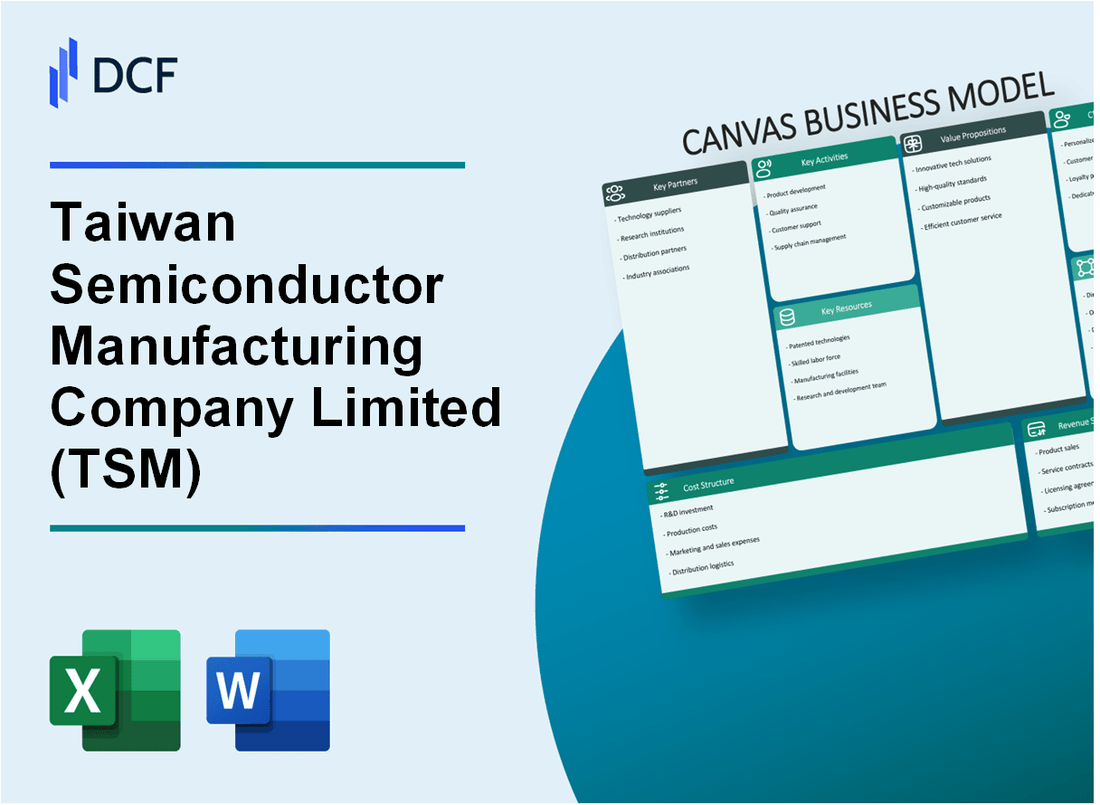
Fully Editable: Tailor To Your Needs In Excel Or Sheets
Professional Design: Trusted, Industry-Standard Templates
Investor-Approved Valuation Models
MAC/PC Compatible, Fully Unlocked
No Expertise Is Needed; Easy To Follow
Taiwan Semiconductor Manufacturing Company Limited (TSM) Bundle
In der hochriskanten Welt der Halbleiterfertigung steht die Taiwan Semiconductor Manufacturing Company (TSM) als technologischer Gigant da und orchestriert eine komplexe Symphonie aus Innovation, Präzision und strategischen Partnerschaften, die das globale digitale Ökosystem antreibt. Mit 55% Mit der weltweit fortschrittlichsten Chipproduktion und hochmodernen Anlagen, die den Gipfel der technologischen Leistungsfähigkeit darstellen, verwandelt TSM Silizium in mikroskopisch kleine Motoren, die alles antreiben, von Smartphones bis hin zu künstlicher Intelligenz, und schafft so ein Geschäftsmodell, das so komplex ist wie die nanoskaligen Schaltkreise, die sie herstellen.
Taiwan Semiconductor Manufacturing Company Limited (TSM) – Geschäftsmodell: Wichtige Partnerschaften
Hersteller von fortschrittlicher Halbleiterausrüstung
TSMC arbeitet mit wichtigen Herstellern von Halbleiterausrüstung zusammen:
| Partner | Einzelheiten zur Partnerschaft | Wert der Ausrüstungsbeschaffung 2023 |
|---|---|---|
| ASML | Extreme Ultraviolett (EUV)-Lithographiesysteme | 6,2 Milliarden US-Dollar |
| Angewandte Materialien | Ausrüstung für die Halbleiterfertigung | 4,8 Milliarden US-Dollar |
| Lam-Forschung | Wafer-Verarbeitungsausrüstung | 3,9 Milliarden US-Dollar |
Wichtige Partnerschaften mit Technologieunternehmen
Zu den wichtigsten Technologiepartnerschaften von TSMC gehören:
- Apple: 5-nm- und 3-nm-Chipherstellung
- Nvidia: Fortschrittliche GPU-Chip-Produktion
- Qualcomm: Herstellung mobiler Prozessoren
- MediaTek: Herstellung von Smartphones und IoT-Chips
Zusammenarbeit von Forschungseinrichtungen
| Institution | Forschungsschwerpunkt | Jährliche Investition in die Zusammenarbeit |
|---|---|---|
| Nationale Taiwan-Universität | Fortschrittliche Halbleitermaterialien | 45 Millionen Dollar |
| MIT | Innovationen im Halbleiterprozess | 62 Millionen Dollar |
| Stanford-Universität | Chipdesign der nächsten Generation | 55 Millionen Dollar |
Strategische Chip-Design-Allianzen
Die strategischen Designpartnerschaften von TSMC:
- AMD: Fortschrittliche Prozessorfertigung
- Broadcom: Chipproduktion vernetzen
- Marvell Technology: Kundenspezifische Halbleiterlösungen
Technologiekooperationen der Regierung
| Regierungsbehörde | Art der Zusammenarbeit | Jährliche Investition |
|---|---|---|
| Taiwanesisches Wirtschaftsministerium | Fortschrittliche Halbleiterforschung | 180 Millionen Dollar |
| US-Verteidigungsministerium | Sichere Chipherstellung | 250 Millionen Dollar |
Taiwan Semiconductor Manufacturing Company Limited (TSM) – Geschäftsmodell: Hauptaktivitäten
Fortschrittliche Herstellung von Halbleiterchips
TSMC betreibt weltweit 13 Produktionsstätten mit insgesamt 6 Standorten in Taiwan und 7 internationalen Einrichtungen. Das Unternehmen produzierte im Jahr 2022 etwa 153 Millionen 12-Zoll-Wafer.
| Produktionskapazität | Daten für 2023 |
|---|---|
| Gesamte Waferproduktion | 16,4 Millionen 12-Zoll-äquivalente Wafer |
| Erweiterte Prozessknoten (5 nm und darunter) | 47 % der gesamten Produktionskapazität |
| Jährliche Kapitalausgaben | 36,3 Milliarden US-Dollar |
Modernste Prozesstechnologie-Forschung und -Entwicklung
TSMC investierte im Jahr 2022 4,5 Milliarden US-Dollar in Forschung und Entwicklung und konzentrierte sich dabei auf fortschrittliche Halbleitertechnologien.
- Entwicklung der 3-nm-Prozesstechnologie
- Forschung zur 2-nm-Prozesstechnologie
- Fortschrittliche Verpackungstechnologien
- Innovation in der Extrem-Ultraviolett-Lithographie (EUV).
Präzisionshalbleiterfertigung
| Fertigungskennzahlen | Leistung 2023 |
|---|---|
| Fertigungspräzision | 0,5 Nanometer Genauigkeit |
| Rendite | Über 90 % für fortgeschrittene Knoten |
| Defektdichte | Weniger als 0,1 Fehler pro Quadratzentimeter |
Kontinuierliche Innovation in Chip-Design und Herstellungsprozessen
TSMC behält seine Technologieführerschaft durch kontinuierliche Innovation in allen Halbleiterherstellungsprozessen.
- KI-gesteuerte Fertigungsoptimierung
- Fortschrittliche Forschung zu Halbleitermaterialien
- Entwicklung der Chip-Architektur der nächsten Generation
Hochvolumige und hochpräzise Waferproduktion
| Produktionskennzahlen | Daten für 2023 |
|---|---|
| Gesamtzahl der Waferlieferungen | 16,4 Millionen 12-Zoll-äquivalente Wafer |
| Einnahmen aus der Waferherstellung | 59,4 Milliarden US-Dollar |
| Marktanteil im Gießereimarkt | 53 % weltweit |
Taiwan Semiconductor Manufacturing Company Limited (TSM) – Geschäftsmodell: Schlüsselressourcen
Fortschrittliche Halbleiterfertigungsanlagen
TSMC betreibt ab 2024 13 verschiedene Produktionsstätten in ganz Taiwan. Die gesamte Produktionskapazität erreicht jährlich 18,1 Millionen 12-Zoll-äquivalente Wafer.
| Standort der Einrichtung | Kapazität (12-Zoll-Wafer/Monat) | Technologieknoten |
|---|---|---|
| Wissenschaftspark Hsinchu | 250,000 | 3nm |
| Wissenschaftspark Tainan | 180,000 | 5nm |
| Zentraltaiwanischer Wissenschaftspark | 150,000 | 7nm |
Hochqualifizierte Ingenieure und technische Arbeitskräfte
TSMC beschäftigt im Dezember 2023 insgesamt 56.801 Mitarbeiter, von denen 64 % über einen höheren technischen Abschluss verfügen.
- F&E-Personal: 9.200 Mitarbeiter
- Fortgeschrittene Verfahrenstechniker: 6.500 Spezialisten
- Durchschnittliche Ingenieurerfahrung: 12,4 Jahre
Umfangreiches Portfolio an geistigem Eigentum
TSMC hält im Jahr 2024 weltweit 37.500 Halbleiterpatente, davon 15.200 aktive Patente in Halbleiterherstellungsprozessen.
Massive Kapitalinvestition
Die Investitionsausgaben für 2024 werden voraussichtlich 32 bis 36 Milliarden US-Dollar betragen und konzentrieren sich auf die Entwicklung fortschrittlicher Prozesstechnologie.
| Anlagekategorie | Zuteilung 2024 |
|---|---|
| Erweiterte Knoteneinrichtungen | 22 Milliarden Dollar |
| Forschung und Entwicklung | 4,5 Milliarden US-Dollar |
| Ausrüstungs-Upgrades | 9,5 Milliarden US-Dollar |
Proprietäre Fertigungstechnologien
TSMC ist führend in fortschrittlichen Prozessknoten mit 3nm und 2nm Technologien, die sich derzeit in der Entwicklung befinden.
- Marktanteil des 3-nm-Prozesses: 92 %
- Marktanteil des 5-nm-Prozesses: 87 %
- Marktanteil des 7-nm-Prozesses: 80 %
Taiwan Semiconductor Manufacturing Company Limited (TSM) – Geschäftsmodell: Wertversprechen
Weltweit führende Halbleiterfertigungskapazitäten
Im vierten Quartal 2023 hielt TSMC 53.1% des globalen Marktanteils der Halbleiter-Foundry. Das Unternehmen produzierte 16,4 Millionen Wafer im Jahr 2023, wobei fortschrittliche Prozessknoten (5 nm und darunter) vertreten sind 51% des gesamten Waferumsatzes.
| Prozessknoten | Marktanteil | Umsatzbeitrag |
|---|---|---|
| 5nm | 36% | 22,4 Milliarden US-Dollar |
| 3nm | 15% | 9,6 Milliarden US-Dollar |
Höchste Leistung und fortschrittlichste Chip-Herstellungstechnologien
Die Technologieführerschaft von TSMC zeigt sich durch:
- Erster Hersteller, der 3-nm-Chips in Massenproduktion herstellt
- 2nm-Prozesstechnologie in Entwicklung
- Investiert 32,4 Milliarden US-Dollar bei den Investitionsausgaben für Spitzentechnologieforschung im Jahr 2023
Gleichbleibende Qualität und Zuverlässigkeit in der Halbleiterproduktion
TSMC behauptet 99.9% Fertigungsausbeute für fortgeschrittene Prozessknoten. Die Fehlerdichte des Unternehmens beträgt 0,05 Fehler pro Quadratzentimeter für 5nm-Technologie.
Fähigkeit zur Herstellung der komplexesten und fortschrittlichsten Halbleiterchips
| Technologieknoten | Transistordichte | Energieeffizienz |
|---|---|---|
| 3nm | 290 Millionen Transistoren/mm² | Bis zu 30 % Leistungsreduzierung |
| 2nm (geplant) | Erwartete 450 Millionen Transistoren/mm² | Erwartete Leistungsreduzierung um 40 % |
Kostengünstige Fertigungslösungen für globale Technologieunternehmen
TSMCs Preisstrategie für 2024:
- Preise für den 5-nm-Prozess: 10.500 $ pro Wafer
- Preise für den 3-nm-Prozess: 15.000 $ pro Wafer
- Dient Über 480 Kunden weltweit
Gesamtumsatz im Jahr 2023: 61,5 Milliarden US-Dollar, mit einer Nettogewinnmarge von 36.4%.
Taiwan Semiconductor Manufacturing Company Limited (TSM) – Geschäftsmodell: Kundenbeziehungen
Langfristige strategische Partnerschaften mit großen Technologieunternehmen
TSMC unterhält strategische Partnerschaften mit wichtigen Technologieunternehmen:
| Kunde | Einzelheiten zur Partnerschaft | Jährlicher Kooperationswert |
|---|---|---|
| Apple Inc. | Fortschrittliche Chipherstellung | 22,6 Milliarden US-Dollar (2023) |
| Nvidia Corporation | Fortschrittliches Halbleiterdesign | 15,3 Milliarden US-Dollar (2023) |
| Qualcomm | Herstellung mobiler Prozessoren | 8,7 Milliarden US-Dollar (2023) |
Dedizierter technischer Support und kollaborative Designdienste
Technische Support-Kennzahlen für 2023:
- Weltweite technische Support-Teams rund um die Uhr
- Durchschnittliche Antwortzeit: 2,3 Stunden
- Kundenzufriedenheitsrate: 94,5 %
- Dedizierte Ingenieurteams: 3.200 Spezialisten
Maßgeschneiderte Fertigungslösungen
Anpassungsmöglichkeiten für die Fertigung:
| Herstellungsprozess | Anpassungsebene | Jährliche Kapazität |
|---|---|---|
| 3-nm-Prozess | Hohe Individualisierung | 100.000 Wafer pro Monat |
| 5-nm-Prozess | Mittlere Anpassung | 150.000 Waffeln pro Monat |
Kontinuierliche Technologieentwicklung und Innovation
Investitionen in Forschung und Entwicklung:
- F&E-Ausgaben: 4,5 Milliarden US-Dollar (2023)
- Patentanmeldungen: 2.879 (2023)
- Innovationszentren: 6 globale Standorte
Transparente Kommunikation und Leistungsberichte
Berichts- und Kommunikationskennzahlen:
| Berichtsmetrik | Häufigkeit | Transparenzwert |
|---|---|---|
| Finanzberichte | Vierteljährlich | 95/100 |
| Leistungskennzahlen | Monatlich | 92/100 |
Taiwan Semiconductor Manufacturing Company Limited (TSM) – Geschäftsmodell: Kanäle
Direktvertriebsteams
TSM unterhält 12 globale Vertriebsbüros in wichtigen Technologiemärkten, darunter Standorte in:
| Region | Anzahl der Vertriebsbüros |
|---|---|
| Nordamerika | 3 |
| Europa | 2 |
| Asien-Pazifik | 7 |
Technologiekonferenzen und Branchenveranstaltungen
TSM nimmt jährlich an etwa 18 bis 22 großen Halbleiterkonferenzen teil, mit:
- Jährliche Investition von 3,2 Millionen US-Dollar in die Teilnahme an Branchenveranstaltungen
- Durchschnittlich 45–50 Fachvorträge pro Jahr
- Direkter Kontakt mit 1.200–1.500 wichtigen Technologie-Entscheidungsträgern
Online-Plattformen für technische Dokumentation und Support
| Plattformmetrik | Statistiken |
|---|---|
| Technische Dokumentationsseiten | 3.742 aktive Seiten |
| Jährliche Website-Besucher | 2,1 Millionen |
| Reaktionszeit des Online-Supports | Unter 4 Stunden |
Strategisches Account Management
TSM verwaltet die Beziehungen zu 480 strategischen Technologiekunden und verfügt über dedizierte Account-Teams, die Folgendes abdecken:
- Tier-1-Technologieunternehmen
- Halbleiterdesignfirmen
- Große Elektronikhersteller
Globales Netzwerk der Halbleiterindustrie
Die Netzwerkreichweite umfasst:
| Netzwerkdimension | Umfang |
|---|---|
| Partnerunternehmen | 653 aktive Technologiepartner |
| Forschungskooperationszentren | 27 globale Forschungszentren |
| Jährliche gemeinsame Forschungsinvestition | 412 Millionen Dollar |
Taiwan Semiconductor Manufacturing Company Limited (TSM) – Geschäftsmodell: Kundensegmente
Smartphone-Hersteller
TSMC beliefert große Hersteller von Smartphone-Chips mit den folgenden Schlüsselkunden:
| Kunde | Marktanteil | Chipvolumen (2023) |
|---|---|---|
| Apfel | 25.3% | 180 Millionen Chips |
| Qualcomm | 18.7% | 135 Millionen Chips |
| MediaTek | 15.5% | 110 Millionen Chips |
Grafik- und KI-Chipdesigner
Die fortschrittliche Halbleitertechnologie von TSMC unterstützt die Produktion von Grafik- und KI-Chips:
- NVIDIA: 4-nm- und 5-nm-Prozessknoten
- AMD: 5-nm- und 7-nm-Prozessknoten
- Intel: Kundenspezifische KI-Chip-Herstellung
Hochleistungs-Computing-Unternehmen
TSMC bietet fortschrittliche Halbleiterlösungen für Hochleistungsrechnen:
| Kunde | Computersegment | Chipvolumen (2023) |
|---|---|---|
| Amazon Web Services | Cloud-Computing | 45 Millionen Chips |
| Microsoft Azure | Unternehmens-Computing | 38 Millionen Chips |
| Google Cloud | KI-Infrastruktur | 32 Millionen Chips |
Automobil-Halbleiterhersteller
TSMC unterstützt die Automobilhalbleiterproduktion mit speziellen Prozessen:
- Bosch: 8-Zoll- und 12-Zoll-Waferproduktion
- Continental AG: Chips für fortschrittliche Fahrerassistenzsysteme (ADAS).
- NXP Semiconductors: Automotive-Computing-Plattformen
Marken der Unterhaltungselektronik
TSMC bietet Halbleiterlösungen für verschiedene Unterhaltungselektronik:
| Kunde | Produktkategorie | Chipvolumen (2023) |
|---|---|---|
| Samsung | Smart-Home-Geräte | 75 Millionen Chips |
| Sony | Spielekonsolen | 42 Millionen Chips |
| LG | Unterhaltungselektronik | 35 Millionen Chips |
Taiwan Semiconductor Manufacturing Company Limited (TSM) – Geschäftsmodell: Kostenstruktur
Massiver Kapitalaufwand für Produktionsanlagen
Im Jahr 2023 beliefen sich die Gesamtinvestitionen von TSMC auf 32,4 Milliarden US-Dollar. Die geplanten Investitionsausgaben für 2024 werden voraussichtlich 28 bis 32 Milliarden US-Dollar betragen.
| Jahr | Kapitalausgaben |
|---|---|
| 2022 | 36,3 Milliarden US-Dollar |
| 2023 | 32,4 Milliarden US-Dollar |
| 2024 (geplant) | 28 bis 32 Milliarden US-Dollar |
Bedeutende Forschungs- und Entwicklungsinvestitionen
Die Forschungs- und Entwicklungskosten von TSMC beliefen sich im Jahr 2023 auf insgesamt 4,18 Milliarden US-Dollar, was 7,1 % des Gesamtumsatzes entspricht.
- F&E-Ausgaben 2022: 3,95 Milliarden US-Dollar
- F&E-Ausgaben 2023: 4,18 Milliarden US-Dollar
- Prozentsatz der F&E-Investitionen: 7,1 % des Umsatzes
Hochpreisige, fortschrittliche Fertigungsausrüstung
Fortschrittliche Lithografiemaschinen für extremes Ultraviolett (EUV) kosten etwa 150 Millionen US-Dollar pro Einheit. TSMC betreibt in seinen Produktionsstätten mehrere solcher Maschinen.
Erhebliche Ausgaben für Personal und Talentakquise
Die Gesamtausgaben der Mitarbeiter beliefen sich im Jahr 2023 auf 10,2 Milliarden US-Dollar. Die durchschnittliche Mitarbeitervergütung betrug 94.500 US-Dollar pro Jahr.
| Belegschaftsmetrik | Daten für 2023 |
|---|---|
| Gesamtzahl der Mitarbeiter | 68,000 |
| Gesamtausgaben der Mitarbeiter | 10,2 Milliarden US-Dollar |
| Durchschnittliche Vergütung | $94,500 |
Kontinuierliche Technologieentwicklung und Wartung der Infrastruktur
Die Kosten für die Instandhaltung von Infrastruktur und Technologie im Jahr 2023 wurden auf 2,5 Milliarden US-Dollar geschätzt und umfassen die Modernisierung der Ausrüstung, die Wartung von Anlagen und die Entwicklung der technologischen Infrastruktur.
- Infrastrukturwartung: 1,2 Milliarden US-Dollar
- Kosten für Technologie-Upgrade: 1,3 Milliarden US-Dollar
- Jährliches Budget für Technologieentwicklung: 2,5 Milliarden US-Dollar
Taiwan Semiconductor Manufacturing Company Limited (TSM) – Geschäftsmodell: Einnahmequellen
Verträge zur Herstellung von Halbleiterwafern
Gesamtumsatz im Jahr 2023: 75,04 Milliarden US-Dollar Waferlieferungen im Jahr 2023: 17,1 Millionen 12-Zoll-äquivalente Wafer
| Kundensegment | Umsatzprozentsatz |
|---|---|
| Mobile Geräte | 45% |
| Hochleistungsrechnen | 28% |
| Internet der Dinge | 12% |
| Automobilelektronik | 10% |
| Andere | 5% |
Lizenzierung für fortgeschrittene Prozesstechnologie
Einnahmen aus Technologielizenzen im Jahr 2023: 652 Millionen US-Dollar
Kundenspezifische Chip-Herstellungsdienste
- Umsatz mit kundenspezifischer Chipherstellung: 12,3 Milliarden US-Dollar im Jahr 2023
- Anzahl der kundenspezifischen Chipdesign-Projekte: 480 im Jahr 2023
Hochmoderne Halbleiterproduktion mit hoher Marge
Umsatz mit 3-nm-Prozesstechnologie: 24,6 Milliarden US-Dollar im Jahr 2023 Bruttomarge für fortgeschrittene Knoten: 62,5 %
Einnahmen aus geistigem Eigentum und Technologietransfer
| IP-Kategorie | Einnahmen |
|---|---|
| Prozesstechnologie IP | 438 Millionen US-Dollar |
| Design-IP | 214 Millionen Dollar |
Taiwan Semiconductor Manufacturing Company Limited (TSM) - Canvas Business Model: Value Propositions
You're looking at the core reasons why the world's top technology firms line up for capacity at Taiwan Semiconductor Manufacturing Company Limited (TSM). The value proposition here isn't just about making chips; it's about being the indispensable, highest-quality manufacturer for the most demanding silicon on the planet.
Unmatched process leadership and highest manufacturing yield at scale
Taiwan Semiconductor Manufacturing Company Limited (TSM) maintains its lead by consistently pushing the limits of physics and engineering. This translates directly into superior product performance for customers. As of late 2025, the company's advanced nodes are the primary revenue driver.
The combined output from the advanced 3nm and 5nm nodes accounted for 60% of total wafer sales in the third quarter of 2025. Looking at a broader set of leading-edge technologies, the 3nm, 5nm, and 7nm nodes together represented 74% of total wafer revenue in the second quarter of 2025. The transition to the 2nm node, using GAA (Gate-All-Around) transistors, is set for high-volume production in late 2025. This 2nm technology promises a 24-35% lower power consumption and 15% higher performance than the 3nm node, achieved with 1.15x greater transistor density using N2 NanoFlex DTCO technology.
This technological supremacy is validated by financial results. For instance, in the third quarter of 2025, Taiwan Semiconductor Manufacturing Company Limited (TSM) reported an Earnings Per Share (EPS) of $2.92, beating the consensus estimate of $2.59. The gross margin in that quarter was reported at 59.5% or ~58.6%, with a net profit margin of 45.69%. The company's operational efficiency is clear, with a Return on Assets of 17.43% and a Return on Capital of 21.41% in Q3 2025. To maintain this lead, capital expenditures for 2025 are set between $40 billion and $42 billion, with approximately 70% of that directed toward advanced manufacturing processes.
The sheer scale of this operation means that Taiwan Semiconductor Manufacturing Company Limited (TSM) manufactures nearly 90% of the world's most advanced logic chips. That's a massive amount of silicon that simply has to work right the first time.
| Metric | Value/Range | Period/Context |
| Q3 2025 Revenue | $33.1 billion (or $32.36 billion) | Year-over-year growth of 41% (or 40.1%) |
| Q3 2025 EPS | $2.92 | Beat consensus of $2.59 |
| Gross Margin | 59.5% (or ~58.6%) | Q3 2025 |
| Net Profit Margin | 45.69% | Q3 2025 |
| 2025 Capital Expenditures (CapEx) | $40 billion to $42 billion | ~70% focused on advanced manufacturing |
| Advanced Node Share (3nm/5nm) | 60% | Of total wafer sales (Q3 2025) |
Pure-play foundry model: no competition with customers' end products
You don't have to worry about Taiwan Semiconductor Manufacturing Company Limited (TSM) becoming your competitor. This is the core of the pure-play foundry model, and it's a huge trust factor for fabless designers.
This model has cemented Taiwan Semiconductor Manufacturing Company Limited (TSM)'s position as the market leader. The company commands a dominant share of the global pure-play foundry market, reported at 70.2% or roughly 62% of the global chip market overall. This means that for the most advanced designs, from companies like NVIDIA, AMD, Apple, Qualcomm, and Broadcom, Taiwan Semiconductor Manufacturing Company Limited (TSM) is practically the only choice for large-scale, leading-edge manufacturing.
One-stop-shop for advanced logic and 3D packaging (CoWoS)
The value proposition extends beyond the silicon wafer itself to how those chips are integrated. Advanced packaging, specifically Chip-on-Wafer-on-Substrate (CoWoS), is critical for high-performance computing and AI accelerators.
Taiwan Semiconductor Manufacturing Company Limited (TSM) is aggressively scaling this capability. Advanced packaging revenue is projected to exceed 10% of total revenue in 2025, up from roughly 8% in 2024. The company aims to quadruple its CoWoS capacity by the end of 2025. Estimates for monthly CoWoS capacity by the end of 2025 range from 65,000 to 75,000 Wafer Per Month (WPM). For context, the projected split for 2025 included CoWoS-L reaching around 45,000 WPM monthly.
Demand is heavily concentrated, showing the critical nature of this offering. NVIDIA secured over 70% of Taiwan Semiconductor Manufacturing Company Limited (TSM)'s CoWoS-L advanced packaging capacity for 2025. Looking at overall CoWoS demand share for 2025, NVIDIA dominates with 63%, followed by Broadcom at 13%, while AMD and Marvell each account for 8%.
Enabling the highest performance and power efficiency for AI/HPC chips
The AI infrastructure buildout is the single biggest driver for Taiwan Semiconductor Manufacturing Company Limited (TSM) right now, and its value proposition is directly tied to enabling that growth.
The High-Performance Computing (HPC) segment, which includes advanced AI chips, has overtaken smartphones as the largest revenue source. In the second quarter of 2025, AI applications alone constituted a staggering 60% of revenue. Management expects AI-related revenues to double again in 2025. The company's wafer shipments for AI products are projected to be 12 times those of 2021 by the end of 2025. The demand is so intense that the company confirmed its advanced-node capacity remains three times below customer demand. To secure allocation, some customers are reportedly paying 50-100% "hot-run" premiums.
The value is captured in this market dynamic:
- AI-related revenues are expected to double again in 2025.
- HPC accounted for 57% of Q3 2025 revenue of $33.1 billion.
- Advanced node capacity is three times below customer demand.
- Customers are paying up to 100% premiums for allocation.
Geographically diversified production capacity (Taiwan, US, Japan)
While the bulk of manufacturing remains in Taiwan, the value proposition now includes a commitment to geographic flexibility, driven by customer needs and geopolitical incentives.
Taiwan Semiconductor Manufacturing Company Limited (TSM) is executing a massive global expansion. In the United States, the company is investing $165 billion to build five new state-of-the-art fabrication facilities and two advanced packaging facilities in Arizona. This includes a pledge of up to $6.6 billion to expand its Arizona facilities, complementing an existing $65 billion investment there. The goal is ambitious: Taiwan Semiconductor Manufacturing Company Limited (TSM) expects 30% of its most advanced wafer manufacturing capacity (N2 and below) to be located in the US by 2028.
The diversification also includes Japan, where the company is building its second fabrication facility in Kumamoto. However, you should note that these overseas fabs come with a cost. These new facilities are expected to drag down gross margins by 2-3 percentage points annually over the next three to five years due to higher labor and energy costs, alongside lower initial utilization rates compared to mature fabs in Taiwan.
Taiwan Semiconductor Manufacturing Company Limited (TSM) - Canvas Business Model: Customer Relationships
You're a financial analyst looking at the core of Taiwan Semiconductor Manufacturing Company Limited (TSM)'s moat, which is deeply rooted in its customer relationships. These aren't transactional; they are partnerships that lock in future capacity and technology leadership. The sheer scale of their financial commitment reflects this, with capital expenditures set between $40 billion and $42 billion for fiscal year 2025, with approximately 70% of that spending dedicated to advanced manufacturing processes to meet these commitments.
High-touch, collaborative R&D for custom silicon and process tuning
Taiwan Semiconductor Manufacturing Company Limited (TSM) embeds its engineering teams with key customers to co-develop solutions, especially for leading-edge logic. This collaborative approach ensures silicon success rates and process tuning are optimized for specific, high-volume designs. The success of this model is evident in the technology adoption rates:
- Advanced technologies (7nm and below) accounted for 74% of total revenue in the second quarter of 2025.
- The 3-nanometer (N3) family contributed 24% of wafer revenue in Q2 2025.
- The 5-nanometer (N5) platform remained the largest contributor at 36% of wafer revenue in Q2 2025.
- Management expects AI-related revenues to double again in 2025.
This intense focus on the leading edge means that for the most demanding chips, like AI accelerators, the relationship is a true co-development effort. The company posted Q3 2025 revenues of $33.1 billion, showing the financial payoff from these deep ties.
Long-term capacity reservation agreements for advanced nodes (e.g., N2)
Securing capacity on future nodes, like the upcoming N2, is done through long-term agreements that provide Taiwan Semiconductor Manufacturing Company Limited (TSM) with the revenue visibility needed to justify massive CapEx. These agreements often involve upfront payments or firm volume commitments, effectively de-risking the multi-year technology ramp. While specific N2 contract values aren't public, the commitment to future tech is clear from the current spending profile.
Dedicated account management for top-tier, high-volume clients
The top-tier, high-volume clients, particularly those driving the AI boom, receive the highest level of service, including dedicated management teams that interface across R&D, manufacturing, and supply chain logistics. This ensures priority access to constrained resources like advanced packaging (CoWoS). The company's Q2 2025 revenue was $30.07 billion, a 44.4% increase year-over-year, driven by this demand. The Q3 2025 EPS surged 39% to $2.92, reflecting the pricing power derived from serving these critical customers.
Self-service via the Open Innovation Platform (OIP) for design ecosystem access
For the broader customer base, Taiwan Semiconductor Manufacturing Company Limited (TSM) offers the Open Innovation Platform (OIP) as a self-service infrastructure. This platform lowers design barriers by providing access to proven IP, design implementation tools, and design for manufacturability (DFM) capabilities. The OIP ecosystem is actively managed, with events like the 2025 Global OIP Ecosystem Forum held across North America (September 24), Japan (October 24), Taiwan (November 18), Europe (November 25), and China (December 4). Ecosystem partners, such as Teradyne, earn recognition within the OIP for work on advanced-node testing, validating the platform's role in the supply chain.
Maintaining strict customer trust and IP integrity
Trust is the non-negotiable foundation, especially when handling the most valuable intellectual property in the world. Taiwan Semiconductor Manufacturing Company Limited (TSM)'s commitment to IP protection is demonstrated through its consistent leadership in patent filings. This dedication helps secure its position as the first choice for customers.
Here's a snapshot of the IP commitment based on recent filings:
| Metric | Value/Statistic | Period/Context | Citation |
| Top Resident Invention Patent Applicant | 562 applications | Q2 2025 (Taiwan) | |
| Consecutive Years as Top Resident Applicant | Nine years | Since Q2 2017 | |
| Top Non-Resident Invention Patent Applicant | 242 applications (Applied Materials) | Q2 2025 (Taiwan) | |
| Reported IP Concern Buzz | Allegations involving a former executive | Late 2025 |
The company's consistent patenting activity, leading resident applicants in Q2 2025, underscores the continuous effort to protect both its own innovations and, by extension, the IP entrusted to it by customers. That said, any news, like the late 2025 buzz regarding an IP issue involving a former executive, draws cautious attention from users.
Finance: draft 13-week cash view by Friday.
Taiwan Semiconductor Manufacturing Company Limited (TSM) - Canvas Business Model: Channels
The channels Taiwan Semiconductor Manufacturing Company Limited (TSM) uses to reach its customer segments are deeply integrated with its manufacturing footprint and global sales presence. This is not a simple transactional model; it's a high-touch, capital-intensive delivery system.
Direct sales and technical engagement teams with major customers
Taiwan Semiconductor Manufacturing Company Limited (TSM) relies on direct engagement, which is logical given the complexity of its advanced process technologies. The geographic distribution of revenue clearly shows where this direct sales effort is concentrated. For the latest reported periods in 2025, the United States accounted for approximately 68.8% of total revenue. This high concentration necessitates robust, direct technical teams in North America to support key clients like those in AI and HPC sectors.
The company's sales figures for 2025 reflect this channel's effectiveness, with cumulative revenue for January through October 2025 reaching NT$3,130.44 billion. Even in a single month like August 2025, revenue hit NT$335.77 billion (US$ 10.41 billion). This direct interaction is critical for securing multi-year capacity agreements and managing the ramp-up of advanced nodes.
Global network of fabrication plants (fabs) for manufacturing and delivery
The physical channel is the network of fabrication plants, which are the ultimate delivery mechanism for the value proposition. Taiwan Semiconductor Manufacturing Company Limited (TSM) operates a massive, geographically diversified manufacturing base. In 2024, the annual capacity across all managed facilities was approximately 17 million 12-inch equivalent wafers.
The network includes facilities in multiple jurisdictions, supported by significant capital expenditure, with a planned 2025 CapEx budget between US$38-42 billion.
- Taiwan Operations: Home to four 12-inch wafer GIGAFAB® fabs, four 8-inch wafer fabs, and one 6-inch wafer fab. For example, Fab 15 A has a capacity of 100,000 12-inch wafers per month.
- United States Operations: The Arizona investment is being expanded to a total of US$165 billion, encompassing plans for three new fabrication plants and two advanced packaging facilities. The first Arizona fab began volume production in late 2024.
- Japan Operations: The Japan Advanced Semiconductor Manufacturing, Inc. (JASM) subsidiary operates one 12-inch wafer fab, with construction on a second fab planned to begin in late 2025. The combined facility is expected to produce over 100,000 12-inch wafers per month.
- China Operations: Includes wholly owned subsidiaries like TSMC Nanjing Company Limited (two 12-inch wafer fabs) and TSMC China Company Limited (two 8-inch wafer fabs).
- Europe Operations: Construction started on a specialty technology fab in Dresden, Germany, in 2024.
Online portals and design kits for IP and process access
While manufacturing is physical, access to the process technology itself is facilitated digitally. Taiwan Semiconductor Manufacturing Company Limited (TSM) supports its customer base, which numbered 522 customers in 2024, through digital means. These channels include online portals for accessing design rules, process design kits (PDKs), and intellectual property (IP) libraries necessary for customer chip design.
The sheer volume of manufactured products, 11,878 in 2024, implies a massive, well-utilized digital infrastructure to manage the design-to-fab handoff for all these unique items. This digital access is key to scaling the foundry model without linearly scaling the direct engineering team for every small design change.
Overseas subsidiaries and offices (e.g., US, Japan, Europe) for local support
Beyond the fabs, Taiwan Semiconductor Manufacturing Company Limited (TSM) maintains a physical presence globally for customer support, account management, and engineering services. These offices are crucial for bridging the gap between the main manufacturing sites and international customers, especially those in high-revenue regions like the US (68.8% of revenue).
Key locations for these support and management functions include:
- North America
- Europe
- Japan
- China
- South Korea
The company also secured approximately US$1.17 billion in subsidies in Q1 2025 and US$1.06 billion in Q2 2025 from governments including the US and Germany to support these global expansion efforts.
Third-party logistics providers for secure global wafer shipment
The final step in the channel involves the secure, timely movement of finished wafers. Given the high value and sensitivity of semiconductor products, Taiwan Semiconductor Manufacturing Company Limited (TSM) uses specialized third-party logistics providers to manage global shipment from its fabrication sites to customers worldwide. This outsourcing of logistics helps manage the complexity of moving high-value goods across international borders, complementing the revenue generated outside Taiwan, which was about 90.7% of total revenue in late 2024.
Here's a quick look at the scale of the operation feeding these channels:
| Metric | Value (Latest Available Data) |
| January-October 2025 Cumulative Revenue | NT$3,130.44 billion |
| Q1 2025 Gross Profit Margin | 58.8% |
| Total Planned US Investment | US$165 billion |
| 2024 Customer Count | 522 |
| Global Foundry Market Share (Q3 2024) | 64.9% |
Finance: draft 13-week cash view by Friday.
Taiwan Semiconductor Manufacturing Company Limited (TSM) - Canvas Business Model: Customer Segments
You're looking at the core of Taiwan Semiconductor Manufacturing Company Limited's (TSM) power-who actually pays the bills and drives the technology roadmap. Honestly, the customer list reads like a who's who of global tech, but the concentration is what matters for a financial analyst.
The customer base is highly concentrated, which is both a strength in terms of volume and a risk factor. For instance, in the third quarter of 2025, the top ten customers collectively accounted for approximately 76% of Taiwan Semiconductor Manufacturing Company Limited's total revenue. This reliance means that the fortunes of these few giants directly dictate Taiwan Semiconductor Manufacturing Company Limited's performance.
High-Performance Computing (HPC) and AI chip designers (e.g., NVIDIA, AMD)
This is the engine room now. High-Performance Computing, which captures data center CPUs, GPUs, and AI accelerators, is the single largest revenue contributor. In the third quarter of 2025, this segment drove 57% of total revenue. The growth here is structural, not just cyclical. Management is projecting that revenue from AI-focused chips will roughly double in 2025 alone. Furthermore, the compound annual growth rate (CAGR) for AI-related sales between 2024 and 2029 is now expected to exceed an earlier estimate of 45%.
The advanced nodes are where the action is; the 3nm process alone accounted for 23% of revenue in Q3 2025, and the 5nm node contributed 37%. In total, the most advanced technologies-3nm and 5nm-made up 60% of wafer revenue in Q3 2025.
Smartphone and consumer electronics giants (e.g., Apple, Qualcomm, MediaTek)
While AI leads, the mobile segment is still massive, representing 30% of net revenue in Q3 2025. Apple remains a foundational customer. Back in 2024, Apple's spending hit a record of NT$624.3 billion, which was 22% of Taiwan Semiconductor Manufacturing Company Limited's total revenue that year. You should note that Apple has reportedly secured at least half of Taiwan Semiconductor Manufacturing Company Limited's 2nm process capacity through 2026.
Here's a quick look at the estimated revenue share for the top players in 2025, which clearly shows the split between the AI/HPC titans and the mobile leaders:
| Customer Group | Estimated 2025 Revenue Share (Range 1) | Estimated 2025 Revenue Share (Range 2) |
| Apple | 25% to 27% | 25.18% |
| NVIDIA | 11% | 10.11% |
| MediaTek | 9% | 5.21% |
| Qualcomm | 8% | 6.45% |
| AMD | 7% | 5.54% |
| Broadcom | 7% | 6.45% |
Cloud service providers designing custom silicon (e.g., Amazon, Google, Meta)
These hyperscalers are folded into the HPC segment, but their custom Application-Specific Integrated Circuits (ASICs) are a key driver for advanced node utilization. Their demand for massive, power-efficient AI training and inference hardware keeps the 3nm and 5nm capacity tight. In Q1 2025, HPC revenue growth was 7% Quarter-over-Quarter (QoQ) specifically because cloud and AI customers ramped up orders.
Integrated Device Manufacturers (IDMs) outsourcing advanced nodes (e.g., Intel)
It's interesting to see traditional IDMs becoming foundry customers for the most advanced nodes. Intel is estimated to account for around 6% or 3.91% of Taiwan Semiconductor Manufacturing Company Limited's revenue in 2025. This outsourcing trend validates Taiwan Semiconductor Manufacturing Company Limited's process lead, as Intel relies on the foundry for leading-edge chip production.
Automotive and Industrial chipmakers using specialty processes
This segment is currently showing less momentum compared to AI. While automotive-related revenue did jump 14% QoQ in Q1 2025, driven by ADAS and microcontroller orders, analysts noted that 200-mm silicon wafer shipments-which often reflect industrial and automotive demand-showed weakness early in 2025. Taiwan Semiconductor Manufacturing Company Limited is dedicating capacity to mature and specialty nodes, like 22nm and 28nm, for these customers, but the overall growth narrative is currently dominated by the leading edge.
The reliance on advanced nodes (7nm and below) for 74% of total wafer revenue shows where the current financial gravity lies.
Taiwan Semiconductor Manufacturing Company Limited (TSM) - Canvas Business Model: Cost Structure
You're looking at the engine room of Taiwan Semiconductor Manufacturing Company Limited's (TSM) business model, and frankly, it's a machine built on gargantuan, non-negotiable spending. The cost structure is dominated by the sheer scale and technological intensity required to stay ahead in advanced semiconductor manufacturing.
Extremely High Capital Expenditure
The most visible cost is the Capital Expenditure (CapEx), which reflects the constant need to build and equip the next generation of fabrication plants (fabs). For 2025, Taiwan Semiconductor Manufacturing Company Limited has set its CapEx forecast in the range of US$40-42 billion to meet surging demand, particularly from artificial intelligence applications. This is a significant step up from the approximately US$29.8 billion invested in 2024. To put this into perspective, the company spent US$36.29 billion in 2022, which was a previous record high. The allocation of this massive 2025 CapEx is heavily weighted toward maintaining technological supremacy.
- Advanced process development is slated to receive 70 percent of the 2025 CapEx.
- Specialty processes are targeted for 10-20 percent of the investment.
- High-end IC assembly, testing, photomasking, and other items account for the remaining 10 percent.
Intensive R&D Spending
To maintain the process lead, Taiwan Semiconductor Manufacturing Company Limited pours billions into Research and Development (R&D). In 2024, total R&D expenditures amounted to $6.227 billion, which represented 7.1 percent of that year's revenue. Management has indicated that the 2025 R&D budget is estimated to be around 7 percent of 2025 revenue, ensuring the pipeline of future technologies, like the A16 logic technology platform, remains funded. This spending is critical because the company's competitive advantage is directly tied to its ability to deliver leading-edge nodes.
High Depreciation Costs
The specialized equipment-think Extreme Ultraviolet (EUV) lithography machines-that forms the core of advanced node manufacturing carries an enormous upfront cost and a significant depreciation charge. This is a non-cash expense, but it directly impacts reported profitability and cash flow planning. Looking at the first half of 2025, the reported depreciation expense was NT$359,012,194 thousand for the six months ended June 30, 2025. For the first quarter of 2025 alone, the depreciation expense was NT$173,004,927 thousand.
Significant Utility and Raw Material Costs
Running a wafer fab is incredibly resource-intensive. The cost structure includes substantial recurring expenses for utilities and raw materials. Taiwan Semiconductor Manufacturing Company Limited requires adequate supplies of materials like silicon wafers, gases, chemicals, and photoresist. Furthermore, energy costs are a major component. Management noted that electricity prices in Taiwan have doubled in recent years, and they expect Taiwan to have the highest electricity costs among all operational regions in 2025, potentially reducing the gross profit margin by about 1 percent for the year.
Here's a look at how major cost drivers break down, using available data points:
| Cost Component Category | Specific Item/Metric | Reported Value/Estimate |
|---|---|---|
| Capital Expenditure (2025 Estimate) | Total CapEx Range | US$40 billion to US$42 billion |
| R&D Spending | Annual R&D Expense (2024) | $6.227 billion |
| R&D Spending | Estimated R&D as % of Revenue (2025) | ~7 percent |
| Depreciation Expense | Six Months Ended June 30, 2025 | NT$359,012,194 thousand |
| Raw Materials | Key Inputs | Silicon wafers, gases, chemicals, photoresist |
| Utilities | Electricity Cost Impact (2025 Estimate) | Potential 1 percent reduction in gross profit margin due to Taiwan rates |
Rising Operating Costs from New Overseas Fabs
Expanding manufacturing footprint overseas, notably in Arizona (US) and Japan, introduces new operating cost pressures that differ from the highly optimized Taiwanese base. Management has indicated that higher costs at these overseas facilities are likely to trim the gross margin by 1-2 percentage points in 2025. To be fair, the cost difference isn't as dramatic as some pundits suggested; one analysis indicates processing a 300mm wafer in Arizona is only about 10 percent more expensive than in Taiwan, largely because equipment costs-which are similar globally-make up over two-thirds of the wafer cost, while labor is less than 2 percent of the total cost. Still, the initial ramp-up is costly; for example, one report showed a profit decline in US operations from NT$4.232 billion to NT$41 million QoQ, tied to the buildout and introduction of advanced nodes like 3nm there. This pressure is leading to reported plans to increase prices for advanced nodes, such as a reported 10 percent hike for the 4nm manufacturing node.
Taiwan Semiconductor Manufacturing Company Limited (TSM) - Canvas Business Model: Revenue Streams
You want the hard numbers on how Taiwan Semiconductor Manufacturing Company Limited (TSM) is making its money as of late 2025. This is all about the flow of cash from their foundry services, and honestly, it's dominated by the most advanced silicon.
The core of the revenue stream is, without question, wafer fabrication sales from the leading-edge process nodes. By the third quarter of 2025, the advanced technologies, defined as 7-nanometer and below, represented 74% of total wafer revenue. The 3-nanometer-class production node was a major contributor, making up 23% of total wafer revenue in Q3 2025. The 5-nanometer generation, still a workhorse, accounted for 37% of wafer revenue in that same quarter. Looking back at Q1 2025, the 3nm node was at 22% and 5nm was at 36% of wafer revenue, with 7nm at 15%. The next frontier, N2 (2-nanometer), is on track for volume production in the second half of 2025, setting up the next revenue cycle.
Here's the quick math on how the process nodes stacked up in Q3 2025:
| Process Node Generation | Q3 2025 Wafer Revenue Contribution |
|---|---|
| 3nm-class | 23% |
| N5-series | 37% |
| N7 processes | 14% |
| 7nm and below (Advanced Tech) | 74% |
The platform driving this advanced node demand is High-Performance Computing (HPC) and Artificial Intelligence (AI) chips. For the first quarter of 2025, HPC-related revenue accounted for 59% of the company's total revenue, marking a 7% quarter-over-quarter increase. This aligns with reports that HPC-related revenue surged over 70% year-over-year in Q1 2025, making up nearly 60% of total sales. By Q3 2025, HPC products remained the leader, accounting for 57% of total wafer sales. Management is definitely leaning into this, forecasting that AI-focused chip revenue is expected to roughly double in 2025.
It's not all bleeding edge, though; specialty technology processes contribute, but at a lower margin. In Q3 2025, both the automotive and IoT segments each represented 5% of total wafer sales. This compares to Q1 2025, where IoT alone accounted for 5% of revenue, down 15% sequentially. Smartphone processors were the second-largest segment in Q3 2025 at 30%.
The revenue stream is also bolstered by advanced packaging and testing services, which are critical for AI accelerators. As of Q3 2025, advanced packaging now accounts for 10% of Taiwan Semiconductor Manufacturing Company Limited's total revenue. This is up from the 7% to 9% range reported earlier in the year. The company is aggressively expanding its CoWoS (Chip-on-Wafer-on-Substrate) capacity, aiming to quadruple it by the end of 2025. Furthermore, SoIC (System-on-Integrated-Chips) 3D stacking is scheduled to increase production capacity starting from the second half of 2025.
Overall, the full-year 2025 outlook is strong, though the exact figure varies slightly based on the reporting date. The consensus mark for the full-year 2025 revenues indicates year-over-year growth of 33.7%, pegged at approximately $120.47 billion. This reflects the company boosting its full-year guidance to the mid-30% range following a strong Q3 performance. You should note that the prompt's target of almost 35% growth is well within the range of management guidance and analyst consensus for the full year.
Here is a summary of the platform revenue contribution from Q3 2025:
| Revenue Platform | Q3 2025 Share of Sales |
|---|---|
| HPC (includes AI) | 57% |
| Smartphone processors | 30% |
| Automotive | 5% |
| IoT | 5% |
Finance: draft 13-week cash view by Friday.
Disclaimer
All information, articles, and product details provided on this website are for general informational and educational purposes only. We do not claim any ownership over, nor do we intend to infringe upon, any trademarks, copyrights, logos, brand names, or other intellectual property mentioned or depicted on this site. Such intellectual property remains the property of its respective owners, and any references here are made solely for identification or informational purposes, without implying any affiliation, endorsement, or partnership.
We make no representations or warranties, express or implied, regarding the accuracy, completeness, or suitability of any content or products presented. Nothing on this website should be construed as legal, tax, investment, financial, medical, or other professional advice. In addition, no part of this site—including articles or product references—constitutes a solicitation, recommendation, endorsement, advertisement, or offer to buy or sell any securities, franchises, or other financial instruments, particularly in jurisdictions where such activity would be unlawful.
All content is of a general nature and may not address the specific circumstances of any individual or entity. It is not a substitute for professional advice or services. Any actions you take based on the information provided here are strictly at your own risk. You accept full responsibility for any decisions or outcomes arising from your use of this website and agree to release us from any liability in connection with your use of, or reliance upon, the content or products found herein.